

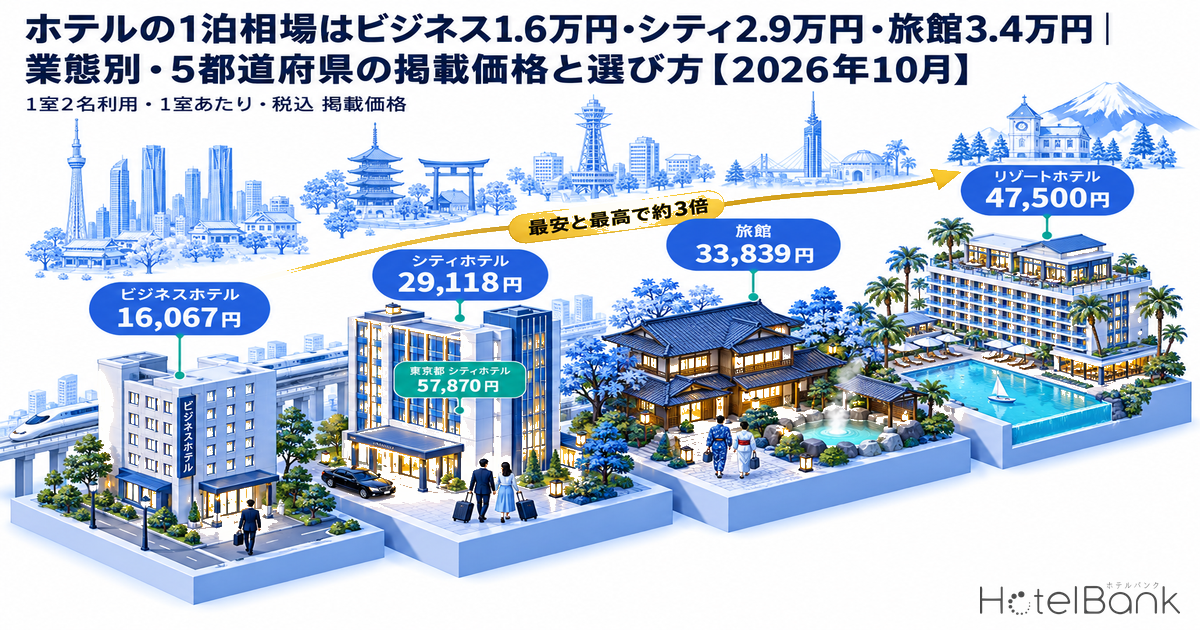
What a hotel night costs in Japan is decided mostly by the type of property. Averaging OTA listed prices for October 2026 stays nationwide (2 guests per room, per room, tax included), a business hotel costs ¥16,067, a capsule hotel ¥17,737, a city hotel ¥29,118, a ryokan ¥33,839 and a resort hotel ¥47,500 (HotelBank Editorial Team research, N=103–7,666 properties, as of October 2026). If you are wondering what a “normal” price for one night is, decide first which type of property you want, start from the figure in this table, and then adjust for the prefecture and day of the week. That order keeps your budget on target.
| Property type | One-night rate (2 per room, tax incl.) | Per person (÷2) | Properties |
|---|---|---|---|
| Business hotel | ¥16,067 | approx. ¥8,000 | 7,666 |
| Capsule hotel | ¥17,737 | approx. ¥8,900 | 103 |
| City hotel | ¥29,118 | approx. ¥14,600 | 1,293 |
| Ryokan | ¥33,839 | approx. ¥16,900 | 6,539 |
| Resort hotel | ¥47,500 | approx. ¥23,800 | 1,793 |
Source: HotelBank Editorial Team research (OTA public data; stays in October 2026, listed prices as of October 2026). Average listed price for 2 guests per room, per room, tax included. Per-person figures are the room rate divided by 2 for reference (rounded to the nearest ¥100).
Note that these amounts are “the price per room when two people share it.” That is a different basis from what one person pays when staying alone. Splitting the rate between two guests gives roughly ¥8,000 per person at a business hotel and about ¥16,900 at a ryokan, but single-occupancy listed prices need a separate tally, so this article deals only with room rates (for measured single-occupancy rates, see capsule hotel prices per person).
- — Nationwide one-night rates run from ¥16,067 at business hotels to ¥47,500 at resort hotels. These are averages of October 2026 OTA listed prices (2 per room, per room, tax included); the cheapest and most expensive types are about 3x apart.
- — City hotels cost about 1.8x a business hotel, ryokan about 2.1x. The ryokan figure of ¥33,839 mostly reflects plans with dinner and breakfast — “two people, two meals included.”
- — City hotels in Tokyo average ¥57,870, about twice the national level. Kyoto runs about 1.5–1.6x the national average, with ryokan at ¥54,339 and city hotels at ¥44,146.
- — Business hotels in Osaka and Fukuoka are in the ¥14,000 range (¥14,411 and ¥14,510), so two people sharing a room can find something below the national average.
- — All amounts are for 2 guests per room. They differ from single-occupancy rates, which is why the capsule hotel figure of ¥17,737 looks high. What you pay also moves by day of the week: at Tokyo business hotels, Saturday is about 40% more expensive than weekdays.
Rates by Property Type — A 3x Range from ¥16,000 Business Hotels to ¥48,000 Resorts
¥16,067 (N=7,666)
¥17,737 (N=103)
¥29,118 (N=1,293)
¥33,839 (N=6,539)
¥47,500 (N=1,793)
Source: HotelBank Editorial Team research (OTA public data, as of October 2026). N = number of properties tallied for each type.
As Figure 1 shows, even within “hotels” there is roughly a 3x gap between the cheapest type, business hotels (¥16,067), and the most expensive, resort hotels (¥47,500). City hotels cost about 1.8x a business hotel and ryokan about 2.1x. Most of the gap comes from what is being sold: a room just to sleep in, or a stay that includes meals, a large communal bath and the view.
A little more on each type. Business hotels (N=7,666) are mainly near stations and sold room-only, and they are the most numerous type nationwide. Their rates and the cheapest prefectures are covered in “Business Hotel Price Surge: National ADR Analysis & 10 Cost-Effective Prefectures“, rates by city and month for two people in a double or twin in “Business Hotel Double or Twin for Two in Japan: ¥16,067 a Night“, and the difference between room-only and breakfast-included rates in “Japan Business Hotel Room-Only Rates: ¥12,915, Breakfast Adds ¥770“, so we do not repeat them here.
Capsule hotels (N=103) appear to cost more than business hotels at ¥17,737 only because the basis is 2 guests per room. Capsules are sold per person, so converting them to a two-person price inflates the figure. What one person actually pays is mostly ¥3,500–9,000 on weekdays; we measured 24 properties in “Capsule Hotel Prices in Japan: ¥3,500–9,000 Weekdays, ¥10k+ Saturdays“.
City hotels (N=1,293) are large urban hotels with banquet halls and restaurants; the bigger rooms and in-house facilities add ¥10,000 or more to a night. The differences from business hotels are summarized in “What Is a City Hotel? Business Hotel Differences and Rates“. Many ryokan (N=6,539) plans include dinner and breakfast, so a figure in the low ¥30,000s for two people in one room is best read as “two people, two meals each and the hot springs.” Resort hotels (N=1,793) swing most with location, season and holidays; keep in mind that the national average of ¥47,500 is an October figure, in the autumn travel season. At the top of the national market, deluxe hotels (N=220) averaged ¥104,024 in the same month, about 6.5x a business hotel.
Rates by Type in Five Major Prefectures — Tokyo City Hotels ¥58,000, Kyoto Ryokan ¥54,000
The same type of property costs very different amounts depending on the prefecture. Table 2 sets the average listed price by type (2 per room, tax included, October 2026) for Tokyo, Osaka, Kyoto, Fukuoka and Hokkaido against the national figure.
| Property type | Nationwide | Tokyo | Osaka | Kyoto | Fukuoka | Hokkaido |
|---|---|---|---|---|---|---|
| Business hotel | ¥16,067 N=7,666 |
¥21,058 N=959 |
¥14,411 N=529 |
¥21,942 N=348 |
¥14,510 N=347 |
¥17,797 N=409 |
| Capsule hotel | ¥17,737 N=103 |
¥15,433 N=33 |
¥14,504 * N=8 |
¥21,115 * N=5 |
¥18,399 * N=7 |
¥29,633 * N=6 |
| City hotel | ¥29,118 N=1,293 |
¥57,870 N=117 |
¥26,101 N=97 |
¥44,146 N=65 |
¥33,203 N=43 |
¥24,637 N=76 |
| Ryokan | ¥33,839 N=6,539 |
¥35,145 N=63 |
¥33,098 N=48 |
¥54,339 N=184 |
¥34,330 N=74 |
¥30,473 N=295 |
| Resort hotel | ¥47,500 N=1,793 |
¥65,779 N=21 |
¥37,417 * N=8 |
¥152,561 N=16 |
¥50,927 N=16 |
¥41,666 N=145 |
Source: HotelBank Editorial Team research (OTA public data; stays in October 2026, listed prices as of October 2026). Average listed price for 2 guests per room, per room, tax included. N = number of properties tallied. * marks cells with fewer than 10 properties; these are reference values easily swayed by a few properties’ prices.
Three points stand out. First, city hotels in Tokyo average ¥57,870 (N=117), about twice the national average, and business hotels at ¥21,058 (N=959) are about ¥5,000 (roughly 30%) above the national level. In Tokyo, budget a step above the national benchmark even for the same type of property. Prefecture values weight every municipality in the prefecture equally, so central station areas come out higher still (for ward-level figures in Tokyo’s 23 wards, see the business hotel double-room benchmark for all 47 prefectures and six major cities). What Tokyo’s luxury hotels cost and in which months and on which days they get cheaper is laid out in “東京の高級ホテル、1泊の相場は?2026年の月別・曜日別料金” (wabistay, in Japanese), using monthly and day-of-week medians for 38–40 deluxe hotels.
Second, Kyoto ryokan average ¥54,339 (N=184) and city hotels ¥44,146 (N=65), about 1.5–1.6x the national level. Business hotels (¥21,942, N=348) are also about 1.4x, and all five types in Table 2 are above the national figure. October is the travel season before the autumn leaves, and Kyoto’s seasonality as a destination flows straight into prices. How far Kyoto lodging climbs toward peak foliage is covered in Japan Autumn Leaves 2026: Peak Dates by Region, Kyoto Hotels 1.72x, which finds November listed prices at about 1.72x August. The resort hotel figure of ¥152,561 is the average of 16 properties and is pulled up by a few high-priced ones.
Third, business hotels in Osaka and Fukuoka average ¥14,411 and ¥14,510 (N=529 and 347), below the national average, so for business trips or a one-night sightseeing stay two people can find a room for under ¥15,000. Fukuoka’s city hotels (¥33,203, N=43), however, are about ¥4,000 above the national level, so within one prefecture the direction of the gap can flip from one type to another. Hokkaido is a little below the national level, with ryokan at ¥30,473 (N=295) and resorts at ¥41,666 (N=145), because October falls in the trough after the summer peak.
The Cheapest Months and Days — Skip Saturdays, Holidays, Foliage Season and New Year
Once property type and prefecture set the rough rate, what finally moves the amount you pay is the day of the week and the month. Here we draw on measurements from our earlier articles.
- Day of the week: only Saturday stands out. In the daily lowest listed prices of 28 Tokyo business hotels (7 September–4 October 2026, 2 per room, tax included, N=654 data points), Sunday–Thursday averaged about ¥10,500 against about ¥15,200 on Saturday, roughly 40% more (“Tokyo Multi-Night Stays: Sun–Thu ¥10,500 vs Saturday ¥15,200“). Across all property types in Tokyo’s 23 wards, a Sunday night averaged about ¥31,400 and a Saturday night about ¥49,300, a gap of about ¥18,000 from the day of the week alone (as of 16 September 2026, 733 properties in 14 wards; “Tokyo Multi-Night Stays: Start on Sunday and Save ~¥30,000 on 3 Nights“).
- Month: cities bottom out in June and peak in autumn and at year-end. Tokyo’s monthly listed prices were 1.33x apart between the highest month, November (¥29,331), and the lowest, June (¥22,022); Osaka’s were 1.61x apart between October (¥23,461) and June (¥14,558) (August 2025–July 2026, per room per night, tax included; “Are May Hotels Expensive in Japan? Tokyo Peaks in November, 1.33x Gap“). Resort areas are the reverse, peaking in summer; in Hokkaido, April (¥20,335) was the cheapest month of the year.
- When to book: don’t count on last-minute drops. On popular dates, vacancies shrink as the stay approaches, and the remaining rooms skew toward higher prices. If your dates are fixed, the rule of thumb is to book at least six weeks ahead.
In other words, the rates in Tables 1 and 2 describe “an average day of the week, an average date.” In practice, read them as at or slightly below the benchmark for weeknights that avoid Saturdays and holidays, and above it for Saturdays, holidays, foliage season and the New Year period. In the Tokyo business hotel example, Saturdays in the same period were about 40% more expensive than Sunday–Thursday.
Which Type Should You Choose? — A Quick Guide by Party Size and Purpose
Once you know the rates, the choice of property type comes down to “how many people” and “what you will do at the hotel.”
| How you travel | Suitable type | One-night guide (nationwide, 2 per room, tax incl.) |
|---|---|---|
| Solo business trip or travel base | Business hotel | ¥16,067 for 2 per room; single occupancy is a separate, lower basis |
| Solo, just to sleep, early start | Capsule hotel | Single rate mostly ¥3,500–9,000 on weekdays (measured in a separate article) |
| Two people, city sightseeing or an anniversary | City hotel | ¥29,118 (Tokyo: ¥57,870) |
| Two people, hot springs and food | Ryokan | ¥33,839 (mostly plans with dinner and breakfast) |
| Family or group, longer stay | Resort hotel | ¥47,500 (swings most with season and holidays) |
Guide amounts are the October 2026 national average listed prices from Table 1. Source: HotelBank Editorial Team research.
The hardest call is city hotel versus business hotel for two people sightseeing in a city. The national averages differ by about ¥13,000. If you will spend little time in the room and eat breakfast out, a business hotel double or twin is enough; if the in-house restaurants, lounge or a spacious room are the point, the city hotel premium is worth paying. A ryokan rate is “one night with two meals,” so comparing it against a city hotel plus the cost of dinner narrows the gap.
What Do Two or Three Nights Cost in Total? — Quick Table by Type, Nights and Region
When planning a trip budget, the total lodging cost often matters more than the price per night. Table 4 multiplies the one-night rates in Tables 1 and 2 by the number of nights to give a lodging budget for two people sharing a room. Capsule hotels are sold per person, so they are left out of this table.
| Property type | 1 night (nationwide) | 2 nights (nationwide) | 3 nights (nationwide) | 2 nights (Tokyo) | 2 nights (Kyoto) |
|---|---|---|---|---|---|
| Business hotel | ¥16,067 | ¥32,100 | ¥48,200 | ¥42,100 | ¥43,900 |
| City hotel | ¥29,118 | ¥58,200 | ¥87,400 | ¥115,700 | ¥88,300 |
| Ryokan | ¥33,839 | ¥67,700 | ¥101,500 | ¥70,300 | ¥108,700 |
| Resort hotel | ¥47,500 | ¥95,000 | ¥142,500 | ¥131,600 | ¥305,100* |
Source: HotelBank Editorial Team research (OTA public data; stays in October 2026, listed prices as of October 2026). Average listed prices from Tables 1 and 2 multiplied by the number of nights; two nights or more rounded to the nearest ¥100. * Kyoto resort hotels are the average of 16 properties, a reference value pulled up by a few high-priced ones.
Two things to read from it. First, the cost of trading up a type grows in proportion to the number of nights. Over two nights at national averages, the gap between a business hotel (¥32,100) and a city hotel (¥58,200) is about ¥26,000, and to a ryokan (¥67,700) about ¥36,000. Second, regional gaps differ by type. For two nights in Tokyo, a ryokan costs ¥70,300, almost the same as nationwide, while a city hotel reaches ¥115,700, about twice the national figure. In Kyoto, a ryokan comes to ¥108,700, about 1.6x nationwide.
This table is a guide for “an average day,” with day-of-week differences averaged in. As the previous section showed, itineraries that include Saturdays or holidays will come out higher, and Sunday–Thursday stays lower.
To Search in More Detail
For comparisons of specific properties, these articles (in Japanese) go into detail.
東京の高級ホテル、1泊の相場は?2026年の月別・曜日別料金 (wabistay — Tokyo luxury hotel rates by month and day of week, 2026)
Tallies listed prices (2 per room, tax included) for 38–40 deluxe hotels in Tokyo by month, day of week and booking timing: the median ranges from ¥53,100 to ¥90,200 depending on the month, and a Saturday night is about 1.3x a Monday night. It introduces four hotels in ascending price order — THE GATE HOTEL Kaminarimon by HULIC (THE GATE HOTEL 雷門 by HULIC) in Asakusa, Tokyo Station Hotel (東京ステーションホテル) and Palace Hotel Tokyo (パレスホテル東京) in Marunouchi, and The Capitol Hotel Tokyu (ザ・キャピトルホテル 東急) in Nagatacho — along with features such as direct station access and views.
箱根の旅館が安い時期はいつ?月別・曜日別の料金【2026】 (HotelPicks — when Hakone ryokan are cheapest, 2026)
Tallies listed prices (2 guests, one night) for 138–144 ryokan in Hakone town by month and day of week, showing the low in June at ¥39,000, the high in November at ¥54,200, and Saturday nights about ¥13,000–16,000 above weekdays. It names three candidates for staying cheaply with meals: Hakone Suimeisou (箱根水明荘), two minutes’ walk from Hakone-Yumoto Station with every room facing the Hayakawa River; Hotel Okada (ホテルおかだ), where guests choose between a Japanese-Western buffet and a kaiseki dinner; and Yumoto Fujiya Hotel (湯本富士屋ホテル), three minutes’ walk away with Japanese, Western and Chinese restaurants.
Frequently Asked Questions
Q. How much does one night at a hotel in Japan usually cost?
A. National averages of OTA listed prices for October 2026 (2 guests per room, per room, tax included) are ¥16,067 for business hotels, ¥17,737 for capsule hotels, ¥29,118 for city hotels, ¥33,839 for ryokan and ¥47,500 for resort hotels. Once you choose a type, the one-night budget is largely clear.
Q. What does it cost to stay alone?
A. Every amount in this article is a room rate for 2 guests per room, a different basis from single-occupancy rates. When two people share, half the room rate is a guide to the cost per person (about ¥8,000 at a business hotel, about ¥14,600 at a city hotel). For measured single rates, see the capsule hotel article (mostly ¥3,500–9,000 on weekdays).
Q. How can I stay more cheaply at the same type of property?
A. Change the day of the week and the month. In measurements at 28 Tokyo business hotels, Sunday–Thursday averaged about ¥10,500 against about ¥15,200 on Saturday, roughly 40% more, and across Tokyo as a whole the highest month (November) and the lowest (June) were 1.33x apart. Simply avoiding Saturdays, holidays, foliage season and the New Year lowers what you pay for the same room.
Q. Why do capsule hotels cost more than business hotels?
A. Because this article’s amounts are based on 2 guests per room. Capsule hotels are sold per person, and converted to a two-person price the national average is ¥17,737 (N=103), which looks higher than business hotels (¥16,067). What one person actually pays is on a different basis, mostly ¥3,500–9,000 on weekdays.
Q. How much does a hotel in Tokyo cost?
A. Tokyo’s average listed prices for October 2026 (2 per room, tax included) are ¥21,058 for business hotels, ¥57,870 for city hotels, ¥35,145 for ryokan and ¥65,779 for resort hotels. Business hotels are about ¥5,000 above the national level and city hotels about twice it. Prefecture values weight every municipality equally, so central station areas come out higher.
Q. Why are ryokan more expensive than hotels?
A. Because most ryokan plans include dinner and breakfast. The national ryokan average of ¥33,839 (2 per room, tax included) is close to “two people, two meals each and the hot springs,” and cannot be compared directly with room-only business hotels (¥16,067). Comparing it with a city hotel (¥29,118) plus the cost of dinner narrows the gap.
Q. What do two or three nights cost in total?
A. Multiplying national average listed prices (2 per room, tax included) by the number of nights, two nights come to about ¥32,100 at a business hotel, ¥58,200 at a city hotel, ¥67,700 at a ryokan and ¥95,000 at a resort hotel. A Tokyo city hotel comes to about ¥115,700 for two nights. These are day-of-week averages, so itineraries with Saturdays or holidays will run higher.
Methodology and Sources
■ Data source
Prices: the prices of lodging plans listed on OTAs, averaged by property type and prefecture on a 2-guests-per-room, per-room, tax-included basis (HotelBank Editorial Team research, OTA public data). Stay month: October 2026; collected on 16 October 2026. Properties tallied nationwide: 7,666 business hotels, 103 capsule hotels, 1,293 city hotels, 6,539 ryokan, 1,793 resort hotels and 220 deluxe hotels; N by prefecture is shown in Table 2. Day-of-week and monthly figures are taken as-is from earlier articles on this site (28 Tokyo business hotels, N=654 data points, 7 September–4 October 2026; 733 properties in 14 of Tokyo’s 23 wards, as of 16 September 2026; monthly listed prices for Tokyo, Osaka and Hokkaido, August 2025–July 2026) and were not newly tallied for this article.
■ Calculation assumptions
“Per person” is the room rate divided by 2 and rounded to the nearest ¥100, for reference. The lodging budgets in Table 4 multiply the average listed prices in Tables 1 and 2 by the number of nights and round to the nearest ¥100, with day-to-day and day-of-week differences left inside the average. Ratios (such as “about 1.8x”) are calculated from the unrounded average listed prices. Prefecture values weight every municipality in the prefecture equally.
■ Limitations
These figures show the price level displayed at booking, not the prices actually paid. How far listed prices sit from actual settled rates is set out by prefecture in “Two Hotel Rates: Listed Price Is 1.7-2.9x Settled ADR, 47-Prefecture Map“. Single-occupancy prices need a separate tally; the single capsule hotel rates come from the linked article (24 properties × 3 dates, as of 15 October 2026). Cells with fewer than 10 properties (* in Table 2) and Kyoto resort hotels (16 properties) are easily swayed by a few properties’ prices. Coupons and member discounts are not reflected.
■ References
Earlier articles cited in the text: “Tokyo Multi-Night Stays: Sun–Thu ¥10,500 vs Saturday ¥15,200“, “Tokyo Multi-Night Stays: Start on Sunday and Save ~¥30,000 on 3 Nights“, “Are May Hotels Expensive in Japan? Tokyo Peaks in November, 1.33x Gap“. Source: HotelBank Editorial Team research.
Related Articles
- Japan Business Hotel Room-Only Rates: ¥12,915, Breakfast Adds ¥770
- Business Hotel Double or Twin for Two in Japan: ¥16,067 a Night (2026)
- What Is a City Hotel? vs Business & Resort Hotels, ¥26,696 Rates
- Two Hotel Rates: Listed Price Is 1.7-2.9x Settled ADR, 47-Prefecture Map
- Japan Business Hotel Double Room Cost 2026: ¥16,067 Avg, Tokyo ¥21,058
- Are May Hotels Expensive in Japan? Tokyo Peaks in November, 1.33x Gap
- Japan Autumn Leaves 2026: Peak Dates by Region, Kyoto Hotels 1.72x
- Women’s Hotel Living in Japan: Safety, ¥15,582 Median Night, Checklist