

When people compare ski destinations, the usual yardsticks are the number of runs and the vertical drop. Seen from the lodging side of the business, though, a more fundamental question comes first: how many guest rooms actually sit at the base of that ski resort? Whether the room stock is thick or thin relative to the lift system’s carrying capacity determines whether an area functions as a stay-over resort or as a day-trip attraction — and the room for investment and new development can be worked backwards from there.
For this article we selected 30 major Japanese ski resorts with confirmed lift operations for the 2026-27 season, and used geographic data to count the lodging facilities and guest rooms within a 3km and a 10km radius of each resort’s base point. We also calculated listing prices for December 2026 – January 2027 and expressed the ratio against the same properties’ summer listing prices as a “seasonal premium.”
Metric Definitions Used in This Article
- 3km radius / 10km radius: Circles of 3km and 10km radius centered on the latitude and longitude of each ski resort’s base point (the base station of the lift system, or the base area). Lodging facilities located inside each circle were extracted from geographic data.
- Facility count / room count: Facilities and room counts registered in the lodging property master maintained by MetroEngines Research. Facilities whose room count is not registered are still included in the facility count, so we recommend reading room count rather than facility count as the primary metric.
- Listing price: The average across all plans of the sale prices published on hotel booking sites and similar channels (per room, based on double occupancy, tax included). This differs from the price at which bookings are actually settled. Area-level figures are the median across the properties covered.
- Relationship to ADR (Average Daily Rate): This article works consistently on a listing-price basis and does not use estimated settled ADR (an estimate on a tax-excluded basis, derived by applying a segment-specific adjustment factor to the level of the cheapest listed plan). The two sit at different levels, so do not directly compare the listing prices in this article with ADR figures in our other articles.
- Seasonal premium: For a given property, the median winter listing price (December 2026 and January 2027) divided by the median summer listing price (July and August 2026). Calculated only for properties observed with listings in both seasons (paired properties).
- Data source: MetroEngines Research
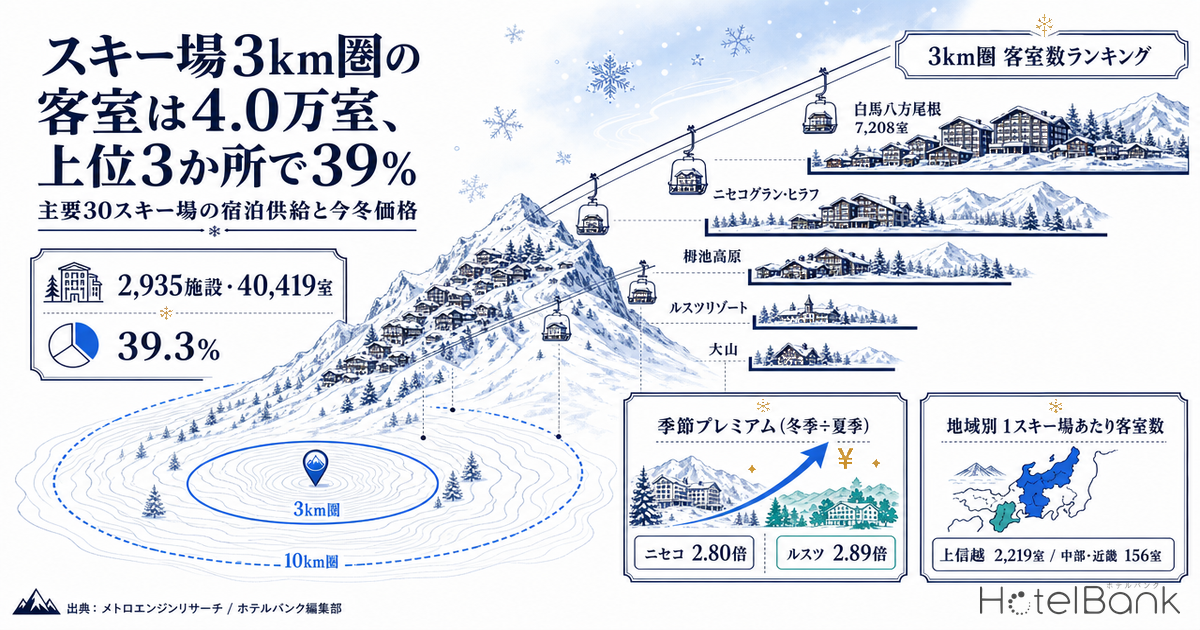
- — Within 3km of Japan’s 30 major ski resorts sit 2,935 facilities and 40,419 rooms. The top three alone — Hakuba Happo-one (7,208 rooms), Niseko Grand Hirafu (5,465 rooms) and Tsugaike Kogen (3,201 rooms) — account for 39.3%.
- — Rooms per resort range from 2,219 in Joshinetsu to 156 in Chubu & Kinki, a roughly 14x gap. Joshinetsu and Hokkaido together hold 86.6% of the total.
- — The seasonal premium (winter ÷ summer listing price) tops out at 2.89x at Rusutsu Resort. At the other end, Daisen at 0.97x and Hakodateyama at 0.90x carry higher listing prices in summer than in winter.
- — Eleven resorts have fewer than 300 rooms within 3km. Kawaba and Osorakan have no lodging facilities at all within 3km, with 2,144 and 104 rooms respectively scattered across their 10km radius.
- — Listings for this winter have been confirmed for 55.5% of the 23,264-room base population. The presence or absence of a listing reflects differences in when properties open sales, not the strength of demand.
2,935 facilities and 40,419 rooms within 3km of Japan’s 30 major ski resorts
The count found 2,935 facilities and 40,419 rooms within 3km of the 30 resorts covered. Because none of the 30 circles overlap one another, this figure is a duplicate-free total. Widening the radius to 10km gives 5,794 facilities and 79,974 rooms after removing duplicates, roughly 2.0 times the 3km figure.
The distribution, however, is extremely skewed. The top three — Hakuba Happo-one (7,208 rooms), Niseko Grand Hirafu (5,465 rooms) and Tsugaike Kogen (3,201 rooms) — account for 39.3% of all rooms within 3km. The bottom 10 combined come to 1,218 rooms, just 3.0% of the total. The number of ski resorts and the number of guest rooms are nowhere near proportional.
Source: Compiled by the HotelBank Editorial Team from MetroEngines Research (N=30 ski resorts / 2,935 facilities within 3km)
The reason 823 facilities cluster within 3km of Hakuba Happo-one (白馬八方尾根) is that Hakuba Village is a dense concentration of small lodgings, including pensions and family-run minshuku. Dividing registered rooms by facility count gives 8.8 rooms per facility: rather than a handful of large hotels, small properties are laid out across the area like tiles. Niseko Grand Hirafu (ニセコグラン・ヒラフ) also has a high facility count at 459 facilities and 5,465 rooms, but there the inventory skews toward condominium-style stock, giving a slightly larger 11.9 rooms per facility.
Supply builds up only where there is stay-over demand to support it. The Hakuba Valley group of 10 ski resorts, which includes Hakuba Happo-one and Tsugaike Kogen, recorded 1.925 million total visitors in the 2025-26 season (up 3% year on year), the highest in 10 seasons. Of those, 925,000 were international visitors (up 17%), representing 48% of the total. Demand at that scale is the backdrop against which room stock of 7,208 and 3,201 rooms accumulated in Hakuba Village and Otari Village. Note, though, that this visitor figure covers the Hakuba Valley group of 10 resorts — a wider area than the two 3km circles isolated in this article. It cannot be divided directly into a per-room visitor figure.
Source: Compiled from the announcement by HAKUBAVALLEY TOURISM (Honichi Lab, July 1, 2026) (N=Hakuba Valley 10 resorts, 2025-26 season cumulative)
By contrast, Kiroro Snow World (キロロスノーワールド) has just six facilities within 3km but holds 926 rooms among them. It is the classic pattern of a small number of large resort hotels co-located at the base, reaching 154 rooms per facility. Even for two areas that both have “on the order of a thousand rooms within 3km,” the Hakuba type and the Kiroro type describe completely different kinds of market.
Mapping the 30 ski resorts and their surrounding room stock
The map below plots the 30 ski resorts, with circle size representing the number of rooms within 3km. Overlaid as small dots are the 53 properties that sit within a 3km radius, have 50 or more rooms, and have confirmed listings for this winter (December 2026 – January 2027). Clicking a circle or a dot displays the facility count, room count and winter listing price.
Source: Compiled by the HotelBank Editorial Team from MetroEngines Research (large circles = 3km radius of the 30 ski resorts / small dots = the 53 properties with 50+ rooms and confirmed listings this winter)
On the map, the large circles cluster in Joshinetsu (Nagano, Niigata and Gunma) and Hokkaido, while the circles in Chugoku, Shikoku and Kyushu shrink almost to points. Part of that reflects differences in the scale of each area’s lift systems, but more than that it reflects a historical difference in how much stay-over demand each area has carried.
Rooms per ski resort vary 14-fold across regions
Grouping the 30 resorts by region makes the difference in room-stock depth sharper still. The 12 Joshinetsu resorts total 26,627 rooms within 3km, or 65.9% of the whole; the five Hokkaido resorts hold 8,358 rooms, or 20.7%. Together these two regions account for 86.6% of the total.
On an average-rooms-per-resort basis, Joshinetsu stands at 2,219 rooms and Hokkaido at 1,672, against 796 in Tohoku, 208 in Chugoku, Shikoku & Kyushu, and 156 in Chubu & Kinki. Between the top and bottom regions the gap is roughly 14x.
Source: Compiled by the HotelBank Editorial Team from MetroEngines Research (N=30 ski resorts)
That gap does not translate directly into a shortage, however. The ski resorts in Chubu & Kinki and in Chugoku, Shikoku & Kyushu lie within day-trip range of major metropolitan areas such as Nagoya, Osaka, Hiroshima and Fukuoka, and have been built on a customer base that never assumed an overnight stay in the first place. Thin room stock at the base is, in that sense, a rational consequence of the demand structure.
Even so, there are signs of change in the day-trip areas. Night skiing, early-morning operation, and stay proposals that combine skiing with other activities have all been spreading; if even part of the day-trip crowd can be converted into overnight guests, thin room stock reads instead as room for new supply.
Seasonal premiums run from 2.9x down to 0.9x — the mountains that spike in winter, and the ones that don’t
Next, prices. For each property we compared winter (December 2026 and January 2027) against summer (July and August 2026) listing prices, and calculated the ratio using only properties observed with listings in both seasons. The chart below shows the 15 ski resorts where at least seven paired properties were available.
Source: Compiled by the HotelBank Editorial Team from MetroEngines Research (winter/summer comparison for the same properties; 15 ski resorts with 7 or more paired properties)
The largest is Rusutsu Resort (ルスツリゾート) at 2.89x (paired N=8; winter median ¥187,400 / summer median ¥64,800), followed by Niseko Grand Hirafu at 2.80x (N=19; winter ¥127,800 / summer ¥45,600). Listing prices at these two sit at an entirely different order of magnitude, and international winter demand shows through strongly in the pricing.
From Tohoku, Appi Kogen (安比高原) holds its own at 1.80x (N=9; winter ¥53,200 / summer ¥29,600). In Joshinetsu the sequence runs Hakuba Happo-one at 1.74x (N=105), GALA Yuzawa at 1.49x (N=32), Shiga Kogen at 1.39x (N=16), Zao Onsen at 1.34x (N=40) and Tsugaike Kogen at 1.33x (N=18).
On the other side, some resorts clearly do not see prices spike in winter. Nozawa Onsen at 1.08x (N=24), Myoko Suginohara at 1.16x (N=14) and Ryuoo Ski Park at 1.18x (N=51) all sit in Joshinetsu yet show small seasonal ratios. These are places with strong year-round pull as hot-spring destinations, so their summer level is already high to begin with. Monthly listing prices in Nozawa Onsen Village ran in the ¥24,000s to ¥28,000s from January to November 2026, and December stays in the ¥31,000s. Winter is not a uniquely special month there.
Further along, Daisen White Resort at 0.97x (N=11) and Hakodateyama at 0.90x (N=15) carry higher listing prices in summer than in winter. Daisen is lifted by summer hiking and cool-weather retreat demand, Hakodateyama by summer resort demand on the shore of Lake Biwa — and the data makes visible that, for the lodgings around them, winter is not the main season. If anything, it is areas like these that retain room to grow winter business. On the question of which season lodging rates peak in across mountain areas, Japan’s 15 Trailhead Towns: Autumn ADR Peaks vs Winter Ski Premiums is also worth reading.
Monthly listing prices in the major ski areas — the shape of the winter ramp
To see how the price curve at a ski resort ramps up, we look at monthly listing prices in four representative municipalities. The X axis runs from January to December, and for Hakuba Village 2025 (dotted line) and 2026 (solid line) are overlaid.
Source: Compiled by the HotelBank Editorial Team from MetroEngines Research (municipality level; monthly averages of listing prices. September onward is based on listings as of the survey date)
Hakuba Village and Yuzawa Town ramp up clearly from November into December. Kutchan Town starts from an already high summer level and layers further increases on top heading into winter. Yamanouchi Town (which includes Shiga Kogen and Ryuoo) shows small amplitude across the year, with a step appearing only in December.
On comparisons with the same month a year earlier: past months such as December 2025 are values based on finalized listing records, whereas September 2026 onward is a snapshot of sale prices listed as of the survey date. The number of properties covered also differs (for Hakuba Village, January 2026 is N=201 properties and January 2027 is N=110). Because the two rest on different calculation bases, this article does not compute year-on-year comparisons for winter listing prices.
Room for new supply remains at the resorts with thin room stock
The map below plots rooms within 3km against the median winter listing price on two axes, with circle size representing facility count. The upper right (many rooms, high prices) is occupied by Niseko, Rusutsu and Hakuba Happo-one, while the day-trip resorts gather in the lower left.
Source: Compiled by the HotelBank Editorial Team from MetroEngines Research (winter listing prices; 15 ski resorts with 7 or more paired properties)
What stands out is that 11 resorts have fewer than 300 rooms within 3km: Kokonoe Forest Park at 269 rooms, Oze Iwakura at 232, Marunuma Kogen at 226, Hakodateyama at 224, JAM Fukui Katsuyama at 213, Hachikita Kogen at 128, Geto Kogen at 88, Takasu Snow Park at 57 and Ishizuchi at 50. And Kawaba Ski Resort and Osorakan Snow Park have not a single lodging facility within 3km.
Widen the radius to 10km and Kawaba Ski Resort has 192 facilities and 2,144 rooms. It is a resort that grew on the strength of being reachable as a day trip from the Tokyo metropolitan area, so having no lodging at its base is not in itself a weakness. That said, those 2,144 rooms within 10km are scattered toward central Numata City, Kawaba Village and the Minakami area; placing a stay-over offering right at the slopes would connect the existing draw directly to overnight demand.
There is policy-side evidence for this thinness as well. The Japan Tourism Agency has selected 17 regions for support under its FY2026 program to promote the development of internationally competitive snow resorts. Alongside areas that already carry deep room stock — Hakuba, Zao, Nozawa Onsen, Echigo-Yuzawa, Myoko and Yamanouchi — the list includes Katsuyama (Fukui), Gujo (Gifu) and Biwako (Shiga). The resorts our count found thin within 3km — JAM Fukui Katsuyama (213 rooms), Takasu Snow Park (57 rooms) and Hakodateyama (224 rooms) — all sit within those selected regions. Building out capacity there is positioned as a target of national support, which means the discussion of new supply carries a context beyond any single operator’s judgment.
Source: Japan Tourism Agency, announcement of regions selected for support under the program to promote the development of internationally competitive snow resorts (updated July 8, 2026; 17 regions in total for FY2026)
Similarly, Geto Kogen has 88 rooms within 3km against 393 within 10km, and Takasu Snow Park 57 rooms within 3km against 832 within 10km. In both cases the immediate room stock is thin relative to the scale of the lift system — territory with few competitors for any operator that brings a stay-over product. Kokonoe Forest Park Ski Resort shows the same structure, with 269 rooms within 3km against 2,542 within 10km, its rooms dispersed across the surrounding hot-spring areas (Sujiyu and the Kuju range).
Conversely, resorts where rooms within 3km make up a high share of those within 10km — Rusutsu Resort at 98.1%, Naeba at 92.2%, Sugadaira Kogen at 85.8% and Appi Kogen at 83.4% — have their lodging function complete at the foot of the slopes. With no rooms leaking outside the area, the structure lends itself to integrated operation that extends to the surrounding commercial functions as well.
How far along is this winter’s selling? — progress against the base population
Of the 40,419 rooms within 3km, 1,274 facilities and 23,264 rooms were observed with listings in at least one month between November 2025 and January 2027. That means a substantial number of facilities are registered in the master but cannot be confirmed as selling on hotel booking sites or similar channels.
Taking those 23,264 rooms as the base population, 456 facilities and 12,900 rooms (55.5%) had confirmed listings for December 2026 – January 2027. In other words, the rooms whose winter allocation is already published amount to a little over half of the rooms with year-round selling activity. By region the spread is wide: Tohoku at 86.5%, Chubu & Kinki at 69.4%, Hokkaido at 57.7%, Joshinetsu at 50.2% and Chugoku, Shikoku & Kyushu at 31.8%.
This figure is an indicator of differences in when properties open sales, not of the strength of demand. The mix includes lodgings whose operating policy is to publish winter rates later, lodgings that secure allocation first through season passes or their own websites, and lodgings that simply close for the winter — so the absence of a listing cannot be read as tight inventory. The winter listing prices in this article are an interim reading based on the allocation published as of this point, and both the level and the base population will shift as further allocation is released. For how much the timing of the winter selling season varies by region, December Listings 56–83% of August: Japan’s Winter Inventory Timing measures it across 13 prefectures.
Source: Compiled by the HotelBank Editorial Team from MetroEngines Research (base population = the 1,274 facilities and 23,264 rooms, out of the 40,419 rooms within 3km, observed with listings in at least one month between November 2025 and January 2027. Regional ratios use each region’s base-population room count as the denominator)
The 30 major ski resorts: room stock and winter listing prices
| Ski resort | Location | 3km facilities | 3km rooms |
10km facilities | 10km rooms |
Winter listing price | Summer listing price |
Seasonal premium | Paired properties |
|---|---|---|---|---|---|---|---|---|---|
| Hakuba Happo-one | Nagano | 823 | 7,208 | 1,321 | 13,189 | ¥97,740 | ¥56,242 | 1.74x | 105 |
| Niseko Grand Hirafu | Hokkaido | 459 | 5,465 | 730 | 8,697 | ¥127,789 | ¥45,568 | 2.80x | 19 |
| Tsugaike Kogen | Nagano | 247 | 3,201 | 1,154 | 11,515 | ¥36,337 | ¥27,332 | 1.33x | 18 |
| Nozawa Onsen | Nagano | 330 | 2,873 | 424 | 3,889 | ¥32,556 | ¥30,080 | 1.08x | 24 |
| GALA Yuzawa | Niigata | 125 | 2,751 | 434 | 6,465 | ¥63,794 | ¥42,861 | 1.49x | 32 |
| Sugadaira Kogen Snow Resort | Nagano | 141 | 2,602 | 190 | 3,031 | — | — | — | — |
| Naeba | Niigata | 83 | 2,599 | 100 | 2,818 | ¥26,558 | ¥21,924 | 1.21x | 8 |
| Shiga Kogen | Nagano | 48 | 2,046 | 253 | 7,437 | ¥43,602 | ¥31,309 | 1.39x | 16 |
| Zao Onsen | Yamagata | 105 | 1,685 | 147 | 2,453 | ¥44,520 | ¥33,300 | 1.34x | 40 |
| Ryuoo Ski Park | Nagano | 109 | 1,455 | 344 | 7,695 | ¥38,945 | ¥32,888 | 1.18x | 51 |
| Myoko Suginohara | Niigata | 147 | 1,434 | 424 | 5,264 | ¥30,857 | ¥26,559 | 1.16x | 14 |
| Appi Kogen | Iwate | 55 | 1,382 | 79 | 1,657 | ¥53,169 | ¥29,597 | 1.80x | 9 |
| Rusutsu Resort | Hokkaido | 45 | 1,082 | 52 | 1,103 | ¥187,430 | ¥64,767 | 2.89x | 8 |
| Kiroro Snow World | Hokkaido | 6 | 926 | 26 | 1,348 | — | — | — | — |
| Furano | Hokkaido | 25 | 521 | 207 | 2,509 | ¥66,106 | ¥52,326 | 1.26x | 7 |
| Daisen White Resort | Tottori | 37 | 513 | 94 | 1,127 | ¥36,790 | ¥37,820 | 0.97x | 11 |
| Shizukuishi | Iwate | 17 | 496 | 47 | 840 | — | — | — | — |
| Sahoro Resort | Hokkaido | 3 | 364 | 12 | 443 | — | — | — | — |
| Grandeco Snow Resort | Fukushima | 7 | 329 | 161 | 2,803 | — | — | — | — |
| Kokonoe Forest Park | Oita | 13 | 269 | 218 | 2,542 | — | — | — | — |
| Oze Iwakura | Gunma | 14 | 232 | 210 | 2,467 | — | — | — | — |
| Marunuma Kogen | Gunma | 28 | 226 | 162 | 2,532 | — | — | — | — |
| Hakodateyama | Shiga | 35 | 224 | 124 | 1,248 | ¥34,940 | ¥38,770 | 0.90x | 15 |
| JAM Fukui Katsuyama | Fukui | 5 | 213 | 48 | 910 | — | — | — | — |
| Hachikita Kogen | Hyogo | 14 | 128 | 108 | 1,659 | — | — | — | — |
| Geto Kogen | Iwate | 1 | 88 | 14 | 393 | — | — | — | — |
| Takasu Snow Park | Gifu | 8 | 57 | 68 | 832 | — | — | — | — |
| Ishizuchi | Ehime | 5 | 50 | 13 | 181 | — | — | — | — |
| Kawaba | Gunma | 0 | 0 | 192 | 2,144 | — | — | — | — |
| Osorakan Snow Park | Hiroshima | 0 | 0 | 13 | 104 | — | — | — | — |
Source: Compiled by the HotelBank Editorial Team from MetroEngines Research. Listing prices are the all-plan average of the per-room rate at double occupancy (tax included), taken as the median across paired properties. Winter = December 2026 and January 2027; summer = July and August 2026. Ski resorts with fewer than seven paired properties are shown as “—”. Because 10km circles overlap between adjacent resorts in areas such as Hakuba Village and Otari Village, Yuzawa Town and Katashina Village, the nationwide total is not a simple sum: after removing duplicates it comes to 5,794 facilities and 79,974 rooms.
⚠ A note on listing prices for future dates: listing prices for December 2026 – January 2027 are a snapshot of the sale prices published as of the survey date. As the check-in date approaches, new plans are added and prices are adjusted, so the level will move. The number of properties covered will also grow as further listings appear. Read the current figures as an interim reading of this winter’s selling.
Methodology and how the ski resorts were selected
The scope covers 30 major ski resorts for which lift operations in the 2026-27 season have been officially announced, or for which no announcement of closure or suspension could be found. To avoid geographic bias, the allocation is 5 in Hokkaido, 5 in Tohoku, 12 in Joshinetsu, 4 in Chubu & Kinki, and 4 in Chugoku, Shikoku & Kyushu.
Facilities with an announced closure were excluded. Gokase Highland Ski Resort in Miyazaki announced its closure in July 2026 and ended operations as a ski resort as of February 2026. Geihoku Kokusai Ski Resort in Hiroshima is currently suspended. Neither is included in the scope.
Because the resorts were also selected so that no two 3km circles overlap, the facility and room counts within 3km can be treated as a duplicate-free total. The 10km circles do overlap in places such as Hakuba Village and Otari Village and Katashina Village, so the nationwide total is shown with duplicates removed.
Conclusion — the geography of room stock is also a map of where to win
Within 3km of Japan’s 30 major ski resorts sit 2,935 facilities and 40,419 rooms. Yet 39.3% of that is concentrated in the top three, while the bottom 10 come to just 1,218 rooms combined. At Japan’s ski resorts, the scale of the lift system and the depth of the room stock are nowhere near proportional.
The deep areas have issues that come with depth. Hakuba Happo-one’s 823 facilities form a fabric of small lodgings averaging 8.8 rooms each, with a seasonal premium of 1.74x. That structure means there is considerable room to lift rates through renovation of existing lodgings or consolidation of small properties. In areas such as Niseko and Rusutsu, where the seasonal premium reaches 2.8–2.9x, winter pricing design is itself the core of the earnings.
The thin areas have opportunities that come with thinness. Kawaba and Osorakan have no lodging facilities within 3km, and Takasu Snow Park at 57 rooms, Ishizuchi at 50 and Geto Kogen at 88 have limited capacity immediately at hand relative to the scale of their lift systems. These are locations with low competitive density — markets with substantial room to enter for any operator with a product designed to convert part of the day-trip crowd into overnight stays.
And then there are resorts such as Daisen and Hakodateyama, where listing prices are higher in summer than in winter. For the lodgings around them, winter is a season with room left to grow. Getting a grip on the geography of room stock is the starting point for deciding where to chase rate, and where to add rooms.
Related Reading
- December Listings 56–83% of August: Japan’s Winter Inventory Timing
- Japan’s 15 Trailhead Towns: Autumn ADR Peaks vs Winter Ski Premiums
- Japan Hotel ADR Swings Up to 4.9x by Season: 633 Municipalities Ranked
- Iwate Hotel Market 2026: 2.2x ADR Gap, Morioka ¥200 Lodging Tax
- Tottori’s 3-Tier Hotel Market: Onsen ADR 2.16x the City Average
References and Sources
■ Data sources
Circles of 3km and 10km radius were drawn around the latitude and longitude of each ski resort’s base point (the base station of the lift system, or the base area), and lodging facilities located inside them were extracted from the MetroEngines Research lodging property master using geographic data. Listing prices use the same firm’s monthly aggregation of published sale prices from hotel booking sites and similar channels (November 2025 – January 2027).
■ Calculation assumptions
Listing prices are the all-plan average of the per-room rate at double occupancy (tax included), with area-level figures taken as the median across the properties covered. The seasonal premium covers only properties observed with listings in both winter (December 2026 and January 2027) and summer (July and August 2026), and is shown only for ski resorts with seven or more paired properties. The 3km figures are simple totals, because the resorts were selected so that their circles do not overlap; the 10km figures are shown as a nationwide total with duplicates removed.
■ Limitations and caveats
Listing prices are not the prices at which bookings are actually settled, and they sit at a different level from estimated settled ADR, so they cannot be compared directly with ADR figures in our other articles. Facilities whose room count is not registered are still included in the facility count, so rooms per facility is understated. December 2026 – January 2027 is a snapshot of the allocation published as of the survey date, and both the level and the base population will move as further listings appear. Visitor numbers are figures published by the ski resorts themselves, and their coverage does not match that of the room-stock data.
■ Market data
- MetroEngines Research — lodging property master (facility locations and room counts) and monthly aggregation of listing prices (3km radius N=2,935 facilities / 10km radius N=5,794 facilities)
■ Ski resort operating status
- Gokase Town, “On the closure of Gokase Highland Ski Resort”
- Ski Dekoboko Kenkyujo, “Ski resorts that will (or may) be discontinued or closed in 2026/2027”
- Ski Dekoboko Kenkyujo, “2026/2027 changes in ski resort owners, operators and names, and new and discontinued lifts”
- SURF&SNOW, “2026-2027 ski resort opening information”
■ Demand trends at ski resorts
- Japan Tourism Agency, announcement of regions selected for support under the program to promote the development of internationally competitive snow resorts (FY2026; 17 regions in total / updated July 8, 2026)
- Honichi Lab, “Roughly half of 2025–26 season visitors to the 10 ski resorts of the Hakuba area were inbound travelers” (July 1, 2026)
- Hakuba Village, “Tourism statistics”
- Japan Tourism Agency, “Overnight Travel Statistics Survey”