

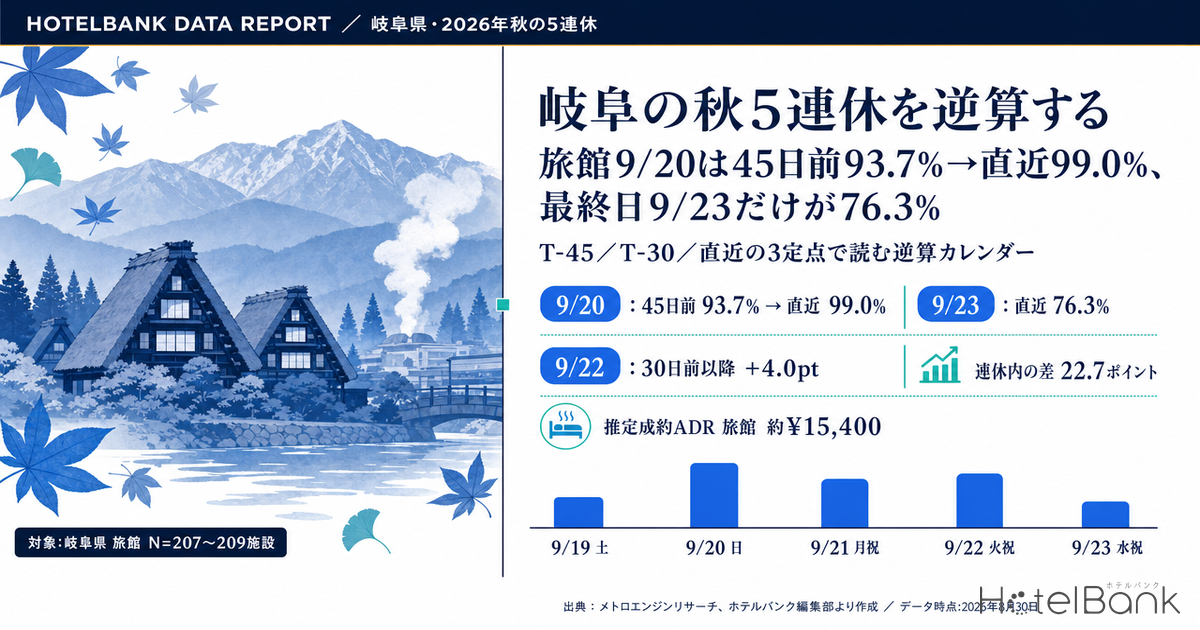
Saturday, September 19 through Wednesday, September 23, 2026 forms a five-day run in Japan, with Respect for the Aged Day (September 21), a bridge holiday (September 22) and the Autumnal Equinox Day (September 23) falling back to back (source: Cabinet Office of Japan, “About National Holidays,” holiday CSV). Across Gifu Prefecture’s ryokan (N=207-209 properties), estimated OCC on an OTA-listed inventory basis for September 20, the middle day of the run, already stood at 93.7% at 45 days out and has since reached 99.0% at the latest observation. The closing day, September 23, moved from 70.4% at T-45 to 76.3% at the latest observation — barely six points of pickup across 45 days. Inside the same holiday sit a day whose outcome was decided before T-45 and a day that keeps trading until the last minute. This article works backwards through the five days at three fixed cross-sections — T-45, T-30 and the latest observation — and separates what to close at T-30 from what to open up from T-14.
Coverage: Gifu Prefecture ryokan, N=207-209 properties, and business hotels, N=109-110 properties (by stay date). The price metric in this article is estimated settled ADR (the transaction price level inferred from OTA and other sales data, tax-excluded equivalent); occupancy is an estimate on an OTA-listed inventory basis. Both are defined at the end of the article. Data as of August 30, 2026.
- — Ryokan on September 20 were already at 93.7% at T-45 — closing the gap to 99.0% at the latest observation adds only +5.3pt. The middle day of the holiday was decided well before 45 days out.
- — The closing day, September 23, sits at 76.3% (70.4% at T-45, +5.9pt). That is below the following ordinary Saturday, September 26 (83.6%): a public holiday landing under a normal weekend.
- — More than half of the pickup lands between T-45 and T-30 (all five ryokan days). Growth after T-30 runs 1-4pt, so the decision to close down can be pulled forward.
The front of the holiday hits its ceiling at T-45; only the closing day stays flat
Start with the ryokan booking curves. The chart below traces cumulative estimated OCC from 45 days before the stay date up to the latest observation. The line for September 20 (Sun, the middle day of the holiday) begins at a height of 93.7% at T-45 and edges up gently to 99.0%. That means the outcome was largely settled before the 45-day mark, and all that remains after it is rate design on the leftover rooms.
September 23 (Wed, Autumnal Equinox Day) is the opposite case: 70.4% at the start, 74.4% at T-30, 76.3% at the latest reading. The pickup across 45 days amounts to just +5.9 points. September 22 (Tue, bridge holiday) runs 78.5% to 89.4%, +10.9 points, the day of the five that builds latest. The classic shape — the start and the middle of a holiday filling first, with the final two days trailing behind — comes through with unusual clarity in Gifu’s onsen ryokan market.
Source: compiled by the HotelBank Editorial Team from MetroEngines Research
Gifu’s ryokan, in onsen towns such as Gero, Takayama and Okuhida, sell a one-night, two-meal product that is hard to stack into consecutive nights, so demand tends to concentrate in the front half of a holiday. September 19 (Sat) runs 87.1% at T-45 to 96.3% at the latest reading, and September 21 (Mon, Respect for the Aged Day) 90.9% to 98.5%. In other words, all three days from September 19 to 21 are now above 96% and have effectively entered sell-out territory. The way demand inside the prefecture splits into distinct layers — Shirakawa-go, Takayama and Gero on one side, Gifu City’s business belt on the other — is analyzed in detail in Gifu’s Hotel Market in 4 Tiers 2026: ADR from ¥6,200 to ¥16,500.
The five days at three fixed points: T-45, T-30 and the latest observation
The table below lines up the three cross-sections. Alongside them sits the share of properties for which no listed inventory can be identified at the latest observation (sold-out rate, estimated). For ryokan, 93.8% of properties show no identifiable inventory on September 20, against 38.6% on September 23. Among business hotels the spread is wider still: 88.1% on September 20 versus 13.6% on September 23.
| Stay date | Property type | N | T-45 | T-30 | Latest | T-45 → latest | Sold-out rate (latest, est.) |
|---|---|---|---|---|---|---|---|
| September 19 (Sat) | Ryokan | 208 | 87.1% | 93.0% | 96.3% | +9.2pt | 77.9% |
| September 20 (Sun) | Ryokan | 209 | 93.7% | 98.0% | 99.0% | +5.3pt | 93.8% |
| September 21 (Mon, hol.) | Ryokan | 208 | 90.9% | 97.0% | 98.5% | +7.6pt | 90.9% |
| September 22 (Tue, hol.) | Ryokan | 207 | 78.5% | 85.4% | 89.4% | +10.9pt | 53.6% |
| September 23 (Wed, hol.) | Ryokan | 207 | 70.4% | 74.4% | 76.3% | +5.9pt | 38.6% |
| September 19 (Sat) | Business | 109 | 88.8% | 92.8% | 94.9% | +6.1pt | 65.1% |
| September 20 (Sun) | Business | 109 | 91.7% | 96.2% | 99.1% | +7.4pt | 88.1% |
| September 21 (Mon, hol.) | Business | 110 | 91.7% | 96.6% | 98.6% | +6.9pt | 83.6% |
| September 22 (Tue, hol.) | Business | 110 | 80.9% | 85.8% | 86.8% | +5.9pt | 28.2% |
| September 23 (Wed, hol.) | Business | 110 | 76.6% | 79.2% | 80.4% | +3.8pt | 13.6% |
Source: compiled by the HotelBank Editorial Team from MetroEngines Research (latest = observed at 21-25 days before the stay date)
For comparison, put the ordinary weekend that follows the holiday through the same frame. Ryokan on September 26 (Sat) run 76.7% at T-45 to 83.6% at the latest reading, and September 27 (Sun) 72.7% to 78.2%. The closing day of the holiday, September 23 (76.3%), sits below the following ordinary Saturday, September 26 (83.6%). The same holds for business hotels: 80.4% on September 23 against 91.3% on September 26. The last day of the holiday is landing as a public holiday that trades under a normal weekend. Treat the run as one monolithic block of high demand and this trough goes unaddressed. Gifu is not alone in seeing the closing day fall below an ordinary day — the same structure shows up in Shiga Silver Week: Front 3 Days Settled, Sep 23 Below a Normal Thu.
Source: compiled by the HotelBank Editorial Team from MetroEngines Research
The pickup skews to the T-45 to T-30 window — which days are still live at the last minute
In designing a backward-planning calendar, what matters is whether the 45-day pickup lands in the first half (T-45 to T-30) or the second (T-30 to the latest observation). Broken out across the five ryokan days: September 19 adds +5.9pt then +3.3pt; September 20, +4.3pt then +1.0pt; September 21, +6.1pt then +1.5pt; September 22, +6.9pt then +4.0pt; September 23, +4.0pt then +1.9pt. On every one of the five days, more than half the pickup occurs in the 15 days between T-45 and T-30. On September 20, 21 and 23 in particular, movement past the 30-day mark thins to roughly 2pt.
September 22 (Tue, bridge holiday) is the one exception, still adding +4.0pt after T-30. It sits closest to the tail of the run and reads as the day most able to pick up late-deciding travellers. Business hotels show the same pattern: September 20 adds +2.9pt after T-30 and September 19 +2.1pt, so the late-stage headroom is limited regardless of property type. For where pickup from T-45 sits nationally (a median of +4.1pt), see Booking Curves Across 47 Prefectures: +4.1pt Median Pickup from T-45.
Source: compiled by the HotelBank Editorial Team from MetroEngines Research
Price levels are worth checking too. Estimated settled ADR for Gifu Prefecture ryokan in September 2026 is approximately ¥15,200 (N=229 properties, estimated from current sales conditions) and for business hotels approximately ¥11,500 (N=119 properties, same basis). These are estimates for a month still in progress and need the month-end settled figures before they can be relied on. Taking the most recent month where settled figures can be compared against settled figures: in July 2026, ryokan came in at ¥13,800 (N=237 properties), down 5.4% from ¥14,600 in the same month a year earlier (N=236 properties), while business hotels were at ¥7,400 (N=121 properties), up 7.0% from ¥6,900 (N=116 properties). Settled figures and current-month estimates are calculated on different bases, so the two are not compared directly here.
For revenue managers running onsen ryokan and business hotels in Gifu: implications and an action plan
(a) Insights from an operating standpoint
1. Manage the holiday as “three days plus two,” not as five. Market estimated OCC for September 19-21 stands at 96.3-99.0% at the latest observation (ryokan), against 89.4% on September 22 and 76.3% on September 23. Within a single holiday, the levels reached differ by more than 20 points. If your rate calendar carries the same rate and the same inventory allocation across all five days, there is room to redesign the front three and the back two as separate products.
2. Benchmark your own pace against the T-45 level. The market started from 93.7% at T-45 on September 20. If your property was clearly below the market on that same day at T-45, that gap is not the kind a last-minute discount recovers; more likely it originates in earlier-stage exposure and product design. The observation in this article — that more than half the pickup concentrates between T-45 and T-30 — points to the decisive window sitting earlier than 45 days out.
3. The September 23 trough is a reason to revisit the assumption that a public holiday fills itself. That ryokan on September 23 (76.3%) sit below the following ordinary Saturday, September 26 (83.6%), is grounds for reconsidering any pricing that treats the Autumnal Equinox Day as a weekend-grade demand day. For business hotels, the sold-out rate on September 23 is 13.6%, so inventory remains across the market as a whole.
4. The thinner the headroom after T-30, the earlier the decision to close down can be taken. Ryokan add +1.0pt after T-30 on September 20 and +1.5pt on September 21. On days shaped like that, securing volume in the higher-confidence window is easier to justify than holding inventory back for late demand that may not arrive. September 22, by contrast, is still moving at +4.0pt after T-30 and is worth keeping a landing zone open for.
(b) Action plan
| Time horizon | Move | Decision trigger (figures from this article) | Intent |
|---|---|---|---|
| Today – this week (21-25 days out) | Take stock of remaining inventory for September 19-21 in the direction of closing down, and narrow the exposure of discount-conditional plans | Market estimated OCC on those days has reached 96.3-99.0% (ryokan) and 94.9-99.1% (business hotels), yet your property still holds double-digit remaining rooms | Avoid continuing to discount inside sell-out territory |
| Today – this week | Carve out a September 23-only product (a room-only or light-meal type at a contained per-night rate, or a landing zone for September 22-23 consecutive nights) | Your September 23 is not reaching the booking level of the following ordinary Saturday (market 83.6%, ryokan) | Stop the closing day of the holiday from finishing below a normal weekend |
| Within two weeks (around T-14) | Open September 22 up as a landing zone for late demand (release additional inventory, relax minimum-stay conditions) | September 22 is still building at +4.0pt after T-30 (ryokan), while September 20 has plateaued at +1.0pt | Hold inventory back only on the days that are still moving |
| Within two weeks | Check your own September rates against the market range | Your realized September rate remains well below the market’s estimated settled ADR (ryokan approx. ¥15,200 / business hotels approx. ¥11,500, both current estimates) | Make visible the rate left on the table on high-occupancy days |
| Looking to next month (designing T-45 for the next holiday) | Redefine holidays as a two-tier calendar: the front half built at T-45, the back half built from T-30 onward | This time, more than half the pickup (all five ryokan days) occurred between T-45 and T-30 | Pull forward the timing of promotions and rate revisions |
| Looking to next month | Make it routine to test the assumption that a public holiday equals a high-demand day, day by day | Market estimated OCC on September 23 (a public holiday) fell below the following ordinary Saturday | Reduce calendar-driven pricing mismatches |
Source: compiled by the HotelBank Editorial Team from MetroEngines Research
In summary: three yardsticks for measuring a holiday
Gifu’s data yields three yardsticks worth carrying into the autumn 2026 five-day holiday.
First, the T-45 level. September 20 started from 93.7% for ryokan and 91.7% for business hotels. Where that starting point is low, what the following 45 days can do is limited. Second, the split of pickup between the first and second halves. On all five ryokan days, more than half the pickup occurred between T-45 and T-30, and growth after T-30 ran around 1-4pt. Reading that ratio lets the decision to close down be pulled forward. Third, the depth of the trough inside the holiday. The 99.0% of September 20 and the 76.3% of September 23 are 22.7 points apart, and the latter came in below even the following ordinary Saturday. Price a holiday day by day, as separate products — that is the most reusable conclusion here.
About the data
· Definition of estimated OCC (OTA-listed inventory basis): occupancy on an OTA-listed inventory basis = 100 − 100 × rooms remaining on OTAs ÷ total rooms. It is an estimate based on the absorption of inventory sold on OTAs and is defined differently from actual room occupancy (it reads higher). The month covered is September 2026.
· Booking curves: based on observations from 45 days before the stay date up to the latest reading. “Latest” refers to the most recent observation for each stay date (21-25 days out for September 19-23; 28-29 days out for September 26 and 27, after the holiday).
· Definition of estimated settled ADR: the transaction price level (tax-excluded equivalent) inferred from OTA and other sales data (lowest-plan level × a property-type coefficient, ensembled across multiple channels). Past months are settled figures; the current and future months are estimates based on current sales conditions. Cross-checked against published operating results, the median error is 6.6%.
· Sold-out rate (estimated): the share of properties for which no listed inventory can be identified on OTAs and similar channels for the day in question.
· Breakdown of coverage: Gifu Prefecture ryokan, N=207-209 properties (by stay date; 4,359-4,381 rooms covered), and business hotels, N=109-110 properties (9,628-9,666 rooms). Estimated settled ADR covers ryokan N=229 properties (September 2026), N=237 properties (July 2026) and N=236 properties (July 2025), and business hotels N=119 properties (September 2026), N=121 properties (July 2026) and N=116 properties (July 2025). City hotels are not covered in this article, as the prefecture holds only N=12 properties and the base is too thin.
· Data as of August 30, 2026. Sales conditions and inventory move daily, so the figures in this article are a snapshot at the time of retrieval.
References and sources
■ Data sources
Booking curves by stay date (remaining inventory and sold-out rates) and estimated settled ADR by property type are based on publicly listed inventory and publicly listed price data from accommodation booking sites, collected and aggregated by MetroEngines Research & Consulting. Coverage is Gifu Prefecture ryokan, N=207-209 properties (4,359-4,381 rooms covered), and business hotels, N=109-110 properties (9,628-9,666 rooms). Public holidays are identified from the Cabinet Office of Japan’s “About National Holidays” list of national holidays and holidays (CSV). Aggregated as of August 30, 2026.
■ Calculation assumptions
The three fixed points are defined by lead time from the stay date: T-45 is 45 days out, T-30 is 30 days out, and “latest” is the most recent observation for each stay date (21-25 days out for September 19-23; 28-29 days out for September 26 and 27). Observations are limited to the range of LT ≤ 45 days; earlier periods are not included in the analysis. Estimated OCC is weighted by room count and estimated settled ADR is based on the area median, with past months given as settled figures (history basis) and the current and later months distinguished as estimates on a listed-snapshot basis.
■ Limitations and caveats
Estimated OCC is an estimate based on the absorption of inventory listed on accommodation booking sites; it is defined differently from actual room occupancy and generally reads higher. It also moves when inventory is withdrawn or additionally released, so a decline in occupancy cannot be distinguished from inventory management on this data alone. Because the observed lead time for “latest” differs by stay date, comparisons across days carry a few days of lead-time difference. This article is an aggregation of the market as a whole and does not explain the situation at any individual property. City hotels are excluded from the analysis, as the prefecture holds only N=12 properties and the base is too thin.
· Cabinet Office of Japan, “About National Holidays,” list of national holidays and holidays (CSV): https://www8.cao.go.jp/chosei/shukujitsu/syukujitsu.csv (September 21, 2026 Respect for the Aged Day; September 22 holiday; September 23 Autumnal Equinox Day)
Related reading
- Gifu’s Hotel Market in 4 Tiers 2026: ADR from ¥6,200 to ¥16,500
- Shiga Silver Week: Front 3 Days Settled, Sep 23 Below a Normal Thu
- Ehime Silver Week: Sep 21 Ryokan 99.9%, Business 91.9%, Sep 23 Flat
- Osaka Sep 2026 Holiday: Demand Peaks First 2 Nights, Sep 23 at 58.0%
- Ibaraki Silver Week: Ryokan-Business Gap Hits 21.9pt, Back Half Flat
- Booking Curves Across 47 Prefectures: +4.1pt Median Pickup from T-45