

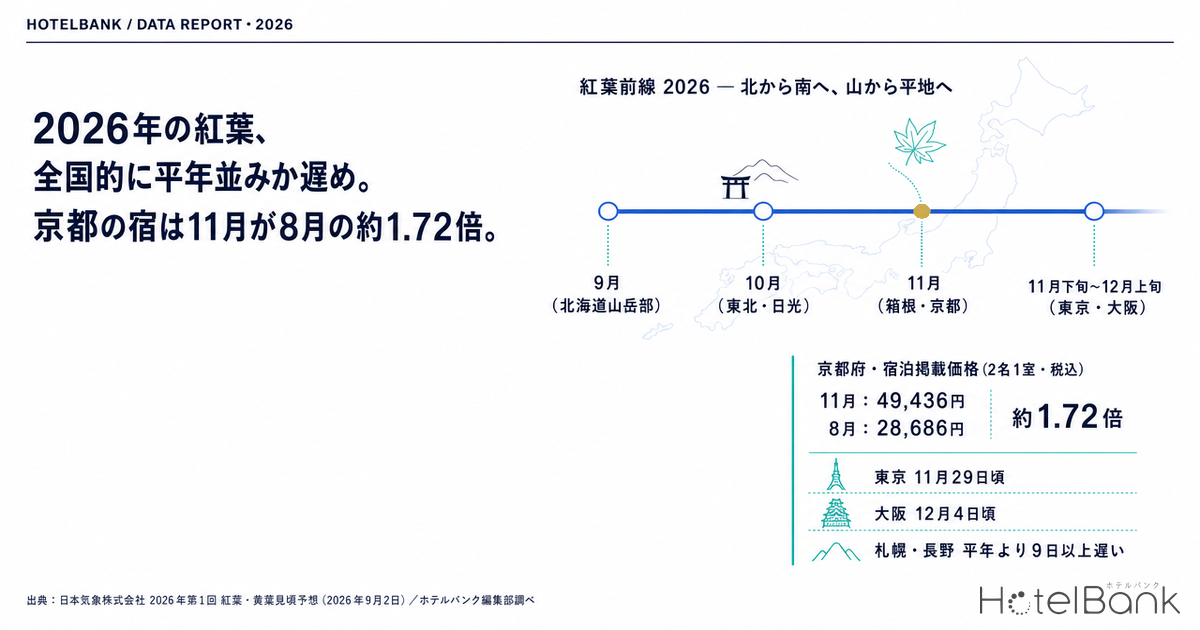
Japan’s autumn foliage in 2026 is expected to arrive on schedule or later than usual across the country. According to the “2026 First Autumn Foliage Forecast” released on September 2, 2026 by the private weather company Japan Weather Inc. (日本気象株式会社), temperatures this autumn are set to run above average nationwide, and Japanese maple (kaede) is forecast to peak around November 29 in Tokyo and around December 4 in Osaka. In some locations, including Sapporo and Nagano, the peak is expected to fall nine or more days later than normal. In the mountains of Hokkaido the colours begin as usual in September; Tohoku and Nikko centre on October, and Hakone and Kyoto on November. For lowland destinations, plan around late November to early December.
- — Autumn leaves in 2026 are expected on schedule or slightly later than usual nationwide. Japanese maple is forecast to peak around November 29 in Tokyo and December 4 in Osaka, with Sapporo and Nagano running nine or more days behind normal.
- — The foliage front moves north to south and mountain to lowland over roughly two and a half months. Hokkaido’s mountains peak in September, Tohoku and Nikko in October, Hakone and Kyoto in November.
- — Kyoto accommodation in November runs at about 1.72x the August level (listed price ¥28,686 → ¥49,436, per room for two, tax included). October is already 1.49x, and December falls back by around 20%.
- — Three levers cut what you pay: staying Sunday to Thursday, shifting one week either side of the peak, and using elevation differences to move the date. Because 2026 skews late, pushing back to the first week of December is the stronger play.
- — Waiting until the peak is confirmed is too late to book. Early September, when the first forecast lands, is the practical starting point. Choose plans with a long free-cancellation window and fine-tune the dates later.
When do the leaves peak in 2026? Guidance by major region
Set out region by region, the usual peak dates show the foliage front descending from north to south and from mountain to lowland over roughly two and a half months. For 2026, read those dates with a “normal to slightly later” correction applied.
| Region / spot | Usual peak | 2026 tendency |
|---|---|---|
| Hokkaido (Daisetsuzan mountain range) | Mid to late September | Normal. Colour has already started near the summits |
| Sapporo / Jozankei | Early to mid October | Sapporo forecast nine or more days later than normal |
| Tohoku (Oirase Gorge, Naruko Gorge) | Mid October to early November | Normal to later |
| Nikko / Kinugawa | Mid October to mid November (Okunikko and Irohazaka: mid to late October) | Normal to later |
| Hakone | Early to late November | Normal to later |
| Central Tokyo | Late November to early December | Japanese maple forecast around November 29 (normal) |
| Kyoto / Arashiyama | Mid November to early December | Normal |
| Osaka | Late November to early December | Japanese maple forecast around December 4 (normal) |
Source: compiled by the HotelBank Editorial Team from Japan Weather Inc. (日本気象株式会社), “2026 First Autumn Foliage Forecast” (released September 2, 2026), together with the normal peak dates published by private weather companies. Forecasts are revised as temperatures develop, so check the latest release shortly before you travel.
Three points matter. First, lingering summer heat tends to push colour change later across the country. Northern Japan’s ginkgo yellowing and eastern Japan in particular are forecast “normal to later”, so aiming at the back half of the usual window is the safer bet. Second, within a single region elevation shifts the peak substantially: Nikko runs two to three weeks apart between the top of Irohazaka and the town below, and Hakone moves between the shore of Lake Ashi and Hakone-Yumoto. Third, lowland destinations such as Kyoto hold their colour into the first week of December in most years.
Foliage-season rooms are expensive and fill early — Kyoto’s November runs 1.7x August
Once you know the peak, the next question is where to stay. Accommodation costs during foliage season stand out as the highest of the year. Listed OTA prices for hotels and ryokan in Kyoto Prefecture (per room for two, tax included; the monthly average of the area median derived from each property’s daily average across all plans), lined up by month from a single observation snapshot taken on August 30, 2026, look like this.
| Stay month | Listed price (per room for two, tax incl.) | vs August |
|---|---|---|
| August 2026 | ¥28,686 | — |
| September 2026 | ¥30,946 | 1.08x |
| October 2026 | ¥42,772 | 1.49x |
| November 2026 | ¥49,436 | 1.72x |
| December 2026 | ¥39,510 | 1.38x |
Source: HotelBank Editorial Team research (aggregated public OTA data; listed prices as observed on August 30, 2026). Coverage: 1,821–2,249 properties per month within Kyoto Prefecture.
November, the foliage peak, runs at about 1.72x the level of August, the summer low season, in Kyoto. Prices are already close to 1.5x from October and fall back by around 20% once December starts. This mountain-shaped curve is common to regions with famous foliage sites. As our check of foliage dates against price peaks across 10 locations found, the price peak forms about two weeks before the leaves peak. Listed prices are the prices of the rooms still unsold, so on peak weekends the affordable plans disappear first. “Booking once the peak is confirmed” is too late on both price and availability. Early September, now that the first forecast is out, is the practical starting point.
Cheaper dates — use weekdays and the week either side of the peak
Even within November, how you choose the date changes what you pay considerably. Three levers are available.
1. Avoid Saturdays and the eve of public holidays; stay Sunday to Thursday. Many foliage illuminations run on weekdays too, so a Sunday or weekday night buys the same scenery for less than a Saturday. In November 2026, demand concentrates around Culture Day (Tuesday, November 3) and Labor Thanksgiving Day (Monday, November 23), so simply avoiding those two peaks helps. Culture Day 2026 falls on a Tuesday, and as our day-by-day price check across seven foliage regions shows, demand builds on the Monday — the “eve of the holiday”.
2. Target the week before or the week after the peak. Demand concentrates on the weekend nearest the forecast peak date, but the colour does not last a single day. In Kyoto, the early stage in mid November, or the weekdays of the first week of December when fallen leaves carpet the ground, come cheaper than the peak weekend and with lighter crowds. Because 2026 skews late nationwide, pushing back (to the first week of December) is the better bet.
3. Shift the timing by using elevation differences between regions. For the same budget, you can pick a region whose peak sits away from the lowland peak of late November — Okunikko or Tohoku in October, Kyoto or Osaka in early December. Our year-on-year read of autumn pricing in Hakone, Kusatsu and Yufuin is also useful material for deciding how far to shift. The foliage front takes two and a half months to descend, so there is more than one peak.
Choosing the property — “can you see it from the window” or “can you walk there”
For a foliage trip, location splits into two options. Either take an in-town property within walking distance of the famous sites and tour them early in the morning when the crowds are thin, or take a mountain or lakeside property that sits inside the foliage itself and watch the colour from your room or the bath. The first gives you a wider range of price options; the second is strong because “you get the leaves to yourself with zero travel”. Some properties design the garden right down to the direction the in-room open-air bath and the public bath windows face, and our list of 30 properties across Japan with the highest-rated gardens makes a good shortlist to start from. Reading an essay on how the setting draws leaves onto the surface of the bath (Yadolist, in Japanese) fills in the depth of this “watching the leaves from the property” approach.
On the practical booking side, three things are enough: (1) choose plans with a long free-cancellation window so you can fine-tune dates when the forecast is updated (the second and later releases); (2) decide early whether you want dinner included, since dinner-inclusive plans sell out first in foliage season; and (3) hold your dates provisionally against the usual illumination period rather than waiting for the official announcement of this year’s dates.
Looking further
For a closer comparison of individual properties, these articles go deeper.
The hour the leaves fall on the water — how in-room open-air baths have invited a single colouring leaf into the bath (Yadolist, in Japanese)
An essay that reads the angle of the garden planting and the depth of the eaves designed to draw autumn leaves onto the surface of an in-room open-air bath, drawing on three properties: Asaba in Shuzenji, Gora Kadan in Hakone-Gora, and Okuhida no Yado Furusato in Okuhida Fukuji. For anyone who wants to watch the leaves from the property itself.
From Okunikko Yumoto to the shore of Lake Chuzenji — five inns of 10 rooms or fewer hidden in the old-growth forest at 1,200m (Wabistay, in Japanese)
A comparison of five properties of 10 rooms or fewer in Okunikko, where foliage season (mid to late October) is the demand peak — including Shiunso and Katsurasou in Yumoto Onsen and Chuzenji Pension overlooking Lake Chuzenji and Mt. Nantai — covering indicative price bands (from ¥23,000 per night for two) and the character of the cloudy white sulphur springs.
Frequently asked questions
Q. When do the autumn leaves peak in 2026?
A. On schedule or slightly later than usual across the country. In the first forecast released by Japan Weather Inc. (日本気象株式会社) on September 2, 2026, Japanese maple is expected to peak around November 29 in Tokyo and around December 4 in Osaka. Some locations, including Sapporo and Nagano, are running nine or more days later than normal. Hokkaido’s mountains centre on September, Tohoku and Nikko on October, and Hakone and Kyoto on November; for lowland areas, plan around late November to early December.
Q. How much more expensive are rooms in foliage season?
A. On listed prices for Kyoto Prefecture (per room for two, tax included), November 2026 comes to ¥49,436 against ¥28,686 in August — about 1.72x. It is already up to 1.49x by October and falls back around 20% once December starts. Regions with famous foliage sites broadly follow this mountain-shaped curve.
Q. How do I stay cheaply during foliage season?
A. Three ways: avoid Saturdays and holiday eves and stay Sunday to Thursday; target the week before or the week after the peak; and use elevation differences to shift the timing. Because 2026 skews late nationwide, pushing back into the first week of December is comparatively easy to secure.
Q. When should I start booking?
A. Waiting until the peak is confirmed is too late on both price and availability. Early September, when the first peak forecast comes out, is the practical starting point. Because forecasts are revised as temperatures develop, the workable approach is to choose a plan with a long free-cancellation window and fine-tune the dates when the second and later releases land.
Q. Do the peak forecasts change?
A. They do. Peak forecasts are revised as temperatures develop and shift with the second and later releases. In 2026 in particular the effect of the lingering summer heat is hard to read, so check the latest release shortly before you travel.
Methodology and sources
■ Peak forecast
Japan Weather Inc. (日本気象株式会社), “2026 First Autumn Foliage Forecast” (released September 2, 2026). Release materials. Peak forecasts are revised as temperatures develop, so check the latest release immediately before finalising travel plans. The usual peak dates were compiled by the HotelBank Editorial Team from regional tourism information and past peak records.
■ Accommodation prices
HotelBank Editorial Team research. Listed prices aggregated from public OTA data, covering all plans on a per-room-for-two, tax-included basis, taking the area median derived from each property’s daily average and averaging it by month. Comparison uses a single observation snapshot as of August 30, 2026, and covers 1,821–2,249 properties per month within Kyoto Prefecture. Listed prices are the prices of unsold rooms still on sale and differ from actual settled prices.
■ Notes
Prices are indicative values based on listings as of the time of writing; actual room rates vary with the plan, whether meals are included, and when the booking is made. Peak timing differs by elevation and tree species even within the same region, so treat the dates in this article as regional guidance.