

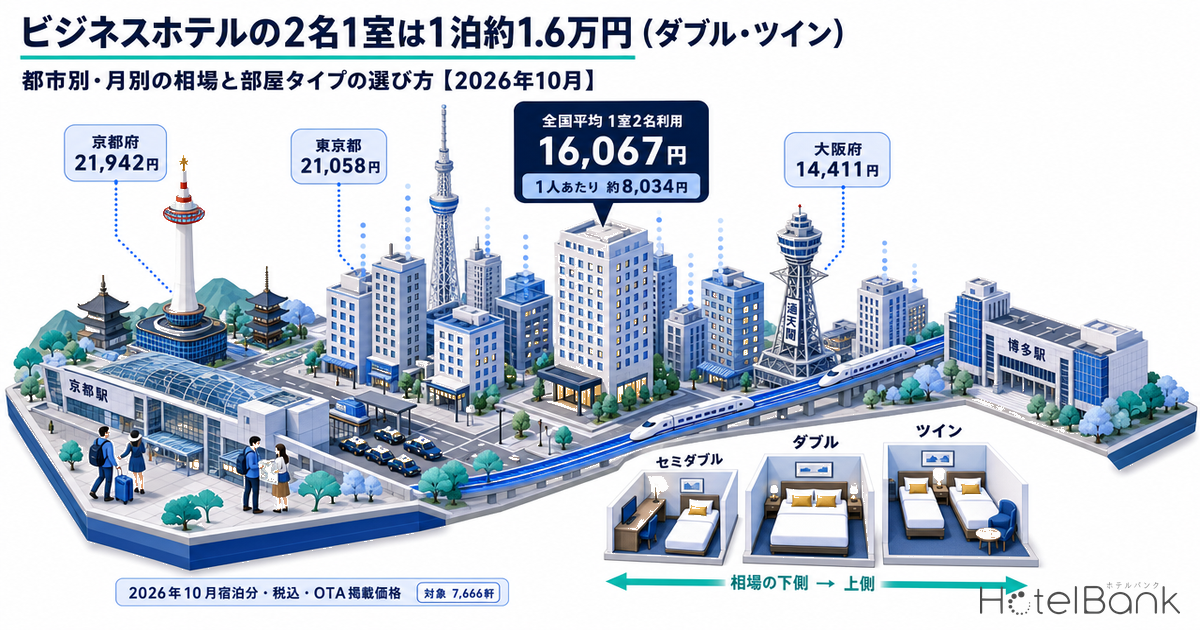
When two people stay at a business hotel in Japan, the national average comes to ¥16,067 per room per night (tax included, two guests sharing one room), or about ¥8,000 per person. That figure is the average listed rate across OTA public data compiled by the HotelBank Editorial Team (as of October 2026, 7,666 business hotels nationwide), and it covers both double and twin rooms. The gap between cities is wide: Tokyo and Kyoto sit in the ¥21,000 range per room, while Osaka and Fukuoka are in the ¥14,000 range. This article sets out, on a listed-rate basis, the going rate by city and by month, the differences between double, semi-double and twin rooms, and how to put together a cheaper stay for two.
- — A room for two at a business hotel in Japan costs ¥16,067 a night, about ¥8,000 per person (October 2026, N=7,666 properties, tax included, listed rate). The average covers double, twin and semi-double rooms
- — By prefecture, Kyoto (¥21,942) and Tokyo (¥21,058) are the most expensive and Osaka (¥14,411) and Fukuoka (¥14,510) the cheapest — a gap of about 1.5x
- — Wards with a major terminal station run 1.4–1.8x the prefectural average (Hakata Ward ¥26,231; Chuo Ward, Osaka City ¥20,488). In Tokyo, choosing Toshima or Ota City cuts ¥5,500 or more off the room rate
- — By month, June 2026 was the cheapest at ¥14,686 and March 2027 the most expensive at ¥16,368: a national swing of ¥1,682 (about 11%)
- — A semi-double bed is about 120cm wide, a double about 140cm, and a twin has two beds. Two people who go to sleep at different times should take a twin; for keeping one night cheap, a semi-double is the rule of thumb
National rate: ¥16,067 a night for two in one room, about ¥8,000 per person
First, the basis. Every price in this article is per room, two guests sharing, tax included, OTA listed rate. Charges collected separately by local governments, such as accommodation tax and bathing (onsen) tax, are not included. If you are looking for the “average cost of a double room” in Japan, this per-room figure is the number that answers it (per room, 2 adults, tax included, listed rate).
| Category | Per room (2 guests) | Per person | Properties |
|---|---|---|---|
| Business hotels | ¥16,067 | approx. ¥8,034 | 7,666 |
| City hotels | ¥29,118 | approx. ¥14,559 | 1,293 |
| Ryokan (Japanese inns) | ¥33,839 | approx. ¥16,920 | 6,539 |
Source: HotelBank Editorial Team research (OTA public data). Listed rates for stays in October 2026, per room, two guests sharing, tax included. Values are averages of daily listed rates aggregated by municipality across Japan; business hotels come in at about 55% of the city-hotel level and about 47% of the ryokan level.
The ¥16,067 figure for business hotels averages the listed rates of every room type two people can book — double, twin, semi-double and so on. At the same hotel a semi-double is often listed several thousand yen below a double, so semi-doubles form the lower end of the range, while twins and larger doubles form the upper end.
By city: Tokyo and Kyoto above ¥20,000, Osaka and Fukuoka around ¥14,000
The rate for two in one room varies by roughly 1.5x between cities. Tokyo and Kyoto exceed ¥21,000 per room and Osaka and Fukuoka stay in the ¥14,000 range, while Hokkaido, Okinawa and Aichi sit in the same ¥16,000–18,000 band as the national average.
Business hotel listed rates in major prefectures (per room, two guests sharing, tax included, stays in October 2026). Source: HotelBank Editorial Team research (OTA public data)
| Prefecture | Per room (2 guests) | Per person | Properties | Central ward benchmark |
|---|---|---|---|---|
| Kyoto | ¥21,942 | approx. ¥10,971 | 348 | Shimogyo Ward, Kyoto City: ¥31,359 (126 properties) |
| Tokyo | ¥21,058 | approx. ¥10,529 | 959 | Taito City: ¥28,342 (180 properties) |
| Nagano | ¥19,724 | approx. ¥9,862 | 165 | — |
| Hokkaido | ¥17,797 | approx. ¥8,899 | 409 | Chuo Ward, Sapporo: ¥21,001 (107 properties) |
| Okinawa | ¥17,641 | approx. ¥8,821 | 205 | Naha City: ¥15,887 (110 properties) |
| Ishikawa | ¥17,495 | approx. ¥8,748 | 114 | — |
| Kanagawa | ¥17,281 | approx. ¥8,641 | 211 | Naka Ward, Yokohama: ¥20,161 (42 properties) |
| Aichi | ¥16,683 | approx. ¥8,342 | 311 | Nakamura Ward, Nagoya: ¥23,786 (63 properties) |
| Hiroshima | ¥16,266 | approx. ¥8,133 | 181 | — |
| Hyogo | ¥15,068 | approx. ¥7,534 | 167 | — |
| Miyagi | ¥14,990 | approx. ¥7,495 | 138 | — |
| Fukuoka | ¥14,510 | approx. ¥7,255 | 347 | Hakata Ward, Fukuoka City: ¥26,231 (138 properties) |
| Osaka | ¥14,411 | approx. ¥7,206 | 529 | Chuo Ward, Osaka City: ¥20,488 (163 properties) |
| Japan (national) | ¥16,067 | approx. ¥8,034 | 7,666 | — |
Source: HotelBank Editorial Team research (OTA public data). Listed rates for stays in October 2026, per room, two guests sharing, tax included. Prefectural values average the municipalities within the prefecture, including suburbs and smaller cities. The “central ward benchmark” is the same measure aggregated at ward level (number of properties in parentheses); if you are staying near a major terminal station, it is closer to what you will actually see.
There are two things to read from this. The first is the gap between the prefectural average and the central wards. Fukuoka Prefecture averages ¥14,510 but Hakata Ward ¥26,231; Osaka Prefecture averages ¥14,411 but Chuo Ward, Osaka City (around Shinsaibashi and Namba) ¥20,488 — areas around terminal stations run 1.4–1.8x the prefectural average. The second is that Tokyo splits into price bands by ward. Taito City (Ueno, Asakusa) is ¥28,342, Shinjuku City ¥29,412 and Chiyoda City ¥29,591, against ¥22,459 in Toshima City (Ikebukuro) and ¥22,733 in Ota City (Kamata, Haneda); just picking a ward 15 minutes from the center by train makes a difference of ¥5,500–7,000 per room. In areas such as around Kyoto Station, where prices split by property even at the same station entrance, comparing indicative prices in property-level articles such as a comparison of business hotels with 100+ rooms within five minutes’ walk of Kyoto Station’s Hachijo exit (innippon, in Japanese) makes it easier to decide where within the range you want to stay.
Month by month: a swing of about ¥1,700 a year, with June–July at the bottom
Lined up month by month, the national average is lowest in June 2026 at ¥14,686 and highest in March 2027 at ¥16,368. The difference is ¥1,682, or about 11%. Individual cities and resorts swing far more, but taken across all business hotels in Japan, the monthly difference stays within “a few hundred to about ¥1,000 per person per night.”
Monthly listed rates at business hotels nationwide (per room, two guests sharing, tax included). Compiled as of October 4, 2026; figures from November 2026 onward are for rooms already on sale. Source: HotelBank Editorial Team research (OTA public data)
| Stay month | Per room (2 guests) | Properties | Notes |
|---|---|---|---|
| May 2026 | ¥15,377 | 7,217 | Includes Golden Week holidays |
| June 2026 | ¥14,686 | 7,162 | Lowest in the period |
| July 2026 | ¥14,860 | 8,083 | |
| August 2026 | ¥15,875 | 7,969 | Obon and summer holidays |
| September 2026 | ¥15,540 | 7,966 | |
| October 2026 | ¥16,067 | 7,666 | Base month for this article |
| November 2026 | ¥15,853 | 7,405 | Advance sales |
| December 2026 | ¥15,507 | 7,241 | Advance sales |
| January 2027 | ¥15,427 | 6,671 | Advance sales |
| February 2027 | ¥16,059 | 6,122 | Advance sales |
| March 2027 | ¥16,368 | 5,510 | Advance sales; highest in the period |
Source: HotelBank Editorial Team research (OTA public data). Listed rates as of October 4, 2026, per room, two guests sharing, tax included. From November onward the stay dates are further out, so fewer properties have opened sales and the property count falls. The average may move as rooms are added closer to the date.
The further out the month, the fewer properties are counted, because some hotels have not yet released rates six months ahead. February–March 2027 looks high because it reflects the price band of hotels that open sales early; the average can fall as rooms are added closer to the date. If you can choose when to travel, June (the rainy season) and July before the summer holidays begin are when rates for two in one room settle down across Japan.
Double, semi-double and twin: the differences, and how to choose for two
The rooms two people can book at a business hotel fall into three types by bed width and number of beds. Bed widths commonly used in Japan are about 120cm for a semi-double, about 140cm for a double and about 160cm for a queen, against about 100cm for a single (source: DAIKEN HomeLife, “Types of bed sizes: a comparison list” (in Japanese); sizes vary somewhat by manufacturer and construction). Hotel room names are based on these bed widths.
| Room type | Bed | Suits which pair | Price position |
|---|---|---|---|
| Semi-double | One bed about 120cm wide | Couples staying just one night with little luggage. Essentially a single-occupancy room used by two | Lower end of the range |
| Double | One bed at least about 140cm wide | Married couples and partners. Some hotels call a 160cm queen bed a “double” | Middle of the range |
| Twin | Two beds (each about 100–120cm) | Friends, colleagues on a business trip, or two people who sleep at different times. Rooms are often larger too | Upper end of the range |
There are three points to choosing. (1) If you sleep at different times, take a twin. One of you can go to bed first and the other can still move around without worrying. (2) If sharing a bed is fine, check the bed width on the booking screen and choose a double. Even under the “double” label, 140cm and 160cm feel very different; hotels that list both the room size (m²) and the bed width are easier to compare. (3) Treat a semi-double as “a cheap single night.” A 120cm width is a single-occupancy standard, so for stays of two nights or more, or trips with a lot of luggage, paying a few thousand yen more for a double or twin leaves you more satisfied. A “Double” that international visitors see on an English booking screen usually means a Japanese double (140cm class), so it is safest to assume it is a size smaller than the queen (160cm class) common in Europe and North America.
Four ways to make a stay for two cheaper
1. Build around Sunday–Thursday nights. Business hotels see business-trip demand concentrate on weekdays, while leisure guests traveling in pairs cluster on Fridays and Saturdays. Because rooms for two sell easily at weekends, listed rates at the same hotel tend to be calmer from Sunday to Thursday. If you were planning a Saturday night, first checking whether you can shift to Friday or Sunday is the move with the biggest effect.
2. Book early, and check again close to the date. As the monthly table shows, prices for months further out are made up of “hotels that started selling early,” and the average moves when rooms are added close to the date. Secure a room first with an early-booking plan, then two weeks before departure — while cancellation is still free — check prices again at the same hotel and nearby hotels; either way, you will not lose out.
3. Stay one stop away from the terminal station. As the city table showed, in Tokyo Taito, Chuo and Minato cities run ¥28,000–33,000 while Toshima and Ota cities are around ¥22,000, so a 15-minute train ride translates into ¥5,500 or more per room. In Osaka, too, Yodogawa Ward (Shin-Osaka) is ¥14,369 against ¥20,488 for Chuo Ward, so if you are traveling by shinkansen, staying on the Shin-Osaka side pays off.
4. Compare room-only and breakfast-included rates separately. For two people, the breakfast difference is doubled too. Hotels with a free breakfast or a large public bath offer more real value at the same listed rate, so comparing on “how much per person including breakfast” rather than just “the listed rate per room” makes the choice easier. In regional cities, some towns have mid-sized hotels within walking distance of the station, with a large public bath, from around ¥14,000 for two in one room (five station-side hotels with large baths in Takamatsu, Matsue and Tokushima, HotelPicks, in Japanese).
For stays of a week or longer, or month-long stays, the cost structure changes depending on how you arrange the days of the week and whether long-stay plans are available. If you are considering a long stay for two, check each property’s consecutive-night and long-stay plans alongside the nightly rates in this article.
Where to look next
For comparisons of specific properties, these articles go deeper (both in Japanese).
Compares six hotels within five minutes’ walk of the shinkansen gates on walking time, room count, whether there is a large public bath, and the indicative price for two in one room. The list includes Hotel Keihan Kyoto Grande (ホテル京阪 京都 グランデ, 320 rooms), connected by underground passage from the Hachijo east exit; ibis Styles Kyoto Station (イビススタイルズ京都ステーション), 30 seconds on foot from the Hachijo west exit; and Daiwa Roynet Hotel Kyoto Hachijoguchi (ダイワロイネットホテル京都八条口), where every room is 18 m² or larger and there is a 24-hour coin laundry.
Friday business trip + one night: “Bleisure basics — West Japan,” volume 2 — Top 5 mid-sized hotels near the station with a large bath for Saturday sightseeing in Takamatsu, Matsue and Tokushima (autumn–winter 2026, five more hotels) (HotelPicks, in Japanese)
Introduces five hotels within six minutes’ walk of the station with separate men’s and women’s large baths, with indicative prices of ¥14,000–35,000 for two in one room. They include JR Clement Inn Takamatsu (JRクレメントイン高松), one minute from Takamatsu Station with a top-floor panoramic bath; Super Hotel Shimane Matsue-ekimae (スーパーホテル島根・松江駅前), with a natural hot spring and free breakfast; and Hotel Sunroute Tokushima (ホテルサンルート徳島), one minute from Tokushima Station with a 100% source-fed natural hot spring — chosen along the route of adding Saturday sightseeing to a Friday business trip.
Frequently asked questions
Q. What is the going rate per night for a double room at a business hotel in Japan?
The listed rate for two in one room at business hotels across Japan is ¥16,067 per room per night for stays in October 2026 (tax included, N=7,666 properties). That works out to about ¥8,000 per person. It is an average covering every room type two people can book, including double, twin and semi-double.
Q. Are these prices per person or per room?
Per room. Every price in this article is a listed rate per room, two guests sharing, tax included; the per-person figure is simply that amount divided by two. Accommodation tax and bathing tax are not included. Booking screens show prices either per person or as a room total, so check which one you are looking at before comparing.
Q. Which cities are the most and least expensive for two in one room?
For stays in October 2026, Kyoto (¥21,942) and Tokyo (¥21,058) were the most expensive, and Osaka (¥14,411) and Fukuoka (¥14,510) the cheapest. Prefectural averages include the suburbs, though: Hakata Ward in Fukuoka City is ¥26,231 and Chuo Ward in Osaka City ¥20,488, so wards with a major terminal station run 1.4–1.8x the prefectural average.
Q. In which months is it cheapest for two people to stay at a business hotel?
On the national average, June 2026 was the lowest at ¥14,686, followed by July at ¥14,860. The highest was March 2027 at ¥16,368 (advance sales as of October 4, 2026), a difference of ¥1,682, or about 11%.
Q. Should we choose a double or a twin?
A double has one bed at least about 140cm wide; a twin has two beds. Two people who sleep at different times, or friends traveling together, should take a twin; two people happy to share a bed should check the bed width and take a double. A semi-double has one bed about 120cm wide and suits a single night when you want to keep costs down.
Methodology and sources
■ Data source
HotelBank Editorial Team research (monthly aggregation of OTA public data, retrieved October 4, 2026). Covers listed rates at business hotels (per room, two guests sharing, tax included). Property counts: N=7,666 nationwide for stays in October 2026; N=5,510–8,083 by month (May 2026–March 2027); N=114–959 by prefecture; N=31–180 by ward. Bed-width benchmarks are from DAIKEN HomeLife, “Types of bed sizes: a comparison list.”
■ Calculation assumptions
National, prefectural and ward values are averages of daily listed rates aggregated by municipality. The per-person figure is the per-room amount simply divided by two. Charges collected separately by local governments, such as accommodation tax and bathing tax, are not included. The multiples between prefectures and central wards, and the monthly differences, are all simple ratios and differences between values in the tables.
■ Limitations and caveats
Listed rates are averages of the selling prices observed in each month and do not represent actual amounts paid or the rate at any individual property. Rates were not aggregated separately by double, twin or semi-double, so the price position of each room type is described as a general tendency. Figures from November 2026 onward are advance sales and may change with future sales. Prefectural values include suburbs and smaller cities, so they come out lower than what you would see around terminal stations.
Related reading