

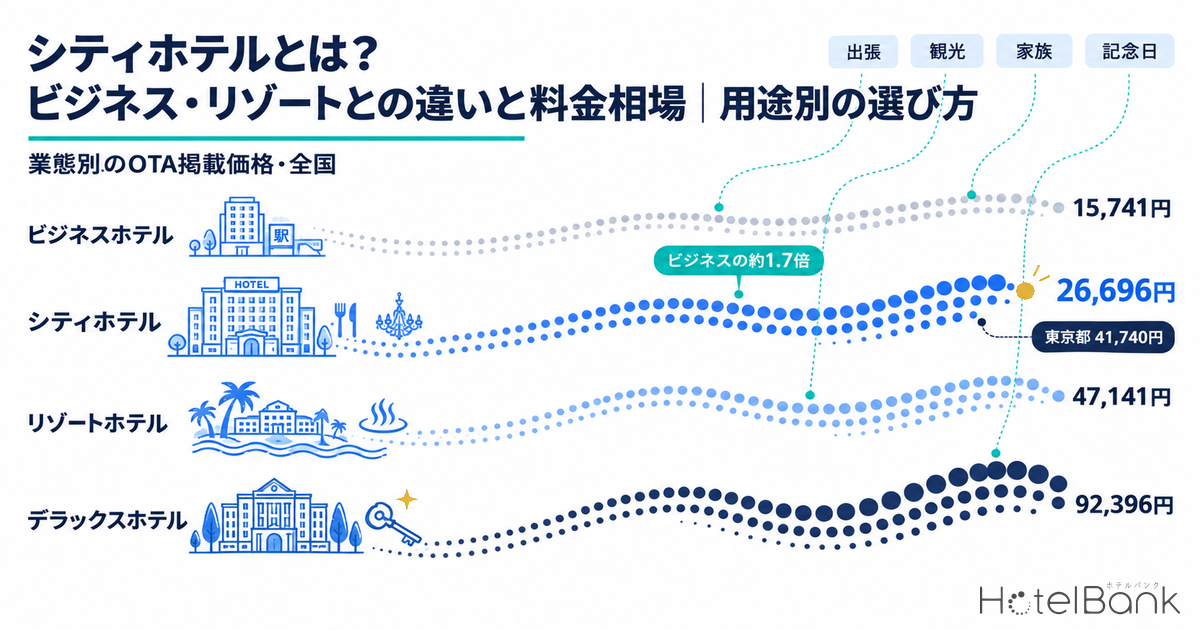
A city hotel is a “full-service” hotel located in a city center that offers restaurants, bars, banquet halls and room service in addition to accommodation. You can do far more on the premises than at a business hotel, which focuses on lodging alone, and it differs from a resort hotel in a tourist destination in both location and how guests spend their time. As a price benchmark, OTA listed prices for September 2026 stays (2 guests per room, per room, tax included) put city hotels at ¥26,700 nationwide — midway between business hotels (¥15,700) and resort hotels (¥47,100). This article sorts out how the four hotel types are defined, what their listed prices actually are, and which type suits business trips, sightseeing, family travel and special occasions.
- — City hotel = urban location × full service. It houses functions beyond lodging — restaurants, banquet halls, room service (there is no legal definition).
- — ¥26,696 nationwide (listed price for September 2026 stays, 2 guests per room, tax included, N=1,253) — about 1.7x the ¥15,741 of business hotels.
- — Tokyo: ¥41,740 (N=115), about 1.6x the national level. Location moves the price more than hotel type does.
- — Choose by purpose: business hotels for business trips; city hotels for city touring, business dinners and special occasions; resort hotels when the stay itself is the goal.
Defining a City Hotel — “Urban Location × Full Service”
There is no legal definition of a city hotel in Japan, but in the industry the term generally refers to a hotel that meets the following four conditions.
- Location: Around major terminal stations or in the central business district of a large city — a place that works for both sightseeing and business.
- On-site facilities: Multiple restaurants, a bar or lounge, and banquet and wedding facilities. A defining feature is that people visit for purposes other than staying the night; everything from dining to meetings can be handled on site.
- Guest rooms: Mostly twins and doubles, with layouts designed for two or more guests — the opposite room mix of single-dominated business hotels.
- Scope of service: A wide range of staffed services such as room service, concierge, cloakroom, and luggage storage and delivery arrangements.
This “full service” adds operating costs, so rates are higher than at lodging-focused hotels. Put the other way, the price difference is what you pay for the restaurants, banquet halls and attentive staffed service.
How City Hotels Differ from Business, Resort and Deluxe Hotels
| Type | Location | Main room types | Restaurants & banquet halls | Scope of service |
|---|---|---|---|---|
| Business hotel | Near stations, office districts | Singles, compact doubles | Mainly a breakfast venue only | Lodging-focused; efficient check-in and check-out |
| City hotel | City center | Twins, doubles | Multiple restaurants + banquet halls | Full service (room service, concierge) |
| Resort hotel | Tourist destinations — seaside, highlands, hot spring towns | Twins to Japanese-Western rooms and suites | Multiple restaurants + pool, spa and other leisure facilities | The stay itself is the purpose; extends to arranging activities |
| Deluxe (luxury) hotel | Prime sites in cities and tourist destinations | Larger rooms; high share of suites | Fine dining + bar and spa | Top tier; staffing built around personalized service |
The boundaries are blurring. More lodging-focused hotels now have large communal baths and restaurants, and the upper room categories of city hotels overlap with deluxe hotels. Even so, viewed along the axis of “how much the hotel offers for spending time on the premises,” these four categories remain a useful yardstick for understanding price differences.
How Much Do Rates Differ? Listed Prices for September 2026
In OTA listed prices for September 2026 stays compiled by the HotelBank Editorial Team (2 guests per room, per room, tax included, as of September 2026), there are clear steps between hotel types at the national level, as shown below.
| Type | Nationwide (2 guests/room, tax incl.) | Properties | Tokyo (2 guests/room, tax incl.) | Properties |
|---|---|---|---|---|
| Business hotel | ¥15,741 | N=7,453 | ¥18,496 | N=949 |
| City hotel | ¥26,696 | N=1,253 | ¥41,740 | N=115 |
| Resort hotel | ¥47,141 | N=1,707 | ¥60,105 | N=21 |
| Deluxe hotel | ¥92,396 | N=214 | ¥83,009 | N=57 |
Source: HotelBank Editorial Team research. OTA listed prices for September 2026 stays aggregated by hotel type (per-room rate for 2 guests, tax included, as of September 2026). Actual booking prices vary by date and plan.
There are three points to take away. First, city hotels cost about 1.7x business hotels nationwide — a rough gauge of the market price of “full service.” Second, city hotels in Tokyo (¥41,700) are 1.6x the national level, so location matters more than hotel type. If you want a city hotel in Tokyo but it doesn’t fit your budget, realistic alternatives are the same type outside Tokyo or an upper-tier business hotel in the city. Third, resort and deluxe hotels play on a different pricing field altogether. The stay itself becomes the purpose of the trip, which changes how you allocate a per-night budget in the first place. Note that the listed prices shown here are a different metric from the rates actually booked; how to read that gap is explained in What Is Hotel ADR? Settled Rates vs Listed Prices by Hotel Type.
Source: HotelBank Editorial Team research. Listed prices for September 2026 stays (per-room rate for 2 guests, tax included). Property counts are as shown in Table 2 (N=21 for resort hotels in Tokyo).
For how business hotel rates are moving and the trends by city, see our detailed article Business Hotel Price Surge: National ADR Analysis & 10 Cost-Effective Prefectures.
Which Type Suits Which Purpose — Business Trips, Sightseeing, Families, Special Occasions
For business trips, a business hotel is the first choice. It wins on station-front locations, efficient check-in and check-out, and price for single occupancy. A city hotel pays off on business trips where you want to hold dinners or meetings inside the hotel, or when hosting clients — its banquet halls and restaurants become tools of the trade. If your travel allowance feels tighter than it used to, that is because market price levels themselves have risen; how to deal with it is covered in Business Trip Budgets Fall Short: Hotel Prices and 5 Fixes.
For sightseeing, it depends on how you travel. If you tour from a base in the city, a city hotel’s location pays off: it’s easy to head out in the evening, and you can leave your luggage and move around light. If your destination is a hot spring town or a beach, on the other hand, choosing a resort hotel from the start avoids wasted travel.
For family trips, the room layout decides it. City hotels center on twins and doubles and offer a wider choice of co-sleeping and extra-bed options, so their room mix tends to suit families better than business hotels. If you’ll stay several nights and spend time at the pool or on the premises, a resort hotel is the top pick.
For special occasions, choose by whether everything can happen under one roof. Enjoying dinner, the bar and breakfast all in one building is the domain of city hotels and deluxe hotels. With room in the budget, go deluxe; to balance atmosphere and price, a city hotel’s upper-floor or guaranteed-view plan is the classic choice. There is also the “urban resort” option of enjoying the stay itself while in the city — for example, choosing by view, as in this comparison of harbor-view hotels in Yokohama’s Minato Mirai area (in Japanese), is a useful reference.
To Explore Further
For detailed comparisons of specific hotels, these articles (in Japanese) go deeper.
An in-depth look at The Tokyo Station Hotel (東京ステーションホテル), which has 150 rooms inside the station building — an Important Cultural Property — from its architectural history to its room mix. The “Dome Side” rooms, where you see the dome reliefs at eye level from the window, and the guests-only breakfast venue, the Atrium, show concretely how a city hotel stay can be spent.
Compares five hotels including The Kahala Hotel & Resort Yokohama (ザ・カハラ・ホテル&リゾート 横浜), InterContinental Yokohama Grand (ヨコハマ グランド インターコンチネンタルホテル) and Hyatt Regency Yokohama (ハイアット リージェンシー 横浜) by the angle of their bay views and price range (guide rate for 2 guests per room). A set of real examples for choosing a city hotel or urban resort for a special occasion or sightseeing.
Frequently Asked Questions
Q. What is the biggest difference between a city hotel and a business hotel?
The range of on-site facilities and services. A city hotel is a full-service type with multiple restaurants, banquet halls, room service, concierge and more, while a business hotel focuses on lodging. Rooms also differ: city hotels are generally built around twins and doubles, business hotels around singles.
Q. What is the typical rate for a city hotel?
Listed prices for September 2026 stays (2 guests per room, per room, tax included) are ¥26,696 nationwide (N=1,253 properties) and ¥41,740 in Tokyo (N=115 properties). Actual booking prices vary by date and plan.
Q. How does a city hotel differ from a deluxe (luxury) hotel?
Deluxe hotels are the top tier, with a high share of larger rooms and suites, fine dining and spas, and service built around personal attention. Their listed price is ¥92,396 nationwide (September 2026 stays, 2 guests per room, tax included, N=214 properties), a very different price range from city hotels.
Q. For a family trip, is a city hotel or a resort hotel better?
If you’ll sightsee from a base in the city, a city hotel is convenient. With rooms centered on twins and doubles, it is often easier for families to use than a business hotel. If the goal is to stay several nights and spend time at the pool or on the premises, a resort hotel is the top pick.
Q. When is a city hotel worth choosing for a business trip?
When you want to hold dinners or meetings inside the hotel, or when hosting clients. For a trip where lodging is the only need, a business hotel — with its station-front location and price advantage — is the first choice.
Methodology and Sources
■ Data source
HotelBank Editorial Team research. Listed prices for September 2026 stays were aggregated nationwide and for Tokyo across four hotel types: business, city, resort and deluxe hotels (property counts are the N= values in Table 2).
■ Calculation assumptions
Prices are per-room rates for 2 guests per room (tax included). “About 1.7x” in the text is national city hotels ÷ business hotels (¥26,696 ÷ ¥15,741), and “about 1.6x” is Tokyo ÷ national city hotels (¥41,740 ÷ ¥26,696), both rounded to one decimal place. Figures such as “¥26,700” in the text are rounded to the nearest hundred yen.
■ Limitations
Listed prices are a different metric from the room rates actually booked (ADR) and vary with date, plan and remaining inventory. The hotel-type categories are classifications for aggregation purposes and include borderline properties. Resort hotels in Tokyo (N=21) are a small sample, so the figure is prone to fluctuation.
Source: Hyatt Hotels Japan (日本ハイアット株式会社), “Press Releases, April 2026” (names and brand classification of the Hyatt hotels mentioned in the text)
Related Articles