

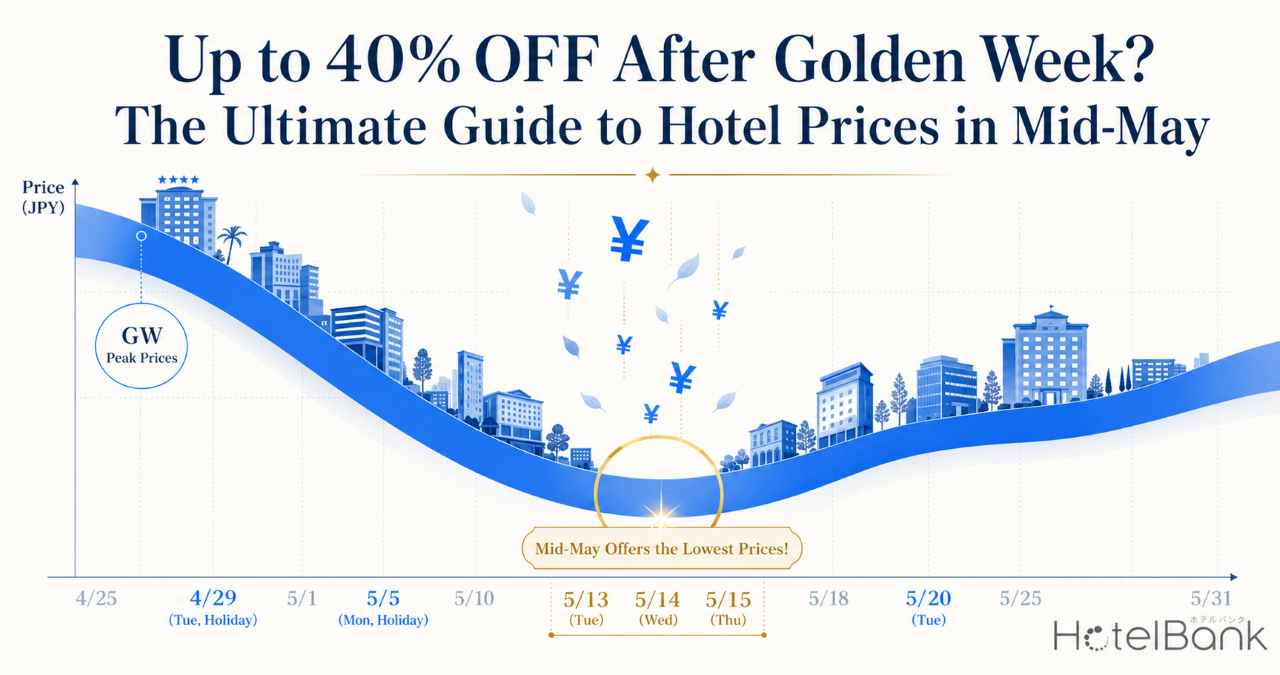
Once Golden Week (GW) ends, hotel prices drop sharply across the board. According to an analysis by Metro Engine Research, which compiled publicly available pricing data from approximately 8,000 properties across six major cities, weekday ADR (Average Daily Rate) in mid-May falls by as much as 44% compared to the GW peak. Combined with the comfortable weather before the rainy season, mid-May can be considered one of the most cost-effective travel periods of the year.
This article analyzes daily pricing data for May 2026 to identify when, where, and what type of accommodation offers the best value. Those planning travel after GW should find this information particularly useful.
Definitions of Key Metrics
- ADR (Average Daily Rate): The average of publicly listed prices on OTAs. This differs from actual transaction prices. Based on per-room rates for double occupancy (tax included), averaged across all plan types (room-only to meal-inclusive).
- Sell-out Rate: The proportion of plans that were no longer available for booking on OTAs at the time of data collection. This differs from actual occupancy rates.
- Data Source: Metro Engine Research
May ADR Trends: The “Peak” of GW and the “Valley” of Weekdays
Looking at overall price trends in May, the ADR across six major cities (Tokyo, Osaka, Kyoto, Hokkaido, Okinawa, and Fukuoka) peaked at ¥51,700 on May 2–3 (GW peak). However, just four days later, on May 7, it dropped to ¥32,000—a decline of approximately 38%.
Another notable trend is the “second valley” formed between May 10–11. During this period, post-GW leisure demand fades while business travel has yet to fully resume, resulting in the lowest prices of the month at around ¥33,700.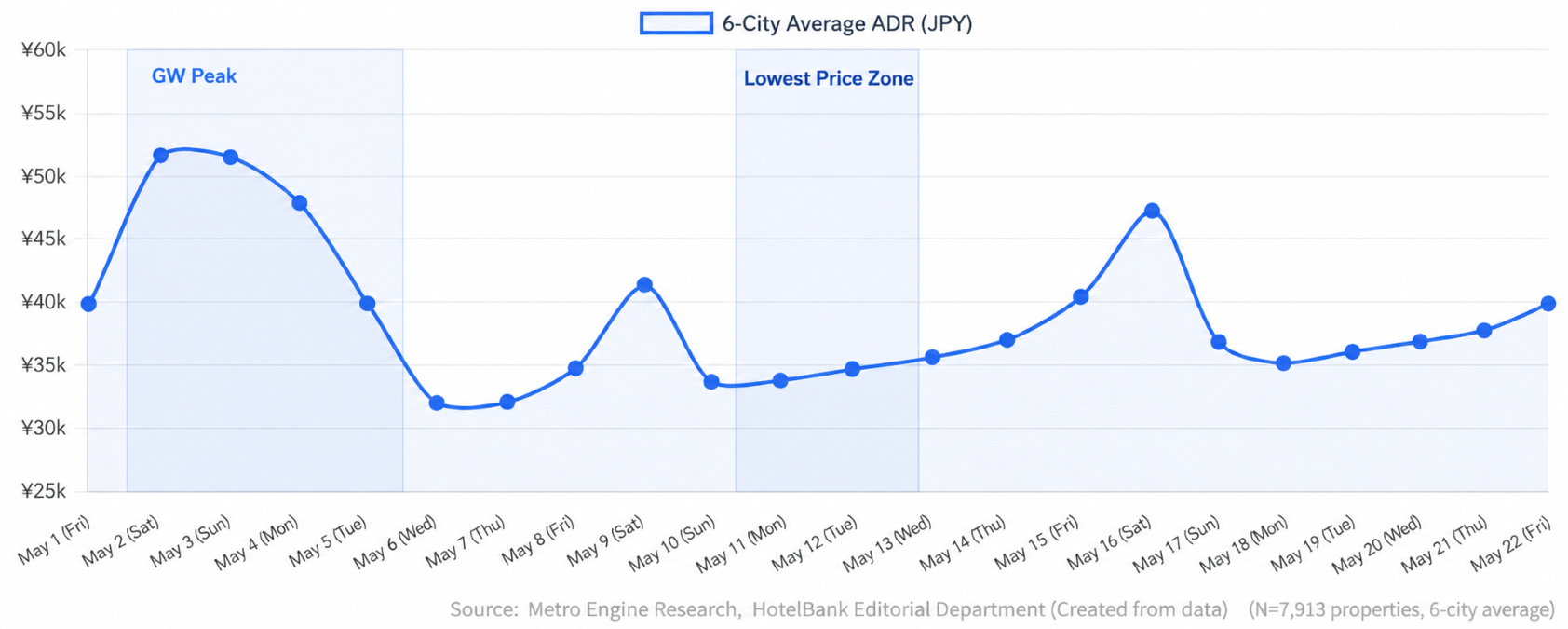
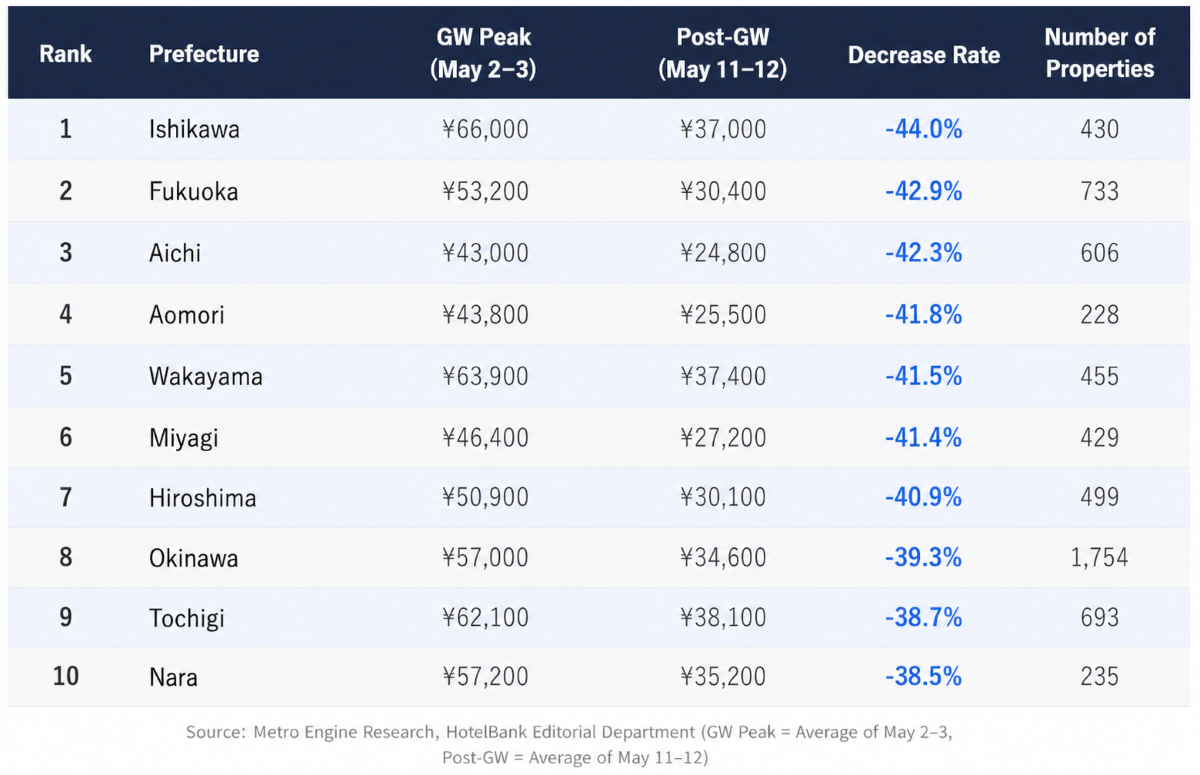
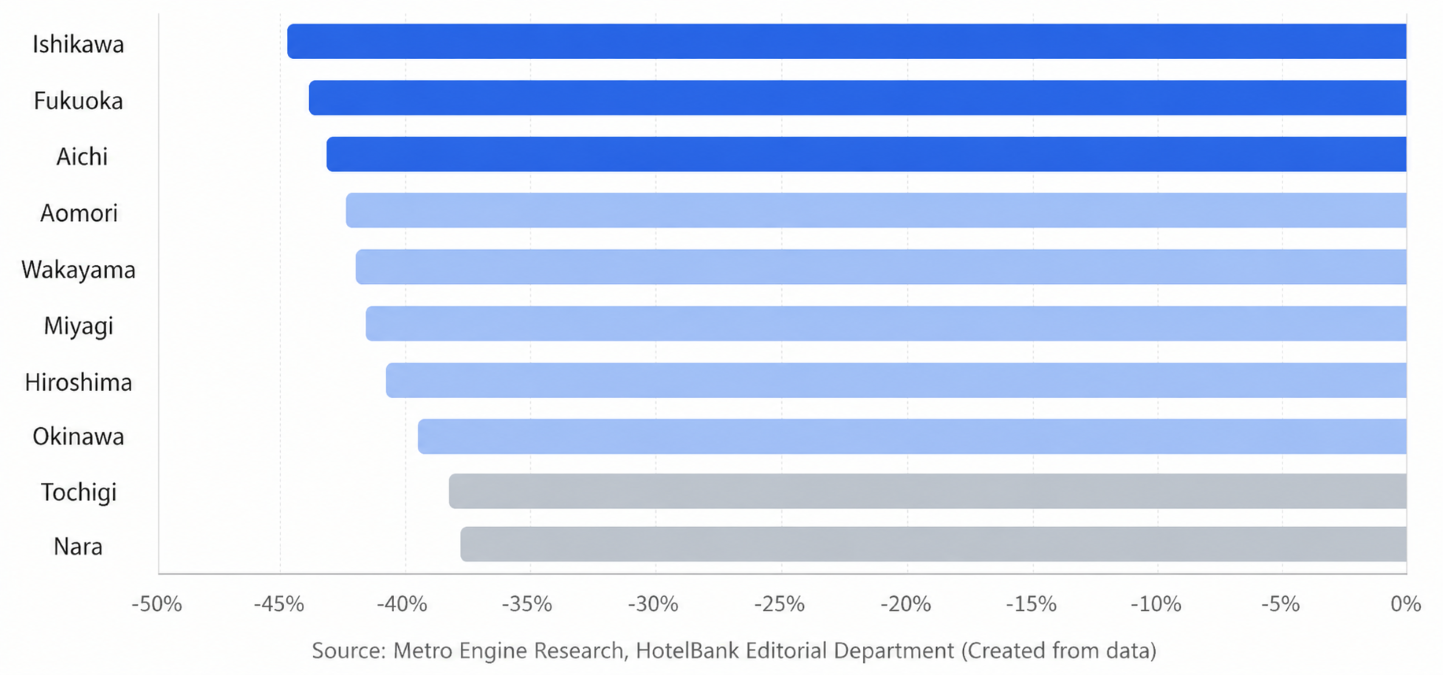
地球温暖化後の価格下落幅が最も大きかった上位10都道府県
宿泊タイプ別の価格下落
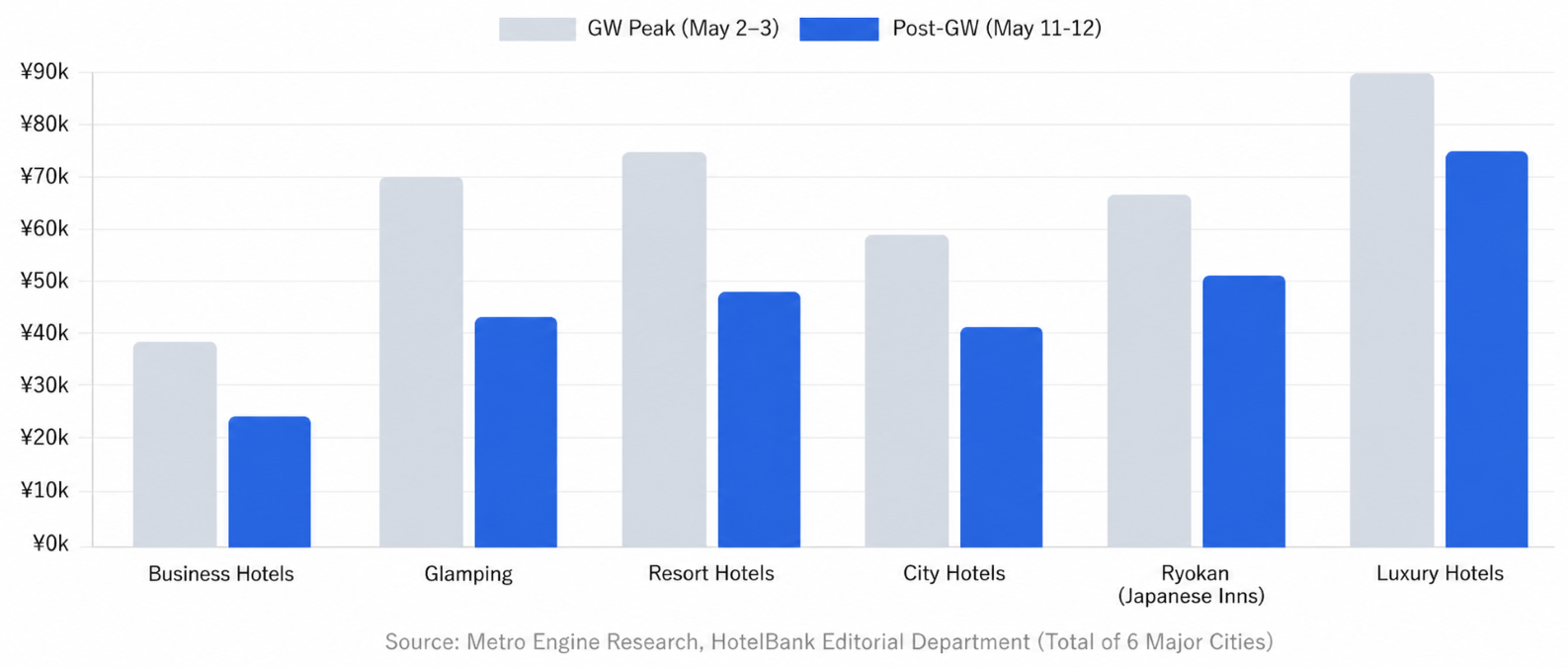
The extent of price declines after Golden Week varies significantly by accommodation type. A category-based comparison across six major cities shows that business hotels experience the largest drop, with a decline rate of -38.0%.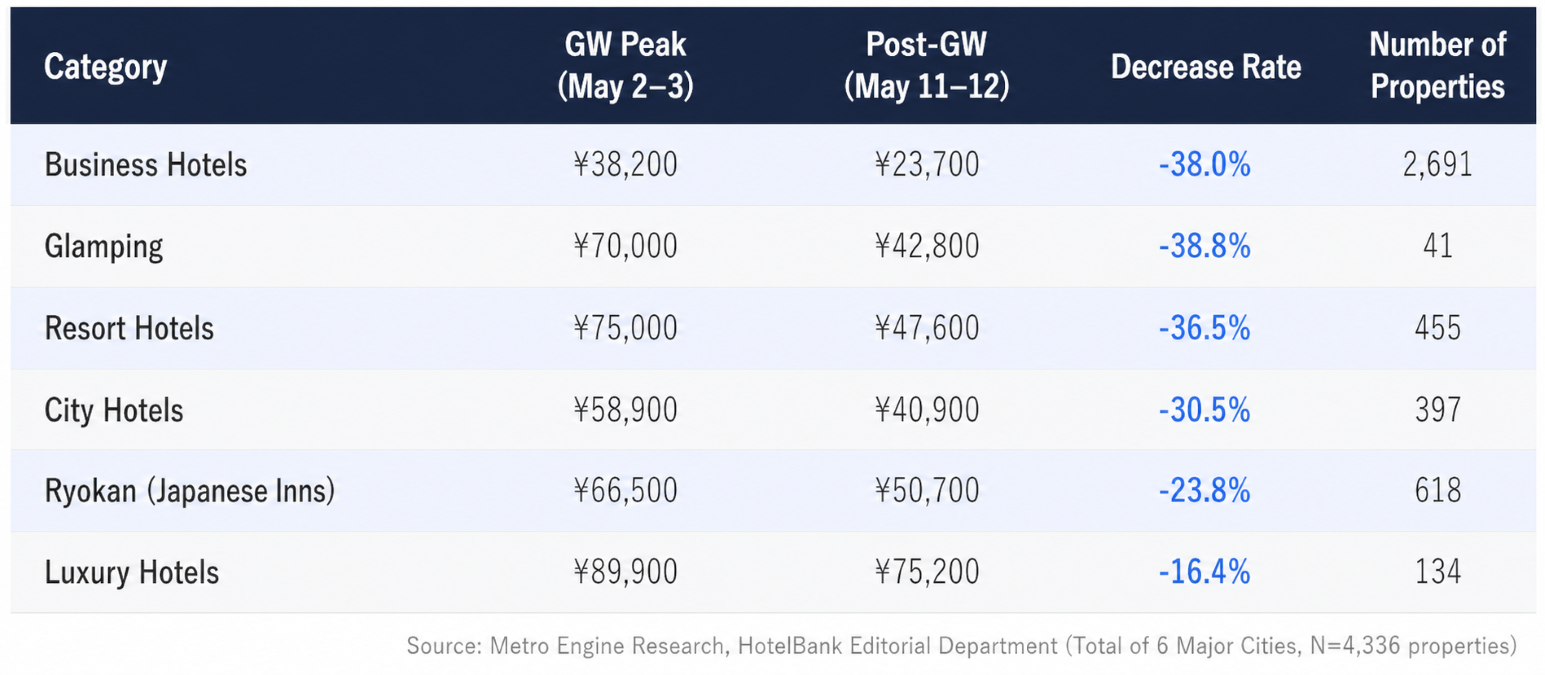
Business hotels see prices surge to nearly double their usual levels during Golden Week. However, once leisure travelers depart, rates revert to typical business-demand pricing on weekdays, resulting in a large fluctuation. ADR drops from ¥38,200 at the GW peak to ¥23,700 afterward, a difference of approximately ¥14,500.
In contrast, ryokan experience a relatively modest decline of -23.8%. This is likely because meals are often included in their pricing, creating a higher cost floor. In addition, hot spring ryokan continue to attract a certain level of weekday demand for relaxation and therapeutic stays even after Golden Week.
Luxury hotels show a smaller decline of -16.4%. Demand from affluent inbound travelers remains stable throughout the year, making them less affected by the drop in domestic leisure demand following Golden Week.
週ごとの価格パターン:日曜日と月曜日が最も安い
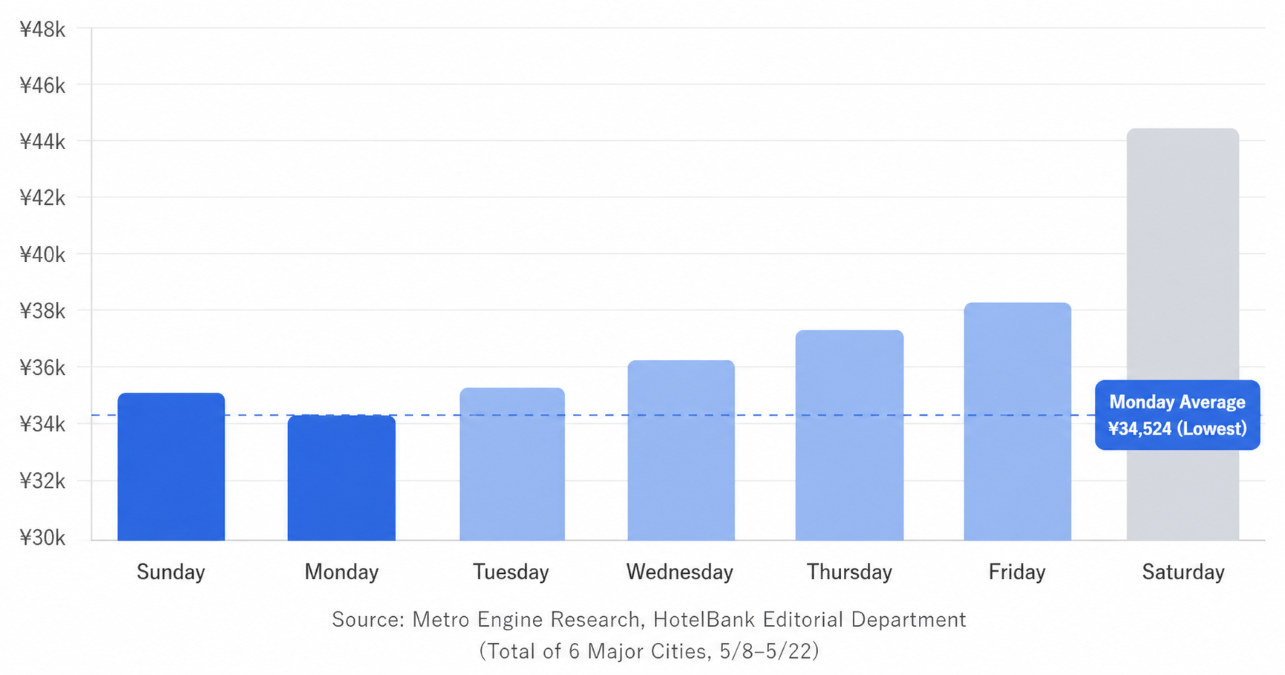
In other words, a one-night stay from Sunday check-in to Monday check-out offers the best value in terms of price. As business travel demand begins to recover from Wednesday to Thursday, ADR rises gradually from ¥36,200 to ¥37,400. By Friday, leisure bookings for the upcoming weekend start to pick up, pushing prices even higher.
Looking at city-level trends, Osaka records the lowest Monday ADR at ¥25,200 among the six cities. In contrast, Tokyo remains relatively high at ¥40,300 even on Mondays, reflecting the strength of its business demand. Kyoto also maintains weekday rates in the ¥45,000 range, indicating steady inbound tourism demand regardless of the day of the week.
都市レベルの洞察
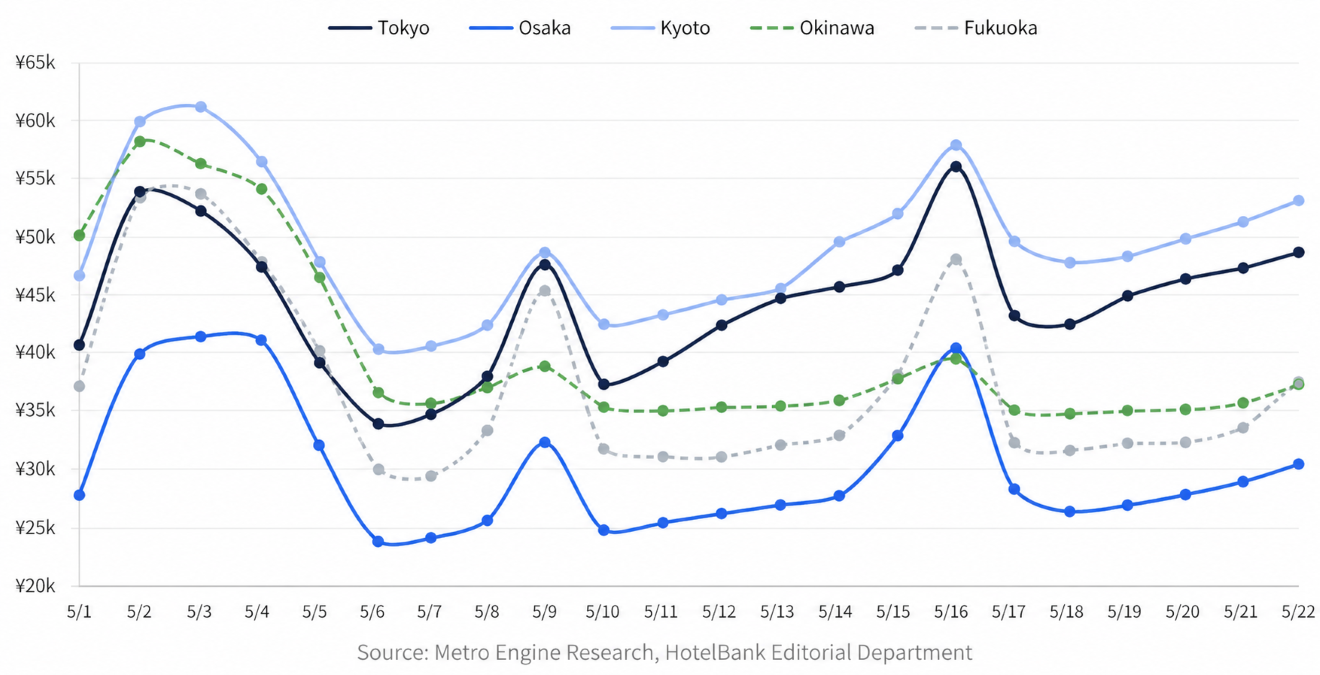
Osaka sees the sharpest post–Golden Week decline, with ADR dropping to as low as ¥23,200 on May 6. In mid-May, weekday rates stabilize in the ¥24,000–26,000 range, making it the most affordable among the six major cities. This steep decline reflects the concentration of demand for theme parks such as USJ during Golden Week, followed by a significant rebound effect.
Okinawa records the highest peak during Golden Week at ¥57,900 among the six cities, but stabilizes at around ¥34,000–35,000 in mid-May. This represents an approximate 40% drop from the GW peak. While ¥34,000 is not necessarily inexpensive, it is relatively good value considering prices exceed ¥50,000 during the peak summer season (July–August). Mid-May can therefore be considered the “last good opportunity” to book a reasonably priced trip to Okinawa.
Kyoto remains relatively high even in mid-May, with ADR ranging from ¥42,000 to ¥50,000. Due to the overlap of the fresh green season and strong inbound tourism demand, prices do not drop significantly after Golden Week. However, compared to the GW peak of ¥60,800, this still represents roughly a 30% decrease. Given the continued strength in demand even after the introduction of the new accommodation tax, mid-May weekdays offer one of the few opportunities to enjoy Kyoto at relatively lower prices.
GW後のベスト予約シナリオ5選
Based on the data above, we propose five scenarios highlighting the best-value accommodations after Golden Week, tailored to different travel purposes. In all cases, the key strategy is to target check-ins between Sunday, May 10 and Thursday, May 14.
結論:5月中旬が滞在に最適な時期です
2026年5月のデータから得られた主な調査結果: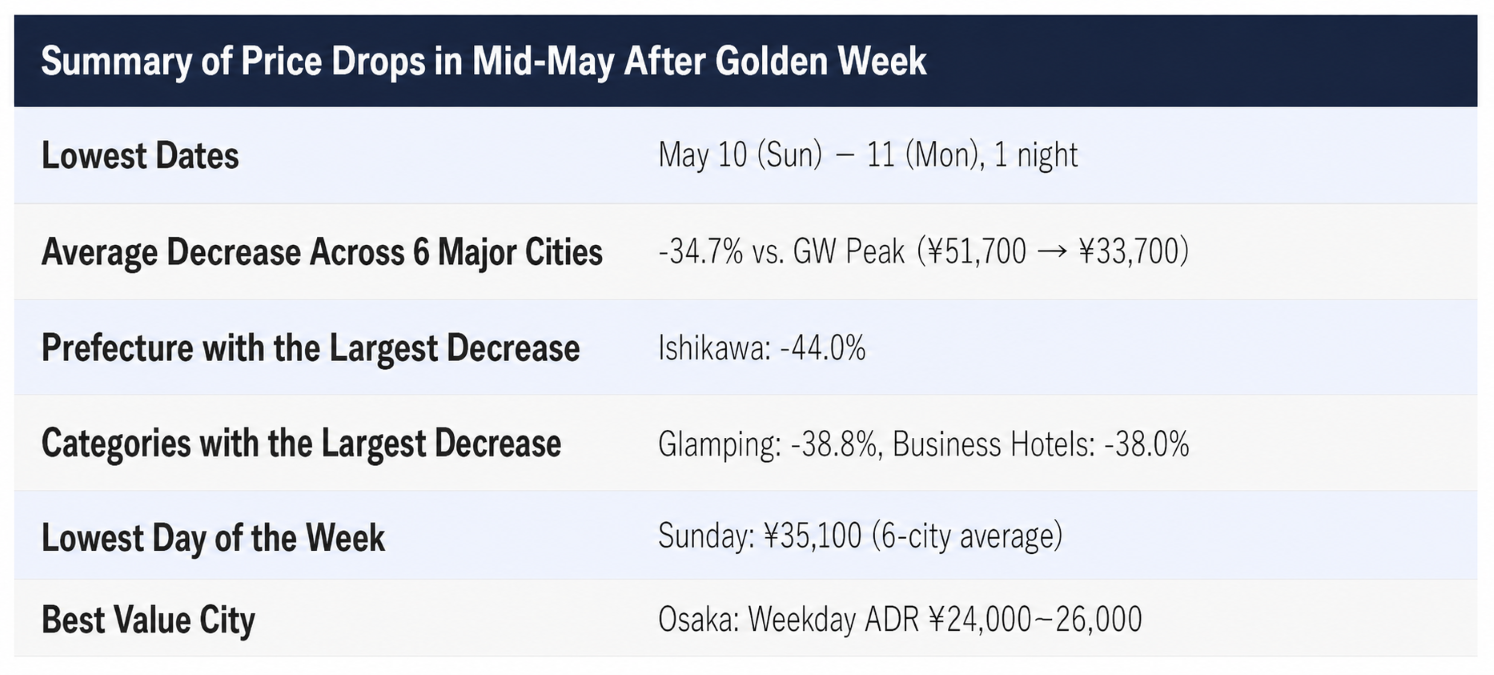
5月中旬は、価格が安く、混雑も少なく、天候も過ごしやすいという、滅多にない好条件が揃う時期です。しかし、この「価格の谷」は長くは続かず、5月第3週以降はビジネスやMICE(会議、報奨旅行、国際会議、展示会)活動により需要が回復します。早めの予約を強くお勧めします。
注:平均客室単価(ADR)は、データ収集時点におけるOTA(オンライン旅行代理店)の公開価格に基づいており、チェックイン日が近づくにつれて変動する可能性があります。現在高めに設定されている価格も、直前割引により宿泊日が近づくにつれて下がる場合があることをご了承ください。
注:この記事のデータは、メトロ・エンジン・リサーチが2026年4月27日時点で実施した調査に基づいています。価格は今後の予約動向によって変更される可能性があります。
外部参照資料:観光庁「宿泊旅行統計調査」、JNTO(日本政府観光局)「外国人観光客統計」。