

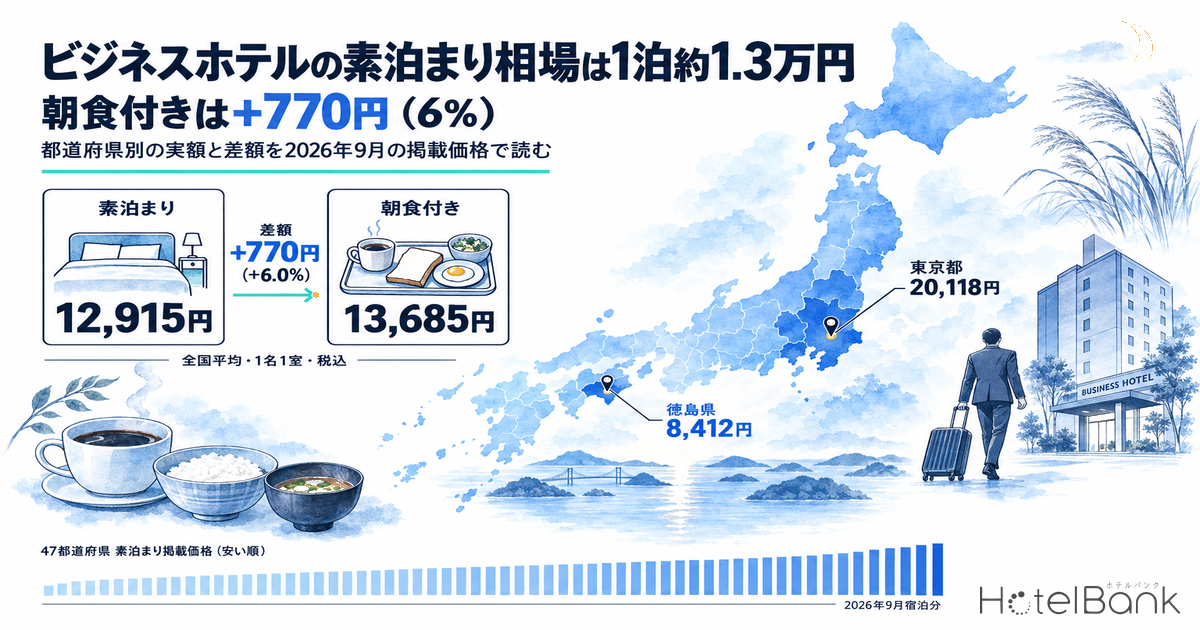
A room-only stay at a Japanese business hotel averages ¥12,915 a night nationwide (one guest per room, tax included). With breakfast the figure is ¥13,685, an increase of ¥770 (+6.0%). The numbers come from prices listed on major booking sites for stays in September 2026, compared across 3,146 hotels where the same property offers both a room-only and a with-breakfast plan, and are a weighted average across the 47 prefectures by the number of hotels covered.
Tokyo comes in at ¥20,118 room-only and ¥21,329 with breakfast, a difference of ¥1,211 (+6.0%, N=367 hotels). The most affordable prefecture, Tokushima, is ¥8,412 room-only (N=27 hotels), which puts Tokyo at 2.4 times that level. The uplift for adding breakfast has a median of 6.9% across prefectures, and in some, such as Nagano and Niigata, the with-breakfast plan actually came out cheaper. Below we walk through the actual rates and differences by prefecture, and then a rule of thumb for booking room-only and eating breakfast outside.
All prices in this article are prices listed on major booking sites (September 2026 stays, one guest per room, tax included), which are close to what a guest actually pays. Because this is a paired comparison limited to hotels that list both a room-only and a with-breakfast plan, the room-only average here is not the lowest price in the market as a whole (hotels that sell only with-breakfast plans, or only room-only plans, are not included).
- — The national average room-only rate is ¥12,915 a night (business hotels, one guest per room, tax included, listed prices for September 2026 stays, N=3,146 hotels). With breakfast it is ¥13,685, a difference of ¥770 (+6.0%).
- — The cheapest is Tokushima at ¥8,412 and the most expensive is Tokyo at ¥20,118, a 2.4x spread. In 16 of the 47 prefectures the room-only rate is below ¥10,000.
- — The uplift for adding breakfast has a median of +6.9% across prefectures. In 28 of the 47 prefectures the difference falls between ¥500 and ¥1,000.
- — In Nagano (-¥505) and Niigata (-¥113) the with-breakfast average is below room-only, while the largest difference is Nara at +¥2,339 (+20.4%).
- — For two guests in one room the difference widens to ¥1,677 (+9.9%) nationally and ¥2,605 (+11.3%) in Tokyo, roughly double the single-occupancy figure.
Room-Only Rates by Prefecture: From ¥8,412 in Tokushima to ¥20,118 in Tokyo
Ranking listed room-only prices from the cheapest, Tokushima at ¥8,412, Oita at ¥8,655, Ehime at ¥8,805, Yamaguchi at ¥9,030 and Iwate at ¥9,143 line up well below ¥10,000. In parts of Shikoku, Kyushu, San’in and Tohoku, a room-only night under ¥10,000 is the benchmark.
At the expensive end are Tokyo at ¥20,118, Hokkaido at ¥15,522, Aichi at ¥15,515, Kyoto at ¥15,319 and Fukuoka at ¥15,154. Tokyo stands out, about ¥4,600 above second-ranked Hokkaido, and even among the three major metropolitan areas Osaka was ¥13,341 (N=171 hotels) and Kanagawa ¥13,754 (N=107 hotels), both more than ¥6,000 cheaper than Tokyo. For anyone trying to hold down lodging costs on a business or leisure trip to Greater Tokyo, the numbers point to staying in Kanagawa, Chiba (¥12,963) or Saitama (¥10,784) as an option.
Prices listed on major booking sites (September 2026 stays, one guest per room, tax included). Weighted by the number of hotels in the paired comparison. Source: HotelBank Editorial Team research.
Listed Room-Only and With-Breakfast Prices in All 47 Prefectures (Cheapest First)
| Rank (cheapest first) | Prefecture | Room only | With breakfast | Difference (%) | Hotels (N) |
|---|---|---|---|---|---|
| 1 | Tokushima | ¥8,412 | ¥8,778 | +¥366 (+4.4%) | 27 |
| 2 | Oita | ¥8,655 | ¥9,352 | +¥697 (+8.1%) | 39 |
| 3 | Ehime | ¥8,805 | ¥9,119 | +¥314 (+3.6%) | 39 |
| 4 | Yamaguchi | ¥9,030 | ¥9,384 | +¥354 (+3.9%) | 44 |
| 5 | Iwate | ¥9,143 | ¥9,777 | +¥634 (+6.9%) | 42 |
| 6 | Wakayama | ¥9,170 | ¥10,130 | +¥960 (+10.5%) | 25 |
| 7 | Tottori | ¥9,297 | ¥10,058 | +¥761 (+8.2%) | 22 |
| 8 | Shimane | ¥9,379 | ¥10,254 | +¥875 (+9.3%) | 27 |
| 9 | Fukushima | ¥9,460 | ¥10,076 | +¥616 (+6.5%) | 56 |
| 10 | Yamagata | ¥9,561 | ¥10,066 | +¥505 (+5.3%) | 37 |
| 11 | Kagoshima | ¥9,590 | ¥10,493 | +¥903 (+9.4%) | 61 |
| 12 | Gunma | ¥9,625 | ¥10,440 | +¥815 (+8.5%) | 48 |
| 13 | Fukui | ¥9,884 | ¥10,975 | +¥1,091 (+11.0%) | 19 |
| 14 | Miyazaki | ¥9,887 | ¥10,799 | +¥912 (+9.2%) | 35 |
| 15 | Tochigi | ¥9,918 | ¥10,333 | +¥415 (+4.2%) | 48 |
| 16 | Kochi | ¥9,969 | ¥11,380 | +¥1,411 (+14.2%) | 36 |
| 17 | Ibaraki | ¥10,076 | ¥10,692 | +¥616 (+6.1%) | 84 |
| 18 | Mie | ¥10,130 | ¥10,905 | +¥775 (+7.7%) | 60 |
| 19 | Akita | ¥10,173 | ¥10,888 | +¥715 (+7.0%) | 35 |
| 20 | Shiga | ¥10,290 | ¥10,643 | +¥353 (+3.4%) | 50 |
| 21 | Shizuoka | ¥10,435 | ¥10,829 | +¥394 (+3.8%) | 133 |
| 22 | Niigata | ¥10,435 | ¥10,322 | -¥113 (-1.1%) | 68 |
| 23 | Hyogo | ¥10,478 | ¥11,293 | +¥815 (+7.8%) | 71 |
| 24 | Nagasaki | ¥10,574 | ¥11,439 | +¥865 (+8.2%) | 54 |
| 25 | Kagawa | ¥10,578 | ¥11,137 | +¥559 (+5.3%) | 30 |
| 26 | Okayama | ¥10,639 | ¥11,642 | +¥1,003 (+9.4%) | 42 |
| 27 | Saga | ¥10,677 | ¥11,597 | +¥920 (+8.6%) | 19 |
| 28 | Saitama | ¥10,784 | ¥11,168 | +¥384 (+3.6%) | 58 |
| 29 | Kumamoto | ¥11,244 | ¥12,204 | +¥960 (+8.5%) | 44 |
| 30 | Toyama | ¥11,276 | ¥11,837 | +¥561 (+5.0%) | 28 |
| 31 | Aomori | ¥11,359 | ¥11,987 | +¥628 (+5.5%) | 56 |
| 32 | Nara | ¥11,482 | ¥13,821 | +¥2,339 (+20.4%) | 15 |
| 33 | Miyagi | ¥11,553 | ¥12,451 | +¥898 (+7.8%) | 81 |
| 34 | Hiroshima | ¥11,574 | ¥12,517 | +¥943 (+8.1%) | 69 |
| 35 | Yamanashi | ¥12,309 | ¥12,467 | +¥158 (+1.3%) | 33 |
| 36 | Gifu | ¥12,705 | ¥14,137 | +¥1,432 (+11.3%) | 42 |
| 37 | Nagano | ¥12,903 | ¥12,398 | -¥505 (-3.9%) | 81 |
| 38 | Chiba | ¥12,963 | ¥13,841 | +¥878 (+6.8%) | 56 |
| 39 | Osaka | ¥13,341 | ¥13,961 | +¥620 (+4.6%) | 171 |
| 40 | Ishikawa | ¥13,714 | ¥14,913 | +¥1,199 (+8.7%) | 36 |
| 41 | Kanagawa | ¥13,754 | ¥14,257 | +¥503 (+3.7%) | 107 |
| 42 | Okinawa | ¥14,199 | ¥15,436 | +¥1,237 (+8.7%) | 77 |
| 43 | Fukuoka | ¥15,154 | ¥15,786 | +¥632 (+4.2%) | 154 |
| 44 | Kyoto | ¥15,319 | ¥17,159 | +¥1,840 (+12.0%) | 74 |
| 45 | Aichi | ¥15,515 | ¥16,291 | +¥776 (+5.0%) | 146 |
| 46 | Hokkaido | ¥15,522 | ¥16,410 | +¥888 (+5.7%) | 200 |
| 47 | Tokyo | ¥20,118 | ¥21,329 | +¥1,211 (+6.0%) | 367 |
Prices listed on major booking sites (September 2026 stays, one guest per room, tax included). Paired comparison of business hotels that list both a room-only and a with-breakfast plan at the same property (national N=3,146 hotels). Source: HotelBank Editorial Team research.
How Much Breakfast Adds: A Median of +6.9%, and Prefectures Where Breakfast Plans Win
Measured as a percentage, the with-breakfast difference falls in the 5% to 10% range in 28 of the 47 prefectures, with 11 prefectures at 0% to 5% and 6 at 10% or more. In money terms that is a ¥500 to ¥1,000 band in most prefectures. A hotel breakfast buffet is often hard to match outside for that amount, so the overall pattern is that guests who always eat breakfast tend to get better value from the with-breakfast plan. When the same 47-prefecture comparison is widened to include city hotels, the ranking of prefectures changes.
The largest differences are in Nara at +¥2,339 (+20.4%, N=15 hotels), Kyoto at +¥1,840 (+12.0%), Kochi at +¥1,411 (+14.2%) and Gifu at +¥1,432 (+11.3%). Breakfast in tourist destinations tends to be a fuller spread built on local ingredients, and that appears to be reflected in the price. Conversely, in Nagano (-¥505, -3.9%, N=81 hotels) and Niigata (-¥113, -1.1%, N=68 hotels) the average with-breakfast plan came in below room-only. With the paired averages reversed, there really are cases in these two prefectures where choosing the with-breakfast plan is the better deal. Yamanashi (+¥158, +1.3%), Shiga (+¥353, +3.4%) and Ehime (+¥314, +3.6%) are also at a level where breakfast comes for little more than its own cost.
Distribution of the difference rate (with breakfast / room only – 1) across the 47 prefectures. Prices listed on major booking sites (September 2026 stays, one guest per room, tax included). Source: HotelBank Editorial Team research.
Note that at chains offering free breakfast, you effectively get breakfast at the room-only price. Toyoko Inn (東横INN) and most Comfort Hotel (コンフォートホテル) and Super Hotel (スーパーホテル) properties include breakfast in the room rate, and their strength is that you can book without thinking about the difference. Hotels that sell a single breakfast-inclusive rate sit outside this comparison, and can be thought of as giving you the with-breakfast plan at the room-only price.
Other Hotel Categories Show a Larger Difference: Tokyo by Category
Running the same comparison by hotel category in Tokyo, the difference rate for business hotels is +6.0% (¥20,118 room-only to ¥21,329 with breakfast, N=367 hotels), against +10.8% for city hotels (¥42,820 to ¥47,447, N=65 hotels) and +13.6% for deluxe hotels (¥91,142 to ¥103,534, N=22 hotels). Capsule hotels also show a high rate at +10.7% (¥10,029 to ¥11,101, N=7 hotels), though the difference in money is only ¥1,072. Business hotels are the category with the smallest breakfast difference, and their defining feature is that adding breakfast does not change the nightly bill by much.
Booking Room-Only and Eating Out: Use the ¥770 Difference as Your Benchmark
The test is simple: can you get breakfast for less than the difference in the prefecture where you are staying (¥770 on the national average, ¥1,211 in Tokyo)? Picking up bread and a drink at a convenience store usually comes in under that, and a set meal at a breakfast chain near the station often lands at about the same level. Trying to assemble the equivalent of a hotel buffet with both Japanese and Western dishes outside, on the other hand, tends to exceed it.
Time matters too. Hotel breakfast starts between 6:30 and 7:00 at many properties, so on days when you are catching the first train or an early flight you may not make it. On those days the efficient choice is to book room-only and buy the next morning’s breakfast at a convenience store the night before. Conversely, when you have time in the morning and are in a destination known for breakfasts built on local ingredients (Kyoto, Nara, Kochi and others), paying the difference for breakfast becomes worthwhile. When looking for a business hotel near a station for a work trip, narrowing down location and price range first, as in this comparison of business hotels with 120 or more rooms around Yokohama Station by walking time from each exit and guide price (in Japanese), makes the room-only versus with-breakfast choice straightforward.
Where to Look in More Detail
For comparisons of specific hotels, the following articles go into detail (both in Japanese).
Compares five hotels within a six-minute walk of the station and with a public bath in Takamatsu, Matsue and Tokushima, the last being the cheapest prefecture for room-only stays. It introduces, with room counts and guide prices, JR Clement Inn Takamatsu (JRクレメントイン高松), one minute on foot from Takamatsu Station with a top-floor public bath; Super Hotel Shimane Matsue Ekimae (スーパーホテル島根・松江駅前), with a natural hot spring and free breakfast; Hotel Sunroute Tokushima (ホテルサンルート徳島), one minute on foot from Tokushima Station with a natural hot spring fed 100% from the source; and Sanuki-no-Yu Dormy Inn Takamatsu (さぬきの湯 ドーミーイン高松), which serves Sanuki udon at breakfast.
Sets out five hotels with 120 or more rooms (1,022 rooms in total) within an eight-minute walk of Yokohama Station’s East Exit and Kita Passage, by walking time from each exit, room count and guide price. It covers Sotetsu Fresa Inn Yokohama Station East Exit (相鉄フレッサイン 横浜駅東口, 283 rooms), two minutes on foot from the Kita East Exit; Richmond Hotel Yokohama Ekimae (リッチモンドホテル横浜駅前), which has rooms with separate bath and toilet; Sotetsu Hotels The Splaisir Yokohama (相鉄ホテルズ ザ・スプラジール 横浜), which includes long-stay rooms with kitchens; Keikyu EX Hotel Minatomirai Yokohama (京急EXホテル みなとみらい横浜), with a public bath 130 m above ground; and JR-East Hotel Mets Yokohama (JR東日本ホテルメッツ 横浜), part of the JR station-building group.
Frequently Asked Questions
Q. What does “sudomari” (room-only) mean at a Japanese hotel?
It is a plan that books the room alone, with no breakfast or dinner. Because no meal is attached, the listed price is lower: at business hotels the national weighted average for September 2026 was ¥12,915 a night (one guest per room, tax included, N=3,146 hotels). Check-in and check-out times and in-house facilities such as the public bath and Wi-Fi are the same as on the same hotel’s with-breakfast plan.
Q. Which is the better deal, a with-breakfast plan or room-only?
The national average difference is ¥770 (+6.0%), and the median across prefectures is 6.9%. It is often hard to find a hotel-style breakfast outside for that amount or less, so guests who always eat breakfast tend to do better on the with-breakfast plan, while those leaving early or skipping breakfast save the difference by booking room-only. In some prefectures, such as Nagano and Niigata, the average with-breakfast plan came in below room-only, so the surest approach is to compare both plans side by side when booking.
Q. How does the breakfast difference change when two people stay?
Breakfast is charged per person, so the gap widens. Comparing listed prices for two guests in one room at business hotels for the same September 2026, the national weighted average was ¥16,899 room-only and ¥18,576 with breakfast, a difference of ¥1,677 (+9.9%, N=3,039 hotels); in Tokyo it was ¥22,994 room-only and ¥25,599 with breakfast, a difference of ¥2,605 (+11.3%, N=361 hotels). That is roughly double the single-occupancy difference (¥770 nationally, ¥1,211 in Tokyo).
Q. Which prefectures have the cheapest and the most expensive room-only rates?
For business hotels in September 2026 (one guest per room, tax included), the most affordable was Tokushima at ¥8,412 (N=27 hotels) and the most expensive was Tokyo at ¥20,118 (N=367 hotels), a 2.4x gap. Oita at ¥8,655, Ehime at ¥8,805, Yamaguchi at ¥9,030 and Iwate at ¥9,143 follow Tokushima, and 16 of the 47 prefectures came in below ¥10,000.
Q. How can I keep room-only hotel costs down in Tokyo?
Tokyo’s room-only average is ¥20,118, about ¥4,600 above second-ranked Hokkaido (¥15,522). Within the same Greater Tokyo area, Kanagawa at ¥13,754, Chiba at ¥12,963 and Saitama at ¥10,784 are all more than ¥6,000 cheaper than Tokyo, so if travel time allows, staying in a neighboring prefecture is an effective option on the numbers.
Q. Is the breakfast difference about the same at city hotels and deluxe hotels?
The premium rate grows as the hotel class rises. In Tokyo (September 2026, one guest per room, tax included), business hotels showed +6.0%, against +10.8% for city hotels (¥42,820 to ¥47,447, N=65 hotels) and +13.6% for deluxe hotels (¥91,142 to ¥103,534, N=22 hotels). Business hotels are the category with the smallest breakfast difference.
Q. How should I think about the difference at business hotels with free breakfast?
Toyoko Inn and most Comfort Hotel and Super Hotel properties include breakfast in the room rate, so you effectively get breakfast at the room-only price. Hotels that sell a single breakfast-inclusive rate are not part of the paired comparison in this article, so you can ignore the difference and choose on location and the rate itself.
Methodology and Sources
■ Data source
The HotelBank Editorial Team compiled listed prices (one guest per room and two guests per room, tax included) for business hotels on major booking sites for September 2026 stays (HotelBank Editorial Team research). The sample is properties that, within each prefecture, list both a room-only (no meals) plan and a with-breakfast plan (single occupancy N=3,146 hotels; double occupancy N=3,039 hotels). The Tokyo comparison by category applies the same conditions to city hotels, deluxe hotels and capsule hotels.
■ Calculation assumptions
Room-only and with-breakfast averages are calculated for each prefecture, and the national figure is a weighted average by the number of hotels covered. The difference rate is “with-breakfast average / room-only average – 1”, and the median of the distribution is the median of the 47 prefectural difference rates. Prices for two guests are the total per room.
■ Limitations and caveats
Listed prices are the selling prices displayed on booking sites and differ from actual transacted prices and from the lowest price in the market as a whole. Hotels that offer only with-breakfast plans, only room-only plans, or a single breakfast-inclusive rate are not included in the paired comparison. In prefectures with few hotels in the sample (15 in Nara, 19 each in Fukui and Saga, for example), note that the average can move on the prices of a small number of properties. Both the number of hotels and the prices change as the months progress.
■ References
- Toyoko Inn official site: free breakfast (in Japanese)
- Comfort Hotel official site: free breakfast (in Japanese)
- Super Hotel official site: breakfast information (in Japanese)