

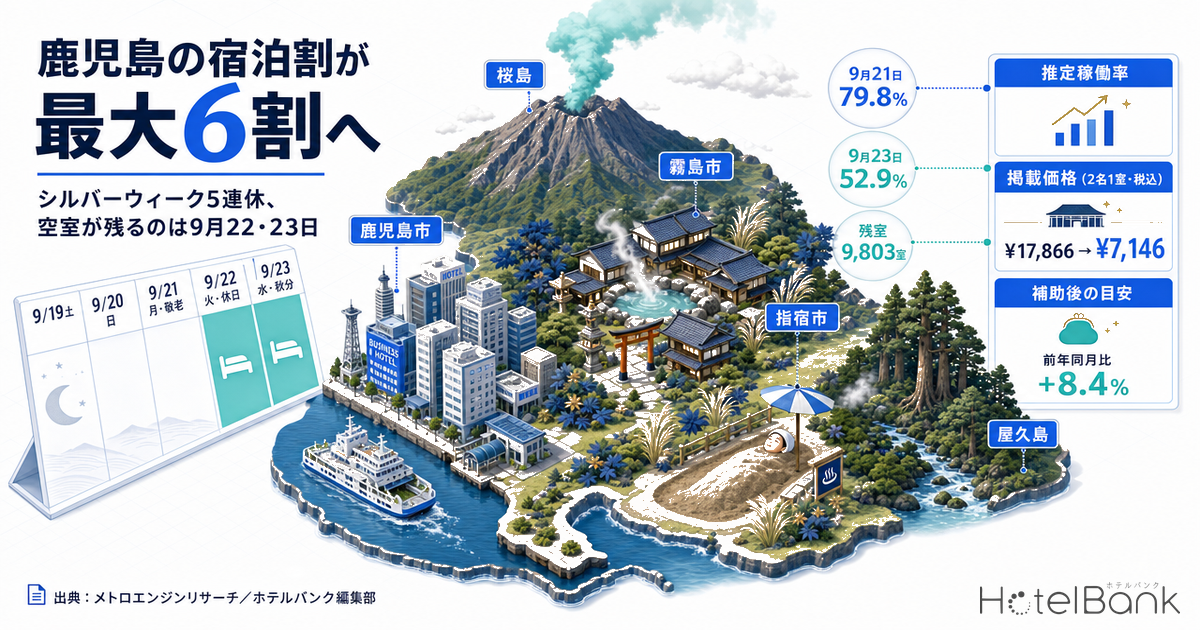
Kagoshima Prefecture is moving to launch its own lodging discount programme that subsidises up to 60% of accommodation costs within the prefecture. While the national “Kyushu Fukko Ouenwari” (九州ふっこう応援割) recovery subsidy starts with stays from October 1, the prefecture’s own scheme is intended to be in place in time for Silver Week 2026 (the five-day run of holidays from September 19 to 23). This article sets out what is being decided, then reads the actual lodging inventory and listed prices across Kagoshima to answer two traveller-side questions: which days of the five-day break are still bookable, and what a 60% subsidy would actually mean in yen.
Metric Definitions Used in This Article
- Listed price: the average of the selling prices each property publishes on hotel booking sites. Per-room rate for two guests sharing one room (tax included), averaged across all plans (room-only through meal-inclusive). This differs from the price actually transacted.
- ADR (average daily rate): an estimated transacted rate (tax-excluded equivalent) calculated by applying a property-type correction factor to the cheapest plan level each property publishes. Cross-checked against per-property results disclosed by listed hotel REITs (91 properties, most recent three months), the median error is about 7%. This is an estimate and differs from actual transacted prices and accounting figures. Area-level ADR is the median of the properties covered.
- Occupancy (OCC): the share of sold rooms against total rooms in an area (an estimate based on inventory offered for sale on hotel booking sites). This differs from a property’s true operating occupancy. It is used only as a macro aggregate at prefecture and property-type level, never for an individual property.
- LT (lead time): days until the check-in date. LT0 = same day.
- Data source: MetroEngines Research
- — The prefecture’s own lodging discount is being arranged at up to 60%, timed to land before Silver Week. It is included in the supplementary budget proposal announced on September 2 and is due to go before the prefectural assembly that opens on September 11. The subsidy rate, per-person cap and eligible period are not yet fixed.
- — The rooms left over the five-day break are on September 22 and 23. September 23 shows an estimated occupancy of 52.9% with 9,803 rooms unsold (as of August 31, 2026), and listed prices more than 30% below the opening day of the break. The peak is September 21 at 79.8%.
- — Ryokan are all but full in the first half. September 20 leaves 60 rooms out of 1,786, and September 21 leaves 84 out of 1,786. September 23, by contrast, loosens to 707 out of 1,789. The difficulty flips completely depending on property type.
- — How much “60%” is worth depends on the cap. At a ¥20,000 cap the ceiling barely binds at Kagoshima’s price levels, but at the same ¥5,000 per person as the previous round the effective discount rate falls to 56.0% prefecture-wide and to 30.7% in Kirishima City.
- — Among Kyushu’s seven prefectures, Kagoshima leaves the lightest post-subsidy bill — roughly ¥7,100 for two guests in one room. That is the combined result of the 60% rate and an already low listed price of ¥17,866 (+8.4% year on year).
What is being decided — the prefecture moving in ahead of the national October start
Following the 2026 Kumamoto Earthquake (令和8年熊本地震) of July 28, 2026, lodging cancellations ran across Kyushu. In Kagoshima alone, cancellations totalling more than 110,000 guest-nights had accumulated by August 7, and the impact on tourism has widened (reported by Kagoshima Television). The demand drop spread even to prefectures outside the centre of the damage.
In response, the Japan Tourism Agency announced the “Kyushu Fukko Ouenwari” travel demand stimulus covering Kyushu’s seven prefectures, starting with stays from October 1. The subsidy rate is 50% as a rule, with Kumamoto and Kagoshima at 60%. The per-person, per-night discount cap is ¥20,000 for lodging only or a one-night package including transport, ¥30,000 for a transport-inclusive stay of two nights or more, and ¥35,000 for multi-prefecture tour itineraries covering two or more prefectures.
The national scheme, however, only starts moving in October. It does not arrive in time for Silver Week, a period that is an even bigger earner than an ordinary September three-day weekend. Kagoshima Prefecture has therefore entered discussions to run its own lodging subsidy at the same maximum 60% as a bridge until the national support begins. The plan is to start it in time for Silver Week, when tourism demand rises, and to keep it running without a gap until the national scheme takes over. The prefecture’s own subsidy is included in the supplementary budget proposal announced on September 2 and is due to be put to the prefectural assembly that opens on September 11.
A note for readers: as of the time of writing (September 1, 2026), the prefecture’s own scheme is still at the “under arrangement” stage. The subsidy rate, per-person cap, eligible period and booking start date will be formally set once the supplementary budget proposal is passed by the prefectural assembly. Before booking, always check the official announcements from Kagoshima Prefecture and from each booking channel.
For reference, the “Minami no Takarabako Kagoshima Summer Lodging Discount Campaign” (南の宝箱 鹿児島 夏のかごしま宿泊割キャンペーン) that Kagoshima ran from May 6 to July 31, 2026 offered a discount of up to 20% with a cap of ¥5,000 per person per night (¥8,000 for stays on the remote islands). The level now under consideration triples the subsidy rate and raises the cap substantially. Even under the same label of “lodging discount,” what it delivers to a traveller is a completely different proposition.
| Scheme | Subsidy rate | Cap per person per night | Eligible period |
|---|---|---|---|
| Summer Kagoshima Lodging Discount (ended) | Up to 20% | ¥5,000 (¥8,000 for remote islands) | 2026/5/6–7/31 |
| Kagoshima Prefecture’s own lodging discount (under arrangement) | Heading for up to 60% | Not yet announced | From a date in time for Silver Week until the national scheme starts |
| Kyushu Fukko Ouenwari (national) | 60% for Kagoshima and Kumamoto / 50% for the other five prefectures | ¥20,000 (¥30,000 for transport-inclusive stays of two nights or more / ¥35,000 for tour itineraries) | Stays from 2026/10/1 (start date set by each prefecture) |
Source: Japan Tourism Agency “2026 Kumamoto Earthquake related information,” Kagoshima Prefecture tourism campaign official site, and reporting by Kagoshima Television and Minami-Nippon Broadcasting; compiled by the HotelBank Editorial Team
Silver Week 2026 runs five days — Saturday September 19 through Wednesday September 23
Silver Week is drawing attention this year because the calendar falls well. Monday September 21 is Respect for the Aged Day and Wednesday September 23 is Autumn Equinox Day. Because Tuesday September 22 sits between them, it becomes a Citizens’ Holiday, giving five consecutive days off from Saturday September 19 through Wednesday September 23. In most years weekends and public holidays are split apart, so a five-day run is a rare window for a proper trip.
From a traveller’s point of view, however, the five days are not uniform. Looking at estimated occupancy by date across 530 properties and roughly 20,700 rooms in Kagoshima, derived from inventory offered for sale on hotel booking sites, the picture changes sharply between the first and second halves. The figures below are observations as of August 31 (LT12–33 for the respective dates).
Source: MetroEngines Research; compiled by the HotelBank Editorial Team (Kagoshima N=530 properties, 501 observed, as of August 31, 2026)
| Check-in date | Category | Estimated occupancy | Unsold rooms / total rooms | Listed price (2 guests, 1 room, tax incl.) |
|---|---|---|---|---|
| Sat September 12 | Ordinary Saturday (reference) | 70.8% | 6,067 / 20,811 | ¥21,972 |
| Sat September 19 | First day of the break | 71.8% | 5,870 / 20,789 | ¥29,209 |
| Sun September 20 | Day two | 78.0% | 4,526 / 20,570 | ¥26,845 |
| Mon September 21 | Respect for the Aged Day | 79.8% | 4,189 / 20,776 | ¥28,154 |
| Tue September 22 | Citizens’ Holiday | 68.5% | 6,535 / 20,737 | ¥24,013 |
| Wed September 23 | Autumn Equinox Day, final day | 52.9% | 9,803 / 20,794 | ¥19,864 |
| Sat October 3 | After the national scheme starts (reference) | 62.9% | 7,671 / 20,662 | ¥22,303 |
Source: MetroEngines Research; compiled by the HotelBank Editorial Team (observed as of August 31, 2026. Occupancy is an estimate based on inventory offered for sale on hotel booking sites)
The peak of the break is Monday September 21, Respect for the Aged Day, at an estimated 79.8%, followed by Sunday September 20 at 78.0%. The final day, Wednesday September 23 (Autumn Equinox Day), stops at 52.9%, leaving roughly 9,800 rooms unsold across the prefecture — nearly 18 points below an ordinary Saturday such as September 12 (70.8%). Listed prices follow: about ¥29,200 on September 19 against about ¥19,900 on September 23, more than 30% cheaper.
In other words, the back half of the break — Tuesday September 22 and Wednesday September 23 in particular — is where a traveller still has real choice. If a subsidy of up to 60% lands on top of that, the terms are very good indeed. Conversely, if September 20 or 21 is the target, there is a case for locking a room in before waiting for the formal announcement. Booking pace over the two back-half days has barely moved since the 47-days-out mark; that fixed-point tracking is followed in detail in Silver Week 2026 Back Half at T-47: Sep 23 Matches a Normal Wednesday.
Ryokan are near-full on Sep 20–21 while 40% sits empty on Sep 23 — the property types invert
Even within the same five days, the difficulty depends entirely on the type of accommodation you want. Splitting Kagoshima’s ryokan (76–77 properties, about 1,790 rooms) from its business hotels (141–142 properties, about 12,500–12,800 rooms) makes the gap obvious.
Source: MetroEngines Research; compiled by the HotelBank Editorial Team (ryokan N=76–77 properties / 1,786–1,789 rooms, business hotels N=141–142 properties / 12,530–12,761 rooms, as of August 31, 2026)
Ryokan show 60 unsold rooms out of 1,786 on Sunday September 20 (estimated occupancy 96.6%) and 84 out of 1,786 on Monday September 21 (95.3%). That is a double-digit room count for the entire prefecture — for anyone set on an onsen ryokan, there is effectively almost nothing left to choose from. Listed prices reflect it: about ¥45,500 for two guests in one room on September 21, a high level by Kagoshima ryokan standards.
The same ryokan segment, however, loosens sharply on Wednesday September 23, with 707 unsold rooms out of 1,789 (estimated occupancy 60.5%) as of August 31, 2026. The listed price of about ¥31,100 is roughly ¥14,400 below September 21. The obvious structural fact that fewer people stay on the final day of a break, because it is the day they travel home, converts directly into a traveller’s opportunity.
Business hotels have even more slack. September 23 shows 7,153 unsold rooms out of 12,761 (estimated occupancy 43.9%) as of August 31, 2026, with a listed price of about ¥9,400 for two guests in one room. For a trip based in Kagoshima City with day trips out to Sakurajima or Ibusuki, the cost can be held well down.
What 60% actually buys — the ¥20,000 cap barely binds at Kagoshima’s price levels
Applying the national Kyushu Fukko Ouenwari design as it stands (60% for Kagoshima, ¥20,000 per person per night) gives a working estimate of the out-of-pocket cost. The prefecture’s own cap has not been announced, so this is a guide based on the national scheme.
The first thing to understand is when the cap actually bites. Because it is set at ¥20,000 per person per night, two guests sharing a room are allowed a combined discount of up to ¥40,000 per room. Turned around, unless the room rate exceeds roughly ¥66,700 — the level at which two people’s discounts reach the cap — the full 60% applies. Listed prices in Kagoshima for September 2026 run about ¥17,900 per room for two guests prefecture-wide, and about ¥32,600 even in Kirishima City, the most expensive area, so in the great majority of cases the cap is never reached. The price band at which this cap starts to bite is set out in Kyushu Recovery Subsidy Set: 60%/50% Split, ¥20,000 Cap Hits Top 10%.
Source: MetroEngines Research; compiled by the HotelBank Editorial Team (September 2026 listed prices. Post-subsidy guide figures apply the national scheme’s 60% rate mechanically)
| Area | Listed price (2 guests, 1 room, tax incl.) | Guide figure after 60% subsidy | Guide discount amount | Properties covered |
|---|---|---|---|---|
| Kirishima City (Kirishima Onsen-kyo and others) | ¥32,594 | ¥13,038 | ¥19,556 | 91 |
| Ibusuki City (Ibusuki Onsen) | ¥27,534 | ¥11,014 | ¥16,520 | 34 |
| Amami City (Amami Oshima) | ¥25,685 | ¥10,274 | ¥15,411 | 77 |
| Yakushima Town | ¥16,759 | ¥6,704 | ¥10,055 | 102 |
| Kagoshima City | ¥15,178 | ¥6,071 | ¥9,107 | 112 |
| Satsumasendai City | ¥13,578 | ¥5,431 | ¥8,147 | 27 |
| Kanoya City | ¥13,295 | ¥5,318 | ¥7,977 | 24 |
| Kagoshima overall | ¥17,866 | ¥7,146 | ¥10,720 | — |
Source: MetroEngines Research; compiled by the HotelBank Editorial Team (September 2026 listed prices. Post-subsidy amounts apply a 60% rate mechanically and are estimates; actual eligibility, caps and qualifying plans depend on each scheme’s requirements)
The largest yen impact lands in the high-rate onsen areas. Kirishima City would theoretically save about ¥19,600 a night, Ibusuki City about ¥16,500. In the Kagoshima City business hotel band the discount itself is smaller at about ¥9,100, but the fall in what you actually pay — down to roughly ¥6,100 for two guests in one room — is substantial. At this subsidy rate, “staying one grade above your usual budget” becomes a realistic option.
That said, this estimate simply applies the national scheme’s ¥20,000 per person per night cap. The prefecture’s own cap has not been announced, and the immediately preceding Summer Kagoshima Lodging Discount was set at ¥5,000 per person per night. Where the cap lands changes the take-home discount considerably, even at the same headline “up to 60%.” The table below varies both the subsidy rate and the per-person per-night cap to show how the bill for two guests in one room moves.
| Subject | Subsidy rate | ¥5,000 cap | ¥10,000 cap | ¥20,000 cap (national scheme) |
|---|---|---|---|---|
| Kagoshima overall (¥17,866) | 20% (summer actual) | ¥14,293 | ¥14,293 | ¥14,293 |
| 50% (five Kyushu prefectures) | ¥8,933 | ¥8,933 | ¥8,933 | |
| 60% (Kagoshima and Kumamoto) | ¥7,866* | ¥7,146 | ¥7,146 | |
| Kirishima City (¥32,594) | 20% (summer actual) | ¥26,075 | ¥26,075 | ¥26,075 |
| 50% (five Kyushu prefectures) | ¥22,594* | ¥16,297 | ¥16,297 | |
| 60% (Kagoshima and Kumamoto) | ¥22,594* | ¥13,038 | ¥13,038 |
Source: MetroEngines Research; compiled by the HotelBank Editorial Team (subsidy rates and caps applied mechanically to September 2026 listed prices. Because the cap is per person per night, it is assumed that up to double the cap applies to two guests in one room. Actual eligibility and qualifying plans depend on each scheme’s requirements)
What this shows is that where the cap is set changes what “60%” means. If the cap matches the national scheme’s ¥20,000, it barely binds at Kagoshima’s price levels and the full 60% comes through. If instead it is held at ¥5,000 per person as in the previous round, the cap binds first even at the prefecture-wide average price, pulling the effective discount rate down to 56.0%, and to 30.7% in a high-rate area such as Kirishima City. The more you are aiming at an onsen ryokan, the more it matters to wait for the cap announcement rather than the subsidy rate.
Kagoshima’s room rates are up 8.4% year on year — the pre-subsidy base has already risen
Before discussing the subsidy, the underlying price level is worth checking. Tracking Kagoshima’s listed prices by month, September 2026 comes to about ¥17,900 per room for two guests, +8.4% against the same month last year (about ¥16,500). Against September 2024 (about ¥15,700) it is +13.9%.
Source: MetroEngines Research; compiled by the HotelBank Editorial Team (Kagoshima, monthly trend in listed prices. Figures from August 2026 onward are estimates based on listed levels at the time of observation)
The seasonal peak is August, with September and October only slightly below it. Across the year Kagoshima is cheapest in June (about ¥16,000), rising gently into the autumn. Year on year, the price band is steadily stepping up — worth keeping in mind that the subsidy is a discount applied to an already elevated level.
Across Kyushu’s seven prefectures, Kagoshima pairs a 60% rate with low room rates
Under Kyushu Fukko Ouenwari, Kumamoto and Kagoshima get 60% and the other five prefectures 50%. Overlaying each prefecture’s lodging price level reveals the structure of where the value actually sits for a traveller.
| Prefecture | Subsidy rate | September 2026 listed price | Year on year | Guide figure after subsidy |
|---|---|---|---|---|
| Kagoshima | 60% | ¥17,866 | +8.4% | ¥7,146 |
| Kumamoto | 60% | ¥25,961 | +7.5% | ¥10,384 |
| Miyazaki | 50% | ¥17,391 | +19.8% | ¥8,696 |
| Nagasaki | 50% | ¥19,550 | +5.4% | ¥9,775 |
| Fukuoka | 50% | ¥24,397 | +10.0% | ¥12,199 |
| Saga | 50% | ¥28,896 | +8.7% | ¥14,448 |
| Oita | 50% | ¥34,277 | +12.5% | ¥17,139 |
Source: MetroEngines Research; compiled by the HotelBank Editorial Team (September 2026 listed prices, two guests in one room, tax included. Subsidy rates follow the Kyushu Fukko Ouenwari design published by the Japan Tourism Agency. Post-subsidy amounts are mechanical estimates)
Applying the subsidy rates mechanically to listed prices, the lightest post-subsidy bill among Kyushu’s seven prefectures is Kagoshima’s, at roughly ¥7,100 for two guests in one room, followed by Miyazaki (about ¥8,700) and Nagasaki (about ¥9,800). That is the combined effect of a relatively restrained underlying room rate and a 60% subsidy. Oita, rich in onsen ryokan, sits at a 50% rate on top of high room rates, so it still comes to about ¥17,100 after the subsidy. How this 10-point scheme difference bites the moment you cross a prefectural border is covered in Kyushu Subsidy: 10pt Border Step Cuts Kurokawa-Yufuin Gap to ¥665.
Properties rated highly for food — what guest reviews say about Kagoshima’s value in staying
Price alone cannot choose a property. In guest reviews across Kagoshima compiled by the HotelBank Editorial Team (most recent 24 months; food category, N=156 properties, 13,696 reviews), the median food rating in the prefecture is 4.44 out of 5 — high even by national standards. Kurobuta pork, kibinago sardines, keihan chicken rice, jidori free-range chicken and shochu: the depth of the region’s food resources shows up in the numbers.
The properties rated most highly for food are as follows (those with 30 or more reviews each).
| Property | Area | Food rating | Reviews |
|---|---|---|---|
| Bettei Amafuru Oka (別邸 天降る丘) | Ibusuki City | 4.97 | 107 |
| Anraku Onsen Shuho (安楽温泉 朱峰) | Kirishima City | 4.97 | 34 |
| Minshuku Takayoshi (民宿たかよし) | Ibusuki City | 4.95 | 94 |
| D+kirishima | Kirishima City | 4.95 | 38 |
| Kirishima Shikisai no Sato Manyu (霧島四季彩の郷 万遊) | Kirishima City | 4.95 | 37 |
| Tsukimiso (月見荘) | Ibusuki City | 4.91 | 54 |
| samana hotel Yakushima | Yakushima Town | 4.89 | 126 |
| sankara hotel & spa Yakushima (屋久島) | Yakushima Town | 4.88 | 98 |
| Tori Asobu Mori no Yado Futarishizuka (鳥遊ぶ森の宿 ふたり静) | Kirishima City | 4.87 | 31 |
| HOTEL&RESIDENCE Nanshukan (南洲館) | Kagoshima City | 4.84 | 146 |
Source: HotelBank Editorial Team research (guest reviews over the most recent 24 months, 30 or more reviews per property, Kagoshima N=156 properties, 13,696 reviews)
The top of the list is dominated by small properties in onsen and nature areas such as Ibusuki, Kirishima and Yakushima. These are already filling up for the first half of the five-day break, but September 22 and 23, or October onward, remain well within reach. Kagoshima also carries a high premium on breakfast: comparing room-only and breakfast-inclusive plans within the same hotel, business hotels in Kagoshima City show an average uplift of +17.5% for adding breakfast (about +¥2,400 per room for two guests; August 2026, paired comparison across 33 properties) — a sign of how many properties put real effort into the morning meal.
Five things to check before you book
| Check | Detail |
|---|---|
| 1. The scheme is not yet fixed | The prefecture’s own measure is included in the supplementary budget proposal announced on September 2 and is due before the prefectural assembly opening September 11. The subsidy rate, cap, eligible period and booking start date all await official announcement. |
| 2. Business trips and day trips are excluded | The national Kyushu Fukko Ouenwari excludes stays for business purposes (work travel and corporate use) as well as day trips that do not involve an overnight stay. Publicly funded business travel was also excluded under past prefectural campaigns. |
| 3. It can end early once the budget runs out | Campaigns of this kind end as soon as the budget ceiling is reached. The same proviso applied to the 2026 summer campaign. A last-minute rush just before the break may not make it in time. |
| 4. Start dates differ by booking channel | These schemes are normally handled through direct bookings with the property, travel agencies and hotel booking sites alike, but the timing of when sales open differs by channel. Past prefectural campaigns also opened channel by channel. |
| 5. Existing bookings are generally excluded | Past campaigns stated explicitly that applications made before the booking and sales start date were not eligible. The same may apply this time, so check with each channel whether you need to rebook. |
Source: Japan Tourism Agency “2026 Kumamoto Earthquake related information” and the Kagoshima Prefecture tourism campaign official site; compiled by the HotelBank Editorial Team
Conclusion — lock in Sep 20–21 now, or bet on Sep 22–23 and October
In short, a traveller’s decision splits two ways.
The first is targeting the first half of the break, September 19 to 21. Ryokan are down to 60 unsold rooms out of 1,786 on September 20 and 84 out of 1,786 on September 21 — squeezed to double digits across the whole prefecture. Waiting for the formal announcement risks there being no room left to stay in at all. If these dates are the priority, the realistic move is to secure the room first and confirm eligibility for the subsidy with the booking channel afterwards.
The second is shifting to the back half (September 22 and 23) or to October onward. September 23 shows an estimated occupancy of 52.9% prefecture-wide (as of August 31, 2026) with 9,803 unsold rooms, and ryokan still hold 707 out of 1,789. Listed prices sit roughly 30% below the opening day of the break. Add a subsidy of up to 60% on top and the terms are in a different league from the first half. From October 1 the national Kyushu Fukko Ouenwari also comes fully into force, so the more flexible your dates, the more there is to gain from pushing them back.
The starting point for all of this is the drop in tourism demand across Kyushu after the 2026 Kumamoto Earthquake. Kagoshima was not directly hit, yet cancellations still reached more than 110,000 guest-nights. Waiting for the formal announcement while settling the destination and the dates first — that is the most practical preparation available ahead of this five-day break.
A note on prices for future dates: the September and October 2026 listed prices and occupancy figures in this article are estimates based on the inventory and selling prices published on hotel booking sites at the time of the survey (August 31 to September 1, 2026). They move as the check-in date approaches, through new plans being added, price adjustments, and inventory returning from cancellations. Post-subsidy amounts also apply each scheme’s subsidy rate mechanically; actual eligibility, caps and qualifying plans depend on each scheme’s requirements.
Frequently Asked Questions
When will Kagoshima Prefecture’s own lodging discount begin?
As of the time of writing (September 1, 2026) it is still “under arrangement.” The prefecture intends to start it in time for Silver Week 2026 (September 19 to 23) and to continue it without a gap until the national Kyushu Fukko Ouenwari begins on October 1. The measure is included in the supplementary budget proposal announced on September 2 and is due before the prefectural assembly that opens on September 11. For the start date and the booking start date, check the official announcements from the prefecture and from each booking channel.
With a subsidy of up to 60%, what will I actually pay?
The listed price for Kagoshima overall is ¥17,866 per room for two guests (tax included) for stays in September 2026. Applying the national scheme’s 60% rate and ¥20,000 per person per night cap mechanically brings the payment to about ¥7,146. However, the prefecture’s own cap has not been announced; at the same ¥5,000 per person as the previous Summer Kagoshima Lodging Discount, the payment would be about ¥7,866 and the effective discount rate only 56.0%. In a high-rate area such as Kirishima City the gap widens further.
Can I still get a room in Kagoshima over Silver Week?
It depends heavily on the date. As estimated on August 31, 2026, Monday September 21 (Respect for the Aged Day) runs at 79.8% estimated occupancy and Sunday September 20 at 78.0%, while Wednesday September 23 (Autumn Equinox Day) sits at 52.9% with roughly 9,803 rooms left across the prefecture. Narrowing to onsen ryokan, September 20 is down to 60 unsold rooms out of 1,786 — so if the first half is your target, the practical move is to secure a room without waiting for the formal announcement.
How does this differ from the national “Kyushu Fukko Ouenwari”?
The national Kyushu Fukko Ouenwari covers stays from October 1, 2026, with subsidy rates of 60% for Kumamoto and Kagoshima and 50% for the other five prefectures, and a per-person per-night discount cap of ¥20,000 for lodging only or a one-night transport-inclusive package. The prefecture’s own lodging discount is a bridge until that national scheme starts, run by Kagoshima alone at a timing that reaches Silver Week. Its subsidy rate is reported to be heading for the same maximum 60%, but the cap and eligible period have not been announced.
Do existing bookings or business trips qualify for the discount?
Past prefectural campaigns stated explicitly that applications made before the booking and sales start date were not eligible, and the same may apply this time; check with each channel whether rebooking is needed. The national Kyushu Fukko Ouenwari also excludes stays for business purposes (work travel and corporate use) and day trips without an overnight stay. Publicly funded business travel was excluded under past prefectural campaigns as well.
Related Reading
- Kyushu Fukko Ouenwari: 60% Off in Kumamoto, Kagoshima, ¥20,000 Cap
- Kagoshima’s Capital Is Its Cheapest: ADR ¥6,819 vs Kirishima ¥14,330
- Kagoshima Summer Booking Curves: 23.2pt Gap by Type at 45 Days Out
- Silver Week 2026 Back Half at T-47: Sep 23 Matches a Normal Wednesday
- Kyushu Subsidy: Kumamoto & Kagoshima Hold 34.9% of Oct Unsold Rooms
- Kyushu Recovery Subsidy Set: 60%/50% Split, ¥20,000 Cap Hits Top 10%
- Kyushu Subsidy: 10pt Border Step Cuts Kurokawa-Yufuin Gap to ¥665
- Kyushu Subsidy Starts Oct 1 in 7 Prefectures: Nov Pickup Level with Oct
References and Sources
Primary news coverage
- Kagoshima Prefecture to run its own lodging discount, subsidising up to 60%, starting in time for Silver Week (Kagoshima Television / FNN Prime Online, September 1, 2026)
- Video report of the same story (FNN Prime Online official channel, published September 1, 2026)
- “Up to 60% of lodging costs subsidised”: Kagoshima Prefecture’s own lodging discount being arranged for a start within the month (Minami-Nippon Broadcasting, September 1, 2026)
Government and official sites
- Japan Tourism Agency, “2026 Kumamoto Earthquake related information” (includes details of Kyushu Fukko Ouenwari)
- Kagoshima Prefecture tourism campaign, “Minami no Takarabako Kagoshima Summer Lodging Discount” official site
Market data
- MetroEngines Research — monthly trend in listed prices (Kagoshima, Kyushu’s seven prefectures, municipalities within the prefecture), estimated occupancy based on inventory offered for sale on hotel booking sites, booking curves by property type, and paired comparison of the meal premium
- HotelBank Editorial Team research — aggregation of guest reviews (Kagoshima N=156 properties, 13,696 reviews, most recent 24 months, food category)