

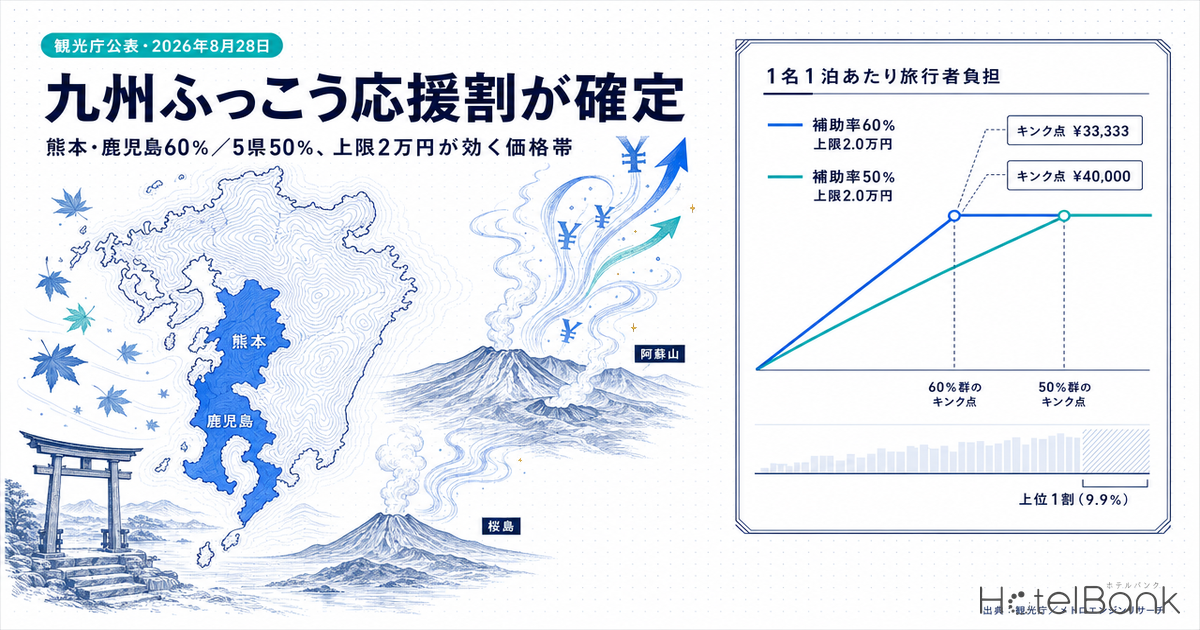
On August 28, 2026, the Japan Tourism Agency published the design of the “Kyushu Fukko Ouenwari” (Kyushu Recovery Support Discount), a travel demand stimulus introduced in response to the 2026 Kumamoto Earthquake. The subsidy rate is 50% of the travel or accommodation price (per person, per night), rising to 60% in Kumamoto and Kagoshima, where cancellations have caused the greatest damage. The cap is ¥20,000 for accommodation-only products and for one-night transport-inclusive packages, ¥30,000 for transport-inclusive packages of two nights or more, and ¥35,000 for multi-prefecture itineraries covering stays in two or more prefectures. The discount applies to stays from Thursday, October 1, 2026.
This article is a follow-up to our earlier piece, which estimated net rates from the design of past subsidy programmes before the scheme was announced. Because the subsidy rate, the cap, the eligible area and the start date — all undetermined at that point — have now been published, we replace every assumed value with the confirmed one, and re-examine which price bands the cap actually binds in and what hotels should prepare, using real market rates across Kyushu’s seven prefectures and October inventory sell-through.
A companion piece looks at the same announcement from a different angle: Kyushu Subsidy: 10pt Border Step Cuts Kurokawa-Yufuin Gap to ¥665 examines the net-rate gap between hot-spring areas that face each other across a prefectural border. This article focuses on the scheme design itself and on hotel-side preparation.
Basis of this article (as of August 28, 2026)
- The subsidy rate, cap, eligible area and start date are the confirmed contents stated in the Japan Tourism Agency’s published “Kyushu Fukko Ouenwari” materials.
- The booking start date, the end of the eligible period, whether regional coupons are included, and the exclusion conditions remain unpublished. The Agency’s materials do not state them; the specifics are left to each prefecture in the Kyushu region.
- The overall support package is ¥147.8bn from the FY2026 contingency reserve (Cabinet decision of August 28, 2026). The budget for the Kyushu Fukko Ouenwari alone has not been published.
- The net-rate and cap-reach estimates in this article apply the published subsidy rate and cap to our own price data; treatment may differ under each prefecture’s implementation guidelines.
Metric Definitions Used in This Article
- ADR (estimated settled ADR): an estimated settled rate (tax-excluded equivalent) derived by applying category-specific adjustment factors to the lowest published plan rate each property lists on OTAs and other channels (two guests per room, per-room rate, tax included). Cross-checked against property-level results disclosed by listed hotel REITs (91 properties, most recent three months), the median error is about 7%. It is an estimate and differs from each property’s actual transacted rates or accounting figures. Area-level ADR is the median of the properties covered (the level of a typical property in the area).
- Listed price (all-plan average, tax included): the average selling price each property publishes on OTAs and other channels (two guests per room, per-room rate, covering room-only through meal-inclusive plans). Because the subsidy cap applies to the tax-included travel price the traveller actually pays, cap-reach is judged against this listed price rather than against ADR (the estimated settled, tax-excluded-equivalent rate).
- Per person-night conversion: because the subsidy rate is defined per person per night, a reference value obtained by dividing the per-room rate by two, assuming two guests per room. Accommodation only; transport is not included.
- OCC (occupancy): sold rooms as a share of total rooms in the area (an estimate based on OTA sales inventory).
- Kink point: the price at which the discount amount reaches the cap and the effective discount rate begins to fall below the headline subsidy rate. Calculated as cap ÷ subsidy rate.
- Data sources: MetroEngines Research / Japan Tourism Agency, published “Kyushu Fukko Ouenwari” materials
- — The kink point for the ¥20,000 cap is ¥33,333 per person-night in the 60% group and ¥40,000 in the 50% group. On a two-guests-per-room basis that is ¥66,667 and ¥80,000 per room.
- — Listed prices for October check-ins across Kyushu’s seven prefectures (two guests per room, tax included, all-plan average) have a median of ¥25,100, N=4,076 properties. Only the top 10% (9.9%) reach the cap; for the other 90% the subsidy rate passes straight through as the effective discount rate.
- — The share of properties where the cap starts to bind is highest in Oita at 16.3% and lowest in Miyazaki at 5.4%. The cap’s effect is concentrated in prefectures with a thick base of hot-spring ryokan.
- — The 10-point gap between 60% and 50% means a 50% property must cut its price by 20% for the traveller’s out-of-pocket cost to match. Relative pricing across prefectural borders shifts structurally.
- — October sell-through varies by prefecture. Estimated occupancy for Saturday, October 10 is 84.9% in Saga against 61.5% in Kagoshima. The prefecture with the highest subsidy rate has the most slack left.
The confirmed design — what differs from our earlier assumptions
Our earlier article applied the design of the past Kyushu Fukko Wari, prefectural residents’ discounts and the National Travel Support programme, and estimated a cap of ¥5,000–¥8,000 per person-night. The confirmed cap is ¥20,000 per night — 2.5 to 4 times the level we had assumed. That difference materially changes what the scheme means for hotels.
| Item | Treatment in the earlier article (as of August 20, 2026) | Confirmed contents (published August 28, 2026) |
|---|---|---|
| Name | “Kyushu Ouenwari” (provisional name used in press reports) | Kyushu Fukko Ouenwari |
| Subsidy rate | Undetermined (20–70% assumed from past schemes) | 50% (per person-night); 60% in Kumamoto and Kagoshima |
| Cap | Undetermined (¥5,000–¥8,000 per person-night assumed) | ¥20,000 for accommodation-only and one-night transport-inclusive; ¥30,000 for transport-inclusive of two nights or more; ¥35,000 for multi-prefecture itineraries (two or more prefectures) |
| Eligible area | Unclear whether Kumamoto only or all seven Kyushu prefectures | The Kyushu region (Kumamoto and Kagoshima at the higher rate; Fukuoka, Saga, Nagasaki, Oita and Miyazaki at the standard rate) |
| Start date | Undetermined | Stays from Thursday, October 1, 2026 |
| Sales channels | Undetermined | Travel agents, accommodation operators and online booking sites (each prefecture funds the discount differential) |
| Booking start date | Undetermined | Still unpublished (set by each prefecture) |
| End of eligible period | Undetermined | Still unpublished |
| Regional coupons | Undetermined | Not stated in the published materials |
Source: compiled by the HotelBank Editorial Team from the Japan Tourism Agency’s published “Kyushu Fukko Ouenwari” materials and from the earlier article.
The delivery scheme has also been published. The national government grants funds to each prefecture in the Kyushu region; each prefecture funds the discount differential for travel agents, accommodation operators and online booking sites; and those operators sell to travellers at the discounted price — a three-tier structure. Because a route in which accommodation operators receive support directly is explicitly set out, the design allows for direct sales on a hotel’s own website to be eligible, which makes it an important point to confirm when designing plans. How far each prefecture actually extends eligibility, however, awaits the implementation guidelines.
The ¥20,000 cap kinks at ¥33,333 and ¥40,000 per person-night
In practice the first thing to pin down under any subsidy scheme is the price at which the discount amount tops out at the cap — the kink point. It is simply the cap divided by the subsidy rate. For the 60% group (Kumamoto and Kagoshima) that is ¥33,333 per person-night; for the 50% group (the other five prefectures) it is ¥40,000. On a two-guests-per-room basis, ¥66,667 and ¥80,000 per room.
Above those levels the headline subsidy rate becomes nominal. A plan at ¥60,000 per person-night, for example, receives a flat ¥20,000 discount in both the 60% and the 50% group, so the effective discount rate falls to 33.3%. Put the other way round, below the kink point the difference in subsidy rate translates directly into a difference in what the traveller pays.
Source: charted by the HotelBank Editorial Team from the subsidy rate and cap in the Japan Tourism Agency’s published “Kyushu Fukko Ouenwari” materials.
| Travel price per person-night | 60% group (Kumamoto, Kagoshima) discount | Traveller cost | Effective discount rate | 50% group (5 prefectures) discount | Traveller cost | Effective discount rate |
|---|---|---|---|---|---|---|
| ¥3,300 Kagoshima level | ¥1,980 | ¥1,320 | 60.0% | ¥1,650 | ¥1,650 | 50.0% |
| ¥4,600 Kumamoto level | ¥2,760 | ¥1,840 | 60.0% | ¥2,300 | ¥2,300 | 50.0% |
| ¥5,400 Fukuoka level | ¥3,240 | ¥2,160 | 60.0% | ¥2,700 | ¥2,700 | 50.0% |
| ¥6,300 Oita level | ¥3,780 | ¥2,520 | 60.0% | ¥3,150 | ¥3,150 | 50.0% |
| ¥10,000 | ¥6,000 | ¥4,000 | 60.0% | ¥5,000 | ¥5,000 | 50.0% |
| ¥20,000 | ¥12,000 | ¥8,000 | 60.0% | ¥10,000 | ¥10,000 | 50.0% |
| ¥33,333 kink point, 60% group | ¥19,999 | ¥13,333 | 60.0% | ¥16,666 | ¥16,666 | 50.0% |
| ¥40,000 kink point, 50% group | ▲ ¥20,000 | ¥20,000 | 50.0% | ▲ ¥20,000 | ¥20,000 | 50.0% |
| ¥60,000 | ▲ ¥20,000 | ¥40,000 | 33.3% | ▲ ¥20,000 | ¥40,000 | 33.3% |
Source: estimated by the HotelBank Editorial Team from the subsidy rate and cap (accommodation-only product, one night) in the Japan Tourism Agency’s published “Kyushu Fukko Ouenwari” materials. The price bands in each row correspond to the per person-night conversion of each prefecture’s estimated settled ADR (July 2026, N=2,232 properties). ▲ marks cells where the cap has been reached. Regional coupons are not included.
In the upper half of the table — the standard rate band across the seven Kyushu prefectures, ¥3,300 to ¥6,300 per person-night — neither the 60% nor the 50% group comes anywhere near the cap. In that band the subsidy rate is the effective discount rate. Our earlier article assumed a cap of ¥5,000–¥8,000 and concluded that “the cap is largely irrelevant to Kyushu’s price band”; the confirmed ¥20,000 is far above even that assumption, so the accurate reading is that the direction of the conclusion is unchanged while the margin of headroom is far wider.
The cap binds only the top 10% — October price distribution across 4,076 Kyushu properties
So how many properties actually reach the cap? We took every property selling October 1–31, 2026 check-ins across the seven Kyushu prefectures, computed each property’s monthly average listed price (two guests per room, tax included, all-plan average), and looked at the distribution. The population is N=4,076 properties (those observed on sale for five or more days within the month).
Source: MetroEngines Research; compiled by the HotelBank Editorial Team (October 1–31, 2026 check-ins, N=4,076 properties).
The median is ¥25,100, the 90th percentile ¥66,300 and the 95th percentile ¥84,200. Properties reaching the 60% group’s kink point of ¥66,667 number 405, or 9.9%; those reaching the 50% group’s ¥80,000 number 235, or 5.8%. In other words, 90% of Kyushu’s room inventory sits in the band where the subsidy rate passes straight through as the effective discount rate.
| Prefecture | Subsidy rate | Properties | Median listed price | 90th percentile | 95th percentile | ≥ ¥66,667 | ≥ ¥80,000 |
|---|---|---|---|---|---|---|---|
| Fukuoka | 50% | 871 | ¥28,274 | ¥58,963 | ¥76,567 | 64 (7.3%) | 42 (4.8%) |
| Saga | 50% | 218 | ¥30,050 | ¥74,770 | ¥98,468 | 28 (12.8%) | 16 (7.3%) |
| Nagasaki | 50% | 509 | ¥21,667 | ¥57,052 | ¥74,782 | 37 (7.3%) | 24 (4.7%) |
| Kumamoto | 60% | 662 | ¥25,738 | ¥67,725 | ¥78,797 | 75 (11.3%) | 31 (4.7%) |
| Oita | 50% | 799 | ¥36,072 | ¥76,911 | ¥91,249 | 130 (16.3%) | 72 (9.0%) |
| Miyazaki | 50% | 297 | ¥17,367 | ¥48,030 | ¥70,415 | 16 (5.4%) | 12 (4.0%) |
| Kagoshima | 60% | 720 | ¥17,798 | ¥58,451 | ¥81,538 | 55 (7.6%) | 38 (5.3%) |
| 7-prefecture total | — | 4,076 | ¥25,116 | ¥66,339 | ¥84,199 | 405 (9.9%) | 235 (5.8%) |
Source: MetroEngines Research; compiled by the HotelBank Editorial Team. Listed price is each property’s monthly average for October 1–31, 2026 check-ins (two guests per room, tax included, all-plan average). Properties observed on sale for five or more days within the month are included. Shaded rows are the 60% subsidy prefectures.
By prefecture, the share of properties where the cap starts to bind is highest in Oita at 16.3%, followed by Saga at 12.8% and Kumamoto at 11.3% — all prefectures with a thick base of high-rate hot-spring ryokan. Miyazaki is lowest at 5.4%. The cap therefore bites asymmetrically, according to the weight of ryokan rather than the size of the prefecture.
That share is judged on monthly averages, however. On high-demand dates such as long weekends and Saturdays, properties whose ordinary monthly average sits below the cap can of course price above it on the day. Cap-reach has to be assessed date by date and plan by plan — an important operational caveat. On price structure by property type, see also our analysis of Kumamoto’s day-of-week demand peaks and troughs: Kumamoto Day-of-Week Occupancy Inverts by Type.
The 10-point gap between 60% and 50% — matching the neighbour means cutting price 20%
The design feature with the greatest operational bite is the 10-point gap between 60% in Kumamoto and Kagoshima and 50% in the other five prefectures. Seen from the traveller’s wallet, that gap converts into a price. At any price P, the traveller in the 60% group pays 0.4P and in the 50% group 0.5P. To equalise the two, the 50% group’s price has to fall to 0.8P. In other words, a prefecture in the 50% group must cut its price by 20.0% to match on out-of-pocket cost. How this 10-point gap plays out between real hot-spring areas facing each other across a border is tested against 13 areas of measured data in Kyushu Subsidy: 10pt Border Step Cuts Kurokawa-Yufuin Gap to ¥665.
| Travel price per person-night (60% group) | Traveller cost, 60% group | 50% group price giving the same cost | Required price difference |
|---|---|---|---|
| ¥10,000 | ¥4,000 | ¥8,000 | ▲20.0% |
| ¥20,000 | ¥8,000 | ¥16,000 | ▲20.0% |
| ¥30,000 | ¥12,000 | ¥24,000 | ▲20.0% |
Source: estimated by the HotelBank Editorial Team from the subsidy rates in the Japan Tourism Agency’s published “Kyushu Fukko Ouenwari” materials (assuming price bands below the kink point).
Twenty percent is not small in the Kyushu lodging market. Fukuoka and Kumamoto are joined by a main travel axis, and Oita and Kumamoto share tourist flows around Mount Aso. In catchments where travellers compare options across a prefectural border, the subsidy gap will show up directly as a difference in perceived value for money.
Even so, it would not be rational for properties in the 50% group to cut prices by 20%. A subsidy scheme lifts total demand; turning it into a price war means eroding your own rate for the duration of the programme. In the 50% group the more effective design closes the gap on the value of the stay rather than on price: consecutive nights, bundled local experiences, an upgraded meal offering — a composition chosen on satisfaction per night rather than on the absolute amount paid. The fact that the cap for multi-prefecture itineraries is set highest, at ¥35,000, is consistent with a design intent to encourage stays that cross prefectural borders.
The next table breaks down what happens when the subsidy rate is applied to a typical room in each prefecture in October (median listed price). The structure is one in which the hotel’s revenue is unchanged and only the traveller’s cost falls.
| Prefecture | Subsidy rate | October median listed price (per room) | Per person-night | Discount per person | Public funding per room-night | Traveller cost (per room) |
|---|---|---|---|---|---|---|
| Fukuoka | 50% | ¥28,274 | ¥14,137 | ¥7,068 | ¥14,137 | ¥14,137 |
| Saga | 50% | ¥30,050 | ¥15,025 | ¥7,512 | ¥15,025 | ¥15,025 |
| Nagasaki | 50% | ¥21,667 | ¥10,834 | ¥5,417 | ¥10,834 | ¥10,834 |
| Kumamoto | 60% | ¥25,738 | ¥12,869 | ¥7,721 | ¥15,443 | ¥10,295 |
| Oita | 50% | ¥36,072 | ¥18,036 | ¥9,018 | ¥18,036 | ¥18,036 |
| Miyazaki | 50% | ¥17,367 | ¥8,684 | ¥4,342 | ¥8,684 | ¥8,684 |
| Kagoshima | 60% | ¥17,798 | ¥8,899 | ¥5,339 | ¥10,679 | ¥7,119 |
Source: estimated by the HotelBank Editorial Team from MetroEngines Research (median listed price, October 2026 check-ins, N=4,076 properties) and the subsidy rates in the Japan Tourism Agency’s published “Kyushu Fukko Ouenwari” materials. Assumes two guests per room and an accommodation-only product; regional coupons are not included.
A typical room in Kumamoto lists at ¥25,700, but the traveller pays ¥10,300. In Kagoshima, ¥17,800 becomes ¥7,100. Public funding per room-night is highest in Oita at ¥18,000 and lowest in Miyazaki at ¥8,700 — meaning the same budget supports more than twice as many room-nights in one prefecture as in another. That is the base arithmetic for reading budget allocation and burn rate.
October sell-through — the most slack sits in Kagoshima, where the subsidy is highest
Whether the scheme works at all depends on whether inventory is open in the first place. If a property is full, the subsidy simply flows to guests who would have come anyway. We therefore checked current sell-through for October 2026 check-in dates, the first month covered by the discount. The prefecture-by-prefecture picture is set out below.
Source: MetroEngines Research; compiled by the HotelBank Editorial Team (observed August 28, 2026, lead time 40–43 days; 3,016 properties and 152,106 rooms across the seven prefectures).
| Prefecture | Subsidy rate | Properties observed | Rooms | Oct 7 (Wed) occupancy (est.) | Oct 10 (Sat) occupancy (est.) | Oct 24 (Sat) occupancy (est.) |
|---|---|---|---|---|---|---|
| Fukuoka | 50% | 619 | 54,266 | 72.2% | 81.8% | 89.1% |
| Saga | 50% | 173 | 6,804 | 66.6% | 84.9% | 84.7% |
| Nagasaki | 50% | 381 | 18,752 | 77.2% | 81.0% | 76.8% |
| Kumamoto | 60% | 506 | 21,179 | 66.1% | 75.0% | 73.1% |
| Oita | 50% | 589 | 18,148 | 66.7% | 83.5% | 75.9% |
| Miyazaki | 50% | 228 | 12,371 | 68.1% | 81.0% | 90.3% |
| Kagoshima | 60% | 520 | 20,586 | 51.6% | 61.5% | 57.4% |
| 7-prefecture total | — | 3,016 | 152,106 | — | — | — |
Source: MetroEngines Research; compiled by the HotelBank Editorial Team. Estimated from remaining rooms observed on August 28, 2026 at lead times of 40–57 days. These are estimates based on the sell-through of inventory offered on OTAs and differ from a property’s overall actual occupancy.
Three things stand out. First, Kagoshima has by far the most slack: 61.5% for Saturday, October 10, 57.4% for Saturday, October 24, and 51.6% even for Wednesday, October 7 — the only prefecture of the seven still in the 50s. The prefecture that qualifies for the 60% rate is the one holding the thickest block of empty rooms. In terms of demand creation, it is where public money can most efficiently be converted into incremental demand.
Second, Fukuoka is already tightening. Saturday, October 24 stands at 89.1%, high for a lead time of 57 days. Its subsidy rate is the lower 50%, but with little empty inventory to begin with, the room for incremental demand is limited even with the subsidy. Fukuoka accounts for 54,266 of the seven prefectures’ 152,106-room stock (35.7%), so budget will be absorbed quickly there while the policy’s incremental effect is likely to be thin. We raised this in the earlier article; placing Fukuoka at the standard 50% rate has somewhat softened the asymmetry of allocation.
Third, the wider the weekday-weekend gap, the clearer where subsidised inventory belongs. Saga runs 66.6% on Wednesday, October 7 against 84.9% on Saturday, October 10 — a gap of 18.3 points; Oita runs 66.7% against 83.5%, a gap of 16.8 points. Weekends are already filling, so weighting the subsidised allocation toward them mostly displaces existing demand. Routing weekday inventory into the subsidy first is the straightforward design, both for revenue and for the policy objective. For a comparable reading of inventory progress by lead time, see Nagasaki Early Sep Booking Curves.
October–December price trend — last year’s results and today’s listed levels
It is worth establishing the price level before the subsidy arrives. The following compares estimated settled ADR (per room, tax-excluded equivalent) for the seven Kyushu prefectures on a settled-month basis, October–December 2024 against October–December 2025.
Source: MetroEngines Research; compiled by the HotelBank Editorial Team.
| Prefecture | Oct–Dec 2024 average ADR | Oct–Dec 2025 average ADR | YoY | July 2026 ADR (settled month) | October 2026 estimated level (based on listings at the time of research) |
|---|---|---|---|---|---|
| Fukuoka | ¥10,861 | ¥12,453 | +14.7% | ¥10,873 | ¥14,330 |
| Saga | ¥14,879 | ¥12,825 | -13.8% | ¥11,365 | ¥14,318 |
| Nagasaki | ¥7,919 | ¥8,085 | +2.1% | ¥7,228 | ¥11,756 |
| Kumamoto | ¥11,079 | ¥11,327 | +2.2% | ¥9,205 | ¥13,061 |
| Oita | ¥14,486 | ¥16,114 | +11.2% | ¥12,606 | ¥15,586 |
| Miyazaki | ¥6,907 | ¥6,980 | +1.1% | ¥6,498 | ¥9,794 |
| Kagoshima | ¥6,670 | ¥6,925 | +3.8% | ¥6,522 | ¥9,566 |
Source: MetroEngines Research; compiled by the HotelBank Editorial Team. October–December 2024 and 2025 and July 2026 are settled-month actuals (N=Fukuoka 460+, Saga 145+, Nagasaki 250+, Kumamoto 366+, Oita 436+, Miyazaki 159+, Kagoshima 308+). The October 2026 figures are estimates based on prices published on OTAs and other channels at the time of research; because they are computed on a different basis from settled months, they are excluded from the year-on-year comparison.
In October–December 2025, Fukuoka rose 14.7% year on year and Oita 11.2%, while Saga fell 13.8%. The other four prefectures moved only modestly, between +1% and +4%. Even before the subsidy arrives, Kyushu’s autumn rates are moving in different directions by prefecture.
The October 2026 figures are estimates from listings at the time of research and are computed on a different basis from settled months, so they cannot be read as year-on-year. As a snapshot of current listed levels, however, all seven prefectures sit above their July 2026 settled figures. October is Kyushu’s autumn peak, so the subsidy lands in a period when rates were already rising anyway. That cannot be overlooked when deciding inventory allocation: opening subsidised allocation without conditions means selling off high-rate dates cheaply that would have sold without any subsidy.
Five things to prepare now that the scheme is confirmed — plans, allocation, price bands, terms, channels
With the subsidy rate and cap confirmed, preparation can be a step more granular than in the earlier article. The booking start date is set by each prefecture and remains unpublished — which is precisely why starting work only once the booking date is known will be too late. The following five items can be settled without waiting for the implementation guidelines.
| Preparation item | What to decide now, given the confirmed design |
|---|---|
| 1. Plan design | Sort your three plan families — room-only, breakfast-included and half-board — by whether the per person-night conversion exceeds ¥33,333 (60% group) or ¥40,000 (50% group). Plans below the line carry the full subsidy rate, so they can be made eligible as they are, without any price revision. For plans above it, calculate the effective discount rate after the cap and switch to a design that makes up the lost sense of value with meals or amenities. |
| 2. How to carve out allocation | Set the ceiling share of inventory routed to the subsidy by day of week. Across the seven prefectures in October the estimated occupancy gap between weekdays and weekends runs as wide as 18.3 points, and weekends are filling without any subsidy. Heavy on weekdays, light on weekends is the base case. Decide in advance when you will review (for example, sell-through two weeks after launch) and the procedure for reverting to standard plans if the budget runs out. |
| 3. Where to set price bands | Judge cap-reach date by date and plan by plan. Even properties below the cap on a monthly average can exceed it on long weekends and Saturdays. Draw the kink point as a horizontal line across your October–December rate calendar and identify the dates that cross it. |
| 4. Cancellation and exclusion handling | Exclusion conditions are not stated in the published materials and await each prefecture’s implementation guidelines, but under past schemes residency requirements, identity verification, combinability with other discounts and same-day changes all became points of contention. Check first whether your own terms and conditions conflict with the conditions of subsidised plans, and prepare a script the front desk and reservations staff can answer from immediately. The treatment of the cap for accommodation-only stays of two nights or more is also not specified in the published materials; note it as an item to confirm. |
| 5. Sales channel registration | The delivery scheme explicitly names three eligible routes: travel agents, accommodation operators and online booking sites. Map out in advance which plans go to which route, who owns the work and how long it takes. If direct sales qualify, properties with a high direct-booking share can carry the subsidy without commission, which changes the order of priority. |
Source: compiled by the HotelBank Editorial Team from the Japan Tourism Agency’s published “Kyushu Fukko Ouenwari” materials and from the operational record of past schemes.
In addition, the ¥35,000 cap for multi-prefecture itineraries is a new option for Kyushu hotels. The condition of staying in two or more prefectures cannot be met by a single property. Reciprocal referrals between hotels across a prefectural border, and joint product development with travel agents, now carry a clearer economic incentive than before. For prefectures on the 50% rate in particular, it is worth examining as a way to close the 10-point gap with the 60% group.
Summary
The subsidy rate, cap, eligible area and start date of the Kyushu Fukko Ouenwari were confirmed on August 28, 2026. The rate is 50% (per person-night), rising to 60% in Kumamoto and Kagoshima. The cap is ¥20,000 for accommodation-only and one-night transport-inclusive products, ¥30,000 for transport-inclusive stays of two nights or more, and ¥35,000 for multi-prefecture itineraries (stays in two or more prefectures). The discount applies to stays from Thursday, October 1, 2026. The booking start date and the end of the eligible period are set by each prefecture and have not yet been published.
Applied to Kyushu’s actual market rates, the confirmed design carries three practical implications.
First, the cap barely binds at all. The kink points are ¥33,333 per person-night (60% group) and ¥40,000 (50% group), while the median October listed price across the seven prefectures is ¥25,100 per room (¥12,600 per person-night). Only the top 10% reach the cap (405 properties, 9.9%), concentrated in the ryokan-heavy prefectures of Oita at 16.3%, Saga at 12.8% and Kumamoto at 11.3%. For the remaining 90%, the subsidy rate is the effective discount rate.
Second, the gap between 60% and 50% converts to 20% in price terms. For a property in the 50% group to match the traveller cost of Kumamoto or Kagoshima, it would have to cut price by 20.0%. Since responding with a price cut means eroding your own rate for the duration of the scheme, the realistic moves are on the value side of the stay — consecutive nights, bundled experiences, upgraded meals — or cross-border collaboration on the multi-prefecture products for which the ¥35,000 cap was set.
Third, the slack sits most thickly in Kagoshima, on the 60% rate. Estimated occupancy for Saturday, October 10 is 61.5% in Kagoshima against 84.9% in Saga; for Saturday, October 24 it is 57.4% against 89.1% in Fukuoka. In prefectures where weekend inventory is thin, weighting subsidised allocation toward weekends mostly displaces existing demand, and routing weekday inventory first is the straightforward design for both revenue and policy.
Waiting for the booking start date before moving means missing the initial budget allocation. Sorting plans, setting allocation shares by day of week, identifying the dates that cross the kink point, reconciling your terms and conditions, and sizing the channel registration workload — all five can be progressed today, without waiting for each prefecture’s implementation guidelines.
Frequently Asked Questions
Q. What are the discount rate and the cap for the Kyushu Fukko Ouenwari?
A. According to the Japan Tourism Agency’s published materials, the subsidy rate is 50% of the travel or accommodation price (per person-night), rising to 60% in Kumamoto and Kagoshima, where cancellations have had the greatest impact on tourism. The cap is ¥20,000 for accommodation-only products and one-night transport-inclusive packages, ¥30,000 for transport-inclusive packages of two nights or more, and ¥35,000 for multi-prefecture itineraries covering stays in two or more prefectures.
Q. When does it start, and when do bookings open?
A. The discount applies to stays from Thursday, October 1, 2026. The Japan Tourism Agency’s published materials do not state a booking start date; it is to be set by each prefecture in the Kyushu region. As of August 28, 2026 it has not been published.
Q. Does it cover all seven Kyushu prefectures? Is Okinawa included?
A. The published materials define the scope as “travel and accommodation products of one night or more in the Kyushu region,” and identify seven prefectures: Kumamoto and Kagoshima at the 60% rate, and Fukuoka, Saga, Nagasaki, Oita and Miyazaki at the standard 50% rate. There is no mention of Okinawa.
Q. Will the ¥20,000 cap affect my property?
A. The cap is reached when the travel price per person-night exceeds ¥33,333 in the 60% group or ¥40,000 in the 50% group. Across the seven Kyushu prefectures, 405 properties (9.9%) list at ¥66,667 or more per room for October 2026 check-ins (two guests per room, tax included, all-plan average), and 235 (5.8%) at ¥80,000 or more (N=4,076 properties). Most properties do not reach the cap, but the judgement has to be made date by date and plan by plan rather than on a monthly average.
Q. Which sales channels are eligible?
A. The published delivery scheme shows the national government granting funds to each prefecture in the Kyushu region, and each prefecture funding the discount differential for travel agents, accommodation operators and online booking sites. Because a route in which accommodation operators receive support directly is explicitly set out, the design allows for a hotel’s own direct sales to be eligible — but how far each prefecture actually extends eligibility awaits publication of the implementation guidelines.
Q. How large is the budget?
A. The overall support package for the 2026 Kumamoto Earthquake, approved by Cabinet decision on August 28, 2026, draws ¥147.8bn from the FY2026 contingency reserve. The budget for the Kyushu Fukko Ouenwari alone is not stated in the Japan Tourism Agency’s published materials.
⚠ Note on forward-dated ADR and inventory: the October 2026 listed prices and estimated occupancy in this article are estimates based on prices and inventory published on OTAs and other channels as of August 28, 2026. They shift as the check-in date approaches, through plan additions, price revisions and cancellations. Year-on-year comparison of estimated settled ADR covers only settled months computed on the same basis (October–December 2024 and October–December 2025).
⚠ Note on the scheme: the subsidy rate, cap, eligible area and start date are confirmed contents based on the Japan Tourism Agency’s published materials, but the booking start date, the end of the eligible period, whether regional coupons are included, the exclusion conditions and the treatment of the cap for accommodation-only stays of two nights or more have not been published. Please check the official announcements and implementation guidelines of the national government and of each prefecture in the Kyushu region for the actual conditions of application.
Related Reading
- Kyushu Subsidy: 10pt Border Step Cuts Kurokawa-Yufuin Gap to ¥665
- Kyushu Travel Subsidy Due Aug 28: ¥3,200-¥6,300 ADR, Rate Beats Cap
- Aso & Kurokawa Onsen Are Open: Autumn ADR Flat, Sept Holiday 1.5% Left
- Kumamoto Day-of-Week Occupancy Inverts by Type: Thu 88.3% vs Sat 89.9%
- Nagasaki Early Sep Booking Curves: 9/12 OCC 82.7%, Ryokan 24.2pt Gap
- Kumamoto Quake 2026: 2016 Recovery Curve as Kyushu’s 7-Pref Benchmark
- China National Day 2026: 21pt Weekday OCC Gap Across 26 Prefectures
- Kurokawa Onsen After the 2026 Kumamoto Quake: Open as Usual (Aug 15)
References and Sources
■ Primary source for the scheme
- Japan Tourism Agency, “Kyushu Fukko Ouenwari” (published materials) — subsidy rate, cap, eligible period, delivery scheme
■ Data sources
Figures for the scheme itself (subsidy rate, cap, eligible area, start date, delivery scheme) come from the Japan Tourism Agency’s published materials as the primary source; market-side figures come from MetroEngines Research aggregations. These comprise three series: estimated settled ADR (monthly by prefecture, October 2024 to October 2026), listed prices (October 1–31, 2026 check-ins, two guests per room, tax included, all-plan average, N=4,076 properties), and inventory sell-through (observed August 28, 2026; 3,016 properties and 152,106 rooms across the seven prefectures). The scheme side and the market side are separate sources; the estimates that combine them are this article’s own calculations.
■ Market data
- MetroEngines Research — estimated settled ADR (monthly, October 2024 to October 2026, seven Kyushu prefectures), listed prices (October 1–31, 2026 check-ins, N=4,076 properties), inventory sell-through (observed August 28, 2026; 3,016 properties, 152,106 rooms)
■ Estimation assumptions
- Kink point = cap ÷ subsidy rate. Using the ¥20,000 cap for a one-night accommodation-only product, ¥33,333 for the 60% group and ¥40,000 for the 50% group (both per person-night). Converted to a per-room basis assuming two guests per room, ¥66,667 and ¥80,000.
- Discount = min(travel price × subsidy rate, cap). Regional coupons are not included. The per person-night conversion is a reference value obtained by dividing the per-room rate by two on a two-guests-per-room basis, covering accommodation only (transport not included).
- The cap-reach share was judged by computing each property’s monthly average listed price (two guests per room, tax included, all-plan average) for October 1–31, 2026 check-ins among properties observed on sale for five or more days, and comparing it with the kink point. It is not a date-by-date or plan-by-plan judgement, so the number of qualifying properties rises if high-demand dates are isolated.
■ Limitations and caveats
- ADR is an estimate and differs from each property’s actual transacted rates or accounting figures (median error of about 7% against property-level disclosure by listed hotel REITs). Properties without listed inventory are not included in the aggregation.
- Estimated settled ADR, listed prices and estimated occupancy for October 2026 are estimates based on listings at the time of research and are computed on a different basis from settled months. They are therefore not used for year-on-year comparison.
- Estimated occupancy is an estimate based on the sell-through of inventory offered on OTAs and differs from a property’s overall actual occupancy. It is aggregated at prefecture level and does not indicate the occupancy of any individual property.
- The booking start date, the end of the eligible period, whether regional coupons are included, the exclusion conditions and the treatment of the cap for accommodation-only stays of two nights or more have not been published and are not covered in this article.
■ Press coverage
- “Kyushu Fukko Ouenwari”: 60% off in Kumamoto and Kagoshima, 50% off in Fukuoka and four other prefectures, from October (Nishinippon Shimbun, August 28, 2026)
- Livelihood rebuilding support and tourism demand stimulus: government support package draws ¥147.8bn from the contingency reserve (Kumamoto Nichinichi Shimbun, August 2026)