

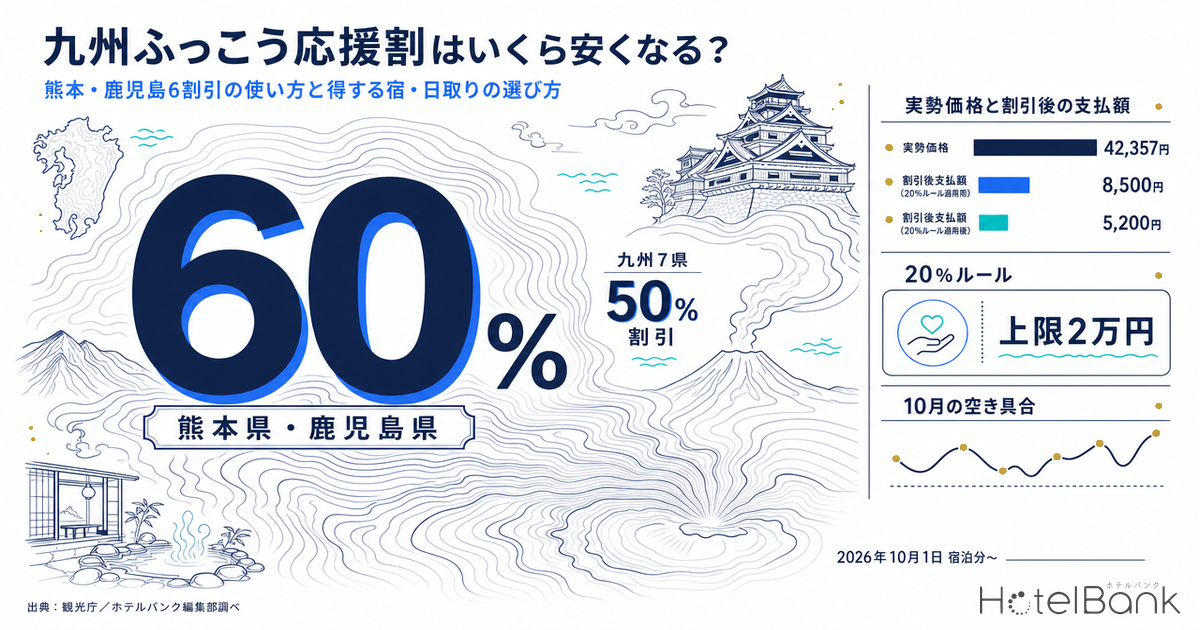
On August 28, 2026, the Japan Tourism Agency published the outline of the Kyushu Fukko Ouenwari recovery travel subsidy. The short answer: for stays from Thursday, October 1 onward, travel and accommodation charges are discounted by 50% across the seven Kyushu prefectures and by 60% in Kumamoto and Kagoshima, with a cap of ¥20,000 per night for accommodation-only bookings. As long as the per-person, per-night charge stays below ¥40,000 (about ¥33,000 in Kumamoto and Kagoshima), the headline rate applies in full. Most Kyushu properties sit well inside that range — a Kumamoto ryokan listed in the ¥40,000s for two guests in one room, for example, works out at roughly ¥17,000.
What is not settled as of August 28, 2026: the booking start date, the end of the eligible stay period, whether regional coupons will be issued, and the exclusion conditions. The Tourism Agency states only that “each prefecture sets the specific booking start date and eligible period,” so the prefectural implementation guidelines still have to come out. This article works from the parts of the scheme that are confirmed, plus prevailing rates and October availability across the seven prefectures, to answer three questions from a guest’s point of view: how much cheaper it actually gets, which prefecture is the better place to stay, and how to pick the dates.
• The scheme details (discount rate, cap, eligible areas, start date) follow the Japan Tourism Agency’s published materials (updated August 28, 2026). The booking start date, the end of the eligible period, whether regional coupons will be issued, and the exclusion conditions were unpublished as of August 28, 2026.
• Listed prices are per-room rates for two guests in one room (tax included), averaged by prefecture and property type for October 2026 stays, compiled as of August 2026.
• Post-discount payments are estimates produced by applying the scheme’s discount rate and cap mechanically to the per-person, per-night charge, rounded to the nearest ¥100. Actual discounts will depend on each prefecture’s implementation guidelines.
• “Share already taken” = the share of rooms listed on OTAs that are already booked or closed out (observed August 26, 2026). It is not the occupancy rate of the accommodation sector as a whole.
• Source: HotelBank Editorial Team research
- — The discount is 50% across the seven Kyushu prefectures and 60% in Kumamoto and Kagoshima, applied to the travel and accommodation charge per person, per night.
- — The ¥20,000 cap only starts to bite above ¥40,000 per person per night in the 50% group and about ¥33,333 in the 60% group. Average rates in all seven prefectures sit far below that, so the headline rate applies in full.
- — A Kumamoto ryokan averages ¥42,357 for two guests in one room, yet the payment works out at about ¥8,500 per person. Kagoshima ryokan come to roughly ¥5,200 — about what a business hotel costs at its normal rate.
- — For the 50% group to match the 60% group on what you pay, the 50% side has to be 20% cheaper (the “20% rule”). This bears directly on choosing between onsen areas that face each other across a prefectural border.
- — The booking start date, the end of the eligible period, whether regional coupons will be issued, and the exclusion conditions were all unpublished as of August 28, 2026. The prefectural implementation guidelines still have to come out.
How much cheaper does it actually get? What is confirmed and what is not
Four points are confirmed in the Japan Tourism Agency’s published materials (updated August 28, 2026).
| Item | Details |
|---|---|
| Discount rate | 50% of the travel and accommodation charge (per person, per night). 60% in Kumamoto and Kagoshima |
| Cap | Accommodation-only products and one-night packages including transport: ¥20,000 / packages including transport, two nights or more: ¥30,000 / multi-prefecture touring products (stays in two or more prefectures): ¥35,000 |
| Eligible products | Travel and accommodation products of one night or more within the Kyushu region. Stays from Thursday, October 1, 2026 onward |
| Eligible areas | The seven Kyushu prefectures (Kumamoto, Kagoshima, Fukuoka, Saga, Nagasaki, Oita, Miyazaki). There is no mention of Okinawa |
Source: Japan Tourism Agency, “Information Related to the 2026 Kumamoto Earthquake” (updated August 28, 2026), compiled by the HotelBank Editorial Team.
What cannot yet be stated, on the other hand, is when booking opens. The following were unpublished as of August 28, 2026 and await announcements from each prefecture.
- Booking start date (set by each prefecture)
- End of the eligible stay period (stays from October 1 onward; the end date is set by each prefecture)
- Whether regional coupons will be issued
- Exclusion conditions (eligible properties, eligible products, booking channels, treatment of existing reservations, and so on)
So the useful move right now is to decide in advance which prefecture and which price band to stay in, and to be ready to act the moment each prefecture’s guidelines land. For how comparable past support schemes were designed in terms of subsidy rates, and what could be read before the announcement, see Kyushu Travel Subsidy Due Aug 28: ¥3,200-¥6,300 ADR, Rate Beats Cap. The next section runs the numbers.
Where does the ¥20,000 cap start to bite? Running the seven prefectures’ prevailing rates
The discount is the smaller of “per-person, per-night charge × discount rate” and ¥20,000. In other words, the cap starts to bite once the per-person, per-night charge passes ¥40,000 in the 50% group and about ¥33,333 in the 60% group; below that, the headline rate applies in full. Converted to two guests in one room, the dividing line is ¥80,000 per room (about ¥67,000 in Kumamoto and Kagoshima).
So where do Kyushu properties actually sit? We compiled OTA listed prices (October 2026 stays, two guests in one room, tax included, as of August 2026) by prefecture and property type, and estimated the payment per person.
| Prefecture | Discount | Ryokan | Business hotels | ||||
|---|---|---|---|---|---|---|---|
| Listed price (2 guests / room) | Per person | Post-discount per person | Listed price (2 guests / room) | Per person | Post-discount per person | ||
| Kumamoto | 60% | ¥42,357 N=207 | ¥21,200 | ¥8,500 | ¥13,604 N=114 | ¥6,800 | ¥2,700 |
| Kagoshima | 60% | ¥25,889 N=80 | ¥12,900 | ¥5,200 | ¥12,657 N=147 | ¥6,300 | ¥2,500 |
| Oita | 50% | ¥32,655 N=281 | ¥16,300 | ¥8,200 | ¥16,167 N=82 | ¥8,100 | ¥4,000 |
| Fukuoka | 50% | ¥34,887 N=71 | ¥17,400 | ¥8,700 | ¥14,782 N=332 | ¥7,400 | ¥3,700 |
| Nagasaki | 50% | ¥38,359 N=65 | ¥19,200 | ¥9,600 | ¥14,034 N=116 | ¥7,000 | ¥3,500 |
| Saga | 50% | ¥40,861 N=85 | ¥20,400 | ¥10,200 | ¥13,791 N=48 | ¥6,900 | ¥3,400 |
| Miyazaki | 50% | ¥28,997 N=37 | ¥14,500 | ¥7,200 | ¥12,298 N=79 | ¥6,100 | ¥3,100 |
Source: HotelBank Editorial Team research. Averages of OTA listed prices (October 2026 stays, two guests in one room, tax included) by prefecture and property type, as of August 2026. N is the number of properties covered. Post-discount figures are estimates produced by applying the scheme’s discount rate and cap mechanically, rounded to the nearest ¥100. Actual discounts will depend on each prefecture’s implementation guidelines.
As the table shows, for both ryokan and business hotels the average rate in all seven prefectures sits far below the cap. A Kumamoto ryokan averages ¥42,357 for two guests in one room, but that is about ¥21,200 per person, so the discount comes to roughly ¥12,700 and the payment to about ¥8,500. Kagoshima ryokan average just under ¥26,000, the lowest of the seven, and after the 60% discount the payment per person lands at about ¥5,200 — essentially the normal rate of a business hotel.
The cap only matters at the ¥150,000-per-room class of luxury ryokan and detached villas. At ¥75,000 per person the discount would be ¥37,500 at 50% and ¥45,000 at 60%, but both are capped at ¥20,000. In that band the difference between Kumamoto/Kagoshima and the other five prefectures disappears: everyone gets ¥20,000 off per person. Put the other way round, if you want the full benefit of the 60% rate, choose a property under ¥33,000 per person per night, or ¥67,000 for two guests in one room.
Chart: Estimated post-discount payment per person per night, by prefecture and property type. Listed prices from the table above (two guests in one room, tax included) converted to a per-person basis, with the scheme’s discount rates applied and rounded to the nearest ¥100. Kumamoto and Kagoshima at 60%, the other five prefectures at 50%. Source: HotelBank Editorial Team research.
To let you apply this to the property you have in mind, the next table lays out the payment per person by listed price band. It is calculated purely from the scheme’s discount rate and cap, so it does not depend on prefecture or property type.
| Listed price (2 guests / room, tax incl.) | Per person | Payment 50% group Fukuoka, Saga, Nagasaki Oita, Miyazaki | Payment 60% group Kumamoto, Kagoshima | Difference | Notes |
|---|---|---|---|---|---|
| ¥15,000 | ¥7,500 | ¥3,750 | ¥3,000 | ¥750 | |
| ¥20,000 | ¥10,000 | ¥5,000 | ¥4,000 | ¥1,000 | |
| ¥30,000 | ¥15,000 | ¥7,500 | ¥6,000 | ¥1,500 | |
| ¥40,000 | ¥20,000 | ¥10,000 | ¥8,000 | ¥2,000 | |
| ¥50,000 | ¥25,000 | ¥12,500 | ¥10,000 | ¥2,500 | |
| ¥60,000 | ¥30,000 | ¥15,000 | ¥12,000 | ¥3,000 | |
| ¥66,667 | ¥33,334 | ¥16,667 | ¥13,334 | ¥3,333 | The 60% group hits the cap here |
| ¥80,000 | ¥40,000 | ¥20,000 | ¥20,000 | ¥0 | The 50% group hits the cap here too. Beyond this both groups pay the same |
| ¥100,000 | ¥50,000 | ¥30,000 | ¥30,000 | ¥0 | |
| ¥150,000 | ¥75,000 | ¥55,000 | ¥55,000 | ¥0 | The discount tops out at ¥20,000 per person |
Source: Estimated by the HotelBank Editorial Team from the discount rates and caps in the Japan Tourism Agency’s “Information Related to the 2026 Kumamoto Earthquake” (updated August 28, 2026). The discount rate is applied to the travel and accommodation charge per person per night, and discounts above ¥20,000 are capped at ¥20,000. Figures are rounded to the nearest yen. Actual discounts will depend on each prefecture’s implementation guidelines.
Chart: Estimated payment per person per night by listed price band. From ¥80,000 (two guests in one room), where the two lines converge, there is no difference in payment between the 60% rate in Kumamoto and Kagoshima and the 50% rate in the other five prefectures. Source: HotelBank Editorial Team research.
Kumamoto and Kagoshima or the neighbouring prefecture? The “20% rule”
Kumamoto and Kagoshima are on 60%; neighbouring Oita, Miyazaki, Fukuoka, Saga and Nagasaki are on 50%. To land on the same payment, a property on the 50% side has to be 20% cheaper than one on the 60% side. The arithmetic is simple: after a 60% discount you pay 40% of the list price, and after a 50% discount you pay 50%. Since 40 ÷ 50 = 0.8, payments are equal when the 50% side’s list price is 0.8 times the 60% side’s — that is, 20% cheaper.
Where this bites is in choosing between onsen areas across a prefectural border. The obvious case is Kurokawa Onsen on the Kumamoto side versus Yufuin, Beppu and Kokonoe on the Oita side. A Kurokawa property at ¥25,000 per person per night means a payment of ¥10,000. To get to that same ¥10,000 in Yufuin, you would be looking for a property listed at ¥20,000. Even on the averages in the table above, Oita ryokan at ¥32,655 for two guests in one room are about ¥10,000 cheaper than Kumamoto — yet the post-discount payment per person comes out at ¥8,200 for Oita and ¥8,500 for Kumamoto, near enough identical. A ¥10,000 gap in listed price shrinks to a few hundred yen after the discount. For how far that cross-border reversal actually goes, Kyushu Subsidy: 10pt Border Step Cuts Kurokawa-Yufuin Gap to ¥665 tests it on prevailing rates for Kurokawa and Yufuin.
On the Kagoshima side, the same relationship holds between the Kirishima onsen district (Kagoshima, 60%) and Ebino or central Miyazaki on the Miyazaki side (50%). Kagoshima’s ryokan average is lower than Miyazaki’s and carries the 60% rate on top, so if you are narrowing down to southern Kyushu onsen, the Kagoshima side tends to win on what you pay.
That said, deciding purely on price can leave you with a cramped itinerary. Yufuin to Kurokawa is about an hour by car, and Kurokawa to Sugitate Onsen on the prefectural border about 20 minutes, so the inland onsen areas of Oita and Kumamoto can be strung together in a single line. Touring products (stays in two or more prefectures) carry a higher cap of ¥35,000, so putting the first night in Oita and the second in Kumamoto to claim both discount rates is a realistic way to build the trip. For specific properties and a route across the border over two nights, Two nights from Yufuin to Kurokawa and Sugitate (wabistay, in Japanese) builds one from three inland ryokan.
Which nights in October? Availability differs sharply by prefecture
October, when the discount starts, fills up very differently from prefecture to prefecture. The chart below shows the share of rooms listed on OTAs that were already taken (observed August 26, 2026) for each stay date in October. This is the state of play before the subsidy was announced, so bookings will build on top of it.
Chart: Share of OTA-listed inventory already taken by stay date, October 2026 (Kumamoto N=477 properties / Kagoshima N=510 / Oita N=573 / Fukuoka N=608, observed August 26, 2026). Source: HotelBank Editorial Team research.
| Prefecture | Mon-Thu average | Fri-Sat average | Sat, October 10 first day of the long weekend | Notes |
|---|---|---|---|---|
| Kumamoto | 66.0% | 71.8% | 75.0% | Saturday October 17 is the month’s high at 78.8%. Weekdays stay in the 60s with room to spare |
| Kagoshima | 53.7% | 57.5% | 61.5% | The most availability of the seven prefectures. Even the long weekend is only around 60% |
| Oita | 67.6% | 74.2% | 83.5% | Concentrated on the long weekend and Saturdays. Monday to Thursday stays below 70% |
| Fukuoka | 71.2% | 78.7% | 81.8% | Saturday October 24 reaches 89.1%. Saturday listed prices also run 1.5-2x weekday levels |
| Nagasaki | 76.3% | 75.7% | 81.0% | High on weekdays too; October 20-22 (Tue-Thu) runs 83-87% |
| Saga | 68.6% | 77.5% | 84.9% | Few properties, so holiday weekends fill early |
| Miyazaki | 66.4% | 74.6% | 81.0% | Saturday October 24 stands out at 90.3% for the month |
Source: HotelBank Editorial Team research. Share of OTA-listed rooms already booked or closed out, by stay date in October 2026, observed August 26, 2026. Day-of-week averages are simple averages of Monday-Thursday and Friday-Saturday respectively; Sundays are excluded. N = Kumamoto 477, Kagoshima 510, Oita 573, Fukuoka 608, Nagasaki 375, Saga 169, Miyazaki 225 properties.
That narrows the date-picking down to three points.
- The long weekend (October 10-12) and every Saturday will fill up, discount or no discount. Oita, Saga and Fukuoka are already above 80% on the first day of the long weekend. If you want to use the subsidy on those dates, book them the moment the guidelines are published — or leave them out from the start.
- Monday to Thursday has room to spare in all seven prefectures. October 12-14, right after the long weekend, and October 25-28 at the end of the month are low everywhere. Listed prices on weekdays also run at 50-70% of Saturday levels, and the discount comes on top of that, so a weekday stay cuts what you pay the most.
- Kagoshima has the most availability all month. It is the only prefecture where the 60% discount and plenty of open rooms coincide, which makes it the first candidate if you want both date flexibility and a low payment. For a two-night route from Ibusuki through Kirishima, Two nights in Satsuma: Ibusuki to Kirishima (yadolist, in Japanese) sets one out across three properties.
When does booking open? What you can do now
To repeat: the booking start date is set by each prefecture and was unpublished as of August 28, 2026. Under comparable past support schemes, eligible products and start dates sometimes differed by booking channel (travel agency, the property’s own site, OTAs), and this time too, “where you have to book for it to count” has to wait for each prefecture’s guidelines. The treatment of reservations already held for October is likewise unpublished.
Three things you can do with certainty right now.
- Narrow your shortlist to properties under ¥33,000 per person in the 60% group and under ¥40,000 in the 50% group. Within that range the headline discount rate applies in full.
- Check the cancellation terms, then hold your preferred weekday dates first. Whether you will be able to rebook into a discount-eligible reservation after the guidelines appear is unpublished, so keep to bookings inside the free-cancellation window.
- Watch each prefecture’s official tourism site and the Japan Tourism Agency’s information page. The Agency says it “will post the specific periods on this page as each prefecture announces them.”
If you want to go deeper
For property-by-property comparisons, these articles go into detail (both in Japanese).
Two nights from Yufuin to Kurokawa and Sugitate: inland Kyushu onsen at luxury ryokan (wabistay)
Links Sanso Murata in Yufuin (all detached villas), Yamamizuki Bettei Miyama Sanso in Kurokawa Onsen (private baths in every room) and Komeya Bessou in Sugitate Onsen (a kaiseki menu that changes monthly), on a route of about an hour by car from Yufuin to Kurokawa and 20 minutes from Kurokawa to Sugitate. A directly usable template for a touring trip across the Oita-Kumamoto border.
Two nights in Satsuma: Ibusuki to Kirishima, a late-summer table of Kagoshima produce (yadolist)
Links Ibusuki Shusuien in Ibusuki Onsen (47 rooms, built on its cooking) and Ginsho (kaiseki with an onsen table looking over Kinko Bay), plus Tsumikusa no Yado Komatsu in the Kirishima onsen district (six rooms, each with its own open-air bath), on a two-night route out of Kagoshima Airport. A concrete itinerary for sea-and-mountain dining in 60%-discount Kagoshima.
Frequently asked questions
How much cheaper does the Kyushu Fukko Ouenwari subsidy make a stay?
50% of the travel and accommodation charge, or 60% in Kumamoto and Kagoshima, is discounted per person per night. The discount is capped at ¥20,000 per night for accommodation-only bookings. Average rates for ryokan and business hotels across all seven Kyushu prefectures sit far below the cap, so at most properties the headline rate applies in full. A Kumamoto ryokan, for example, averages ¥42,357 for two guests in one room, but the payment works out at about ¥8,500 per person.
When does booking open?
It was unpublished as of August 28, 2026. The Japan Tourism Agency states that “each prefecture sets the specific booking start date and eligible period,” so the implementation guidelines of each of the seven Kyushu prefectures still have to come out. The end of the eligible period, whether regional coupons will be issued, the exclusion conditions and the treatment of reservations already made were all unpublished at that date as well.
When does the ¥20,000 cap actually apply?
When the travel and accommodation charge per person per night exceeds ¥40,000 in the 50% group, or about ¥33,333 in the 60% group. Converted to two guests in one room, the dividing lines are ¥80,000 and about ¥67,000 respectively. Above those bands the discount tops out at ¥20,000 per person, and from ¥80,000 per room upward there is no difference in payment between Kumamoto/Kagoshima and the other five prefectures.
Is it better to stay in Kumamoto/Kagoshima or in a neighbouring prefecture?
After a 60% discount you pay 40% of the list price, and after a 50% discount you pay 50%, so payments are equal when the 50% side is 20% cheaper than the 60% side. On prevailing rates, Oita ryokan average ¥32,655 for two guests in one room — about ¥10,000 less than Kumamoto — yet the post-discount payment per person comes to ¥8,200 in Oita against ¥8,500 in Kumamoto, near enough the same. In other words, a gap in listed price narrows to a few hundred yen once the discount is applied.
Which October dates are easiest to book?
Monday to Thursday has room to spare in all seven prefectures. October 12-14, right after the long weekend, and October 25-28 at the end of the month are particularly low everywhere, and weekday listed prices run at 50-70% of Saturday levels. The long weekend (October 10-12) and every Saturday, by contrast, will fill up with or without the discount — Oita, Saga and Fukuoka are already above 80% on the first day of the long weekend. By prefecture, Kagoshima has the most availability throughout October and is the only prefecture where that coincides with the 60% discount.
Is Okinawa covered?
There is no mention of Okinawa in the Japan Tourism Agency’s published materials. The areas explicitly named as eligible are the seven Kyushu prefectures: Kumamoto, Kagoshima, Fukuoka, Saga, Nagasaki, Oita and Miyazaki.
Methodology and sources
■ Data sources
The scheme details (discount rate, cap, eligible areas, eligible stay period) follow the Japan Tourism Agency’s “Information Related to the 2026 Kumamoto Earthquake” (updated August 28, 2026) and the “Kyushu Fukko Ouenwari” outline document (PDF) posted on that page. Listed prices are averages by prefecture and property type compiled by the HotelBank Editorial Team from public OTA data for October 2026 stays, two guests in one room, tax included (as of August 2026). Ryokan coverage is 207 properties in Kumamoto, 80 in Kagoshima, 281 in Oita, 71 in Fukuoka, 65 in Nagasaki, 85 in Saga and 37 in Miyazaki; business hotel coverage is 114, 147, 82, 332, 116, 48 and 79 respectively. Availability is the share of rooms listed on OTAs that are already booked or closed out, aggregated by stay date (observed August 26, 2026; N = Kumamoto 477, Kagoshima 510, Oita 573, Fukuoka 608, Nagasaki 375, Saga 169, Miyazaki 225 properties).
■ Calculation assumptions
Post-discount payments were produced by applying the discount rates published by the Japan Tourism Agency (50% across the seven Kyushu prefectures, 60% in Kumamoto and Kagoshima) and the cap (¥20,000 for accommodation-only products and one-night packages including transport) mechanically to the travel and accommodation charge per person per night. Listed prices for two guests in one room were halved to a per-person basis. The prefecture-and-type table is rounded to the nearest ¥100 and the price-band table to the nearest yen. Discounts above ¥20,000 are capped at ¥20,000. Day-of-week averages are simple averages of Monday-Thursday and Friday-Saturday respectively; Sundays are excluded.
■ Limitations
The booking start date, the end of the eligible period, whether regional coupons will be issued and the exclusion conditions (eligible properties, eligible products, booking channels, treatment of existing reservations) were unpublished as of August 28, 2026, and the actual discount and its conditions will depend on each prefecture’s implementation guidelines. The estimates here are calculated mechanically from the framework of the scheme alone and do not guarantee the discount at any particular property. Listed prices are averages by prefecture and property type and differ from the price of any individual property, date or plan. “Share already taken” indicates how far listed OTA inventory has been absorbed, not the occupancy rate of the accommodation sector as a whole. It was also observed before the subsidy was announced and does not reflect bookings made since.
Related Reading
- Kyushu Subsidy: 10pt Border Step Cuts Kurokawa-Yufuin Gap to ¥665
- Kyushu Travel Subsidy Due Aug 28: ¥3,200-¥6,300 ADR, Rate Beats Cap
- Kurokawa Onsen After the 2026 Kumamoto Quake: Open as Usual (Aug 15)
- Aso & Kurokawa Onsen Are Open: Autumn ADR Flat, Sept Holiday 1.5% Left
- China National Day 2026: 21pt Weekday OCC Gap Across 26 Prefectures
- Obon T-7: Kyushu’s 31.7pt Gap — Fukuoka 73.0%, Kagoshima 41.3%
- Japan Lodging Tax 2026: ¥100–200 per Night, Kyoto Up to ¥10,000