

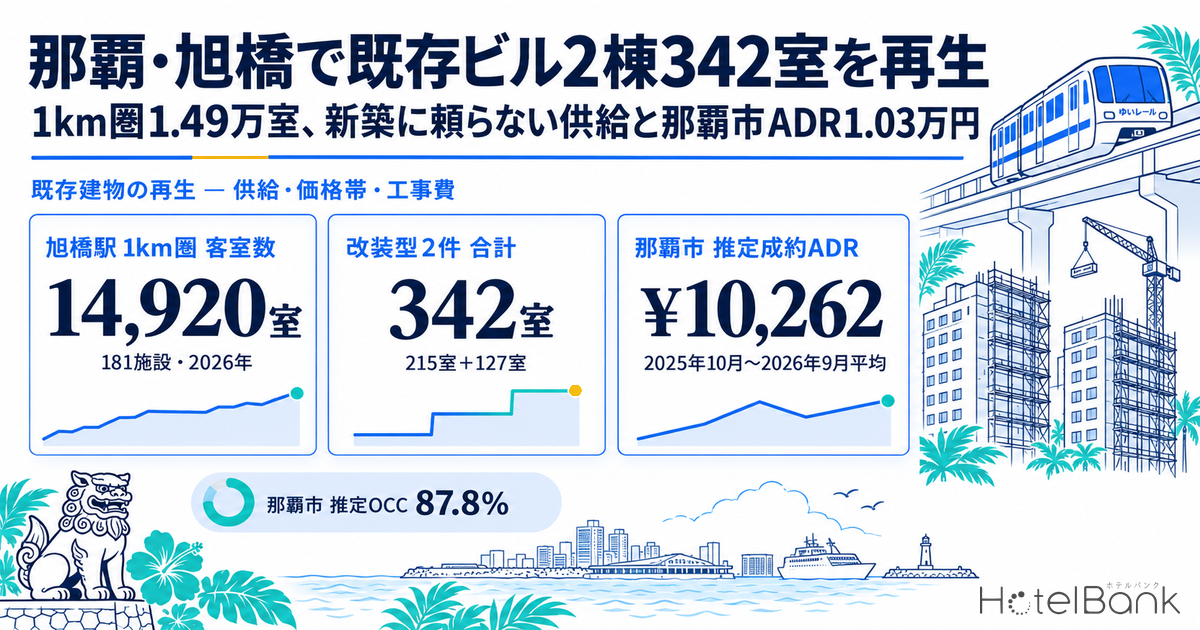
Around Asahibashi Station in Naha, two plans to turn existing buildings into hotels were announced in quick succession in August–September 2026. On August 24, Marriott International announced City Express by Marriott Okinawa Naha (215 rooms, scheduled to open in spring 2027), and on September 15, Columbia Works announced a whole-building renovation of the former Ryukyu Sun Royal Hotel (琉球サンロイヤルホテル) (127 rooms, scheduled to open in spring 2028). Both are regeneration projects that reuse an existing structure rather than new builds. Rooms within 1km of Asahibashi Station grew about 1.9x, from 7,909 in 2012 to 14,920 in 2026 (major booking site listing basis, 181 properties), and Naha City’s estimated settled ADR averaged ¥10,300 over the latest 12 months (N=136–144 properties). This article quantifies where the two projects sit in the area’s stock and price bands, and how the cost of renovating a 40-year-old building compares with a new build, using supply trends, the price band distribution, estimated occupancy and official construction cost statistics.
Metric Definitions Used in This Article
- ADR (Average Daily Rate): an estimated settled rate (tax-excluded equivalent), calculated by applying a segment-specific adjustment factor to the lowest plan level each property publishes on OTAs (per room, 2 guests per room, tax included). Checked against property-level results disclosed by listed hotel REITs (91 properties, latest 3 months), the median error is about 7%. These are estimates and differ from each property’s actual settled rates and accounting figures. Area-level ADR is the median of the covered properties (the level of a typical property in the area).
- OCC (Occupancy): the share of rooms sold out of the total rooms in the area (an estimate based on OTA sales inventory; consistency checks against monthly REIT disclosures confirm accuracy of roughly a few percentage points). It is based on how OTA inventory is absorbed and differs from a property’s actual overall occupancy.
- Properties and rooms: figures on a “major booking site listing basis”, counting properties tracked by MetroEngines Research that are listed on major booking sites and confirmed as operating. Ryokan, minshuku and simple lodgings not listed on OTAs are excluded.
- Data sources: MetroEngines Research & Consulting, Ministry of Land, Infrastructure, Transport and Tourism (MLIT), Ministry of Internal Affairs and Communications / Ministry of Economy, Trade and Industry, Okinawa Prefecture, company press releases
- — Rooms within 1km of Asahibashi Station total 14,920 (181 properties, 2026), about 1.9x the 2012 level. The two conversions’ 342 rooms equal about 2.3%, and the net addition after the closure is only 215 rooms.
- — Naha City’s estimated settled ADR averaged ¥10,262 from October 2025 to September 2026 (N=136–144 properties), up 16.3% on the same period a year earlier.
- — Over 80% of rooms within 1km are priced below ¥15,000, and the ¥15,000–20,000 band holds just 4 properties and 654 rooms, the thinnest band.
- — The planned construction cost of accommodation buildings was ¥591,000/m² in 2024. A new build of the same size works out to about ¥25.15M per room, giving a GOP yield on construction cost of 6.9%, versus 9.7–14.9% for three (assumed) renovation levels.
- — Naha City’s estimated occupancy was 87.8% in September 2026 (179 properties). What decides the economics is less occupancy than the combination of the price band a renovated hotel enters and the amount invested.
Executive Summary — Adding 2.3% to the 14,920 Rooms Within 1km Through Renovation, Not New Construction
The bottom line first: the two Asahibashi projects are less about pushing up supply in the area than about replacing what is inside the existing stock. Rooms within 1km rose by 1,368 in 2022, were broadly flat in 2023–2024, then added 788 in 2025 and 313 in 2026. The 215 rooms opening in spring 2027 will be a net addition, while in spring 2028 the site of the 135-room hotel that closed in March 2026 will return with 127 rooms. Together the 342 rooms are about 2.3% of the 1km area, and net of the closure the increase is only 215 rooms.
On pricing, Naha City’s estimated settled ADR averaged ¥10,300 over the latest 12 months, up 16.3% from ¥8,800 in the prior-year period, and estimated OCC stayed high at 87.8% in September 2026. Looking at the distribution of the 69 properties and 9,648 rooms within 1km of Asahibashi for which an estimated settled ADR is available, 45% of rooms are below ¥10,000 and 38% are in the ¥10,000–15,000 band, while the ¥15,000–20,000 band has only 4 properties and 654 rooms. The price points targeted by a midscale international brand and by a renovated lifestyle hotel with a spa and sauna sit right around this thin band.
The Two Projects — A 215-Room International Brand and a 40-Year-Old Building Reconfigured into 127 Rooms
First, the published facts, following the primary sources. City Express by Marriott Okinawa Naha is a project for which Marriott International signed an opening agreement with a fund formed by LaSalle Investment Management (ラサール不動産投資顧問) and with EastGate Hospitality; an existing property in central Naha will be renovated and is scheduled to open in spring 2027. It will have 215 rooms, including family rooms with bunk beds and a balcony or patio. The announced location is about 300m (about a 5-minute walk) from Yui Rail Asahibashi Station, about 4km from Naha Airport and about 1km from Kokusai-dori, and it will be the brand’s first property in Okinawa. The release does not give the street address, the number of floors or the contract type (franchise or management agreement), and this article does not speculate on them.
The former Ryukyu Sun Royal Hotel (6-20 Higashimachi, Naha) is an SRC building completed in June 1986, with 10 floors above ground and one basement level, a site of 1,140.12m² (about 345 tsubo) and a gross floor area of 5,403.64m² (about 1,635 tsubo). Located a 2-minute walk from Asahibashi Station, it closed on March 6, 2026, after which it was acquired by Columbia Works, which will renovate the entire building while retaining the existing structure and exterior walls. Rooms will be reduced from 135 to 127, and the hotel will be operated by Amaneku (アマネク), which runs 12 properties nationwide. Under the concept “RYUKYU CHAMPLOO Style”, the plan includes local shops, a lounge and dining, a cultural experience space and a spa and sauna using Ryukyu herbs, with opening scheduled for spring 2028. The acquisition price has not been disclosed.
| Date | Event | Source |
|---|---|---|
| June 1986 | Ryukyu Sun Royal Hotel completed (opened in July of the same year, 135 rooms) | Columbia Works announcement, estie |
| March 6, 2026 | Ryukyu Sun Royal Hotel closes | estie |
| August 24, 2026 | Marriott announces the opening agreement for City Express by Marriott Okinawa Naha (215 rooms). Renovation of an existing property, about 300m from Asahibashi Station | Marriott announcement (PR TIMES), Travel Voice |
| September 15, 2026 | Columbia Works announces the acquisition and whole-building renovation of the former Ryukyu Sun Royal Hotel (127 rooms), to be operated by Amaneku | Columbia Works announcement (PR TIMES) |
| February 1, 2027 | Okinawa Prefecture accommodation tax takes effect (flat 2%, capped at ¥2,000) | Okinawa Prefecture |
| Spring 2027 (planned) | City Express by Marriott Okinawa Naha opens | Marriott announcement |
| Spring 2028 (planned) | The former Ryukyu Sun Royal Hotel reopens with 127 rooms | Columbia Works announcement |
What the published schedules show is how short the construction periods of conversions are. It is about 8 months from the agreement announcement to opening (City Express) and about a year and a half from the acquisition announcement to opening (former Ryukyu Sun Royal), a different timeline from a new build that must go through demolition, design and building confirmation. The Columbia Works release also explicitly cites a shorter construction period as the reason for keeping the structure and exterior walls.
Room Trends Within 1km and 2km of Asahibashi — 1.9x in 14 Years, Re-accelerating After a 2023–2024 Plateau
Rooms within 1km of Asahibashi Station (26.2120°N, 127.6757°E) grew from 70 properties and 7,909 rooms in 2012 to 136 properties and 11,281 rooms in 2019, reaching 181 properties and 14,920 rooms in 2026 (all on a major booking site listing basis). Within 2km, rooms rose from 134 properties and 11,553 rooms to 380 properties and 23,307 rooms, a 2.0x increase over the same period. Growth was uneven: after 1,368 rooms were added within 1km in 2022, growth all but stopped, at +54 rooms in 2023 and −41 in 2024. The two projects were announced just as supply started moving again, with +788 rooms in 2025 and +313 in 2026.
The main openings listed within 1km since 2025 were mid-to-large hotels of over 200 rooms: La’gent Hotel Okinawa Naha (257 rooms, May 2025), THE NEST Naha (366 rooms, July 2025), The Royal Park Hotel Iconic Naha (257 rooms, January 2026) and Hotel Monterey La Soeur Naha (223 rooms, April 2026). Add small limited-service and condominium-type properties of 40–50-odd rooms, and that nearly accounts for the 788-room net increase in 2025. In 2026, against 545 rooms of new listings, the net increase was only 313 rooms, reflecting closures and delistings, including the former Ryukyu Sun Royal’s 135 rooms. The supply structure and ADR tiers of Naha as a whole are also covered in Shuri Castle Revival Lifts Naha Hotel Demand.
| Year | 1km properties | 1km rooms | YoY change | 2km properties | 2km rooms | YoY change |
|---|---|---|---|---|---|---|
| 2018 | 114 | 10,016 | +757 | 237 | 15,891 | +991 |
| 2019 | 136 | 11,281 | +1,265 | 274 | 17,472 | +1,581 |
| 2020 | 150 | 11,868 | +587 | 307 | 19,219 | +1,747 |
| 2021 | 161 | 12,438 | +570 | 340 | 20,332 | +1,113 |
| 2022 | 169 | 13,806 | +1,368 | 353 | 21,597 | +1,265 |
| 2023 | 170 | 13,860 | +54 | 359 | 21,681 | +84 |
| 2024 | 170 | 13,819 | -41 | 359 | 21,640 | -41 |
| 2025 | 178 | 14,607 | +788 | 372 | 22,782 | +1,142 |
| 2026 | 181 | 14,920 | +313 | 380 | 23,307 | +525 |
For future supply, two observations are worth setting side by side. Across Okinawa Prefecture, new openings confirmed on major booking sites numbered 137 properties and 1,328 rooms in 2024, 129 properties and 2,077 rooms in 2025, and 96 properties and 2,932 rooms in 2026 as of October (confirmed OTA listing basis). Because listings appear several months before opening, figures for the most recent and upcoming months may rise as more listings come in. On the other hand, on the building-confirmation-application basis of MLIT’s Building Dynamics Statistics Survey, the main identifiable plan in Okinawa is a 200-room project in Nishihara, Urasoe City (17 floors, scheduled for completion in July 2026); this is only a floor based on applications as of the survey date, and the count and room total are expected to rise as further applications are filed. Either way, central Naha is not facing a queue of large new-build projects, and supply has entered a phase in which conversions of existing buildings, like the two in Asahibashi, play a part. How much of accommodation supply comes through non-new-build routes in the construction starts statistics is counted in Hotel Supply: 16.7% of 5,707 Starts Are Not New Builds.
Location — Asahibashi, Where an Office District of 41,000 Workers Overlaps a Residential Area of 20,000
Asahibashi Station connects directly to the Naha Bus Terminal and sits at the junction of the government district around the prefectural and city offices and the tourist flow along Kokusai-dori. Aggregating the Economic Census for Business Activity (2021) of the Ministry of Internal Affairs and Communications and the Ministry of Economy, Trade and Industry at the small-area level, there are 3,439 establishments and 40,599 workers within 1km of the station, of whom 12,273 (30.2%) work in office-type industries. That is a solid base for weekday business demand. Meanwhile, according to MLIT’s 250m-mesh future population projections, the resident population within the same 1km area was 20,304 in 2025 and is projected to fall to 18,889 by 2040 (−10.3% versus 21,064 in the 2020 Census), with 28.9% aged 65 or over. Note that resident population is the census-based settled population, not the daytime or transit population, but the location can be read as one where pressure to convert to housing is weak relative to visitor demand from tourism and business.
On the map, accommodation within 1km is concentrated north of Asahibashi Station (Kume, Matsuyama, Higashimachi) and east of it (Izumizaki, Kenchomae), and is sparse to the south toward Naha Port and Onoyama. The former Ryukyu Sun Royal Hotel is in Higashimachi on the west side of the station, just a 2-minute walk away. Since the street address of City Express has not been published, the map only shows a circle “about 300m from the station”. Both conversions are on the side where accommodation is already clustered and visitor flows are established; these are locations for competing on price band and brand within existing demand, not for generating new demand.
Naha’s Price Band Distribution — 45% Below ¥10,000; the ¥15,000–20,000 Band Has 4 Properties and 654 Rooms
Naha City’s estimated settled ADR (median of covered properties in the city) averaged ¥10,300 over the 12 months from October 2025 to September 2026 (N=136–144 properties), up 16.3% from ¥8,800 in the prior-year period, a comparison of finalized months only. By month, February 2026 jumped to ¥14,200 during the professional baseball spring camp season, and September 2026 was ¥9,700, up 8.6% from the same month a year earlier (¥8,900). The 12-month average for Okinawa Prefecture as a whole was ¥11,900 (N=482–515 properties), so Naha is about 14% below the prefectural average, which includes resort areas.
Split by segment, the differences are clear. The 12-month average estimated settled ADR in Naha was ¥9,500 for business hotels (N=103–106 properties), ¥13,700 for resort hotels (N=18–21) and ¥19,500 for city hotels (N=10–14). There is a gap of about ¥10,000 between business and city hotels, with resort-category properties falling in between. Because the city hotel sample is 14 properties or fewer, its level should be read with a margin.
Next, narrowing to within 1km of Asahibashi Station, we sorted by price band the 69 properties and 9,648 rooms for which an estimated settled ADR could be calculated in at least 6 of the latest 12 months. Individual properties are not named; they are treated as an area aggregate. The below-¥10,000 band holds 37 properties and 4,376 rooms (45% of rooms) and the ¥10,000–15,000 band 22 properties and 3,669 rooms (38%), which together account for more than 80% of rooms. The ¥15,000–20,000 band has 4 properties and 654 rooms, ¥20,000–30,000 has 5 properties and 861 rooms, and ¥30,000 and above has 1 property with 88 rooms; the median was ¥9,700.
Crowded band: below ¥10,000 x limited-service
37 properties, 4,376 rooms. 45% of rooms within 1km fall here, and the business-segment median of ¥9,500 sits at the top of this band. It is a space where new entrants find it hard to differentiate on price.
Target band 1 ¥10,000–15,000 x standardized international brand
22 properties, 3,669 rooms. This band includes many of the mid-to-large hotels that opened in 2025–2026, and the level a value-focused midscale international brand would aim for in Naha likely overlaps it. With a loyalty base and family rooms, such a brand would position itself above the crowded band.
Target band 2 ¥15,000–20,000 x renovated lifestyle
4 properties, 654 rooms: the thinnest band. A renovated lifestyle hotel with ancillary features such as a spa and sauna, a lounge and cultural experiences has room to fit below the city segment (¥19,500) and above the resort segment (¥13,700).
Both bands are this article’s hypotheses; neither project has published its rates. Still, in a structure where over 80% of rooms within 1km are below ¥15,000, a standardized midscale international brand and a renovated lifestyle hotel that differentiates through ancillary features are unlikely to compete in the same band. The natural reading is a division of roles: the former pushes up the top of the crowded band, and the latter fills the thin band.
Development Scenarios — Full Renovation of a 40-Year-Old Building Assumed at ¥8M–18M per Room vs ¥25.15M per Room for New Construction
Let us frame the cost gap between renovation and new construction starting from official statistics. According to MLIT’s Building Construction Starts Survey, accommodation buildings started nationwide in 2024 totaled 2,836 buildings, 1.756 million m² of floor area and ¥1.0384 trillion in planned construction cost, or ¥591,000 per m² (about ¥1.95M per tsubo). That is a sharp rise from ¥278,000/m² in 2015 and ¥364,000/m² in 2019, and an increase of more than 40% in one year from ¥417,000/m² in 2023. Planned construction cost is the building construction cost the owner expects at the time of the confirmation application and excludes land, demolition, design and supervision, and furniture, fixtures and equipment.
Dividing the former Ryukyu Sun Royal Hotel’s gross floor area of 5,403.64m² by 127 rooms gives about 42.5m² of floor area per room. Building the same floor area new at the 2024 national average unit cost would cost about ¥3.19bn in building construction alone, or about ¥25.15M per room. By contrast, the cost of a full renovation that keeps the structure and exterior walls varies widely by project, and no official statistical series covers it. This article therefore assumes ¥8M per room for an interior-led renovation, ¥12M for a full renovation including equipment replacement, and ¥18M for a complete overhaul involving reconfiguration of uses. These correspond to roughly 30%, 50% and 70% of the new-build construction cost, and actual estimates move significantly depending on asbestos surveys, elevator replacement, the scope of plumbing and HVAC renewal, and whether sprinklers are required. Please read them strictly as a yardstick for comparison.
| Scenario (127 rooms) | Construction cost per room | Total construction cost | Assumed ADR | Annual revenue | GOP (35%) | GOP yield on construction cost |
|---|---|---|---|---|---|---|
| A. Interior-led renovation | ¥8M (assumed) | ¥1.02bn | ¥11,000 | ¥430M | ¥152M | 14.9% |
| B. Full renovation incl. equipment replacement Base case | ¥12M (assumed) | ¥1.52bn | ¥13,500 | ¥530M | ¥186M | 12.2% |
| C. Complete overhaul with reconfiguration of uses | ¥18M (assumed) | ¥2.29bn | ¥16,000 | ¥630M | ¥221M | 9.7% |
| Reference: same size built new (construction cost only) | ¥25.15M | ¥3.19bn | ¥16,000 | ¥630M | ¥221M | 6.9% |
We stress that the yields in the table use only construction cost as the denominator. Because the acquisition price has not been disclosed, the building acquisition cannot be included, and the yield on the actual total investment will be lower. Even so, against 6.9% with the new-build construction cost as the denominator, the renovation cases yield 9.7–14.9% even with conservatively set ADRs; the smaller investment translates directly into the yield gap. Factor in the difference in construction period as well (no need for the demolition, design and confirmation application stages of a new build), and the numbers explain why regenerating existing buildings is being chosen while construction costs remain high. Where the boundary lies at which renovation investment outperforms new construction has also been tested against the ADR uplift of five published large-scale renovation projects in a separate HotelBank analysis.
| Sensitivity (Scenario B, construction cost ¥1.52bn) | Assumed ADR | Occupancy | Annual revenue | GOP | GOP yield on construction cost |
|---|---|---|---|---|---|
| Base | ¥13,500 | 85% | ¥532M | ¥186M | 12.2% |
| ADR −10% | ¥12,150 | 85% | ¥479M | ¥168M | 11.0% |
| Occupancy −5pt | ¥13,500 | 80% | ¥501M | ¥175M | 11.5% |
| Both | ¥12,150 | 80% | ¥451M | ¥158M | 10.3% |
The sensitivity shows that a 10% drop in ADR and a 5pt drop in occupancy reduce the yield by about the same amount, around 1pt, and even if both happen at once the yield stays at 10.3%. With Naha City’s estimated OCC running at 86–88%, where ADR lands matters more for the economics than occupancy. For owners of existing buildings, the most effective decision at the planning stage is to fix first which price band the hotel will enter after renovation, and to keep the investment within what that band can support.
Two-Way Sensitivity of Construction Cost and Assumed ADR — Fixing the Price Band First Determines the Affordable Construction Cost
Because the scenario table moves construction cost and assumed ADR together, it is hard to see which one drives the yield. We therefore varied construction cost per room (6 levels) and assumed ADR (5 levels) independently and laid out the GOP yield on construction cost. The ADR columns correspond to Naha City’s estimated settled ADR (around ¥10,000), Scenario A’s ¥11,000, Scenario B’s ¥13,500, Scenario C’s ¥16,000 and the city segment’s ¥19,500 (all referencing October 2025–September 2026 levels).
| Construction cost per room | ¥10,000 | ¥11,000 | ¥13,500 | ¥16,000 | ¥19,500 |
|---|---|---|---|---|---|
| ¥8M | 13.6% | 14.9% | 18.3% | 21.7% | 26.5% |
| ¥10M | 10.9% | 11.9% | 14.7% | 17.4% | 21.2% |
| ¥12M | 9.0% | 10.0% | 12.2% | 14.5% | 17.6% |
| ¥15M | 7.2% | 8.0% | 9.8% | 11.6% | 14.1% |
| ¥18M | 6.0% | 6.6% | 8.1% | 9.7% | 11.8% |
| ¥25.15M (new build, reference) | 4.3% | 4.7% | 5.8% | 6.9% | 8.4% |
Reading the table down, at the same assumed ADR, raising construction cost from ¥8M to ¥18M per room more than halves the yield. Reading across, securing around 10% with a complete overhaul (¥18M) requires entering a price band of ¥16,000 or more, while a ¥12M full renovation reaches 10.0% even at ¥11,000, close to Naha City’s typical level. With the new-build construction cost (about ¥25.15M per room) as the denominator, even a city-segment ADR of ¥19,500 yields only 8.4%, below a ¥12M renovation that works at ¥11,000. This article’s conclusion—decide first which price band the renovated hotel can enter, then work back to the construction cost ceiling that band can support—holds on this two-way view as well.
Naha City Estimated OCC by Segment — 87.8% Overall and 89.6% for Resorts in September 2026
As a check on the demand side, the table shows estimated OCC (OTA listed inventory basis, estimated) by segment for September 2026, the latest finalized month. Naha City overall was 87.8% (179 properties / 15,059 rooms covered, major booking site listing basis), business hotels 87.7% (76 properties / 9,421 rooms) and resort hotels 89.6% (17 properties / 2,298 rooms). In August 2026 the overall figure was 86.0% (176 properties / 15,261 rooms), so the level held from the summer peak into September. The city hotel category covers only 7 properties, so no estimate is shown. Okinawa Prefecture overall was 86.7% in September (708 properties / 36,220 rooms), with Naha 1pt above the prefectural average.
| Area / segment | Properties covered | Rooms covered | Sep 2026 est. OCC | Aug 2026 est. OCC |
|---|---|---|---|---|
| Naha City, overall | 179 | 15,059 | 87.8% | 86.0% |
| Naha City, business hotels | 76 | 9,421 | 87.7% | 85.9% |
| Naha City, resort hotels | 17 | 2,298 | 89.6% | 87.8% |
| Naha City, city hotels | 7 | 1,530 | Not shown (too few properties) | — |
| Okinawa Prefecture, overall | 708 | 36,220 | 86.7% | — |
Estimated OCC close to 90% shows that demand in central Naha has kept its capacity to absorb supply through the 2025–2026 increase. The 215 rooms arriving in spring 2027 equal 1.4% of the 1km area; compared with the 788-room net increase (5.7%) that was absorbed in 2025, this is not a scale that will shift the supply-demand balance much. What deserves more attention is whether the shift toward higher price bands, backed by high occupancy, continues. Judging by segment ADR trends, there is still room for more properties to fill the gap between the business segment’s ¥9,500 and the city segment’s ¥19,500.
Okinawa Accommodation Tax Begins — Flat 2% from February 1, 2027, ¥100 per Person per Night on a ¥10,000 Room
Okinawa Prefecture will introduce an accommodation tax from February 1, 2027. The rate is a flat 2% of the accommodation charge (excluding meals etc., with amounts under ¥1,000 truncated), capped at ¥2,000 per person per night, and stays for school educational activities such as school trips are exempt. Where a municipality levies its own tax, the rate is split into 0.8% prefectural and 1.2% municipal, but the municipalities the prefecture lists as planning their own levies are Motobu, Onna, Chatan, Miyakojima, Ishigaki and Nago; Naha is not among them. For a room at Naha City’s estimated settled ADR of about ¥10,000 shared by two guests, the charge per person is around ¥5,000 and the tax is about ¥100 per person per night. City Express’s planned opening (spring 2027) comes right after the tax takes effect, so both conversions will launch with rate designs that factor in the accommodation tax. Details are covered in Okinawa 2% Lodging Tax from Feb 1, 2027: Rates, Cap and How Hotels Should Prepare.
Conclusion — The Two Asahibashi Projects Replace What Is Inside the Stock Rather Than “Add Supply”
To summarize what this article found: first, rooms within 1km of Asahibashi Station have grown about 1.9x in 14 years to 14,920 and entered another growth phase in 2025–2026, but the two conversions’ 342 rooms are 2.3% of the area and the net increase excluding the closure is 215 rooms, not enough to unsettle supply and demand. Second, Naha City’s estimated settled ADR averaged ¥10,300 over the latest 12 months, up 16.3% year on year, and estimated OCC was 87.8%, so both price and occupancy are trending up. Third, over 80% of rooms within 1km are below ¥15,000 and the ¥15,000–20,000 band is thin at 4 properties and 654 rooms, leaving room in separate bands for a midscale international brand and a renovated lifestyle hotel. Fourth, with the construction cost of accommodation buildings having risen to ¥591,000/m² (2024), renovations that keep the structure tend to beat new builds on yield relative to construction cost, and together with shorter construction periods, there is a rational case for choosing to regenerate existing buildings.
For owners of aging hotels or offices in Naha, these two projects are easy-to-reference precedents. The key is to decide first which price band the hotel will enter after renovation and to fit the scope of works to the investment that band can support. Naha City’s price band distribution and segment ADRs can serve as the starting point for that decision. All estimates in this article are simplified, based on official statistics and estimated values, and do not substitute for building surveys, cost estimates and financing plans for individual projects.
Frequently Asked Questions
Q. Will the two Asahibashi conversions lead to oversupply in Naha?
A. The two projects’ combined 342 rooms are about 2.3% of the 14,920 rooms within 1km of Asahibashi Station, and the former Ryukyu Sun Royal Hotel’s 127 rooms replace the 135 rooms that closed in March 2026. The net increase is only 215 rooms, smaller than the 788-room net increase absorbed within 1km in 2025.
Q. What are hotel rates like in Naha?
A. On this article’s estimated settled ADR (per room for 2 guests, an estimate on a tax-excluded equivalent basis), Naha City’s 12-month average from October 2025 to September 2026 was ¥10,300 (N=136–144 properties). By segment, business hotels were ¥9,500, resort hotels ¥13,700 and city hotels ¥19,500.
Q. How much does it cost to renovate a 40-year-old hotel?
A. There is no official statistical series for renovation costs, so this article assumes three levels of ¥8M, ¥12M and ¥18M per room. For comparison, applying the 2024 planned construction cost for accommodation buildings of ¥591,000 per m² from MLIT’s Building Construction Starts Survey to the same size (42.5m² of floor area per room), the new-build construction cost comes to about ¥25.15M per room.
Q. When does Okinawa’s accommodation tax start, and how much is it?
A. From February 1, 2027, a flat 2% of the accommodation charge (excluding meals etc.), capped at ¥2,000 per person per night. Naha is not among the municipalities planning their own levy, and for a ¥10,000 room shared by two guests the tax is about ¥100 per person per night.
Related Articles
- Okinawa 2% Lodging Tax from Feb 1, 2027: ¥100–¥320 a Night, ¥2,000 Cap
- Ex-JR Kyushu HQ to Hotel: ¥93M Sale, ¥3bn+ Refit, Moji ADR ¥7,428
- Pre-Renovation Asbestos Surveys: 1975/2006 Cut-offs, ¥10k–¥570k/Room
- Courtyard by Marriott Kochi: 210 Rooms, +3.8% Supply, ¥7,900 ADR
- Okinawa Meal Premiums: Business Breakfast +12.9%, Resort +7.4%
Further Reading
- Okinawa Hotel Room Count Ranking 2026: #1 at 826, 34 With 300+ Rooms
- Hotel Supply: 16.7% of 5,707 Starts Are Not New Builds
- Shuri Castle Revival Lifts Naha Hotel Demand — Supply & ADR Upside
- Okinawa 2026: 2,842 New Rooms, 0.6% Business vs 22.1% City Inventory
- Hotel Renovation Downtime Costs 32.6% of Capex — ¥3.98m per Room
- Hotel Brand Conversion Costs 1/7 of New Build: 15 Sapporo Hotels
- Hotel Construction Cost ¥20.67M/Room: 35.0m² Floor Area in 31 Plans
References and Sources
■ Data sources
Estimated settled ADR, estimated occupancy, property counts and room counts are aggregated by MetroEngines Research & Consulting (major booking site listing basis). Areas are aggregated within 1km and 2km of Asahibashi Station (26.2120°N, 127.6757°E), and Naha City and Okinawa Prefecture figures use city- and prefecture-level aggregates. Construction costs are from MLIT’s Building Construction Starts Survey (accommodation, national), workers from the Economic Census for Business Activity (2021) of the Ministry of Internal Affairs and Communications and the Ministry of Economy, Trade and Industry, resident population from MLIT National Land Numerical Information, and project information from company press releases and news reports.
■ Estimate assumptions
127 rooms, annual occupancy 85% (full year), GOP margin 35%, rooms revenue only. Renovation costs are assumed at ¥8M, ¥12M and ¥18M per room; the new build is the building construction cost obtained by multiplying the 5,403.64m² gross floor area by the 2024 planned construction cost for accommodation of ¥591,000 per m². The yield denominator is construction cost only and excludes the building acquisition price, land, demolition, design and supervision, FF&E and interest.
■ Limitations
Estimated settled ADR and estimated occupancy are estimates based on public OTA data and differ from each property’s actual results. 2026 property and room counts are listings confirmed as of the survey date (October 2026). The price band distribution within 1km of Asahibashi is limited to the 69 properties and 9,648 rooms with an estimated settled ADR for 6 months or more. Neither project’s rates, acquisition price or renovation cost has been disclosed, and the price band positioning and estimates are hypotheses for comparison.
■ Market data
- MetroEngines Research & Consulting — estimated settled ADR (Naha City N=136–144 properties, Okinawa Prefecture N=482–515 properties), properties and rooms within 1km and 2km of Asahibashi Station (major booking site listing basis), estimated OCC by segment (Naha City 179 properties / 15,059 rooms)
■ Government statistics and public data
- MLIT, Building Construction Starts Survey (建築着工統計調査) (e-Stat table ID 0003114490: number of buildings, floor area and planned construction cost by use and owner)
- MLIT, Building Dynamics Statistics Survey (建築物動態統計調査) (planning information on a confirmation application basis)
- MLIT National Land Numerical Information (250m-mesh future population projections, 2024 National Policy Bureau estimates)
- Ministry of Internal Affairs and Communications / Ministry of Economy, Trade and Industry, Economic Census for Business Activity (2021) (e-Stat statistical GIS, small-area aggregates)
- Okinawa Prefecture, “About the Okinawa Prefecture Accommodation Tax”
■ REIT and industry reports
■ News and press releases
- Marriott International, announcement of the opening agreement for City Express by Marriott Okinawa Naha (PR TIMES, August 24, 2026)
- Travel Voice, “Marriott brings a midscale brand to Okinawa for the first time with 215 rooms in Naha” (August 27, 2026)
- Columbia Works, announcement of the acquisition and whole-building renovation of the Ryukyu Sun Royal Hotel (PR TIMES, September 15, 2026)
- estie, “Columbia Works acquires the Ryukyu Sun Royal Hotel in Naha” (September 16, 2026)