

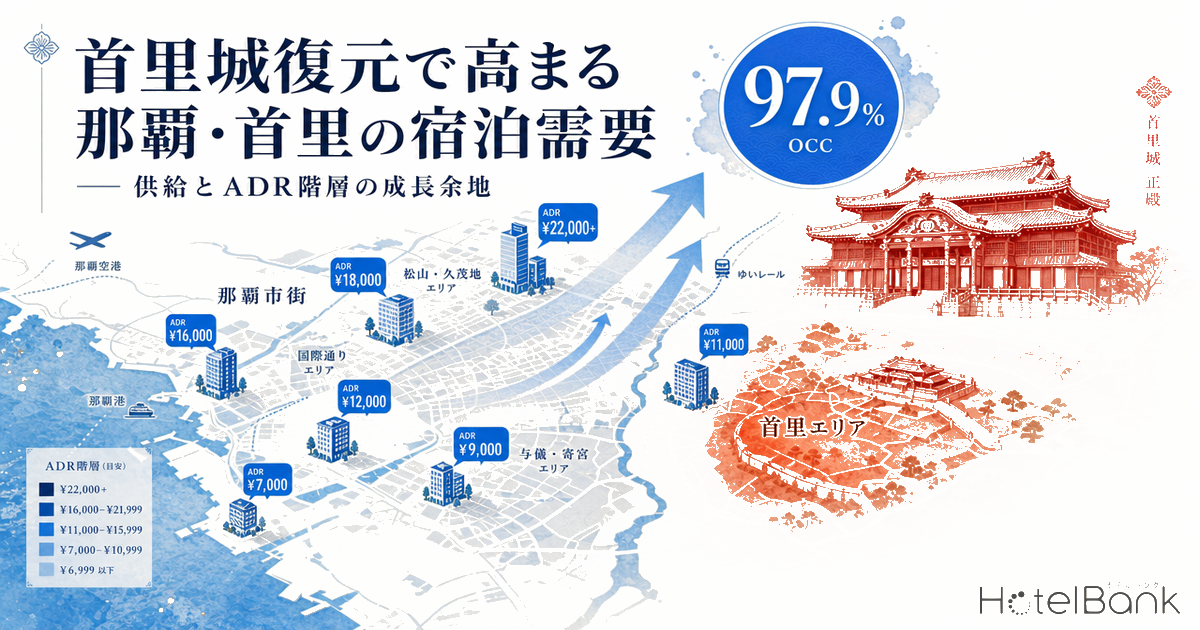
In autumn 2026, the reconstruction of the Seiden (main hall) of Shuri Castle — a roughly six-year undertaking — will be completed and opened to the public. The Naha and Shuri area, home to the World Heritage Site of Shuri Castle, already carries some of the strongest lodging demand in Japan; now the revival of this historic landmark adds a new demand driver. Drawing on MetroEngines Research public-price data and estimated occupancy (OCC), this article reads the hotel supply structure and ADR (average daily rate) hierarchy of the Naha–Shuri area and quantifies its room for future growth.
Metric Definitions Used in This Article
- ADR (average daily rate): the average of listed selling prices published on OTAs and similar channels. This differs from actual transaction prices (cross-checking against REIT disclosure data shows it tends to run about +25–30% above the booked ADR; because unsold higher-priced plans remain listed on OTAs, the average of published prices is structurally biased upward relative to booked prices). Per-room rate for double occupancy (tax included), averaged across all plans (from room-only to meal-inclusive plans).
- OCC (occupancy): the share of sold rooms against the total room supply within the area (an estimate based on OTA sales inventory).
- Data source: MetroEngines Research
- — Okinawa’s estimated OCC is 97.9% (as of May 2026, all-property average, N=1,003 properties). Every price tier from budget to luxury sits above 97%, with the supply-demand squeeze reaching across the board.
- — Naha’s ADR is up +19.1% year on year (May 2026, ¥18,300). Double-digit increases line up across the entire Naha metropolitan area, including Urasoe +36.8% and Ginowan +17.6%.
- — The autumn 2026 reconstruction of the Shuri Castle Seiden becomes a new reason to visit. Before the fire, Shuri Castle Park was Okinawa’s foremost tourism hub, drawing roughly 2.8 million visitors a year.
- — The 3 km radius around Shuri Castle holds 114 properties and 5,815 rooms. Supply is concentrated in the mid-scale and budget tiers, with luxury plus upper-midscale accounting for only about 13% of rooms.
- — The ADR range spans from roughly ¥12,000 at Toyoko Inn–class properties to about ¥57,000 at The Naha Terrace. The thinness of the upper tier signals the area’s room for growth, widening the opportunity to capture high-value-added demand.
A Supply-Demand Squeeze Across Every Category in Okinawa
First, consider the overall supply-demand balance in Okinawa. In May 2026, the prefecture’s estimated OCC reached 97.9% on an all-property average. This figure is aggregated across the 1,003 properties (roughly 50,765 rooms) within the prefecture that MetroEngines Research tracks and for which occupancy could be confirmed. By category, business hotels stand at 97.6%, city hotels at 98.5%, resort hotels at 98.5%, luxury (ADR ¥100,000 or more) at 98.8%, and capsule-type at 99.4% — uniformly high regardless of price tier.
In other words, Okinawa’s lodging demand is robust across the board, from economy to luxury, without skewing toward any single segment. This squeeze reflects a structure in which supply has not kept pace with the sheer number of visitors. A survey by the Okinawa Development Finance Corporation likewise reports that occupancy at the prefecture’s major hotels is on a recovery track across all types, consistent with this data.
Source: MetroEngines Research, compiled by the HotelBank Editorial Team
Naha’s ADR Is Up +19.1% Year on Year, With a Clear Upward Trend
The squeeze is also clearly reflected in prices. Naha’s ADR in May 2026 was ¥18,300, up +19.1% year on year from ¥15,300 in the same month a year earlier. Other areas in the prefecture show the same pattern, with Urasoe up +36.8%, Ginowan +17.6%, and Tomigusuku +15.0% — double-digit gains lining up across the entire Naha metropolitan area. One of the demand factors pushing Naha’s ADR higher is cruise-ship calls, an effect we analyze in detail in Verifying the ADR Premium in Yokohama, Kobe, and Naha.
Overlaying Naha’s monthly ADR trajectory year by year reveals both seasonality and a steady year-over-year lift in the baseline. In 2024 the rate hovered in the ¥13,000–¥17,000 range throughout the year; in 2025 it shifted up to the ¥15,000–¥18,000 range; and in 2026, some months have topped ¥20,000 (such as February), with the entire price range stepping up. The seasonality that peaks in midsummer (July–August) is preserved, while the underlying base price level itself is rising.
Source: MetroEngines Research, compiled by the HotelBank Editorial Team
Shuri Castle’s Reconstruction as a New Demand Driver
The autumn 2026 reconstruction of the Shuri Castle Seiden adds a fresh tailwind to this rising demand. Shuri Castle lost its Seiden and other major structures in a fire in October 2019, but reconstruction has proceeded under the theme of a “reconstruction on display,” opening the rebuilding process itself to the public. The exterior of the Seiden was completed in July 2025, and the temporary roof that had covered it was dismantled by the end of that year — revealing its graceful form for the first time in about six years. Roughly 60,000 red roof tiles were used, and after interior painting and the installation of fire-prevention equipment, the interior is scheduled to open to the public in autumn 2026 (source: Okinawa Commemorative National Government Park; Arukikata).
The full revival of Shuri Castle — a World Heritage Site and a symbol of the Ryukyu Kingdom — provides a powerful reason to visit for school excursions, domestic tourism, and inbound travelers alike. Before the fire, Shuri Castle Park was Okinawa’s foremost tourism hub, drawing roughly 2.8 million visitors a year. With the return of the Seiden, its greatest attraction, the potential for stay demand around the Shuri area to climb further is high. This stands out as a factor that lifts the medium- to long-term growth potential of the Naha–Shuri lodging market.
Supply Structure Within 3 km of Shuri Castle — Weighted Toward Mid-Scale and Budget
Taking Shuri Castle — the heart of the demand driver — as the starting point, let us examine hotel supply within a 3 km radius. Within MetroEngines Research’s coverage, 114 properties and a total of 5,815 rooms operate inside this radius. The area centers on the Naha urban core, including Kokusai-dori and Shintoshin (Omoromachi), where both tourism and business hubs cluster.
Among the largest by room count are DoubleTree by Hilton Naha Shuri Castle (333 rooms), Hewitt Resort Naha (331 rooms), Novotel Okinawa Naha (328 rooms), Okinawa Miyako Hotel (307 rooms), and Hyatt Regency Naha Okinawa (294 rooms; opened July 2015 / Hyatt Hotels Japan, “Press Release, April 2026”). Alongside these large properties, limited-service brands such as Daiwa Roynet, Almont, and Toyoko Inn form a substantial layer.
Tallying room counts by grade, the center of gravity of supply lies in the midscale (18 properties, 2,211 rooms) and budget (44 properties, 1,399 rooms) tiers. Luxury, by contrast, accounts for only 2 properties and 622 rooms, and upper-midscale just 2 properties and 146 rooms, leaving the upper grades at only about 13% of the total room share. In short, even though demand is squeezed across every price tier, supply is weighted toward the mid- and lower-price tiers, and relative headroom remains in the high-rate band. New supply activity is also continuing in Naha, including a development project in the Maejima district.
Source: MetroEngines Research, compiled by the HotelBank Editorial Team (N=114 properties)
| Grade | Properties | Rooms | Room share |
|---|---|---|---|
| Luxury | 2 | 622 | 10.7% |
| Upper-midscale | 2 | 146 | 2.5% |
| Midscale | 18 | 2,211 | 38.0% |
| Economy | 10 | 888 | 15.3% |
| Budget | 44 | 1,399 | 24.1% |
| Unclassified | 38 | 549 | 9.4% |
Source: MetroEngines Research, compiled by the HotelBank Editorial Team
The ADR Hierarchy — A Price Range That Widens at the Top
Looking at the ADR levels of major properties within the same radius from May through August 2026, the breadth of the price range stands out. At the very top, The Naha Terrace runs about ¥57,000 and Station Hotel Makishi about ¥51,900, both above ¥50,000. Next come Hyatt Regency Naha Okinawa at about ¥43,400, Novotel Okinawa Naha at about ¥38,700, and DoubleTree by Hilton Naha Shuri Castle at about ¥35,300, forming an upper band in the high ¥30,000s to ¥40,000s.
Meanwhile, the core limited-service properties cluster in the high ¥10,000s to ¥30,000s, functioning as the receiving capacity for tourist bookings. Given that demand is squeezed across every price tier, the upper-band rooms are highly scarce, and with the Shuri Castle reconstruction as a catalyst for capturing high-value-added demand, this is a band with upside on both price and experience. This is not a question of any single property’s merits, but a structural market opportunity — the area as a whole has room to add depth in the upper grades.
Source: MetroEngines Research, compiled by the HotelBank Editorial Team
Map of the Competitive Distribution Around Shuri Castle
The geographic distribution of major properties shows that lodging supply concentrates not in the immediate vicinity of Shuri Castle itself, but at the transit nodes of the Naha urban core — Kokusai-dori, Shintoshin (Omoromachi), and Makishi. While urban hotels that serve as access points to Shuri Castle act as the receiving capacity for demand, lodging supply in the Shuri district itself is limited, suggesting further room for growth on the locational front as well. Changes in access demand to Naha, including by air, are also worth considering as part of this picture.
Source: MetroEngines Research, compiled by the HotelBank Editorial Team
Conclusion — Demand Squeezed Across the Board, and Headroom at the Top
As of May 2026, Okinawa’s lodging supply-demand sits in an extremely tight state, with OCC above 97% across every category, and Naha’s ADR continues to climb strongly at +19.1% year on year. Against this robust demand, the autumn 2026 reconstruction of the Shuri Castle Seiden adds a new reason to visit — the revival of a World Heritage–class landmark.
At the same time, supply within a 3 km radius of Shuri Castle is weighted toward the mid-scale and budget tiers, with the luxury and upper-midscale upper band at only about 13% of room share. Given that demand is squeezed across every price tier, this thinness at the top in fact signals the area’s room for growth. By capturing the high-value-added demand catalyzed by the Shuri Castle reconstruction, opportunities such as expanding upper-grade supply and gradually raising ADR are opening up across the Naha–Shuri area.
Related Reading
References & Sources
■ Data sources
OTA public-price data and estimated occupancy (OCC) compiled by MetroEngines Research. Okinawa covers N=1,003 properties / roughly 50,765 rooms; the 3 km radius around Shuri Castle covers N=114 properties / 5,815 rooms. ADR and OCC are as of May 2026; monthly trends span 2024–2026.
■ Estimation assumptions
ADR is the all-plan average of published OTA selling prices (double occupancy, tax included) and differs from actual transaction prices (cross-checking against REIT disclosure data shows it runs about +25–30% above the booked ADR). OCC is an estimate based on OTA sales inventory. Grade classification is an in-area categorization based on ADR level.
■ Limitations & caveats
Because figures are based on published prices, they diverge from transaction prices, so the absolute ADR level is biased upward. OCC is estimated from trackable inventory and is not a full census. The demand increase from the Shuri Castle reconstruction is a qualitative outlook and does not include a quantitative forecast of visitor numbers or lodging demand.
■ Market data
- MetroEngines Research — OTA public-price data (Okinawa N=1,003 properties / 50,765 rooms; Shuri Castle 3 km radius N=114 properties), estimated occupancy (OCC)
■ Shuri Castle & tourism statistics
- Okinawa Commemorative National Government Park, “Shuri Castle – Current Highlights”
- Arukikata, “Autumn 2026: The Shuri Castle Seiden Is Rebuilt!”
- Okinawa Story, “The Shuri Castle Seiden Reconstruction Today”
- Okinawa Development Finance Corporation, “Occupancy Status of Major Hotels in the Prefecture”
- Japan Tourism Agency, “Overnight Travel Statistics Survey”
■ Hotel information
- Hyatt Hotels Japan, “Press Release, April 2026”
Source: Hyatt Hotels Japan, “Press Release, April 2026”