

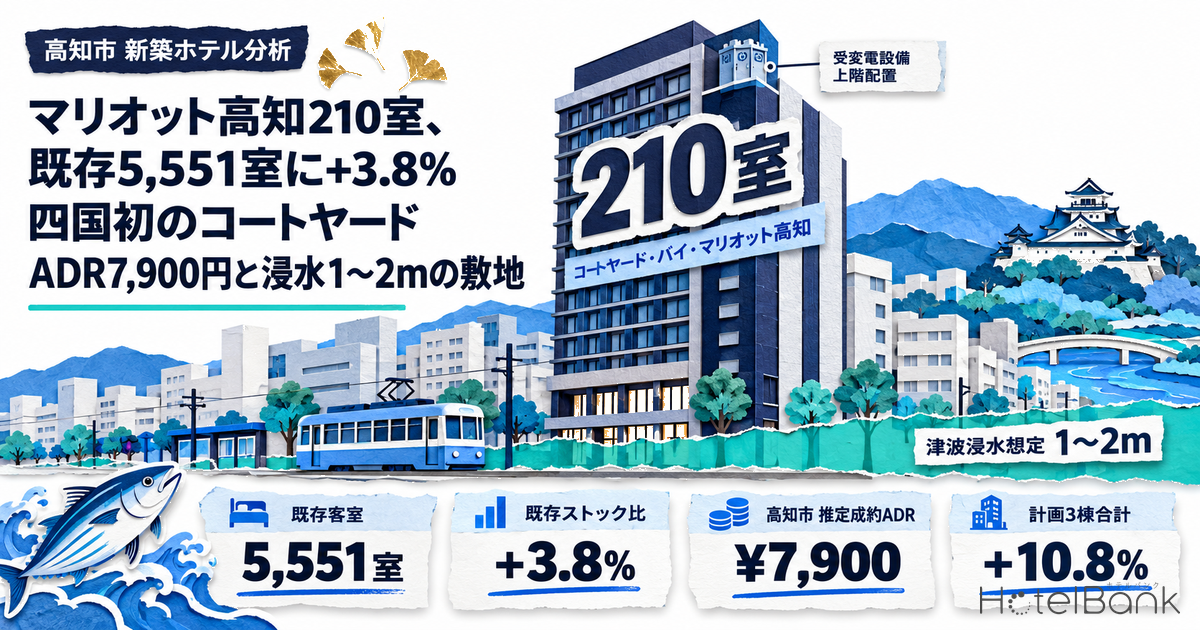
On September 17, 2026, Shikoku Railway Company (JR Shikoku) held a groundbreaking ceremony for the Courtyard by Marriott Kochi (コートヤード・バイ・マリオット高知) in Honmachi 3-chome, Kochi City, and construction is now under way. The 14-storey building is planned to have 210 rooms, an all-day dining restaurant, meeting rooms and a fitness gym, with opening scheduled for autumn 2028. It will be the first Courtyard by Marriott in Shikoku, built on the former site of the Kochi Shimbun Broadcasting Hall along the city’s main tram street (Densha-dori). This article places this single new-build project within Kochi City’s room stock and estimated settled ADR, and estimates how much new demand the 210 rooms will need to capture. We also check the site’s land price and the tsunami and long-term inundation scenarios using the MLIT Real Estate Information Library and Kochi Prefecture’s published materials, and show with a simple model how flood-protection capex and business continuity planning (BCP) affect the project’s economics.
How This Article Relates to Our Earlier Coverage
HotelBank has previously covered the price tiers of Kochi Prefecture’s 25 municipalities and the rebranding of existing hotels to ANA Crowne Plaza (Kochi, Hamamatsu, Chiryu). This article focuses narrowly on two questions: how much room the market has to absorb one new-build hotel (Courtyard by Marriott Kochi), and how the site’s disaster risk affects development cost, insurance and BCP.
Metric Definitions Used in This Article
- ADR (Average Daily Rate): An estimated settled rate (tax-excluded equivalent), calculated by applying a category-specific adjustment factor to the lowest-priced plan each property publishes on OTAs (per room, double occupancy, tax included). Benchmarked against property-level results disclosed by listed hotel REITs (91 properties, most recent 3 months), the median error is approximately 7%. These are estimates and differ from each property’s actual settled rates and accounting figures. Area-level ADR is the median across the properties covered (the level of a typical property in the area).
- OCC (Occupancy Rate): The share of sold rooms in total rooms in the area (an estimate based on OTA sales inventory; consistency checks against REIT monthly disclosures confirm accuracy within roughly a few percentage points). Because it is based on how OTA-listed inventory sells through, it differs from each property’s actual occupancy. This article uses values as of the day before arrival (LT1).
- Booking curve / LT: The trajectory of remaining OTA rooms toward the check-in date. LT (lead time) = days until check-in. This article uses only the LT45→LT1 range.
- Room occupancy rate (Japan Tourism Agency): Published figures from the Japan Tourism Agency’s Overnight Travel Statistics Survey (final 2025 data, Kochi Prefecture).
- Listed price: Per-room rate for two guests sharing one room (tax included). Stated explicitly whenever referenced in the text.
- Data sources: MetroEngines Research & Consulting / Japan Tourism Agency, Overnight Travel Statistics Survey / MLIT Real Estate Information Library / MLIT National Land Numerical Information / MIC & METI, Economic Census for Business Activity / Kochi Prefecture, Nankai Earthquake Long-Term Inundation Countermeasure Study
Source: Shikoku Railway Company (announcement of October 18, 2024) / MetroEngines Research & Consulting (N=57–60 properties) / MLIT National Land Numerical Information (tsunami inundation scenarios), GSI elevation data
- The 210 rooms equal +3.8% of the 5,551 rooms across the 63 hotels and ryokan currently confirmed as operating in Kochi City. Including the two other buildings due to open or complete in 2027–2028 (392 rooms in total), the three projects add +602 rooms, or +10.8%.
- Kochi City’s estimated settled ADR averaged ¥7,900 over the last 12 months (September 2025–August 2026), up 6.3% year on year. The monthly range, from the low in June (¥6,900) to the high in August (¥9,600), is a narrow 1.38x — a market in which business demand supports a year-round floor.
- On a 12-month average by property, the ¥10,000-and-above price band contains 13 properties and 1,515 rooms. The Courtyard’s 210 rooms would add +13.9% to this upper band, making absorption a higher hurdle than the +3.8% city-wide figure suggests.
- Estimated weekday (Mon–Thu) OCC in June–August 2026 was 79–85%, and Saturday was 94.6%. During the Yosakoi Festival (August 9–13) it exceeded 99%, with no inventory left on peak dates. The room for 210 new rooms to capture demand lies on weekdays and in off-peak months.
- The site is in a commercial zone (600% floor-area ratio), with a tsunami inundation scenario of 1–2m in the National Land Numerical Information and an elevation of 1.6m. Of the city’s existing 5,551 rooms, 95.9% are likewise inside the tsunami inundation zone, making flood risk a shared precondition across the city center. As a result, design that allows a fast reopening after flooding — such as placing power-receiving and transformer equipment on upper floors — becomes a point of differentiation against competitors.
Project Overview — Shikoku’s First Courtyard, Owned by JR Shikoku with Operations Outsourced
According to JR Shikoku’s announcement of October 18, 2024, the Courtyard by Marriott Kochi site is at 3-40-1 Honmachi, Kochi City (lot number), with a total floor area of approximately 11,000㎡, 14 storeys above ground and 210 planned rooms. JR Shikoku will own the hotel, and EastGate Hospitality Co., Ltd. will operate it. EastGate has a track record of taking over operation of the Novotel Okinawa Naha, and at the time of the announcement operated Hotel Springs Makuhari and Best Western Onna / Koki. The hotel is scheduled to participate in Marriott International’s loyalty program, Marriott Bonvoy.
| Item | Details |
|---|---|
| Name | Courtyard by Marriott Kochi (コートヤード・バイ・マリオット高知) |
| Site | 3-40-1 Honmachi, Kochi City, Kochi Prefecture (lot number) / on Densha-dori, former site of the Kochi Shimbun Broadcasting Hall |
| Building scale | Total floor area approx. 11,000㎡, 14 storeys above ground |
| Rooms | 210 (planned) |
| Facilities | All-day dining, meeting rooms, fitness gym, etc. |
| Owner / Operator | Shikoku Railway Company / EastGate Hospitality Co., Ltd. |
| Construction | “JR Shikoku Kochi New Hotel (tentative name) New Construction and Other Works” — Obayashi-Goda Specified Construction Joint Venture, contract price ¥8.5 billion (contract dated April 18, 2025) |
| Groundbreaking / Opening | September 17, 2026 / Autumn 2028 |
Source: Shikoku Railway Company, “Courtyard by Marriott Kochi to open in autumn 2028” (October 18, 2024); the company’s “Public Notice of Successful Bidders (Construction Works)” (April 28, 2025); TV Kochi (September 17, 2026)
The construction contract can be confirmed in the “Public Notice of Successful Bidders (Construction Works)” that JR Shikoku published on April 28, 2025. The contract covers the entire “JR Shikoku Kochi New Hotel (tentative name) New Construction and Other Works”; the contractor is the Obayashi-Goda Specified Construction Joint Venture, represented by Obayashi Corporation’s Shikoku branch, and the contract price is ¥8.5 billion (¥8,500,000,000). That works out to roughly ¥40.5 million per room across 210 rooms, or about ¥773,000 per ㎡ over the approx. 11,000㎡ total floor area. Nationwide, accommodation-use buildings in the Building Construction Starts Statistics (2024, planned construction cost ÷ floor area) averaged about ¥591,000 per ㎡, so this project is 1.31 times that level. Because the contract price includes “other works,” its scope differs from pure building cost, but the unit cost reflects a 14-storey configuration with more common space and dining and meeting functions than a limited-service hotel. Total floor area per room is about 52㎡.
The JR Shikoku group opened JR Clement Inn Kochi (187 rooms) in Kitahonmachi near Kochi Station in 2020, so this will be its second hotel in the city. According to TV Kochi, the exterior design draws on Tosa tsumugi (pongee silk) and the guest rooms on the prefecture’s clear rivers, making use of a location overlooking Kochi Castle. JR Shikoku’s announcement also cites a role as a base for adventure travel on the Niyodo, Yoshino and Monobe rivers, all within an hour’s drive.
Market Rates — Kochi City Estimated Settled ADR of ¥7,900, +6.3% YoY
MetroEngines Research data show that Kochi City’s estimated settled ADR averaged ¥7,900 (simple average) over the last 12 months (September 2025–August 2026), up 6.3% from ¥7,400 in the prior-year period (September 2024–August 2025). Each month covers 57–60 properties. By category, business hotels — the most numerous at 43–46 properties — averaged ¥7,700, up 6.0% year on year, moving almost in line with the overall market. City hotels number only four, too small a sample for rate comparisons, so this article does not use them for category comparisons.
Source: MetroEngines Research & Consulting (Kochi City, all categories, estimated settled ADR, N=57–60 properties). Months from September 2026 onward are not shown because they are estimates based on listed rates at the time of the survey
By month, the highest is August, home to the Yosakoi Festival (¥9,600 in August 2026, +5.8% YoY), and the lowest is June, the rainy season (¥6,900, +2.0%). In only one of the 12 months — February 2026 (−0.3%) — did the rate fall below the same month a year earlier, while some months posted double-digit gains, such as October 2025 (+14.0%) and January 2026 (+15.6%). The gap between the highest and lowest months is just 1.38x. Compared with resort-type markets where rates nearly double in summer and autumn travel seasons, this reads as a prefectural-capital rate structure in which weekday business demand supports a year-round floor and seasonal swings are small.
| Month | All categories | YoY | Business | YoY | Properties (all categories) |
|---|---|---|---|---|---|
| Sep 2025 | ¥7,566 | +7.4% | ¥7,506 | +6.9% | 58 |
| Oct 2025 | ¥7,987 | +14.0% | ¥7,928 | +13.2% | 58 |
| Nov 2025 | ¥8,901 | +10.4% | ¥8,784 | +10.0% | 58 |
| Dec 2025 | ¥7,438 | +7.5% | ¥7,148 | +6.2% | 59 |
| Jan 2026 | ¥7,881 | +15.6% | ¥7,268 | +12.9% | 58 |
| Feb 2026 | ¥7,551 | −0.3% | ¥7,363 | −1.3% | 59 |
| Mar 2026 | ¥7,938 | +5.0% | ¥7,672 | +5.1% | 60 |
| Apr 2026 | ¥7,492 | +1.5% | ¥7,422 | +3.1% | 60 |
| May 2026 | ¥8,042 | +6.7% | ¥7,985 | +6.7% | 60 |
| Jun 2026 | ¥6,938 | +2.0% | ¥6,849 | +3.8% | 60 |
| Jul 2026 | ¥7,230 | +1.2% | ¥7,192 | +2.9% | 58 |
| Aug 2026 | ¥9,575 | +5.8% | ¥9,282 | +3.4% | 57 |
| 12-month average | ¥7,878 | +6.3% | ¥7,700 | +6.0% | 57–60 |
Source: MetroEngines Research & Consulting (Kochi City, estimated settled ADR, tax-excluded equivalent. Business hotels: 43–46 properties per month)
To look at the market’s rate levels in more detail, we calculated each operating property’s 12-month average estimated settled ADR and grouped the results by price band (59 properties and 5,434 rooms with at least six months of observations). The property-level median is ¥7,600, and the ¥10,000-and-above band holds 13 properties and 1,515 rooms, about 28% of all rooms. Five properties with 489 rooms are at ¥15,000 or more, three of which are ryokan.
| 12-month average est. settled ADR per property | Properties | Rooms | Share of rooms | Main categories |
|---|---|---|---|---|
| Under ¥6,000 | 9 | 499 | 9.2% | Business 9 |
| ¥6,000–8,000 | 22 | 1,784 | 32.8% | Business 16, ryokan 5, city 1 |
| ¥8,000–10,000 | 15 | 1,636 | 30.1% | Business 14, city 1 |
| ¥10,000–15,000 | 8 | 1,026 | 18.9% | Business 5, city 2, ryokan 1 |
| ¥15,000 and above | 5 | 489 | 9.0% | Ryokan 3, business 1, resort 1 |
| Total | 59 | 5,434 | 100.0% |
Source: MetroEngines Research & Consulting (Kochi City; 59 properties with at least six months of observations between September 2025 and August 2026, 5 rooms or more)
Courtyard by Marriott is a brand Marriott International operates at more than 1,310 hotels in 60 countries and territories (per JR Shikoku’s October 18, 2024 announcement), and this project, too, will have an all-day dining restaurant and meeting rooms in addition to guest rooms. It is generally positioned between full-service and limited-service. In price terms, it is likely to overlap with Kochi City’s top two bands (¥10,000 and above). If the 210 rooms fall into this band, rooms in that band would rise from 1,515 to 1,725, a 13.9% increase — more than three times the +3.8% city-wide ratio when measured against competing rooms. Estimating absorption capacity therefore requires looking not only at city-wide supply and demand but also at the depth of demand in the upper price bands.
Supply Pipeline — Three Buildings and 602 Rooms in the City Center by 2028
Kochi City currently has 63 operating hotels and ryokan with 5,551 rooms (five categories — business, city, resort, ryokan and capsule — with listed rates observed in June–August 2026). Eight of them have 200 rooms or more, including Toyoko Inn Kochi (209 rooms), which opened in 2026. The Courtyard’s 210 rooms equal +3.8% of this existing stock.
Combining MLIT’s Building Activity Statistics with company announcements and press reports, three projects will line up along Densha-dori in the city center in 2027–2028. Kyoritsu Maintenance’s Japanese-style brand “Onyado Nono Kochi” (御宿 野乃 高知, tentative name; 12 storeys, 172 rooms) in Honmachi 1-chome is scheduled to open in spring 2027 or later, the brand’s first location in Shikoku. Route Inn Group’s “Hotel Route-Inn Grand Kochi” (ホテルルートインGrand高知, tentative name; 14 storeys, 220 rooms) in Harimaya-cho 3-chome broke ground in June 2026, and according to Kentsu Shimbun, completion is expected around spring 2028. Once complete, the group will have hotels in all 47 prefectures.
| Project | Location | Rooms | Scale | Opening / completion |
|---|---|---|---|---|
| Onyado Nono Kochi (tentative) | Honmachi 1-chome (on Densha-dori) | 172 | 12 storeys | Spring 2027 or later |
| Hotel Route-Inn Grand Kochi (tentative) | Harimaya-cho 3-chome (on Densha-dori) | 220 | 14 storeys, approx. 10,567㎡ total floor area | Completion around spring 2028 |
| Courtyard by Marriott Kochi | Honmachi 3-chome (on Densha-dori) | 210 | 14 storeys, approx. 11,000㎡ total floor area | Autumn 2028 |
| Total, 3 projects | 602 | +10.8% on existing 5,551 rooms |
Source: Compiled by MetroEngines Research & Consulting from MLIT Building Activity Statistics / Shikoku Railway Company announcements / Sun Sun TV (December 24, 2024; May 21, 2025) / Kochi Shimbun (May 21, 2025) / Kentsu Shimbun (June 2, 2026). *Based on building confirmation applications and announcements as of the survey date. Counts and room totals are expected to rise as further applications are filed; treat these figures as the lower bound of the confirmed pipeline at present
Source: MetroEngines Research & Consulting (based on confirmed OTA listings, 63 existing properties) / MLIT Building Activity Statistics, company announcements and press reports. Each year’s value is cumulative, adding openings and completions scheduled within that year; closures of existing properties are not factored in
If all three projects open as planned, the city’s room count will reach 6,153 in 2028, +10.8% from today. Adding the 209 rooms of Toyoko Inn Kochi, which opened in 2026, the city gains 811 rooms over the three years 2026–2028. All are mid- to high-rise buildings of around 200 rooms in the center along Densha-dori. Of the three, only the Courtyard is an international brand; the other two are upper-tier and Japanese-style brands of domestic chains. So even if they open around the same time, the range of directly competing rooms is not uniform.
In the Japan Tourism Agency’s Overnight Travel Statistics Survey (final 2025 data), Kochi Prefecture’s room occupancy was 68.1% for business hotels, 70.8% for city hotels and 48.6% for all accommodation. Compared with the national averages (business hotels 75.3%, city hotels 74.1%), business hotels are 7.2pt lower, leaving headroom in how rooms fill. If city room supply rises by +10.8%, keeping occupancy at today’s level would require lodging demand to grow by the same amount.
Let us split that “same amount” requirement into three scenarios by demand growth. Assume the 5,551 rooms of 2026 become 6,153 rooms (+10.8%) by the end of 2028, with no closures of existing properties. As the market-wide baseline occupancy we use the Japan Tourism Agency’s figure for Kochi Prefecture business hotels (final 2025 data, full year 68.1%). If demand is flat, 2028 market occupancy falls 6.7pt to 61.4% for the full year. At +3% a year it holds at 65.2% (−2.9pt), and maintaining today’s level requires demand growth of +5.3% a year for two consecutive years. Kochi City’s estimated settled ADR is rising at +6.3% YoY, but that is rate growth; it does not show that the volume of lodging demand is growing at the same pace.
| Scenario | Lodging demand growth (annual, assumed) | 2028 demand (2026=100) | 2028 market occupancy (full year, est.) | vs. baseline (68.1%) |
|---|---|---|---|---|
| Pessimistic | 0.0% (flat) | 100.0 | 61.4% | −6.7pt |
| Mid | +3.0% | 106.1 | 65.2% | −2.9pt |
| Optimistic (current level maintained) | +5.3% | 110.9 | 68.1% | ±0.0pt |
Source: Estimated from the Japan Tourism Agency’s Overnight Travel Statistics Survey (final 2025 data, Kochi Prefecture business hotel room occupancy, full year 68.1%) and MetroEngines Research & Consulting (Kochi City’s 63 existing properties / 5,551 rooms, 3 planned projects / 602 rooms). Occupancy = 68.1% × demand index ÷ room index (6,153 ÷ 5,551 = 1.108). Demand growth rates are illustrative assumptions, not forecasts. Because the Courtyard opens in autumn 2028, its rooms contribute only partially within calendar 2028
Depth of Demand — Weekdays at 79–85%, Saturdays and Yosakoi Near Full
First, we check the composition of demand from the employment and residential catchment. Within a 1km radius of the site (near 3-2-15 Honmachi, the former Kochi Shimbun Broadcasting Hall; 33.5587°N, 133.5343°E), the 2021 Economic Census counts 2,925 establishments and 27,407 workers. Office-type industries account for 22.3%, a business cluster typical of a prefectural capital’s core where government, finance and commerce concentrate. Kochi Prefecture’s total guest nights (final 2025 data) also show 1.447 million guest nights at facilities where tourism guests make up less than 50%, exceeding the 1.029 million at facilities where they are 50% or more — business and other purposes account for a large share of stays across the prefecture as well.
Meanwhile, the resident population within a 1.5km radius (National Land Numerical Information 250m mesh estimates) is projected to fall from 37,770 in 2020 to 35,550 in 2025 and 30,141 in 2040 — down 20.2% from 2020 and 15.2% from 2025. The share of residents aged 65 and over was 34.5% in 2025. These resident figures are census-based estimates, not daytime population or visitor counts. Because lodging demand comes mainly from business travelers and tourists from outside the area, a shrinking resident population does not translate directly into falling lodging demand. However, the depth of retail and dining in the city center is shaped by the resident population over the long term, which raises the importance of a hotel having its own food and beverage outlets.
Source: MLIT National Land Numerical Information (future population estimates by 250m mesh, 2024 MLIT National Policy Bureau estimates). Center = near the site; radius 1.5km
Next, we look at Kochi City’s supply and demand from OTA inventory data. For a fixed cohort of properties that list at least 30% of their total rooms on major booking sites, we averaged estimated OCC as of the day before arrival (LT1) by day of week for June–August 2026 (excluding August 8–16, which covers the Yosakoi Festival and Obon). Weekday Monday–Thursday ran 79.4–84.5%, Friday 87.3%, Saturday 94.6% and Sunday 79.1%. Saturdays are close to full, while weekdays and Sundays leave around 15pt of rooms unsold.
Source: MetroEngines Research & Consulting (Kochi City, estimated OCC at LT1. 34–36 properties / 3,285–3,370 rooms (based on major booking-site listings). June 10–August 31, 2026, excluding August 8–16)
During the Yosakoi Festival, from August 9 to 13, 2026, estimated OCC on the four observed dates (9th, 11th, 12th and 13th) reached 99.3–99.9%, leaving only 2–10 of the cohort’s 3,285 rooms unsold as of the day before. The listed price on the main festival day, August 11 (cohort average, tax included), was ¥48,900, about four times the weekday level (Mon–Thu average for June–August, roughly ¥12,000). Existing rooms cannot fully meet demand in this period, which gives the 210 new rooms an opportunity to set high rates on peak dates. Such peak dates, however, number only a few per year. What drives annual profitability is occupancy on weekdays and in off-peak months such as June, December and January. We covered Yosakoi booking pace in detail in “Yosakoi 2026: Kochi Aug 11 86.9% Sold Out at 45 Days”.
Source: MetroEngines Research & Consulting (Kochi City, all categories, average booking curve across all stay dates in each month, LT45→LT1. 34–35 properties / 3,159–3,333 rooms (based on major booking-site listings). June covers 21 days from June 10)
On the booking curve, estimated OCC at 45 days before arrival (LT45) was in the 57% range for June and July and 65.8% for August, and from there it built up by +24.4pt in June, +27.1pt in July and +23.3pt in August by the day before arrival. In July and August, more than 10pt was added in the final two weeks alone (from LT14; June +9.9pt), indicating a market with a large share of late-moving demand. Markets centered on business travel tend to see many last-minute bookings, which is consistent with the seasonal pattern in the Japan Tourism Agency’s final 2025 data: Kochi Prefecture business hotel occupancy is high in November (76.1%) and October (73.5%) and low in December (62.4%) and January (59.6%).
Source: Compiled by MetroEngines Research & Consulting from the Japan Tourism Agency’s Overnight Travel Statistics Survey (final 2025 data, Kochi Prefecture, room occupancy by facility type)
From these figures, we can roughly estimate the volume of demand the 210 rooms need to capture. If the Courtyard runs at an annual OCC of 70% (a full-year assumption), it sells about 54,000 room nights a year. If Kochi City’s existing 5,551 rooms run at 68.1%, in line with the Japan Tourism Agency’s business hotel figure, the city sells about 1.38 million room nights a year, and the single Courtyard accounts for about 3.9% of that. Once all three projects open, demand would need to rise by about 10.8% to hold occupancy at the same level. Since Saturdays and peak dates are already near full, most of the additional demand would have to come from weekday business and MICE demand and off-season leisure demand. With meeting rooms and an international loyalty program that can attract corporate and inbound demand, the Courtyard is well placed to help expand this weekday demand. Kochi’s recent domestic demand growth is covered in “Domestic Demand H1 2026: Tottori & Ibaraki +27.7%, Kochi OCC +7.2pt”.
Location Assessment — Commercial Zone, 600% FAR, Land Price +3.8% over Four Years
Checking the site (near 3-2-15 Honmachi) in MLIT’s Real Estate Information Library, the zoning is commercial, with a designated floor-area ratio of 600% and a building coverage ratio of 80%. The plan for approx. 11,000㎡ of floor area over 14 storeys makes use of this high-FAR designation. The official land price point “Kochi 5-4 (2-104 Honmachi),” about 290m east of the site, was ¥164,000 per ㎡ as of January 1, 2026, up 1.2% year on year.
Source: Compiled by MetroEngines Research & Consulting from the MLIT Real Estate Information Library (official land prices)
This point was flat in 2022 and 2023 and turned upward from 2024. Over the four years from 2022 to 2026 it rose 3.8%. In the central shopping district, “Kochi 5-12 (1-170 Obiyamachi, etc.)” was ¥273,000 in 2026 (+1.5%) and “Kochi 5-1 (1-38-1 Honmachi, etc.)” was also ¥273,000 (+3.0%), while “Kochi 5-6 (1-108 Harimaya-cho),” near Harimaya Bridge, was ¥221,000 (+0.9%). Land price growth is modest compared with the centers of Japan’s three major metropolitan areas, but the continuing upward trend supports asset value for owners planning to hold long term.
| Item | Result near the site | Source / notes |
|---|---|---|
| Zoning | Commercial zone, FAR 600%, building coverage 80% | MLIT Real Estate Information Library (zoning) |
| Elevation | T.P.+1.6m | GSI elevation data (1m laser survey) |
| Tsunami inundation scenario | 1m to under 2m | National Land Numerical Information, tsunami inundation scenarios (Kochi Prefecture, set in 2016) |
| Flood inundation scenario (maximum assumed scale) | 0.5m to under 3.0m (Kagami and Kokubu rivers) | National Land Numerical Information, flood inundation zones |
| Landform class for liquefaction | Former river channel / former pond (class highly prone to liquefaction) | MLIT liquefaction tendency map based on landform classification (250m mesh) |
| Long-term inundation elevation criterion | Applies (T.P.+2.7m or lower) | Kochi Prefecture, “Nankai Earthquake Long-Term Inundation Countermeasure Study” (March 2013) |
Source: Compiled by MetroEngines Research & Consulting from the MLIT Real Estate Information Library. The site location is the point obtained by converting the residential address of the former Kochi Shimbun Broadcasting Hall with the GSI geocoder, and may differ from individual parts of the actual building
Inundation Scenarios — 95.9% of City Stock Shares the Same Conditions; the Differentiator Is “Speed of Reopening”
Kochi City is expected to experience significant ground subsidence in a Nankai Trough earthquake. Kochi Prefecture’s “Nankai Earthquake Long-Term Inundation Countermeasure Study” (March 2013), based on the Central Disaster Management Council’s 2003 model, assumes 1.95m of subsidence near Urado Bay and concludes that the area currently at T.P.+2.7m or lower — about 2,800ha — would be inundated for an extended period. The study states that the central urban area, National Route 32, the prefectural and city government offices and a regional disaster base hospital are all within the long-term inundation zone. In the 1946 Showa Nankai Earthquake, Kochi City also experienced about 1.2m of subsidence, and a wide area including the urban core was inundated.
On tsunamis, Kochi Prefecture released a new tsunami inundation forecast in October 2025, its first in 13 years. The analysis grid was refined from 10m to 5m squares, and in Kochi City the area inundated by 1cm or more shrank from 4,689.5ha to 4,367.6ha. According to Kochi Shimbun, in the city center inundation of 3–5m is forecast around Densha-dori east of Harimaya Bridge and 1–2m around Otesuji and Kochi Station, with inundation of the city center beginning 40–60 minutes after the earthquake. In the National Land Numerical Information tsunami inundation scenario (set in 2016) used for this article’s map and tallies, the site also falls in the 1–2m class, not materially different from the new forecast. Design for individual sites should nonetheless be re-checked against the new forecast maps published by the prefecture.
Source: MetroEngines Research & Consulting (Kochi City’s 63 existing properties; circle size = number of rooms) / MLIT National Land Numerical Information (tsunami inundation scenarios). The two other planned buildings are placed at the representative point of their chome as approximate locations
The key point is that these inundation conditions are not unique to the site. Matching the locations of Kochi City’s 63 existing properties (5,551 rooms) against the same tsunami inundation scenario, 58 properties and 5,324 rooms — 95.9% of rooms — fall within the inundation zone. The largest group is the same 1–2m class as the site, with 38 properties and 4,097 rooms (73.8% of rooms). By elevation, 56 properties and 5,180 rooms (93.3%) sit at or below T.P.+2.7m, the long-term inundation criterion. In other words, flood risk is not something a hotel business in central Kochi can avoid; it is a precondition shared by every operator.
Source: MetroEngines Research & Consulting (Kochi City’s 63 existing properties / 5,551 rooms) / MLIT National Land Numerical Information (tsunami inundation scenarios, set by Kochi Prefecture in 2016)
If so, the way a new-build hotel can differentiate itself from existing properties is not by avoiding inundation but by how quickly it can reopen afterward. The “Guidelines for Flood Countermeasures for Electrical Equipment in Buildings,” published by MLIT and METI in June 2020, set out new-build measures: placing power-receiving, transformer and other electrical equipment on floors above the assumed inundation depth; installing flood barriers at entrances and openings to keep water out; and choosing equipment that remains usable even if flooded. On a site with an assumed inundation of 1–2m, the basic approach is to place the power-receiving/transformer equipment and emergency generators on the second floor or higher.
Post-disaster lodging demand is another consideration. After the 2026 Kumamoto Earthquake of July 28, 2026, estimated OCC in Chuo Ward, Kumamoto City (38 properties / 5,501 rooms, based on major booking-site listings) rose from 82.8% in July 2026 to 96.5% in August. The figure includes summer-holiday seasonality, but it illustrates how lodging demand arises around disaster areas from people engaged in reconstruction and relief work. In central Kochi, which lies in the long-term inundation zone, a hotel that can quickly restore power and rooms after flooding could also serve as a base for this kind of recovery demand.
Simple Profitability Model — ADR × OCC Sensitivity and the Weight of Flood-Protection Capex
Finally, we build a simple profitability model for the 210 rooms using actual market levels as a guide. ADR is set not from the brand’s assumptions but from Kochi City’s property-level distribution: ¥12,000 is at the lower end of the upper price band (¥10,000 and above), ¥14,000 is its middle, and ¥16,000 is close to the highest 12-month average (¥16,600) among properties in the city with 150 rooms or more. OCC is set in a 65–80% range, based on the Japan Tourism Agency’s final 2025 figures for Kochi Prefecture of 70.8% for city hotels and 68.1% for business hotels. Room revenue is assumed at 80% of total revenue and the GOP margin at 30% (GOP = gross operating profit: revenue minus labor, cost of sales and operating expenses, before rent, depreciation and interest). The GOP margin was set at a conservative level given that this is a format with food and beverage and meeting rooms. The denominator is the ¥8.5 billion construction contract price; land acquisition, pre-opening costs and furniture, fixtures and equipment are not included.
| ADR \ OCC (full-year assumption) | 65% | 70% | 75% | 80% |
|---|---|---|---|---|
| ¥12,000 | ¥220M (2.6%) | ¥240M (2.8%) | ¥260M (3.0%) | ¥280M (3.2%) |
| ¥14,000 | ¥260M (3.1%) | ¥280M (3.3%) | ¥300M (3.6%) | ¥320M (3.8%) |
| ¥16,000 | ¥300M (3.5%) | ¥320M (3.8%) | ¥340M (4.1%) | ¥370M (4.3%) |
Source: MetroEngines Research & Consulting estimates. Cells show annual GOP (in parentheses, GOP as a ratio to the ¥8.5 billion construction contract price). Assumptions: 210 rooms × 365 days, room revenue share 80%, GOP margin 30%. This is a simplified estimate; actual investment decisions require a detailed feasibility study
The model yields annual GOP of ¥220–370 million, or 2.6–4.3% of the construction contract price. Achieving GOP equal to 5% of the contract price (¥425 million) under the same assumptions would require RevPAR (ADR × OCC) of roughly ¥14,800. That is 2.8 times the market benchmark (about ¥5,400) obtained by multiplying Kochi City’s estimated settled ADR (¥7,900) by the Japan Tourism Agency’s business hotel occupancy (68.1%). This level is hard to explain with a limited-service revenue model; it reads as a business structure that works through a combination of dining and meeting room revenue, the distribution power of an international brand, and the cost of capital of an operator holding the land and building long term. For a railway company creating vitality in the city center together with station and line-side development, this is an investment to be evaluated not only on the hotel’s standalone yield but also including its spillover into urban development.
How heavy is flood-protection capex within this model? Assuming an additional 1–3% of the construction contract price (¥85–255 million) for measures such as placing power-receiving/transformer equipment on upper floors, flood barriers and enhanced emergency generators, the GOP ratio to construction cost in the ADR ¥14,000 / OCC 70% (full-year assumption) case falls from 3.31% to 3.28–3.22%, a drop of 0.03–0.09pt. Dividing the additional amount by this case’s daily GOP (about ¥770,000) equals 110–330 days of operations.
| Additional flood-protection investment (assumed) | Additional amount | GOP ratio to construction cost | Equivalent in daily GOP |
|---|---|---|---|
| None (baseline) | — | 3.31% | — |
| 1% of construction contract price | ¥85M | 3.28% | approx. 110 days |
| 2% of construction contract price | ¥170M | 3.25% | approx. 220 days |
| 3% of construction contract price | ¥255M | 3.22% | approx. 330 days |
Source: MetroEngines Research & Consulting estimates (ADR ¥14,000, OCC 70% (full year), annual GOP approx. ¥280 million, approx. ¥770,000 per day). Additional investment ratios are illustrative assumptions, not actual construction costs
In ratio terms, the additional flood protection only slightly lowers the yield. Converted into “days of operations” at the daily GOP, however, it is by no means a small amount. The return on this investment depends on how much it reduces the cost and time of replacing power-receiving/transformer equipment when flooding occurs. When high-voltage power-receiving equipment is submerged, procuring and replacing it often takes a long time, and the closure in the meantime translates directly into lost GOP. In areas where long-term inundation is expected, the wait for water-stopping and drainage to be restored adds further time. For lenders, these design measures become inputs when considering the terms of insurance covering business-interruption losses and loan terms premised on business continuity.
Developers
Flood risk is common to almost every property in the city center. What differentiates is equipment placement and time to reopening, and placing power-receiving/transformer equipment on upper floors is the measure that can be built in most cheaply at the design stage.
Railway-affiliated developers
The prefectural capital’s upper price band is thin at 1,515 rooms. Expanding weekday business and MICE demand together with station and line-side development is the shortest route to supporting occupancy for the 210 rooms.
Regional banks / non-recourse lenders
Review RevPAR sensitivity (ADR ¥12,000–16,000 × OCC 65–80%) together with assumed closure days in a flood. Design-level measures inform the terms of business-interruption insurance and loan conditions.
Conclusion
Courtyard by Marriott Kochi’s 210 rooms equal +3.8% of Kochi City’s existing stock of 5,551 rooms — a reasonable addition relative to the size of the city as a whole. However, given that three projects with 602 rooms will be added in the city center by 2028, and that the potentially competing ¥10,000-and-above price band has only 1,515 rooms, the absorption hurdle is higher than the headline numbers suggest. Kochi City’s estimated settled ADR is on an upward trend at +6.3% YoY, and Saturdays and the Yosakoi period are nearly full. Growth headroom therefore depends on how far weekday and off-season demand can be expanded.
The site is in the city center, in a commercial zone with a 600% FAR, and land prices have been rising since 2024. The conditions of a 1–2m tsunami inundation scenario and 1.6m elevation are shared by 95.9% of the city’s existing rooms. So the question for this project is less about avoiding inundation than whether it is designed to reopen quickly after flooding. Measures such as placing power-receiving/transformer equipment on upper floors have only a small effect on yield while shaping closure periods and insurance and financing terms. For operators considering an international brand in a prefectural capital, the Kochi project is a test case of how far brand drawing power and equipment specifications can compensate for two factors: a thin upper price band and a disaster risk shared across the region.
Note on the figures in this article: Estimated settled ADR and estimated OCC are values for actual months up to the survey date (September 2026); months from September 2026 onward are not used because they are estimates based on listed rates at the time of the survey. Opening/completion timing and room counts are based on company announcements and press reports and may change with further design work and consultations. The profitability model is a simplified estimate based on actual market levels, not the brand’s or operator’s assumptions.
Related Articles
- Yosakoi 2026: Kochi Aug 11 86.9% Sold Out at 45 Days, 45.0pt Gap
- Domestic Demand H1 2026: Tottori & Ibaraki +27.7%, Kochi OCC +7.2pt
References and Sources
■ Data Sources
Estimated settled ADR is an estimate (tax-excluded equivalent) obtained by multiplying the lowest-plan level of hotels and ryokan in Kochi City with observable OTA listed rates (57–60 properties per month; 43–46 for business hotels) by category-specific adjustment factors, using actual months from September 2025 to August 2026. Estimated OCC and booking curves were calculated from the remaining-room trajectories of a fixed cohort (34–36 properties) that lists at least 30% of total rooms on major booking sites. Existing stock (63 properties / 5,551 rooms) counts properties in five categories with listed rates observed in June–August 2026. Planned properties are based on MLIT’s Building Activity Statistics and company announcements and press reports; site conditions on the MLIT Real Estate Information Library, National Land Numerical Information and GSI elevation data; and prefectural occupancy on the Japan Tourism Agency’s Overnight Travel Statistics Survey (final 2025 data).
■ Model Assumptions
The simple profitability model assumes 210 rooms × 365 days, a room revenue share of 80%, a GOP margin of 30%, and a denominator of the ¥8.5 billion construction contract price (excluding land acquisition, pre-opening costs and FF&E). ADR of ¥12,000–16,000 and full-year OCC of 65–80% are assumptions, not the brand’s or operator’s projections. Additional flood-protection investment of 1–3% of the construction contract price is an illustrative assumption. Demand scenarios use the Japan Tourism Agency’s Kochi Prefecture business hotel occupancy (full year 68.1%) as the baseline and assume rooms reach 6,153 by the end of 2028 with no closures.
■ Limitations
Estimated settled ADR and estimated OCC are estimates based on OTA sales inventory and differ from each property’s actual settled rates and occupancy. Estimated OCC is the value as of the day before arrival (LT1); because rooms withdrawn from sale are also counted as sold, last-minute pickup appears somewhat larger. Tsunami inundation scenarios are the National Land Numerical Information classes (set by Kochi Prefecture in 2016), whose grid resolution differs from the new forecast published in October 2025. The site location is a representative point converted from the residential address. Room counts and timing of planned properties may change.
■ Project and Company Publications
- Shikoku Railway Company, “Courtyard by Marriott Kochi to open in autumn 2028” (October 18, 2024, Japanese)
- Shikoku Railway Company, “Public Notice of Successful Bidders (Construction Works): JR Shikoku Kochi New Hotel (tentative name) New Construction and Other Works” (April 28, 2025, Japanese)
- TV Kochi, “Shikoku’s first Marriott-brand hotel holds groundbreaking ceremony” (September 17, 2026, Japanese)
- Sun Sun TV, “Onyado Nono Kochi” (December 24, 2024, Japanese)
- Sun Sun TV, “Hotel Route-Inn Grand Kochi” (May 21, 2025, Japanese)
- Kochi Shimbun, “Route Inn enters Kochi for the first time” (May 21, 2025, Japanese)
- Kentsu Shimbun, “Route Inn Grand breaks ground with Daio Shinyo” (June 2, 2026, Japanese)
■ Government Statistics and Public Data
- MLIT Real Estate Information Library — official land prices, zoning, tsunami inundation scenarios, flood inundation zones, liquefaction tendency maps
- MLIT National Land Numerical Information (future population estimates by 250m mesh)
- Japan Tourism Agency, Overnight Travel Statistics Survey (final 2025 data)
- e-Stat, Building Construction Starts Statistics (statistics ID: 0003114490, accommodation use, 2024)
- MIC & METI, Economic Census for Business Activity (2021)
- Kochi Prefecture, “Nankai Earthquake Long-Term Inundation Countermeasure Study” (March 2013, Japanese)
- Kochi Prefecture, “FY2025 [Kochi Prefecture Edition] Seismic Intensity Distribution and Tsunami Inundation Forecast for a Nankai Trough Earthquake” (Japanese)
- Kochi Shimbun, “[Kochi Prefecture Tsunami Inundation Forecast] Kochi City” (October 2025, Japanese)
- MLIT & METI, “Guidelines for Flood Countermeasures for Electrical Equipment in Buildings” (June 2020, Japanese)
■ Market Data and Industry Sources
- MetroEngines Research & Consulting — estimated settled ADR (Kochi City, N=57–60 properties), estimated OCC and booking curves (34–36 properties), property master (Kochi City, 63 properties / 5,551 rooms)