

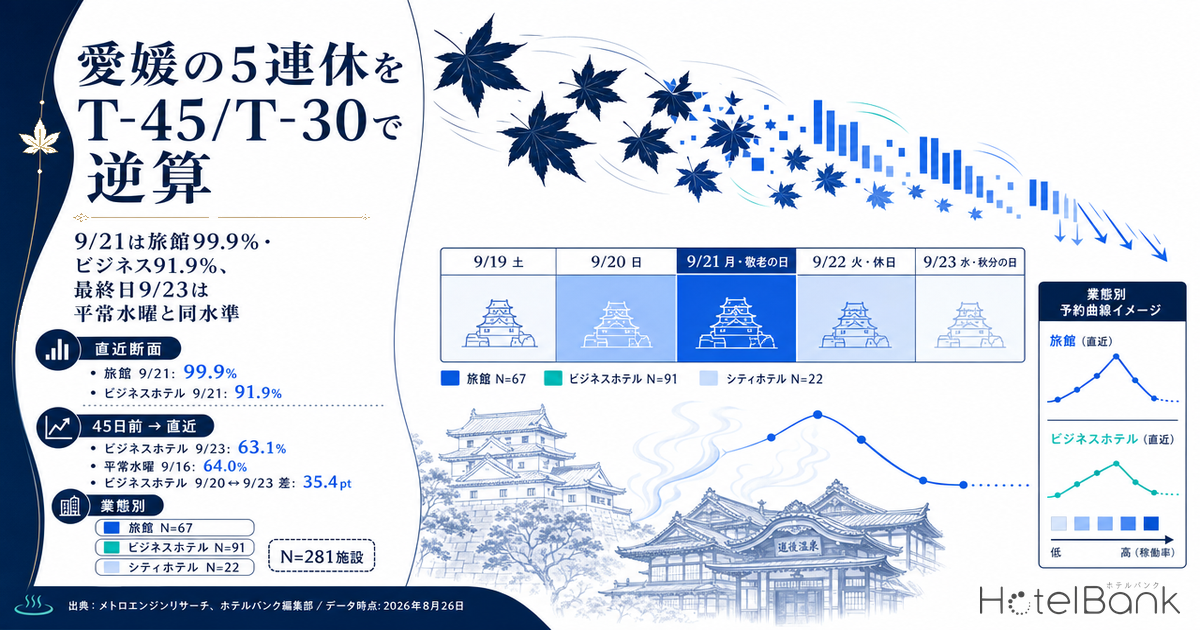
The five-day holiday running from Saturday, September 19 to Wednesday, September 23 (Autumnal Equinox Day), 2026 is not lifting lodging demand in Ehime Prefecture evenly. Tracking listed inventory across 281 properties in the prefecture, ryokan estimated OCC on Sunday, September 20 and Monday, September 21 (Respect for the Aged Day) reaches 100.0% and 99.9% at the latest reading, with properties showing no confirmable listed inventory accounting for 98.5% and 97.0%. The final day, September 23, by contrast stops at 75.5% for ryokan, 63.1% for business hotels and 73.9% for city hotels; compared at the T-45 reading, all properties sit at 63.4%, marginally below an ordinary Wednesday in the same month (September 16, 64.0%). The five-day break is not a five-day peak — it is a peak across the first three days and a trough on the final day.
Scope: all properties in Ehime Prefecture, N=281 (ryokan 67, business hotels 91, city hotels 22; reading of September 21, 2026). The price metric in this article is estimated settled ADR (the transacted price level estimated from OTA and other sales data, tax-excluded equivalent); occupancy is an estimate on an OTA-listed-inventory basis. Both definitions appear at the end of the article. Data as of August 26, 2026.
- — Ryokan had already built to 99.0% and 98.9% at T-45 for September 20 and 21; pickup over the following 18–19 days was just +1.0pt. Pricing decisions were settled earlier than T-45.
- — Business hotels on September 21 moved from 79.3% at T-45 to 91.9% at the latest reading, +12.6pt. It is the day that built the most across the five-day break, and it is where the room to pick up demand over the remaining four weeks sits.
- — The final day, September 23, sits at 63.4% for all properties at T-45, below the ordinary Wednesday of September 16 (64.0%). It is being sold not as a public holiday but as the eve of a Thursday.
- — Applying the median remaining-inventory sell-through rate measured across 61 past stay dates, September 23 lands at 83.2% for all properties and 80.1% for business hotels. Even on a thin day, roughly half of the remaining inventory sells down.
- — For confirmed months, business hotel estimated settled ADR beat the prior year in every month from January to July (seven-month average +5.9%), while ryokan came in at +2.4% and July at −1.2%. Split the days you take on occupancy from the days you take on rate, by property type.
The latest reading across the five-day break — the first three days are sold out, only the final day is left
The September 2026 break comes to five consecutive days including the weekend because September 21 is Respect for the Aged Day, September 23 is Autumnal Equinox Day, and September 22 in between becomes a holiday under the Public Holiday Act (Cabinet Office, “On National Holidays”; National Astronomical Observatory of Japan, “Calendar Outline for Reiwa 8”). This alignment, created by Autumnal Equinox Day falling on a Wednesday, is the first in 11 years, and demand arrives in a different shape from an ordinary three-day weekend.
Start with the latest reading. The chart below shows estimated OCC by property type at 25–29 days out (the most recent observation for each stay date). On Sunday, September 20, even business hotels reach 98.5% and ryokan 100.0%, with the prefecture as a whole at 98.0%. Monday, September 21 (Respect for the Aged Day) is also high, at 99.9% for ryokan, 91.9% for business hotels and 91.0% for city hotels. But on Tuesday, September 22 (holiday) it falls to 95.8% for ryokan and 73.0% for business hotels, and on Wednesday, September 23 (Autumnal Equinox Day) business hotels drop to 63.1%. The gap between September 20 and September 23 for business hotels reaches 35.4pt.
Source: compiled by the HotelBank Editorial Team from MetroEngines Research
The reason for the drop lies in the structure of the break itself. Stay on September 23 and the next day, Thursday, September 24, is a working day — travellers are back at work or school immediately. The final night is therefore being sold less as part of the holiday than as the eve of a Thursday. As shown below, the way September 23 sells is barely different from an ordinary Wednesday.
| Stay date | Property type (N=) | T-45 | T-30 | Latest | T-45 → latest |
|---|---|---|---|---|---|
| Sep 19 (Sat) 25 days out | Ryokan (66) | 94.5% | 97.9% | 98.7% | +4.2pt |
| Business hotels (91) | 81.1% | 87.3% | 89.9% | +8.8pt | |
| City hotels (22) | 81.5% | 86.2% | 90.4% | +8.9pt | |
| Sep 20 (Sun) 26 days out | Ryokan (66) | 99.0% | 99.9% | 100.0% | +1.0pt |
| Business hotels (91) | 87.6% | 96.3% | 98.5% | +10.9pt | |
| City hotels (22) | 85.5% | 91.3% | 95.3% | +9.8pt | |
| Sep 21 (Mon, Respect for the Aged Day) 27 days out | Ryokan (67) | 98.9% | 99.8% | 99.9% | +1.0pt |
| Business hotels (91) | 79.3% | 89.2% | 91.9% | +12.6pt | |
| City hotels (22) | 85.9% | 87.2% | 91.0% | +5.1pt | |
| Sep 22 (Tue, holiday) 28 days out | Ryokan (67) | 85.9% | 93.3% | 95.8% | +9.9pt |
| Business hotels (91) | 66.2% | 71.2% | 73.0% | +6.8pt | |
| City hotels (22) | 73.6% | 77.3% | 80.5% | +6.9pt | |
| Sep 23 (Wed, Autumnal Equinox Day) 29 days out | Ryokan (67) | 69.6% | 75.0% | 75.5% | +5.9pt |
| Business hotels (91) | 60.4% | 62.6% | 63.1% | +2.7pt | |
| City hotels (22) | 69.9% | 73.4% | 73.9% | +4.0pt |
Source: compiled by the HotelBank Editorial Team from MetroEngines Research
Across the three fixed points, the largest pickup from T-45 to the latest reading came on business hotels’ September 21 (+12.6pt) and September 20 (+10.9pt). Ryokan, by contrast, had already built to 99.0% and 98.9% at T-45 for September 20 and 21, moving only +1.0pt over the following 18–19 days. For ryokan the first half of the break was decided by T-45; for business hotels it was where the most volume was added between T-45 and the latest reading. Within the same holiday, the moment at which decisions have to be made differs by property type.
From T-45 to the latest reading — four curves separating the days that move from the days that do not
Next, look at the progression itself from 45 days out to the latest reading. The chart below plots estimated OCC for ryokan and business hotels against days remaining, for the peak day of the break (September 21) and the final day (September 23).
Source: compiled by the HotelBank Editorial Team from MetroEngines Research
The four lines split cleanly. Ryokan on September 21 run flat against the ceiling, from 98.9% at T-45 to 99.9% at the latest reading. Business hotels on September 21 climb steadily from 79.3% to 91.9%, narrowing the 19.6pt gap to ryokan at T-45 to 8.0pt at the latest reading. On this day ryokan sold out first and business hotels caught up afterwards.
By contrast, both lines for September 23 are flat. Ryokan moved from 69.6% to 75.5%, +5.9pt; business hotels from 60.4% to 63.1%, +2.7pt. Given that this is the full extent of movement over 16 days, the natural reading is that demand for this day is not still to come but thin to begin with. For business hotels on September 23 in particular, the share of properties with no confirmable listed inventory was unchanged at 2.2% at T-45 and 2.2% at the latest reading — in effect, none of the 91 properties in the prefecture has sold out.
| Stay date | T-45 All properties |
T-45 Ryokan |
T-45 Business |
T-30 All properties |
T-30 Ryokan |
T-30 Business |
|---|---|---|---|---|---|---|
| Sep 21 (Mon, Respect for the Aged Day) | 83.9% | 98.9% | 79.3% | 90.5% | 99.8% | 89.2% |
| Sep 22 (Tue, holiday) | 70.8% | 85.9% | 66.2% | 76.1% | 93.3% | 71.2% |
| Sep 23 (Wed, Autumnal Equinox Day) | 63.4% | 69.6% | 60.4% | 66.6% | 75.0% | 62.6% |
| Sep 12 (Sat, ordinary) | 71.3% | 80.1% | 67.5% | 74.9% | 82.2% | 71.4% |
| Sep 16 (Wed, ordinary) | 64.0% | 68.4% | 62.3% | 67.4% | 70.5% | 65.4% |
| Sep 26 (Sat, ordinary) | 68.1% | 75.9% | 65.6% | — | — | — |
Source: compiled by the HotelBank Editorial Team from MetroEngines Research/September 26 was 31 days out as of this article’s data date, so the T-30 observation has not yet been reached
This table shows the harshest fact of all. Wednesday, September 23 (Autumnal Equinox Day) stands at 63.4% for all properties at T-45 against 64.0% for the ordinary Wednesday of September 16, and 66.6% against 67.4% at T-30 — marginally below an ordinary Wednesday despite being a public holiday. For business hotels alone it is 60.4% against 62.3% at T-45 and 62.6% against 65.4% at T-30, widening the gap further. On the holiday calendar it is part of the break, but in sales terms it is being treated as a weekday Wednesday. This drop on the final day is not specific to Ehime: the same shape appears in Silver Week 2026 Back Half at T-47: Sep 23 Matches a Normal Wednesday, which tracked September 23 across major regions nationwide at a common T-47 reading.
September 22 (Tue, holiday) is a different case. All properties at 70.8% at T-45 sit 6.8pt above an ordinary Wednesday (64.0%) and roughly level with the ordinary Saturday of September 12 (71.3%). For ryokan, 85.9% at T-45 built to 93.3% at T-30 and 95.8% at the latest reading, +9.9pt. The middle day of the break has to be treated as clearly distinct from the final day. How ordinary Saturdays in Ehime build from T-45 is covered in detail in Ehime Saturday Booking Curves: Aug +14.7pt, Sep Flat at +1.2pt, which lines up four Saturdays across August and September.
The same shape shows up in the most recent elapsed month. Ehime’s August 2026 actuals (26 elapsed days) put monthly average estimated OCC at 94.4% for ryokan, 86.8% for business hotels and 89.3% for all properties. Tuesday, August 11, the Obon peak, rose to 99.7% for ryokan, 96.1% for business hotels and 97.5% for all properties, but Sunday, August 16, the last day of the break, fell to 93.7% for ryokan, 75.4% for business hotels and 81.0% for all properties. The fall from the peak was −6.0pt for ryokan and −20.7pt for business hotels, pointing the same way as the gap between property types observed across the September break. Business hotels being left behind on the final day of a long holiday is not a one-off in this region.
How far can the remaining four weeks build? — bracketing the landing with sell-through measured across 61 past stay dates
So far this has been about readings and progressions. What operating decisions need is one step further: how far will this day build over the remaining four weeks? Rather than guessing, the range here is derived from measured results over stay dates that have already passed.
Only one metric is used: the remaining-inventory sell-through rate. It measures what share of the inventory still open at N days out is sold by the stay date, as (estimated OCC on the day − estimated OCC at N days out) ÷ (100 − estimated OCC at N days out). Measured by property type across the 61 stay dates from June 1 to July 31, 2026 in Ehime, the median sell-through from 28 days out was 59.7% for ryokan, 45.1% for business hotels and 50.1% for city hotels. At identical days remaining, property types differ this much. The table below assigns the first quartile of that distribution to the pessimistic case, the median to the central case and the third quartile to the optimistic case, and applies them to the latest reading for each day of the break.
| Stay date | Property type (N=) | Latest estimated OCC | Remaining-inventory sell-through p25 / median / p75 | Pessimistic (low) | Central | Optimistic (high) |
|---|---|---|---|---|---|---|
| Sep 22 (Tue, holiday) at 28 days out | Ryokan (67) | 95.8% | 51.8/59.7/65.9 | 98.0% | 98.3% | 98.6% |
| Business hotels (91) | 73.0% | 33.2/45.1/55.7 | 82.0% | 85.2% | 88.0% | |
| City hotels (22) | 80.5% | 41.0/50.1/59.6 | 88.5% | 90.3% | 92.1% | |
| All properties (280) | 78.3% | 38.0/48.4/55.4 | 86.5% | 88.8% | 90.3% | |
| Sep 23 (Wed, Autumnal Equinox Day) at 29 days out | Ryokan (67) | 75.5% | 52.0/59.8/65.5 | 88.2% | 90.2% | 91.5% |
| Business hotels (91) | 63.1% | 33.9/45.9/55.8 | 75.6% | 80.0% | 83.7% | |
| City hotels (22) | 73.9% | 41.7/51.5/60.1 | 84.8% | 87.3% | 89.6% | |
| All properties (280) | 67.1% | 38.7/49.1/55.6 | 79.8% | 83.3% | 85.4% | |
| Sep 21 (Mon, Respect for the Aged Day) — reference at 27 days out | Ryokan (67) | 99.9% | 51.2/58.8/64.9 | 100.0% | 100.0% | 100.0% |
| Business hotels (91) | 91.9% | 33.4/45.0/55.3 | 94.6% | 95.5% | 96.4% |
Source: compiled by the HotelBank Editorial Team from MetroEngines Research/Sell-through rates are the measured quantiles across 61 stay dates from June 1 to July 31, 2026
There are three ways to read this. First, September 23 is thin, but it is not finished. The latest reading is low at 67.1% for all properties and 63.1% for business hotels, but the central case lands at 83.2% for all properties and 80.1% for business hotels, with roughly half the remaining inventory selling down as it usually does. Even the pessimistic case brings business hotels to 75.6%. What this day calls for is not dumping rates but re-basing to ordinary-Wednesday pricing and selling it down normally.
Second, ryokan on September 22 are effectively settled. Upside from the latest 95.8% runs from 98.0% pessimistic to 98.6% optimistic — a spread of just 0.6pt, leaving no point in separating scenarios. Business hotels on the same September 22, however, still carry a 6.1pt spread from 82.0% to 88.1%, making it the single day where actions have the greatest effect. Third, the width between the pessimistic and optimistic cases is itself the marker of a day that can still be moved. Ryokan on September 21 have a spread of under 0.1pt; business hotels on September 23 have 8.1pt. Working from the widest spread downward is the rational way to allocate the remaining four weeks.
| Latest estimated OCC (rows) / remaining-inventory sell-through (columns) | 30% | 40% | 50% | 60% | 70% |
|---|---|---|---|---|---|
| 60 | 72.0% | 76.0% | 80.0% | 84.0% | 88.0% |
| 65 | 75.5% | 79.0% | 82.5% | 86.0% | 89.5% |
| 70 | 79.0% | 82.0% | 85.0% | 88.0% | 91.0% |
| 75 | 82.5% | 85.0% | 87.5% | 90.0% | 92.5% |
| 80 | 86.0% | 88.0% | 90.0% | 92.0% | 94.0% |
Source: compiled by the HotelBank Editorial Team/Landing = latest + sell-through × (100 − latest). Shaded cells are those closest to all properties on September 23 (latest 67.1%) and all properties on September 22 (latest 78.3%)
The grid below is provided so the numbers can be read against your own property. Take your own latest estimated OCC on the rows and the sell-through you assume on the columns; the intersection is the guide to where you land. Where to set sell-through is determined by property type: measured in Ehime, the ranges are roughly 52–66% for ryokan, 33–56% for business hotels and 41–60% for city hotels. If your own latest reading is below the market yet you assume market-level sell-through, you will misread the landing, so calibrate at least once against your own past results. Note that by definition this calculation cannot exceed 100%.
The rate base — year-on-year estimated settled ADR for confirmed months
With the shape of occupancy in view, check the rate base. Only year-on-year comparisons between months that are confirmed on a monthly basis (past months) are used here. Estimated settled ADR for business hotels in Ehime was ¥5,871 in July 2026 (N=103 properties), up 5.1% from ¥5,584 a year earlier. All seven months from January to July 2026 beat the prior year, with growth ranging from +2.6% (June) to +12.2% (January). On a seven-month average, 2026 came to ¥5,950 against ¥5,618 in 2025, up 5.9%.
Source: compiled by the HotelBank Editorial Team from MetroEngines Research
Lining up the property types changes the picture. Both ryokan and city hotels include months that fell below the prior year.
| Property type | 2025 Jan–Jul average | 2026 Jan–Jul average | YoY (period) | July 2026 | YoY (month) | N= |
|---|---|---|---|---|---|---|
| Business hotels | ¥5,618 | ¥5,950 | +5.9% | ¥5,871 | +5.1% | 103 |
| City hotels | ¥7,388 | ¥7,628 | +3.2% | ¥7,287 | −4.0% | 23 |
| Ryokan | ¥10,334 | ¥10,586 | +2.4% | ¥9,652 | −1.2% | 77 |
Source: compiled by the HotelBank Editorial Team from MetroEngines Research/All comparisons are between confirmed values (past months)
Ryokan fell below the prior year in March 2026 (−0.1%), April (−5.1%), June (−4.5%) and July (−1.2%), leaving the seven-month average at just +2.4%. City hotels were also below the prior year in February (−3.3%), June (−2.0%) and July (−4.0%). In other words, in Ehime the ryokan segment that leads on occupancy is the one lagging on year-on-year rate, while business hotels, which still have occupancy headroom, have pushed rate up for seven consecutive months. Days like this break, when ryokan sit against the ceiling from T-45 onward, are among the few chances to reverse that pattern. For reference, confirmed levels for September of the prior year were ¥5,880 for business hotels (N=101), ¥7,876 for city hotels (N=21) and ¥9,488 for ryokan (N=76). Rate levels within the prefecture also split by area, with Dogo Onsen, Matsuyama and the Shimanami Kaido each sitting at a different tier of estimated settled ADR.
For revenue managers running ryokan and business hotels in Ehime — implications and an action plan
■ Operating implications
(1) For ryokan, September 20 and 21 are days on which the pricing decision is already over. Market estimated OCC at the latest reading is 100.0% and 99.9%, with pickup from T-45 of only +1.0pt on both. If your property still has these two days open, that is more likely a property-specific factor than remaining market demand. If they are already full, what can be moved over the remaining four weeks is not rate but length of stay and ancillary spend. The fact that the market was already at 98.9% at T-45 indicates that, for comparable breaks in future years, the point at which to make rate changes sits earlier than T-45.
(2) Redesign the final day, September 23, as a Wednesday rather than a public holiday. All properties sit at 63.4% at T-45 and 66.6% at T-30, below the ordinary Wednesday of September 16 (64.0% and 67.4%). For business hotels, the share of properties with no confirmable listed inventory is unchanged at 2.2% at both T-45 and the latest reading. If your own September 23 is still set on the assumption of a holiday premium, the market is not supporting that assumption.
(3) The upside for business hotels sits in the middle day and the first half. September 21 built the most of the five days, +12.6pt from 79.3% at T-45 to 91.9% at the latest reading. September 22 also moved +6.8pt from 66.2% to 73.0%, and stood 6.8pt above an ordinary Wednesday at T-45. These are the two days that can still be picked up over the remaining four weeks.
(4) Divide the roles of occupancy and rate by property type. Business hotel estimated settled ADR beat the prior year for seven consecutive confirmed months (July 2026 ¥5,871, N=103, +5.1%), while ryokan ran a series of months below the prior year, July at −1.2% with N=77. For ryokan, full days like the first half of this break are among the few days in the year that can be taken on rate.
| Time frame | Action | Decision trigger (figures from this article) | Objective |
|---|---|---|---|
| Today–this week (25–29 days out) | Finalise how the remaining allocation on September 20–21 is handled | Market estimated OCC for ryokan is 100.0% and 99.9%, with properties showing no confirmable listed inventory at 98.5% and 97.0% | Check the room to take the last few units on rate |
| Today–this week | Re-base the September 23 (Wed) setting to an ordinary Wednesday | All properties on September 23 remain below the ordinary Wednesday of September 16, at 63.4% vs 64.0% at T-45 and 66.6% vs 67.4% at T-30 | Close the gap between holiday-premium settings and actual demand |
| Today–this week | Concentrate exposure and inventory on September 22 (Tue, holiday) | Ryokan moved from 85.9% at T-45 to 95.8% at the latest reading (+9.9pt), while business hotels still have headroom at 73.0% | Avoid leaving the middle day, where upside remains, on the table |
| Within two weeks (through 14 days out) | Build a multi-night path from the sold-out days toward September 23 | Ryokan show a 24.4pt gap between September 21 (99.9%) and September 23 (75.5%) | Shift demand from the full days onto adjacent days |
| Within two weeks | Reconcile your own booking pace against how the market has built | Market business hotels went from 79.3% at T-45 to 91.9% at the latest reading on September 21 (+12.6pt), while September 23 moved only +2.7pt | Select the days on which to spend the final two weeks of effort |
| Looking to next month | Inventory holiday-type demand in three segments: first half, middle day and final day | In the August 2026 actuals as well, the final day of August 16 was −6.0pt for ryokan and −20.7pt for business hotels against the August 11 peak | Design the calendar day by day for the next long holiday |
Source: compiled by the HotelBank Editorial Team from MetroEngines Research
Summary — three yardsticks for breaking a holiday down day by day
Yardstick 1: how far it had built at T-45. Ryokan were at 99.0% and 98.9% at T-45 on September 20 and 21, and moved only +1.0pt over the following 18–19 days. The T-45 level had all but decided the outcome for those days. Business hotels on September 21, by contrast, added +12.6pt from 79.3% at T-45. The T-45 value itself is the first yardstick for sorting a day into “already decided” and “still to be decided”.
Yardstick 2: how it compares with an ordinary day at the same days remaining. September 23 came in at 63.4% at T-45 and 66.6% at T-30, below the ordinary Wednesday of September 16 (64.0% and 67.4%). Judge not by whether a date is a public holiday but by whether it sits above or below an ordinary day at identical days remaining. September 22 stood 6.8pt above an ordinary Wednesday at T-45, showing that days within the same break call for different handling.
Yardstick 3: is it a day to take on occupancy, or on rate? Across Ehime’s confirmed months, business hotel estimated settled ADR beat the prior year in every month from January to July (seven-month average +5.9%), while ryokan stopped at +2.4% and July fell below at −1.2%. Take days already at the occupancy ceiling on rate, and days with occupancy headroom on occupancy. Whether that split can be made day by day is what separates operators on a calendar as uneven as a five-day break.
About the data
| Item | Detail |
|---|---|
| Definition of estimated OCC | Occupancy on an OTA-listed-inventory basis = 100 − 100 × rooms still listed on OTAs ÷ total rooms. It is an estimate based on how listed inventory is being sold down and is defined differently from actual room occupancy (it reads higher). This article labels it “estimated OCC (OTA-listed-inventory basis)”. |
| Booking curve | Based on observations from 45 days before the stay date to the latest reading. Stay dates covered are September 12, 16, 19, 20, 21, 22, 23 and 26, 2026. |
| Sold-out property rate | The estimated share of properties for which no bookable inventory could be confirmed on OTAs and similar channels. All stay dates covered are within 30 days of the data date. |
| Definition of estimated settled ADR | The transacted price level (tax-excluded equivalent) estimated from OTA and other sales data (lowest-plan level × property-type coefficient, ensembled across multiple channels). Past months are confirmed values; the current and future months are estimates based on present sales conditions. Median error of 6.6% when reconciled against published operating results. This article covers only year-on-year comparisons between confirmed values (past months). |
| Breakdown of N | Estimated OCC: all 281 properties in Ehime Prefecture (ryokan 67, business hotels 91, city hotels 22; reading of September 21, 2026; 14,998 rooms in total). Estimated settled ADR: business hotels N=103 (July 2026), city hotels N=23, ryokan N=77. August 2026 elapsed-month actuals cover 26 days. |
| Data date | Data as of August 26, 2026. Sales conditions and inventory change daily, so the figures here are a snapshot at the time of retrieval. |
Source: compiled by the HotelBank Editorial Team from MetroEngines Research
References and sources
■ Data sources
Estimated OCC and remaining-inventory sell-through are aggregations of listed inventory in Ehime Prefecture based on publicly listed OTA price and inventory data collected by MetroEngines Research (all 281 properties, 14,998 rooms in total; reading of September 21, 2026). Estimated settled ADR is the transacted price level (tax-excluded equivalent) estimated from the same data, using confirmed values (past months) only. The holiday sequence was verified against the Cabinet Office’s “On National Holidays” and the National Astronomical Observatory of Japan’s “Calendar Outline for Reiwa 8 (2026)”. Data as of August 26, 2026.
■ Calculation assumptions
Landing scenarios were calculated as: landing estimated OCC = latest estimated OCC + remaining-inventory sell-through × (100 − latest estimated OCC). The sell-through rate was measured by property type across the 61 stay dates from June 1 to July 31, 2026 (stay dates that have already passed), capturing how much of the remaining inventory was sold between 27–29 days out and one day out, with the first quartile, median and third quartile assigned to the pessimistic, central and optimistic cases. The observation at one day out is used as a proxy for the landing, and days remaining were matched to the latest observation for each stay date (27 days for September 21, 28 for September 22, 29 for September 23). Under this definition the landing value cannot exceed 100%.
■ Limitations and caveats
Estimated OCC is an estimate on an OTA-listed-inventory basis and is defined differently from actual room occupancy (it reads higher). Estimated settled ADR carries a median error of 6.6% (tax-excluded equivalent) when reconciled against published operating results; current and future months are estimates and are therefore not used in this article. The landing scenarios apply a sell-through distribution from 61 past stay dates to future stay dates, and actual results can fall outside that distribution because of holiday-specific demand shapes, weather, events or additional inventory being released. Because the sample covers all days of the week across June and July, it is not a distribution specific to a particular day of week or calendar attribute such as the final day of a holiday. September 26 was 31 days out as of this article’s data date and has therefore not reached the T-30 observation.
■ External sources
• Cabinet Office, “On National Holidays” https://www8.cao.go.jp/chosei/shukujitsu/gaiyou.html(confirms September 21, 2026 as Respect for the Aged Day, September 22 as a holiday and September 23 as Autumnal Equinox Day)
• National Astronomical Observatory of Japan, Calendar Computation Office, “Calendar Outline for Reiwa 8 (2026): National Holidays” https://eco.mtk.nao.ac.jp/koyomi/yoko/2026/rekiyou261.html
Related reading
- Ehime Saturday Booking Curves: Aug +14.7pt, Sep Flat at +1.2pt
- Silver Week 2026 Back Half at T-47: Sep 23 Matches a Normal Wednesday
- Osaka Sep 2026 Holiday: Demand Peaks First 2 Nights, Sep 23 at 58.0%
- Ibaraki Silver Week: Ryokan-Business Gap Hits 21.9pt, Back Half Flat
- Wakayama Silver Week Peaks Midway: Ryokan 93.7% Sun, 82.9% Sat
- Hokkaido Silver Week: Sep 20 Peaks, Ryokan 96.4%, Only Business Dips
- Booking Curves Across 47 Prefectures: +4.1pt Median Pickup from T-45