

APA Hotel Kagoshima Tenmonkan (アパホテル〈鹿児島天文館〉) opened its new ANNEX building (74 rooms) on September 17, 2026, bringing the property to three buildings and 280 rooms alongside its West and East wings. Six months earlier, on March 10, Hotel Gran Ceresso Kagoshima (ホテルグランセレッソ鹿児島), which had operated in Yamanokuchi-cho, relocated to a new building in Funatsu-cho and reopened as the 151-room Hotel Gran Ceresso Kagoshima Tenmonkan (ホテルグランセレッソ鹿児島天文館). Both projects were undertaken by operators already established in Kagoshima, adding rooms within the same 1km catchment around Tenmonkan-dori tram stop. This article reads that “reinvestment by incumbent operators” as a signal of demand depth, and works through the numbers owners, regional banks and development teams weighing extensions or rebuilds in Kyushu’s regional core cities need to know: room-stock trends within 1km, Kagoshima City’s estimated settled ADR, inventory absorption over holiday periods, the working population, and zoning, land prices and hazard assumptions.
Metric Definitions Used in This Article
- ADR (Average Daily Rate): An estimated settled rate (tax-exclusive equivalent) calculated by applying segment-specific adjustment factors to the lowest-priced plan each property publishes on OTAs and similar channels (2 guests per room, per-room rate, tax-inclusive). Checked against property-level results disclosed by listed hotel REITs (91 properties, most recent 3 months), the median error is about 7%. These are estimates and differ from each property’s actual transaction prices and accounting figures. Area-level ADR is the median of the covered properties (the level of a typical property in the area), shown with N = number of properties. Settled months (through September 2026) and forward months (October 2026 onward, estimated from listed levels at the time of the survey) are not compared on the same basis.
- Listed price: The average of all plans published on OTAs and similar channels (2 guests per room, per room, tax-inclusive). This article labels it separately from ADR.
- OCC (Occupancy): The share of rooms sold relative to total rooms in the area (an estimate based on OTA sales inventory). Estimated OCC in this article means “occupancy (estimated from OTA-listed inventory),” shown with the number of properties and rooms. It is based on how OTA-sold inventory is absorbed and differs from each property’s actual overall occupancy.
- LT (Lead Time): Days until check-in. Early sell-out LT = the lead time at which remaining rooms first reached zero (a larger value means the property sold out earlier). This article uses only observations within 45 days of the stay date; sell-outs earlier than that are capped at 45 days and counted as “sold out 45+ days ahead.”
- Room stock: Annual totals, based on opening and closing dates, for a 1km radius centered on Tenmonkan-dori tram stop (31.5905°N, 130.5553°E). For 2026, the article also shows an October 2026 figure reconciled property by property against primary sources, including the ANNEX (74 rooms) that opened in September.
- Data sources: MetroEngines Research & Consulting (OTA public price and inventory data), MLIT Real Estate Information Library, National Land Numerical Information, MIC/METI Economic Census, and company press releases.
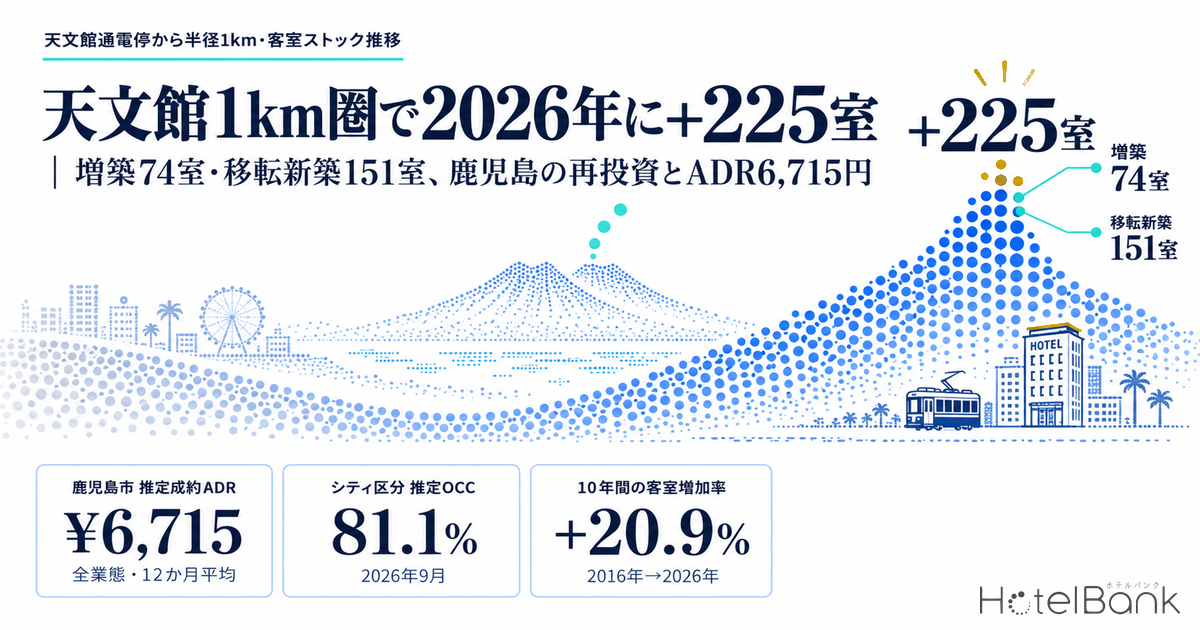
- — +225 rooms — The rooms added within 1km of Tenmonkan-dori tram stop in 2026 are the 74-room extension at APA Hotel Kagoshima Tenmonkan ANNEX and the 151-room relocated new build of Hotel Gran Ceresso Kagoshima Tenmonkan. Both are reinvestments by operators that have long done business in Kagoshima.
- — About 6,400 rooms at 70 properties — Room stock within 1km as of October 2026 (reconciled against primary sources). On the annual series, stock grew +20.9% over ten years, from 4,955 rooms in 2016 to 5,993 in 2026.
- — Estimated settled ADR ¥6,715 — Kagoshima City, all segments, 12-month average (September 2025–August 2026, N=71–73). Even in January–September 2026, when supply grew, ADR was essentially flat at −0.8% YoY.
- — Sold out 2–3 weeks before the holiday — Over Silver Week (September 19–23, 2026), large business hotels at ¥5,500–6,500 filled first; the ¥6,000–7,500 band (12 properties, 1,657 rooms) had a room-weighted early sell-out LT of 9.0 days.
- — 5.4% yield on building cost — A simple estimate (excluding land) using ADR ¥6,715, the city-hotel segment’s September 2026 occupancy, a 50% GOP margin (assumed) and construction cost of about ¥18.44M per room. Factoring in two years of construction-cost inflation brings it to 4.9%.
Executive Summary — 2026’s +225 Rooms Came From Incumbents Adding Capacity, Not New Entrants
The bottom line: 2026 in the Tenmonkan 1km catchment was not a year in which new brands arrived from outside, but one in which operators already earning money in Kagoshima added rooms to the same market. APA Hotel added a third building of 74 rooms, following its 80-room West wing (opened 2016) and 126-room East wing (opened 2021). Gran Ceresso, operated by Green Hospitality Management, moved about 600m east from its former Yamanokuchi-cho building, which closed in March 2025, to Funatsu-cho and restarted with 151 rooms. Together, the +225 rooms equal 3.5% of the room stock within 1km (about 6,400 rooms).
Three demand-side figures underpin this added capacity. First, Kagoshima City’s estimated settled ADR averaged ¥6,715 over the 12 months from September 2025 to August 2026 (all segments, N=71–73), and the January–September 2026 average was −0.8% YoY, essentially flat even in a year of rising supply. Second, over Silver Week (September 19–23), estimated OCC for the city-hotel segment rose to 99.9% on September 20 and 99.4% on the 21st, and large business hotels at ¥5,500–6,500 had zero rooms left 2–3 weeks before the holiday. Third, the 1km catchment combines a business cluster of 42,450 workers with a resident population of about 25,000, layering weekday business travel with weekend and evening demand from the entertainment district. Whether the reinvestment takes the form of an “extension” or a “relocated new build,” confirming these three conditions first is the starting point for any decision to add rooms in Tenmonkan.
2026 Projects Within 1km of Tenmonkan — A 74-Room Extension and a 151-Room Relocated New Build, Net +225 Rooms
We first checked each project against primary sources to classify it as a new build, extension, relocation or renaming. Renamings and rebrands add no net rooms, so this classification is essential to calculating net growth. Two projects actually added rooms within 1km in 2026.
| Project | Type | Rooms | Location | Developer / Operator | Timing |
|---|---|---|---|---|---|
| APA Hotel Kagoshima Tenmonkan ANNEX (new building) (アパホテル〈鹿児島天文館〉ANNEX) | Extension (third building added to two existing) | 74 rooms 280 rooms across 3 buildings | 13-4 Sennichi-cho, Kagoshima City | APA Hotel (franchise agreement with SWAN Co., Ltd.) | Opened September 17, 2026 |
| Hotel Gran Ceresso Kagoshima Tenmonkan (ホテルグランセレッソ鹿児島天文館) | Relocated new build (about 600m east of the former Yamanokuchi-cho building) | 151 rooms 13 room types, 4,259㎡ floor area | 5-22 Funatsu-cho, Kagoshima City | Developer: Kagoshima Arc City Co., Ltd. / Operator: Green Hospitality Management Co., Ltd. | Opened March 10, 2026 |
| Reference: projects in the same 1km catchment in 2025 | |||||
| Hotel Oriental Express Kagoshima Tenmonkan (ホテルオリエンタルエクスプレス鹿児島天文館) | Reopening of an existing building (the former Hotel Gran Ceresso Kagoshima’s 13-storey building, 165 rooms) | 165 rooms | 2-1 Yamanokuchi-cho, Kagoshima City | — | Began operating April 2025 |
| Henn na Hotel Premier Kagoshima Tenmonkan (変なホテルプレミア鹿児島 天文館) | New build | 90 rooms | Kagoshima City (Tenmonkan) | — | Opened July 2025 |
Source: APA Hotel Co., Ltd. press release (September 17, 2026); Green Hospitality Management Co., Ltd. press releases (October 31, 2025 and March 10, 2026); MetroEngines Research & Consulting (based on OTA listing checks)
How net growth is calculated depends on the project type. The ANNEX’s 74 rooms, as an extension, are a straight net addition to the market. The relocated new build, by contrast, closed a 165-room old building and opened a 151-room new one at the operator level, so Gran Ceresso itself has −14 rooms. It is worth stating clearly that a relocated new build does not, in itself, increase citywide room supply. In this case, however, the old building has continued operating under another brand since April 2025 (Hotel Oriental Express Kagoshima Tenmonkan, 165 rooms), so those 165 rooms did not leave the market. As a result, net growth in the Tenmonkan 1km catchment in 2026 reads as 74 + 151 = +225 rooms.
The ANNEX comprises 44 Standard rooms, 16 Cozy rooms, 6 pairs (12 rooms) of S-S Connect rooms that join adjacent rooms for up to four guests, and 1 pair (2 rooms) of ground-floor adjoining rooms, all non-smoking. The 16% share of connecting rooms reads as a design to capture family and group demand within the same building. Gran Ceresso Tenmonkan has a view-deck public bath overlooking Sakurajima on the 13th floor and a 60-seat restaurant on the 14th, serving a breakfast buffet centered on local cuisine. Both are reinvestments that “add more of a format that already sells, in the same market,” and neither substantially changes the price band. We could not confirm the details or dates of a renovation at Daiwa Roynet Hotel Kagoshima Tenmonkan PREMIER (ダイワロイネットホテル鹿児島天文館 PREMIER) (217 rooms, opened 2022) in an official announcement, so it is not included in the 2026 project table.
Room Stock Within 1km — From 4,707 Rooms in 2012 to 5,993 in 2026, 3,200 Rooms More Than the Chuo Station 1km Ring
Next, we lined up room stock since 2012 for the 1km ring around Tenmonkan-dori tram stop and the 1km ring around Kagoshima-Chuo Station. On annual totals based on opening and closing dates, the Tenmonkan ring grew +27.3%, from 4,707 rooms at 41 properties in 2012 to 5,993 rooms at 58 properties in 2026, and +20.9% over the past decade (4,955 rooms in 2016 → 5,993 in 2026). The Chuo Station ring was unchanged at 20 properties and 2,542 rooms from 2012 to 2017; APA Hotel Kagoshima-Chuo Ekimae Nishiguchi (アパホテル〈鹿児島中央駅前西口〉) (156 rooms) and Hotel Noir Kagoshima Chuo Station (ホテルノイル鹿児島中央駅) (93 rooms) joined in 2024, taking it to 34 properties and 2,804 rooms (+10.3%) in 2026.
Source: MetroEngines Research & Consulting (annual totals based on opening and closing dates; Tenmonkan-dori tram stop 31.5905°N, 130.5553°E and Kagoshima-Chuo Station 31.5839°N, 130.5422°E, 1km radius each)
The step-like growth on the Tenmonkan side was built by openings such as Unizo Inn Express Kagoshima Tenmonkan (ユニゾインエクスプレス鹿児島天文館) (295 rooms) in 2019, KOKO HOTEL Kagoshima Tenmonkan (295 rooms) in 2020, Daiwa Roynet Hotel Kagoshima Tenmonkan PREMIER (217 rooms) in 2022 and Henn na Hotel Premier Kagoshima Tenmonkan (90 rooms) in 2025. The dip to 5,262 rooms in 2021 reflects closures and suspensions during the COVID-19 pandemic in the annual totals; stock then rose every year from 2022 to 2025 (the 2026 figure excludes the ANNEX). On the Chuo Station side, the opening of Smile Hotel Kagoshima Chuo Ekimae (スマイルホテル鹿児島中央駅前) (101 rooms) in November 2026 can be confirmed from listings, but this is forward information based on OTA listing checks, and the count may rise as more listings appear.
The 2026 value in the annual series (5,993 rooms) was compiled before the September opening of the ANNEX (74 rooms). Reconciled property by property against primary sources and including the ANNEX’s 74 rooms, the Tenmonkan 1km catchment had 70 properties and about 6,400 rooms as of October 2026 (including small properties such as guesthouses), or 43 properties and 5,970 rooms counting only properties with 50+ rooms. The KPIs in this article use this reconciled figure, while the trend chart keeps the annual totals to preserve series consistency.
Kagoshima City Estimated Settled ADR — ¥6,715 12-Month Average, Holding Flat in a Year of +225 Rooms
If reinvestment signals depth of demand, we need to check that rates did not crack in the year rooms were added. Kagoshima City’s estimated settled ADR (all segments, settled months) averaged ¥6,715 over the 12 months from September 2025 to August 2026 (N=71–73), ¥6,426 for the business-hotel segment (N=58–59) and ¥9,482 for the city-hotel segment (N=8–9). Monthly, February (¥7,340) and November (¥7,137) were the peaks and June (¥6,096) the trough, keeping the annual swing to about ¥1,250.
Source: MetroEngines Research & Consulting (Kagoshima City, all segments, estimated settled ADR, settled months only; N=70–74 properties/month)
| 2026 | All-segment ADR | YoY | N | Business ADR | YoY | N |
|---|---|---|---|---|---|---|
| January | ¥6,950 | +6.4% | 71 | ¥6,796 | +11.9% | 58 |
| February | ¥7,340 | +9.7% | 72 | ¥6,870 | +5.1% | 58 |
| March (Gran Ceresso Tenmonkan opens) | ¥6,709 | +0.4% | 73 | ¥6,442 | −2.1% | 58 |
| April | ¥6,374 | −1.9% | 73 | ¥6,204 | −1.3% | 58 |
| May | ¥7,044 | −1.5% | 73 | ¥6,798 | −1.5% | 58 |
| June | ¥6,096 | −2.8% | 73 | ¥5,760 | −3.6% | 58 |
| July | ¥6,380 | −4.6% | 73 | ¥5,959 | −4.9% | 58 |
| August | ¥6,788 | −15.6% | 73 | ¥6,459 | −17.1% | 58 |
| September (ANNEX opens) | ¥6,895 | +5.8% | 73 | ¥6,670 | +6.9% | 58 |
| Jan–Sep average | ¥6,731 | −0.8% | — | ¥6,440 | −1.2% | — |
Source: MetroEngines Research & Consulting (Kagoshima City, estimated settled ADR, settled months; YoY compares with settled values for the same month of 2025)
The key point is that in March–May, when Gran Ceresso Tenmonkan’s 151 rooms came on line, all-segment rates stayed within ±2% of the prior year, and June was only −2.8%. The July and August declines read as a combination of a high base (August 2025 peaked at ¥8,042) and a period of reduced access to Kagoshima after the 2026 Kumamoto earthquake (令和8年熊本地震) suspended part of the Kyushu Shinkansen, which did not fully reopen until September 18, after 52 days. Indeed, September, with the Shinkansen back, beat the prior year at +5.8% for all segments and +6.9% for business hotels, so rates stepped up in the month the ANNEX’s 74 rooms were added. On a January–September average, all segments were −0.8% and business hotels −1.2%, so 2026 can be summarized as a year in which +225 rooms of supply were absorbed with rates essentially held.
Looking at forward months, October–December show ¥8,200–8,800, estimated from listed levels at the time of the survey. However, these are forward snapshots on a different basis from settled months, and demand is also being pulled forward during the eligibility period of the Kyushu Fukko Ouenwari travel subsidy (九州ふっこう応援割, stays through end-February 2027), so this article does not compare them with settled months. Measured October listed prices after the Shinkansen’s full restoration diverged between Kagoshima City (+15.3%) and Kirishima City (−5.2%), as covered in Kagoshima Oct Rates +15.3%, Kirishima −5.2% After the Shinkansen Reopens (listed-price basis, as of September 2026).
ADR × Early Sell-Out Scatter — Large ¥5,500–6,500 Properties Sold Out 2–3 Weeks Before the Holiday
To see how the price band the new buildings entered actually fills, we look at past settled dates. The window is the five-day Silver Week holiday (stays September 19–23, 2026). Among Kagoshima City properties, we took the 70 whose OTA-published allotment is at least 30% of total rooms (narrowed from 94 properties with inventory data in the city; the city has 225 properties in scope), then applied the conditions of being within 1km of Tenmonkan, having 30+ rooms and having ADR for the most recent 12 months, extracting 27 properties. The horizontal axis is each property’s estimated settled ADR (average of settled months, October 2025–September 2026), the vertical axis is the average early sell-out LT over the five days (sell-outs earlier than 45 days before the stay date capped at 45), and bubble size is room count.
Source: MetroEngines Research & Consulting (Kagoshima City, stays September 19–23, 2026, properties with OTA-published allotment of 30%+ only, N=27 properties; based on major booking-site listings)
| Estimated settled ADR band | Properties | Rooms | Avg early sell-out LT (simple) | Same (room-weighted) |
|---|---|---|---|---|
| Under ¥6,000 | 5 | 556 | 15.6 days | 17.2 days |
| ¥6,000–7,500 (band of ANNEX and Gran Ceresso Tenmonkan) | 12 | 1,657 | 6.8 days | 9.0 days |
| ¥7,500–9,000 | 4 | 381 | 4.2 days | 2.6 days |
| ¥9,000 and above | 6 | 961 | 10.3 days | 12.0 days |
Source: MetroEngines Research & Consulting (same as above; early sell-out LT is the average of each of the five stay dates, capped at 45 days)
What the scatter shows is that each price band has a different “booking window.” The ¥6,000–7,500 band is the deepest, at 12 properties and 1,657 rooms, with a room-weighted average early sell-out LT of 9.0 days, but within it, large properties near the bottom of the band (around ¥6,000) fill early. Hotel Sun Days Kagoshima (ホテルサンデイズ鹿児島) (351 rooms, ADR about ¥6,300) reached zero rooms 22.4 days ahead on a five-day average, Kagoshima Plaza Hotel Tenmonkan (かごしまプラザホテル天文館) (220 rooms, about ¥5,500) 18.4 days ahead, and APA Hotel Kagoshima Tenmonkan’s two existing buildings (206 rooms, about ¥6,100) 9.8 days ahead, with September 21 sold out 45+ days before the stay date. The ANNEX’s 74 rooms enter exactly this band, where big-box hotels fill first ahead of holidays. It is precisely because the existing buildings have a track record of selling out early over holidays that adding a third building on the same site makes sense.
Meanwhile, Gran Ceresso Tenmonkan (151 rooms, ¥7,459 average over its first seven months), at the top of the same band, sold out 4.2 days ahead on average, and Hotel Oriental Express Kagoshima Tenmonkan (165 rooms, about ¥9,000) in the next band up (¥7,500–9,000) 0.6 days ahead — both filled by selling right up to the holiday. This shows capacity to capture last-minute demand while holding price, and the fact that the 151 rooms nearly sold through the five-day holiday in their first year is a fast enough ramp-up for a relocated new build. In the ¥9,000+ band as well, Daiwa Roynet Hotel Kagoshima Tenmonkan PREMIER (217 rooms, about ¥15,600) reached zero rooms 18.2 days ahead and SHIROYAMA HOTEL kagoshima (355 rooms, about ¥27,400) 16.2 days ahead, so holiday demand reaches large upper-tier properties too.
Looking at holiday supply and demand across the whole area, estimated OCC for Kagoshima Prefecture’s city-hotel segment (16 properties, 1,931 rooms; based on major booking-site listings) rose from 79.5% on September 18 to 95.4% on the 19th, 99.9% on the 20th, 99.4% on the 21st and 92.7% on the 22nd, before easing to 73.4% on the 23rd. The September monthly average was 81.1%, nearly 10 points above the 71.4% for all segments (301 properties, 11,313 rooms). This is how the city-hotel segment fills, and it is the backdrop for Tenmonkan’s reinvestment taking the form of an extension and a relocated new build.
Source: MetroEngines Research & Consulting (Kagoshima Prefecture, September 2026; occupancy estimated from OTA-listed inventory. City-hotel segment 16 properties / 1,931 rooms; all segments 301 properties / 11,313 rooms; based on major booking-site listings)
A Business District of 42,000 Workers and Evening Demand From the Entertainment District
As evidence of the weekday demand behind the reinvestment, we checked the working population within 1km of Tenmonkan-dori tram stop in the Economic Census. The catchment has 4,747 establishments and 42,450 workers, of whom 8,699 (20.5%) are in office-type sectors (information and communications, finance, real estate, professional services, etc.). Kagoshima City’s business-hotel ADR of ¥6,426 (N=58–59), about ¥300 below the all-segment figure, reflects the many properties that steadily capture this business demand on weekdays, and the ANNEX extension also primarily targets this segment. Measuring market depth by the working population within 1km of a tram stop is the same approach we have applied to Kumamoto’s Suidocho area. The city-hotel segment’s ¥9,482 (N=8–9), on the other hand, reflects a model that lifts rates on weekends and evenings through its entertainment-district location and Sakurajima views; Gran Ceresso Tenmonkan, with its view-deck bath on the 13th floor, leans toward this side by design.
| Indicator (1km radius of Tenmonkan-dori tram stop) | Value | Source |
|---|---|---|
| Establishments | 4,747 | MIC/METI Economic Census for Business Activity (2021); boundaries from 2020 Census small areas |
| Workers | 42,450 | |
| Office-type worker share | 20.5% (8,699) | |
| Resident population (2025) | 25,247 | MLIT National Land Numerical Information (future population projections by 250m mesh, R6 MLIT estimate) |
| Aged 65+ share (2025) | 28.1% | |
| Change in resident population to 2040 | −6.8% (vs 2020, 23,688) / −6.2% vs 2025 |
The resident population is projected to fall 6.8%, from 25,412 in 2020 to 23,688 in 2040 (−6.2% from 25,247 in 2025), and the aged-65+ share of 28.1% is slightly below the national average. Since the main drivers of lodging demand are visitors rather than residents, this decline does not translate directly into hotel revenue; but as evening footfall to restaurants and shops sustains the entertainment district’s appeal, the catchment’s population trend is worth keeping as a medium- to long-term assumption. The map below shows resident population by 250m mesh (census-based, not daytime or transient population): population is dense east of the tram stop and along the Kotsuki River, continuing west toward Kagoshima-Chuo Station.
Source: MLIT National Land Numerical Information (future population projections by 250m mesh, R6 MLIT estimate)
Site Analysis — Sennichi-cho and Funatsu-cho Are Commercial Zones at 500% FAR; Land Prices Near the Tram Stop Up 4 Years Running; Flood Depth 0.5–3.0m
Finally, we checked both sites — the extension and the relocated new build — against zoning, official land prices and hazard assumptions in the MLIT Real Estate Information Library. Both the ANNEX at 13-4 Sennichi-cho and Gran Ceresso Tenmonkan at 5-22 Funatsu-cho are in commercial zones with a floor-area ratio (FAR) of 500% and a building coverage ratio of 80%. The benchmark sites in Higashisengoku-cho and Naka-machi nearest the tram stop are in a 700% FAR area, and both projects added rooms in the 500% area one step further out.
In the official land price survey, Higashisengoku-cho 13-34 and others (Kagoshima 5-16), 69m from Tenmonkan-dori tram stop, stood at ¥1.18M/㎡ in 2026 (+1.7% YoY), up +4.4% in four years from ¥1.13M in 2022. Funatsu-cho 4-20 and others (Kagoshima 5-3) was ¥322,000/㎡ (+2.5%), up +5.9% from ¥304,000 in 2022, and Yamanokuchi-cho 11-25 (Kagoshima 5-21) was ¥368,000/㎡ (+3.7%); versus 2022, Funatsu-cho posted the highest rise of the five sites. Sites that fell in 2023–2024 have all turned upward since 2025, showing that the reinvestment decisions coincided with land prices bottoming out.
Source: Compiled by MetroEngines Research & Consulting from the MLIT Real Estate Information Library (official land prices, commercial land)
| Benchmark site | Distance from tram stop | 2026 official price | YoY | 2022→2026 | FAR |
|---|---|---|---|---|---|
| Higashisengoku-cho 13-34 and others (Kagoshima 5-16) | 69m | ¥1,180,000/㎡ | +1.7% | +4.4% | 700% |
| Naka-machi 5-29 (Kagoshima 5-7) | 180m | ¥631,000/㎡ | +1.0% | +1.9% | 700% |
| Yamanokuchi-cho 11-25 (Kagoshima 5-21) | 200m | ¥368,000/㎡ | +3.7% | +2.8% | 500% |
| Higashisengoku-cho 5-8 (Kagoshima 5-20) | 291m | ¥375,000/㎡ | +1.4% | +4.2% | 500% |
| Funatsu-cho 4-20 and others (Kagoshima 5-3) | 366m | ¥322,000/㎡ | +2.5% | +5.9% | 500% |
Source: MLIT Real Estate Information Library (official land prices 2022–2026, commercial land)
We checked three hazard assumptions. Under the Kotsuki River flood inundation scenario (maximum assumed scale), both the Sennichi-cho and Funatsu-cho sites fall within areas of 0.5m to under 3.0m flood depth. Where a front desk or plant room sits on the ground floor, flood barriers and placing power-receiving equipment on upper floors become design considerations. Neither site falls within a tsunami inundation zone. As for volcanic risk, Sakurajima is a designated volcano for volcanic disaster alert areas under the Act on Special Measures for Active Volcanoes, and Kagoshima City is a member of the Sakurajima Volcano Disaster Prevention Council established under Article 4 of the Act (August 10, 2016). Ashfall must be routinely budgeted as a cost of air-conditioning filters and exterior cleaning, and in July 2026 Kagoshima City reissued its plan for responding to large-scale pumice and volcanic ash according to volcanic alert levels. All of these are conditions that operators with long histories in Tenmonkan have already priced in, and we list them as the first items a new entrant should check.
Source: MetroEngines Research & Consulting (properties with 30+ rooms within 1km of Tenmonkan-dori tram stop; bubble size = rooms, color = estimated settled ADR band)
Investment Takeaways — Extension vs Relocated New Build: Which Reinvestment Works?
Here we organize the numbers so far from the perspective of an operator considering an extension or rebuild in Tenmonkan. The extension model (ANNEX) can reuse the existing buildings’ booking track record and operating setup, so ramp-up costs per room are low, and even in a 500% FAR commercial zone it is an option on the same site if there is spare site capacity. The relocated new build model (Gran Ceresso Tenmonkan) gives up the old building in exchange for designing a view-deck bath and room-type mix from scratch, and at around ¥7,500 it ramped up to nearly selling through holidays in its first year. Both share the approach of “adding a format that sells in Kagoshima, in the same market” — an investment that stacks rooms onto a proven price band.
| Item | Base case | ADR +¥785 | ADR +¥1,785 |
|---|---|---|---|
| Estimated settled ADR (assumption) | ¥6,715 | ¥7,500 | ¥8,500 |
| Estimated OCC (assumption: city-hotel segment, September 2026) | 81.1% | 81.1% | 81.1% |
| RevPAR | ¥5,446 | ¥6,082 | ¥6,894 |
| Annual room revenue (per room) | ¥1.99M | ¥2.22M | ¥2.52M |
| GOP (assuming 50% GOP margin) | ¥0.99M | ¥1.11M | ¥1.26M |
| Construction cost (RC, ¥2.026M per tsubo × ~9.1 tsubo/room, 2025 actual) | ¥18.44M | ¥18.44M | ¥18.44M |
| Yield on building cost (excl. land, 2025 actual basis) | 5.4% | 6.0% | 6.8% |
| Construction cost (2 years of +5%/yr inflation) | ¥20.33M | ¥20.33M | ¥20.33M |
| Yield on building cost (after inflation) | 4.9% | 5.5% | 6.2% |
Source: MetroEngines Research & Consulting (ADR, OCC); Archibook compilation based on MLIT Building Construction Starts statistics (cost per tsubo); Invincible Investment Corporation operating disclosures (GOP margin reference). Simple estimate assuming 30㎡ (about 9.1 tsubo) of floor area per room
The simple estimate assumes Kagoshima City’s estimated settled ADR of ¥6,715 and the city-hotel segment’s estimated OCC of 81.1% (September 2026, 16 properties / 1,931 rooms), giving annual room revenue of about ¥1.99M per room and, at a 50% GOP margin, about ¥0.99M. Construction cost is about ¥18.4M — the 2025 RC actual of ¥2.026M per tsubo (Archibook compilation based on MLIT Building Construction Starts statistics) times about 9.1 tsubo per room — giving a building-only yield of 5.4%, or 4.9% after factoring in two years of +5%/yr cost increases during construction. A 50% GOP margin is higher than the 38.9% GOP margin disclosed by Invincible Investment Corporation (インヴィンシブル投資法人) for its 91 operating properties (fiscal period ended December 2024), so it is an assumption that is hard to achieve except in the extension model, where the existing buildings’ operations can be shared.
On sensitivity, each ¥785 increase in ADR improves the yield by about 0.6 points. Given the track record of ¥6,000-range big-box hotels filling before holidays and September’s +5.8% YoY, moving from the base case toward ¥7,500 is within a realistic range. Conversely, rising construction costs act to restrain supply from new entrants, which is also an upside factor for incumbents in the sense that the competitive environment is unlikely to change abruptly. Note that this is a simple estimate on a building-investment basis excluding land; actual investment decisions require a detailed feasibility study.
Sensitivity Analysis — Yield on Building Cost Across Two Axes: ADR and Occupancy
Because the estimate above moves only ADR, we also lay out yields when occupancy moves at the same time. Rows are assumed full-year occupancy, columns are estimated settled ADR, and the 50% GOP margin and construction cost of about ¥18.44M per room (2025 actual basis, excluding land) are the same as in the table above.
| Occupancy (full-year assumption) \ Est. settled ADR | ¥6,000 | ¥6,715 | ¥7,500 | ¥8,500 |
|---|---|---|---|---|
| 70% | 4.2% | 4.7% | 5.2% | 5.9% |
| 75% | 4.5% | 5.0% | 5.6% | 6.3% |
| 81.1% (base) | 4.8% | 5.4% | 6.0% | 6.8% |
| 85% | 5.0% | 5.6% | 6.3% | 7.2% |
Source: Simple estimate based on MetroEngines Research & Consulting base values (ADR, occupancy). Yield = ADR × occupancy × 365 days × 50% GOP margin ÷ construction cost. ¥6,000 is a downside case close to the June 2026 monthly level (¥6,096)
The base case’s 81.1% is a single-month value for September 2026, which includes a holiday, so at a full-year occupancy of 75% the yield at the same ADR falls to 5.0%, and at 70% to 4.7%. If ADR is ¥6,000, close to June’s level, and occupancy stays at 70%, the yield is 4.2%; reaching a 6%-plus yield requires ADR of ¥7,500 with occupancy of 81% or more, or ADR of ¥8,500 with 75% or more. And if the GOP margin is set to the 38.9% actual for Invincible Investment Corporation’s 91 operating properties (fiscal period ended December 2024), the base-case yield is 4.2%.
| Risk factor | Details | Assessment |
|---|---|---|
| Market (supply) | +225 rooms in 2026, plus Smile Hotel Kagoshima Chuo Ekimae (101 rooms) on the Chuo Station side in November 2026 (based on listing checks). January–September ADR at −0.8% shows the supply is being absorbed | Low–Medium |
| Policy (demand pulled forward) | Demand may normalize after the Kyushu Fukko Ouenwari travel subsidy ends (up to 60% off in Kagoshima, stays through end-February 2027). Listed levels for forward months October–December are high | Medium |
| Construction (cost) | RC cost per tsubo kept rising from 2022 to 2025, with an outlook of around +5% per year. Extensions can more easily contain unit costs by sharing existing infrastructure | Medium |
| Disaster (flooding, ashfall) | Flood depth of 0.5–3.0m under the Kotsuki River maximum-scale scenario; Sakurajima ashfall is an ongoing maintenance cost. Outside tsunami inundation zones | Low–Medium |
Overall, 2026 in the Tenmonkan 1km catchment was a year in which the incumbents who know demand depth best added rooms just as the site conditions — FAR and a bottoming in land prices — lined up. For operators now considering extensions or rebuilds in the same market, there are three takeaways. First, know, on a room-count basis, how many days before a holiday your own price band fills, and add rooms in that band. Second, since this is a market with a small seasonal rate swing of about ¥1,250, build ADR upside through plan design and room types (connecting rooms, public baths). Third, factor flooding and ashfall in at the design stage, and decide ground-floor uses and equipment placement accordingly.
Related Articles
References and Sources
■ Data Sources
OTA public price and inventory data collected by MetroEngines Research & Consulting (Kagoshima City estimated settled ADR: all segments N=70–74 properties/month; Kagoshima Prefecture city-hotel segment estimated occupancy: 16 properties / 1,931 rooms, September 2026; holiday inventory absorption: N=27 properties, stays September 19–23, 2026), annual room-stock totals based on opening and closing dates (1km radius each of Tenmonkan-dori tram stop and Kagoshima-Chuo Station), MLIT Real Estate Information Library and National Land Numerical Information, Economic Census, and company press releases.
■ Estimate Assumptions
The simple per-room estimate assumes an estimated settled ADR of ¥6,715 (12-month average, September 2025–August 2026), the city-hotel segment’s September 2026 occupancy of 81.1%, a 50% GOP margin (assumed), and construction cost of RC ¥2.026M per tsubo × about 9.1 tsubo (30㎡ of floor area per room) = about ¥18.44M. The inflation case raises construction cost by +5% per year for two years. Yields are on a building-investment basis excluding land.
■ Limitations
ADR and occupancy are estimates based on OTA public data, not property accounting figures. The base occupancy value is a single month that includes a holiday, not a full-year actual, and should be read together with the two-axis sensitivity table. The 50% GOP margin is an assumption for the estimate and is higher than the listed REIT’s disclosed actual (38.9%). Land acquisition, FF&E, pre-opening costs and interest are not included. Forward-month levels are based on listed prices and are not compared directly with settled months.
■ Market Data
- MetroEngines Research & Consulting — Estimated settled ADR (Kagoshima City, all segments N=70–74, business N=55–59, city N=8–9 per month), area room-supply time series (1km radius), estimated OCC (Kagoshima Prefecture city-hotel segment 16 properties / 1,931 rooms; all segments 301 properties / 11,313 rooms), inventory absorption ranking (70 Kagoshima City properties with OTA-published allotment of 30%+), property-level ADR (27 properties)
■ Government Statistics and Public Data
- MLIT Real Estate Information Library (国土交通省 不動産情報ライブラリ) — Official land prices (2022–2026, commercial land), zoning, flood inundation zones (maximum assumed scale), tsunami inundation assumptions
- MLIT National Land Numerical Information (国土交通省 国土数値情報) — Future population projections by 250m mesh (R6 MLIT estimate)
- MIC/METI “Economic Census for Business Activity” (2021) / 2020 Census small areas (e-Stat statistical GIS)
- Archibook, “How high is hotel construction cost per tsubo? [2026 edition]” (based on MLIT Building Construction Starts statistics) — 2025 cost per tsubo by structure (RC ¥2.026M)
- Japan Meteorological Agency, Fukuoka Regional Headquarters, “Sakurajima Volcano Disaster Prevention Council” — Council under Article 4 of the Act on Special Measures for Active Volcanoes (established August 10, 2016; member cities: Kagoshima City, Tarumizu City)
- Kagoshima City, materials on responding to large-scale pumice and volcanic ash (July 2026)
■ REIT and Industry Reports
- Invincible Investment Corporation — GOP margin of 38.9% for 91 operating properties (fiscal period ended December 2024)
■ News and Press Releases
- APA Hotel Co., Ltd., “APA Hotel Kagoshima Tenmonkan ANNEX (new building) opens today” (PR TIMES, September 17, 2026)
- Travel Watch, “APA Hotel Kagoshima Tenmonkan ANNEX to open September 17” (August 21, 2026)
- Green Hospitality Management Co., Ltd., “Hotel Gran Ceresso Kagoshima Tenmonkan grand opening March 10, 2026” (PR TIMES, March 10, 2026)
- Green Hospitality Management Co., Ltd., “Hotel Gran Ceresso Kagoshima Tenmonkan to open Tuesday, March 10, 2026” (PR TIMES, October 31, 2025)
- Daiwa House Industry, “Centerrace Tenmonkan” news release (March 22, 2022) — Hotel on floors 7–14 (Daiwa Roynet Hotel Kagoshima Tenmonkan PREMIER)
- Kumamoto Nichinichi Shimbun, “Kyushu Shinkansen runs full line for first time in 52 days; tourism push for Kumamoto quake recovery” (September 18, 2026)
- Travel Voice, overview of the “Kyushu Fukko Ouenwari” program (August 28, 2026) — Up to 60% off in Kagoshima, stays through end-February 2027