

The Kyushu Shinkansen resumed service between Kumamoto and Shin-Minamata from the first train on September 18, 2026, ending a suspension of roughly 50 days caused by the 2026 Kumamoto Earthquake. Kagoshima-Chuo Station had already been running again since the August 7 restart of the section south of Shin-Minamata, but the through route to Honshu was only reconnected on September 18. October 2026, the month that follows immediately after, is Kagoshima’s first full trading month since the line was fully restored — and also a month in which a lodging subsidy campaign and the autumn travel season overlap.
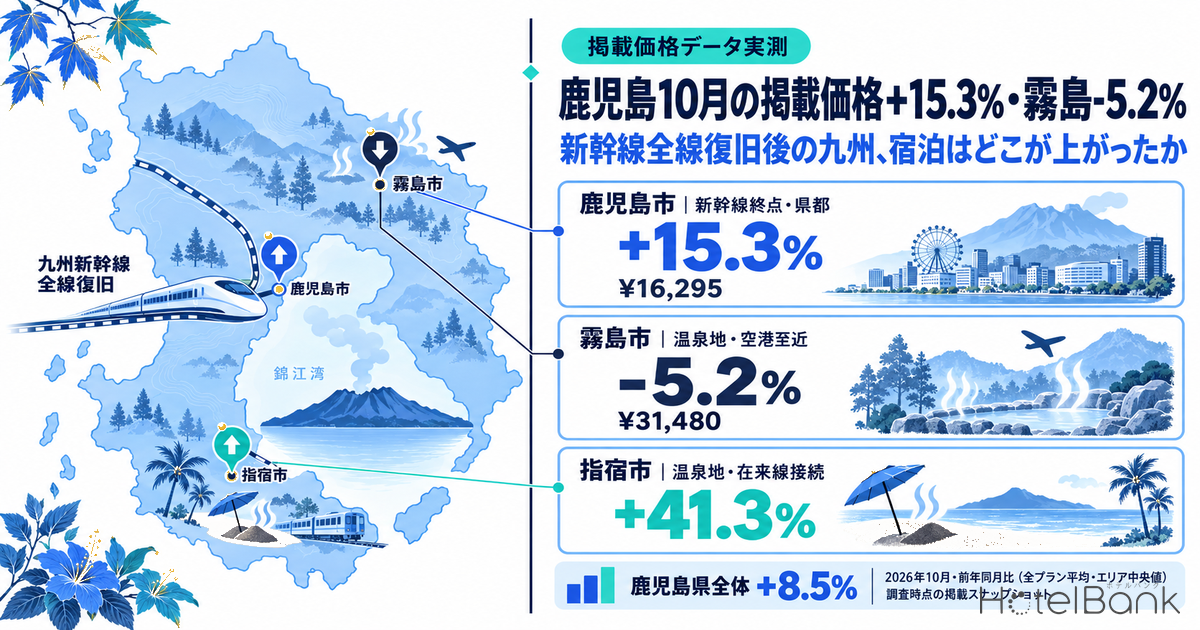
This article is not a walkthrough of the subsidy schemes. Taking September 18 as the pivot, it measures how prices and inventory actually moved either side of that date, using listing data compiled by MetroEngines Research. The short version: Kagoshima City’s listed price for October 2026 is up 15.3% year on year, while Kirishima City — an onsen destination in the same prefecture — is down 5.2%. “Kagoshima went up” does not survive as a single statement. Measure one and the same property against three different yardsticks and the increase comes out anywhere between +5.0% and +38.4%. We take the yardsticks one at a time.
Metric Definitions Used in This Article
- Listed price: the rate each property publishes on the major booking sites. Per-room rate for two guests per room (tax-inclusive). This article explicitly distinguishes three variants: the all-plan average, the within-month average of the lowest plan, and the observed within-month range (low / average / high). An area-level listed price is derived from the area median of the daily average rates of the properties covered, and represents the level of a typical property in that area.
- ADR (estimated settled ADR): an estimated settled rate (tax-exclusive equivalent) derived by applying a property-type adjustment factor to the lowest plan rate each property publishes. Cross-checked against per-property disclosures from listed hotel REITs (91 properties, most recent three months), the median error is about 7%. These are estimates and differ from each property’s actual transacted rates and accounting figures. Note that this metric is computed on a verified historical basis for settled past months and on a listing-snapshot basis from the current month onward, so the basis switches between August and September 2026. This article does not use it as the primary year-on-year measure (reasons below).
- OCC (occupancy): rooms sold as a share of total rooms in the area (estimated from OTA sales inventory). It is an estimate based on how far the inventory offered on the major booking sites has been taken up, and differs from a property’s actual overall occupancy.
- Data sources: MetroEngines Research (listed prices and inventory); published materials from the Japan Tourism Agency, MLIT and JR Kyushu (schemes and train operations).
- — Kagoshima City’s listed price for October 2026 (area median of the all-plan average) is ¥16,295, +15.3% against ¥14,137 a year earlier. But October is a listing snapshot as of September 21, not a comparison of two settled months.
- — Movements inside the prefecture do not line up. The onsen town of Kirishima City is -5.2% (¥31,480), Ibusuki City +41.3% (¥29,585, 34 properties covered), and Kagoshima Prefecture as a whole +8.5% (¥18,061).
- — At Sheraton Kagoshima, the within-month average of the lowest listed plan is +20.4% year on year — but only +5.0% against March 2026, before the earthquake. Change the baseline date and the rate of increase differs fourfold.
- — Across the 18 large hotels in the city with 190+ rooms that can be compared with last year, the lowest plan moved by a median of -1.0%, within a range of -49.9% to +39.5%. Eight are up and ten are down: not even the direction is shared.
- — Estimated occupancy for Kagoshima Prefecture (based on OTA listed inventory) sank to 63.4% in August, and the trough sits mainly in the business-hotel segment (69.8% in July to 48.0% in August). With the Shinkansen restoration, the prefecture’s own subsidy and the autumn season all overlapping, October’s movement cannot be attributed to any single cause.
What Happened Over 50 Days — From Earthquake to Full Restoration, and On to October
First, the sequence of events. At 16:27 on July 28, 2026, an earthquake of magnitude 7.1 with a maximum seismic intensity of 7 struck Kyushu. On Kumamoto Prefecture’s own count, lodging cancellations within the prefecture reached roughly 146,000 person-nights worth about ¥2.06bn as of August 10; adding some ¥4.04bn of damage to buildings and equipment, total damage to the lodging industry is put at about ¥6.0bn. What stood out is that the Aso and Amakusa areas, which were relatively lightly damaged, accounted for the majority of cancellations — physical damage and booking cancellations did not track each other.
Transport came back in stages. On the Kyushu Shinkansen, the Shin-Minamata to Kagoshima-Chuo section reopened on August 7, so travel within Kagoshima Prefecture recovered relatively early. At that point, however, trains ran on a reduced timetable with all cars unreserved, and the through service from Honshu remained severed. On the Kumamoto to Shin-Minamata stretch, close to the Hinagu fault zone, structural damage such as viaduct cracking ran to roughly 600 locations; that section was repaired and the full line reconnected on September 18. Even after full reopening, trains continued to run at reduced speed near Shin-Yatsushiro Station, with southbound arrivals at Kagoshima-Chuo expected to run up to eight minutes late.
One caution is needed here: other factors cluster around September 18. Kagoshima Prefecture’s own “Kagoshima Tourism Subsidy” (60% discount, capped at ¥20,000 per person per booking) opened for reservations on September 14, covering stays from September 14 to October 13. Full restoration of the Shinkansen came four days later. So even if inventory and prices are cut mechanically at September 18, both the rail restoration and the prefecture’s own discount programme sit on the same side of that line, and neither can be isolated as a standalone effect.
| Date | Event | Relevance to the Kagoshima lodging market |
|---|---|---|
| 7/28 | 2026 Kumamoto Earthquake (Mj7.1, maximum seismic intensity 7) | Kyushu Shinkansen suspended across all sections; cancellations spread widely |
| 8/7 | Kyushu Shinkansen reopens Shin-Minamata – Kagoshima-Chuo (reduced timetable, all cars unreserved) | Travel within the prefecture recovers; through service to Honshu still severed |
| As of Aug 10 | Kumamoto Prefecture lodging cancellations of roughly 146,000 person-nights, about ¥2.06bn | Cancellations spread even in lightly damaged areas |
| 9/14 | Kagoshima Tourism Subsidy opens for bookings (60%, ¥20,000 cap; stays Sep 14 – Oct 13) | Acts directly on demand from late September to early October |
| 9/18 | Kumamoto – Shin-Minamata reopens; Kyushu Shinkansen fully restored (after roughly 50 days) | Through service to Honshu restored; reduced speed continues near Shin-Yatsushiro |
| 9/19–9/23 | Autumn holiday weekend | Peak inventory take-up (99.0% prefecture-wide on Sep 20) |
| 10/1 | Eligible stays under the Kyushu Recovery Subsidy begin (¥15.5bn budget; 60% for Kumamoto and Kagoshima) | Kagoshima Prefecture bookings expected to open in mid-October |
Source: compiled by the HotelBank Editorial Team from published materials of JR Kyushu, Kumamoto Prefecture and the Japan Tourism Agency, and from news reports
Inventory Take-Up Sank in August and Recovered in September — But the Trough Is Concentrated in One Segment
Read monthly, estimated occupancy for Kagoshima Prefecture on an OTA listed-inventory basis runs 63.0% in June, 74.7% in July, 63.4% in August and 71.4% in September (1st to 21st) — a clear trough in August. The earthquake struck on July 28, so that trough is the month immediately following it. Coverage runs to 289–301 properties and 11,223–11,334 rooms depending on the month.
Split by property type, though, the trough is anything but uniform. Business hotels fell 21.8 points, from 69.8% in July to 48.0% in August, while resorts actually rose from 82.9% to 84.6% and ryokan were roughly flat at 75.8% to 76.3%. August is structurally a thin month for business demand in any year, and indeed on this metric business hotels were already low at 50.8% in June, before the earthquake. A listed-inventory metric on its own cannot separate seasonality from earthquake impact. What can be said is narrower: the August fall sits mainly in the business segment, while leisure-segment take-up was, if anything, firm in the same month.
Source: MetroEngines Research; compiled by the HotelBank Editorial Team (Kagoshima Prefecture; September aggregated over the 1st–21st)
| Property type | Jun | Jul | Aug | Sep (1st–21st) | Properties / rooms in September |
|---|---|---|---|---|---|
| All properties | 63.0% | 74.7% | 63.4% | 71.4% | 301 properties / 11,313 rooms |
| Business | 50.8% | 69.8% | 48.0% | 64.9% | 72 properties / 5,868 rooms |
| City | 76.8% | 80.8% | 79.0% | 81.0% | 14 properties / 1,844 rooms |
| Resort | 78.7% | 82.9% | 84.6% | 80.3% | 29 properties / 1,453 rooms |
| Ryokan | 71.6% | 75.8% | 76.3% | 72.2% | 57 properties / 1,325 rooms |
Source: MetroEngines Research; compiled by the HotelBank Editorial Team (estimated occupancy on an OTA listed-inventory basis)
On a daily basis, the days from the day after full restoration record the highest levels in the month: 85.2% on September 19, 99.0% on September 20 (118 rooms left out of 11,313) and 81.7% on September 21. Those three days, however, fall on the autumn holiday weekend and land just after the prefecture’s own discount scheme opened for bookings. This article therefore does not read that level as an effect of the Shinkansen restoration.
Kagoshima City’s Listed Price Is +15.3% Year on Year in October — But the Two Months Are Different in Kind
Turning to price. Kagoshima City’s listed price (all-plan average, area median) is ¥14,976 in September 2026 and ¥16,295 in October — a month-on-month rise of 8.8%. Against the same month a year earlier, that is +15.3% on ¥14,137 in October 2025, while September 2026 is +9.1% on ¥13,731 in September 2025. Coverage is 113 properties in 2026 and 96 in October 2025.
Two caveats belong here. The first is the sample: within the same city, coverage has grown from 96 properties to 113, so the mix of properties the median is taken over does not match last year exactly. The second is the nature of the month. This study was run as of September 21, and October 2026 is not “the result of a month already finished” but “a snapshot of the prices currently listed on booking sites”. As check-in dates approach, new plans are added and rates adjusted, and the level moves. The figure of +15.3% year on year is not a comparison of two settled outcomes.
Source: MetroEngines Research; compiled by the HotelBank Editorial Team (Kagoshima City, 95–113 properties covered)
Seen across the full year, Kagoshima City in 2026 tracked roughly 2–6% above the prior year from January through May, and sat slightly below it in June and July. It only moves clearly above the prior year from September onward. The spike of ¥16,997 in August 2025 reflects that summer’s own conditions, and August 2026 at ¥14,648 is 13.8% below it. The shape is not “2026 is high all year” but “the gap opened from September”.
Estimated settled ADR, by contrast, cannot carry this comparison. Kagoshima City’s estimated settled ADR rises 14.8%, from ¥6,788 in August 2026 to ¥7,790 in September — but figures through August are computed on a settled historical basis and those from September on a listing-snapshot basis, and the method switches exactly at that boundary. Coverage barely changes, at 72–73 properties, so the step is a product of the differing basis rather than the sample. Prefecture-wide the step is larger still: ¥6,906 in August to ¥9,406 in September, or +36.2%. For a year-on-year discussion it is therefore the listed-price series, whose method is consistent, that should be used.
One Property, Three Yardsticks — What Rose Was the Floor, Not the Ceiling
A market-wide median says nothing about what is happening property by property. So take one: Sheraton Kagoshima, a 228-room full-service hotel in the Kiramek Terrace complex in front of Kagoshima-Chuo Station (opened May 2023, guest review score 4.38), and measure the same property three ways. Its plan line-up is wide, which makes it a good case for seeing how much the picture changes with the choice of price metric.
The first yardstick is the within-month average of the lowest listed plan. Against ¥26,903 in October 2025, October 2026 comes in at ¥32,384, or +20.4%. Against the preceding month — ¥23,395 in September 2026 — it is +38.4%. The second yardstick is the listed price (all-plan average): ¥51,705 to ¥63,836, or +23.5%. The third is the observed within-month range, which sets the low, average and high of the plans observed over the same period side by side.
Source: MetroEngines Research; compiled by the HotelBank Editorial Team (Sheraton Kagoshima, within-month average of the lowest listed plan)
| Month | Within-month low | Within-month average | Within-month high | Range multiple | Plans observed |
|---|---|---|---|---|---|
| September 2025 | ¥20,770 | ¥41,637 | ¥194,000 | 9.3x | 5,176 |
| October 2025 | ¥20,770 | ¥46,795 | ¥200,050 | 9.6x | 2,042 |
| March 2026 (pre-earthquake) | ¥23,595 | ¥66,600 | ¥255,310 | 10.8x | 4,055 |
| September 2026 | ¥21,780 | ¥49,352 | ¥233,530 | 10.7x | 5,520 |
| October 2026 | ¥26,620 | ¥63,642 | ¥231,110 | 8.7x | 3,188 |
| November 2026 | ¥29,161 | ¥63,090 | ¥222,640 | 7.6x | 3,128 |
Source: MetroEngines Research; compiled by the HotelBank Editorial Team (two guests per room, tax-inclusive; aggregated per plan observed)
Three things can be read off this table. First, against the same month a year earlier, what rose was mainly the floor. The low moved 28.2%, from ¥20,770 to ¥26,620, while the high rose only 15.5%, from ¥200,050 to ¥231,110. Second, the average rose 36.0%, from ¥46,795 to ¥63,642 — outpacing both the floor and the ceiling. That points to a change not just in how individual plans are priced but in the composition of the plans being observed. The number of plans observed grew from 2,042 to 3,188, so which price bands sit on the shelf as inventory differs from last year.
Third, the picture changes again against the pre-earthquake level. Against a within-month average of ¥66,600 in March 2026, October 2026 at ¥63,642 is 4.4% lower. On the within-month average of the lowest plan, October’s ¥32,384 is +5.0% on March 2026’s ¥30,829. So “+20.4% year on year” and “+5.0% against the pre-earthquake level” both describe the same property in the same month, and both are true. The size of the increase depends heavily on which point is taken as the baseline.
The City’s 18 Large Hotels Are Not Moving Together — The Median Is -1.0%
One property’s movement is not necessarily representative of the market. Taking the 18 large hotels in Kagoshima City with 190 or more rooms that can be compared with the same month last year, and comparing the within-month average of the lowest listed plan for October 2026 against a year earlier, the distribution comes out as below. Individual property names are withheld; only scale and rate of change are shown.
Source: MetroEngines Research; compiled by the HotelBank Editorial Team (18 properties in Kagoshima City with 190+ rooms; year-on-year change in the within-month average of the lowest listed plan)
Of the 18, eight are above the same month last year and ten below, giving a median of -1.0%. The range runs from -49.9% to +39.5%, so not even the direction is shared. The 228-room hotel discussed in the previous section sits fourth from the top at +20.4%, while the largest increase belongs to a different, 355-room property. This is not a picture of one single hotel pushing prices up on its own.
The area median is +15.3% while the median lowest plan across the 18 large hotels stops at -1.0%, and the reason is that the two measure different things. The former takes the all-plan average first and then the median across properties, and its coverage is all 113 properties, small ones included. The latter is the distribution across 18 properties, restricted to the lowest plan. The sentence “hotels in Kagoshima have got more expensive” comes out as either -1.0% or +15.3% depending on which metric, which sample and which baseline date it is measured against. To judge for themselves, readers need all three of those together.
Capital City and Onsen Towns Diverge — Kirishima -5.2%, Ibusuki +41.3%
Now the geographic angle. Lining up the prefecture’s three main lodging destinations by listed price for October 2026 (all-plan average, area median) gives the following.
| Area | Character | October 2025 | October 2026 | YoY change | Properties covered |
|---|---|---|---|---|---|
| Kagoshima City | Shinkansen terminus; prefectural capital | ¥14,137 | ¥16,295 | +15.3% | 96→113 |
| Kirishima City | Onsen town; close to the airport | ¥33,224 | ¥31,480 | -5.2% | 82→93 |
| Ibusuki City | Onsen town; linked to the capital by conventional line | ¥20,935 | ¥29,585 | +41.3% | 36→34 |
| Kagoshima Prefecture total | — | ¥16,649 | ¥18,061 | +8.5% | 682→767 |
Source: MetroEngines Research; compiled by the HotelBank Editorial Team (listed price; two guests per room, tax-inclusive; area median of the all-plan average)
Kirishima City has run in the ¥28,000–32,000 band all year, and October’s ¥31,480 sits below the prior year’s ¥33,224. Month to month it has barely moved either, from ¥31,742 in September to ¥31,480 in October. Ibusuki City, by contrast, has stepped up through the year — ¥24,844 in June 2026, ¥26,839 in July, ¥27,761 in August — so October’s ¥29,585 is a continuation of a level that was already shifting. Ibusuki’s +41.3%, in other words, did not begin in October. Note too that Ibusuki’s coverage is small at 34 properties, so the pricing of a few properties can move the median.
Source: MetroEngines Research; compiled by the HotelBank Editorial Team
Overlaying the rail geography brings out how the three areas differ in character. Kagoshima City is the Kyushu Shinkansen terminus, the location where restored through service from Honshu bites most directly. Ibusuki City is linked to Kagoshima-Chuo Station by conventional line, so arrivals mostly route through the prefectural capital. Kirishima City, by contrast, sits close to Kagoshima Airport, and air access carries relatively more weight. It is true that the movement in listed prices looks consistent with that ordering — but the prefecture’s own discount scheme and the autumn travel season fall in the same window, so this cannot be explained causally as an effect of the rail restoration. What is shown here goes no further than the factual point that movements differ even within one prefecture.
On the prefecture’s price hierarchy itself, Kagoshima’s Capital Is Its Cheapest: ADR ¥6,819 vs Kirishima ¥14,330 tracks 12 months of movement. Among the three main areas covered here, the relationship in which the prefectural capital is the cheapest is unchanged as of October (Kagoshima City ¥16,295 against Kirishima City ¥31,480 and Ibusuki City ¥29,585). On the all-plan-average listed price, some municipalities — Izumi, Kanoya and Satsumasendai among them — are cheaper still than the capital.
The Contrast with Kumamoto — A High Number Is Not Straightforwardly Strong Demand
What about Kumamoto Prefecture, close to the epicentre? Comparing estimated occupancy on an OTA listed-inventory basis for September (1st to 21st), Kumamoto runs 88.4% across all properties (284 properties, 12,706 rooms), 93.1% for business hotels and 94.2% for city hotels — far above Kagoshima’s 71.4%, 64.9% and 81.0%. Over time, Kumamoto’s business segment traces a jump after the disaster: 81.4% in July, 95.4% in August, 93.1% in September.
Source: MetroEngines Research; compiled by the HotelBank Editorial Team (September 1–21, 2026; estimated occupancy on an OTA listed-inventory basis)
The nature of the metric needs stating plainly here. This occupancy figure measures how much of the inventory posted on booking sites has been taken up; it is not a property’s actual occupancy. When rooms are diverted to demand that never passes through a booking site — recovery-related long stays, contracts with local authorities — the listed inventory itself shrinks. A smaller denominator lifts the take-up rate. Kumamoto’s figures in the 93% range therefore show that “what is posted on the booking sites is filling well”, but how much of that is the strength of visitor demand and how much is inventory moving off-platform cannot be separated with this metric alone.
The same applies to listed prices. The average listed price for Kumamoto’s business segment moved from ¥11,256 in July to ¥17,692 in August and ¥17,070 in September — but if cheaper inventory is taken up first, or moves off-platform, the average of what remains listed rises even without any property changing its rate card. A rise in the average listed price can be produced by factors other than a change in operators’ pricing behaviour. Individual operators’ intentions cannot be read off it. The daily recovery path on the Kumamoto side — including Kurokawa Onsen and Aso — is a separate question this article does not take up.
Worth holding onto as a contrast is that Kumamoto’s resort segment barely moves at all: 75.8% in June, 78.0% in July, 76.8% in August, 77.9% in September. Business and city hotels jumping while the leisure segment stays flat is consistent with the demand that grew after the disaster not having been tourism. In Kagoshima the shape is the reverse — business sank in August while leisure held firm — so the same earthquake shows up differently by prefecture and by segment.
Why October Cannot Be Pinned on One Cause, and Where the Headroom Sits
At least four factors land on Kagoshima in October 2026 at once: full restoration of the Shinkansen (Sep 18); the prefecture’s own Kagoshima Tourism Subsidy (stays Sep 14 – Oct 13); the start of eligible stays under the Kyushu Recovery Subsidy (from Oct 1, with Kagoshima Prefecture’s bookings expected to open in mid-October); and the autumn travel season. Their windows overlap, so movements in listed prices or inventory take-up cannot be attributed to any one of them.
One note on the scheme itself. The Kyushu Recovery Subsidy carries a budget of ¥15.5bn at a 50% subsidy rate (60% for Kumamoto and Kagoshima Prefectures), with per-person discount caps of ¥20,000 for a lodging-only one-night stay, ¥30,000 for two or more nights with transport included, and ¥35,000 for multi-prefecture itineraries covering two or more prefectures. At Kagoshima’s 60%, the ¥20,000 cap only binds above ¥33,333 per person per night, and Kagoshima City’s median listed price of ¥16,295 (two guests per room, about ¥8,100 per person) is nowhere near it. The design of the scheme and how it bites by price band are covered in Kyushu Recovery Subsidy Set: 60%/50% Split, ¥20,000 Cap Hits Top 10%, so this article does not go further into it.
Finally, where the headroom visible in public data sits. First, Kagoshima’s business segment ran take-up of 64.9% as of September, more than 15 points below city hotels at 81.0% and resorts at 80.3%. How far weekday business-travel demand returns alongside restored through service from Honshu is something the monthly series from October onward can settle. Second, on price, Kirishima City has been roughly flat all year and shows no movement at October’s level relative to the capital or Ibusuki. Whether differences in access route are showing up as differences in how demand returns cannot be judged without the series from November onward.
Third, as the Sheraton Kagoshima case showed, October’s observed within-month average (per plan observed) is 4.4% below the pre-earthquake March level — though on the monthly all-plan average it is +1.9%, with October at ¥63,836 against March’s ¥62,648. Even with the market-wide median above last year, some yardsticks leave individual properties in months that have not fully returned to their pre-earthquake level. Listed prices for November and December 2026 stand at ¥16,618 and ¥16,564 in Kagoshima City, in line with October, so on current listings October is not an outlier month. Whether November onward lands at October’s level, or falls back as factors specific to October drop away, will need re-examining once results are settled.
⚠ A note on prices for future dates: the listed prices and estimated settled ADR for October 2026 onward used in this article are a snapshot of the rates published on booking sites as of the study date (September 21, 2026), and will move as check-in dates approach and plans are added or rates adjusted. Please note that year-on-year comparisons set a settled past month against a current listing snapshot.
Frequently Asked Questions
Q. Are hotel rates in Kagoshima City higher in October 2026 than a year earlier?
A. On listed price (two guests per room, tax-inclusive, area median of the all-plan average), October 2026 comes to ¥16,295, up 15.3% on ¥14,137 in the same month a year earlier. But the October figure is a snapshot of the prices listed on booking sites as of September 21, 2026, not a comparison of two settled outcomes. Coverage has also grown from 96 properties to 113.
Q. Which areas within Kagoshima Prefecture are seeing rates rise?
A. Year on year for October 2026: Kagoshima City +15.3%, Ibusuki City +41.3%, Kirishima City -5.2%, and Kagoshima Prefecture as a whole +8.5%. Ibusuki has been stepping up since June, so the move did not begin in October. Note too that its coverage is small at 34 properties, so a few properties’ pricing can move the median. Kirishima has been roughly flat all year.
Q. Has hotel demand in Kagoshima returned now that the Kyushu Shinkansen is fully restored?
A. Estimated occupancy on an OTA listed-inventory basis hit the highest levels of the month on the days after full restoration: 85.2% on September 19, 99.0% on the 20th and 81.7% on the 21st. Those three days fall on the autumn holiday weekend and land just after the prefecture’s own Kagoshima Tourism Subsidy opened for bookings, so the effect of the Shinkansen restoration cannot be isolated.
Q. Why does the same hotel appear to have raised rates by different amounts?
A. Because the price yardstick and the baseline date differ. For Sheraton Kagoshima in October 2026, the within-month average of the lowest listed plan is +20.4% year on year and the all-plan average +23.5% — but against March 2026, before the earthquake, the lowest plan’s within-month average is only +5.0%. The number of plans observed has also grown from 2,042 a year earlier to 3,188, so the composition of the plans on the shelf has itself changed.
Q. How much does the Kyushu Recovery Subsidy’s ¥20,000 cap actually bite at Kagoshima hotels?
A. Kagoshima Prefecture’s subsidy rate is 60%, with a lodging-only discount cap of ¥20,000 per person per night. The cap only binds above ¥33,333 per person per night, and Kagoshima City’s median listed price of ¥16,295 (two guests per room, about ¥8,100 per person) is well short of it. How the cap bites by price band is covered in the related articles.
Methodology and Sources
Listed-price and inventory data are from MetroEngines Research. An area-level listed price is the monthly average of the area median of the daily average rates of the properties covered, on a per-room basis for two guests per room (tax-inclusive), all-plan average. Coverage varies by month: 95–113 properties in Kagoshima City, 79–95 in Kirishima City, 28–37 in Ibusuki City and 650–787 across Kagoshima Prefecture. Estimated occupancy is based on how far the inventory offered on booking sites has been taken up, covering 289–301 properties and 11,223–11,334 rooms in Kagoshima Prefecture and 270–312 properties and 12,433–13,262 rooms in Kumamoto Prefecture; September 2026 is aggregated over the 1st to the 21st. Per-property listed-price ranges are aggregated per plan observed, for two guests per room, tax-inclusive. Of roughly 168,000 properties in Japan tracked by MetroEngines Research, about 27,000 properties and some 1.26 million rooms with confirmed activity on booking sites form the analysis set; ryokan, minshuku and simple lodging houses not listed on booking sites are excluded.
Related Reading
- Kagoshima’s Capital Is Its Cheapest: ADR ¥6,819 vs Kirishima ¥14,330
- Kyushu Recovery Subsidy Set: 60%/50% Split, ¥20,000 Cap Hits Top 10%
References and Sources
■ Data sources
Listed prices, inventory and estimated occupancy are aggregated by MetroEngines Research (study date September 21, 2026). Lodging cancellations and damage figures from the earthquake are from Kumamoto Prefecture’s published figures and news reports; Kyushu Shinkansen service restoration is from JR Kyushu announcements and news reports; the terms of the Kyushu Recovery Subsidy and the Kagoshima Tourism Subsidy are from published materials of the Japan Tourism Agency and Kagoshima Prefecture.
■ Calculation assumptions
An area-level listed price is the monthly average of the area median of the daily average rates of the properties covered (two guests per room, per-room, tax-inclusive, all-plan average). For individual properties, three measures are kept distinct: the within-month average of the lowest listed plan, the all-plan average, and the within-month range per plan observed. Estimated occupancy is an estimate based on how far the inventory offered on the major booking sites has been taken up; September 2026 is aggregated over the 1st to the 21st. Year-on-year comparisons set medians from months with differing property coverage against each other.
■ Limitations and caveats
Figures from October 2026 onward are a listing snapshot as of the study date, not settled results. Property coverage differs by year (95–113 properties in Kagoshima City, 28–37 in Ibusuki City), so changes in the mix affect the median. Estimated occupancy differs from a property’s actual overall occupancy and can overstate when inventory is diverted to demand that never passes through a booking site (long stays, local-authority contracts and the like). Because full restoration of the Shinkansen, the prefecture’s own subsidy and the autumn travel season all fall in the same window, none can be isolated as a standalone effect.
■ Market data
- MetroEngines Research — listed prices (by area and by property), estimated occupancy on an OTA listed-inventory basis, and observed within-month plan ranges
■ Transport and operations
- Kyushu Shinkansen to fully reopen on September 18; Kumamoto–Shin-Minamata suspended by the earthquake (Nikkei)
- [Breaking] Kyushu Shinkansen fully reopens; Kumamoto–Shin-Minamata running (Kumamoto Nichinichi Shimbun)
- Kyushu Shinkansen Shin-Minamata–Kagoshima-Chuo to resume on the 7th, JR Kyushu (Nikkei)
- Kyushu Shinkansen: Shin-Minamata–Kagoshima-Chuo resumes August 7 (RailLab)
■ Damage and schemes
- 2026 Kumamoto Earthquake related information (includes the Kyushu Recovery Subsidy) / Japan Tourism Agency, MLIT
- Kumamoto Prefecture: ¥2.1bn of lodging cancellations, some 146,000 person-nights, and ¥4.0bn of property damage from the earthquake (Kanko Keizai Shimbun)
- ¥6.0bn of damage to tourism as the summer holidays take a direct hit; lodging cancellations leave operators in the dark — Kumamoto Earthquake (Jiji Press)
- Japan Tourism Agency to launch the Kyushu Recovery Subsidy in October, discounting travel and lodging by 50%, and 60% in Kumamoto and Kagoshima (Travel Voice)
- Kagoshima Tourism Subsidy (official Kagoshima Prefecture tourism campaign site)