

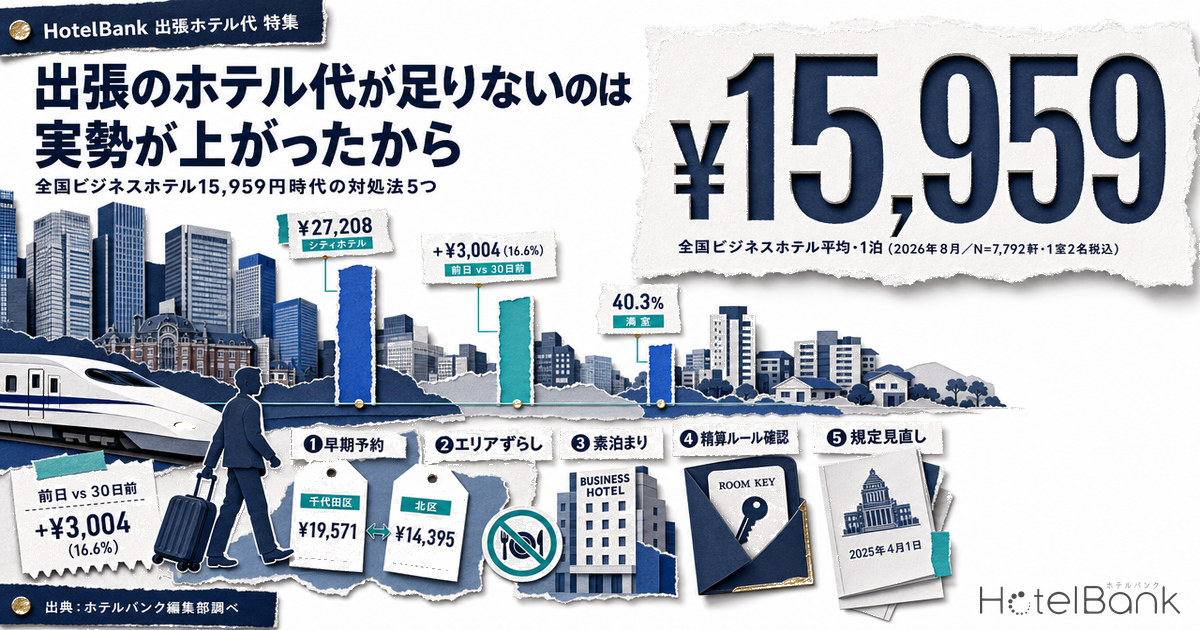
If the hotel budget for your business trip does not stretch far enough, it is not your imagination and it is not because you are searching badly. Market rates for business hotels across Japan have climbed to ¥15,959 a night on an aggregation of OTA listed prices (August 2026, N=7,792 properties, two guests sharing one room, per room, tax included), and in a growing number of cities an older travel policy built around roughly ¥10,000 a night simply no longer reaches. Listed price in this article means the rate actually shown on hotel booking sites, aggregated; it is not the amount finally paid after discounts or corporate rates are applied. Below we use market data to check why the budget falls short, then narrow the response down to five fixes you can use today.
- — Business hotels across Japan list at ¥15,959 a night (August 2026, N=7,792 properties, two guests per room, per-room rate including tax). That leaves a wide gap against travel policies capped at around ¥10,000.
- — Booking the day before costs ¥3,004 (16.6%) more on average than booking 30 days out. By the day before, 40.3% of properties were sold out, so the range of choice itself narrows.
- — Even within Tokyo, Chiyoda averages ¥19,571 against ¥14,395 in Kita. Inside the same commuting range that is about ¥5,200 a night, and more than ¥10,000 over two nights.
- — Japan’s travel-expense system for national public employees moved to capped reimbursement of actual lodging costs under an amendment effective 1 April 2025. The reference amounts were set prefecture by prefecture on the basis of surveys of actual market rates.
- — What works at the individual level is (1) booking early, (2) shifting the area, (3) going room-only; what needs the company is (4) checking the reimbursement rules in advance and (5) revising the policy.
The Budget Falls Short Because Market Rates Have Risen
When the HotelBank Editorial Team aggregated OTA listed prices, business hotels across Japan averaged ¥15,959 a night as of August 2026 (N=7,792 properties). City hotels run higher, at ¥27,208 (N=1,351 properties). Both figures are aggregated on a basis of two guests sharing one room, per-room rate including tax, so the market rate for the single occupancy common on business trips can differ from these values. Even so, the distance between that market level and a policy still capping lodging at ¥8,000–10,000 a night is easy to read.
The gap is not uniform across the country. We cover the difference between policy caps and market rates prefecture by prefecture in Government Per-Diem vs Market ADR — 47-Prefecture Gap Visualized (2026), which lets you check where your own destination sits. The same upward movement runs through the major business-travel cities — Sapporo, Sendai, Hiroshima and Fukuoka among them — so the pattern is not confined to Tokyo. From here on we look at what you can do yourself, on the assumption that the policy will not change today.
Fix 1: Book Early — the Last Minute Adds ¥3,000 a Night
Book the moment the trip is confirmed. This is the most reliable fix, and its effect can be checked in the numbers. Tracking 864 business hotels in Tokyo for a stay on Wednesday 15 July 2026, the average listed price of the rooms still available (two guests per room, tax included) moved as follows by booking timing.
| Booking timing | Average listed price | Share of properties sold out |
|---|---|---|
| 90 days out | ¥18,113 | 8.9% |
| 30 days out | ¥18,137 | 8.3% |
| 7 days out | ¥19,576 | 12.2% |
| 3 days out | ¥20,283 | 17.7% |
| Day before | ¥21,141 | 40.3% |
Source: Compiled by the HotelBank Editorial Team (864 business hotels in Tokyo; OTA listed prices for a stay on 15 July 2026 aggregated by booking lead time; two guests per room, tax included)
Comparing 30 days out with the day before, the average gap came to about ¥3,000 (roughly 17%). On top of that, 40% of properties were sold out by the day before, so the range of choice itself had thinned. The closer the stay, the more the cheaper rooms have already gone, which naturally lifts the average of what remains. The tighter the budget, the more it pays to move the booking forward. Many hotels set their free-cancellation deadline at the day before or a few days out, so even when the schedule may still shift, securing a room first often works in your favour.
Fix 2: Shift One or Two Stations Away
If you do not insist on the station nearest the place you are visiting, the amount you pay changes substantially. Looking at listed prices for business hotels in Tokyo by ward (August 2026, two guests per room, tax included), Chiyoda averages ¥19,571 (N=67 properties), while Kita — 15 to 20 minutes north on the Keihin-Tohoku Line — averages ¥14,395 (N=20 properties). Within the same commuting range into the centre, that is a difference of about ¥5,200 a night. Over two nights it exceeds ¥10,000.
The point is not to change city but to look a few stations along the same line. Simply accepting a 15- to 20-minute ride, within range of the last train, sharply widens the set of options that fit inside the policy. Even when the visit itself is in the centre, putting the room in the neighbouring ward or city is an idea that works the same way in Osaka, Nagoya and Fukuoka as it does in Tokyo. How this gap between the centre and the surrounding areas has opened up over the past year is tracked across 12 months in Tokyo Business Hotel ADR 12-Month Trend: 30% Central vs Outer Ward Gap.
Fix 3: Switch to Room-Only and Cover Meals with In-Room Facilities
At the same hotel and in the same room, a plan with breakfast and a room-only plan often differ by roughly ¥1,000–2,000 a night (this varies widely by property; it is a general guide rather than one of our aggregated figures, so compare the two plans side by side when you book to see the actual difference). If your company sets its lodging cap on the room rate excluding meals, switching to room-only alone can bring the stay inside the policy. Taking breakfast at a convenience store or in the station also holds down what you actually spend.
For a trip of several consecutive nights, another option is a stay-type hotel with a microwave and a refrigerator. Simply being able to reheat prepared food and keep drinks cold cuts the number of restaurant meals and compresses food costs, which pile up outside the lodging budget. Five extended-stay hotels where every room has a microwave and a refrigerator, holding down the cost of eating out on consecutive nights without cooking (Innippon, in Japanese) compares specific properties from exactly this angle.
Fix 4: The Basics of Paying Up Front — Settle the Reimbursement Rules First
The more likely the hotel bill is to exceed the policy, the more you want the reimbursement process settled in advance. Lodging on a business trip is generally handled in company accounting as travel and transport expenses. If you pay up front, always take a receipt (safest made out in the company’s name), and use the advance-payment system if your company has one. Whether the amount above the cap comes out of your own pocket, or the actual cost is allowed once you apply in advance, differs from company to company, so it is safest to check with accounting or general affairs before you book. Detailed tax treatment depends on the company’s own circumstances, so if a judgement call is needed, confirm it with your accounting staff or a tax accountant.
Fix 5: Ask Your Company to Revise the Policy — the Government Changed Its Own in April 2025
If individual workarounds cannot absorb the gap, it is worth asking the company to revise the policy itself. The wind is behind you here, because the government has moved. Under an amendment effective 1 April 2025, the travel-expense system for national public employees changed lodging from a fixed allowance to reimbursement of actual costs up to a cap. The cap — the lodging reference amount — was set prefecture by prefecture on the basis of surveys of actual rates for business-purpose stays, and where a stay cannot be arranged within the reference amount, reimbursement of the actual cost remains possible under certain conditions (source: Ministry of Finance, “Revision of the Travel Expense System for National Public Employees”).
That design change — set the cap against market reality, and provide for what happens when it is exceeded — gives private companies a plain reference point when they revise their own rules. When you raise it, data works better than impressions. The national average of ¥15,959 (August 2026, N=7,792 properties), together with the gap between policy and market rate in the prefecture you are travelling to, makes the conversation concrete. How far private-sector travel policies sit from market reality is broken down by seniority level in Outdated Travel Allowances? Actual ADR vs. Rank Limits in 47 Prefectures, which you can take into that conversation as it stands.
Job Hunting Runs Into the Same Structure
Students staying in cities to attend recruitment interviews have no company policy behind them, but they meet the same market. The fixes are the same, and the two that bite hardest are booking early (Fix 1) and shifting the area (Fix 2). Secure a room a few stations from the venue on the day the interview date comes through. In the crowded part of the selection season, the figures above — roughly ¥3,000 more on average for a day-before booking, with 40% of properties sold out — apply to the night before an interview exactly as they stand.
Where to Look Next
For detailed comparisons of specific properties, these articles go further.
Somewhere to park for business travellers driving a company car — roadside and station-front hotels in North Kanto (Utsunomiya, Takasaki and Maebashi) chosen for free parking and early departures, Top 5 (HotelPicks, in Japanese)
Compares five properties, including a price band from the ¥6,000s per night for one guest, on free parking and the time breakfast starts. Hotel Route-Inn Utsunomiya Yuinomori, with 165 free surface parking spaces and an EV charger, and Hotel Sealuck Pal Takasaki, where breakfast opens at 6 a.m., are picked from the practical standpoint of travelling by car.
Compares five properties nationwide from the angle of using in-room facilities to hold down food costs on consecutive nights. Tokyu Stay Osaka Honmachi (Honmachi business district, 256 rooms), the lowest price band of the five, and Tokyu Stay Ikebukuro, a one-minute walk from Ikebukuro Station, line up alongside other stay-type hotels carrying discounted plans for seven nights or more.
Frequently Asked Questions
What is the going rate for a hotel on a business trip?
Business hotels across Japan list at ¥15,959 a night as of August 2026 (N=7,792 properties), and city hotels at ¥27,208 (N=1,351 properties). Both are aggregated on a basis of two guests sharing one room, per-room rate including tax, so the market rate for the single occupancy common on business trips can differ from these figures.
When should I book to pay less?
Across 864 business hotels in Tokyo for a stay on 15 July 2026, the average was ¥18,137 at 30 days out against ¥21,141 the day before — a gap of ¥3,004 (16.6%). Ninety days out (¥18,113) and 30 days out sit at almost the same level, so “secure it by 30 days before the stay” is a sufficient rule of thumb. By the day before, 40.3% of properties were sold out.
How much do I save by shifting the area I stay in?
In Tokyo in August 2026, Chiyoda averaged ¥19,571 (N=67 properties) against ¥14,395 in Kita (N=20 properties) — a difference of about ¥5,200 a night, and more than ¥10,000 over two nights. Travel time and the last train are added constraints, however, so in practice it works best to decide the ride time you can accept before you start searching.
What happens if the lodging cost exceeds my company’s policy?
It varies by company. Whether the excess comes out of your own pocket, or the actual cost is allowed once you apply in advance, is set by the work rules or the travel-expense policy, so the safe course is to check with accounting or general affairs before you book. Lodging on a business trip is generally handled in company accounting as travel and transport expenses.
Is there material I can use to ask my company to revise its travel policy?
The travel-expense system for national public employees was amended effective 1 April 2025, changing lodging from a fixed-allowance method to reimbursement of actual costs up to a cap. The lodging reference amount that forms the cap was set prefecture by prefecture in light of surveys of actual rates for business-purpose stays, and where certain conditions are met, actual costs above the reference amount can still be reimbursed (Ministry of Finance). Presented alongside market data, it makes the conversation easier to move forward.
References and Sources
■ Data sources
Listed-price and inventory data collected by the HotelBank Editorial Team from public information on hotel booking sites. National, prefectural and municipal averages by property category are aggregated as of August 2026; the movement by booking timing is observed across 864 business hotels in Tokyo for a stay on 15 July 2026. Statements about the public system draw on the Ministry of Finance, “Revision of the Travel Expense System for National Public Employees (ministerial ordinance edition).”
■ Calculation assumptions
All prices are aggregated on a basis of two guests sharing one room, per-room rate including tax. The “share of properties sold out” refers to the proportion of properties with no bookable rooms remaining at the time of observation. Booking timing is expressed as the number of days before the stay. Averages by ward and city are averages of the business hotels located in that ward or city, and N is the number of properties covered by the aggregation.
■ Limitations and caveats
Listed prices are not transacted prices, and they do not reflect discounts, corporate rates or direct-booking-only plans. Because the basis is two guests sharing one room, the market rate for single occupancy can differ. The aggregation by booking timing observes a single stay date — 15 July 2026 in Tokyo — so both the level and the slope shift with the day of the week, the season and local events. The figure of 864 properties is the size of the property set; the number of properties for which a price could be observed at each point varies between 786 and 838. In wards with N around 20, the average moves easily as a small number of properties enter and leave the set.
■ Public system materials
Ministry of Finance, “Revision of the Travel Expense System for National Public Employees (ministerial ordinance edition)” (in Japanese; effective 1 April 2025 — lodging moved from a fixed-allowance method to reimbursement of actual costs up to a cap, with the lodging reference amount set prefecture by prefecture on the basis of surveys of market rates)
Related reading
- Business Hotel Price Surge: National ADR Analysis & 10 Cost-Effective Prefectures
- Tokyo Business Hotel ADR 12-Month Trend: 30% Central vs Outer Ward Gap
- Outdated Travel Allowances? Actual ADR vs. Rank Limits in 47 Prefectures
- Fiscal Half-End Weekday Demand? 5 Business Cities Show No Lift
- Government Per-Diem vs Market ADR — 47-Prefecture Gap Visualized (2026)