

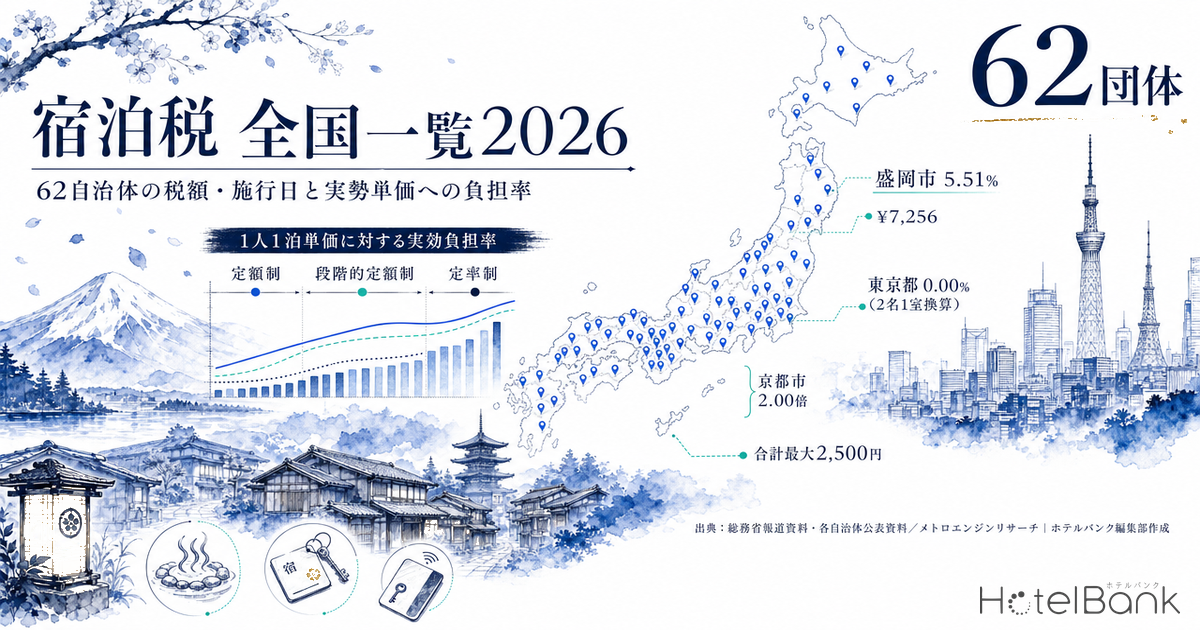
The number of municipalities levying a lodging tax has climbed sharply over the past two years. Within the scope of the Ministry of Internal Affairs and Communications (MIC) press releases and municipal disclosures we were able to verify for this article, the local governments that have obtained the Minister’s consent to establish a new lodging tax now number at least 62. The 42 bodies tallied by the House of Councillors Standing Committee Research Office as of October 2025 have since been joined by Nagano Prefecture, Morioka City, the 11 bodies consented in February 2026 and the seven consented in June 2026. Yet few sources let you confirm “who charges how much” in a single list, and the rate structures split into three types — flat, tiered-flat and ad valorem — which makes side-by-side comparison difficult.
This article compiles the full national list after verifying each municipality’s tax amounts and effective dates against its own ordinances and published materials, then estimates what share of the prevailing room rate the lodging tax represents per guest per night. To state the conclusion first: what determines the effective burden rate is not the headline tax rate but the design of the tax-free threshold. In Morioka City (盛岡市), Iwate, with its flat ¥200, the ratio reaches 5.51% on a double-occupancy conversion, while Tokyo — which moves to “3% of the accommodation charge” in April 2027 — will still levy nothing on the double-occupancy rate of a typical property in the city (roughly ¥7,300 per person).
Metric Definitions Used in This Article
- ADR (Average Daily Rate): An estimated settled rate (net-of-tax equivalent) calculated by applying category-specific adjustment coefficients to the lowest publicly listed plan level each property posts on OTAs (double occupancy, per-room rate, tax included). The median error against property-level actuals disclosed by listed hotel REITs is approximately 7% (91 properties, most recent three months). These are estimates and differ from each property’s actual transaction prices and accounting figures. Area-level ADR is the median of the properties covered (the level of a typical property in that area).
- Per-person, per-night rate: In this article, the per-room ADR above divided by the number of guests occupying the room. Double occupancy (ADR ÷ 2) is the default; for markets driven mainly by business demand, single occupancy (ADR = the per-person rate) is shown alongside it.
- Effective burden rate: The tax obtained by applying each municipality’s tax brackets to the per-person, per-night rate above, divided by that same rate.
- Data sources: Institutional details from each municipality’s ordinances and published materials and from MIC press releases. Market data from MetroEngines Research.
- — Local governments that have obtained the Minister’s consent to establish a new lodging tax now number at least 62. Of these, 32 reach their effective date in 2026, and nine or more follow in 2027.
- — The rate structures fall into three types: flat for 28 bodies, tiered-flat for 22 and ad valorem for 12. As of October 2025 only Kutchan Town used an ad valorem rate; it has spread rapidly in the year since.
- — Applied to prevailing rates, the effective burden per guest per night spans 0.00%–5.51%. Morioka City tops the list at 5.51%, followed by Hirosaki City at 5.35% and Miyazaki City at 4.98%.
- — What sets the burden rate is not the nominal tax rate but where the tax-free threshold sits relative to your own area’s rate level. The same flat ¥200 works out to 5.51% in Morioka City and 1.62% in Atami City.
- — Tokyo’s shift to a 3% ad valorem rate in April 2027 leaves double-occupancy stays (about ¥7,300 per person) short of the ¥13,000 tax-free threshold, so no tax applies. The impact falls on single occupancy, where the ratio moves from 0.68% to 2.99%.
Flat, Tiered-Flat and Ad Valorem — 62 Bodies Split Across Three Designs
The lodging tax is a non-statutory special-purpose local tax under the Local Tax Act, and the design of the rate is left to each municipality’s discretion. As the House of Councillors Standing Committee Research Office sets it out, rates come in three kinds: (1) a uniform flat amount, (2) a tiered flat amount that sets several tax amounts according to the accommodation charge, and (3) an ad valorem rate that applies a fixed multiplier to the accommodation charge. On top of that, whether a tax-free threshold exempts stays below a certain charge is the practical dividing line.
What deserves attention here is the shift in the mix of types. Of the 42 bodies that had consent as of October 9, 2025, only one — Kutchan Town (倶知安町), Hokkaido — used an ad valorem rate. Among the bodies consented since, however, come Okinawa Prefecture (2% ad valorem) and its municipalities (1.2%), Yamagata City (3%), Tomakomai City (3%) and Kitahiroshima City (3%), while Tokyo, already levying, moves to a 3% ad valorem rate in April 2027. A shift in design philosophy from flat amounts to ad valorem rates has taken place over the past year.
Source: Compiled by the HotelBank Editorial Team from MIC press releases, the House of Councillors Standing Committee Research Office’s Rippo to Chosa No. 479, and municipal disclosures
By year of entry into force, 2026 stands out with 32 bodies. April 1, 2026 in particular is the day Hokkaido, 15 municipalities within the prefecture, Gifu City, Yugawara Town, Toba City and Hiroshima Prefecture — 20 bodies in all — started at once, the largest single cluster in the history of Japan’s lodging taxes. Nine or more bodies follow in 2027, so the increase is still under way.
National List (1) Flat Rate — 28 Bodies Charging a Uniform Amount
The flat design is the simplest, and the lightest in terms of front-desk operation and filing work. Because the tax per guest per night is constant regardless of the rate, it is also easy to explain to guests. Below are the municipalities on a flat rate whose tax amounts and effective dates we were able to verify for this article.
| Municipality | Tax amount (per person, per night) | Effective date | Tax-free threshold |
|---|---|---|---|
| Otaru / Asahikawa / Kushiro / Obihiro / Kitami / Abashiri / Otofuke / Koshimizu, Hokkaido | ¥200 | 2026-04-01 | None |
| Wakkanai City, Hokkaido | ¥200 | 2027-03-01 (planned) | — |
| Hirosaki City, Aomori | ¥200 | 2025-12-01 | None |
| Miyagi Prefecture | ¥300 (within Sendai City, the prefectural portion is ¥100) | 2026-01-13 | Under ¥6,000 |
| Sendai City, Miyagi | ¥200 | 2026-01-13 | Under ¥6,000 |
| Morioka City, Iwate | ¥200 | 2026-10-01 | None |
| Nagano Prefecture | ¥300 (¥200 for the first three years) | 2026-06-01 | Under ¥6,000 |
| Matsumoto City, Nagano | City ¥100 (¥150 from year four) / ¥200 combined with the prefecture (¥300 thereafter) | 2026-06-01 | Under ¥6,000 |
| Achi Village, Nagano | ¥200 | 2026-06-01 | Under ¥6,000 |
| Fujiyoshida City / Fujikawaguchiko Town, Yamanashi | ¥200 | 2027-04-01 (planned) | — |
| Gifu City, Gifu | ¥200 | 2026-04-01 | None |
| Atami City, Shizuoka | ¥200 | 2025-04-01 | None |
| Tokoname City, Aichi | ¥200 | 2025-01-06 | None |
| Toba City, Mie | ¥200 | 2026-04-01 | None |
| Matsue City, Shimane | ¥200 | 2025-12-01 | Under ¥5,000 |
| Hiroshima Prefecture | ¥200 | 2026-04-01 | Under ¥6,000 |
| Fukuoka Prefecture | ¥200 (¥50 within Fukuoka City and Kitakyushu City; ¥100 within municipalities that levy their own lodging tax) | 2020-04-01 | None |
| Kitakyushu City, Fukuoka | ¥150 | 2020-04-01 | None |
| Kumamoto City, Kumamoto | ¥200 | 2026-07-01 | None |
| Miyazaki City, Miyazaki | ¥200 | 2026-07-01 | None |
Source: Compiled by the HotelBank Editorial Team from municipal ordinances and disclosures and MIC press releases
National List (2) Tiered Flat Rate — 22 Bodies Where the Amount Changes by Rate Band
The tiered flat design switches the tax amount by band of accommodation charge. It can ask more of the high-rate bands, but it creates a step where the effective burden rate jumps the moment a stay crosses a boundary. The number of brackets ranges from two to six, the most being the six used by Nasu Town (那須町), Tochigi.
| Municipality | Tax amount (per person, per night) | Effective date | Tax-free threshold |
|---|---|---|---|
| Hokkaido Prefecture | Under ¥20,000: ¥100 / ¥20,000–under ¥50,000: ¥200 / ¥50,000 and above: ¥500 | 2026-04-01 | None |
| Sapporo City, Hokkaido | Under ¥50,000: ¥200 / ¥50,000 and above: ¥500 | 2026-04-01 | None |
| Hakodate City, Hokkaido | Under ¥20,000: ¥100 / ¥20,000–under ¥50,000: ¥200 / ¥50,000–under ¥100,000: ¥500 / ¥100,000 and above: ¥2,000 | 2026-04-01 | None |
| Furano City, Hokkaido | Under ¥20,000: ¥200 / ¥20,000–under ¥50,000: ¥300 / ¥50,000 and above: ¥500 | 2026-04-01 | None |
| Niseko Town, Hokkaido | Under ¥20,000: ¥200 / ¥20,000–under ¥50,000: ¥500 / ¥50,000–under ¥100,000: ¥1,000 / ¥100,000 and above: ¥2,000 * For the time being, ¥100 for charges under ¥5,001 | 2024-11-01 | None |
| Rusutsu Village / Shimukappu Village, Hokkaido | Under ¥20,000: ¥100 / ¥20,000–under ¥50,000: ¥200 / ¥50,000 and above: ¥500 | 2026-04-01 | None |
| Akaigawa Village, Hokkaido | ¥8,000–under ¥20,000: ¥200 / ¥20,000 and above: ¥500 | 2025-11-01 | Under ¥8,000 |
| Shintoku Town, Hokkaido | Under ¥5,000: ¥50 / ¥5,000–under ¥20,000: ¥100 / ¥20,000–under ¥50,000: ¥200 / ¥50,000 and above: ¥500 | 2026-04-01 | None |
| Toyako Town, Hokkaido | Under ¥20,000: ¥200 / ¥20,000–under ¥50,000: ¥300 / ¥50,000 and above: ¥500 | 2026-04-01 | None |
| Nasu Town, Tochigi | Under ¥10,000: ¥100 / ¥10,000–under ¥20,000: ¥300 / ¥20,000–under ¥30,000: ¥500 / ¥30,000–under ¥50,000: ¥800 / ¥50,000–under ¥100,000: ¥1,500 / ¥100,000 and above: ¥3,000 | 2026-10-01 | None |
| Tokyo | ¥10,000–under ¥15,000: ¥100 / ¥15,000 and above: ¥200 * Moves to a 3% ad valorem rate from 2027-04-01 | 2002-10-01 | Under ¥10,000 |
| Yugawara Town, Kanagawa | Under ¥50,000: ¥300 / ¥50,000 and above: ¥500 | 2026-04-01 | None |
| Kanazawa City, Ishikawa | ¥5,000–under ¥20,000: ¥200 / ¥20,000 and above: ¥500 | 2019-04-01 | Under ¥5,000 |
| Karuizawa Town, Nagano | ¥6,000–under ¥10,000: ¥150 / ¥10,000–under ¥100,000: ¥200 / ¥100,000 and above: ¥650 * ¥100 / ¥150 / ¥600 for the first three years | 2026-06-01 | Under ¥6,000 |
| Hakuba Village, Nagano | ¥6,000–under ¥20,000: ¥150 / ¥20,000–under ¥50,000: ¥350 / ¥50,000–under ¥100,000: ¥850 / ¥100,000 and above: ¥1,850 * ¥100 / ¥300 / ¥800 / ¥1,800 for the first three years | 2026-06-01 | Under ¥6,000 |
| Takayama City, Gifu | Under ¥10,000: ¥100 / ¥10,000–under ¥30,000: ¥200 / ¥30,000 and above: ¥300 | 2025-10-01 | None |
| Gero City, Gifu | Under ¥5,000: ¥100 / ¥5,000 and above: ¥200 | 2025-10-01 | None |
| Kyoto City, Kyoto | Under ¥6,000: ¥200 / ¥6,000–under ¥20,000: ¥400 / ¥20,000–under ¥50,000: ¥1,000 / ¥50,000–under ¥100,000: ¥4,000 / ¥100,000 and above: ¥10,000 | 2018-10-01 Revised 2026-03-01 | None |
| Osaka Prefecture | ¥5,000–under ¥15,000: ¥200 / ¥15,000–under ¥20,000: ¥400 / ¥20,000 and above: ¥500 | 2017-01-01 Revised 2025-09-01 | Under ¥5,000 |
| Fukuoka City, Fukuoka | Under ¥20,000: ¥150 / ¥20,000 and above: ¥450 | 2020-04-01 | None |
| Nagasaki City, Nagasaki | Under ¥10,000: ¥100 / ¥10,000–under ¥20,000: ¥200 / ¥20,000 and above: ¥500 | 2023-04-01 | None |
Source: Compiled by the HotelBank Editorial Team from municipal ordinances and disclosures and MIC press releases
National List (3) Ad Valorem — From One Body to More Than Ten in a Single Year
The ad valorem design multiplies the accommodation charge by a rate. Because the tax rises in proportion as the rate rises, the effective burden stays constant even in a rising-price environment. Since Kutchan Town introduced Japan’s first ad valorem lodging tax in 2019 it stood alone for years, but it has spread rapidly in the past year.
| Municipality | Tax rate (per person, per night) | Effective date | Tax-free threshold |
|---|---|---|---|
| Kutchan Town, Hokkaido | 2% of the accommodation charge * 3% from 2026-04-01 (includes the prefectural portion) | 2019-11-01 | None |
| Tokyo | 3% of the accommodation charge | 2027-04-01 | Under ¥13,000 |
| Yamagata City, Yamagata | 3% of the accommodation charge | 2027-04-01 (planned) | None |
| Tomakomai City, Hokkaido | 3% of the accommodation charge | 2027-04-01 (planned) | — |
| Kitahiroshima City, Hokkaido | 3% of the accommodation charge | 2027-10-01 (planned) | — |
| Okinawa Prefecture | 2% of the accommodation charge (tax capped at ¥2,000; tax base capped at ¥100,000) * Where a municipality also levies, the prefectural rate is 0.8% (capped at ¥800) | 2027-02-01 | None |
| Ishigaki City / Miyakojima City / Nago City / Motobu Town / Onna Village / Chatan Town, Okinawa | 1.2% of the accommodation charge (tax capped at ¥1,200) | Ishigaki City starts 2027-02-01 alongside the prefecture; others per each municipality’s announcement | None |
Source: Compiled by the HotelBank Editorial Team from municipal ordinances and disclosures and MIC press releases
* Separately, Nozawaonsen Village, Nagano, which obtained the Minister’s consent dated February 13, 2026, is among the municipalities levying their own tax within Nagano Prefecture, but it is excluded from the list because we could not verify published material on its tax brackets at the time of writing.
The Ratio Riding on Prevailing Rates Runs 0%–5.51% — It Is the Threshold, Not the Rate, That Bites
This is where the B2B analysis begins. Simply listing statutory tax amounts says little to an accommodation operator. What matters is what share of your own area’s prevailing rate the tax accounts for. We therefore took MetroEngines Research estimated settled ADR (12 months, August 2025–July 2026, confirmed-history basis), divided the per-room rate by two for double occupancy to obtain a per-person, per-night rate, and mechanically applied each municipality’s tax brackets to it.
■ Estimation assumptions
(1) The area’s per-room estimated settled ADR (12-month average, median of the properties covered) was divided by two to convert it to a per-person, per-night rate. A single-occupancy basis (one room = one guest) is also shown for markets driven mainly by business demand. (2) The converted per-person, per-night rate was applied to each municipality’s published tax brackets, and the effective burden rate was calculated as tax ÷ per-person, per-night rate. (3) For Okinawa Prefecture, the ordinance’s treatment of rounding the tax base down to the nearest ¥1,000 is reflected. (4) For the government-designated cities (Kyoto, Sendai and Kumamoto), ward-level estimated settled ADR was weighted by the number of properties covered to produce a city-wide figure. (5) Months in which the number of properties covered fell below 60% of the period median were excluded from the monthly estimated settled ADR as thin samples.
Source: MetroEngines Research; compiled by the HotelBank Editorial Team
| Municipality | Tax structure | Estimated settled ADR Per room, 12-month avg. | Per-person, per-night rate Double occupancy | Tax | Effective burden rate Double occupancy | Effective rate Single occupancy | N |
|---|---|---|---|---|---|---|---|
| Morioka City | Flat ¥200 | ¥7,256 | ¥3,628 | ¥200 | 5.51% | 2.76% | 42 |
| Hirosaki City | Flat ¥200 | ¥7,470 | ¥3,735 | ¥200 | 5.35% | 2.68% | 24 |
| Miyazaki City | Flat ¥200 | ¥8,036 | ¥4,018 | ¥200 | 4.98% | 2.49% | 57 |
| Tokoname City | Flat ¥200 | ¥8,195 | ¥4,098 | ¥200 | 4.88% | 2.44% | 13 |
| Kyoto City | Tiered, 5 brackets | ¥17,136 | ¥8,568 | ¥400 | 4.67% | 2.33% | 418 |
| Kumamoto City | Flat ¥200 | ¥8,904 | ¥4,452 | ¥200 | 4.49% | 2.25% | 82 |
| Kanazawa City | Tiered, 2 brackets | ¥10,279 | ¥5,140 | ¥200 | 3.89% | 1.95% | 116 |
| Osaka Prefecture | Tiered, 3 brackets | ¥10,724 | ¥5,362 | ¥200 | 3.73% | 1.86% | 644 |
| Matsumoto City | Flat ¥200 (prefecture + city) | ¥13,356 | ¥6,678 | ¥200 | 2.99% | 1.50% | 102 |
| Yamagata City | 3% ad valorem | ¥12,225 | ¥6,112 | ¥183 | 2.99% | 2.99% | 59 |
| Kutchan Town | 3% ad valorem | ¥27,458 | ¥13,729 | ¥411 | 2.99% | 3.00% | 21 |
| Nasu Town | Tiered, 6 brackets | ¥20,192 | ¥10,096 | ¥300 | 2.97% | 2.48% | 50 |
| Nagasaki City | Tiered, 3 brackets | ¥10,107 | ¥5,054 | ¥100 | 1.98% | 1.98% | 63 |
| Hokkaido Prefecture | Tiered, 3 brackets | ¥10,137 | ¥5,068 | ¥100 | 1.97% | 0.99% | 921 |
| Okinawa Prefecture | 2% ad valorem | ¥11,793 | ¥5,896 | ¥100 | 1.70% | 1.87% | 492 |
| Atami City | Flat ¥200 | ¥24,628 | ¥12,314 | ¥200 | 1.62% | 0.81% | 101 |
| Takayama City | Tiered, 3 brackets | ¥17,121 | ¥8,560 | ¥100 | 1.17% | 1.17% | 133 |
| Tokyo | Tiered, 2 brackets (current) | ¥14,631 | ¥7,316 | ¥0 | 0.00% | 0.68% | 1125 |
| Sendai City | Flat ¥300 (prefecture + city) | ¥11,134 | ¥5,567 | ¥0 | 0.00% | 2.69% | 118 |
| Hiroshima Prefecture | Flat ¥200 | ¥8,655 | ¥4,328 | ¥0 | 0.00% | 2.31% | 300 |
Source: MetroEngines Research (estimated settled ADR, August 2025–July 2026; N = number of properties covered in each area); compiled by the HotelBank Editorial Team from municipal disclosures
The highest ratio was Morioka City’s 5.51%. The ¥200 flat amount is itself the most common level in the country, but Morioka City’s estimated settled ADR is ¥7,256 per room — among the lowest nationally — which converts to ¥3,628 per person at double occupancy. With a smaller denominator, the ratio jumps. Hirosaki City at 5.35%, Miyazaki City at 4.98%, Tokoname City at 4.88% and Kumamoto City at 4.49% follow, and the top of the table is dominated by the combination of “flat ¥200 with no tax-free threshold” plus “a low-rate market”. Our comparison of the two municipalities taking effect on the same October 1, one tiered and one flat, in Nasu vs Morioka Lodging Tax Oct 1 found the same pattern: differences in rate level translate directly into differences in burden.
By contrast, Tokyo, Sendai City and Hiroshima Prefecture come to 0.00% on a double-occupancy conversion. All three set a tax-free threshold (under ¥10,000 for Tokyo, under ¥6,000 for Sendai City and Hiroshima Prefecture), and their per-person, per-night rates of ¥7,316, ¥5,567 and ¥4,328 fall below it. They are every bit as much “municipalities with a lodging tax,” yet a standard two-guest stay incurs no tax at all.
What follows from this is the simple fact that it is the relationship between the tax-free threshold and the prevailing rate, not the nominal tax rate, that determines the effective burden. The same ¥200 works out to 5.51% in Morioka City and 1.62% in Atami City — a 3.4-fold gap. Once the presence or absence of a threshold is included, everything from 0.00% to 5.51% sits under the same name, “lodging tax.”
Plotted by Price Band, the Three Designs Show Their Character
To bring out the character of each design, we plotted the effective tax-rate curve as the per-person, per-night rate moves from ¥3,000 to ¥60,000. The horizontal axis is the accommodation charge per person per night; the vertical axis is the effective tax rate.
Source: Compiled by the HotelBank Editorial Team from municipalities’ published tax brackets
The flat design (grey line) traces a downward hyperbola. The higher the rate, the thinner the ratio, so it is regressive and bites hardest in the low-rate band. Hiroshima Prefecture (light blue), which sets a threshold, rises vertically from 0% to 3.33% at ¥6,000 and then merges into the same curve. That step means that when a property raises its price from just below the threshold to just above it, the guest’s total payment increases discontinuously by the amount of the tax.
The tiered flat design (Kyoto City and Nasu Town) is sawtoothed. The ratio jumps every time a bracket boundary is crossed, then declines gradually until the next one. Kyoto City has steps at ¥6,000, ¥20,000, ¥50,000 and ¥100,000; just above ¥50,000 in particular the tax quadruples from ¥1,000 to ¥4,000, so the ratio surges from 2.0% to 8.0%. That is a discontinuity worth taking seriously in luxury-band price design.
The ad valorem design (Okinawa Prefecture’s horizontal line, Tokyo’s stepped 2027 line) is the most predictable. Okinawa is perfectly flat at 2% (above ¥100,000 it begins to taper because of the ¥2,000 cap), while Tokyo is 0% below ¥13,000 and flat at 3% thereafter. Because the ratio does not change as prices move, it is the easiest design to work with from a revenue management standpoint. Behind the rapid spread of ad valorem rates lies not only the municipal advantage that revenue automatically tracks rising rates, but also this predictability for operators.
Kyoto City’s March 2026 Revision Was a “Doubling” for Properties Around ¥10,000
The largest recent institutional change is the rate revision Kyoto City applied from March 1, 2026. The tenfold increase in the top amount, from ¥1,000 to ¥10,000, was widely reported, but it is not the top bracket that governs the impact on the market as a whole.
Before the revision Kyoto City had three brackets (under ¥20,000: ¥200 / ¥20,000–under ¥50,000: ¥500 / ¥50,000 and above: ¥1,000). After it there are five, with a new ¥400 bracket inserted for ¥6,000–under ¥20,000. Kyoto City’s estimated settled ADR is ¥17,136 per room (12-month average, N=418 properties), which converts to ¥8,568 per person at double occupancy. That rate sits squarely in the middle of the newly created ¥6,000–¥20,000 bracket.
Source: MetroEngines Research; compiled by the HotelBank Editorial Team
As a result, the lodging tax per guest per night at a typical Kyoto City property went from ¥200 to ¥400 — exactly 2.00 times. In effective burden terms that is a rise from 2.33% to 4.67%. Month by month it is the same story: in the lowest-rate month (¥6,095 per person) it goes from 3.28% to 6.56%, and in the highest (¥12,536 per person) from 1.60% to 3.19% — as long as the rate stays within the ¥6,000–¥20,000 band, every month doubles alike. Behind the headline of a tenfold top rate, the quiet doubling of the market’s volume zone carries the larger practical impact.
Tokyo’s 3% Ad Valorem Rate Bites Single Occupancy, Not Double
The other major change is Tokyo’s move to a 3% ad valorem rate from April 1, 2027. The exemption threshold rises from under ¥10,000 to under ¥13,000 per person per night, and simple lodging houses and private lodging (minpaku) are added to the taxable scope. The metropolitan government estimates annual revenue under the new system at roughly ¥19 billion.
Overlaying estimated settled ADR reveals an interesting asymmetry. Tokyo’s estimated settled ADR is ¥14,631 per room (12-month average, N=1,125 properties). At double occupancy that is ¥7,316 per person, well below the post-revision ¥13,000 threshold. Even the highest-rate month (¥8,915 per person) does not reach it.As long as two-guest occupancy is assumed, a typical Tokyo property will still owe no lodging tax after the revision, by this calculation.
Viewed on a single-occupancy basis (one room = one guest), however, the picture changes. At ¥14,631 per person the threshold is exceeded, 3% applies, and the tax is ¥438. That is 4.4 times the ¥100 under the current system (an effective 0.68%), and the effective burden jumps to 2.99%. In a high-rate month (¥17,830) it is ¥534. Tokyo has a high share of single occupancy driven by business demand, so for limited-service properties this is effectively the main battleground. The impact of the change will therefore differ sharply with a property’s guest mix. For Tokyo limited-service properties centred on single occupancy, Tokyo Business Hotel ADR 12-Month Trend sets out the rate gap between the five central wards and the 18 outer wards, and the position relative to the ¥13,000 threshold varies by area as well.
| Occupancy basis | Per-person, per-night rate | Current (flat) | From April 2027 (3% ad valorem) | Change |
|---|---|---|---|---|
| Double occupancy, 12-month avg. | ¥7,316 | ¥0 (0.00%) | ¥0 (0.00%) | No change |
| Double occupancy, highest month | ¥8,915 | ¥0 (0.00%) | ¥0 (0.00%) | No change |
| Single occupancy, 12-month avg. | ¥14,631 | ¥100 (0.68%) | ¥438 (2.99%) | Tax x4.4 |
| Single occupancy, highest month | ¥17,830 | ¥200 (1.12%) | ¥534 (2.99%) | Tax x2.7 |
Source: Compiled by the HotelBank Editorial Team from the Tokyo Metropolitan Bureau of Taxation’s “Review of the Lodging Tax” and MetroEngines Research (estimated settled ADR, August 2025–July 2026, N=1,125 properties)
In Hokkaido the Prefectural and Municipal Taxes Stack — Up to ¥2,500 Combined
Where a prefecture and a municipality both levy, the guest pays the sum of the two. Hokkaido has the most complex version of this layering. From April 1, 2026 Hokkaido levies a prefectural tax (under ¥20,000: ¥100 / ¥20,000–under ¥50,000: ¥200 / ¥50,000 and above: ¥500), on top of which 18 municipalities add their own lodging tax.
According to Hokkaido’s published rate table, the combined rate breaks down finely by the combination of location and price band. In Sapporo City it is ¥300 under ¥20,000, ¥400 for ¥20,000–under ¥50,000 and ¥1,000 at ¥50,000 and above. For Niseko Town and Hakodate City at ¥100,000 and above, the ¥500 prefectural tax plus ¥2,000 municipal tax comes to ¥2,500, the second-highest level in the country after Kyoto City’s ¥10,000.
To the guest it is a single charge, but the operator, as the special collection agent, must file and remit separately to the prefecture and to the municipality. Some, like Kutchan Town, consolidate by stating explicitly that “the 3% includes the prefectural portion,” so even within Hokkaido the operational build differs. Miyagi Prefecture and Sendai City (¥100 prefectural and ¥200 municipal within the ¥300 total) and Nagano Prefecture and Matsumoto City (¥100 and ¥100 within the ¥200 total) use the same layered structure.
| Location | Under ¥20,000 | ¥20,000–under ¥50,000 | ¥50,000–under ¥100,000 | ¥100,000 and above |
|---|---|---|---|---|
| Hokkaido (other than below) | ¥100 | ¥200 | ¥500 | ¥500 |
| Sapporo City | ¥300 | ¥400 | ¥1,000 | ¥1,000 |
| Otaru, Asahikawa and other municipalities on a flat ¥200 | ¥300 | ¥400 | ¥700 | ¥700 |
| Hakodate City | ¥200 | ¥400 | ¥1,000 | ¥2,500 |
| Niseko Town | ¥300 | ¥700 | ¥1,500 | ¥2,500 |
| Rusutsu Village | ¥200 | ¥400 | ¥1,000 | ¥1,000 |
| Toyako Town | ¥300 | ¥500 | ¥1,000 | ¥1,000 |
| Kutchan Town | 3% of the accommodation charge (includes the prefectural portion) | |||
Source: Compiled by the HotelBank Editorial Team from Hokkaido’s “Lodging Tax Rate Table” (taxation from April 1, 2026)
Three Operational Points Worth Nailing Down
First, the tax base is the “room-only equivalent charge.”The ordinances of Kyoto City, Nagano Prefecture, Okinawa Prefecture and others define the accommodation charge as room and service charges, excluding meals, consumption tax, bathing tax and the like. At onsen ryokan, where one night with two meals is the norm, the bracket is determined on the selling price net of the meal component. The estimates in this article are based on the pre-deduction level and are therefore an upper-bound guide; the actual assessed amount can be lower. In municipalities on a tiered system, how the meal component is carved out can drop a stay one bracket, so the design of the rate breakdown feeds directly into the tax.
Second, price strategy means something different just below and just above the threshold.In municipalities with a threshold, a price increase that crosses the line raises the guest’s total payment discontinuously by the amount of the tax. The ¥6,000 lines in Hiroshima Prefecture and Sendai City, ¥5,000 in Kanazawa City and ¥13,000 in Tokyo are all such points. What works here is to present the step not as a bare surcharge but paired with an improvement in what is delivered. Combining a breakfast upgrade, late check-out or a bundled local activity makes the higher total read as a fuller experience. Many municipalities explicitly earmark lodging tax revenue for tourism infrastructure and secondary transport, so the explanation that “the tax comes back to the area’s visitor environment” genuinely holds.
Third, in flat-rate areas, building higher-tier plans dilutes the ratio.A flat ¥200 falls as a share as the rate rises. On a single-occupancy basis in Morioka City, it is 2.76% against the current estimated settled ADR of ¥7,256, but 1.67% on a ¥12,000 plan and 1.00% on a ¥20,000 plan. Building higher-tier plans differentiated by breakfast and facilities for extended-stay and business demand points the same way on both the tax-ratio and the revenue view. Developing an upper price band in a flat-rate area has a rationale beyond simple revenue improvement.
In addition, for municipalities taking effect from 2026 onward, the treatment of bookings that straddle the effective date becomes an operational question. Many, like Kumamoto City, state explicitly that “even where the booking was made before the effective date, stays on or after it are taxable,” so how to communicate the added tax on existing bookings is worth preparing several months ahead of the start date.
Frequently Asked Questions
Q. How many municipalities nationwide have introduced a lodging tax?
A. Within the scope of the MIC press releases and municipal disclosures we were able to verify for this article, at least 62 local governments have obtained the Minister’s consent to establish a new lodging tax. Of these, 32 reach their effective date in 2026 and nine or more in 2027, so the increase is still under way.
Q. What kinds of lodging tax structures are there?
A. Three types: a uniform flat amount, a tiered flat amount that changes by band of accommodation charge, and an ad valorem rate that applies a multiplier to the accommodation charge. As of October 2025 only Kutchan Town used an ad valorem rate; since then Okinawa Prefecture, Yamagata City, Tomakomai City and Kitahiroshima City have adopted one, and Tokyo moves to a 3% ad valorem rate in April 2027.
Q. Which municipality has the highest tax amount?
A. The highest per guest per night is Kyoto City, which charges ¥10,000 in the bracket for accommodation charges of ¥100,000 and above (revised March 1, 2026). In Hokkaido, the prefectural and municipal taxes combined come to ¥2,500 for Niseko Town and Hakodate City at ¥100,000 and above.
Q. Can both a prefecture and a municipality levy the tax?
A. Yes. Hokkaido and 18 municipalities within it, Miyagi Prefecture and Sendai City, and Nagano Prefecture and Matsumoto City are all cases where both levy. The guest pays the combined amount, and the operator files and remits to each in principle. Some, like Kutchan Town, consolidate by folding the prefectural portion into the municipality’s 3% ad valorem rate.
Q. Do meal charges count toward the taxable “accommodation charge”?
A. No. Under the ordinances of Kyoto City, Nagano Prefecture, Okinawa Prefecture and others, the accommodation charge forming the tax base is the room-only charge corresponding to room and service charges, and does not include meals, consumption tax, bathing tax and the like.
Q. How does Tokyo’s move to a 3% ad valorem rate change the actual burden?
A. Because the exemption threshold rises from under ¥10,000 to under ¥13,000 per person per night, no tax applies after the revision at the roughly ¥7,300 per person that Tokyo’s estimated settled ADR converts to at double occupancy. On a single-occupancy basis (one room = one guest), however, roughly ¥14,600 exceeds the threshold, and the tax changes from the current ¥100 to about ¥438.
Conclusion
The lodging tax has reached the stage where at least 62 bodies have introduced it or decided to. On April 1, 2026, 20 bodies — centred on Hokkaido and its municipalities — take effect at once, and 32 begin taxing in 2026 alone. The systems divide into flat, tiered-flat and ad valorem, and over the past year the shift toward ad valorem has been unmistakable.
Estimating the burden ratio against prevailing rates gives a spread from 0.00% to 5.51% on a double-occupancy conversion. What produces the difference is not the nominal tax rate but the relationship between the design of the threshold and the rate level of the area. The same flat ¥200 works out to 5.51% in low-rate Morioka City and 1.62% in Atami City. In Tokyo, Sendai City and Hiroshima Prefecture, which set thresholds, a standard two-guest stay is not taxed at all.
The impact of institutional change is uneven too. Kyoto City’s March 2026 revision drew attention for its tenfold top rate, but in the market’s volume zone of ¥6,000–¥20,000 per person the tax exactly doubled. Tokyo’s April 2027 move to a 3% ad valorem rate leaves a standard double-occupancy rate untaxed, while on single occupancy the effective burden moves from 0.68% to 2.99%.What is useful in reading these systems is not the rate table itself but checking where your own area’s and your own property’s per-person, per-night rate sits relative to the tax brackets and the threshold. Because the position moves as the rate moves, this is the kind of question to revisit at every price revision.
Related Reading
- Nasu vs Morioka Lodging Tax Oct 1: Tiered 1.0-3.0% vs Flat ¥200
- Okinawa’s 2% Lodging Tax: ¥60–¥340 per Guest Night by Municipality
- Nagano Accommodation Tax June 1: 2nd Prefecture, ADR Impact & Pass-Through Scenarios
- Onsen Bathing Tax Rises: ¥350 Aizuwakamatsu, ¥300 Izu, 1.1–1.6% of ADR
- Tokyo Business Hotel ADR 12-Month Trend: 30% Central vs Outer Ward Gap
- Iwate Hotel Market 2026: 2.2x ADR Gap, Morioka ¥200 Lodging Tax
- Mt. Fuji 2026: ¥4,000 Climbing Fee + Lodging Tax Double-Tax Structure
- Furusato Tax Curbs vs. Lodging Tax: Local Government Revenue Shift Hits Regional Hotels
References and Sources
■ Data sources
Institutional details (tax brackets, effective dates, tax-free thresholds and tax base) were verified as primary sources against each municipality’s ordinances and published materials, together with MIC press releases (February 13, 2026 and June 30, 2026) and the House of Councillors Standing Committee Research Office’s Rippo to Chosa No. 479. Market data uses MetroEngines Research estimated settled ADR (12 months, August 2025–July 2026, confirmed-history basis; area-level figures are the median of the properties covered). Individual source URLs are listed in the sections below.
■ Limitations and caveats
The limitations of these estimates are as follows. Estimated settled ADR carries a median error of approximately 7% against actuals disclosed by listed hotel REITs and differs from each property’s actual transaction prices and accounting figures. Converting from a per-room rate by headcount does not reflect the actual mix of party sizes. Because each municipality’s tax base is the room-only equivalent charge excluding meals, the actual assessed amount at ryokan where one night with two meals is the norm can be lower than the figures estimated here (these estimates are an upper-bound guide). For municipalities that have not yet started taxing, published tax brackets were mechanically applied to the current rate distribution; this is not a forecast of market levels as of the effective date.
■ National government materials
- MIC press release, “Establishment of a Lodging Tax” (February 13, 2026; Koshimizu Town, Toyako Town, Matsumoto City, Nozawaonsen Village, Miyazaki City, Okinawa Prefecture, Ishigaki City, Miyakojima City, Motobu Town, Onna Village, Chatan Town)
- MIC press release, “Establishment and Revision of the Lodging Tax” (June 30, 2026; Tomakomai City, Kitahiroshima City, Wakkanai City, Yamagata City, Fujiyoshida City, Fujikawaguchiko Town, Nago City, Tokyo)
- Shuta Nouchi, “Tax Policy Issues Surrounding the Lodging Tax,” House of Councillors Standing Committee Research Office, Rippo to Chosa No. 479 (October 28, 2025) — list of local government lodging taxes (42 bodies)
■ Municipal ordinances and disclosures (primary sources)
- Kyoto City, “About the Lodging Tax” (five brackets; details of the revision effective March 1, 2026)
- Tokyo Metropolitan Bureau of Taxation, “Review of the Lodging Tax” (3% ad valorem from April 1, 2027; ¥13,000 tax-free threshold)
- Osaka Prefecture, “Lodging Tax” (three brackets from September 1, 2025; ¥5,000 tax-free threshold)
- Hokkaido, “Hokkaido Lodging Tax” and “Lodging Tax Rate Table” (combined prefectural and municipal rates)
- Miyagi Prefecture, “Lodging Tax” (¥300; breakdown within Sendai City; ¥6,000 tax-free threshold)
- Nagano Prefecture, “Nagano Prefecture Lodging Tax” (flat ¥300; ¥200 for the first three years; ¥6,000 tax-free threshold)
- Okinawa Prefecture, “Okinawa Prefecture Lodging Tax” (2% ad valorem; ¥2,000 cap; effective February 1, 2027)
- Morioka City, “Introduction of the Lodging Tax” (¥200; taxation begins October 1, 2026)
- Yamagata City, “About the Lodging Tax” (3% ad valorem; effective April 1, 2027)
- Kumamoto City, “Outline of the Lodging Tax” (¥200; taxation begins July 1, 2026)
- Miyazaki City, “About the Lodging Tax” (¥200; effective July 1, 2026)
- Tomakomai City, “Ministerial Consent for the Establishment of a Lodging Tax”
■ Market data
- MetroEngines Research — estimated settled ADR (12 months, August 2025–July 2026, confirmed-history basis). Properties covered: Tokyo N=1,125, Hokkaido N=921, Osaka Prefecture N=644, Nagano Prefecture N=810, Okinawa Prefecture N=492, Fukuoka Prefecture N=467, Kyoto City N=418, Hiroshima Prefecture N=300, Miyagi Prefecture N=291, Takayama City N=133, Sendai City N=118, Kanazawa City N=116, Matsumoto City N=102, Atami City N=101, Kumamoto City N=82, Nagasaki City N=63, Yamagata City N=59, Miyazaki City N=57, Nasu Town N=50, Morioka City N=42, Hirosaki City N=24, Kutchan Town N=21, Tokoname City N=13.