

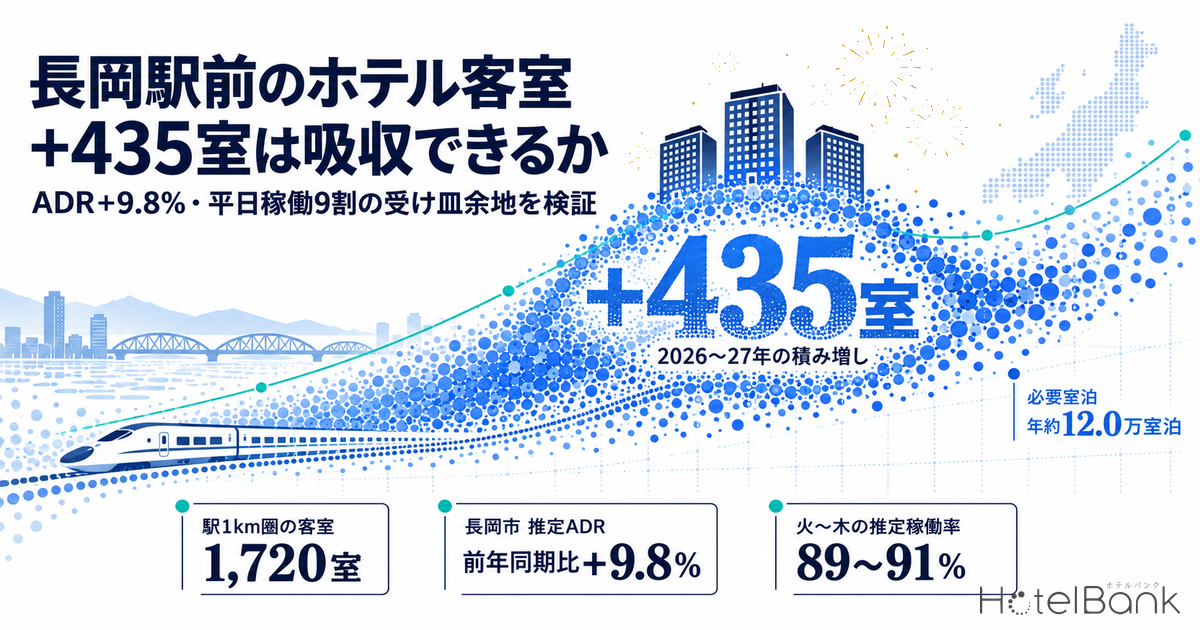
Within a 1 km radius of the Ote Exit of JR Nagaoka Station, Hotel New Green Plaza (ホテルニューグリーンプラザ) expanded from 110 to 330 rooms through an extension and renovation in June 2026, and in the same month Hotel Global View Nagaoka (ホテルグローバルビュー長岡, 206 rooms) opened on the site of the former Hotel Alpha-1 Nagaoka (ホテル・アルファーワン長岡). Toyoko Inn Nagaoka Ekimae (東横INN長岡駅前, tentative name, 215 rooms) is scheduled to follow in February 2027. For a regional business city this is a lot of rooms to add in a short period, and for regional banks, local hotel operators and developers the question comes down to one thing: who will sleep in these rooms? This article takes stock of the room inventory within 1 km of the station, then quantifies in turn the 24-month trend in Nagaoka’s estimated settled ADR, estimated occupancy by day of week, and the number of room-nights needed to absorb the increase.
Metric Definitions Used in This Article
- ADR (average daily rate): An estimated settled rate (tax-exclusive equivalent) calculated by applying a segment-specific adjustment factor to the lowest-plan price level each property publishes on OTAs and similar channels (two guests per room, price per room, tax included). Checked against property-level actuals disclosed by listed hotel REITs (91 properties, most recent three months), the median error is about 7%. These are estimates and differ from each property’s actual settled prices and accounting figures. Area-level ADR is the median of the properties covered (the level of a typical property in the area), and the number of properties covered each month is shown as N=. Months from September 2026 onward are estimates based on listed price levels at the time of the survey, so this article does not treat them as final and limits its aggregation to August 2026.
- OCC (occupancy): The share of rooms sold out of total rooms in the area (an estimate based on OTA sales inventory). This article labels it “occupancy (estimated, OTA-listed inventory basis)”. It is calculated from rooms remaining on the day before the stay date, for a sample made up of properties that list 30% or more of their total rooms on major booking sites. It is an estimate based on how inventory sold on OTAs is consumed and differs from a property’s actual overall occupancy. Because rooms not listed are counted as sold, the level tends to read high, so it is used here for relative comparison between days of the week and between months.
- LT (lead time): The number of days before the stay date. Early sell-out LT is the lead time at which rooms remaining on major booking sites first reached zero (the larger the value, the earlier the sell-out). This article uses only observations within LT45; properties with zero rooms remaining beyond 45 days are described as “sold out 45 or more days before the stay date”.
- Room supply time series: The number of properties and rooms in each year, counted on an opening-date and closing-date basis. Each property’s current registered room count is applied to past years as well (room counts before an extension are not reflected).
- Data sources: MetroEngines Research & Consulting (prices, inventory, supply); Ministry of Land, Infrastructure, Transport and Tourism, National Land Numerical Information (resident population); Ministry of Internal Affairs and Communications and Ministry of Economy, Trade and Industry, Economic Census for Business Activity (employment)
- — +435 rooms: With the 220-room extension of New Green Plaza in June 2026 and the 215-room Toyoko Inn Nagaoka Ekimae due to open in February 2027, rooms within 1 km of the station rise 27.2% against the 1,602-room pre-extension base. Net of closures, the increase versus the end of 2024 is +331 rooms.
- — ADR +9.8%: Nagaoka City’s estimated settled ADR averaged about ¥8,300 over September 2025-August 2026 (N=29-31 properties). The rise stands out against Chuo Ward, Niigata City (−0.6%) and Joetsu City (−1.4%).
- — Flat year on year after the openings: ADR in August 2026, after 426 rooms had opened, was about ¥9,600, −1.3% year on year. The new rooms entered the market without a collapse in rates.
- — Midweek runs at about 90%: For stay dates from June 10 to September 30, 2026, estimated occupancy (OTA-listed inventory basis) was 89-91% on Tuesday through Thursday. Sunday (83.3%) and Monday (86.9%) still leave room to absorb demand.
- — 120,000 room-nights a year: Filling 435 rooms at the national average occupancy for business hotels (75.3%) takes about 120,000 room-nights a year, or about 480 room-nights per weekday. That is equivalent to 2.6% of the 18,428 workers within 1 km of the station.
Room inventory within 1 km of the station — 215 rooms in February 2027 join 1,720 rooms at 17 operating properties
Room supply within a 1 km radius of Nagaoka Station (37.4475°N, 138.8513°E), as counted by MetroEngines Research & Consulting on an opening-date and closing-date basis, grew from 1,663 rooms at 15 properties in 2012 to 1,822 rooms at 18 properties in 2026 — an increase of just under 10% in 14 years. Apart from the additions of Atrium Nagaoka (14 rooms) in 2013, Hotel Livemax Niigata Nagaoka Ekimae (83 rooms) in 2019 and Guesthouse Nagaoka Machiyado (64 rooms) in 2020, both the number of properties and the number of rooms have been essentially flat. Note that because this count applies each property’s current room count to past years, it does not show Hotel New Green Plaza as it was before the extension (110 rooms). Subtracting the 220 rooms added by the extension gives 1,602 rooms, which serves as the approximate baseline for supply in the area before Alpha-1 Nagaoka ceased operations in March 2025 (as of the end of 2024). The 1,822 rooms for 2026 also include Hotel New Green (102 rooms), which ceased operations at the end of May 2026; as of October 2026, operating rooms total 1,720 at 17 properties.
Against that baseline, the 435 rooms made up of the 220-room extension in June 2026 and the 215-room Toyoko Inn Nagaoka Ekimae planned for February 2027 are equivalent to +27.2%. Setting the Toyoko Inn’s 215 rooms alone against the 1,720 operating rooms gives +12.5%. It is not common for supply in front of the station of a regional business city to rise by nearly 30% in less than a year, and judging how much of it can be absorbed is the subject of this article. A comparable situation, in which a 300-room-class hotel is added to the center of a business city, is examined from the side of the employment base and business demand in Utsunomiya 300-Room Hotel Plan: LRT, Business Demand & +5% Supply.
This chart is compiled on a confirmed-OTA-listing basis. Only about 19% of properties are listed on OTAs before they open, and more than half are listed after opening, so the property counts for the most recent months and years may increase as further listings appear. We recommend reading it together with the construction pipeline based on building confirmation applications (Ministry of Land, Infrastructure, Transport and Tourism, “Survey on Building Construction Trends”).
However, movements that the opening-date time series does not capture are concentrated in 2025 and after. The table below sets out the actual changes in supply from primary sources: for the roughly 15 months from the end of operations at Hotel Alpha-1 Nagaoka (208 rooms) in March 2025 to the two openings in June 2026, the area was operating with around 200 fewer rooms. At the end of May 2026, Hotel New Green (102 rooms) in Jonaicho 1-chome ceased operations and its business was consolidated into New Green Plaza. Net of closures, the increase versus the end of 2024 is +331 rooms even including the Toyoko Inn.
| Timing | Property and event | Change in rooms | Primary source |
|---|---|---|---|
| March 16, 2025 | Hotel Alpha-1 Nagaoka ceased operations (after 26 years) | −208 rooms | Local news site report (March 3, 2025) |
| End of May 2026 | Hotel New Green (Jonaicho 1-chome) ceased operations; consolidated into the Plaza | −102 rooms | Niigata Nippo (June 15, 2026) |
| June 2026 | Hotel Global View Nagaoka opened (former Alpha-1 site; Rio Hotels Kan-etsu) | +206 rooms | Rio Hotels announcements (November 2025, April 2026); room count per our own tally |
| June 20, 2026 | Hotel New Green Plaza extension and renovation (110 to 330 rooms; new large public bath and sauna) | +220 rooms | Niigata Nippo (December 13, 2024; June 15, 2026) |
| February 2027 (planned) | Toyoko Inn Nagaoka Ekimae (tentative name) scheduled to open; 13 floors above ground, 215 rooms | +215 rooms | Building plan notice (215 rooms, total floor area 4,222.66 sqm, scheduled completion August 15, 2026); Toyoko Inn Co., Ltd. recruitment listing (opening planned for February 2027) |
| Net increase vs. end of 2024 (including Toyoko Inn) | +331 rooms | Sum of the above | |
By size band, the area has two properties with 200 or more rooms — New Green Plaza (330 rooms) and Global View Nagaoka (206 rooms) — and five with 100-199 rooms: Hotel New Otani Nagaoka (178 rooms), Nagaoka Terminal Hotel (168 rooms), Hotel Hokke Club Niigata Nagaoka (156 rooms), Hotel Route-Inn Nagaoka Ekimae (133 rooms) and JR-East Hotel Mets Nagaoka (122 rooms). Adding the Toyoko Inn’s 215 rooms makes three 200-room-class properties, shifting the picture to one in which three large properties carry about 40% of lodging capacity in front of the station. Properties with 30 or more rooms are listed below. Business hotels account for most of the rooms, and city hotels are limited to two: the New Otani and Nagaoka Grand Hotel (92 rooms).
| Size band | Property | Rooms | Type | Opened |
|---|---|---|---|---|
| 200+ rooms | Hotel New Green Plaza (ホテルニューグリーンプラザ) | 330 | Business | 1990 (extended and renovated June 2026) |
| Hotel Global View Nagaoka (ホテルグローバルビュー長岡) | 206 | Business | June 2026 | |
| 100-199 rooms | Hotel New Otani Nagaoka (ホテルニューオータニ長岡) | 178 | City | 1984 |
| Nagaoka Terminal Hotel (長岡ターミナルホテル) | 168 | Business | — | |
| Hotel Hokke Club Niigata Nagaoka (ホテル法華クラブ新潟長岡) | 156 | Business | 2007 | |
| Hotel Route-Inn Nagaoka Ekimae (ホテルルートイン長岡駅前) | 133 | Business | 2003 | |
| JR-East Hotel Mets Nagaoka (JR東日本ホテルメッツ長岡) | 122 | Business | 1999 | |
| 50-99 rooms | Nagaoka Grand Hotel (長岡グランドホテル) | 92 | City | 1981 |
| Hotel Livemax Niigata Nagaoka Ekimae (ホテルリブマックス新潟長岡駅前) | 83 | Business | 2019 | |
| Guesthouse Nagaoka Machiyado (ゲストハウス長岡街宿) | 64 | Guesthouse | 2020 | |
| 30-49 rooms | HOTEL&OFFICE Sotokukan (HOTEL&OFFICE 崇徳館) | 40 | Business | — |
| Business Hotel Sun Palace (ビジネスホテルサンパレス) | 36 | Business | 2011 | |
| Super Price Hotel Impact 2002 (スーパープライスホテルインパクト2002) | 34 | Business | 2002 | |
| Nagaoka Town Hotel (長岡タウンホテル) | 32 | Business | — | |
| Tosenkaku (東泉閣) | 30 | Business | — | |
| Planned | Toyoko Inn Nagaoka Ekimae, tentative name (東横INN長岡駅前) | 215 | Business | Opening planned for February 2027 |
24 months of Nagaoka ADR — rates ran ahead during 15 months of thin supply, then settled from June
Nagaoka City’s estimated settled ADR (median of properties in the city, N=29-33 properties) averaged about ¥8,300 over the 12 months from September 2025 to August 2026, up 9.8% on the prior-year period (about ¥7,600). Tracking year-on-year change by month, September 2025 was +12.0%, November +20.5%, January 2026 +14.5% and February +14.4% — double-digit gains running through the autumn and winter, when business demand dominates. This period overlaps with the time when the area had about 200 fewer rooms following the end of operations at Alpha-1 Nagaoka, and it can be read as an environment in which the remaining properties found it easy to raise rates.
The trend after 426 rooms opened in June 2026 is a contrast. June held at +12.4%, but July was +3.6%, and August — which includes the Nagaoka Festival Grand Fireworks Show (August 2 and 3) — came in at about ¥9,600, −1.3%, almost level with about ¥9,800 a year earlier. That rates stayed at the prior-year level in months when supply had grown by nearly 30% shows the new rooms entered the market without a collapse in rates, and it supports the depth of demand in the peak month. Nagaoka is not the only case in which rates held immediately after a supply increase: the same pattern was seen in other regional markets that took on new supply in summer 2026. Months from September 2026 onward are estimates based on listed price levels at the time of the survey and are not treated as final in this article.
Compared with the other business cities in the prefecture, Nagaoka’s rise stands out. The 12-month average for Chuo Ward, Niigata City (N=44-46 properties) was about ¥6,900, −0.6% on the prior-year period, and for Joetsu City (N=33-37 properties) about ¥7,100, −1.4% — both essentially flat. Nagaoka City is also above both in level: its roughly ¥9,600 in August 2026 fell short of Chuo Ward’s roughly ¥10,200 but was nearly 30% above Joetsu City’s roughly ¥7,400. Excluding the fireworks month of August, Nagaoka City recorded the highest value of the three cities in 11 of the 12 months (for the city-wide sell-out on the fireworks dates and the spillover of demand into surrounding areas, see Nagaoka Fireworks 2026: City Sold Out by March, Demand Ripples Out).
| Area | 12-month average | vs. prior-year period | August 2026 | August YoY |
|---|---|---|---|---|
| Nagaoka City (N=29-31) | ¥8,313 | +9.8% | ¥9,636 | −1.3% |
| Chuo Ward, Niigata City (N=44-46) | ¥6,865 | −0.6% | ¥10,155 | +4.6% |
| Joetsu City (N=33-37) | ¥7,108 | −1.4% | ¥7,425 | −11.6% |
Nagaoka City ran at about ¥7,500-8,100 in January-April 2026, +8.4% to +14.5% year on year. The seasonal shape — larger gains in the winter business period and a flat fireworks August — indicates that business demand has been what supports rates.
Estimated occupancy by day of week — about 90% Tuesday to Thursday, with headroom on Sunday and Monday
To see which days of the week have room to absorb the added supply, we look at stay dates that have already passed. For the all-category sample for Nagaoka City (12-23 properties / 475-969 rooms covered, on a major-booking-site listing basis, varying by stay date), averaging stay dates from June 10 to September 30, 2026 by day of week gives Tuesday 88.9%, Wednesday 91.2%, Thursday 90.9% and Friday 88.7%, against Saturday 93.7%, Sunday 83.3% and Monday 86.9%. Monthly averages were 91.9% in June, 88.9% in July, 89.1% in August and 87.7% in September, holding at around 90% even from July onward, after the 426 rooms were added.
For reference, the business hotel sample for Niigata Prefecture as a whole (27-52 properties / 3,925-6,159 rooms covered, on a major-booking-site listing basis) over the same period shows Thursday (91.5%) and Saturday (93.8%) high and Sunday (78.0%) and Monday (82.0%) low. Nagaoka City is distinctive in that its Sunday and Monday dip is smaller than the prefectural average and demand is more even across the week. Its Tuesday-to-Thursday level is equal to or slightly above the prefectural average, which suggests existing inventory fills easily midweek, when business demand is concentrated. The headroom the new 215 rooms should target is therefore both this excess midweek demand and the slack of a little over 10% that remains on Sunday and Monday.
These are estimates based on how inventory sold on OTAs is consumed and differ from a property’s actual overall occupancy. The sample is limited to properties that list 30% or more of their total rooms, and because rooms not listed are counted as sold, the level reads high. In the Japan Tourism Agency’s Overnight Travel Statistics Survey, the 2025 annual figure (final) for room occupancy at business hotels nationwide is 75.3%; please read the figures in this article as relative differences between days of the week and between months, not as levels.
The depth of midweek demand is also visible in room-level remaining inventory. For the 12 days from Monday, September 7 to Friday, September 18, 2026 (including the weekend of the 12th and 13th), we looked at the 29 properties in Nagaoka City that list 30% or more of their total rooms (of 155 properties in the city, 34 have observation data, and 29 of those are in the sample). At all seven business and city hotels within 1 km of the station, rooms remaining on major booking sites reached zero on 11 to 12 of the 12 days. Some properties reach zero two weeks before the stay date and others fill the day before, so average early sell-out LT ranges widely, from 5.7 to 29.9 days. This is the typical shape of business demand, in which weekday bookings thicken as the stay date approaches, and it is a tailwind for new rooms that add capacity for last-minute demand.
Room-nights needed to absorb +435 rooms — 120,000 a year, about 480 per weekday
Next we restate the increase in terms of demand. Using the national average occupancy for business hotels of 75.3% (annual figure for January-December 2025, final; Japan Tourism Agency, Overnight Travel Statistics Survey) as a yardstick, filling the Toyoko Inn’s 215 rooms for a year takes about 59,000 room-nights, and the full 435 rooms including the extension take about 120,000 room-nights. By month, the benchmark is 9,172 room-nights for 435 rooms in the opening month of February 2027 (28 days) and 10,154 room-nights in a 31-day month. Lifting occupancy to 85% would take 135,000 room-nights a year.
Setting this scale against the employment base in the area: based on the Economic Census for Business Activity (2021), there are 2,053 establishments and 18,428 workers within 1 km of Nagaoka Station, of which office-type employment accounts for 24.7%. Dividing 120,000 room-nights a year by 250 business days gives about 480 room-nights a day, which works out to a number of guests equivalent to 2.6% of the area’s workers staying every business day — a realistic range for demand carried by visitors from outside the area, such as client visits, construction work and training. If demand stays flat while operating rooms alone rise from 1,720 to 1,935, occupancy falls by a little over 10% in relative terms (×0.889). For existing and new properties to hold the same occupancy, room-night demand across the area needs to grow by 12.5%; taking the extension into account as well, growth of 27.2% is required.
| Month | Days | 215 rooms × 75.3% | 435 rooms × 75.3% | 435 rooms × 85% |
|---|---|---|---|---|
| Feb 2027 | 28 | 4,533 | 9,172 | 10,353 |
| Mar 2027 | 31 | 5,019 | 10,154 | 11,462 |
| Apr 2027 | 30 | 4,857 | 9,827 | 11,092 |
| May 2027 | 31 | 5,019 | 10,154 | 11,462 |
| Jun 2027 | 30 | 4,857 | 9,827 | 11,092 |
| Jul 2027 | 31 | 5,019 | 10,154 | 11,462 |
| Aug 2027 | 31 | 5,019 | 10,154 | 11,462 |
| Sep 2027 | 30 | 4,857 | 9,827 | 11,092 |
| Oct 2027 | 31 | 5,019 | 10,154 | 11,462 |
| Nov 2027 | 30 | 4,857 | 9,827 | 11,092 |
| Dec 2027 | 31 | 5,019 | 10,154 | 11,462 |
| Jan 2028 | 31 | 5,019 | 10,154 | 11,462 |
| 12-month total | 365 | 59,094 | 119,558 | 134,955 |
Sensitivity analysis — demand growth and area occupancy after the Toyoko Inn opens (estimate)
The same relationship can be shown on two axes. When the opening of Toyoko Inn Nagaoka Ekimae raises operating rooms from 1,720 to 1,935, we estimated where area occupancy lands after the opening for each combination of the current area occupancy level and the growth rate of room-night demand from February 2027 onward. If demand is flat, occupancy falls uniformly by about 10% relative to the current level (×0.889), and growth of 12.5% brings it back to the current level. Where the current level is around 90%, as on midweek days, even 5% demand growth keeps post-opening occupancy in the mid-80s, so together with the slack on Sunday and Monday, headroom remains.
| Current occupancy level (assumption) | Demand ±0% | +5% | +10% | +12.5% | +20% |
|---|---|---|---|---|---|
| 80% | 71.1% | 74.7% | 78.2% | 80.0% | 85.3% |
| 85% | 75.6% | 79.3% | 83.1% | 85.0% | 90.7% |
| 90% | 80.0% | 84.0% | 88.0% | 90.0% | 96.0% |
Looking at the sources of demand from the residential side, the picture is clear. According to the 250 m mesh future population projections in the National Land Numerical Information, the resident population within 1.5 km of the station is 36,004 in 2025 and declines to 30,774 in 2040, −18.2% versus 2020, with the share of older residents reaching 33.3%. This is not a phase in which demand tied to the resident population — weddings, funerals and family visits home — will grow; absorbing the added rooms depends on business visitors, events such as the fireworks and high school and university events, and pass-through demand at a junction between the Hokuriku and Joetsu Shinkansen corridors. On the map, residential meshes spread to the east and west of the station, while the commercial meshes in front of the station have little population, which shows that the source of lodging demand lies outside the area.
Price bands from February 2027 — five properties at ¥8,000-9,999, one city hotel above ¥10,000
Finally, we look at where there is space in the price bands the new rooms will enter. Among the 12 properties within 1 km of the station for which estimated settled ADR is available for September 2025-August 2026 (for the two properties that opened or were extended in 2026, the average of observed months only), the distribution is: one property below ¥5,000, two at ¥5,000-5,999, two at ¥6,000-6,999, one at ¥7,000-7,999, three at ¥8,000-8,999, two at ¥9,000-9,999 and one at ¥10,000 or more. The core is the five properties in the ¥8,000-9,999 band, where the newer business hotels closest to the station cluster. Only one city hotel is above ¥10,000, and small, older properties line up in the ¥5,000s and below.
Putting weekday inventory consumption and rates on the same chart shows more of this price structure. Over the 12 days of September 7-18, the property with the longest average early sell-out LT (29.9 days) is a city hotel in the ¥7,000s, a picture of a property with banquet and conference demand securing business guests early. Properties in the ¥8,000-9,000s have short early sell-out LTs of 5.7-11.0 days, yet they still reach zero rooms remaining on 11 of the 12 days. In other words they capture business demand that fills at the last minute without dropping rates, and if the 215 rooms arriving in February 2027 compete in the same band, inventory control that catches demand just before the stay date will be the key. The fact that there is only one property in the band above ¥10,000 leaves space on the upside for properties offering added value such as a large public bath or a lounge, and New Green Plaza’s new large public bath and sauna can be seen as a step in that direction.
Properties in the scatter chart are shown by size band and type only. A = city, 50-99 rooms; B = business, 100-199 rooms; C = business, 200+ rooms (extended and renovated June 2026; 4 months observed); D = business, 30-49 rooms; E = business, 50-99 rooms; F = business, 30-49 rooms; G = business, 200+ rooms (opened June 2026; 1 month observed). Properties that list less than 30% of their total rooms on major booking sites are outside the inventory-trend sample; several factors may be involved, including sales centered on other channels such as their own website or corporate contracts, inventory control that adds listed allotments as the stay date approaches, and small contractual listing allotments.
Implications — how to read the decision to add rooms in front of the station
To sum up, the supply increase in front of Nagaoka Station rests on three facts. First, from March 2025 to June 2026 the area had about 200 fewer rooms, and in that time Nagaoka City’s ADR rose 9.8% on the prior-year period, far outpacing other cities in the prefecture. Second, in July and August, immediately after 426 rooms opened in June 2026, ADR held at the prior-year level and (estimated) occupancy stayed at around 90%. Third, midweek inventory consumption is deep, and the capacity available for business demand is not yet full.
For local hotel operators, rather than expecting midweek price competition from February 2027, the investment opportunity lies in the slack of a little over 10% on Sunday and Monday and in differentiation through added value such as a large public bath, breakfast and multi-night stays. A price structure with only one property above ¥10,000 points to room to move upward through renovation and capital investment. For regional banks, the axis of the credit decision is whether the demand needed for absorption — 120,000 room-nights a year — can be explained by the 18,428 workers in the area together with business visitors from outside, the fireworks and other events, and pass-through demand at the Shinkansen junction. For developers, the reading is that there is more room for absorption in targeting the bands and guest segments where space remains in the area than in adding another property of the same scale in front of a station where three properties will already be in the 200-room class. Toyoko Inn’s first entry into Nagaoka and the extension of New Green Plaza are both decisions to add rooms in front of the station of a business city, and the results of summer 2026 support those decisions.
Supply
Operating rooms within 1 km of the station total 1,720 at 17 properties. Following +426 rooms in June 2026, the 215-room Toyoko Inn Nagaoka Ekimae arrives in February 2027; the net increase versus the end of 2024 is +331 rooms. Three properties will be in the 200-room class.
Rates and occupancy
Nagaoka City ADR averaged about ¥8,300 over 12 months, +9.8% on the prior-year period. August, after the 426 rooms opened, also held at the prior-year level (−1.3%), and (estimated) occupancy is 89-91% Tuesday to Thursday.
Demand needed for absorption
Filling 435 rooms at 75.3% occupancy takes about 120,000 room-nights a year, or about 480 per weekday. If demand is flat, occupancy falls by a little over 10% in relative terms; demand growth of 12.5% restores the original level.
Frequently Asked Questions
Q. How many hotel rooms will be added in front of Nagaoka Station in 2027?
A. As of October 2026, operating rooms within 1 km of the station total 1,720 at 17 properties. Toyoko Inn Nagaoka Ekimae (tentative name, 215 rooms) is scheduled to open in February 2027; together with the extension of New Green Plaza in June 2026 (+220 rooms), the addition comes to 435 rooms, +27.2% against the 1,602-room pre-extension base. Net of closures, the increase versus the end of 2024 is +331 rooms.
Q. Are hotel rates in Nagaoka City rising?
A. Estimated settled ADR (median of properties in the city) averaged about ¥8,300 over the 12 months from September 2025 to August 2026, +9.8% on the prior-year period. The rise stands out while Chuo Ward, Niigata City (−0.6%) and Joetsu City (−1.4%) are flat, but August 2026, after 426 rooms opened, settled at about ¥9,600, −1.3% year on year and level with the prior year.
Q. How much lodging demand is needed to fill the added rooms?
A. Using the national average occupancy for business hotels of 75.3% (annual figure for January-December 2025, Japan Tourism Agency final figure) as a yardstick, 435 rooms take about 120,000 room-nights a year, and the Toyoko Inn’s 215 rooms alone about 59,000 a year. Per weekday that is about 480 room-nights, a scale equivalent to 2.6% of the 18,428 workers within 1 km of the station staying every business day.
Related Articles
References and Sources
■ Data sources
Prices, inventory and supply are compiled by MetroEngines Research & Consulting (major-booking-site listing basis). Estimated settled ADR covers Nagaoka City N=29-33 properties, Chuo Ward, Niigata City N=44-46 properties and Joetsu City N=33-37 properties; estimated occupancy by day of week covers 12-23 properties in Nagaoka City; early sell-out LT covers 29 properties in Nagaoka City. Resident population is from the 250 m mesh future projections in the National Land Numerical Information, employment from the Economic Census for Business Activity (2021), and the national occupancy level for business hotels from the Japan Tourism Agency’s Overnight Travel Statistics Survey.
■ Estimation assumptions
Required room-nights = added rooms × calendar days × occupancy level (assumption). The mid case is the national average for business hotels of 75.3% (annual figure for January-December 2025, final), and the high case is 85%. Room-nights per day are the annual requirement divided by 250 business days. The sensitivity analysis uses as its denominator 1,935 rooms — the 1,720 operating rooms plus the 215 rooms of Toyoko Inn Nagaoka Ekimae — and holds all conditions other than growth in room-night demand constant.
■ Limitations and caveats
Estimated occupancy counts rooms not listed as sold, so it is an estimate that reads high in level and is used for relative comparison between days of the week and between months. Estimated settled ADR is an estimate with a median error of about 7% when checked against actuals disclosed by listed hotel REITs, and months from September 2026 onward are not treated as final. The room supply time series applies each property’s current room count to past years and does not reflect room counts before an extension. The room count and opening date for Toyoko Inn Nagaoka Ekimae are based on the posted building plan notice and the company’s recruitment listing, because the hotel was not yet shown in the hotel list on the official website at the time of the survey.
■ Market data
- MetroEngines Research & Consulting — estimated settled ADR (Nagaoka City N=29-33; Chuo Ward, Niigata City N=44-46; Joetsu City N=33-37), occupancy (estimated, OTA-listed inventory basis), room-level remaining inventory (29 properties in Nagaoka City), room supply time series within 1 km of the station
■ Government statistics and public data
- Japan Tourism Agency, Overnight Travel Statistics Survey, 2025 annual figures (final) — room occupancy at business hotels of 75.3% (annual figure for January-December 2025)
- Ministry of Land, Infrastructure, Transport and Tourism, National Land Numerical Information, “Future population projections by 250 m mesh (FY2024 National Spatial Planning and Regional Policy Bureau projection)” — resident population and share of older residents within 1.5 km of Nagaoka Station
- Ministry of Internal Affairs and Communications and Ministry of Economy, Trade and Industry, “Economic Census for Business Activity (2021)”; boundaries are 2020 Population Census small areas (e-Stat Statistics GIS) — number of establishments and workers within 1 km of Nagaoka Station
- Geospatial Information Authority of Japan, address search API — block-center coordinates of the planned Toyoko Inn Nagaoka Ekimae site (Jonaicho 2-chome 6)
■ News, press releases and official information
- Niigata Nippo, “Hotel investment picks up around JR Nagaoka Station in Niigata Prefecture: New Green Plaza to be extended, Toyoko Inn to enter Nagaoka for the first time” (December 13, 2024; in Japanese)
- Niigata Nippo, “Hotel New Green Plaza (Nagaoka City) triples rooms to 330 through extension and renovation, opening on the 20th as an ‘oasis’ for business guests” (June 15, 2026; in Japanese)
- Hotel New Green Plaza official website
- Rio Hotels, “Notice of the planned opening of Hotel Global View Nagaoka” (November 2025; in Japanese); Rio Hotels, “Notice of postponement of the opening” (April 2026; in Japanese); Rio Hotels, property page
- Gatachira, “Business hotel Hotel Alpha-1 Nagaoka to cease operations on March 16” (March 3, 2025; in Japanese)
- Niigata Guidance, “[High-rise construction status] Toyoko Inn Nagaoka Ekimae” (updated May 24, 2026; transcription of the building plan notice: 215 rooms, 13 floors above ground, total floor area 4,222.66 sqm, scheduled completion August 15, 2026; in Japanese)
- Toyoko Inn Co., Ltd. recruitment listing, “Toyoko Inn Nagaoka Ekimae” (opening planned for February 2027; 2-6-23 Jonaicho, Nagaoka City; in Japanese)
- Official land prices for Otedori, Nagaoka City (2026; Otedori 1-chome ¥228,000 per sqm, 0.0% year on year; in Japanese)