

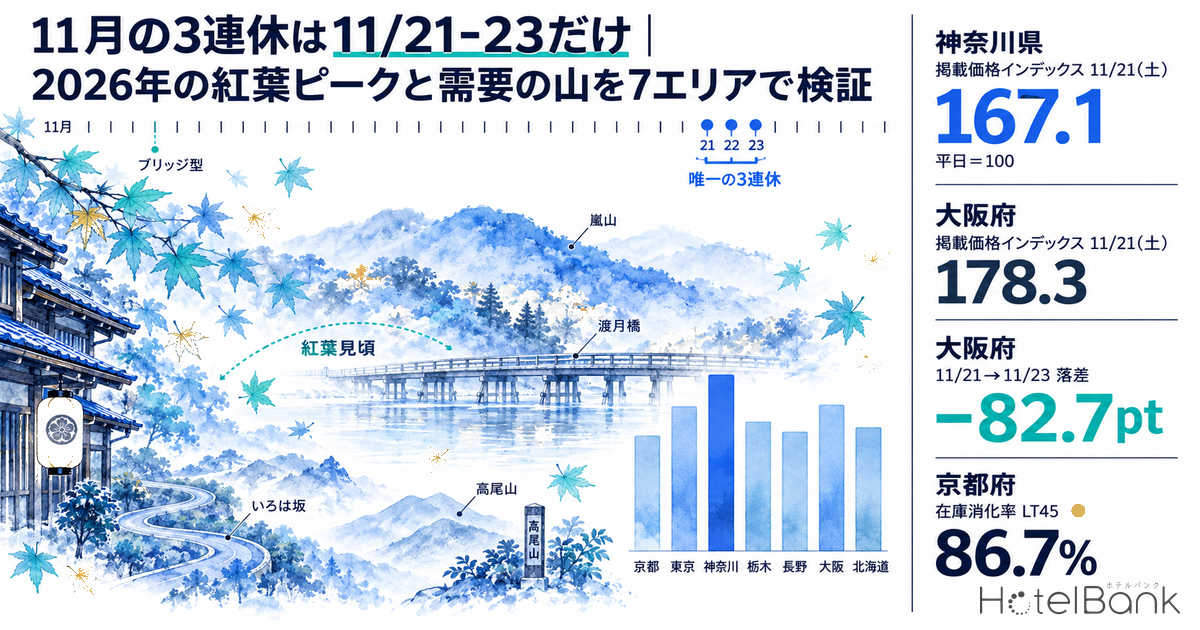
The calendar for November 2026 has an unusual shape when you think about lodging demand. There are two public holidays — Culture Day (November 3) and Labor Thanksgiving Day (November 23) — but the only one that joins a weekend to form a three-day weekend is November 21 (Sat) to 23 (Mon), and that is the single occasion in the month. Because November 3 falls on a Tuesday, taking the day before off (Monday, November 2) turns October 31 (Sat) through November 3 (Tue) into a four-day break — a “bridge” holiday. How does this calendar shape show up in the prices and inventory of the main destinations? We checked using daily data for seven areas.
Metric Definitions Used in This Article
- Listed price: the all-plan average of the selling prices each property publishes on the major booking sites (room-only through meals-included). Per room for two people sharing, tax included. Daily comparisons use the median, within each area, of each property’s average price for that date.
- Listed price index: an index in which each area’s median listed price on the Tuesdays, Wednesdays and Thursdays of November 2026 (11 days, excluding the November 3 holiday) is set to 100. Because price levels differ widely between areas, it is used to compare the daily highs and lows within a single area.
- ADR (average daily rate): an estimated settled rate (tax-excluded equivalent) calculated by applying a property-type correction factor to the cheapest plan level each property publishes on the major booking sites (two people per room, per-room rate, tax included). Cross-checked against the property-level results disclosed by listed hotel REITs (91 properties, most recent three months), the median error is about 7%. It is an estimate and differs from each property’s actual settled prices and accounting figures. An area-level ADR is the median of the properties covered (the level of a typical property in that area).
- Inventory sell-through rate (estimated occupancy): sold rooms as a share of the total room count in the area (an estimate based on the inventory offered for sale on the major booking sites). The population is a fixed cohort of properties that list at least 30% of their total rooms on the booking sites. It is an estimate based on how the inventory sold through the booking sites is taken up, and differs from a property’s actual overall occupancy.
- LT (lead time): the number of days before the stay date. LT45 = 45 days before the stay date. Because observations of booking progress are limited to within 45 days of the stay date, this article uses only snapshots inside that window.
- Data source: MetroEngines Research
- — November 21 (Sat) carries the highest listed price of the month in four areas: Kyoto, Tokyo, Kanagawa and Osaka. Tochigi, Nagano and Hokkaido are a close second, so the opening-day peak of the three-day weekend is common to all seven areas.
- — On the final day of the break, November 23, the index falls to weekday levels or below — Osaka −82.7pt and Tokyo −59.3pt against November 21 — while Kyoto gives up only 18.8pt: the more an area works as a destination, the better it holds demand on the last day.
- — Over the most recent three-day weekend, October 10–12, the opening day’s sell-through rate 45 days before the stay date ran 18.0pt above an ordinary Saturday in both Kyoto and Kanagawa. The same snapshot for November 21–23 arrives on October 7–9.
The November 2026 Calendar — One Three-Day Weekend, and One Holiday That Needs a Bridge
First, pin down the calendar. November 1, 2026 is a Sunday, so November is a 30-day month beginning on a Sunday. There are two public holidays: Culture Day (November 3) and Labor Thanksgiving Day (November 23). Mapped onto the week, November 3 falls on a Tuesday and November 23 on a Monday.
That leaves only one three-day weekend formed by joining a weekend: November 21 (Sat), 22 (Sun) and 23 (Mon, holiday). Culture Day, by contrast, stands alone on a Tuesday and is a stray day off as it is. Put one day of paid leave on the preceding Monday, November 2, however, and October 31 (Sat) through November 3 (Tue) becomes a four-day break. That is the shape in which “bridge” demand, premised on taking leave, is created.
| Date | Day | Type | Demand context |
|---|---|---|---|
| Nov 1–Nov 3 | Sun / Mon / Tue | Culture Day (Nov 3) | A four-day break if leave is taken on Nov 2. Bridge type |
| Nov 7–Nov 8 | Sat / Sun | Ordinary weekend | The earliest weekend of the month not flanked by a holiday |
| Nov 14–Nov 15 | Sat / Sun | Ordinary weekend | The start of the autumn foliage season |
| Nov 21–Nov 23 | Sat / Sun / Mon | Labor Thanksgiving Day (Nov 23) | The month’s only three-day weekend |
| Nov 28–Nov 29 | Sat / Sun | Ordinary weekend | The weekend just after the foliage peak in western Japan |
Source: National Astronomical Observatory of Japan, “Calendar Essentials for Reiwa 8 (2026)”; Cabinet Office, “About National Holidays” — compiled by the HotelBank Editorial Team
Where Prices Put the Peak — Nov 21 Is the Month’s High in 4 of 7 Areas
The shape of the calendar is settled. So which days of November does the market treat as peaks? For seven major areas (Kyoto, Tokyo, Kanagawa, Tochigi, Nagano, Osaka and Hokkaido) we aggregated the listed price for each day of November 2026 by property and took the median within the area. Figures are shown as an index with each area’s weekday median (Tue, Wed, Thu — 11 days, excluding the November 3 holiday) set to 100.
Source: MetroEngines Research; compiled by the HotelBank Editorial Team (property counts by day: Kyoto 703–771, Tokyo 847–888, Kanagawa 428–474, Tochigi 316–360)
The clearest case is November 21 (Sat). In four areas — Kyoto, Tokyo, Kanagawa and Osaka — November 21 carries the highest listed price of the month. In the remaining three it is a close second: Tochigi reads 135.1 on November 21 against 135.8 on November 7, and Hokkaido 126.0 against 126.1 on November 14 — effectively level. The calendar condition of being the opening day of a three-day weekend shows up in prices across all seven areas, however far along the foliage season is in each.
The gaps in level are wide. Kanagawa’s November 21 reads 167.1 (median about ¥42,500), 1.67 times the weekday level. Osaka is 178.3 (about ¥27,600) and Tokyo 142.6 (about ¥37,800). Kyoto, at 126.8 (about ¥57,200), is modest as a multiple — but that is because Kyoto’s November already sits high on weekdays, and in absolute terms it is the highest of the seven areas.
| Area | Weekday base | Nov 2 (Mon) | Nov 3 (Tue, hol.) | Nov 7 (Sat) | Nov 14 (Sat) | Nov 21 (Sat) | Nov 22 (Sun) | Nov 23 (Mon, hol.) | Nov 28 (Sat) |
|---|---|---|---|---|---|---|---|---|---|
| Kyoto | ¥45,100 | 92.5 | 86.5 | 108.2 | 116.0 | 126.8 | 121.5 | 108.0 | 123.1 |
| Tokyo | ¥26,500 | 86.8 | 83.3 | 135.2 | 135.3 | 142.6 | 125.6 | 83.3 | 130.2 |
| Kanagawa | ¥25,400 | 114.5 | 100.7 | 142.5 | 143.7 | 167.1 | 159.6 | 104.7 | 148.4 |
| Tochigi | ¥23,600 | 110.5 | 106.1 | 135.8 | 124.0 | 135.1 | 132.3 | 108.6 | 118.7 |
| Nagano | ¥25,700 | 110.0 | 102.3 | 118.3 | 115.6 | 116.4 | 116.0 | 103.5 | 112.3 |
| Osaka | ¥15,500 | 103.0 | 94.7 | 164.3 | 171.1 | 178.3 | 147.0 | 95.6 | 153.1 |
| Hokkaido | ¥19,800 | 111.8 | 101.6 | 121.1 | 126.1 | 126.0 | 118.0 | 98.2 | 118.9 |
Source: MetroEngines Research; compiled by the HotelBank Editorial Team (figures are the listed price index with the weekday median = 100; bold marks each area’s highest day of the month)
Day Three of the Long Weekend Is “Going-Home Day” — the Nov 23 Drop Varies Sharply by Area
One point reads clearly from the data: it is better not to treat the three-day weekend as a single block. Compare November 21 (Sat) with November 23 (Mon, holiday) and the index gap opens up very differently from area to area.
Source: MetroEngines Research; compiled by the HotelBank Editorial Team (property counts by day: 316–888 per area)
The widest gap is Osaka, at 178.3 on November 21 against 95.6 on November 23 — a spread of fully 82.7 points, putting the last day of the break below the month’s weekday level. Tokyo shows 142.6 against 83.3, a 59.3-point gap, which makes November 23 the third-lowest level of the month in Tokyo. In the cities the final day of a three-day weekend is treated as the “going-home day” before work resumes the next morning, and lodging demand behaves much like a weekday.
Kyoto is the contrast: 126.8 on November 21 against 108.0 on November 23, a drop of only 18.8 points. Tochigi (135.1 → 108.6, a 26.5-point gap) and Nagano (116.4 → 103.5, a 12.9-point gap) are also relatively gentle. The stronger an area is as a destination worth staying in, the better it holds lodging demand on the final day. Put the other way, for a city property November 23 is a day that needs a different design from nights one and two.
The same structure appears in the bridge-type break earlier in the month. The index for November 2 (Mon) reads Kanagawa 114.5, Hokkaido 111.8, Tochigi 110.5 and Nagano 110.0 — more than 10% above weekday level at leisure destinations. Tokyo, at 86.8, and Kyoto, at 92.5, fall below weekday level instead. And November 3 (Tue), the holiday itself, is lower still: Tokyo 83.3 and Kyoto 86.5, the lowest levels of the month. The night before the holiday prices higher than the holiday itself. Travellers who take leave and set out the day before stay on November 1 and 2, which leaves November 3 as a day trip or a day to head home.
Foliage Peaks and Calendar Peaks Diverge — Nikko Three Weeks Early, Kyoto a Week Late
Alongside the calendar, the other axis that shapes November demand is the autumn foliage. What matters here is that the 2026 peak-viewing forecast does not necessarily coincide with the three-day weekend.
According to the autumn foliage peak-viewing forecast (first release) published by Weathernews on September 3, 2026, average temperatures continue to run high nationwide, so peak viewing is expected to be later than normal, or slightly later, across a wide area. Forecast dates for the main spots are around October 31 for Irohazaka in Tochigi, around November 22 for Mt. Takao in Tokyo, and around November 24 for Arashiyama in Kyoto.
| Spot | Location | 2026 peak-viewing forecast | Relation to the Nov 21–23 long weekend |
|---|---|---|---|
| Mt. Asahidake, Daisetsuzan | Hokkaido | Around September 14 | About two months before the break |
| Kamikochi | Nagano | Around October 21 | About one month before the break |
| Irohazaka | Tochigi (Nikko) | Around October 31 | About three weeks before the break |
| Mt. Takao | Tokyo | Around November 22 | Falls exactly on the middle day of the break |
| Korankei | Aichi | Around November 22 | Falls exactly on the middle day of the break |
| Arashiyama | Kyoto | Around November 24 | The day after the break ends |
Source: Weathernews, “2026 Autumn Foliage Peak-Viewing Forecast (first release)” (published September 3, 2026) — compiled by the HotelBank Editorial Team
In other words, the calendar peak and the foliage peak meet head-on only at spots on the Kanto plain. Irohazaka in Nikko peaks roughly three weeks before the three-day weekend, and Arashiyama’s forecast date is the day after the break ends. That offset leaves a clear mark on actual prices.
Look at Kyoto and November 28 (Sat) reads 123.1, the second-highest day of the month, above November 14 (Sat) at 116.0 and November 7 (Sat) at 108.2. More striking are the weekdays: November 24 (Tue) 109.3, November 25 (Wed) 107.6 and November 26 (Thu) 109.3 — the highest weekday levels of the month. That contrasts with the first half, where weekdays ran between 86 and 95. In the second half of November, Kyoto is structured so that foliage demand lifts even the weekdays once the calendar’s long weekend is over.
Tochigi shows the reverse shape. November 7 (Sat) is the month’s high at 135.8, and November 28 (Sat) falls back to 118.7. The weekdays in the second half — November 25 (Wed) 94.0 and November 24 (Tue) 96.1 — are the lowest of the month. Given that Irohazaka’s peak-viewing forecast is around October 31, foliage demand in the Nikko area crests in early November, leaving the three-day weekend as a single isolated peak in the second half.
The Japan Meteorological Agency’s phenological observations also report that autumn events in Kyoto (leaf colouring and leaf fall) are occurring later year by year (Kyoto Local Meteorological Observatory, “Changes in Flowering, Full Bloom, Autumn Colouring and Other Phenological Phenomena in Kyoto”), so the recent shift to later peaks is observed as a long-term change, not only as one year’s weather. Demand from late November into early December can no longer be treated on the assumption that the season is over.
When Inventory Moves — Reading the Most Recent Long Weekend (Oct 10–12)
Price shows which days the market treats as peaks, but how much is actually selling needs a different metric. Because observations of booking progress are limited to within 45 days of the stay date, inventory take-up for November 21–23 only becomes visible from October 7, 2026. This article therefore uses the most recent comparable case: the three-day weekend of October 10 (Sat) to 12 (Mon, holiday), 2026. That break already has a complete set of snapshots inside 45 days of the stay date, and serves as a yardstick for preparing for November’s long weekend.
Source: MetroEngines Research; compiled by the HotelBank Editorial Team (a fixed cohort of properties listing at least 30% of their total rooms on the booking sites: Kyoto 786 properties / 33,383 rooms, Tokyo 866 / 105,867, Kanagawa 483 / 32,601, Tochigi 411 / 14,910, Nagano 715 / 22,102, Osaka 444 / 60,994, Hokkaido 798 / 54,886)
Compared at the same 45-days-out snapshot, the sell-through rate for the opening day, October 10 (Sat), had reached 86.7% in Kyoto, 84.6% in Kanagawa and 80.3% in Nagano. An ordinary Saturday in the same month (October 3) read 68.7%, 66.6% and 71.6% respectively, so in Kyoto and Kanagawa the opening day ran 18.0 points above an ordinary Saturday. The first day of a three-day weekend is already selling well ahead, a month and a half before the stay date.
The final day, October 12 (Mon, holiday), read 69.9% in Kyoto, 60.4% in Kanagawa and 46.4% in Tochigi at the same snapshot — 16.8 to 28.1 points below the opening day. The “day three is going-home day” pattern visible in listed prices is borne out by inventory movement as well.
Source: MetroEngines Research; compiled by the HotelBank Editorial Team (Kyoto, 786 properties / 33,383 rooms; fixed cohort of properties listing at least 30% of their total rooms on the booking sites)
Tracking Kyoto’s sell-through, the opening day (October 10) moved from 86.7% at LT45 to 92.7% at LT29 — 6.0 points over 16 days. The ordinary Saturday (October 3) went from 68.7% to 75.5%, 6.8 points. The final day (October 12) went from 69.9% to 74.0% as of LT35. The slope of the curve itself barely differs; the gap is essentially already set at LT45. How price and inventory are allocated before the 45-days-out mark is what decides the outcome of the long weekend.
By property type, the pace differs even within the same area. At the LT45 point for October 10, Kyoto’s business hotels stood at 89.4% (198 properties / 20,011 rooms) and city hotels at 90.4% (36 / 5,050), against 75.1% for ryokan (115 / 2,102). Nagano likewise showed ryokan at 83.9% (293 / 6,809) against city hotels at 89.3% (15 / 1,446) — lodging-led formats move earlier. Ryokan and resorts gained the most through LT29, with Kyoto’s ryokan reaching 84.3% and Nagano’s 90.5%. As with Kyoto’s ryokan (+9.2pt), the property types furthest behind at LT45 can have the most room left to run in the final month.
| Area | Property type | Properties | Rooms | LT45 | LT29 | Gain |
|---|---|---|---|---|---|---|
| Kyoto | Business | 198 | 20,011 | 89.4% | 95.2% | +5.8pt |
| City | 36 | 5,050 | 90.4% | 93.2% | +2.8pt | |
| Ryokan | 115 | 2,102 | 75.1% | 84.3% | +9.2pt | |
| Kanagawa | Business | 120 | 16,077 | 86.0% | 93.0% | +7.0pt |
| City | 29 | 6,071 | 86.8% | 95.4% | +8.6pt | |
| Resort | 38 | 4,630 | 81.0% | 88.1% | +7.1pt | |
| Ryokan | 175 | 4,401 | 82.4% | 87.5% | +5.1pt | |
| Tochigi | Business | 62 | 5,281 | 71.5% | 77.3% | +5.8pt |
| Resort | 27 | 1,779 | 76.4% | 82.6% | +6.2pt | |
| Ryokan | 147 | 5,687 | 78.4% | 84.0% | +5.6pt | |
| Nagano | Business | 81 | 7,280 | 81.9% | 91.1% | +9.2pt |
| City | 15 | 1,446 | 89.3% | 95.6% | +6.3pt | |
| Resort | 62 | 4,172 | 76.9% | 83.0% | +6.1pt | |
| Ryokan | 293 | 6,809 | 83.9% | 90.5% | +6.6pt |
Source: MetroEngines Research; compiled by the HotelBank Editorial Team (sell-through rate for October 10, 2026 check-in. Only properties listing at least 30% of their total rooms on the booking sites are aggregated. For Tokyo, Osaka and Hokkaido, see the main text)
Kyoto’s November Is the Highest Month of 2026 — Placing It by Monthly ADR
Stepping back from the daily peaks and troughs, it is worth placing November on a monthly basis as well. On the monthly path of estimated settled ADR, Kyoto’s November 2026 stands at ¥25,800 (562 properties), above April’s ¥21,700 and October’s ¥21,100, and on track to be the highest month of 2026. Against the same month a year earlier (November 2025, ¥24,800) that is +4.0%.
Source: MetroEngines Research; compiled by the HotelBank Editorial Team (Kyoto; property counts by month range from 532 to 607)
Most other areas are also on track to exceed last November. Hokkaido moves from ¥9,100 to ¥11,200 (+23.3%), Nagano from ¥12,400 to ¥13,800 (+11.0%), Tokyo from ¥17,100 to ¥18,700 (+9.5%) and Tochigi from ¥12,400 to ¥13,400 (+8.1%). Kanagawa is essentially flat, ¥15,600 to ¥15,600 (+0.5%), while Osaka slips from ¥12,000 to ¥11,500 (−4.2%). Note that the November 2026 figures are estimates based on the selling prices published as of the survey date, and will move as the stay date approaches.
| Area | November 2025 | November 2026 (estimate) | Year on year | Properties covered |
|---|---|---|---|---|
| Kyoto | ¥24,800 | ¥25,800 | +4.0% | 562 |
| Tokyo | ¥17,100 | ¥18,700 | +9.5% | 1,070 |
| Kanagawa | ¥15,600 | ¥15,600 | +0.5% | 537 |
| Tochigi | ¥12,400 | ¥13,400 | +8.1% | 366 |
| Nagano | ¥12,400 | ¥13,800 | +11.0% | 732 |
| Osaka | ¥12,000 | ¥11,500 | −4.2% | 627 |
| Hokkaido | ¥9,100 | ¥11,200 | +23.3% | 832 |
Source: MetroEngines Research; compiled by the HotelBank Editorial Team (estimated settled ADR. November 2026 is an estimate based on listed levels as of the survey date. Amounts are rounded to the nearest ¥100, and year-on-year changes are calculated before rounding)
What It Means for Operators — Designing a Month With Only One Long Weekend
From the data so far, four directions emerge for allocating inventory in November.
1. Design the three days of the long weekend separately. November 21 (Sat), 22 (Sun) and 23 (Mon, holiday) each carry a different character of demand. On the listed price index, the third day in the cities falls to near-weekday levels. That leaves room for two-night packages and for late check-out on the final day. In Tokyo and Osaka especially, a design that encourages an extra night from November 21 or 22 is more likely to lift total revenue across the three days than selling November 23 as a standalone single night.
2. Chase the November 2 (Mon) bridge demand at destination properties. Kanagawa 114.5, Hokkaido 111.8, Tochigi 110.5 and Nagano 110.0 show that at leisure destinations a four-day break built around a day of paid leave really does turn into demand. A “one day off, four days away” message premised on taking leave is an effective lever for filling weekdays in early November. Conversely, November 3 (Tue) itself sits below the night before, so combining non-lodging revenue — day-use rooms for day trippers, standalone restaurant use — is worth considering.
3. The weekday trough sits in a different place in each area. Rather than generalising about the first or second half of the month, check the actual data. Tokyo’s trough is November 8–9 (86.7 and 87.0) and November 29–30 (82.7 and 81.3); Kyoto’s is November 3–5 (86.5 to 87.9); Tochigi’s November 24–25 (96.1 and 94.0); Nagano’s November 24–26 (95.9 to 96.5). In Kyoto the second-half weekdays are instead among the month’s higher readings at 107 to 109, so there is no trough in the second half. Identify where your own area’s trough is first, then aim multi-night discounts, early-booking benefits and weekday-only experience packages at it — the efficiency of the measures goes up.
4. What moves, moves before 45 days out. In the October long weekend’s actuals, the gap between the opening day and an ordinary Saturday was already 18 points at LT45, and the slope of the curve through LT29 was much the same for both. For November 21–23, LT45 falls on October 7–9. Locking in the price ladder and the inventory release plan by that point translates directly into results. Alongside that, keep in mind that some property types — Kyoto’s ryokan, at +9.2pt from LT45 to LT29 — still have room to move in the final month even when they are behind at LT45.
⚠ A note on data for future dates: the listed prices and estimated settled ADR for November 2026 in this article are estimates based on the selling prices published on the major booking sites as of the survey date (September 12, 2026), and will move as the stay date approaches. Please note that prices set high at present may be adjusted downward close in, and that levels may change as new plans are added. Also, because observations of the inventory that indicates booking progress are limited to within 45 days of the stay date, inventory take-up for November 21–23, 2026 has not been observed as of this article. The inventory data used here are actuals for the October 2026 long weekend, which is already inside the 45-day window.
Summary
November 2026 has only one three-day weekend, November 21–23, and Culture Day (November 3, Tue) is a bridge-type holiday that becomes a four-day break if leave is taken the day before. Aggregating daily listed prices across the seven major areas, November 21 (Sat) is the month’s high in Kyoto, Tokyo, Kanagawa and Osaka, and a close second in the remaining three.
The final day of the break, November 23, drops sharply — −82.7 points against November 21 in Osaka and −59.3 points in Tokyo. Rather than treating the three days as one unit, it pays to design them day by day. The foliage peak-viewing forecasts — around October 31 for Irohazaka, around November 22 for Mt. Takao and around November 24 for Arashiyama — split the areas into those where the foliage peak coincides with the calendar peak and those where it does not. In Kyoto the weekdays after the break, and November 28 (Sat), sit high within the month: the weather, more than the calendar, is shaping demand.
Inventory movement is largely settled 45 days before the stay date. For November 21–23 that snapshot arrives on October 7–9, so fixing the price and inventory allocation before then is the precondition for making the most of the month’s only three-day weekend.
Related reading
- Kanagawa Hotel Market 2026: Four Tiers and a ¥15,400 Autumn ADR Gap
- Seasonal Events | Articles on season-driven demand and the hotel market
- Area & Property Analysis | Hotel market data by region
- Market Trends | The latest ADR and occupancy trends
References and Sources
■ Calendar and public holidays
- National Astronomical Observatory of Japan, Calendar Computation Office, “Calendar Essentials for Reiwa 8 (2026): National Holidays”
- Cabinet Office, “About National Holidays”
■ Autumn foliage and phenological observations
- “2026 autumn foliage peak-viewing forecast: later than normal nationwide; Arashiyama in Kyoto around November 24” — announcement by Weathernews (September 3, 2026)
- Weathernews, “Autumn Foliage Information 2026”
- Japan Meteorological Agency, “Phenological Observation Information (maple leaf colouring)”
- Kyoto Local Meteorological Observatory, “Changes in Flowering, Full Bloom, Autumn Colouring and Other Phenological Phenomena in Kyoto”
- Japan Weather Association, tenki.jp, “Autumn Foliage Peak-Viewing Forecast”
■ Market data
- MetroEngines Research — daily listed prices (November 1–30, 2026; seven prefectures; two people per room, per-room rate, tax included), monthly estimated settled ADR (January 2024 – December 2026), inventory sell-through rate (October 2026 check-ins, 45 to 29 days before the stay date)