


The reasons hotel living starts to feel “exhausting” or “draining” come down to five things: an environment where you never quite switch off, the constraints on cooking and laundry, housekeeping staff coming in and out, the weight of the cost, and the disappearance of the line between work and life.
This article walks through those five causes and what to do about each, who hotel living suits and who it does not, and the actual cost — calculated from OTA published rates as of August 2026 (¥16,722 per night for a business hotel in Tokyo, N=967 properties).
It also covers the upsides and downsides of hotel living, along with what people who have actually done it say about it.
If you are considering hotel living, or want to know what the hard parts really are, read on.
Five reasons hotel living feels exhausting
The short answer: the stress of hotel living does not come from the hotel being bad. It comes from bringing daily life into a space that was never designed to be lived in. Breaking down the most common complaints — “hotel living is tiring,” “worn out from hotel life,” “hotel living is draining” — gives five recurring causes.
- You never fully switch off — You have few of your own belongings around you and you cannot rearrange the furniture, so no matter how many days pass, it rarely starts to feel like home. Many people also sleep more lightly in unfamiliar surroundings, which is why even a few nights on a business trip can leave you tired.
- You lose control over meals and laundry — Most guest rooms have no kitchen, so eating out and takeaway become the default. You also end up scheduling your day around whether there is a coin laundry and when it is open, which quietly wears you down.
- Housekeeping and staff coming in keeps you on edge — Regular cleaning is a genuine benefit, but it also means tidying your things away on the assumption that someone will enter the room, plus the low-level tension of never quite spreading out your own belongings.
- The cost is always on your mind — Because you are billed by the night, the thought that “today cost me another ¥X” never goes away. As shown below, urban room rates have stayed high through 2026, so this weighs more than it used to.
- Work and life blur into one — With remote work or a workation, where you sleep, where you work and where you eat all fit inside the same few square metres. There is no way to switch between on and off, so fatigue accumulates.
Causes 1 and 5 produce fatigue even on short stays; causes 2 to 4 build up over a long one. The remedies differ, so they are handled separately in the “fixes” section later in this article.
What is hotel living?
Hotel living means staying in a hotel for an extended period instead of settling in an owned or rented home. The term is also used, regardless of length of stay, for moving from hotel to hotel while travelling, and for the newer way of working known as a “workation”.
The COVID-19 pandemic made a far wider range of working styles acceptable than before.
Remote work is the clearest example. As the freedom to work anywhere grew — not only from home but from cafés and hotels — hotel living drew attention. Even now it is mainly people in jobs where telework is permitted and who earn above a certain level, along with students preparing for exams, job seekers, and people about to move house.
Hotels are often located within easy reach of major stations and offer comfortable space to spread out in, so the practice looks set to spread further among people who keep working primarily by telework even now that the pandemic has subsided.
“Hotel living is exhausting” — what people actually say

Hotel living has a comfortable image, but a surprising number of people describe it as tiring.
“A few days of hotel living in a row really does wear you out.”
“Five days of training in Tokyo finally over — five nights of hotel living is genuinely tiring.”
Searching Japanese social media for “hotel living tiring” shows that plenty of people feel worn out even after only a few days.
The likely causes are the unfamiliar surroundings, and the fact that when the stay is work-related — training, for instance — even the hours spent in the hotel start to feel like part of the job.
“Hotel living really is tiring and unsettling and makes me anxious. Home is better.”
“Day four of hotel living and I am bored of it — something about it is unsettling, so it is tiring.”
People who normally live with family, and anyone uneasy about spending time alone somewhere that is not home, feel this most.
Spending a sustained period somewhere you cannot fully relax means that hotel living does, quite often, come with moments of real fatigue.
For most people today, the upsides still outweigh the downsides

Hotel living looks comfortable from the outside and does tire a fair number of people out — but it still has real advantages. Here are the main ones.
The advantages of hotel living
- Low upfront cost
- Furniture and appliances already provided
- Cleaning and bed-making included
- Good locations
The first advantage of hotel living is how little you have to pay upfront.
Hotels come with the furniture and appliances you need, so nothing is missing for day-to-day life.
Renting a normal apartment means buying furniture and appliances and hiring movers, which makes relocating difficult — so this is a significant difference and a genuine benefit.
How often it happens varies by hotel, but regular cleaning and bed-making also remove the time housework would otherwise take.
Some hotels have rooms with a kitchen where you can cook for yourself, so anyone who enjoys cooking can choose that type.
Hotels are also usually well located for major stations, which is convenient when you are heading out for work or sightseeing.
Hotels with gyms and saunas are appearing too
More and more hotels now offer facilities beyond a place to sleep, such as an in-house training gym. Saunas in particular have become one of the most sought-after hotel amenities.
Saunas have grown popular in Japan alongside the phrase “totonou” (getting into a balanced, restored state), but visiting one every day can add up to tens of thousands of yen a month.
One option, then, is to live in a hotel with a sauna, putting what you save on rent and utilities toward the cost of the stay.
Anxiety is another thing people who live in hotels often mention — and because hotels tend to be close to stations, you also cut down on walking home alone through dark streets.
On top of security cameras and locks on each room, many hotels have staff at the front desk around the clock, so there is always someone to turn to if something goes wrong. In some cases that makes hotel living feel safer than living alone in an apartment.
Hotel living is therefore a genuinely secure option, and depending on the property it can let you build your leisure interests into where you live.
Who hotel living works well for

Safe and comfortable, hotel living suits people who move between two bases or who have no fixed home at all.
Most are people whose work can be completed with nothing but a laptop, regardless of time or place, and who hold specialist skills.
Until recently the majority were web designers, marketers and similar professionals. In the current climate, though, demand is rising among a much broader group who want to use a hotel to get their working and living environment right.
Hotel living lets you concentrate on work and then relax in the gaps between.
For anyone who wants to do what they want without being tied to a time or place, and for anyone looking to balance work and private life on their own terms, hotel living is close to ideal.
The downsides of hotel living

The drawbacks of hotel living
- More expensive than ordinary accommodation use
- You cannot cook for yourself
- You cannot register a hotel address on your residence record
- You cannot receive post
The appeal of hotel living is that you can start the day you check in. Against that, it costs relatively more than ordinary accommodation use, and if the room has no kitchen you cannot cook, so you end up eating out constantly.
You also cannot register a hotel address on your Japanese residence record (juminhyo), so you need a workaround for official notifications and for receiving post.
Set those specific drawbacks aside and hotel living is usually comfortable, with concierge service and an environment that is kept easy to live in at all times.
Questions of registered address and post can also be solved with a PO box, an automatic forwarding request, or by keeping your residence record at your family home. Whether you can leave it at your family home is covered in Hotel Living: Keep Residence Registration Home, or File Within 14 Days, together with how the “base of daily life” test works and the deadline for filing a move-in notification.
Hotel living is well located and works for both work and sightseeing, and the drawbacks above can sometimes be resolved simply by asking the hotel. If you are planning a long stay, do not agonise over it — talk to the hotel you intend to book first.
Eight hotels that work well for hotel living
Below are hotels in four cities — Tokyo, Osaka, Fukuoka and Okinawa — that are well suited to hotel living.
[Tokyo] Hotel Tourist Inn Ueno Okachimachi (ホテルツーリストイン上野御徒町)
| Address | 2-20-4 Misuji, Taito-ku, Tokyo 111-0055 |
| Nearest station | About 3 min walk from Exit A4, Shin-Okachimachi Station (Toei Oedo Line / Tsukuba Express) |
| One-month stay | ¥90,000 |
| Note | Rates vary by period. |
One stop from Ueno and easy to reach, this hotel works as a base for business and sightseeing alike.
A full month comes to roughly ¥90,000. Renting a normal apartment in the same area often means rent above ¥100,000.
Factor in convenience and hotel living can work out the better deal.
Visit the official site for Hotel Tourist Inn Ueno Okachimachi
[Tokyo] ibis Styles Tokyo Ginza (イビススタイルズ東京銀座)
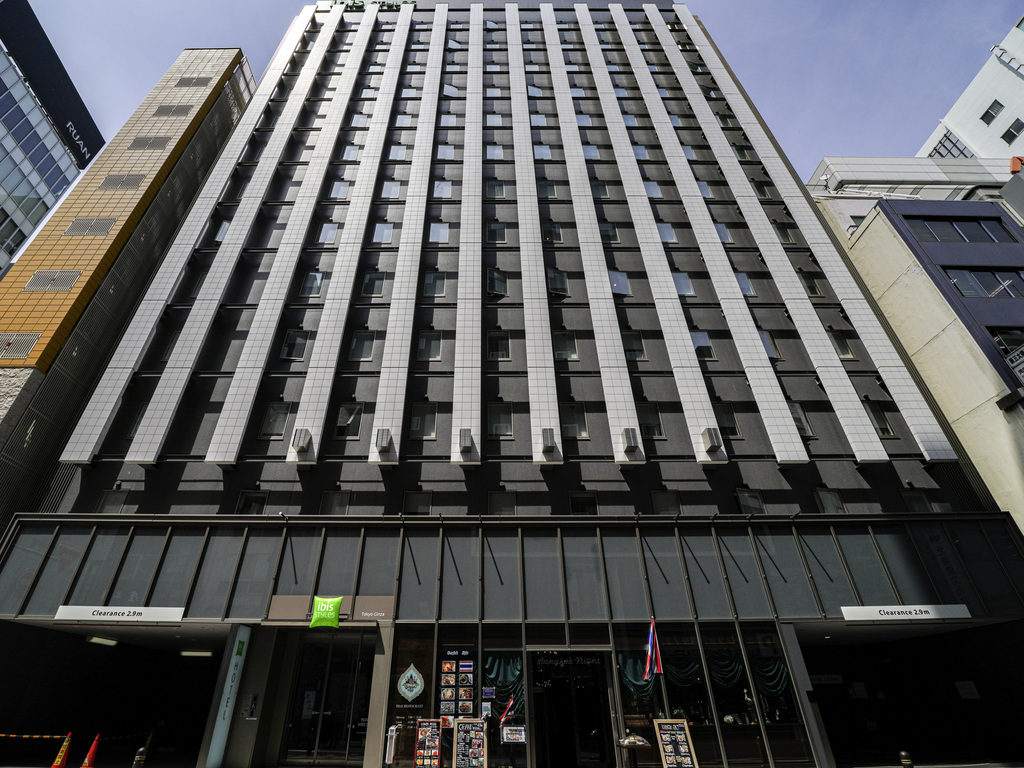
| Address | 7-10-9 Ginza, Chuo-ku, Tokyo 104-0061 |
| Nearest station | 6 min walk from JR Shimbashi Station; 5 min walk from Tokyo Metro Ginza Station |
| One-month stay | From ¥108,000 |
| Note | Rates vary by period. |
Set in Ginza, within walking distance of the Kabukiza theatre and the designer stores along Ginza-dori, ibis Styles Tokyo Ginza puts every Tokyo landmark within reach and works equally well for work and sightseeing.
Free Wi-Fi throughout and a full set of amenities mean it is well regarded for comfort as well as for its location and surroundings.
[Osaka] Hotel Vine Osaka Kitahama (ホテルVINE大阪北浜)
| Address | 1-6-6 Hiranomachi, Chuo-ku, Osaka 541-0046 |
| Nearest station | About 3 min walk from Exit 5, Kitahama Station (Subway Sakaisuji Line); about 6 min walk from Exit 28, Kitahama Station (Keihan Main Line) |
| One-month stay | ¥77,850 |
| Note | Rates vary by period. |
Three minutes on foot from Kitahama Station in the heart of Osaka, this hotel suits sightseeing-led hotel living as much as business travel.
It is a relatively new property, and the clean condition of the building and fittings makes it the kind of place people picture when they imagine hotel living.
[Osaka] Sakishima Cosmo Tower Hotel (さきしまコスモタワーホテル)

| Address | 1-14-16 Nanko-kita, Suminoe-ku, Osaka 559-0034 |
| Nearest station | About 7 min walk from Cosmosquare Station (Osaka Metro Chuo Line / New Tram); about 5 min walk from Trade Center-mae Station, directly connected |
| One-month stay | From ¥75,000 |
| Note | Rates vary by period. |
Sakishima Cosmo Tower Hotel looks out over a view selected as one of Japan’s 100 finest night landscapes.
The location is convenient too, working as a base for business or for visits to Kansai International Airport, Universal Studios Japan and the Osaka Aquarium Kaiyukan.
Premium mattresses on the beds and free video streaming in the rooms also make it comfortable to spend time inside the hotel itself.
[Fukuoka] Hotel MyStays Fukuoka Tenjin-Minami (ホテルマイステイズ福岡天神南)
| Address | 3-14-20 Haruyoshi, Chuo-ku, Fukuoka 810-0003 |
| Nearest station | 5 min walk from Exit 6, Tenjin-Minami Station (Subway Nanakuma Line) |
| One-month stay | ¥120,000 |
| Note | Rates vary by period. |
Over a full month it sits at the higher end for hotel living, but some rooms have a kitchenette, which makes it one of the properties genuinely built for long stays.
The Nakasu food-stall district and nightlife area are within walking distance, so it suits anyone who wants to travel while moving between hotels.
[Fukuoka] Sunlife Hotel 2 & 3 (サンライフホテル2・3)

| Address | 1-12-3 Hakata-eki Higashi, Hakata-ku, Fukuoka 812-0013 |
| Nearest station | 2 min walk from the Chikushi exit of JR Hakata Station — directly opposite as you leave the Chikushi (Shinkansen) exit |
| One-month stay | From ¥106,260 |
| Note | Rates vary by period. |
Sunlife Hotel 2 & 3 stands directly opposite the Chikushi exit of JR Hakata Station, and Fukuoka Airport is six minutes away by subway — an excellent position.
Being connected to the station also means you can come and go without worrying about rain or strong sun.
Local ingredients on the menu and renovated guest rooms make for a comfortable stay in Fukuoka.
[Okinawa] Cabin & Hotel ReTIME (キャビン アンド ホテル リタイム)
| Address | 14-10 Higashimachi, Naha, Okinawa 900-0034 |
| Nearest station | About 5 min walk from Asahibashi Station on the Yui Rail |
| One-month stay | ¥60,510 |
| Note | Rates vary by period. |
As well as being inexpensive for a long stay, this hotel has a large public bath and a sauna. Transport links are good, which makes it very practical.
Rates in Okinawa can move with the season, but hotel living here may let you experience daily life on the islands a little more deeply than a holiday would.
Visit the official site for Cabin & Hotel ReTIME
[Okinawa] New Normal Hotel Inn Matsuyama (ニューノーマルホテルイン松山)

| Address | 1-35-14 Matsuyama, Naha, Okinawa 900-0032 |
| Nearest station | About 7 min by car from Naha Airport; about 5 min by car to Kokusai-dori |
| One-month stay | From ¥95,130 |
| Note | Rates vary by period. |
New Normal Hotel Inn Matsuyama is built so you can live much as you would at home, with an auto-locking entrance and security cameras throughout the building.
During your stay there is a 24-hour call support centre, and staff will come out in an emergency — privacy is protected while you still have help on hand.
Making hotel living comfortable
Making hotel living comfortable means paying attention not only to the facilities but to what it costs you day after day.
Booking night by night through a normal reservation site carries a real risk of the total climbing high.
Consecutive-night and monthly plans exist precisely for this, and they typically discount around 20% against booking each night separately, which suits a longer workation or a stretch of hotel living. How these plans are structured, and how they compare with a monthly furnished apartment, is set out in Monthly Hotels in Japan: No Lease, 20% Off at 30 Nights (Aug 2026).
Booking can also be completed online, so the arrangement is finished simply by turning up at the hotel on the day.
Five ways to reduce the fatigue and stress of hotel living
Each of the five causes above can be eased through how you choose a hotel and how you use it. The five fixes map one-to-one onto the five reasons.
- Create room to make it feel like home (fixes cause 1) — Stay in the same hotel for two weeks or more at a stretch, bring one or two things that carry your own scent such as a pillow or blanket, and designate one corner of the room as your “desk”. Settling in one place beats moving constantly, and the drop in fatigue is obvious.
- Make a kitchen and laundry non-negotiable from the start (cause 2) — Long-stay rooms and apartment-type properties usually include a kitchenette, a microwave and on-site laundry. Simply lowering how often you eat out steadies both your health and your spending.
- Set the cleaning frequency yourself (cause 3) — Long-stay plans increasingly let you choose the frequency: cleaning twice a week, linen change only, and so on. Ask the front desk before you book and fix the days when someone comes in; on every other day you can leave your things out.
- Lock the cost in as a monthly figure first (cause 4) — Extending one night at a time carries a high unit rate, and the daily awareness of being charged becomes its own stress. OTAs offer consecutive-night discount plans at thresholds such as 7 nights or 30 nights, which let you fix the monthly figure in advance. Exactly which night the discount starts to bite is covered in Japan Hotel Long-Stay Discounts: 15% at 7 Nights, 20% at 30 Nights, with measured market rates at 7, 14 and 30 nights.
- Keep one place to work outside the room (cause 5) — Make the in-house lounge, a coworking space or a nearby café your “office”, and let the guest room go back to being where you rest. Choosing a hotel with a gym or a large public bath works well as an on/off switch too.
Who hotel living suits — and who it does not
For every person who finds it exhausting there is another who says hotel living made life easier. The dividing line is what you are willing to give up in daily life.
| Suits you if… | Does not suit you if… |
|---|---|
| • You would rather not spend time on housework (cleaning, rubbish, making the bed) • You travel light and want to move base easily • You have a fixed end date — a transfer, a training course, a home renovation • You value a location near a station, and security • You can keep your workplace outside the room (an office or coworking space) |
• Cooking is central to your daily life and a kitchen is essential • You cannot settle without your own things and furniture around you • You work from home for long hours and rarely leave the room • You deal with post and administrative paperwork frequently • You live with family or pets |
If two or more items in the right-hand column apply to you, comparing serviced apartments and monthly furnished apartments first will usually leave you less worn out than going straight to a hotel.
What hotel living actually costs in 2026 — from OTA published rates in four prefectures
The per-hotel monthly rates quoted earlier in this article (¥60,000 to ¥120,000) are the figures that were published back in 2022. For a 2026 view, the table below gives the average nightly OTA published rate by prefecture (business hotels, double occupancy, per room, tax included) and converts it to 30 nights.
| Prefecture | Average per night | 30 nights (standard booking) | Guide with a 20% long-stay discount | Properties covered (N) |
|---|---|---|---|---|
| Tokyo | ¥16,722 | approx. ¥501,660 | approx. ¥401,000 | 967 |
| Osaka | ¥13,844 | approx. ¥415,320 | approx. ¥332,000 | 528 |
| Fukuoka | ¥14,103 | approx. ¥423,090 | approx. ¥338,000 | 347 |
| Okinawa | ¥19,947 | approx. ¥598,410 | approx. ¥479,000 | 204 |
Period covered: stays in August 2026. Average of OTA published rates in the “business hotel” category. Double occupancy, per-room rate, tax included. The “guide with a 20% long-stay discount” column applies the average discount rate for long-stay bookings described in this article (about 20%) mechanically; it is a reference figure, not an actual plan price. Source: HotelBank Editorial Team research.
Three things stand out.
- Stringing together 30 standard bookings costs around ¥500,000 a month in Tokyo. The ¥16,722 nightly figure (N=967 properties) is based on double occupancy, so a single traveller pays less — but extending night by night is still the most financially stressful way to do it.
- Osaka and Fukuoka run ¥2,600 to ¥2,900 a night below Tokyo. Osaka is ¥13,844 (N=528) and Fukuoka ¥14,103 (N=347), which over 30 nights works out to a gap of roughly ¥80,000 a month against Tokyo. If you can choose your base, that difference converts directly into budget you do not have to worry about.
- Okinawa is the most expensive of the four because August is peak season (¥19,947, N=204). The ¥60,000-range figure quoted for the Naha hotel earlier in this article was the published rate in 2022; this is the area where rates swing most by season and by year.
The 30-night conversions above are a mechanical guide — nightly rate multiplied by 30. In practice a long-stay plan, a room-only rate, single occupancy or a different time of year will bring the figure down considerably, so anyone who wants to fix a monthly budget should check the conditions attached to consecutive-night plans (minimum nights, cleaning frequency, cancellation terms) before booking. The items worth checking are set out in detail in Business Hotels for Long Stays: 6 Checks and ¥16,722 a Night in Tokyo, built on the same ¥16,722 Tokyo benchmark.
Frequently asked questions about hotel-living fatigue and cost
Q. How long does it take before hotel living starts to feel exhausting?
On short business trips and training courses, people tend to start saying they feel unsettled or bored around the fourth or fifth night — that is causes 1 (never switching off) and 5 (no line between work and life). Over a longer stay, causes 2 to 4 (meals, housekeeping, cost) take over. Settling into one hotel and choosing a room with a kitchen and laundry changes the pattern considerably.
Q. Which fix reduces the stress of hotel living the most?
Locking the cost in as a monthly figure up front. Extending one night at a time carries a high unit rate and the sense of being charged daily never goes away. Fix the monthly figure with an OTA consecutive-night discount plan or a long-stay booking, then set the cleaning frequency yourself, and the psychological load drops sharply.
Q. What does a month of hotel living cost in 2026?
Average nightly OTA published rates for August 2026 (business hotels, double occupancy, tax included) are ¥16,722 in Tokyo, ¥13,844 in Osaka, ¥14,103 in Fukuoka and ¥19,947 in Okinawa. Stringing together 30 standard bookings comes to roughly ¥500,000 in Tokyo and around ¥420,000 in Osaka and Fukuoka. Long-stay plans and single occupancy bring that down.
Q. Who is hotel living not suitable for?
People for whom cooking is central to daily life, people who cannot settle without their own belongings around them, people who work from home for long hours and rarely leave the room, people who deal with post and administrative paperwork frequently, and people who live with family or pets. If two or more of these apply, compare serviced apartments and monthly furnished apartments first.
Related reading
- Business Hotels for Long Stays: 6 Checks and ¥16,722 a Night in Tokyo
- 6 Downsides of Hotel Living in Japan: ¥502,000 per 30 Nights & Fixes
- Hotel Living in Japan: 4 Room Criteria, Packing & Daily Routines
- Is Hotel Living Cheaper Than Rent in Tokyo? Break-Even at 24 Nights
- One Week of Hotel Living in Tokyo: ¥88,200 for 7 Nights, Any Start Day
- Japan Hotel Long-Stay Discounts: 15% at 7 Nights, 20% at 30 Nights
- Monthly Hotels in Japan: No Lease, 20% Off at 30 Nights (Aug 2026)
- Hotel Living: Keep Residence Registration Home, or File Within 14 Days