

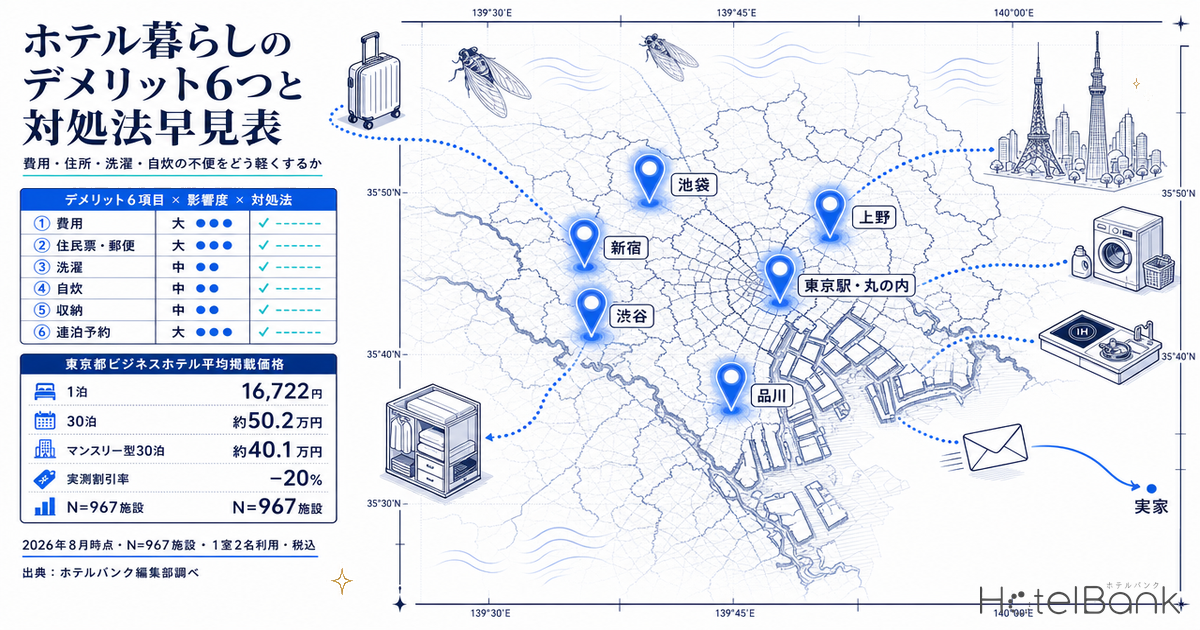
Hotel living has six main downsides — a cost that can reach roughly ¥500,000 a month, the handling of your residence registration and mail, the hassle of laundry, the difficulty of cooking for yourself, limited storage, and the trouble of securing consecutive nights. All six, however, are the kind of inconvenience you can work around once you know about them, and how serious they are depends heavily on your lifestyle. This article starts with an at-a-glance table of the full picture, checks the cost against actual market data, and gets you to the point where you can judge whether hotel living suits you.
- — The average listed price for a business hotel in Tokyo is ¥16,722 per night (as of August 2026, N=967 properties, per room for two guests, tax included). Thirty nights puts the starting point at about ¥502,000.
- — The two with the biggest impact are cost and residence registration and mail. Both involve contracts and paperwork, so you need to decide your approach before you start.
- — The remaining four — laundry, cooking, storage, and consecutive-night bookings — can be eased considerably through the facilities you choose and how you pick your rate plan.
- — Applying the measured discount rate for 30-night monthly-style plans (−20%) brings 30 nights down to about ¥401,000. The shorter and more clearly bounded your stay — a few weeks to a few months — the better this way of living fits.
Conclusion: The Downsides at a Glance (Impact and Fixes)
| Downside | Impact | How to deal with it |
|---|---|---|
| Costs add up (about ¥500,000 for 30 nights at a Tokyo business hotel) | High | Compress it with consecutive-night discounts, long-stay plans, and single-occupancy rates |
| Residence registration, address, and mail are cumbersome | High | Secure a base where you can register your address (a family home, for example) and receive mail via forwarding |
| Laundry is a chore (most properties have no washing machine in the room) | Medium | Choose properties with an on-site laundry corner, or rooms with a washer-dryer |
| No cooking, so it is a constant run of eating out and takeout | Medium | Make a microwave and refrigerator your baseline, and consider extended-stay hotels with a kitchen |
| Limited storage means paring down your belongings | Medium | Combine with a storage unit or storage at a family home and keep your possessions minimal |
| Consecutive nights are hard to book in some periods (sellouts and price spikes in peak season) | Medium | Lock in a block of dates early with a monthly or long-stay plan |
The two rated “High” — cost and address — involve contracts and administrative procedures, so you want to settle your approach before you begin. The remaining four can be eased considerably through your choice of property and how you operate day to day. Let us take them in order.
Cost: About ¥502,000 for 30 Nights at a Tokyo Business Hotel
The biggest downside is, unsurprisingly, cost. Aggregating listed OTA prices, the average listed price for a business hotel in Tokyo is ¥16,722 per night (as of August 2026, N=967 properties, per room for two guests, tax included; HotelBank Editorial Team analysis). Thirty nights at that rate comes to about ¥502,000 (¥16,722 × 30 nights = ¥501,660). That is expensive next to the rent on a one-room apartment in central Tokyo, but you have to discount it for the fact that utilities, internet, cleaning, bedding, and key money and deposits are all included in the figure.
| Assumption | Per night | 30-night total |
|---|---|---|
| Standard plan (Tokyo business hotel average) | ¥16,722 | About ¥502,000 |
| 30-night monthly-style plan (reference estimate applying the measured median discount of −20%) | About ¥13,378 | About ¥401,000 |
The lower row is a reference figure produced by mechanically applying the median discount by length of stay that we measured separately (−20% at 30 nights or more) to the average nightly rate in the upper row. It is not the quoted price of any specific, real plan. The measured basis for the discount rates is set out in our article on long-stay discounts.
That said, this figure is an average for “two guests per room, standard booking.” In actual hotel living it moves up and down with the following factors.
- Single occupancy: many properties come in below the figure above for single rooms or single-occupancy plans
- Consecutive-night and long-stay discounts: some hotels have plans where the nightly rate falls as you go from 7 to 14 to 30 nights
- Area and timing: central versus suburban, and peak versus off-peak, can pull you a long way from the average
For a guide to how many nights it takes before the rate drops and by how much, see our detailed breakdown of long-stay hotel discounts at 7, 14, and 30 nights if you want to tighten up the cost side.
Address and Mail: Decide Where to Register Your Residence First
The address on your residence registration refers to the “address” defined by Japan’s Basic Resident Registration Act — the base of your daily life. A hotel is generally unlikely to be recognized as such a base, and whether you can register there ultimately comes down to the municipality’s judgment, so in practice the safe approach is to plan on the assumption that you cannot register at a hotel. If you are terminating a lease entirely and moving into hotel living, you will run into problems with banks, credit cards, and government procedures unless you work out where to register your residence and how to receive mail before you start. The impact is small for people who can register at a family home, but for those who cannot, this is the single biggest hurdle in hotel living. If you are weighing hotel living around a new job or a job change, our cost guide covering residence registration and onboarding paperwork is worth checking for the procedural side.
Laundry, Cooking, and Storage: Inconveniences You Can Largely Design Away
Laundry: Shared Coin Laundry, or an In-Room Washer-Dryer
Laundry is a quietly significant downside. At most business hotels the coin laundry sits on a shared floor, which means a trip back and forth from your room every time you wash. Some extended-stay hotels aimed at long-term guests put a washer-dryer inside the room, so if you are staying a while, make that a criterion.
Cooking: A Microwave and Fridge Are the Minimum; Serious Cooks Need a Kitchen
Cooking for yourself is essentially impossible at a typical business hotel. A steady diet of restaurant meals and takeout drives up your food budget and makes it harder to stay healthy. The fix comes in two stages: first, make a room with a microwave and refrigerator your baseline condition. If you want to cook seriously beyond that, there are extended-stay hotels with an induction kitchen in the room. As in this comparison of extended-stay hotels with kitchens in Nagoya’s Fushimi–Marunouchi area, a reasonable number of properties in major cities equip rooms with both a kitchen and laundry facilities.
Storage: Assume You Are Working With One Closet
Storage means fitting your belongings into a single closet. The realistic approach is to leave off-season clothing and books in a storage unit or at a family home and keep your possessions to a minimum. Our guide to making hotel living comfortable covers how to pare down what you carry and how to make the room work for you.
Trouble Booking Consecutive Nights: In Peak Season, the Inventory Goes First
What tends to get overlooked is booking stability. Unlike a lease, hotels raise their rates in peak season and do sell out. If you are stringing together 30 nights one booking at a time, you will hit stretches over long holidays or event periods where you “cannot get the next night” or “cannot stay in the same room.” The fix is simple: choose a hotel that offers monthly or extended-stay plans and lock in a block of dates in advance. Because the rate is fixed, you also avoid the risk of peak-season spikes.
The Upsides, in Fairness: Who It Suits and Who It Does Not
It is not all downsides. You can move in the same day with zero deposit, key money, or furniture and appliance costs, and cleaning, linen changes, utilities, and internet are all included. The lightness of being able to move to a different city next month when you tire of this one is something a lease can never match. Losing the chore of managing a breakdown of fixed costs matters, too, if you are busy.
Pulling it together:
- Suits: people whose stay is bounded at a few weeks to a few months (training, a project, temporary housing before a move), people who have a separate base where they can register an address, people who travel light and do not mind eating out, and people who want to change where they live flexibly without upfront costs
- Does not suit: people planning to settle in the same city for years (a lease usually wins on total cost), people for whom cooking is central to daily life, people with a lot of belongings or bulky hobby equipment, and people who cannot secure somewhere to register their residence
In short, hotel living is a way of living optimized for a “light, time-limited life,” and most of its downsides are the price of that. If your timeframe and purpose are clear, it is a thoroughly realistic option once you pair it with the fixes above.
If You Want to Search in Detail
For hands-on comparisons of specific properties, these articles go deeper.
Five Extended-Stay Hotels With Kitchens in Nagoya’s Fushimi–Marunouchi Area — Comparing a Month-Long Base in the Chukyo Region by In-Room Facilities and Monthly Cost Structure (innippon, in Japanese)
Compares five properties by in-room facilities and monthly cost structure, including Espacio Time Sharing For Urban — a two-minute walk from Fushimi Station, with an induction kitchen and washer-dryer in all 54 rooms — the Nagoya B’s Hotel ANNEX with its mini kitchen and drum-type washer-dryer, and Grand Base Osu with its roomier units equipped with a microwave and refrigerator. Aimed at readers who want to solve “I cannot cook” through the facilities themselves.
“Carrying the Rhythm of Home With You” — Top 5 Extended-Stay Hotels in Sendai’s Aoba Ward Where Cooking, Laundry, and a Work Desk Do the Heavy Lifting (HotelPicks, in Japanese)
Introduces five properties that support consecutive-night living, with indicative prices: Richmond Hotel Premier Sendai Ekimae, a three-minute walk from the west exit of Sendai Station with a generous desk; Hotel Metropolitan Base Sendai, where every room has a microwave, refrigerator-freezer, and mini kitchen (no stovetop); and Dormy Inn Sendai Ekimae with its natural hot-spring large bath and coin laundry.
Frequently Asked Questions
Q. How much does hotel living cost per month?
The average listed price for a business hotel in Tokyo is ¥16,722 per night (as of August 2026, N=967 properties, per room for two guests, tax included), so 30 nights works out to about ¥502,000 as a guide. If you can use a monthly-style plan of 30 nights or more (measured median discount of −20%), the reference estimate is about ¥401,000. It moves up or down with single occupancy, area, and timing.
Q. Can I register my residence at a hotel?
The “address” defined by Japan’s Basic Resident Registration Act refers to the base of your daily life, and a hotel is generally unlikely to be recognized as such, so whether you can register there comes down to the municipality’s judgment. In practice the safe design is to assume you cannot register at a hotel, secure a base such as a family home where you can register an address, and receive mail via forwarding.
Q. What should I do about laundry?
Most business hotels have you use a coin laundry on a shared floor, which means a trip back and forth from your room every time. If you are staying a while, making an in-room washer-dryer at an extended-stay hotel — or at least an on-site laundry corner — one of your criteria will cut the burden substantially.
Q. Can I cook for myself while living in a hotel?
At a typical business hotel, essentially not. The realistic approach is two-stage: first make a room with a microwave and refrigerator your baseline condition, and if you want to cook seriously, choose an extended-stay hotel with an induction kitchen in the room.
Q. Will I be unable to book consecutive nights in peak season?
If you string bookings together one night at a time, you will hit stretches over long holidays and event periods where you cannot get the next night or cannot stay in the same room. If you lock in a block of dates with a monthly or extended-stay plan, the rate is fixed and you also avoid peak-season spikes.
Q. Who does hotel living suit?
It suits people whose stay is bounded at a few weeks to a few months (training, a project, temporary housing before a move), people who have a separate base where they can register an address, and people who travel light and do not mind eating out. Conversely, for people planning to settle in the same city for years, people for whom cooking is central to daily life, and people with a lot of belongings, a lease tends to come out ahead.
About the Data in This Article
■ Data Sources
The ¥16,722 average listed price for business hotels in Tokyo (N=967 properties, as of August 2026) is a HotelBank Editorial Team analysis based on publicly available OTA data. The median discount rates by length of stay (−10% at 2 nights, −15% at 7 nights, −20% at 30 nights) are also measured by the same editorial team. The treatment of residence registration draws on Japan’s Basic Resident Registration Act (e-Gov Law Search) and the Ministry of Internal Affairs and Communications’ “Basic Resident Registration” materials.
■ Calculation Assumptions
The price basis is “two guests per room, rate per room (tax included).” The 30-night total is calculated mechanically as the average nightly rate × 30 nights (¥16,722 × 30 nights = ¥501,660). The approximately ¥401,000 monthly-style figure is a reference estimate assuming the measured median discount by length of stay of −20% applies uniformly across the entire stay; it is not the quoted price of any specific, real plan.
■ Limitations and Caveats
These are averages of listed prices and do not match actual transacted rates or single-occupancy rates. They can diverge widely from the average by area (central versus suburban) and timing (peak versus off-peak). Whether you can register your residence at a hotel is judged differently by each municipality, so ultimately you need to confirm with the municipal office where you are moving.
Related Reading
- Hotel Living for a New Job: 1 Month Max, ¥17,238 Median Night in Tokyo
- Hotel Living in Japan: 4 Room Criteria, Packing & Daily Routines
- Japan Hotel Long-Stay Discounts: 15% at 7 Nights, 20% at 30 Nights
- Hotels Near Convenience Stores & Supermarkets: National Ranking
- Hotel Subscription Market Tipping Point 2026 — goodroom, unito, HafH Disrupt Settled-Living Hotel Demand