

A rented apartment while yours is being renovated, the gap between moving out and moving in, a scouting trip before a solo work relocation — the need to “live in a Tokyo hotel for just one week” clusters in exactly the window that neither a standard lease nor a monthly apartment can absorb. This article aggregates the listed prices of 764 business hotels across 10 major wards of Tokyo’s 23 wards to measure what seven nights actually costs, and how that total moves depending on when you check in.
Metric Definitions Used in This Article
- Lowest listed price (median): For each property and each date, the cheapest publicly listed room plan is taken as one observation (one property × one day), and the median across properties in the area is calculated for that date. Prices are per room for double occupancy (tax included). They differ from actual transacted prices.
- ADR (average daily rate): An estimated transacted rate derived by applying category-specific adjustment factors to the lowest publicly listed plan level on OTAs and other channels (tax-excluded equivalent). Cross-checked against disclosed results from listed hotel REITs, the median error is 6.6% (verified categories: business, city, resort, ryokan, capsule). These are estimates and differ from each property’s actual transacted prices and accounting figures. Area-level ADR is the median of the properties covered.
- OCC (occupancy rate): Rooms sold as a share of total rooms in the area (an estimate based on OTA sales inventory). Used as a macro indicator at the prefecture and municipality level.
- Coverage: 764 business hotels located in 10 major wards of Tokyo (Chiyoda, Chuo, Minato, Shinjuku, Shibuya, Shinagawa, Taito, Sumida, Koto, Toshima), over the 77 days from June 1 to August 16, 2026, for a total of 57,163 property-days of observations.
- Data source: MetroEngines Research
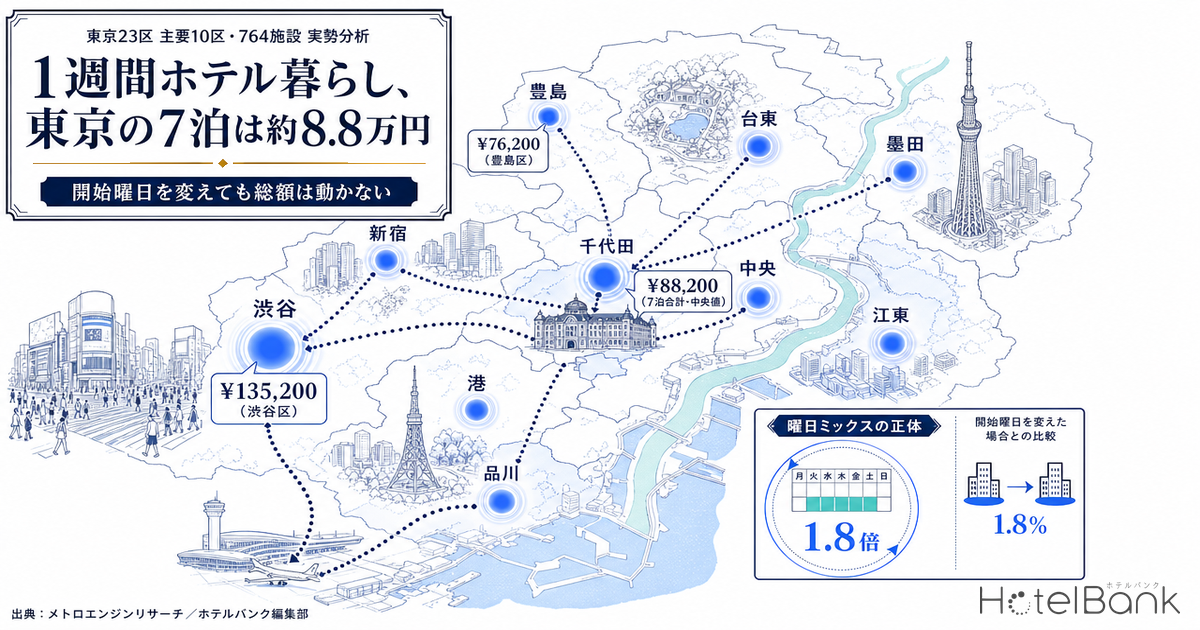
- — Seven nights costs a median of about ¥88,200 (roughly ¥12,600 per night), based on the lowest listed prices of 764 properties across 10 major Tokyo wards.
- — The gap between wards reaches 1.8x. Toshima and Koto sit in the ¥76,000 range while Shibuya runs about ¥135,200 — the total is decided by where you stay.
- — For seven nights, changing the check-in day barely moves the total (a 1.8% spread), because any seven-night stay contains each weekday exactly once. For three nights the spread is 40%.
- — Stretching the stay does not automatically lower the nightly rate. From 7 to 28 nights the change stays within ±1%; a genuine discount appears only when you switch to a dedicated extended-stay plan.
Why “one week” — the three motives that cluster at seven nights
One week is precisely the length that falls through the cracks of Japan’s housing system. Most rental apartments require a minimum contract of one month or longer, and monthly apartments are also priced in 30-day units. Hotels, by contrast, are sold by the night, which makes them the only option you can buy in an awkward seven-night block.
In practice, seven-night stays fall into roughly three situations. First, temporary housing during renovation or repairs. Plumbing and flooring work often finishes in about a week, and the home has to be vacated for that period. Second, the gap between moves. It is common for the move-out date and the move-in date to be a few days to a week apart, and some people put their belongings in storage and shift to a hotel with nothing but a suitcase. Third, trial stays and scouting. Before committing to a new city for a transfer or for school, people want to experience the actual commute and the neighborhood noise before choosing a property.
What all three share is a desire to avoid extra paperwork. Deposits, key money, agency fees, fire insurance and guarantor-company screening — the upfront costs of a Japanese lease are clearly excessive for a one-week stay. A hotel is confirmed in a few clicks on a booking site, and there is no restoration obligation on departure. For how long a hotel remains realistic as temporary housing around a job change or transfer, see Hotel Living for a New Job: 1 Month Max, ¥17,238 Median Nightly Rate.
What one week in Tokyo actually costs — a median of about ¥88,200 for seven nights
Start with the headline figure. For the 764 business hotels across the 10 major wards, we calculated the daily median of the lowest listed price, then summed seven consecutive nights for every possible start date. The median came to about ¥88,200 (roughly ¥12,600 per night). For reference, MetroEngines Research puts the estimated transacted ADR for business hotels in Tokyo at about ¥12,300 as of July 2026 (N=913 properties), broadly consistent with the per-night figure built up from listed prices.
That number, however, is only the median for “Tokyo as a whole.” By ward, the seven-night total ranges from ¥76,200 to ¥135,200 — a 1.8x gap between the cheapest (Toshima) and the most expensive (Shibuya). Even over a period as short as one week, the choice of area has a decidedly non-trivial effect on the total.
Source: MetroEngines Research; compiled by the HotelBank Editorial Team (N=764 properties, June 1–August 16, 2026)
| Ward | 7-night total (median) | Per night | 7-night total, low–high | Properties covered |
|---|---|---|---|---|
| Toshima | ¥76,200 | ¥10,900 | ¥67,400–81,200 | 59 |
| Koto | ¥76,300 | ¥10,900 | ¥68,900–83,500 | 31 |
| Shinagawa | ¥80,000 | ¥11,400 | ¥68,300–84,300 | 31 |
| Sumida | ¥80,100 | ¥11,400 | ¥71,200–85,900 | 26 |
| Taito | ¥82,300 | ¥11,800 | ¥74,200–89,700 | 188 |
| Chiyoda | ¥88,200 | ¥12,600 | ¥72,700–95,000 | 68 |
| Shinjuku | ¥90,500 | ¥12,900 | ¥82,200–99,400 | 94 |
| Chuo | ¥96,700 | ¥13,800 | ¥82,100–103,500 | 137 |
| Minato | ¥97,700 | ¥14,000 | ¥76,800–104,300 | 102 |
| Shibuya | ¥135,200 | ¥19,300 | ¥117,500–154,400 | 28 |
Source: MetroEngines Research; compiled by the HotelBank Editorial Team (median of lowest listed prices, double occupancy, tax included)
Taito Ward stands out with 188 properties covered because small business hotels are densely clustered around the Ueno and Asakusa areas. Conversely, Shibuya, Sumida and Koto have only around 30 qualifying properties each, so their medians are more easily pulled by the price movements of individual hotels. This spread across wards is not unique to the current season: Tokyo Business Hotel ADR 12-Month Trend: 30% Central vs Outer Ward Gap confirms a persistent level difference between the five central wards and the 18 outer wards.
The day-of-week mix — one Saturday night costs 1.8x a Sunday
The single biggest driver of a one-week total is neither the area nor the property grade — it is the day of the week. Pooling all 10 wards, the median lowest listed price is about ¥9,900 on Sunday, the cheapest day, versus about ¥17,900 on Saturday, the most expensive. That is a gap of roughly 1.8x. Prices climb gently through the low ¥10,000s from Monday to Thursday, pause on Friday, and then only Saturday jumps.
Source: MetroEngines Research; compiled by the HotelBank Editorial Team (10 wards pooled, N=764 properties)
That Saturday spike is backed by supply and demand. The occupancy rate for Tokyo business hotels in July 2026 (estimated, based on OTA listed inventory) averaged 93.2% for the month (N=861 properties / 125,487 rooms), but broken out by day of week it runs 89.5% on Monday against 96.3% on Saturday. In an already high-occupancy market, Saturday alone tightens inventory by nearly another 10%. For how this weekend uplift is distributed across individual properties, see Weekend Premium 2026: Tokyo Business 24% vs Hakone Ryokan 10%, N=659.
So when you ask “what does one week of hotel living cost,” the first thing to check is not the average but how many Saturdays your seven nights contain. And from there follows a conclusion that many people find counterintuitive.
At seven nights the start day barely matters — 40% for three nights, 1.8% for seven
For a three-night stay, when you check in changes the rate substantially. Three nights starting Sunday (Sun–Tue) average about ¥10,600 per night, while three nights starting Thursday (Thu–Sat) run about ¥14,900. The gap is 40.4%. Whether or not you straddle the weekend turns the same three nights into an entirely different purchase.
At seven nights, that gap all but disappears. Seven nights checking in on Sunday cost about ¥12,500 per night; checking in on Friday, about ¥12,700. The spread by start day is just 1.8%. The reason is simple: seven nights always contain each day from Monday through Sunday exactly once. Whichever day you start on, the mix of weekdays is identical — the expensive Saturday and the cheap Sunday are each included once.
Source: MetroEngines Research; compiled by the HotelBank Editorial Team (10 wards pooled, median per-night rate by check-in day)
Tracking this property across stay lengths produces a clean valley. The spread in per-night rate caused by the start day (median across the 10 wards) narrows from 65.9% at one night, to 32.7% at three, to 11.2% at six, and bottoms out at just 1.4% at seven nights. Extend to eight nights and it rebounds to 8.9%: an eight-night stay contains one weekday twice, and whether that day is a Saturday or a Sunday reopens the gap. At 14, 21 and 28 nights — that is, at multiples of seven — it returns to the 1% range.
Source: MetroEngines Research; compiled by the HotelBank Editorial Team (median across 10 wards; spread = difference between the highest and lowest per-night rate by start day)
The practical implication is clear. If your plans fit exactly seven nights, shifting the check-in date to chase a cheap day of the week simply does not work. Effort is better spent on choosing the area and the property than on juggling the calendar.
If, on the other hand, you have one night of flexibility, the picture changes. Six nights checking in on Sunday (Sun–Fri, avoiding Saturday) deliver a clearly lower per-night rate than seven. In Toshima, seven nights run about ¥10,900 per night versus about ¥9,900 for six; in Taito, about ¥11,700 versus about ¥10,800; in Shinjuku, about ¥13,000 versus about ¥11,800. Cutting a single night lowers the nightly rate by 8–9% precisely because the night removed is the most expensive one, Saturday.
Extended-stay plans that start at seven nights
Everything above builds up nightly listed prices. But the lodging industry also sells extended-stay plans that productize the seven-night threshold directly. Tokyu Stay (東急ステイ), which operates residential-style hotels, sets its weekly plan to cover 7 to 29 nights, with its medium- and long-stay plans as a whole handled within a single framework up to 31 nights (32 nights and beyond are arranged through a dedicated inquiry form). There is no product called a monthly plan; stays from one week up are designed to be absorbed by the weekly plan.
What stands out is the flat-rate concept the company applies at participating hotels. Its official site explains that during a long stay, guests “can stay at the same rate without the accommodation charge changing from day to day.” Under a flat rate, the Saturday spike seen in the previous section is not reflected in the total. In the sense that it levels out the day-of-week peaks and troughs, an extended-stay plan is a product that changes the price structure itself.
Another example is Hotel MONday (ホテルMONday), whose portfolio includes apartment-style hotels. According to its official site, weekly and monthly plans are set at 7, 14 and 30 or more nights, at 10% off the standard rate. Beyond 30 days, extensions can be made a day at a time. Apartment-type rooms come with a fully automatic washer-dryer, an IH kitchen, a microwave, a refrigerator, a rice cooker and cookware — equipped so a week of ordinary life can be carried in as is.
On facilities, participating Tokyu Stay hotels provide an in-room washer-dryer and a mini kitchen (microwave and cookware), with rooms averaging around 20 square meters. Housekeeping is generally structured as once-a-week bed-making, which is operated differently from a standard stay where towels are changed daily. If you are staying a full week, whether that weekly housekeeping cadence suits your routine is a point worth checking in advance.
Three things to confirm when looking for an extended-stay plan
(1) The minimum number of nights at which the plan applies (from 7 nights, or from 10 or 14?); (2) whether the rate is flat or still varies by day; and (3) the housekeeping frequency and linen-change rules. Even under the same “weekly” label, these three are designed differently by each operating company, so confirming the current terms on the official site is essential.
Compared with two weeks and one month — length alone does not lower the nightly rate
The intuition that “staying longer makes it cheaper” is persistent. But as long as you are stacking up nightly listed prices, it does not happen. Calculating the median per-night rate across 7-, 14-, 21- and 28-night windows, the variation stayed within ±1% in all 10 wards. The largest moves were +0.8% in Shinjuku and −0.8% in Chiyoda, both within the margin of error.
| Ward | Per night at 7 nights | 14 nights | 21 nights | 28 nights | 7 → 28 nights |
|---|---|---|---|---|---|
| Toshima | ¥10,880 | ¥10,888 | ¥10,834 | ¥10,856 | −0.2% |
| Taito | ¥11,755 | ¥11,753 | ¥11,754 | ¥11,710 | −0.4% |
| Chiyoda | ¥12,603 | ¥12,621 | ¥12,552 | ¥12,496 | −0.8% |
| Shinjuku | ¥12,932 | ¥12,995 | ¥12,971 | ¥13,035 | +0.8% |
| Minato | ¥13,955 | ¥13,945 | ¥13,886 | ¥13,928 | −0.2% |
Source: MetroEngines Research; compiled by the HotelBank Editorial Team (five representative wards, based on the median of lowest listed prices)
In other words, a declining nightly rate does not emerge from accumulating days by itself. As long as you keep buying one night at a time, the per-night burden over two weeks or a month is almost the same as it is over seven nights. The rate falls only when you switch to a dedicated extended-stay plan of the kind described in the previous section. For actual discount levels by stay length, see Japan Hotel Long-Stay Discounts: 15% at 7 Nights, 20% at 30 Nights.
This structure matters more the longer the period runs. At seven nights, the absolute total rarely exceeds ¥100,000 by much even without an extended-stay plan, but at 14 or 30 nights the difference becomes tens of thousands of yen. This article deliberately confines itself to cases that finish within seven nights; if your stay looks likely to run past a week, check the terms of the weekly and monthly plans described above before you book.
What makes one week easy — luggage, laundry, residence registration
Price is not the only reason seven nights get chosen. More often, it is the lightness of the paperwork that decides it.
Luggage. For one week, a single carry-on-sized suitcase is enough. Rather than packing seven days of clothes, plan for three or four days and do laundry midway, and the volume halves. When bridging a renovation or a move, the advantage of a hotel is that you can leave the bulky items in storage or at a family home and travel with nothing else.
Laundry. This is the dividing line at one week. Three nights can be managed without washing anything, but seven nights require at least one load. There are three options: choose a residential-style hotel with an in-room washer-dryer, use a coin laundry inside the building, or walk to a nearby one. As noted above, some residential-style hotels equip rooms with a washer-dryer as standard, so you can run a load late at night without competing for a machine. Even if the nightly rate is a few hundred yen higher, over seven nights that can absorb the cost of the coin laundry and the time spent getting there.
Residence registration. A one-week stay will almost never require filing a move-in notification. Notification under Japan’s Basic Resident Registration system is required when you move the base of your daily life, and temporary housing during a renovation is normally not treated as such. Because the judgment depends on individual circumstances, however, if the stay may run long or you are unsure how to handle your address, consult Hotel Living: Keep Residence Registration Home, or File With the Ward Office? and then confirm with your local municipal office to be certain.
Mail. For about a week, it is often not worth using Japan Post’s forwarding service. For deliveries you miss, it is usually enough to schedule redelivery for a date after your stay. If there is a chance the stay will extend past a week, however, consider arranging forwarding early.
One thing easily overlooked on a week-long stay is the housekeeping policy for consecutive nights. An increasing number of properties make eco-housekeeping the default and clean only every few days during a multi-night stay. Whether you can still get a daily towel change, and whether declining housekeeping earns a perk, varies by property, so add it to your pre-booking checklist. Concrete tips for staying comfortable are collected in Hotel Living in Japan: 4 Room Criteria, Packing & Daily Routines.
Conclusion — seven nights are decided by area and product, not by the calendar
Four findings emerge from the listed prices of 764 properties across Tokyo’s 10 major wards. First, one week of hotel living runs a median of about ¥88,200 for seven nights, or roughly ¥12,600 per night. Second, the gap between wards reaches 1.8x, from about ¥76,000 in Toshima and Koto to about ¥135,000 in Shibuya. Third, because any seven-night stay contains the same mix of weekdays, moving the start date barely changes the total (a spread of 1.8%). Fourth, extending the stay does not automatically lower the nightly rate; the decline appears only once you switch to a dedicated extended-stay plan.
So the priority order when designing a one-week stay is area selection first, then whether an extended-stay product exists — not calendar juggling. And if you do have one night of slack, simply dropping Saturday for a six-night stay lowers the per-night rate by 8–9%. That is an effect no amount of shifting the start day can produce.
A note on the data: The prices in this article aggregate the cheapest plans each property published on OTAs and other channels over the 77 days from June 1 to August 16, 2026, and differ from actual transacted prices and final bills. Prices for future dates reflect listed levels at the time of the survey and move as the check-in date approaches. Public holidays, extended holiday periods and major event dates fall outside the day-of-week pattern described here and should be checked individually.
Related Reading
- Is Hotel Living Cheaper Than Rent in Tokyo? Break-Even at 24 Nights
- Japan Hotel Long-Stay Discounts: 15% at 7 Nights, 20% at 30 Nights
- 6 Downsides of Hotel Living in Japan: ¥502,000 per 30 Nights
- Hotel Living for a New Job: 1 Month Max, ¥17,238 Median Nightly Rate
- Tokyo Business Hotel ADR 12-Month Trend: 30% Central vs Outer Ward Gap
- Weekend Premium 2026: Tokyo Business 24% vs Hakone Ryokan 10%, N=659
References and Sources
■ Data sources
Daily lowest listed prices (double occupancy, tax included) were aggregated for 764 business hotels located in 10 major wards of Tokyo (Chiyoda, Chuo, Minato, Shinjuku, Shibuya, Shinagawa, Taito, Sumida, Koto, Toshima) over the 77 days from June 1 to August 16, 2026, for a total of 57,163 property-days. Occupancy is an estimate based on OTA listed inventory covering 861 business hotels / 125,487 rooms in Tokyo for the same period (July 2026). Qualifying stay lengths, discount rates and room facilities for extended-stay plans were confirmed on each operating company’s official site in August 2026.
■ Calculation assumptions
The seven-night total was built by summing the median lowest listed price over seven consecutive days for every start date within the coverage period, then taking the median across all start dates. Per-night rates by start day were re-aggregated by weekday using the same period and the same property set pooled together. Per-night rates by stay length (7, 14, 21, 28 nights) were calculated by dividing the median total of each window by the number of nights. Discounts from dedicated extended-stay plans are not included in these calculations; the figures represent the level obtained by stacking listed prices one night at a time.
■ Limitations and caveats
Listed prices are the prices of the cheapest plans each property published, and differ from actual transacted prices and final bills. Shibuya, Sumida and Koto have only around 30 properties covered each, so their medians are more easily pulled by the price movements of individual properties. Public holidays, extended holiday periods and major event dates fall outside the day-of-week pattern described here and require individual checking. Prices for future dates reflect listed levels at the time of the survey and move as the check-in date approaches.
- MetroEngines Research — listed prices for 764 business hotels across 10 major wards of Tokyo, 57,163 property-days (June 1–August 16, 2026); estimated transacted ADR and occupancy rate for Tokyo business hotels (estimated, based on OTA listed inventory)
- Tokyu Stay, “About medium- and long-stay plans (up to 31 nights),” official site (weekly plan covering 7–29 nights; confirmed August 2026)
- Tokyu Stay, “Flat-rate long-stay plans,” official site (flat-rate pricing structure, room facilities, housekeeping frequency; confirmed August 2026)
- Tokyu Stay Suidobashi, official site (operating status and access; confirmed August 2026)
- Hotel MONday, “Guide to weekly and monthly plans,” official site (qualifying stay lengths of 7, 14 and 30+ nights, discount rate, room facilities; confirmed August 2026)
- Ministry of Internal Affairs and Communications, “Basic Resident Registration” (overview of the Basic Resident Registration system)