

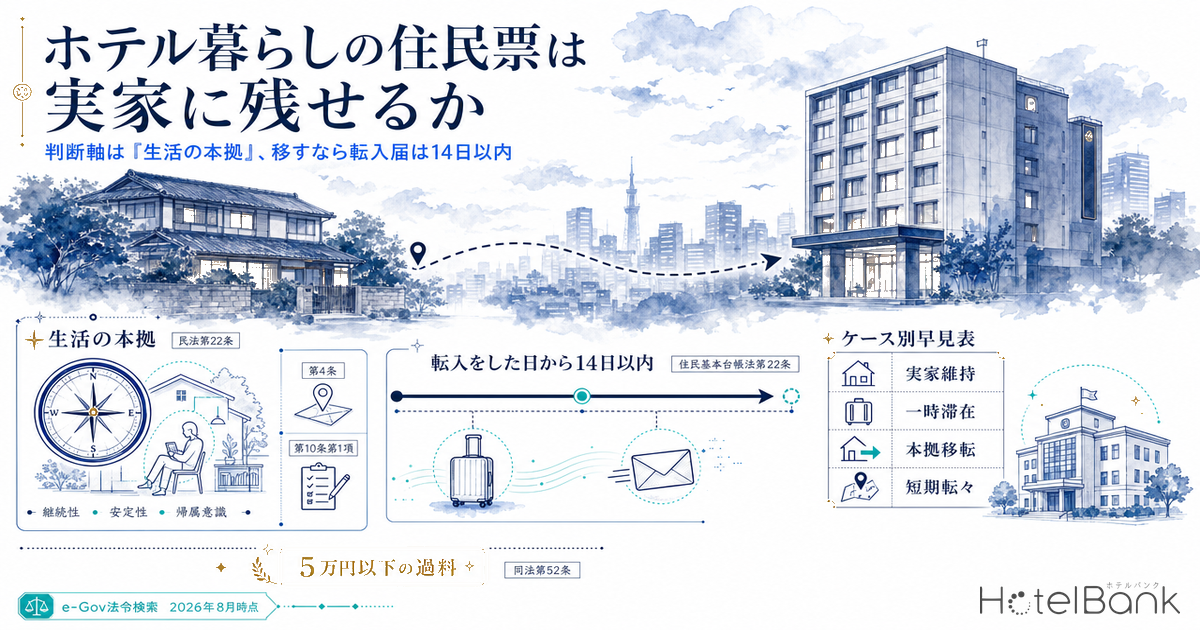
When you start living in a hotel for anything from a few weeks to a few months, the first question most people run into is what to do with their residence registration (住民票, juminhyo). The short answer: as a matter of law, a residence registration belongs where your “base of daily life” (生活の本拠) is, so if the stay is temporary and your base of daily life can still be said to be at your family home, leaving the registration there while living in a hotel is consistent with how the system is designed. If instead you give up your home and move your entire base of living, a notification obligation arises within 14 days of the date you moved in (Article 22, Basic Resident Registration Act). This article sets out the criteria for when you can keep the registration where it is and when you should move it, plus the practical steps if you do move it, based on the statutory text and official explanations of the system.
- — A residence registration belongs where your “base of daily life” is. Article 22 of the Civil Code defines a person’s domicile as the base of that person’s daily life, and Article 4 of the Basic Resident Registration Act provides that it must not be construed as having a different meaning.
- — If the stay is temporary, keeping the registration at your family home works. Where the period is bounded and your belongings and household finances remain centered at the family home — that is, the base of daily life has not moved — no “move-in” or “relocation” requiring notification has occurred at all.
- — If you moved your base, the move-in notification is due within 14 days (Article 22, Basic Resident Registration Act). A move within the same municipality is also due within 14 days (Article 23), and a move-out must be filed in advance (Article 24).
- — Failing to file, or filing falsely, carries a non-penal fine of up to ¥50,000 (Article 52, paragraphs 1 and 2). Proceedings concerning the fine are handled by the summary court (Article 53).
- — Whether you can register a hotel address depends on the municipality. The statutes do not categorically exclude hotels; the counter in the municipality where you are staying decides in light of the actual living situation. You also need to confirm the hotel’s own policy.
A Residence Registration Belongs at Your “Base of Daily Life”
In law, “domicile” is defined by Article 22 of the Civil Code, which provides that “the base of each person’s daily life shall be that person’s domicile.” Article 4 of the Basic Resident Registration Act then provides that provisions of laws and regulations concerning a resident’s address must not be construed as establishing an address with a meaning different from the resident’s address under Article 10, paragraph 1 of the Local Autonomy Act — making clear that the address on your residence registration carries the same “base of daily life” meaning (both verified against the statutory text on e-Gov Law Search as of August 2026).
In other words, whether to move your residence registration is not a procedural choice you are free to make; under the design of the system, it is settled by the fact of whether your base of daily life has actually moved. The Ministry of Internal Affairs and Communications likewise positions the Basic Resident Register as the record of residents’ residential relationships and the foundation for a range of administrative functions.
Where you have moved your base of daily life, the statutes set the filing deadlines as follows.
- Move-in notification (転入崩): when you newly establish an address in a different municipality, file within 14 days of the date of moving in (Article 22, Basic Resident Registration Act)
- Relocation notification (転居崩): when you change address within the same municipality, likewise within 14 days of the date of the move (Article 23 of the same Act)
- Move-out notification (転出崩): when moving to another municipality, file in advance (Article 24 of the same Act)
A person who fails to make these filings without justifiable grounds is subject to a non-penal fine of up to ¥50,000 (Article 52, paragraph 2 of the same Act), and a false filing is subject to the same fine of up to ¥50,000 (paragraph 1 of the same Article). Whether the fine is imposed is decided by the summary court (Article 53 of the same Act). It is worth registering that the approach of “leaving the registration at the family home even though the base of daily life has in fact moved” can become a problem in relation to this filing obligation.
When You Can Keep It at Your Family Home
Read the other way around, if your base of daily life has not moved, then no “move-in” or “relocation” subject to notification has occurred. Where a hotel stay of several weeks to several months is a temporary stay and your base of daily life is still at your family home, keeping the registration there does not conflict with how the system is conceived. Circumstances such as the following serve as the practical clues.
- The stay has a period fixed in advance, on the premise that you return to your family home (or your own home) when it ends
- Most of your furniture, household goods and belongings remain at the family home
- The delivery address for your mail and the center of your household finances are on the family-home side
- You move between hotels in short stints, with no single location where your daily life has taken root
No one of these decides the matter mechanically; the basic approach is to weigh the actual circumstances as a whole. Project-based long business trips, temporary housing during a renovation or rebuild, and a trial run at two-base living are typical examples that are easy to treat as temporary. A case such as leaving the family home for a new job and starting hotel living is different, since employers frequently ask for a copy of the residence registration as part of onboarding. Residence registration and the related procedures in the new-job context are covered in Hotel Living for a New Job: 1 Month Max, ¥17,238 Median Night in Tokyo, which also summarizes the monthly cost picture.
Can You Register a Hotel Address? There Is No Blanket Answer
Where the situation is “I am not going back to my family home or my own place — the hotel is the center of my life,” the next question is whether you can move your residence registration to the hotel’s address. The statutory text does not limit the type of address, and there is no provision making hotels categorically ineligible. That said, whether a long-stay hotel is recognized as a “base of daily life” is decided by the municipal counter receiving the notification, in light of the actual living situation, and treatment varies with the length of stay, the form of the arrangement and your future plans. Because no blanket yes or no can be given, confirming in advance with the residence-registration desk of the municipality where you are staying is the reliable route. Note too that if you intend to settle into one property, the rate conditions differ from a short stay: our measured figures on how many nights it takes for discounts to start working are summarized in Japan Hotel Long-Stay Discounts: 15% at 7 Nights, 20% at 30 Nights, worth reading alongside how you design the length of your stay.
The hotel’s own policy deserves the same check. Some properties do not envisage a guest registering a residence there at all, while others run monthly long-stay plans and will handle mail receipt. Apartment-style hotels built for extended stays — with an in-room kitchen and a washer-dryer — are run differently again from standard rooms, so confirm what a property actually supports before you settle in.
Quick Reference by Case — How to Approach Your Residence Registration
| Case | How to approach the residence registration | Procedure / where to confirm |
|---|---|---|
| A 2–4 week business trip or workation (family home or own home retained) | Easy to treat as a case where the base of daily life has not moved. Keeping the registration at the family home (or own home) is natural | No filing required in principle. Only arrange temporary handling of mail |
| Several months of hotel living, with a bounded period and a return to the family home at the end | In many cases it can be treated as a temporary stay and kept at the family home. Depends on the actual circumstances | If unsure, consult the municipal counter on the family-home side |
| Home given up, nowhere to return to, long stay at one specific hotel | May constitute a move of the base of daily life. Notification is due within 14 days of the date of moving in (Article 22, Basic Resident Registration Act) | Whether a hotel address is accepted rests with the municipality. Confirm in advance with both the municipal counter where you are staying and the hotel |
| Moving between several hotels in short stints | Hard to call any specific place the base of daily life, so the judgment is difficult | Consult the municipal counter, including on whether the base can remain at the family home |
Figure 1: Decision flow for your residence registration
STEP 1
Has the base of daily life moved? Check the actual situation — whether your belongings, household finances and a place to return to remain at your family home (or own home).
STEP 2A — IT HAS NOT MOVED
No “move-in” or “relocation” has occurred, so no filing is required. The registration can stay at the family home. Only the mail delivery address needs arranging.
STEP 2B — IT HAS MOVED
File the move-in notification within 14 days of the date of moving in (Article 22). Confirm in advance with the counter of the municipality where you are staying whether a hotel address will be accepted.
Source: Basic Resident Registration Act, Articles 4 and 22 to 24; Civil Code, Article 22 (statutory text as of August 2026, verified on e-Gov Law Search)
The table is a general framework only; the final judgment is made by each municipality on the basis of the actual living situation. If you are unsure, explaining your circumstances at the counter is the shortest path.
Practical Points — Mail, Identification Documents and More
Even where you keep the registration at your family home, the practical side needs arranging separately. The choices that make the stay itself easier — picking the room, what to pack — are organized in Hotel Living in Japan: 4 Room Criteria, Packing & Daily Routines, and are worth handling separately from your registration policy.
- Mail: mail forwarding is a separate system from the residence registration, so you can set up forwarding without moving the registration. Whether mail addressed to a hotel can be received depends on the property’s policy, so check with the front desk. The reliable option is to fix your family home as the delivery address
- Driver’s license, banks, credit cards: important documents arrive at your registered address, so check that it is an address where you can actually receive them. If you move your residence registration, address-change procedures are required
- My Number card: the address is printed on the card, so a change-of-entry procedure is required when you move in or relocate
- Elections and administrative services: voting and various administrative procedures are based on the municipality where your registration is held. If you will be away from home for a long period, check with that municipality, including on systems such as absentee voting
Tax and social-insurance treatment varies widely with individual circumstances, so this article does not go into it. Confirm with your municipality or your employer’s responsible desk as needed.
Frequently Asked Questions
Q. Can I keep my residence registration at my family home even for several months of hotel living?
A. Yes, if the stay is temporary and your base of daily life can still be said to be at your family home. Domicile is defined as the “base of daily life” by Article 22 of the Civil Code, and Article 4 of the Basic Resident Registration Act provides that it must not be construed as having a different meaning. If the base of daily life has not moved, no “move-in” or “relocation” requiring notification has occurred in the first place. The judgment weighs the circumstances as a whole — a bounded period, most belongings remaining at the family home, and household finances centered there.
Q. Will I face a fine if I do not move my residence registration?
A. Failing to file a move-in, relocation or move-out notification without justifiable grounds carries a non-penal fine of up to ¥50,000 (Article 52, paragraph 2, Basic Resident Registration Act). A false filing is subject to the same fine of up to ¥50,000 (paragraph 1 of the same Article). Proceedings concerning the fine are handled by the summary court (Article 53). Conversely, if the stay is temporary and the base of daily life has not moved, no filing obligation arises to begin with.
Q. Can I move my residence registration to a hotel address?
A. There is no blanket “yes” or “no.” The statutes do not limit the type of address and there is no provision making hotels ineligible, but whether a long-stay location is recognized as a “base of daily life” is decided by the municipality receiving the notification, in light of the actual living situation. Because treatment varies with the length of stay and your future plans, the reliable route is to confirm in advance with both the residence-registration desk of the municipality where you are staying and the hotel.
Q. What are the deadlines for the move-in, relocation and move-out notifications?
A. The move-in notification is due within 14 days of the date of moving in (Article 22, Basic Resident Registration Act). The relocation notification, for an address change within the same municipality, is likewise due within 14 days of the date of the move (Article 23). The move-out notification, when moving to another municipality, is to be filed in advance (Article 24).
Q. Can I receive mail at a hotel without moving my residence registration?
A. Mail forwarding is handled through Japan Post’s change-of-address procedure, which is a separate system from moving your residence registration. You can therefore set up forwarding without moving the registration. Whether mail addressed to you can be received at a hotel depends on the property’s policy, so check with the front desk. The safest approach is to fix a reliable delivery address, such as your family home.
Q. If I do move my residence registration, what happens to my driver’s license and My Number card?
A. If you change the address on your residence registration, separate address-change procedures are required for your driver’s license, banks, credit cards and other registered addresses. The My Number card has the address printed on it, so a change-of-entry procedure is carried out when you move in or relocate. It is safer to map out, before the stay begins, any gap between the address where important documents arrive and the place where you can actually receive them.
The statutory descriptions in this article are based on the text of the Basic Resident Registration Act (Act No. 81 of 1967), Articles 4, 22, 23, 24, 52 and 53; the Civil Code (Act No. 89 of 1896), Article 22; and the Local Autonomy Act (Act No. 67 of 1947), Article 10, paragraph 1 (as of August 2026, verified on e-Gov Law Search), together with published materials from the Ministry of Internal Affairs and Communications on the Basic Resident Register system. Because whether any individual case is permissible rests with each municipality, always confirm with the counter where you are staying and the one on the family-home side.
Methodology and Sources
■ Data Sources
Basic Resident Registration Act (Act No. 81 of 1967), Articles 4, 22, 23, 24, 52 and 53; Civil Code (Act No. 89 of 1896), Article 22; Local Autonomy Act (Act No. 67 of 1947), Article 10, paragraph 1. In each case the current text published by e-Gov Law Search as of August 15, 2026 was retrieved, and the article numbers, deadlines and fine amounts were checked against the original text. The positioning of the system draws on the Ministry of Internal Affairs and Communications’ published materials on the Basic Resident Register, and the mail-forwarding points on Japan Post’s guidance for its change-of-address and forwarding service.
■ Assumptions
This article rests on the following assumptions. (1) The stay envisaged is hotel use of several weeks to several months and does not include securing housing under a lease agreement. (2) The split between keeping the registration at the family home and moving it is organized on the single point of whether the statutory “base of daily life” has actually moved; the effort and cost of the procedures are not treated as decision criteria. (3) The case quick reference (Table 1) and the decision flow (Figure 1) are a general framework derived from the statutes and the design of the system, and do not reproduce any specific municipality’s operational standards. (4) The treatment of taxes, social insurance and various benefits is out of scope, as individual circumstances weigh heavily on it.
■ Limitations and Notes
(1) Recognition of the base of daily life weighs the actual living situation as a whole, and no single clue listed in this article decides it mechanically. (2) Whether a filing at a hotel address is accepted, and which documents are required, differ by municipality, so the same stay pattern can be treated differently. (3) Whether mail can be received depends on the hotel’s policy. (4) Statutes are subject to amendment, so confirm the latest text and the municipality’s guidance at the time you actually file. (5) This article is general information and not legal advice on any individual case.
■ Primary Sources
- e-Gov Law Search — Basic Resident Registration Act (Act No. 81 of 1967) (Article 4 interpretive provision, filing deadlines in Articles 22 to 24, non-penal fines in Articles 52 and 53)
- e-Gov Law Search — Civil Code (Act No. 89 of 1896) (Article 22, “the base of each person’s daily life shall be that person’s domicile”)
- e-Gov Law Search — Local Autonomy Act (Act No. 67 of 1947) (residents’ address under Article 10, paragraph 1)
- Ministry of Internal Affairs and Communications — Basic Resident Register (positioning of the Basic Resident Register system and related legislation)
- Japan Post — Change of Address and Mail Forwarding Service (mail forwarding is a separate procedure from moving a residence registration)
Related Reading
- Hotel Living for a New Job: 1 Month Max, ¥17,238 Median Night in Tokyo
- Hotel Living in Japan: 4 Room Criteria, Packing & Daily Routines
- Japan Hotel Long-Stay Discounts: 15% at 7 Nights, 20% at 30 Nights
- Hotel Subscription Market Tipping Point 2026 — goodroom, unito, HafH Disrupt Settled-Living Hotel Demand