

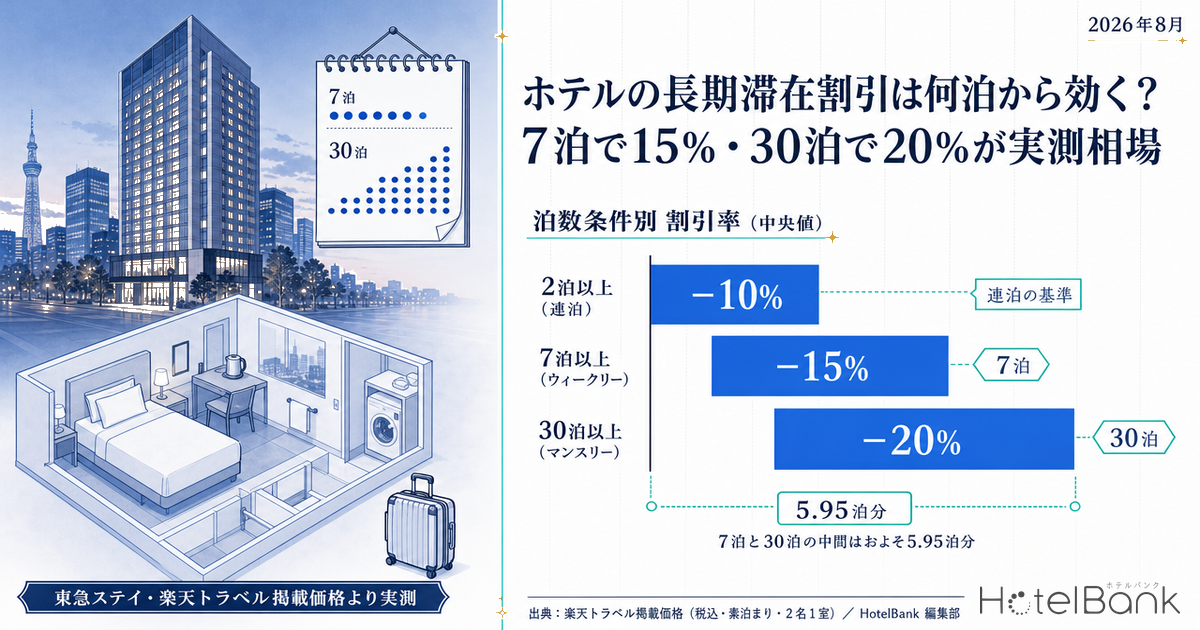
Long-stay discounts at Japanese hotels deepen in steps at three thresholds — 2 nights, 7 nights, and 30 nights — across most chains. Comparing OTA listed prices (tax included, as of August 2026) at stay-focused hotel chains for the same hotel, same check-in date, and same room type, consecutive-night plans of 2 nights or more are roughly 10% cheaper, weekly-type plans of 7 nights or more around 15% cheaper, and 30-night-plus plans around 20% cheaper. At 7 nights, the gap is equivalent to getting nearly one night free. This article lays out the measured discount rates by length of stay, the booking channels where discounts actually apply, and the break-even point for how many nights make a longer stay worthwhile.
- — About 10% at 2 nights, about 15% at 7 nights, and about 20% at 30 nights are the median discount rates by length of stay, measured from OTA listed prices. Discounts are not continuous — they deepen in steps at each night-count threshold.
- — If you are planning 6 nights, extending to 7 costs less in total. Under a −15% weekly-type plan, paying for 7 nights equals 5.95 nights at the standard rate, so it undercuts paying the standard rate for 6 nights.
- — Discount depth varies widely with each chain’s pricing philosophy. Stay-focused chains go down to −15% at 7 nights and −20% at 30 nights, while major business hotel chains built around a flat rate including breakfast keep consecutive-night discounts at only 1–4%.
- — There are two entry points: official mid-to-long-stay plans and OTA plans with minimum-night conditions. Official plans charge the same rate every day of the stay, making the total easy to read; OTAs let you stack point rewards on top of the discount.
- — The discount is paid for by lower operating costs. Prepayment in a single lump sum, no shortening of the stay once booked, and reduced housekeeping frequency are common conditions, so check the terms section of the plan details before booking.
How Many Nights It Takes and How Much You Save — Measured Figures by Length of Stay
We took Tokyu Stay (東急ステイ), a chain with an explicit long-stay pricing structure, and compared the per-night listed price of its “standard plan” against its “plans with minimum-night conditions” at the same property, same room type, and same stay date, using each property listed on OTAs. All figures are displayed prices for room-only stays with two guests per room (per person, tax included), taken from OTA listed prices as of August 13, 2026, for stay dates from August 14 to December 31, 2026.
| Minimum-night condition | Discount rate (median) | Spread across properties | Coverage |
|---|---|---|---|
| 2 nights or more (consecutive-night plan) | −10% | −8 to −10% | 18 properties, N=9,223 (room × stay date) |
| 7 nights or more (weekly type) | −15% | −10 to −20% | 21 properties, N=5,603 |
| 30 nights or more (monthly type) | −20% | −18 to −25% | 13 properties, N=2,702 |
Source: HotelBank Editorial Team analysis based on publicly available OTA data (tax included, room-only, per person for two guests per room). Retrieved August 13, 2026; stay dates August 14 to December 31, 2026. Only observations where the standard plan and the conditional plan could be compared for the same room type and same date were aggregated. On high-demand dates, minimum-night plans are withdrawn from sale and no discount applies.
Source: HotelBank Editorial Team analysis based on publicly available OTA data (Tokyu Stay properties, room-only, per person for two guests per room, tax included). Retrieved August 13, 2026; stay dates August 14 to December 31, 2026. Bar lengths are shown relative to a 25% maximum.
Discount depth, however, differs sharply depending on how each chain designs its rates. Using the same method, Comfort Hotel’s (コンフォートホテル) “2-night eco stay” discount comes to a median of −6.7% against its standard variable-rate plan (11 properties, N=3,205, same period), with the discount kicking in from the second night. By contrast, at major business hotel chains where breakfast is included as standard (50 properties, same period), consecutive-night plan discounts stay at only about 1–4%, reflecting a flat-rate model that bundles breakfast and large communal baths every day. In other words, the reliable way to check “how big the long-stay discount is” is not the plan name but the minimum-night condition written into the plan and the difference in per-night rate against the standard plan. For how much the baseline per-night rate itself varies by region, see our national comparison in Business Hotel Price Surge: National ADR Analysis & 10 Cost-Effective Prefectures.
Per-Night Rates by Length of Stay at One Hotel on One Date — A Worked Example
At Tokyu Stay Shimbashi (東急ステイ新橋), lining up the per-night listed prices for the same room type on the same date — a Cozy Double, 15 sqm, non-smoking, checking in on Monday, November 9, 2026 — produces the following (room-only, per person for two guests per room, tax included; OTA listed prices as of August 13, 2026).
| Plan category | Per night (per person) | Discount rate |
|---|---|---|
| Standard (no minimum-night condition) | ¥14,500 | — |
| 2 nights or more | ¥13,050 | −10% |
| 7 nights or more (weekly) | ¥11,600 | −20% |
| 30 nights or more (monthly type) | ¥10,875 | −25% |
Source: HotelBank Editorial Team analysis based on publicly available OTA data (Tokyu Stay Shimbashi, Cozy Double 15 sqm non-smoking, check-in November 9, 2026, room-only, per person for two guests per room, tax included). Retrieved August 13, 2026.
Calculated over an actual 7-night stay (nights of November 9–15, 2026), the standard plan totals ¥115,500 against ¥96,300 for the weekly type. That is a difference of ¥19,200 per person, or ¥38,400 for two in the same room on the same dates. (The 7-night figures are the sum of each night’s listed price, so the per-night rate varies by date, and on some high-demand dates within the period the conditional plan is priced the same as the standard plan.) Even within one chain, the depth of the steps differs by property: this one was set at −20% for 7 nights and −25% for 30 nights, deeper than the chain median.
Terminology
Weekly plan: A long-stay plan generally conditional on 7 nights or more. Designed for week-long stays, with a per-night rate set below the standard plan.
Monthly plan (monthly type): A long-stay plan conditional on roughly 30 nights or more. In this article the term refers to “listed plans carrying a minimum-night condition of 30 nights or more.” Names and night-count brackets vary by operator.
Apartment hotel: Lodging with in-room living facilities such as a kitchen and washer-dryer, priced on the assumption of week- or month-long stays.
Where the Discount Applies — Official Long-Stay Plans versus OTA Consecutive-Night Plans
There are two main entry points to a long-stay discount.
1. Mid-to-long-stay plans on the official website
In Tokyu Stay’s case, the official mid-to-long-stay weekly plan can be searched and booked for 7 to 29 nights, with bookings accepted up to 31 nights. Stays of 32 nights or more are handled as “Tokyu Stay Residence” (東急ステイレジデンス) on an inquiry basis with an individual quote (Source: Tokyu Stay official — About mid-to-long-stay plans, in Japanese). The official flat-rate long-stay plan charges the same rate on every day of the stay and includes utilities and Wi-Fi, which makes the total easy to read (Source: Tokyu Stay official — Flat-rate long-stay plans, in Japanese). Unlike OTAs, where prices move day by day, a flat rate keeps the total more stable for stays that straddle a peak season.
2. OTA plans with minimum-night conditions
On OTAs, the minimum-night condition is spelled out in the plan name — “2 consecutive nights,” “7 nights or more,” “30 nights or more” — and, as shown above, the per-night rate steps down accordingly. The strength of booking through an OTA is that point rewards can be stacked on top of the discount. That said, long-stay plans often carry conditions such as “prepayment in a single lump sum only,” “the stay cannot be shortened once booked,” and “housekeeping on request rather than daily (roughly once a week).” The discount is the return on those operating-cost savings, so check the terms section of the plan details before booking.
How Many Nights Make It Worthwhile — The Break-Even Logic
Applying the measured discount rates, the break-even points work out as follows.
- 2 nights: At chains offering a −7 to −10% consecutive-night plan, the discount already kicks in from the second night. This is the first threshold that matters.
- Planning 6 nights? Consider 7: Under a −15% weekly-type plan, paying for 7 nights works out to about 5.95 nights at the standard rate. In other words, adding one night and switching to the 7-night plan makes the total cheaper than paying the standard rate for 6 nights — a reversal.
- Beyond 24 nights, take the 30-night plan: At −20%, paying for 30 nights equals 24 nights at the standard rate. For a stay of around 25 nights, the 30-night plan can come out cheaper.
| Actual nights stayed | Paying the standard rate | Using a minimum-night plan | Verdict |
|---|---|---|---|
| 6 nights | 6.00 nights’ worth | 7-night plan (−15%) = 5.95 nights’ worth | The 7-night plan is cheaper (adding a night pays off) |
| 7 nights | 7.00 nights’ worth | 7-night plan (−15%) = 5.95 nights’ worth | −15% |
| 14 nights | 14.00 nights’ worth | 7-night plan (−15%) = 11.90 nights’ worth | −15% |
| 24 nights | 24.00 nights’ worth | 30-night plan (−20%) = 24.00 nights’ worth | Roughly even (this is the tipping point) |
| 25 nights | 25.00 nights’ worth | 30-night plan (−20%) = 24.00 nights’ worth | The 30-night plan is cheaper |
“Standard-rate night equivalents” indicates how many nights at the unconditioned standard rate the total payment corresponds to. These are reference figures calculated mechanically using the median discount rates above (−15% at 7 nights, −20% at 30 nights); actual totals move up or down with daily price fluctuations. Note: at properties where a 2-night consecutive-stay plan can also be used, the cost of the standard-rate option falls further.
Because the structure is “the more nights you stay, the lower the per-night rate,” the case for extending is strongest for travelers whose stay falls just short of a threshold (7 or 30 nights). Whether you can extend also depends on availability, which tightens or loosens by season and region.
When the Discount Is Thin — Long-Stay-Focused Lodging as an Alternative
Plenty of hotels set almost no length-of-stay discount at all. Rather than trying to negotiate one, the stronger option in that case is a category priced for long stays from the outset. Apartment hotels and stay-focused hotels with a kitchen and washer-dryer tend to lower the all-in cost of a week- or month-long stay once dining out and laundry are counted. For stays on the order of 30 nights, “living facilities that compress your whole cost of living” often matters more than the headline discount rate.
Frequently Asked Questions
Q. From how many nights does a hotel long-stay discount apply?
A. At most chains it starts from 2 nights. Measured against OTA listed prices, the medians were about 10% for consecutive-night plans of 2 nights or more, around 15% for weekly-type plans of 7 nights or more, and around 20% for 30 nights or more. The discount does not decline continuously in proportion to nights stayed — it deepens in steps at the 2-, 7-, and 30-night thresholds.
Q. Concretely, how much do I save by staying 7 nights?
A. At −15%, paying for 7 nights is equivalent to 5.95 nights at the standard rate — very nearly one free night. In the Tokyu Stay Shimbashi example (check-in November 9, 2026, same room type), the 7-night total was ¥115,500 on the standard plan versus ¥96,300 on the weekly type: a difference of ¥19,200 per person, or ¥38,400 for two.
Q. I am planning 6 nights — would extending to 7 be cheaper?
A. It can be. Under a −15% weekly-type plan, paying for 7 nights amounts to 5.95 nights at the standard rate, so adding one night and switching to the 7-night plan brings the total below paying the standard rate for 6 nights. Likewise, for stays longer than 24 nights the 30-night plan (−20%, equal to 24 nights at the standard rate) can come out cheaper.
Q. Is it better to book on the official website or through an OTA?
A. It depends on your priority. An official flat-rate long-stay plan charges the same rate every day and includes utilities and Wi-Fi, so the total is easy to read — an advantage for stays that straddle a peak season. OTA plans with minimum-night conditions have the edge in letting you stack point rewards on top of the discount.
Q. What conditions come attached to long-stay plans?
A. Common conditions include prepayment in a single lump sum only, no shortening of the stay once booked, and housekeeping on request rather than daily. The discount is the return on those operating-cost savings, so check the terms section of the plan details before booking.
Q. What should I do if a hotel has almost no length-of-stay discount?
A. At major business hotel chains built around a flat rate including breakfast, consecutive-night discounts can stay at only about 1–4%. In that case, consider an apartment hotel or stay-focused hotel with a kitchen and washer-dryer, which tends to lower the all-in cost once dining out and laundry are counted.
Methodology and Sources
■ Data source
OTA listed prices (tax included, room-only, displayed per person for two guests per room). Retrieved August 13, 2026; stay dates August 14 to December 31, 2026. In addition to Tokyu Stay properties, 11 Comfort Hotel properties (N=3,205) and 50 properties of a major business hotel chain that includes breakfast as standard were compared over the same period.
■ Aggregation method
For the same property, same room type, and same stay date, the per-night listed price of the “standard plan with no minimum-night condition” was matched against that of the “plan with a minimum-night condition,” and the difference was taken as the discount rate. Only observations where both were captured simultaneously were included; a median was computed per property, and the median across the chain was used as the representative value. N is the number of observations (room × stay date). Property-level average rates and plan-level rates are of different granularity and have not been mixed.
■ Assumptions behind the calculation
The break-even figures in Table 3 were computed mechanically on the assumption that the measured chain-median discount rates (−15% for 7 nights or more, −20% for 30 nights or more) apply uniformly across the entire stay. “Standard-rate night equivalents” = actual nights × (1 − discount rate), benchmarked against the standard plan with no minimum-night condition. Daily price movements, withdrawal from sale during peak periods, and property-by-property differences in discount rate are not taken into account, so actual totals will diverge.
■ Limitations and caveats
(1) These are listed prices, not actual transacted prices. (2) On high-demand dates, minimum-night plans are withdrawn from sale and no discount applies. (3) Even within the same chain, discount depth varies by property; the medians in the text smooth out those differences. (4) Total-cost estimates by length of stay are the sum of each night’s listed price, so the per-night rate moves with daily fluctuations. (5) Night-count brackets and plan names vary by operator and are subject to revision.
■ Primary sources
- Tokyu Stay official — About mid-to-long-stay plans (night-count brackets for the weekly plan and bookable length of stay; in Japanese)
- Tokyu Stay official — Flat-rate long-stay plans (same rate throughout the stay, utilities and Wi-Fi included; in Japanese)
- Comfort Hotel official — SDGs initiatives, “eco housekeeping for consecutive nights” (bed sheets and pillowcases are not changed on consecutive nights — the operating-cost saving that funds the consecutive-night discount; in Japanese)
Further Reading