

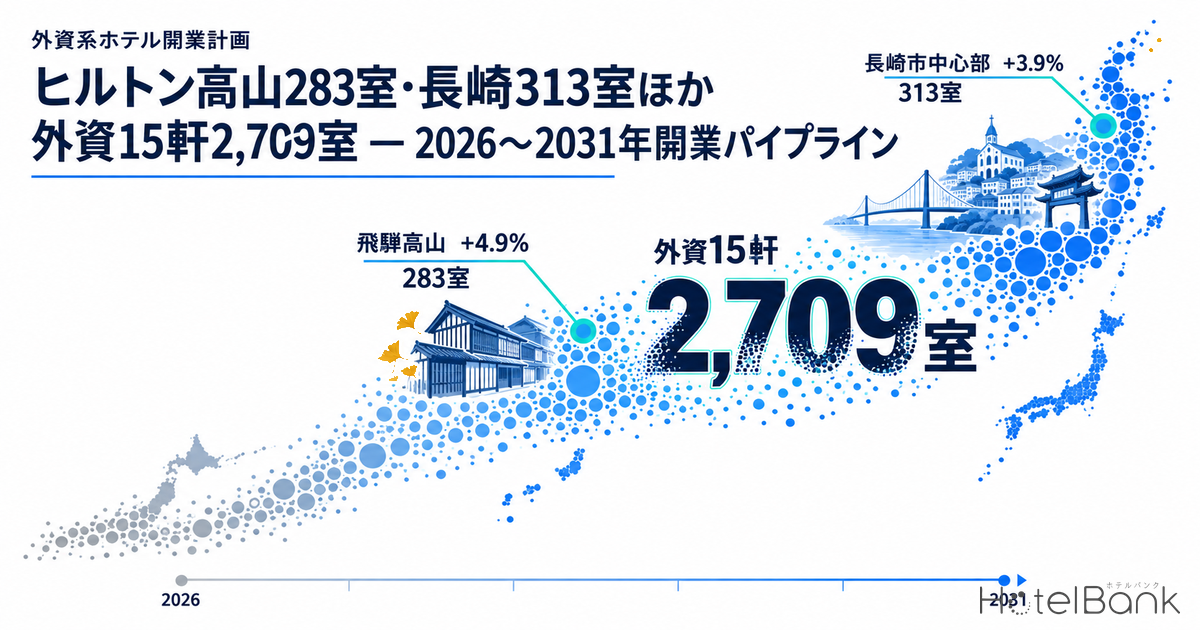
The idea that foreign hotel chains are “pushing into” Japan has been repeated in trade papers and on social media alike. Most of that talk, however, stops at qualitative impressions and rarely lands on the numbers that matter: how many properties, how many rooms, and exactly where they touch down. This article catalogues the opening plans each group has disclosed as of September 2026 along three axes — property count, room count and location — and matches each landing point against the existing room stock around it. To state the conclusion first, foreign-brand projects scheduled to open from September 2026 onward for which room counts have been disclosed total 15 hotels and 2,709 rooms, which amounts to no more than 0.1-1.2% of existing stock at the prefectural level. Narrow the frame to the trade area (a 2-10km radius), however, and the figure reaches +4.9% in Hida Takayama and +3.9% in central Nagasaki — a scale that cannot be dismissed. Isolate the high-rate tier alone and there are several markets where a single opening doubles or triples the number of rooms in that price band.
- — 15 hotels, 2,709 rooms — foreign-brand projects scheduled to open from September 2026 onward with disclosed room counts. A further 10 projects have yet to disclose either room count or opening year.
- — +0.10% to +1.17% at the prefectural level. The worry that “foreign chains are moving in and supply will flood the market” does not hold at this level of granularity.
- — The picture changes at trade-area level — Hida Takayama +4.90%, central Nagasaki +3.89%, Miyajimaguchi +3.81%. The impact lands outside the big-city cores, in regional and resort markets.
- — In the high-rate tier the multiples jump — in Hida Takayama the ¥45,000-and-above band, currently 4 properties and 109 rooms, grows 3.6x; in Takamatsu, 114 rooms enter a ¥30,000-and-above band that holds only 41 rooms today.
- — What is actually opening is a different layer — 19 properties and 3,292 rooms of 100-plus-room supply, mostly mid-sized regional and suburban hotels, overlap the foreign pipeline in only one case. Foreign brands are taking the top of the price range while domestic chains take volume and coverage — a two-tier structure.
Metric Definitions Used in This Article
- ADR (Average Daily Rate): An estimated settled rate (tax-exclusive equivalent) calculated by applying a segment-specific adjustment factor to the lowest published plan level each property lists on OTAs and elsewhere (double occupancy, per-room rate, tax-inclusive). Cross-checked against property-level results disclosed by listed hotel REITs (91 properties, most recent three months), the median error is roughly 7%. These are estimates and differ from each property’s actual transacted rates and accounting figures. Area-level ADR is the median of the properties in scope (the level of a typical property in that area).
- Existing stock in the trade area: The total registered room count of properties tracked by MetroEngines Research that fall within the stated radius of a given coordinate. Because it includes properties not listed on OTAs and properties temporarily closed, it does not match the number of rooms actually on sale.
- Pipeline: Among the opening plans each group has disclosed, only projects for which both the opening year and the room count can be confirmed from primary sources or trade press are counted. Projects with undisclosed room counts are labelled as such and are not added to the room totals.
- Data sources: MetroEngines Research, and materials published by each group
Hilton operates 33 hotels across 9 brands and has 13 more planned
Start with the disclosed pipeline, group by group. The most specific numbers come from Hilton, which as of its February 2026 announcement operates 33 hotels across 9 brands in Japan and has disclosed plans for 13 new openings on top of that. Breaking the plan down, what stands out is that conversions of existing hotels (rebrands) account for a substantial share, not just ground-up new builds.
Three of the 13 have already opened during 2026: Canopy by Hilton Okinawa Miyakojima Resort (306 rooms, April 1), Hilton Garden Inn Yokohama Minatomirai (228 rooms, April 7) and Conrad Nagoya (170 rooms, July 31). The Green Leaf Niseko Village, Tapestry Collection by Hilton opened the previous December, but its room count could not be confirmed in published materials, so it is excluded from the room totals in this article.
The most recent addition as of writing is Hilton Takayama Resort, opening Monday, September 14, 2026. It rebrands Hotel Associa Takayama Resort, operated to date by JR Tokai Hotels, as a Hilton flagship, and will be the first Hilton in Gifu Prefecture. The property has 283 rooms in total, but only about 90 will be in service at opening; room count will rise as the renovation progresses, with all rooms due to be ready by spring 2027. We have separately analysed how this project sits within Hida’s high-rate tier.
From 2027 onward come Hilton Garden Inn Nagasaki Chinatown (313 rooms, first half of 2027), Conrad Yokohama (272 rooms, May 2027), Waldorf Astoria Tokyo Nihonbashi (197 rooms, autumn 2027), Canopy by Hilton Tokyo Akasaka (174 rooms, 2028), Kyoto Brighton Hotel, Curio Collection by Hilton (provisional name / approx. 160 rooms, winter 2028) and Umiuta Hiroshima, LXR Hotels & Resorts (61 rooms, 2028, Hatsukaichi, Hiroshima). Casara Niseko Village, LXR Hotels & Resorts and Hilton Sapporo Park Hotel (provisional name) are also in the plan, but neither the opening date nor the room count has been firmly disclosed at this point, so they are excluded from the totals.
The 10 properties with disclosed room counts add up to 2,164 rooms. By brand, the line-up spans three luxury brands — Waldorf Astoria, Conrad and LXR — the lifestyle/collection brands Canopy, Curio and Tapestry, and the upper-midscale Hilton Garden Inn: a structure designed to hold several price bands at once rather than a single one.
Hyatt operates 22 hotels and 5,066 rooms; of 10 planned openings, only 3 have confirmed room counts
For Hyatt, the press materials of Hyatt Japan (April 2026) serve as the organised primary source. According to them, the company operates 22 hotels and 5,066 rooms across 9 brands in Japan. By region, the Kanto area accounts for a majority at 11 hotels and 2,903 rooms, followed by Kansai with 4 hotels and 663 rooms, Okinawa with 2 hotels and 637 rooms, and Hokuriku with 2 hotels and 345 rooms.
Ten new openings have been announced, but only three of them have both an opening year and a room count confirmed: Hyatt Centric Sapporo (216 rooms, 2026), Park Hyatt Sapporo (157 rooms, 2029) and Hyatt Centric Namba Osaka (267 rooms, 2031), totalling 640 rooms. Of the remaining seven, Andaz Nagoya and Hotel Nei Nara (The Unbound Collection by Hyatt) have neither an opening date nor a room count fixed, while five properties under the new Atona brand — Yoichi, Hakone, Yufu, Yakushima and Kuju — are slated for 2028 or later with room counts undetermined.
What deserves attention here is that while the pipeline counts 10 properties, room counts are fixed for only three of them. Atona in particular is a new brand launching from 2028 onward, and its scale cannot yet be read. Counting properties alone cannot measure supply impact — that is the basic difficulty of pipeline analysis.
Accor, Mandarin Oriental and Marriott each enter as a pair: one urban property plus one non-urban
Accor will open Pullman Tokyo Ginza (145 rooms) at the end of 2027, the second Pullman in Japan after Pullman Tokyo Tamachi. The company has disclosed one more project: a full renovation of Madarao Kogen Hotel in Nagano Prefecture, reopening as an MGallery Collection property (80 rooms) at the end of 2027. It will be MGallery’s first property in a Japanese snow-mountain area. Opening a prime central Tokyo location like Ginza and a ski resort like Madarao in the same year is a compact illustration of how foreign groups are advancing on two fronts at once — urban and resort.
Mandarin Oriental Hotel Group has announced a three-property concept for the Setouchi area, its second Japanese location after Tokyo. Leading the way are Mandarin Oriental Setouchi — Takamatsu (92 rooms) and Naoshima (22 rooms), both scheduled for summer 2027. The Naoshima property will combine ryokan-style suites and villas with three detached buildings in the town centre. A third property, targeting 50 rooms on another Setouchi island for 2030, remains at the concept stage.
From Marriott, Courtyard by Marriott Kyoto Station (270 rooms) opens on Monday, November 16, 2026. It also appears in the data on “what is actually opening” discussed below, making it the one project where the pipeline and actual openings connect.
The foreign-brand pipeline from September 2026 — 15 hotels, 2,709 rooms
The table below narrows all of the above to projects scheduled to open from September 2026 onward for which room counts could be confirmed. The total comes to 15 hotels and 2,709 rooms.
| Hotel | Operating group | Location | Scheduled opening | Rooms |
|---|---|---|---|---|
| Hilton Takayama Resort | Hilton | Takayama, Gifu | September 14, 2026 | 283 |
| Hyatt Centric Sapporo | Hyatt | Sapporo, Hokkaido | 2026 | 216 |
| Courtyard by Marriott Kyoto Station | Marriott | Kyoto City, Kyoto | November 16, 2026 | 270 |
| Hilton Garden Inn Nagasaki Chinatown | Hilton | Nagasaki City, Nagasaki | First half of 2027 | 313 |
| Conrad Yokohama | Hilton | Yokohama, Kanagawa | May 2027 | 272 |
| Mandarin Oriental Setouchi — Takamatsu | Mandarin Oriental | Takamatsu, Kagawa | Summer 2027 | 92 |
| Mandarin Oriental Setouchi — Naoshima | Mandarin Oriental | Naoshima, Kagawa | Summer 2027 | 22 |
| Waldorf Astoria Tokyo Nihonbashi | Hilton | Chuo, Tokyo | Autumn 2027 | 197 |
| Pullman Tokyo Ginza | Accor | Chuo, Tokyo | End of 2027 | 145 |
| Madarao Kogen Hotel, MGallery Collection | Accor | Nagano (Madarao Kogen) | End of 2027 | 80 |
| Canopy by Hilton Tokyo Akasaka | Hilton | Minato, Tokyo | 2028 | 174 |
| Kyoto Brighton Hotel, Curio Collection by Hilton (provisional name) | Hilton | Kyoto City, Kyoto | Winter 2028 | approx. 160 |
| Umiuta Hiroshima, LXR Hotels & Resorts | Hilton | Hatsukaichi, Hiroshima | 2028 | 61 |
| Park Hyatt Sapporo | Hyatt | Sapporo, Hokkaido | 2029 | 157 |
| Hyatt Centric Namba Osaka | Hyatt | Osaka City, Osaka | 2031 | 267 |
| Total (disclosed room counts) | 2,709 rooms | |||
Source: compiled by the HotelBank Editorial Team from materials published by each group and trade press reports. All Hyatt figures are based on Hyatt Japan, “Press Materials, April 2026.”
A good number of projects are not in this list. From Hilton, Casara Niseko Village, LXR Hotels & Resorts and Hilton Sapporo Park Hotel (provisional name); from Hyatt, Andaz Nagoya, Hotel Nei Nara, and the five Atona properties (Yoichi, Hakone, Yufu, Yakushima and Kuju, all slated for 2028 or later) have left either the room count or the opening year undisclosed. Mandarin Oriental’s third Setouchi property (50 rooms, targeting 2030) is also at the concept stage. If these 10 projects firm up, the pipeline’s total room count will build further above the 2,709 rooms shown here, which is the reasonable reading.
Split confirmed from unconfirmed and the pipeline spans 1,890 to roughly 4,325 rooms
Describing the pipeline with a single number mixes projects of very different certainty. Splitting it into three cases by opening timing and by how undisclosed projects are treated gives the following range.
| Case | Assumption | Properties | Rooms |
|---|---|---|---|
| Low (opening by end-2027) | Only projects with both date and room count disclosed and scheduled to open in 2026-2027 | 10 hotels | 1,890 rooms |
| Mid (all disclosed room counts) | The above plus 5 properties and 819 rooms scheduled for 2028 or later — every project with a disclosed room count | 15 hotels | 2,709 rooms |
| High (undisclosed projects imputed) | The above plus the 10 undisclosed projects. The third Setouchi property is taken at its concept figure of 50 rooms; the remaining 9 are placeholders at 174 rooms, the median room count of the 15 disclosed properties | 25 hotels | approx. 4,325 rooms |
Source: compiled by the HotelBank Editorial Team from materials published by each group. In the high case, the 1,566 rooms covering 9 undisclosed projects are our own placeholder estimate at the median and are not figures published by the groups concerned.
The low end of 1,890 rooms and the high end of roughly 4,325 rooms differ by a factor of 2.3. What matters is not the total itself but by when, and with what certainty, the rooms arrive. The 5 properties and 819 rooms slated for 2028 or later all have sites or buildings already identified, yet their opening years span a wide range, and the 9 projects in the high case have not even produced room counts.
At the prefectural level it is 0.1-1.2% — a rounding error in aggregate
Next, these 2,709 rooms are aggregated by landing point and compared with existing room stock. At the prefectural level, the highest uplift is Nagasaki at +1.17%, followed by Gifu at +0.95% and Kagawa at +0.65%. Tokyo, by contrast, comes in at +0.20%, Osaka at +0.18%, and Nagano at just +0.10%.
Source: compiled from MetroEngines Research and the HotelBank Editorial Team
| Prefecture | Existing properties | Existing rooms | New (disclosed) | vs existing |
|---|---|---|---|---|
| Nagasaki | 1,109 | 26,822 | 313 | +1.17% |
| Gifu | 1,442 | 29,862 | 283 | +0.95% |
| Kagawa | 774 | 17,415 | 114 | +0.65% |
| Kyoto | 4,182 | 77,275 | 430 | +0.56% |
| Kanagawa | 1,915 | 68,544 | 272 | +0.40% |
| Hokkaido | 4,200 | 129,515 | 373 | +0.29% |
| Tokyo | 4,059 | 260,040 | 516 | +0.20% |
| Osaka | 2,001 | 150,287 | 267 | +0.18% |
| Hiroshima | 1,113 | 37,970 | 61 | +0.16% |
| Nagano | 5,169 | 80,048 | 80 | +0.10% |
Source: compiled from MetroEngines Research and the HotelBank Editorial Team (existing stock is the total registered room count of tracked properties, including properties not listed on OTAs and properties temporarily closed)
In other words, at prefectural granularity the disclosed pipeline of the foreign mega-chains adds only around 1% to existing stock. The worry that “foreign chains are moving in and supply will flood the market” does not hold at this level. That, however, simply means the analysis is too coarse. Hotels compete within trade areas, not within prefectural boundaries.
At trade-area level it is +4.9% in Hida Takayama and +3.9% in central Nagasaki — the picture changes with granularity
So the next step sets a trade area with a radius of 2-10km around each project’s location and compares it with the existing room stock inside that range. Dense urban areas use a 2-3km radius; resort and regional locations use 5-10km.
Source: compiled from MetroEngines Research and the HotelBank Editorial Team
| Trade area | Existing properties | Existing rooms | Project entering | Uplift rate |
|---|---|---|---|---|
| Hida Takayama (10km radius) | 312 | 5,772 | Hilton Takayama Resort, 283 rooms | +4.90% |
| Central Nagasaki (3km radius) | 160 | 8,048 | Hilton Garden Inn Nagasaki Chinatown, 313 rooms | +3.89% |
| Miyajimaguchi / Hatsukaichi (5km radius) | 69 | 1,603 | Umiuta Hiroshima, LXR, 61 rooms | +3.81% |
| Madarao Kogen (10km radius) | 315 | 4,828 | MGallery Collection, 80 rooms | +1.66% |
| Central Takamatsu (5km radius) | 191 | 7,906 | Mandarin Oriental Setouchi, 114 rooms (Takamatsu + Naoshima) | +1.44% |
| Yokohama Minatomirai (3km radius) | 243 | 24,260 | Conrad Yokohama, 272 rooms | +1.12% |
| Central Sapporo (3km radius) | 387 | 40,771 | Hyatt Centric + Park Hyatt, 373 rooms | +0.91% |
| Kyoto Kamigyo / Gosho-nishi (3km radius) | 1,194 | 23,603 | Curio Collection, approx. 160 rooms | +0.68% |
| Tokyo Akasaka (2km radius) | 227 | 28,447 | Canopy by Hilton Tokyo Akasaka, 174 rooms | +0.61% |
| Tokyo Nihonbashi (2km radius) | 393 | 43,762 | Waldorf Astoria Tokyo Nihonbashi, 197 rooms | +0.45% |
| Tokyo Ginza (2km radius) | 286 | 37,675 | Pullman Tokyo Ginza, 145 rooms | +0.38% |
Source: compiled from MetroEngines Research and the HotelBank Editorial Team
Figures that stayed within a 0.1-1.2% band at the prefectural level widen to 0.4-4.9% once dropped into trade areas. In particular, the three trade areas of Hida Takayama (+4.90%), central Nagasaki (+3.89%) and Miyajimaguchi (+3.81%) each see a single opening raise the trade area’s total room count by roughly 4%. Ginza, Nihonbashi and Akasaka in Tokyo, by contrast, all come in below 1%: in the city centre the existing denominator is too large for one property to move. Foreign expansion in Japan is often described as “concentrated in Tokyo,” but in terms of supply impact the regional and resort side is larger by an order of magnitude.
The four markets with the highest uplift are close to selling out in peak season
Stopping the discussion at supply would show only one side. Do the trade areas with high uplift rates have room for supply because demand there is soft? Judging by the most recent peak season, no. Estimated inventory sell-through in August 2026 across the top four markets ran 87.6-92.6% — each of them sold roughly 90% of listed inventory.
| Market (city level) | Estimated inventory sell-through, August 2026 | Properties covered | Trade-area uplift rate |
|---|---|---|---|
| Takayama City | 92.6% | 194 properties | +4.90% (Hida Takayama, 10km radius) |
| Takamatsu City | 90.6% | 112 properties | +1.44% (central Takamatsu, 5km radius) |
| Nagasaki City | 88.2% | 90 properties | +3.89% (central Nagasaki, 3km radius) |
| Hatsukaichi City | 87.6% | 55 properties | +3.81% (Miyajimaguchi / Hatsukaichi, 5km radius) |
Source: compiled from MetroEngines Research and the HotelBank Editorial Team. Estimated inventory sell-through is an estimate of the share of room inventory listed on OTAs that has stopped being offered for sale (August 2026, average of daily observations across 31 days, observation coverage 91.5-97.9%). It is aggregated at city level and therefore does not match the radius-based trade areas used to calculate uplift rates. It also differs from a property’s actual occupancy rate.
In these four markets, then, roughly 4% of trade-area room count is being added to markets where existing stock is close to full in peak season. This is not a picture of supply simply running to surplus and ADR collapsing; the question is how much of the demand currently being turned away in peak season can be captured. Conversely, in markets where off-season demand is thin the same 4% could weigh heavily, and judging by uplift rate alone would lead to a misreading.
Plotting the landing points on a map makes the skew easier still to see. Circle size represents the number of rooms entering.
Source: compiled by the HotelBank Editorial Team from materials published by each group
The second layer actually opening now — 19 properties and 3,292 rooms of mid-sized regional and suburban supply
Everything up to this point concerns disclosed plans. So what is actually opening its doors? Extracting properties of 100 rooms or more opening (including scheduled openings) on or after September 9, 2026, within the scope MetroEngines Research tracks, gives 19 properties and 3,292 rooms. The median is 159 rooms per property and the mean is 173.
What is interesting is how little this group of 19 overlaps the foreign pipeline. The only overlap is Courtyard by Marriott Kyoto Station (270 rooms); the other 18 are projects by domestic chains. Locations are dispersed too — 2 each in Aomori, Aichi, Nagano, Kumamoto and Kanagawa — and few stand in the centres of the three major metropolitan areas.
| Opening date | Property | Location | Type | Rooms |
|---|---|---|---|---|
| 2026-09-11 | Toyoko Inn Tsukuba Station | Ibaraki | Limited-service | 217 |
| 2026-09-13 | Hotel Route Inn Kobe Sanda Shin-Sanda Ekimae | Hyogo | Business hotel | 231 |
| 2026-09-15 | Hotel Route Inn Aichi Togo | Aichi | Business hotel | 196 |
| 2026-09-30 | Sotetsu Fresa Inn Kitakami Ekimae | Iwate | Business hotel | 167 |
| 2026-09-30 | AB Hotel Chino | Nagano | Business hotel | 121 |
| 2026-10-01 | Tabino Hotel Aomori Rokkasho-mura | Aomori | Business hotel | 210 |
| 2026-10-01 | Hotel Amanek Kumamoto | Kumamoto | Business hotel | 176 |
| 2026-10-01 | Richmond Hotel Hachinohe Square | Aomori | Business hotel | 126 |
| 2026-10-15 | HOTEL AZ Okayama Bizen | Okayama | Business hotel | 157 |
| 2026-10-16 | Smile Hotel Hachioji Minamiguchi Ekimae | Tokyo | Business hotel | 114 |
| 2026-10-30 | Toyoko Inn Ofuna Station West Exit | Kanagawa | Limited-service | 122 |
| 2026-10-31 | Smile Hotel Premium Tottori | Tottori | Business hotel | 119 |
| 2026-11-01 | Kamenoyu by HATAGO INN | Kumamoto | Resort hotel | 134 |
| 2026-11-15 | Tabino Hotel lit Toyokawa | Aichi | City hotel | 112 |
| 2026-11-16 | Courtyard by Marriott Kyoto Station | Kyoto | City hotel | 270 |
| 2026-12-01 | THE ALPS HOTEL HAKUBA | Nagano | Resort hotel | 159 |
| 2026-12-15 | HOTEL THE MITSUI HAKONE | Kanagawa | Resort hotel | 126 |
| 2026-12-17 | Solaria Nishitetsu Hotel Osaka Hommachi | Osaka | Business hotel | 202 |
| 2026-12-31 | The Grand Castle Naha Shurijo by Hewitt Resort | Okinawa | Resort hotel | 333 |
| Total, 19 properties | 3,292 rooms | |||
Source: MetroEngines Research & Consulting (based on confirmed OTA listings, N=19 properties)
One point about the nature of the data needs to be stated here. This opening data is based on confirmed OTA listings, and because listings appear from several months before opening, counts for the most recent months onward may rise as further listings are added. In fact, among properties that opened in 2024-2025, only 19% had a confirmed OTA listing before opening, while 31% were not confirmed until 91 days or more after opening. Accordingly, the 19 properties above are a lower bound of what is currently observable, not a complete count. Likewise, the foreign pipeline is based on what each group has disclosed and excludes undisclosed projects.
Even so, the character of this second layer is clear. It runs to 100-330 rooms per property, centred on mid-sized limited-service and business hotels in front of stations or along arterial roads, in locations where demand skews to business travel — Rokkasho-mura in Aomori, Kitakami in Iwate, Tottori, Bizen in Okayama, Togo in Aichi. Domestic chains are steadily covering markets whose occupancy they can forecast, and that is a different competitive axis from the high-rate tier foreign brands are targeting. Japan’s hotel supply is advancing as a two-tier structure in which foreign brands take the top of the price range and domestic chains take volume and coverage, is how it reads.
Isolate the high-rate tier and some trade areas see one opening double or triple the band’s room count
Comparing against a trade area’s total room count is not enough to measure supply impact, because what a new brand targets is not the trade area’s average price band but its upper end. So estimated settled ADR from MetroEngines Research (average for June-August 2026) was calculated for existing properties in each trade area, and room counts were stacked by price band.
In Hida Takayama (10km radius), the median across the 55 properties for which ADR could be calculated is ¥13,500. Of these, 8 properties and 230 rooms sit at ¥30,000 and above; narrow to ¥45,000 and above and there are only 4 properties and 109 rooms. The upper end consists of small high-end ryokan — Honjin Hiranoya Kachoan (26 rooms, ¥50,800), Machiyado Ichiryu (24 rooms, ¥48,700) and Hidatei Hanaogi (48 rooms, ¥47,100) — each with fewer than 50 rooms. Into this comes Hilton Takayama Resort with 283. On a simple calculation, the room count in the ¥45,000-and-above band becomes 3.6 times what it is today.
Miyajimaguchi / Hatsukaichi (5km radius) has a similar structure. The median across the 27 properties for which ADR could be calculated is a relatively high ¥26,100, but only 4 properties and 81 rooms sit at ¥45,000 and above. Add the 61-room LXR and that band grows roughly 1.75 times.
Central Takamatsu (5km radius) is more extreme still. The median across 58 properties is a low ¥8,100, with 3 properties and 101 rooms at ¥20,000 and above, and just 1 property and 41 rooms at ¥30,000 and above. The price band Mandarin Oriental is entering with 92 rooms in Takamatsu and 22 on Naoshima barely exists in central Takamatsu today.
Yokohama Minatomirai (3km radius) is the contrast. The median across 71 properties is ¥12,300, yet 2 properties and 721 rooms sit at ¥40,000 and above, and 5 properties and 1,686 rooms at ¥30,000 and above. The upper end is already thick, so Conrad Yokohama’s 272 rooms lift the existing high-rate tier by only about 38%. In central Nagasaki (3km radius) too, the 313-room Hilton Garden Inn entering is an upper-midscale brand and should land in a different band from the upper end of 3 properties and 443 rooms at ¥25,000 and above.
Source: compiled from MetroEngines Research and the HotelBank Editorial Team (estimated settled ADR is the monthly average for June-August 2026; property counts are those for which ADR could be calculated in each trade area)
The multiple depends on where the line is drawn — sensitivity to the price-band threshold
Saying “one property makes that band 3.6 times larger” depends on where the threshold sits. Within the same trade area, drawing the line at ¥30,000 rather than ¥45,000 moves the multiple substantially. The table below sets out four principal trade areas at two thresholds each.
| Trade area | Project entering | Threshold | Existing | After entry | Multiple |
|---|---|---|---|---|---|
| Hida Takayama (10km radius) | Hilton Takayama Resort, 283 rooms | ¥30,000 and above | 8 properties, 230 rooms | 513 rooms | 2.23x |
| ¥45,000 and above | 4 properties, 109 rooms | 392 rooms | 3.60x | ||
| Central Takamatsu (5km radius) | Mandarin Oriental, 114 rooms | ¥20,000 and above | 3 properties, 101 rooms | 215 rooms | 2.13x |
| ¥30,000 and above | 1 property, 41 rooms | 155 rooms | 3.78x | ||
| Miyajimaguchi / Hatsukaichi (5km radius) | Umiuta Hiroshima, LXR, 61 rooms | ¥45,000 and above | 4 properties, 81 rooms | 142 rooms | 1.75x |
| Yokohama Minatomirai (3km radius) | Conrad Yokohama, 272 rooms | ¥30,000 and above | 5 properties, 1,686 rooms | 1,958 rooms | 1.16x |
| ¥40,000 and above | 2 properties, 721 rooms | 993 rooms | 1.38x |
Source: compiled from MetroEngines Research and the HotelBank Editorial Team (estimated settled ADR is the monthly average for June-August 2026; property counts are those for which ADR could be calculated in each trade area. Multiple = (existing rooms + rooms entering) / existing rooms, a simple calculation assuming every room of the entering project falls at or above the stated threshold)
Hida Takayama runs 2.23x and 3.60x, Takamatsu 2.13x and 3.78x — in both, raising the threshold one step moves the multiple by a factor of 1.6-1.8. Yokohama Minatomirai, by contrast, stays at 1.16x and 1.38x: moving the threshold does not change the structure. Put another way, the thinner a market’s upper end, the more the conclusion swings with which band you look at. When examining your own trade area, the line has to be drawn first at the price band you actually compete in.
The size of the white space, in other words, differs entirely by trade area. In markets with a thin upper end — Hida Takayama, Miyajimaguchi, Takamatsu — a single foreign entry multiplies the room count in that price band several times over. In markets where the upper end is already thick, such as Yokohama, the entry is more a matter of joining the existing set of players. The same phrase, “foreign entry,” means something entirely different to incumbents in each case.
What it means for incumbents — as the ceiling lifts, room opens up for mid-tier pricing
It is worth rereading these numbers from an incumbent’s point of view. One high-rate brand entering a market with a thin upper end means the price ceiling of that trade area is raised. In Hida Takayama, a level above ¥45,000 has until now been “something special available at only 4 properties and 109 rooms”; once a 283-room brand occupies the same band, that level becomes one of the trade area’s standard options.
This can work as an upside factor for the existing mid-tier. If the ceiling rises, relative room for pricing opens up in the bands beneath it. In a market with a ¥13,500 median, taking a ¥20,000-¥30,000 position has meant being compared directly against the trade area’s top group. Once a 283-room catcher exists above, the ¥20,000s shift into a position that can draw demand from both directions — guests stepping down from the top and guests stretching up from below. In a market like Takamatsu, where only 41 rooms currently sit above ¥30,000, this effect could work more strongly still.
A foreign brand’s entry also lifts awareness of the trade area itself. A Waldorf Astoria or Mandarin Oriental opening in Japan is in itself material for overseas media coverage, and it adds entry points for guest flow. In a small trade area like Miyajimaguchi, with 69 existing properties and 1,603 rooms, one could argue that this awareness effect outweighs the supply impact of 61 rooms.
One more point not to overlook is that a considerable share of the 13 properties are conversions (rebrands of existing hotels). Hilton Takayama Resort, Kyoto Brighton Hotel and Madarao Kogen Hotel are all rebrands of existing properties, which means they represent a repositioning of existing rooms rather than a net addition through new construction. The trade area’s total room count does not rise, but the distribution across price bands changes. We have analysed the cost per room of converting an existing hotel to a foreign brand using measured figures from 15 Sapporo properties, showing that conversion can achieve a shift in price band for roughly one seventh of the investment a new build requires. That this pipeline contains so many conversions is the flip side of that economic logic.
It is also worth adding that added supply does not necessarily push ADR down. Our analysis of four markets in summer 2026 found that ADR rose 6.5% in Kure even as supply grew 21%, confirming that the relationship between a supply shock and ADR depends heavily on each market’s demand growth.
Summary
Reducing the Japanese expansion of the foreign mega-chains to numbers gives the following. First, projects scheduled to open from September 2026 onward with disclosed room counts number 15 properties and 2,709 rooms, with a further 10 projects yet to disclose either room count or opening year. Second, those 2,709 rooms amount to only 0.1-1.2% of existing stock at the prefectural level, but dropped into trade areas they land hard on the regional and resort side — Hida Takayama +4.90%, central Nagasaki +3.89%, Miyajimaguchi +3.81%. Third, isolating the high-rate tier, Hida Takayama’s ¥45,000-and-above room count jumps from 4 properties and 109 rooms to more than triple in one step, while in Takamatsu 114 rooms enter a market holding only 41 rooms above ¥30,000.
Meanwhile, the 19 properties and 3,292 rooms of 100-plus-room supply whose doors are actually opening are mostly mid-sized regional business hotels in Aomori, Iwate, Tottori and Okayama, and barely overlap the foreign pipeline. It is a two-tier structure: foreign brands take the top of the price range, domestic chains take volume and coverage. For incumbents, thickness appearing at the upper end means the trade area’s price ceiling rises, which can translate into upside as room opens up for mid-tier pricing. Knowing how many rooms sit above you in your own trade area is the starting point in this phase.
On the limits of the data:The opening data in this article is based on confirmed listings at major OTAs and on materials published by each group; it is not a complete census. Because OTA listings appear from several months before opening, counts for the most recent months onward may rise as further listings are added. Future projects based on building plans are also expected to increase as further construction applications are filed, so please treat this as a lower bound on the confirmed pipeline at this point in time. Opening years and room counts are as disclosed by each group at the time of publication and are subject to change.
A note on ADR for future dates:The estimated settled ADR in this article is an estimate based on selling prices published on OTAs at the time of the survey, and it moves as the check-in date approaches. Please note that rates set high at present may fall through last-minute adjustments.
Related reading
- Hilton Takayama Resort Opens Sept 14: 283 Rooms Into a 562-Room Tier
- Niseko’s Top Tier: Just 2 Hotels, 75 Rooms — Where Fairmont’s 165 Fit
- Hotel Brand Conversion Costs 1/7 of New Build: 15 Sapporo Hotels
- New Supply Didn’t Cut ADR: Kure +21% Rooms, +6.5%; Shinsaibashi -36%
- Nagasaki Hotel Investment Map 2026: 3.2x ADR Gap, Land Only 3.8-9.2%
- Japan Hotel Acquisition Rules 2026: 165 Watch Zones, 9.6% of Rooms
- Hiroshima Bay Resort Luxury Pipeline: Miyajimaguchi and Ondo as a Third Axis
- Sapporo Hotel Supply 2026-2029: Hyatt Opens a New High-ADR Tier
References and sources
■ Data sources
Opening plans are from materials published by each group and trade press reports (listed under “Published materials and press reports” below). Existing property and room counts are the registered room counts of properties tracked by MetroEngines Research, aggregated by prefecture and by radius from a given coordinate (as of September 2026). Estimated settled ADR is the monthly average for June-August 2026. Estimated inventory sell-through is the average of daily observations for August 2026 (city level).
■ Calculation assumptions
The pipeline includes in its room totals only projects for which both the opening year and the room count could be confirmed. Uplift rate = rooms entering / existing rooms in the trade area. Price-band multiple = (existing rooms + rooms entering) / existing rooms, a simple calculation assuming every room of the entering project falls at or above the stated threshold. In the high pipeline case, the 9 undisclosed projects are placeholders at 174 rooms, the median of the 15 properties with disclosed room counts; this is our own estimate and not a figure published by the groups concerned.
■ Limitations and caveats
The opening data is a sample based on confirmed listings at major OTAs and on materials published by each group; it is not a complete census. Existing trade-area stock includes properties not listed on OTAs and properties temporarily closed, so it does not match the number of rooms actually on sale. Estimated inventory sell-through is aggregated at city level, does not match the radius-based trade areas used to calculate uplift rates, and differs from a property’s actual occupancy rate. Opening years and room counts are as disclosed by each group at the time of publication and are subject to change. Estimated settled ADR for future dates is an estimate based on published prices at the time of the survey and moves as the check-in date approaches.
■ Market data
- MetroEngines Research — estimated settled ADR, room stock by trade area, new opening data (based on confirmed OTA listings)
■ Published materials and press reports
- Hyatt Japan, “Press Materials, April 2026” (22 hotels and 5,066 rooms operated in Japan; 10 new openings planned)
- Hilton plans 13 new openings in Japan, accelerating development from luxury to lifestyle (Travel Voice, February 2, 2026)
- Hilton to open 13 new hotels in Japan, centred on conversions and dominant-market expansion (Travel Vision)
- “Hilton Takayama Resort” begins taking reservations ahead of its September 14, 2026 opening (JR Tokai Hotels)
- “Hilton Takayama Resort” opens September 14; all 283 rooms ready by spring 2027 (Travel Watch)
- “Hilton Garden Inn Nagasaki Chinatown,” with 313 rooms among the largest in the area, scheduled to open in the first half of 2027 (Hilton / Daiwa House Industry)
- “Conrad Yokohama” scheduled to open in 2027 (Hilton)
- “Waldorf Astoria Tokyo Nihonbashi” marks the brand’s Japan debut (Hilton)
- “Canopy by Hilton Tokyo Akasaka” scheduled to open in 2028 (Mitsubishi Estate, April 25, 2025)
- Kyoto Brighton Hotel to open in winter 2028 as “(provisional name) Kyoto Brighton Hotel, Curio Collection by Hilton” (Hilton)
- LXR hotel making the brand’s Hiroshima debut named “Umiuta Hiroshima, LXR Hotels & Resorts” (Hilton)
- “Canopy by Hilton Okinawa Miyakojima Resort” opened April 1, 2026 (Hilton)
- “Conrad Nagoya” opened July 31, 2026 (Mitsubishi Estate)
- Accor to open “Pullman Tokyo Ginza” at the end of 2027
- JR Tokai Group creates a new travel hub in Kyoto: “Courtyard by Marriott Kyoto Station” opens November 16, 2026 (Central Japan Railway Company)
- Accor expands its “MGallery Collection” brand to Madarao and Myoko in the Shinshu highlands (Patience Capital Group)
- Mandarin Oriental Hotel Group announces a concept for three new resort hotels in the Setouchi area
- Mandarin Oriental to open three properties in Setouchi; Takamatsu and Naoshima in summer 2027 (Travel Voice)