

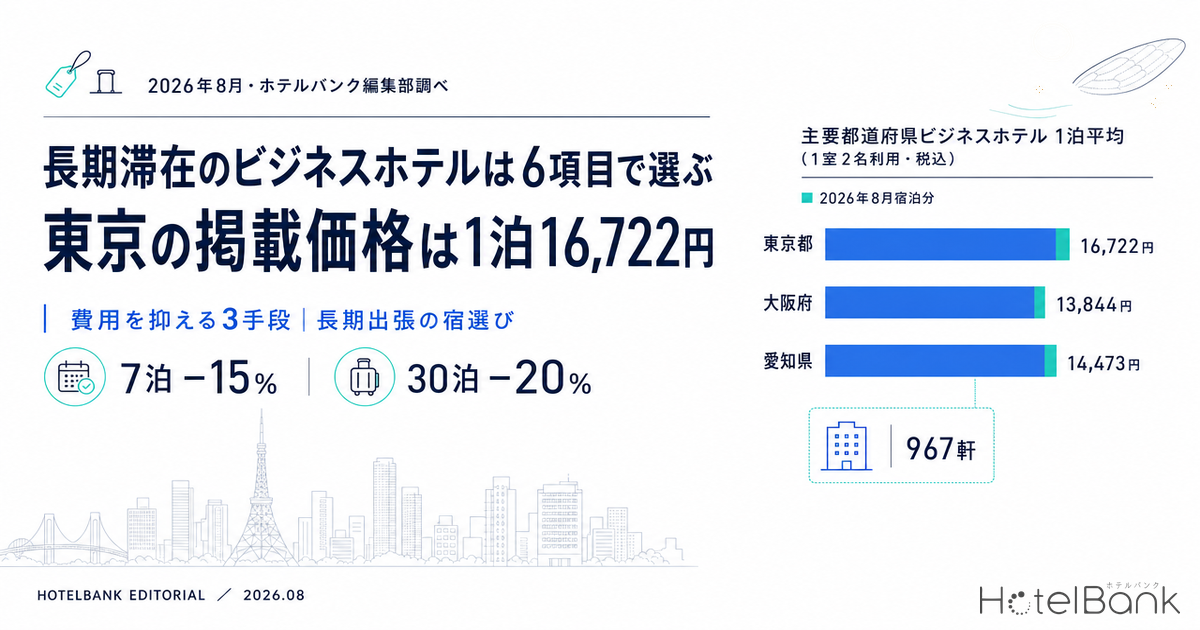
If you are staying at a business hotel for consecutive nights on a long assignment, the fastest way to choose is against six items: the walking route from the station, laundry, breakfast opening time, desk and chair, housekeeping frequency on consecutive-night stays, and the cancellation policy. On cost, the average OTA listed price for business hotels in Tokyo is ¥16,722 per night per room (double occupancy, per room, tax included, 967 properties, as of August 2026), and our measurements show long-stay plans running roughly 15% lower at 7 nights or more and around 20% lower at 30 nights or more. This article covers the pre-booking checklist and three ways to hold costs down, in the detail you need to decide.
- — Checking six items before booking a long-assignment hotel (station route, laundry, breakfast start time, desk and chair, housekeeping frequency on consecutive nights, cancellation policy) all but eliminates mid-stay rework.
- — The listed price for business hotels in Tokyo is ¥16,722 per night (average of 967 properties, double occupancy, per room, tax included, for August 2026 stays). That is about 40% of the city hotel average of ¥39,479 (118 properties).
- — Long-stay discounts do not scale smoothly with the number of nights; they deepen in steps at 2, 7 and 30 nights — roughly 10% from 2 nights, around 15% from 7 nights, and around 20% from 30 nights (medians).
- — A 30-night stay in Tokyo runs about ¥500,000 on a standard plan. At 15% for 7-plus nights it is ¥426,411, and at 20% for 30-plus nights it is ¥401,328 — roughly ¥100,000 of movement from how you book alone.
- — The three levers for holding costs down are long-stay discounts, weekly/monthly plans, and corporate contracts. The right order is to check whether your employer has a corporate contract and what the lodging cap in its travel expense rules is, before you book.
The six items to choose a business hotel for a long assignment
For one or two nights you can put up with some inconvenience, but over a stay of a week to a month the small daily frictions accumulate. Confirming the following six points on the official site or in the plan details before booking removes almost all of the stress of consecutive-night stays.
| Check item | What to look at | Why it matters on a long stay |
|---|---|---|
| 1. Walking route from the station | Within 5 minutes on foot; whether there is an underground or covered route that keeps you out of the rain | You make the round trip daily, so a 10-minute difference per day becomes a 5-hour difference over a month |
| 2. Laundry | Number of coin laundry machines on site and their operating hours, or a laundry service, or a washer-dryer in the room | Past three nights your clothes stop cycling. Whether there is a dryer changes how you use your evenings |
| 3. Breakfast opening time | Whether it starts at 6:00–6:30, and whether it can be swapped for a boxed or light meal | Keeps a breakfast-inclusive plan from going to waste on days with an early site start or a first-train departure |
| 4. Desk and chair | A desk with depth, a chair with a backrest, and where the power outlets are | There will always be days when you write reports or take online meetings from the room |
| 5. Housekeeping frequency on consecutive nights | Daily cleaning, lighter cleaning every few days, or how towels are exchanged | No-housekeeping plans are cheaper, but you want to know the rules for trash and linen exchange up front |
| 6. Cancellation policy | The date cancellation fees start on long-stay plans, and how a mid-stay departure is settled | Business trip dates move. The longer the plan, the stricter the cancellation terms tend to be |
Items 2 and 5 in particular are ones you would not notice on a short stay. Extended-stay hotels with a washer-dryer in the room, and consecutive-night plans that let you choose the housekeeping interval, resolve both at once. If laundry is your binding constraint, search on the presence and hours of an on-site coin laundry rather than on room rate alone — properties that publish machine counts and operating hours are the ones you can plan an evening around. For desk setup and what to pack, the practical rule is to confirm desk depth and outlet placement in the room photos before booking, since these are rarely listed in plan text.
Actual business hotel prices: ¥16,722 per night in Tokyo (August 2026)
Average OTA listed prices are a usable basis for estimating cost. Across 967 business hotels in Tokyo, the listed price was ¥16,722 per night (double occupancy, per room, tax included, for August 2026 stays, HotelBank Editorial Team analysis). September rises to ¥18,496 across 949 properties, about 10% higher heading into the autumn business travel season.
What to watch is that this figure is on a “double occupancy, per room” basis. Most business trips are single occupancy, and the single-occupancy listed price for a single room normally comes in below this average, so read it as “a guide close to the upper bound per room.” What one traveler actually pays moves considerably with room type and day of week, even in the same month and the same area. Levels also differ sharply between central and outlying wards within Tokyo; the ward-by-ward gap is covered in detail in Tokyo Business Hotel ADR 12-Month Trend: 30% Central vs Outer Ward Gap.
| Prefecture | Business hotel average | Properties | Reference: city hotel average |
|---|---|---|---|
| Tokyo | ¥16,722 | 967 | ¥39,479 (118) |
| Hokkaido | ¥20,243 | 408 | ¥28,127 (76) |
| Miyagi | ¥15,416 | 137 | ¥21,226 (21) |
| Aichi | ¥14,473 | 318 | ¥37,968 (32) |
| Osaka | ¥13,844 | 528 | ¥22,714 (98) |
| Fukuoka | ¥14,103 | 347 | ¥31,362 (41) |
Source: HotelBank Editorial Team analysis based on publicly available OTA data (listed prices as of August 2026; categories follow the property classifications used on the OTAs).
Staying a month (30 nights) in Tokyo at the average works out to roughly ¥500,000, and how far that can be brought down with long-stay plans or a corporate contract is the next topic. Note that Hokkaido in summer carries overlapping leisure demand, pushing even business hotels above ¥20,000. If you have any choice over timing, simply avoiding peak season changes the total.
Three ways to hold down lodging costs on a long assignment
1. Long-stay discounts: 15% at 7 nights and 20% at 30 nights are the measured guide
Comparing OTA listed prices for the same hotel, same check-in date and same room against a standard plan with no minimum-night condition, the medians were about 10% lower on consecutive-night plans of 2 nights or more (18 properties, N=9,223), around 15% lower on weekly-type plans of 7 nights or more (21 properties, N=5,603), and around 20% lower on monthly-type plans of 30 nights or more (13 properties, N=2,702) — based on listed prices at extended-stay hotel chains as of August 2026, where N is rooms multiplied by stay dates. The discount does not decline smoothly in proportion to nights; it deepens in steps at the 2-, 7- and 30-night thresholds. So if you are planning 6 nights, extending to 7 can invert the total in your favour, and beyond 24 nights it is worth pricing a 30-night plan. The break-even by night count is covered in detail in Japan Hotel Long-Stay Discounts: 15% at 7 Nights, 20% at 30 Nights.
2. Weekly and monthly plans: a flat rate makes the total predictable
On the OTAs, look for plans whose names state the minimum-night condition explicitly, such as “7 nights or more” or “30 nights or more.” Some hotels also place flat weekly or monthly plans on their own official sites, and for stays that straddle a period when daily prices move, a flat rate keeps the total more stable. Apartment-style properties with a kitchen and a washer-dryer can look expensive on a per-night basis, yet frequently come out ahead once you compare the 30-night total including dining-out and laundry costs.
3. Corporate contracts and business travel packages: check your employer’s arrangements first
If your employer holds a contract with a hotel chain’s or an OTA’s corporate service, you may have access to corporate rates below the public price, or to travel packages that bundle lodging with transport. Before booking as an individual, the right order is to ask your general affairs or accounting team about the existence of a corporate contract and the lodging cap in the travel expense rules. In areas where the gap between the cap and actual market prices is wide, the cap itself may need revisiting.
How far the total moves with length of stay and nightly rate
The figures so far convert into “what my own trip costs” with nothing more than multiplication. Multiply the listed price per night by the number of nights, then apply the discount rate for that night band (about 10% from 2 nights, around 15% from 7 nights, around 20% from 30 nights). First, the range for a one-month stay in Tokyo.
| Case | How it is booked | 30-night total | Difference vs pessimistic |
|---|---|---|---|
| Pessimistic | 30 nights on a standard plan with no minimum-night condition | ¥501,660 | — |
| Middle | Weekly-type plan of 7 nights or more (15%) throughout | ¥426,411 | −¥75,249 |
| Optimistic | Monthly-type plan of 30 nights or more (20%) secured | ¥401,328 | −¥100,332 |
Calculation: ¥16,722 per night (Tokyo, double occupancy, per room, tax included, 967 properties, as of August 2026) × 30 nights × (1 − discount rate). The discount rates are the measured medians from the body text applied as-is; the three cases carry no probability weighting.
How you book alone moves a month of lodging by roughly ¥100,000. Layering on differences in price level widens the range further. The next table places length of stay in the rows and the prefecture averages (listed prices) from the body text in the columns, showing the total for the stay.
| Nights (discount applied) | Osaka ¥13,844 |
Fukuoka ¥14,103 |
Aichi ¥14,473 |
Tokyo ¥16,722 |
Hokkaido ¥20,243 |
|---|---|---|---|---|---|
| 3 nights (10% applied) | ¥37,379 | ¥38,078 | ¥39,077 | ¥45,149 | ¥54,656 |
| 7 nights (15% applied) | ¥82,372 | ¥83,913 | ¥86,114 | ¥99,496 | ¥120,446 |
| 14 nights (15% applied) | ¥164,744 | ¥167,826 | ¥172,229 | ¥198,992 | ¥240,892 |
| 21 nights (15% applied) | ¥247,115 | ¥251,739 | ¥258,343 | ¥298,488 | ¥361,338 |
| 30 nights (20% applied) | ¥332,256 | ¥338,472 | ¥347,352 | ¥401,328 | ¥485,832 |
Calculation: listed price per night × nights × (1 − median discount rate for the night band). Listed prices are the business hotel averages for major prefectures (for August 2026 stays); discount rates applied are 10% from 2 nights, 15% from 7 nights and 20% from 30 nights. Incidental costs, day-of-week differences and peak-season variation are excluded.
There are two ways to read it. One is vertically: even in the same city, the total changes with whether you can extend the stay to the 7- or 30-night threshold. The other is horizontally: for the same number of nights, the price level of the destination itself determines the total. At 30 nights, the gap between the Osaka level (¥13,844 per night) and the Hokkaido level (¥20,243 per night) is ¥153,576 — larger than the roughly ¥100,000 that moves with how you book. If the destination is fixed, work on nights and booking method; if the number of nights is fixed, work on timing.
Summary: switch the type of hotel by length of stay
The right answer for a long assignment changes with the length of the stay. Up to three nights, a business hotel near the station on a standard plan or a 2-night consecutive plan is enough. From four nights to two weeks, shift to a weekly-type plan of 7 nights or more, or to an extended-stay hotel with a washer-dryer in the room. At the one-month scale, use a 30-night plan or a flat monthly rate, or an apartment-style property with a kitchen to compress living costs as well. In every case, confirming the six items from the opening (route, laundry, breakfast time, desk, housekeeping frequency, cancellation policy) and checking your corporate contract and travel expense rules before you book reduces failures on both cost and comfort.
Where to look next
For comparisons of specific properties, these articles go deeper (both in Japanese).
Once a business trip runs past three nights, stop booking “hotels” — Top 5 apartment-style properties with a kitchen and washer-dryer (HotelPicks, in Japanese)
Selects five properties across Tokyo, Osaka, Fukuoka and Sapporo with a kitchen and washer-dryer in the room, compared on consecutive-night rates and living infrastructure. It covers Tokyu Stay Hakata (東急ステイ博多), which has a washer-dryer in all 216 rooms (mini-kitchens are limited to certain room types such as the residential type) and runs a permanent long-stay plan from 7 nights; Tokyu Stay Sapporo Odori (東急ステイ札幌大通), three minutes on foot from the Pole Town Tanukikoji 4-chome exit at Odori Station with an underground route that avoids the snow; and MIMARU Osaka Namba STATION (MIMARU大阪 難波STATION), with kitchens and dining areas in rooms of around 40 square metres — each with walking minutes from the station and indicative prices.
Nagoya Fushimi–Marunouchi: 5 extended-stay hotels with kitchens — comparing one-month assignments in the Chukyo region by room facilities and monthly cost structure (innippon, in Japanese)
Compares five properties with in-room kitchens and laundry facilities on monthly cost structure, in the Fushimi–Marunouchi area of Nagoya where one-month assignments in automotive and machine tools concentrate. It covers Nagoya B’s Hotel ANNEX (名古屋ビーズホテル ANNEX), with mini-kitchens and drum-type washer-dryers in its annex; Espacio Time Sharing Four Urban (エスパシオ タイムシェアリング フォーアーバン), two minutes on foot from Fushimi Station with IH kitchens and washer-dryers in all 54 rooms; and Grand Base Osu (グランドベース大須), with full kitchens in every room and consecutive-night discounts from four nights.
Frequently asked questions
What should I use to choose a business hotel for a long assignment?
Six items: the walking route from the station, laundry, breakfast opening time, desk and chair, housekeeping frequency on consecutive nights, and the cancellation policy. Inconveniences you can tolerate for one or two nights accumulate as daily friction over a stay of a week to a month. Confirm them on the official site or in the plan details before booking.
How much is a business hotel per night in Tokyo?
Across 967 business hotels in Tokyo, the listed price averages ¥16,722 per night (double occupancy, per room, tax included, for August 2026 stays). For reference, city hotels on the same basis averaged ¥39,479 across 118 properties.
From how many nights do long-stay discounts take effect?
The medians are about 10% on consecutive-night plans of 2 nights or more, around 15% on weekly-type plans of 7 nights or more, and around 20% on monthly-type plans of 30 nights or more. The discount does not decline smoothly in proportion to nights; it deepens in steps at the 2-, 7- and 30-night thresholds.
Can extending a 6-night plan to 7 nights make it cheaper?
Yes. Because the discount steps down at the 7-night threshold, a 7-night weekly-type plan can come out cheaper in total than the standard rate for 6 nights. By the same logic, for stays beyond 24 nights it is worth pricing a 30-night plan.
Which type of property should I choose for a one-month assignment?
A plan of 30 nights or more, a flat monthly-type plan, or an apartment-style property with a kitchen and washer-dryer. Apartment-style properties can look expensive per night, but frequently come out ahead on the 30-night total once dining-out and laundry costs are included.
How can I reduce lodging costs on company business travel?
Before booking as an individual, ask your general affairs or accounting team about the existence of a corporate contract and the lodging cap in the travel expense rules. If a corporate service contract is in place, you may have access to corporate rates below the public price, or to travel packages that bundle lodging with transport.
Related reading
References and sources
■ Data sources
Average listed prices by prefecture and category come from the proprietary database of MetroEngines Research & Consulting, aggregated from publicly available OTA data (for August 2026 stays; 967 business hotels and 118 city hotels in Tokyo). Long-stay discount levels come from a comparison at extended-stay hotel chains of listed prices for the same hotel, same check-in date and same room, between standard plans with no minimum-night condition and plans with a minimum-night condition (as of August 2026; 18 properties and N=9,223 for 2 nights or more, 21 properties and N=5,603 for 7 nights or more, 13 properties and N=2,702 for 30 nights or more, where N is rooms multiplied by stay dates).
■ Calculation assumptions
All listed prices are on a double occupancy, per room, tax-included basis. Because the search conditions differ for the single occupancy typical of business travel, the amounts actually quoted may not match the levels in this article. Stay totals are calculated as the simple product of “listed price per night × nights × (1 − median discount rate for the night band),” applying 10% from 2 nights, 15% from 7 nights and 20% from 30 nights. Incidental costs such as meals, parking and laundry, day-of-week differences and peak-season variation are excluded. The three scenarios indicate the possible range and carry no probability weighting.
■ Limitations and caveats
Listed prices are publicly quoted asking prices, not transacted prices. Discount rates are medians that vary by property and may not apply to a particular hotel or set of dates. Category classifications follow the property classifications used on the OTAs, so facility standards vary within the same “business hotel” label. Corporate rates and the caps in travel expense rules differ by employer, so applying these amounts depends on each company’s own rules.
■ Market data
- HotelBank Editorial Team analysis based on publicly available OTA data (listed prices as of August 2026)
- Tokyu Stay, “About mid- to long-stay plans (up to 31 nights)” (in Japanese; states that weekly plans are searched by specifying 7 to 29 nights — an example of an official site carrying plans with minimum-night conditions)
- National Tax Agency, Tax Answer No.2508 “What constitutes employment income” (in Japanese; the reference point for the non-taxable scope of travel expenses when considering lodging caps in travel expense rules)
- National Tax Agency, Tax Answer No.6459 “Treatment of business travel expenses, lodging costs, per diems and commuting allowances” (in Japanese; expense treatment for business travel lodging)