

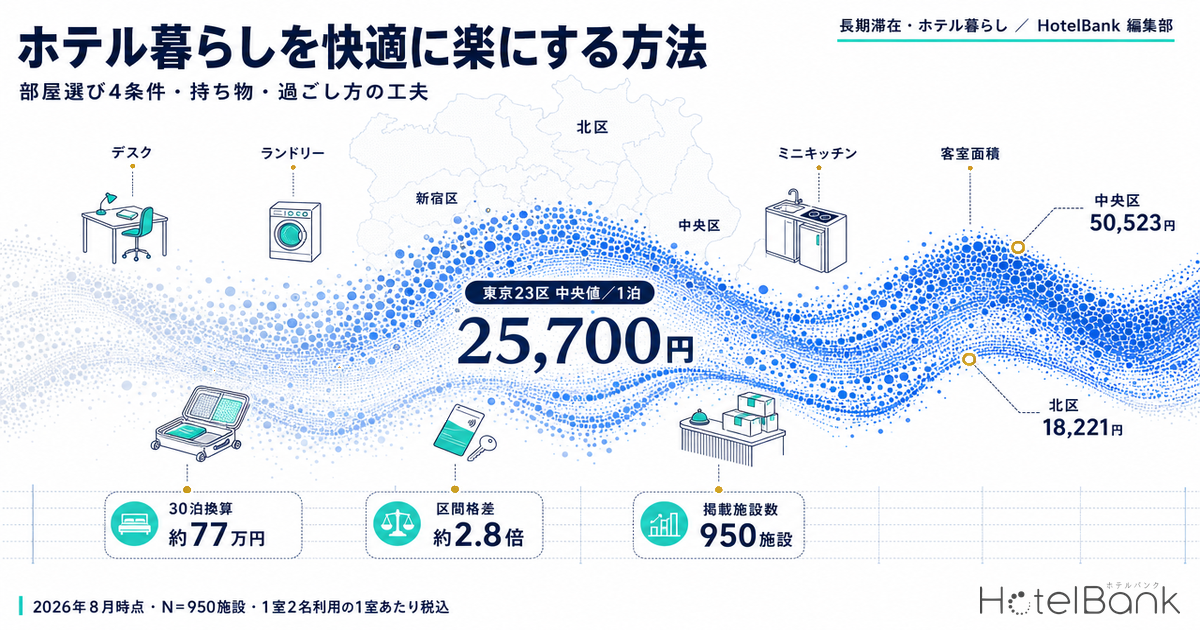
Whether living in a hotel is comfortable and easy comes down, in the end, to three things: (1) the room’s facilities (desk, laundry, kitchenette, floor area), (2) how much you bring (keep it to a minimum), and (3) your daily flow (how you handle laundry, meals, and deliveries). The essence of hotel living is that the hotel takes over a large share of your household chores, so once you decide up front what to leave to the hotel and what to bring yourself, life gets dramatically easier. This article works through the room criteria, the packing list, and the daily routines — in that order — as the points to check before you book.
- — Eighty percent of your comfort is decided by the room you choose. Check four things before booking — desk, laundry, kitchenette, and floor area — and you will avoid almost all post-move-in regret.
- — The packing principle is “cut the duplicates.” Assume the hotel supplies bedding, towels, a hair dryer, and a kettle, and limit clothing to one week’s worth on the assumption that you will do laundry.
- — Fix three routines: laundry, meals, and deliveries. Simply committing to set days and time slots eliminates both waiting and decision fatigue.
- — Listed prices across Tokyo’s 23 wards run about ¥25,700 per night at the ward-level median (as of August 2026, N=950 properties, per room including tax based on double occupancy). That puts the starting point for 30 nights at roughly ¥770,000.
- — Even within the 23 wards, the price range spans about 2.8x. Shifting by a single ward moves your 30-night cost substantially, so narrow your search by a ward’s price band rather than by station name.
Eighty Percent of Comfort Is Decided by the Room — Four Criteria to Check
Terms Used in This Article
Listed price — the selling price displayed on accommodation booking sites (including tax). It is not the price actually transacted, but the “visible” pre-discount figure. Every amount in this article uses this basis.
Long-stay plans (weekly / monthly) — room plans that lower the per-night rate on condition of a minimum number of consecutive nights. The qualifying number of nights, cleaning frequency, and amenity restocking terms differ by property.
Apartment hotels / serviced apartments — accommodation designed for extended stays, with living facilities such as a kitchenette and washing machine as standard. Rooms tend to be larger than at conventional hotels.
Unlike short sightseeing trips, hotel living turns the guest room from “a place to sleep” into “a base for daily life.” Confirming the following four conditions before booking removes almost all cause for regret after you move in.
| Item to check | What to look for | How it affects comfort |
|---|---|---|
| Desk and chair | Is there a reasonably deep desk and a chair with a backrest? Check the photos to confirm it is not a small vanity-cum-table | You will use it for remote work, meals, and writing alike. A poor setup pushes you onto the bed for more of the day, and fatigue accumulates |
| Laundry | An in-room washing machine (a washer-dryer is better still), or the presence and number of coin laundry machines on site | If your only laundry option is off site, every wash means going out — a heavy burden over a long stay |
| Kitchenette | Induction hob, sink, and refrigerator capacity. At minimum, a microwave and a mid-size refrigerator | Eating out for every meal wears you down in both cost and health. Just being able to handle breakfast in the room changes how easy the stay feels |
| Floor area | As a guide, 18㎡ or more for one person, and 25㎡ or more if you have a lot of luggage or are two people. Can you live with a suitcase left open? | A cramped room is bearable for a few nights, but over 30 nights the sense of confinement translates directly into fatigue |
As a cost benchmark, aggregating OTA listed prices across Tokyo’s 23 wards by ward (as of August 2026; standard room plans, per-room rate including tax based on double occupancy) puts the nightly level at roughly ¥25,700 at the ward median (N=950 properties, period August 2026, HotelBank Editorial Team research). A simple calculation gives about ¥770,000 for 30 nights, but this is the level for standard per-night plans; choosing a long-stay plan, single occupancy, or a lower-priced ward will generally bring the amount you actually pay below that. Price levels also vary widely from ward to ward within the same 23 wards, and the structure of that gap is set out ward by ward in “Tokyo Business Hotel ADR 12-Month Trend: 30% Central vs Outer Ward Gap” (note that the article is based on estimated settled ADR, a different basis from the listed prices used here).
| Ward | Per night | 30 nights | N (properties) | Level |
|---|---|---|---|---|
| Chuo | ¥50,523 | approx. ¥1.52M | 134 | |
| Minato | ¥46,291 | approx. ¥1.39M | 100 | |
| Chiyoda | ¥40,929 | approx. ¥1.23M | 67 | |
| Shibuya | ¥36,978 | approx. ¥1.11M | 27 | |
| Taito | ¥30,537 | approx. ¥920,000 | 183 | |
| Sumida | ¥29,813 | approx. ¥890,000 | 46 | |
| Koto | ¥29,130 | approx. ¥870,000 | 31 | |
| Shinagawa | ¥27,090 | approx. ¥810,000 | 30 | |
| Shinjuku | ¥25,746 | approx. ¥770,000 | 84 | |
| Toshima | ¥20,200 | approx. ¥610,000 | 57 | |
| Ota | ¥19,157 | approx. ¥570,000 | 51 | |
| Katsushika | ¥19,436 | approx. ¥580,000 | 26 | |
| Kita | ¥18,221 | approx. ¥550,000 | 20 |
* Wards with fewer than 20 listed properties (Setagaya, Meguro, Bunkyo, Itabashi, Adachi, Edogawa, Nerima, Suginami, Arakawa, and Nakano) are excluded from the table above, because the overall figure would be pulled by the prices of a small number of properties. The 30-night equivalent is a simple multiplication of the nightly rate by 30 and does not reflect long-stay plan discounts or single occupancy.
Between the most expensive ward, Chuo (¥50,523), and the cheapest, Kita (¥18,221), there is a roughly 2.8x spread per night — within the same 23 wards. Over 30 nights that is approximately ¥1.52M versus ¥550,000, a difference of about ¥970,000. Taito has the largest number of listed properties in the 23 wards at 183, and its price sits in the middle band (¥30,537), making it an area where breadth of choice and price are relatively easy to balance. Your hotel-living budget is largely settled by which ward you live in, before you ever get to which nightly rate you pick.
Pack the Bare Minimum — What to Leave to the Hotel, What to Bring
The single biggest trick to making hotel living easy is not bringing things. Find out in advance what the hotel already provides, and cut the luggage that duplicates it.
| Category | Items |
|---|---|
| Commonly provided by the hotel | Bedding, towels, hair dryer, bath amenities such as shampoo, electric kettle, refrigerator, TV, Wi-Fi, iron (on loan) |
| Worth bringing yourself | One week’s worth of clothing (minimal, assuming you do laundry), regular medication, work tools such as a laptop plus chargers, an extension cord, laundry nets and detergent in small portions, the skincare products you are used to, indoor slippers, and identification such as a health insurance card |
That said, amenities and in-room facilities vary considerably by property. Long-stay plans may also differ from standard plans in amenity restocking and cleaning frequency, so always confirm the latest facilities and services on the official website before booking. For a stay of around two weeks, the same list applies, with the clothing volume adjusted to your laundry cycle.
Daily Routines — Fix Three Flows: Laundry, Meals, and Deliveries
Laundry — Fix the Day and the Time Slot
The easiest approach to laundry is to fix the day of the week and the time slot. On-site coin laundries tend to get crowded in the evening, so building a routine around a quieter window — a weekday morning, for example — makes waiting disappear. If your room has a washer-dryer, you can get from wash to dry while you sleep. How many properties in a given area offer a coin laundry varies widely, so it is worth checking at the shortlisting stage rather than after you arrive.
Meals — Do Not Assume You Will Eat Out Every Meal
The trick to not wearing yourself out is to avoid building your stay around eating out for every meal. Settling into a pattern — something light in the room in the morning, then eating out for either lunch or dinner — stabilises both cost and health. Even in a room without a kitchenette, a microwave and a refrigerator are enough to work with prepared foods and frozen meals. In that sense, ease of shopping is an important location criterion, and the distribution of properties close to convenience stores and supermarkets is covered in detail in “Hotels Near Convenience Stores & Supermarkets: National Ranking.”
Mail and Parcels — Confirm the Process at Check-In
Many properties will hold mail and parcels at the front desk, but the process differs from one to the next. If there is something you definitely need to receive during a long stay, confirm at check-in whether they will accept it and what the storage rules are. Note that whether you can use a hotel as your address — for resident registration purposes, for instance — is handled differently by different properties and municipalities, so if you need this, checking in advance with both the property and the municipal office is essential.
Head Off the Things That Wear You Down
Even a comfortable hotel stay has points where fatigue tends to set in once it runs long. The most common ones, and how to handle them:
- The monotony of constant eating out — avoided with the “breakfast in the room” pattern described above. Whether there is a kitchenette or microwave makes the difference
- A mismatch in the cleaning and restocking rhythm — long-stay plans may set cleaning at two to three times a week. Confirm the frequency and whether additional cleaning is available before booking
- Not enough private space — beyond room size, choosing a property with somewhere to be other than your room, such as a lobby lounge or coworking space, makes it easier to change the scenery
- Insufficient storage — the fundamental fix is keeping luggage minimal. Build a cycle of shipping accumulated items back home by parcel service
Summary — Decide What to Delegate and What to Bring, and It Gets Easy
Comfort in hotel living is largely determined by choosing a room that satisfies the four criteria — desk, laundry, kitchenette, and floor area — keeping luggage to a minimum, and fixing your routines for laundry, meals, and deliveries. Because the details of facilities and services differ by property, the one step not to skip is checking the official website before booking. Get these three things right and hotel living becomes not “a tiring way to live” but “an easy life with most of the housework handled for you.”
Frequently Asked Questions
Q. What makes a room suitable for hotel living?
A. Four things: a desk and chair; laundry (an in-room washing machine or an on-site coin laundry); a kitchenette, or at least a microwave and a mid-size refrigerator; and floor area. As a guide, 18㎡ or more for one person, and 25㎡ or more if you have a lot of luggage or are two people. A level of cramping you can put up with for a few nights translates directly into fatigue over 30 nights.
Q. How much does a month of hotel living cost?
A. Listed prices across Tokyo’s 23 wards run about ¥25,700 per night at the ward median (as of August 2026, N=950 properties, per room including tax based on double occupancy), which comes to roughly ¥770,000 as a simple 30-night calculation. However, even within the 23 wards there is a spread of about 2.8x: among wards with 20 or more listed properties, nightly prices range from ¥18,221 (Kita) to ¥50,523 (Chuo). Choosing a long-stay plan or single occupancy will generally bring the amount you actually pay lower still.
Q. What should I bring?
A. Bedding, towels, a hair dryer, bath amenities, an electric kettle, and a refrigerator are usually provided by the hotel, so you can narrow what you bring to one week’s worth of clothing (assuming you do laundry), regular medication, work tools and chargers, an extension cord, laundry nets and detergent in small portions, the skincare products you are used to, indoor slippers, and identification. Because what is provided differs by property, check the official website before booking.
Q. What is the easiest way to handle laundry?
A. Fixing the day of the week and the time slot is easiest. On-site coin laundries tend to get crowded in the evening, so building a routine around a quieter window — a weekday morning, for example — makes waiting disappear. If the room has a washer-dryer, you can complete both wash and dry while you sleep.
Q. Can I receive mail and parcels?
A. Many properties will hold them at the front desk, but storage periods and identity-verification procedures differ from one to the next. If there is something you definitely need to receive during your stay, the reliable approach is to confirm at check-in whether they will accept it and what the storage rules are.
Q. Can I register a hotel as my residence?
A. The address on a resident record is determined by the municipality on the basis of your “principal place of living” (Basic Resident Registration Act). Whether a hotel can be registered as your address depends both on whether the property permits it and on how the municipality judges it, so there is no single answer. If you need this, check in advance with both the property and the municipal office.
References and Sources
■ Data source
The prices in this article are proprietary HotelBank Editorial Team data, compiled by collecting selling prices listed on accommodation booking sites daily and aggregating them by ward. The scope is Tokyo’s 23 wards for stays in August 2026, covering the 950 properties that had listings. Prices are the per-room rate including tax at double occupancy; the representative figure for each ward is the average across properties listed in that ward, and the representative figure for the 23 wards as a whole is the median of the ward-level values (¥25,746).
■ Calculation assumptions
The aggregation method and calculation assumptions are as follows. The 30-night equivalent is simply the nightly listed price multiplied by 30, and does not reflect long-stay plan discounts, reductions for single occupancy, or changes in cleaning frequency for consecutive nights. The ward-level table is limited to the 13 wards with 20 or more listed properties (816 properties in total), excluding wards where the representative figure would be pulled by a small number of properties. The floor-area guides (18㎡ or more for one person / 25㎡ or more for two) are benchmarks set by the editorial team based on typical design for long-stay rooms, not statistical values.
■ Limitations and caveats
Listed prices are displayed prices before discounts are applied, not prices actually transacted. The amount you actually pay may therefore fall below the levels shown here. Facilities, amenities, cleaning frequency, and mail handling are also operated differently by each property, and long-stay plans may carry different terms from standard plans. Use this article as a starting point for booking decisions, and always make the final confirmation on each property’s official website.
■ Primary sources
- Ministry of Health, Labour and Welfare, “Hotel and Inn Business” — https://www.mhlw.go.jp/stf/seisakunitsuite/bunya/0000110603.html (competent-authority information on accommodation business categories and hygiene standards)
- Hotel Business Act (Act No. 138 of 1948) / e-Gov Law Search — https://elaws.e-gov.go.jp/document?lawid=323AC0000000138
- Basic Resident Registration Act (Act No. 81 of 1967) / e-Gov Law Search — https://elaws.e-gov.go.jp/document?lawid=342AC0000000081 (the address on a resident record is determined on the basis of the “principal place of living”)
Related Reading