

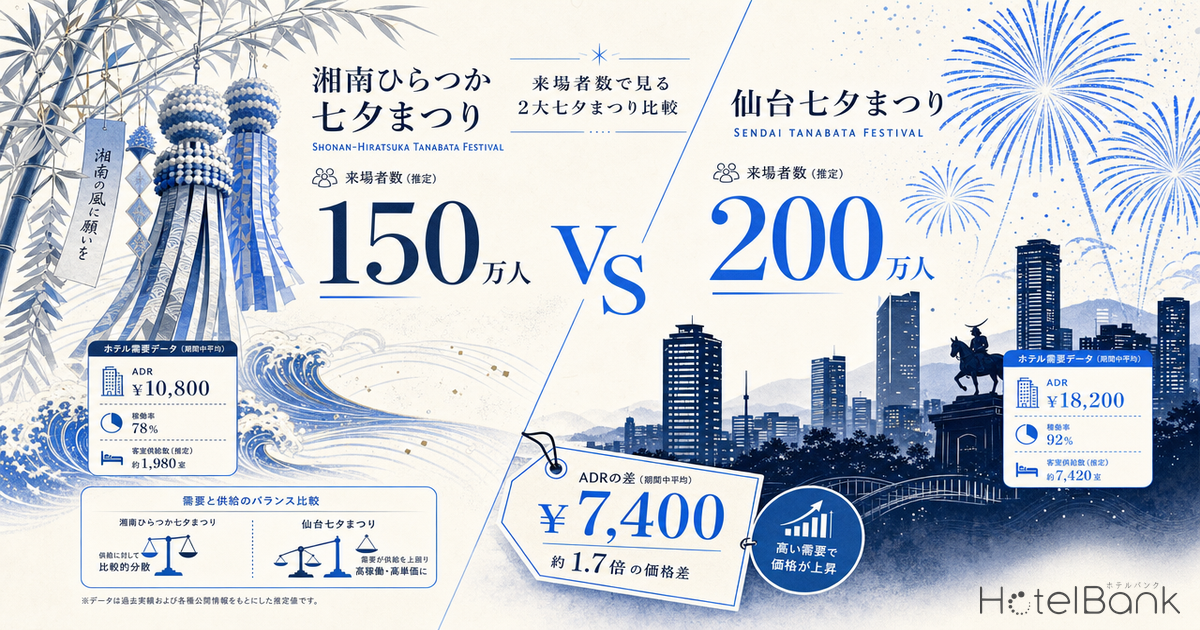
The “Shonan Hiratsuka Tanabata Festival” (湘南ひらつか七夕まつり), held in early July each year, and the “Sendai Tanabata Festival” (仙台七夕まつり) in early August. Both rank among Japan’s signature Tanabata events, yet their ripple effect on lodging demand has an entirely different structure. Drawing on publicly listed price data from OTAs and similar channels, this article compares daily hotel price and occupancy metrics within a 5 km radius of Hiratsuka Station (the Shonan area including Fujisawa, Chigasaki, and Odawara) and within a 5 km radius of Sendai Station, visualizing a supply-demand structure that splits clearly into “day-trip type” and “overnight type” despite the comparable drawing power of 1.5 million versus 2 million visitors.
Metric Definitions Used in This Article
- ADR (Average Daily Rate): The average of listed prices published on OTAs and similar channels. This differs from actual transaction prices (when cross-checked against REIT disclosure data, listed ADR tends to run on average +25–30% higher than transacted ADR). Per-room rate for double occupancy (one room, two guests; tax included), averaged across all plans (from room-only to plans with meals).
- OCC (Occupancy Rate): The ratio of sold rooms to the total number of rooms in the area (an estimate based on OTA sales inventory).
- Scope of Analysis: Within a 5 km radius of Hiratsuka Station plus the 3 km core radius of Fujisawa, Chigasaki, and Odawara (N=44–45 properties) / within a 5 km radius of Sendai Station (N=83–85 properties).
- Data Source: MetroEngines Research
Festival Overview and Crowd Scale
Let’s first lay out the basics of both events. The Shonan Hiratsuka Tanabata Festival runs for three days, July 3 (Fri) to 5 (Sun), 2026, and as one of the Kanto region’s largest Tanabata events it draws roughly 1.5 million visitors each year. The Sendai Tanabata Festival, meanwhile, runs three days from August 6 (Thu) to 8 (Sat), 2026, and including its eve-of-festival Sendai Tanabata Fireworks Festival (around 16,000 shells) on August 5 (Wed), draws roughly 2 million visitors across what is effectively a four-day window. Sendai’s headcount is about 1.3× larger, but as we will see, its impact on room rates diverges by far more than that ratio.
| Item | Shonan Hiratsuka Tanabata | Sendai Tanabata |
|---|---|---|
| Dates (2026) | Jul 3 (Fri) – 5 (Sun) | Aug 6 (Thu) – 8 (Sat) *Eve fireworks Aug 5 (Wed) |
| Attendance (stated) | ~1.5 million | ~2 million |
| Main visitor base | Day-trippers from the greater Tokyo area | Overnight tourists from across Japan |
| Nearest major station | JR Hiratsuka Station | JR Sendai Station |
| Access from major cities | ~60 min from Tokyo Station (Tokaido Line) | ~90 min from Tokyo Station (Tohoku Shinkansen) |
Source: Compiled by HotelBank Editorial Team from official organizing-committee announcements and JR timetables
Daily ADR Comparison — Sendai Holds the ¥34,000 Range Even Midweek, Hiratsuka Relies on the Weekend
Looking at the daily ADR (double occupancy, tax included, all-plan average) across each 2026 event window, the structural difference between the two areas comes into sharp relief. In Sendai, the fireworks night on August 5 (Wed) hit ¥33,600, the festival’s opening day on August 6 (Thu) ¥34,100, and the final day on August 8 (Sat) ¥40,900 — a price band above ¥33,000 across all four days. The Hiratsuka area (the Shonan area including Fujisawa, Chigasaki, and Odawara), by contrast, posted ¥29,500 on the opening Friday (July 3), a peak of ¥39,700 on Saturday (July 4), and ¥27,700 on the closing Sunday (July 5) — a textbook weekend profile in which only Saturday spikes.
Source: Compiled by HotelBank Editorial Team from MetroEngines Research (Hiratsuka area N=44–45 properties / Sendai area N=83–85 properties)
What stands out is Sendai’s midweek (Wed–Fri) price level. As detailed below, ADR within a 5 km radius of Sendai Station normally hovers around ¥22,500 on Wednesdays and Thursdays, but during the Tanabata festival all three midweek days ran ¥33,600–¥35,400 — a +49–57% increase. In the Hiratsuka area, by contrast, the festival Friday (July 3) figure of ¥29,500 is actually 5% lower than a typical non-festival Friday (¥28,000–33,200, averaging ¥31,000). This confirms that Hiratsuka’s Tanabata is supported by “day-trippers who head back to the greater Tokyo area after viewing in the evening and night.”
Versus the Same Weekday Normally — Sendai +49–51% Midweek, Hiratsuka −5 to +1%
The clearest metric is the “comparison against a non-festival day of the same weekday.” To measure the relationship between attendance and lodging demand, only by stripping out the day-of-week effect can the festival’s pure lift be seen. In Sendai, compared against typical Wednesday and Thursday ADRs from late July to late August (excluding the special peak factor of Obon week), both the fireworks night and the festival’s opening day show a clear rate lift.
Source: Compiled by HotelBank Editorial Team from MetroEngines Research (baseline: average same-weekday ADR during non-festival periods)
Within a 5 km radius of Sendai Station, the fireworks Wednesday (Aug 5) reached ¥33,600 versus ¥22,500 on a normal Wednesday, for +49%, and the festival’s opening Thursday (Aug 6) hit ¥34,100 versus ¥22,500 on a normal Thursday, for +51% — pushing the midweek rate up roughly 1.5×. The Hiratsuka area, by contrast, saw its opening Friday (Jul 3) at ¥29,500, 5% below a normal Friday’s ¥31,000, while Saturday’s (Jul 4) ¥39,700 came in just +1% above the ¥39,400 average of non-festival Saturdays (¥36,800–¥42,000). The attendance gap is +33% (1.5M → 2M), but the structural gap in rate uplift is several times that.
Booking Pace (Sold-Out Rate) — Sendai Tops 25% Even Midweek
As another gauge of occupancy, we look at the sold-out rate of currently selling plans as of the survey date (May 2026). The sold-out rate at the 60–90-day lead-time stage before check-in is a leading indicator of final occupancy.
Source: Compiled by HotelBank Editorial Team from MetroEngines Research (sold-out rate = share sold out within OTA sales inventory)
In Sendai, the sold-out rate reached 26–33% across all four days (Wed–Sat) of the fireworks and main festival, peaking at a high 32.9% on Saturday (Aug 8). This shows that nearly a third of hotel inventory around Sendai Station has already been locked up in advance sales. In the Hiratsuka area the three festival days also ran 20–28%, but what stands out is that there is almost no difference from non-festival days. The Hiratsuka area’s sold-out rate was 34.1% on Saturday June 27 and 31.8% on July 18 — both above the festival Saturday’s (Jul 4) 27.8%. In other words, no festival-driven pull-forward of bookings can be observed in the Hiratsuka area. For booking progress across Tohoku’s three great festivals as a whole, we provide a broader view that includes Aomori and Akita in Tohoku’s Three Great Festivals 2026 Booking Progress: Reading the Summer Buildup Through Early-August ADR and Sold-Out Rates in Aomori, Akita, and Sendai.
Year-over-Year (YoY) — Sendai Up +12–21% Midweek
Comparing against the same dates a year earlier (2025), the growth rates of the two areas also differ. Sendai’s festival Thursday, Friday, and Saturday show rate increases of +12.8% to +21.4% YoY. The Hiratsuka area, on the other hand, saw its festival Saturday (Jul 4, 2026) grow +9.2% versus the prior-year festival Saturday (Jul 5, 2025) — a level roughly in line with the nationwide, inbound-led ADR uptrend.
| Period | 2025 ADR | 2026 ADR | YoY (same weekday) |
|---|---|---|---|
| Hiratsuka Area (Shonan) | |||
| Festival Friday | ¥26,100 | ¥29,500 | +12.9% |
| Festival Saturday | ¥36,400 | ¥39,700 | +9.2% |
| Festival Sunday | ¥25,200 | ¥27,700 | +9.9% |
| Sendai Area | |||
| Fireworks Fest (Wed) | ¥29,800 | ¥33,600 | +12.6% |
| Festival Day 1 (Thu) | ¥29,400 | ¥34,100 | +15.7% |
| Festival Day 2 (Fri) | ¥29,200 | ¥35,400 | +21.4% |
| Festival Final Day (Sat) | ¥36,200 | ¥40,900 | +12.8% |
Source: Compiled by HotelBank Editorial Team from MetroEngines Research
Sendai’s +21.4% on the festival’s second day, Friday (Aug 7), is noteworthy. The prior year (2025) it also fell on a Friday, and as a rate-growth figure for a midweek festival day it is striking, pointing to structural strength in lodging demand. This suggests that hotels around Sendai Station, leveraging their geographic advantage as the gateway to Tohoku tourism, are capturing multi-night demand for “festival + a Tohoku tour the following weekend.”
Monthly Trends Reveal the Structural Gap Between the Two Areas
Having examined the daily festival impact, looking at long-term monthly trends makes the fundamental difference in the two areas’ demand structures even clearer. The Shonan area (Hiratsuka, Fujisawa, Chigasaki, and Odawara combined) swings widely between its summer peak (July–August) and winter trough (January–April) — a supply-demand structure with a strong coastal-resort character. Sendai City, by contrast, moves within a relatively flat range of ¥27,000–¥34,000 year-round, a stable profile underpinned by business demand.
Source: Compiled by HotelBank Editorial Team from MetroEngines Research (Shonan: Hiratsuka + Fujisawa + Chigasaki + Odawara / Sendai: five wards of Sendai City combined)
The Shonan area shows abnormally high ADRs of ¥81,400–¥94,300 for July–August 2026, but this is most likely the average being pulled up by an increase from June onward in registrations of high-end resort-style plans (luxury inns around Hayama, Yugawara, and Hakone) — the property count holds stable at around 30. Because these figures are likely to be revised as the booking date approaches, this article centers its discussion on daily data narrowed to within a 5 km radius of Hiratsuka Station (an area with a weaker luxury-resort character). For how one-off summer events affect room rates, we analyze the overlap with Obon peak days in Lake Suwa Fireworks 2026: How the Aug 15 Obon Peak and Booking Changes Affect the Lodging Market.
Market Macro — JHR Portfolio’s +9.0% RevPAR Growth
From a macro perspective, Japan Hotel REIT Investment Corporation (8985) disclosed, as of March 2026, a portfolio-wide RevPAR of +9.0% YoY (OCC +3.1 pt, ADR +5.0%), showing that Japan’s overall hotel market is on a gradual growth trajectory. Sendai’s +12.8–21.4% YoY rate growth during the Tanabata festival demonstrates a peak-event effect that clearly exceeds this market-wide growth rate. The Hiratsuka area’s +9.2–12.9% is roughly on par with the market-wide growth rate, and can be read as reflecting the nationwide ADR uptrend rather than a pure festival premium.
Revenue Management Implications — A Strategic Split Between the Sendai and Shonan Models
The structural difference between the two areas points to a clear split in revenue-management strategy as well. For hotels around Sendai Station, the Tanabata festival is one of the year’s largest pricing opportunities — a rare set of dates where bookings still close even after midweek rates are raised to roughly 1.5× normal levels. Hotels in the Shonan area, on the other hand, may maximize their revenue opportunity not by treating the Tanabata period as a “special event” but by concentrating on weekend pricing that maximizes Saturday within the broader summer coastal and holiday demand. For how multi-day consecutive events affect a specific area’s ADR, we quantify the case of a 15-day consecutive run in Grand Sumo May Tournament 2026: Ryogoku Lodging Demand Analysis.
In Sendai in particular, given that the sold-out rate has already reached 25–33% at the 60–90-day lead-time stage, hotels still holding selling inventory have ample room for staged rate increases. The current ADRs for Friday Aug 7 and Saturday Aug 8 (¥35,400–¥40,900) sit at +12–21% YoY, but final transaction prices are expected to climb even higher. In the Shonan area, by contrast, since demand is observed at roughly the same level on festival and non-festival days alike, aggressive pricing premised on a “Tanabata premium” carries a high risk of unsold inventory.
⚠ A note on future-date ADRs: The ADRs in this article are averages of listed prices published on OTAs as of May 2026 and will fluctuate as the check-in date approaches. Given the Sendai area’s currently high booking pace, staged rate increases are more likely than last-minute discounts; on the risk side, however, a sudden drop in demand (e.g., due to weather) warrants caution.
Conclusion
The Shonan Hiratsuka Tanabata Festival (1.5 million visitors) and the Sendai Tanabata Festival (2 million visitors) differ by only about 1.3× in attendance, yet their impact on lodging demand is structurally entirely different. Sendai is an “overnight-type event” where the four-day ADR — midweek included — is pushed up to 1.5× normal levels, whereas Hiratsuka (Shonan) is a “day-trip-type event” where virtually no festival-driven rate uplift can be observed. One reading is that the former’s 90-minute Shinkansen distance from Tokyo and the latter’s closer 60-minute distance each define their respective lodging needs. The two areas require different RM approaches, and for hotels around Sendai Station in particular, this event window is a crucial opportunity to maximize annual revenue.
Related Reading
- Tohoku’s Three Great Festivals 2026 Booking Progress: Reading the Summer Buildup Through Early-August ADR and Sold-Out Rates in Aomori, Akita, and Sendai
- Grand Sumo May Tournament 2026: Ryogoku Lodging Demand Analysis — How a 15-Day Consecutive Event Affects Ryogoku-Area ADR
- Fan-Activity Travel Lodging Demand — How Magical Mirai 2026 and Combined Vocaloid Events Create a New Segment, With Up to +¥75M Upside in the Hamamatsu Area
- Lake Suwa Fireworks 2026: How the Aug 15 Obon Peak and Booking Changes Affect the Lodging Market
- Nagaoka Fireworks 2026 — Nagaoka City Sold Out in March; Quantifying the Demand Spillover to Surrounding Areas With Internal Data
- [As of April 2026] Local-Government Lodging Discounts and the JTA’s ¥138.3 Billion Budget — Assessing Regional Hotel Demand Stimulus and a May–July Strategy
- Last-Minute Demand Ahead of Golden Week 2026 | ADR Trend Analysis by Lead Time
- The Direct Effect of New 2026 Flight Routes on Hotels Near Regional Airports | ADR Trends in Kobe, Sendai, Naha, and Chubu
- Sapporo Hotel ADR During the YOSAKOI Soran Festival: The Structure Behind a ¥52,600 Peak Day and +17.6% YoY
- Sumida River Fireworks 2026 (Jul 25 Countdown) | Testing the ADR Ceiling for Asakusa, Ryogoku, and Kinshicho Hotels
References & Sources
- Shonan Hiratsuka Tanabata Festival — Official Site (event details & attendance)
- Hiratsuka City — “Shonan Hiratsuka Tanabata Festival”
- Sendai Tanabata Festival — Official Site
- Sendai Tanabata Festival — Event Overview
- Japan Hotel REIT Investment Corporation — IR Materials (March 2026 monthly operating status)
- MetroEngines Research — Aggregation of publicly listed price data from OTAs and similar channels (Hiratsuka area N=44–45 properties / Sendai area N=83–85 properties)