

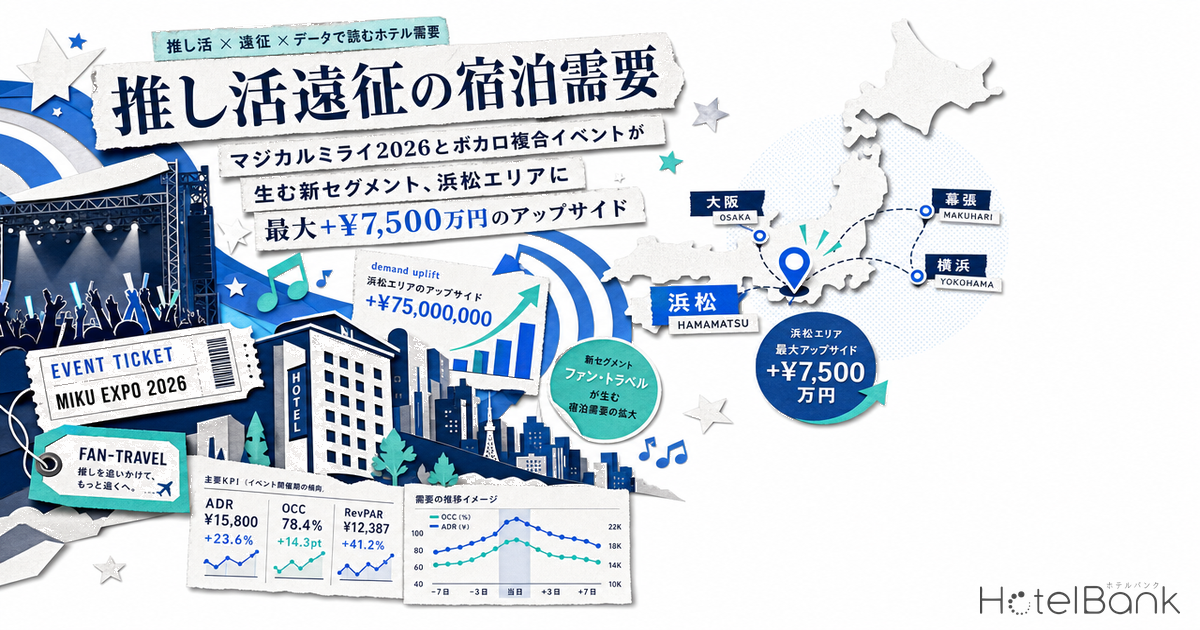
Hatsune Miku’s live concert event “Magical Mirai” will be held in Hamamatsu for the first time in 2026, in addition to Tokyo and Osaka. Furthermore, during Golden Week 2026 (April 30 – May 4), “Project Circles – Resonance with the Mikus” will take place at six venues around Yokohama Station and Shin-Takashima Station, featuring over 100 participating creators. Vocaloid culture, with cumulative attendance reaching 580,000, is reliably driving hotel demand around live venues. This article aggregates hotel pricing data around the three venues and quantifies the scale of hotel demand generated by oshikatsu (fan activity) travelers, along with the revenue opportunities for hotel operators.
Metric Definitions Used in This Article
- ADR (Average Daily Rate): Average of published sale prices on OTAs and similar channels. Differs from actual transaction prices (when cross-checked against REIT disclosure data, published ADR tends to be +25–30% higher than transaction ADR). Per-room rate for double occupancy (tax included), averaged across all plans (including room-only and meal-inclusive plans).
- OCC (Occupancy Rate): Ratio of sold rooms to total rooms in the area (estimated from OTA sales inventory).
- Sales Plan Sold-Out Rate: Ratio of plans marked as sold out among the sales plans published by hotels in the area. A proxy indicator for supply-demand tightness.
- Survey Scope: Hotels within a 2km radius of each venue (Act City Hamamatsu, INTEX Osaka, Makuhari Messe, KT Zepp Yokohama) that MetroEngines Research can confirm as operational.
- Data Source: MetroEngines Research
Magical Mirai 2026 — 18 Performances Across 3 Cities Over 9 Days, First-Ever Hamamatsu Edition
Hatsune Miku’s “Magical Mirai,” organized by Crypton Future Media, is a composite event combining 3DCG live performances and creative exhibitions. Held for 13 consecutive years since its launch in 2013, cumulative attendance through 2025 has exceeded 580,000. In 2025, the event drew over 85,000 attendees across three cities: Sendai, Osaka, and Tokyo.
For 2026, performances have been announced at Act City Hamamatsu (July 24–26), INTEX Osaka (August 14–16), and Makuhari Messe (August 28–30). This is a large-scale tour with 18 performances over 9 days. Hamamatsu in particular carries symbolic significance as the first event in the “City of Music”—home base of Yamaha, the VOCALOID developer that gave birth to Hatsune Miku. Additionally, during Golden Week 2026 (April 30 – May 4), “Project Circles – Resonance with the Mikus” will be held at six venues around Yokohama Station and Shin-Takashima Station, expanding Vocaloid culture into a circulating, multi-venue event format.
Source: Crypton Future Media official announcements, MetroEngines Research, compiled by HotelBank Editorial Team
Oshikatsu Travel — ¥59,000 Average Per Trip, Over 60% Have Experience
According to a 2024 survey by Neo Marketing, over 60% of oshikatsu fans answered that they had “traveled for fan activities,” with 2–3 trips per year being the most common response at 34.7%. The average cost per trip is approximately ¥59,000, broken down into transportation 53.7%, merchandise 30.5%, and accommodation 9.5%. Accommodation is the only controllable cost and thus tends to be the target for savings, with “low price,” “location,” and “interior design (Instagrammability)” emerging as the three major criteria for hotel selection.
Notably, an Airtrip survey found that “local gourmet” rather than merchandise topped the list for “uses of money saved by reducing transportation and accommodation costs.” Oshikatsu travelers tend to keep accommodation costs low while increasing spending on local dining and tourism experiences. This consumption pattern differs from typical resort travelers, and for hotel operators, designing offerings around “room-only plans with cost-performance appeal” maximizes demand capture. An April 2026 survey by Oshicoco also confirmed that local dining and tourism behavior accounts for 60% of oshikatsu travelers’ total spending, indicating substantial spillover effects on regional economies.
Hamamatsu — Sales Plan Sold-Out Rate Surges to 68%, But ADR Has Not Risen
Within a 2km radius of Act City Hamamatsu, MetroEngines Research tracks 50 hotels and 5,131 rooms confirmed as operational. The facility composition is 31 business hotels, 5 city hotels, and 6 ryokans, with business hotels comprising 62%—a “business travel” type hotel market. Note that Hamamatsu Marriott Hotel (236 rooms) opened in this area in May 2026, marking a turning point in the market structure.
Comparing hotel prices during the three Magical Mirai 2026 event days (July 24–26) with a typical weekend of the same day-of-week structure (July 10–12) revealed an interesting pattern. While ADR remained nearly flat (¥18,000 vs. ¥18,500, Δ-2.6%), the sales plan sold-out rate surged from 42.1% to 65.7%, a 23.6-point increase. In particular, Friday July 24 (when early-arrival demand concentrates) reached a 68.4% sold-out rate, while Saturday July 25 hit 87.4%.
Source: MetroEngines Research, compiled by HotelBank Editorial Team (N=32 hotels, 3-day average)
This situation—where “demand significantly exceeds prior-year levels but prices have not followed”—clearly represents a revenue opportunity from a revenue management perspective. Rather than raising prices after demand materializes, activating dynamic pricing the moment concert dates are publicly announced offers the potential to capture high-rate demand earlier. A similar “strong demand but delayed price reflection” pattern has also been observed at multi-day recurring events, as analyzed in our Sumo May 2026 x Hotel Demand: Ryogoku/Kinshicho ADR analysis, which highlighted similar revenue opportunities for a 15-day consecutive event.
Osaka & Makuhari — ADR Has Already Risen, Concert Day Effect Visible
Within a 2km radius of INTEX Osaka (Suminoe-ku), there are 18 hotels and 2,164 rooms. The three-day event ADR (August 14–16) is ¥36,700, up +13.2% from the control period ADR of ¥32,400 (July 31 – August 2). The Osaka area experiences natural demand growth during Obon, but with ADR jumping to ¥39,200 on Friday August 14 (the day before the live event), event demand is clearly being priced in.
The area around Makuhari Messe has fewer hotels—10 properties and 4,054 rooms within 2km—but features clusters of large city hotels such as APA Hotel & Resort Tokyo Bay Makuhari (2,007 rooms). ADR for August 28–30 is ¥39,200, up +6.4% compared to surrounding weekends. Saturday August 29 reached ¥49,300. However, due to the high concentration of competing large properties, price reflection in Makuhari is less pronounced than in Hamamatsu, with gradual pricing adjustments occurring while watching competitor rates.
Source: MetroEngines Research, compiled by HotelBank Editorial Team
Yokohama GW — 99.7% Sold-Out Rate, Vocaloid Event Amplifies Existing GW Demand
The Yokohama Station – Shin-Takashima Station area where “Project Circles” is held is already a popular tourist area with high accommodation demand during Golden Week. Within a 2km radius, there are 72 hotels and approximately 13,123 rooms, with a multi-tiered composition ranging from large luxury hotels to capsule hotels.
The sales plan sold-out rate during the five event days (April 30 – May 4) reached 99.7%, essentially fully booked. This is dramatically higher than the post-GW comparison period of May 22–24 (87.4% sold-out rate). ADR itself remained nearly flat compared to typical weekends (¥38,000 vs. ¥38,600, Δ-1.8%), indicating that demand crystallized at the early booking stage and inventory was absorbed before prices could move. For Yokohama, this case demonstrates “the importance of locking down inventory through advance reservations” more than “room to raise prices.”
Booking Curve Analysis — ADR Trends by Lead Time for Each Venue
We have examined ADR and sold-out rates at each venue’s event date, but for hotel operators, what’s more important is “when prices start to move.” Using time-series OTA pricing data accumulated by MetroEngines Research, we compared booking curves across the four venues from January 2026 through the most recent week (second week of May).
Source: MetroEngines Research weekly average of OTA published prices, compiled by HotelBank Editorial Team (within 2km radius of each venue)
The booking curves for the four venues show distinctly different patterns. Below we summarize the characteristics of each venue and the RM implications that can be drawn from them.
① Yokohama GW (April 30 – May 4): Demand-Leading, Price-Lagging
Yokohama, as an already-completed past event, offers the most complete observable booking curve. ADR moved within a narrow range of ¥60,000–63,000 from ¥48,600 in January through May, showing no significant price fluctuation. In contrast, the sales plan sold-out rate changed dramatically. The sold-out rate, which was around 5% in January, suddenly surged to 53% in the first week of February and reached 96.1% by the fourth week of March. In other words, inventory was consumed over three months while ADR remained nearly flat. This is a textbook case where price adjustments could not keep pace with surging demand. GW’s natural demand was layered with oshikatsu demand from Project Circles, and inventory was absorbed before prices could rise.
② Hamamatsu (July 24–26): Gradual Upward Type
Hamamatsu’s ADR has risen +46% from ¥16,800 in January to ¥24,600 in the second week of May. However, this rise has been gradual over five months, and even with 2.5 months remaining until the event, it has still not surpassed ¥25,000. Worth noting is the sold-out rate spike (38.4%) in the first week of February, which is believed to be the impact of fan club pre-sales preceding the Magical Mirai 2026 schedule announcement (March 5). Subsequently, the sold-out rate normalized, indicating a state of “after the initial demand wave has passed, the full-scale booking rush has not yet arrived.” There is substantial room to gradually raise ADR in preparation for the second wave of demand starting 2 months out (late May – June).
③ Makuhari (August 28–30): Active Price Management Type
Makuhari’s ADR has nearly doubled at +98%, rising from ¥23,500 in January to ¥46,500 in the second week of May. This is the steepest ADR increase among the four venues, evidence that large city hotels (such as APA Hotel & Resort Tokyo Bay Makuhari) are aggressively deploying dynamic pricing. The sold-out rate has remained stable in the 14–25% range, maintaining a healthy state of “demand keeps pace even as prices rise.” With 3.5 months still remaining until the event, further ADR increases are expected.
④ Osaka (August 14–16): Inverse Curve Type (Obon Premium Set Early)
Osaka shows a downward trend in ADR, differing from the other three venues. From a peak of ¥52,700 in the second week of January, it fell -31% to ¥36,100 by the second week of April. This is the classic Obon-season pattern of “set high prices early, then lower them based on booking pace.” Osaka-area hotels set higher ADRs more than six months in advance anticipating high summer demand, but gradually lower prices when actual booking pace falls below expectations. Since May, signs of a bottom have appeared around ¥40,000, and the key question is whether prices will rise again from here toward the event date.
Source: MetroEngines Research weekly trend of OTA sales plan sold-out rates, compiled by HotelBank Editorial Team
RM Practice Implications — “When” You Move Determines Revenue
Comparing the booking curves of the four venues makes it strikingly clear that the timing of price adjustments determines revenue. As in Yokohama, once demand has run ahead and inventory has been consumed, there is virtually no room left for price revision. Conversely, as in Makuhari, by raising prices gradually from early on, ADR can be doubled while maintaining appropriate inventory headroom.
Specifically, the following three timings are crucial.
- T-6 months (schedule announcement): First wave of fan club pre-sales. At this stage, set ADR at +10–15% above normal to capture initial demand at appropriate prices. Hamamatsu’s February spike (38% sold-out) corresponds to this timing.
- T-3 months (after general sale): Second wave accompanying general ticket sales. Once sold-out rate exceeds 30%, raise ADR to the +20–25% range. Makuhari successfully adjusted from ¥35,000 to ¥42,000 in this phase.
- T-1 month (last-minute demand): Final price increase as remaining inventory tightens. In Yokohama GW, ADR did not rise even at 96% sold-out, but in principle a premium of +40–50% was achievable here.
Oshikatsu travelers view “transportation and merchandise costs as fixed, accommodation as variable.” That is, the decision to “travel for one’s oshi (favorite)” is price-inelastic, and sensitivity to ADR increases is lower than for general business travelers. As demonstrated by the 99.7% sold-out rate in Yokohama GW, event demand reliably exists—the challenge is timing the design that converts it into revenue.
Oshikatsu Traveler Reviews — “Location” and “Value” Overwhelmingly Dominant
Aggregating guest reviews from 10 business hotels (with 20+ reviews) around Hamamatsu Station reveals a category score structure aligned with oshikatsu traveler needs. Many properties exceed an average of 4.5 in the “Location” category, with “Cost Performance” and “Cleanliness” also earning high ratings. Hotel Sorriso Hamamatsu’s “Location” 4.65 and “Cost Performance” 4.55, and Kita no Niwa THE KURETAKESO’s “Location” 4.66 and “Comfort” 4.43 demonstrate strengths in elements valued by younger travelers and multi-person sharing groups.
Source: HotelBank Editorial Team research (review data from 10 business hotels around Hamamatsu Station, N=approximately 60,000 reviews, 2017 to May 2026)
To accommodate oshikatsu women who prioritize “Instagrammable space,” interior design of guest rooms and the creation of photo spots within the property are also important. However, large investments are not required—simply adding accents in “oshi colors” to a corner of the lobby or elevator hall can be expected to drive SNS-based exposure and customer acquisition.
Hotel Demand Scale & Revenue Opportunity — Hamamatsu Alone Offers Up to +¥75 Million Upside
We estimate hotel demand across the three venues. Multiplying room count within 2km of each venue by the three event days at an estimated OCC of 70%, current ADR-based hotel revenue across the three venues over 9 days is estimated at approximately ¥690 million.
| Venue | Rooms within 2km | 3-day ADR | Estimated Revenue | Price Reflection |
|---|---|---|---|---|
| Hamamatsu (Jul 24-26) | 5,131 rooms | ¥18,000 | ¥190M | -2.6% (not reflected) |
| Osaka (Aug 14-16) | 2,164 rooms | ¥36,700 | ¥170M | +13.2% (appropriate) |
| Makuhari (Aug 28-30) | 4,054 rooms | ¥39,200 | ¥330M | +6.4% (partially reflected) |
| 3-Venue Total | 11,349 rooms | — | ¥690M | — |
The most notable revenue opportunity is in Hamamatsu. If the current ADR of ¥18,000 were gradually raised to ¥20,400 (equivalent to +13% versus the control weekend), additional revenue across the 9-day Hamamatsu period (3 days × 3 performances) is estimated at approximately ¥25 million. Further, if pushed to ¥25,000 to match Osaka and Tokyo levels, additional revenue upside of approximately ¥75 million is achievable. For Hamamatsu’s business-travel-oriented business hotels, this represents a scale equivalent to several percent of annual revenue.
Source: MetroEngines Research, compiled by HotelBank Editorial Team (assuming OCC 70%)
RM Strategy — 5 Implementation Points
We organize the revenue management design for capturing the oshikatsu travel segment from five perspectives.
① Activate dynamic pricing the moment concert dates are announced
Large-scale events like Magical Mirai have performance dates announced about six months in advance. Immediately following announcement, hotel inventory in the area tends to be reserved early by fan club members, making it effective to have a system that gradually raises ADR in sync with the public release of concert dates. In Hamamatsu’s case, price adjustments could not keep pace once demand materialized, resulting in the situation of “high sold-out rates but no ADR increase.”
② Strengthen room-only plans (no meal service required)
Oshikatsu travelers prioritize spending on local dining, merchandise, and goods, with relatively low utilization of hotel breakfast. By centering on room-only plans and limiting in-house service to simple drink offerings in the lounge area, hotels can maximize room occupancy while keeping operating costs down. In fact, national chains centered on room-only plans, such as Comfort Hotel and Toyoko Inn, are frequently cited in oshikatsu travel hotel selection.
③ Clearly communicate women-only floors and security features
Many oshikatsu travelers are women in their 20s and 30s, often sharing rooms in groups. Clearly promoting security features on OTA pages—such as women-only floors, elevator-linked auto-lock systems, and 24-hour front desk staffing during late-night hours—can be expected to drive repeat visits.
④ Flexible late check-in and baggage storage operations
Many travelers check in after concerts end (21:00–22:00). By extending check-in reception hours and incorporating pre-check-in luggage storage into standard operations, hotels can improve convenience. Anticipating heavy merchandise purchases, more hotels are providing spacious lobby luggage storage areas.
⑤ Multi-night discounts and consecutive-day sales to reliably capture event attendees
For travelers attending multiple performances, design multi-night plans that cover all event days. The 2-night, 3-day plan from Friday evening arrival to Sunday afternoon checkout matches the standard oshikatsu travel pattern. Combining with multi-night discounts enables differentiation from competitors offering only Saturday-night stays.
Oshikatsu Travel as a “New Segment” Alongside Pet and Family Travel
Just as pet-friendly accommodation and family travel have established themselves as new hotel demand segments, oshikatsu travel is now drawing attention as a new growth segment in 2026. The total oshikatsu market is estimated at 13.84 million people and ¥3.5 trillion (CDG Co., Ltd. survey, 2024), with over 60% of that segment engaging in travel. Beyond major events like Magical Mirai, oshikatsu travel opportunities are increasing year by year, including voice actor concerts, VTuber real events, anime exhibitions, and “anime pilgrimages” to sacred sites.
What’s noteworthy is that oshikatsu travelers possess both “repeatability” and “reproducibility.” If the same artist holds a concert at the same venue the following year, there is a high probability that the same fan will choose the same hotel again. Once a relationship is built, this is a segment that can be easily nurtured into long-term loyal customers. For regional cities, like the “City of Music Hamamatsu,” accumulating hosting track records can become a new tourism asset.
⚠ Note regarding future ADR: The ADRs in this article are averages of sales prices published on OTAs as of the survey date (May 2026) and will fluctuate as check-in dates approach. Magical Mirai 2026 takes place from late July through late August, and prices are likely to rise as booking progress continues.
Conclusion
Magical Mirai 2026 will be held as a nationwide tour with 18 performances over 9 days: Hamamatsu (July 24–26), Osaka (August 14–16), and Tokyo (August 28–30). Adding the Golden Week Yokohama “Project Circles,” the hotel demand generated by Vocaloid culture reaches a scale of approximately 11,000 rooms and ¥690 million within the 2km radius of three venues.
While ADR in Osaka and Makuhari has already incorporated event demand, Hamamatsu shows substantial sold-out rate increases but lagging price reflection—a clear revenue opportunity for hotel operators. Combining the five tactics—dynamic pricing activated at the concert date announcement, room-only plan strengthening, women-only floor development, flexible late check-in, and multi-night discounts—can turn the oshikatsu travel segment into a stable revenue source.
Alongside pet and family travel, oshikatsu travel will be an important theme in the hotel market over the next 3–5 years. Hotels that can data-driven visualize demand and capture it with appropriate RM measures will emerge as winners.
Related Articles
References & Sources
- Crypton Future Media “Hatsune Miku Magical Mirai to Hold First Performance in City of Music Hamamatsu!” (March 5, 2026)
- Hatsune Miku “Magical Mirai 2026” official site
- Crypton Future Media “Magical Mirai Draws Over 85,000 Across Three Cities! 2026 Edition Confirmed in Hamamatsu!” (September 2025)
- Crypton Future Media “Over 100 Creators Gather in Yokohama for GW. Project Circles Full Reveal!” (April 10, 2026)
- Neo Marketing “Survey on Oshikatsu × Travel”
- Airtrip “Oshikatsu Travel Survey” (2024)
- CDG “Oshikatsu Reality Survey Results” (13.84M oshikatsu population, ¥3.5T market size)
- Ministry of Finance, Policy Research Institute “Column: Oshikatsu — A Rapidly Growing Form of Consumption Centered on Younger Generations”
- MetroEngines Research — OTA published price data aggregation for hotels within 2km of each venue