

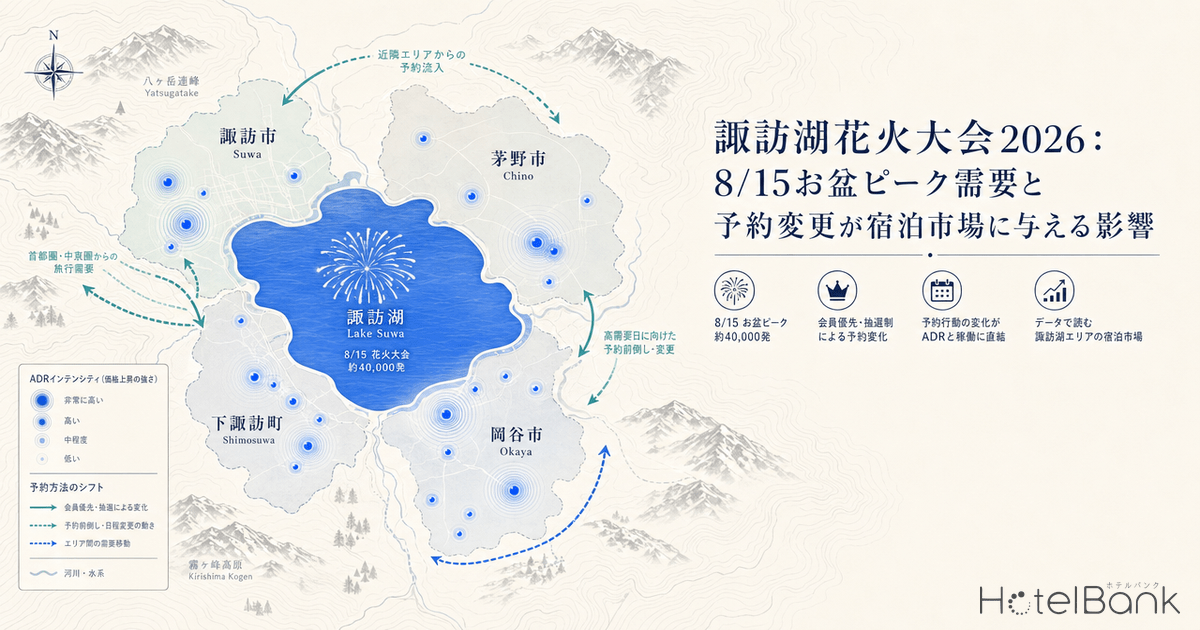

The 78th Lake Suwa Fireworks Festival is scheduled for Saturday, August 15, 2026, when the central day of the Obon holiday overlaps with a Saturday — creating one of the most concentrated peak-demand events of recent years. With approximately 40,000 fireworks launched, an unusual lakeside venue surrounded by mountains, and major changes to reservation methods and pricing introduced this year, the impact extends not only across the four municipalities around Lake Suwa but also reaches Matsumoto, Tateshina, and Lake Shirakaba. This article uses publicly disclosed price data from MetroEngines Research to quantitatively examine August pricing trends, lead times, and demand spillover into surrounding areas across the four Lake Suwa municipalities (Suwa City, Chino City, Okaya City, and Shimosuwa Town).
Metric Definitions Used in This Article: ADR (Average Daily Rate) is the average of publicly listed sales prices among surveyed properties and differs from actual transaction prices. Plan count refers to the number of plans publicly available and bookable on OTAs at the time of survey, and does not represent the total room inventory of properties. Prices are per-room rates (tax included) for two persons per room.
The 78th Suwa Fireworks: A Double Peak of Mid-Obon and Saturday
The Lake Suwa Fireworks Festival began in 1949 as a celebration of recovery from World War II and is now in its 78th year — a long-established festival. Held at Lake Suwa in Suwa City, Nagano Prefecture, around 40,000 fireworks are launched, featuring lakeside-only “water star mines” and a distinctive acoustic effect created by the surrounding mountains echoing the sound. The festival has traditionally been held on August 15 each year, and in 2026 that date falls on a Saturday, creating an exceptionally strong combination for accommodation demand.
What deserves attention is that, starting in 2026, several major ryokans have changed their reservation methods. Hotel Beniya in Kamisuwa Onsen began accepting reservations from its official website at noon on April 20, 2026, with lake-side and mountain-side rooms already sold out via priority booking for prior guests; only annex rooms are now offered to general buyers. Likewise, Hamanoyu in Kamisuwa Onsen has introduced a tiered system: a first-round reservation window limited to guests who stayed on August 15, 2025 (opening August 17, 2025), followed by a second-round window for newly registered members (opening August 30, 2025). The shift from a first-come-first-served model to a member-priority, lottery-style mechanism is both a response to chronic server load and customer-experience deterioration caused by instantaneous booking surges, and a deliberate strategy aimed at solidifying repeat customers and lifting average rates.
Monthly ADR Across the Four Lake Suwa Municipalities Shows a Twin-Peak Pattern in Summer and Fall
First, we examine ADR trends for the four Lake Suwa municipalities (Suwa City, Chino City, Okaya City, and Shimosuwa Town) using a year-over-year overlay. As is typical of mountain resort areas, seasonality is pronounced, with twin peaks in summer (July–August) and the autumn foliage season (September–October).
Source: MetroEngines Research, compiled by HotelBank Editorial Team (four Lake Suwa municipalities / 169 surveyed properties)
From 2024 through 2026, ADR has been rising steadily. The most recent data point for May 2026 is ¥43,300 (+11.1% YoY), and June 2026 stands at ¥42,200 (+10.6% YoY) — both maintaining double-digit growth. Looking specifically at August: 2024 was ¥43,500, 2025 was ¥46,900 (+7.8% YoY), and 2026 reaches ¥53,400 (+13.8% YoY) — an accelerating trajectory. With cooler temperatures at higher elevations and lower flood-disaster risk, mountain areas appear to benefit from preference shifts toward summer mountain resorts driven by global warming.
Aug 14–16 Peak Structure: Suwa City at 1.4× Normal Weekend Rates
The chart below aggregates daily ADR by municipality from August 10 to 18. Clear peaks form on the eve of the festival (8/14) and on the day itself (8/15), centered on Suwa City and Shimosuwa Town.
Source: MetroEngines Research, compiled by HotelBank Editorial Team (check-in basis Aug 10–18, 2026; average of plans bookable at the time of survey)
In Suwa City, ADR reached ¥82,700 on 8/13 and ¥79,100 on 8/14 — roughly 1.2–1.3× the normal weekend level of ¥65,000–¥69,000. Shimosuwa Town’s ADR for 8/14 was ¥59,500, 14% higher than the ¥52,200 recorded on 8/10. Notably, Suwa City’s 8/15 ADR appears lower at ¥56,600 compared to other days. This is not because rates are lower, but because mainstream mid-priced plans are already sold out, leaving only a small number of specialty plans available at the time of survey. The lead-time analysis below supports this hypothesis.
| Area | 8/14 ADR | 8/15 ADR | Normal Sat (8/22) ADR | 8/14 Sold-Out Rate |
|---|---|---|---|---|
| Suwa City | ¥79,100 | ¥56,600 | — | 17.6% |
| Shimosuwa Town | ¥59,500 | ¥67,300 | — | 8.0% |
| Chino City | ¥56,200 | ¥55,700 | — | 15.8% |
| Okaya City | ¥16,700 | ¥24,800 | — | 6.6% |
Source: MetroEngines Research, compiled by HotelBank Editorial Team (as of April 2026 / N=4,219 plans)
Lead-Time Analysis: 8/15 Has Only 30% of the Plans Available on Other Saturdays
Another characteristic of the Lake Suwa Fireworks is its abnormally early sell-out. As of late April 2026 (when this article was written), the chart below compares the number of bookable plans remaining on each Saturday in August. Even among Saturdays, only 8/15 stands out with markedly fewer available plans.
Source: MetroEngines Research, compiled by HotelBank Editorial Team (as of late April 2026; number of bookable plans publicly listed at the time of survey)
In Suwa City, normal Saturdays such as 8/22 had 1,918 plans listed and 8/29 had 1,998, but on the festival day (8/15) only 548 plans were available — just 29% of normal weekend levels. Okaya City is even more extreme: only 25 plans were observed for 8/15, compared with 22% of 8/22 and 22% of 8/29. Shimosuwa Town shows 110 plans for 8/15, only 35% of 8/22. Chino City exhibits the same pattern, with 8/15 sales counts well below other Saturdays.
This indicates that, as of four months out, many ryokans and hotels had already reached reservation caps or had stopped public OTA listings altogether, switching to direct-sales channels or priority distribution via ryokan associations. As with Hamanoyu’s two-stage flow (“first round limited to 2025 guests → second round for newly registered members”), properties using such designs effectively close out direct-sales bookings before plans ever reach the open OTA marketplace. From a customer’s perspective the booking sites appear sold out, but in reality some allocation often remains accessible only through specific channels.
→ Last-Minute Demand Just Before Golden Week 2026 | ADR Trend Analysis by Lead Time
Demand Spills Over to Matsumoto, Tateshina, and Lake Shirakaba; Matsumoto’s 8/15 Sold-Out Rate Hits 37%
Demand that cannot be accommodated near Lake Suwa overflows to neighboring lodging areas. Below we examine ADR and sold-out rates between August 10 and 18 in major candidate alternative regions.
Source: MetroEngines Research, compiled by HotelBank Editorial Team (August 2026; average of bookable plans publicly listed at the time of survey)
Matsumoto City — about 30 minutes from Suwa via the Chuo Main Line and home to a supply of large-capacity hotels — plays a key role in absorbing overflow demand on the festival day. Its sold-out rate reaches 33.8% on 8/14 and peaks at 37.0% on 8/15 — the highest figure during this period — before falling rapidly to 15–16% from 8/16 onward. This confirms a clear “Obon × fireworks” structure that pushes Matsumoto hotel prices sharply upward. The 8/15 ADR also reaches ¥53,800, roughly 25% higher than the low-¥40,000 range seen from 8/16 onward.
Tateshina Town (Lake Shirakaba and Tateshina area) shows a different pattern. As a core mountain resort area, it maintains high ADRs throughout the entire Obon period. Rates remain in the ¥62,000–¥82,000 range from 8/10 through 8/15, then drop sharply to ¥42,000–¥45,000 from 8/16 onward. This indicates that demand here is not primarily about viewing the Suwa fireworks but rather “family resort stays during the Obon holiday,” with 8/15 simply being one part of that broader pattern. Notably, sold-out rates on the festival day are actually somewhat lower than on surrounding days, suggesting that resort-style large properties respond to the overall Obon demand curve rather than to the fireworks event specifically.
| Area | Properties | 8/15 ADR | 8/22 ADR | Fireworks Premium |
|---|---|---|---|---|
| Suwa City | 21 | ¥56,600* | Low inventory | — |
| Shimosuwa Town | 7 | ¥67,300 | Low inventory | — |
| Chino City | 88 | ¥55,700 | ¥47,700 | +16.8% |
| Tateshina Town (Shirakaba/Tateshina) | 16 | ¥62,400 | ¥45,100 | +38.4% |
| Matsumoto City | 113 | ¥53,800 | ¥42,400 | +26.9% |
| Hara Village / Fujimi Town | 17 | ¥39,300 avg | ¥36,800 avg | +6.8% |
*Suwa City’s 8/15 ADR is a reference value, as the figure reflects only the residual plans remaining after most have already sold out. Source: MetroEngines Research, compiled by HotelBank Editorial Team
Ranking the spillover by area: Tateshina Town leads at +38.4%, followed by Matsumoto City at +26.9%, Chino City at +16.8%, and Hara Village/Fujimi Town at +6.8%. This gradient is best explained by two axes — travel time to the Lake Suwa venue, and resort-stay character. Tateshina/Shirakaba is 40–60 minutes by car from Lake Suwa and is too distant for direct viewing, but maintains a strong premium because its demand overlaps with overall Obon mountain resort demand. Hara Village/Fujimi Town, on the other hand, has good access (15–25 minutes by car) but consists of lower-priced properties, so the percentage uplift is more limited.
Management Implications: Maximizing Revenue in the Fireworks Festival Economy
The implications drawn from this data vary substantially by area and property type.
1. Ryokans and hotels in immediate Lake Suwa areas (Suwa City, Shimosuwa Town): Major properties are essentially sold out months in advance, so the priorities consolidate to “rate maximization” and “loyal-customer retention.” The member-priority and prior-guest-priority distribution design adopted by Hamanoyu and Beniya is the textbook approach: it smooths out peak access load on systems while increasing repeat-customer value. There is room to push pricing further beyond 2025 levels, but excessive premium pricing risks dampening booking intent for the following year. Setting up an opt-in window for “priority next-year notification” for guests who could not book this year is therefore important to build a long-term demand pipeline.
2. Chino City, Hara Village, and Fujimi Town: In areas with good access to Lake Suwa and relatively healthy plan inventory, room remains for further price increases. Designing limited-period plans for 8/14–16 — such as “Suwa Fireworks Viewing Plan with shuttle and earlier dinner” — that explicitly articulate the stay motivation could realistically yield ADR uplift of +15–20% above normal weekends. Chino City’s normal Saturday ADR of ¥47,700 (8/22) versus current 8/15 of ¥55,700 represents +16.8% — premium formation has begun but still has room to approach Matsumoto’s +26.9%.
3. Matsumoto City and Tateshina Town (Shirakaba/Tateshina): These areas should be viewed not as Suwa-fireworks destinations alone but as part of integrated “Obon × mountain resort” demand. Beyond the 8/14–16 peak, the early portion 8/10–13 also runs in the ¥45,000–¥80,000 range, so raising the floor rate across the entire Obon period and reducing multi-night discounts of two or more consecutive nights can be effective.
4. Operational innovation through changing reservation methods: The 2026 shift toward “member-priority + lottery-style” mechanisms substantially improves demand-forecasting accuracy. Under OTA first-come-first-served sales, predicting “when will it sell out” is difficult; under tiered member-priority models, response rates from the first window inform handling volumes for the second window, making it easier to deploy complementary upsells (room upgrades, extended-stay proposals, experience options). Increasing direct-sales share also reduces OTA commissions, with average margin improvement of 5–15% expected.
Supplement: Other Major Fireworks Festivals on August 15
Beyond Lake Suwa, several other major fireworks festivals are held around August 15 across Japan. Yamagata Grand Fireworks Festival in Yamagata Prefecture (August 14), Date Furusato Summer Festival Fireworks in Fukushima Prefecture (August 15), and Shirahama Fireworks Festival in Wakayama Prefecture (August 10) are all well known, and each generates similar concentrated lodging demand in its host area. The middle day of Obon — August 15 — would normally see lodging demand dispersed by the homecoming travel rush, but in 2026 it overlaps with a Saturday, layering on additional leisure-style accommodation demand. This is a tailwind not unique to Lake Suwa but common to all tourism destinations hosting major events on mid-Obon.
Conclusion
The 78th Lake Suwa Fireworks Festival (August 15, 2026) — held under the special conditions of mid-Obon coinciding with a Saturday — has pushed August ADR for the four Lake Suwa municipalities up +13.8% YoY. Suwa City’s plan inventory for the festival day has shrunk to 29% of other Saturday levels, quantitatively confirming a “sold-out months in advance” phenomenon. Demand spills over to Matsumoto City (+26.9%), Tateshina Town (+38.4%), and Chino City (+16.8%), making the fireworks festival economic zone span a 30–60 km radius. The 2026 reservation method changes symbolize a shift from instantaneous-rush bookings toward planned distribution design, simultaneously pursuing two strategic directions: improved demand-forecasting precision and higher direct-sales share for better profitability.
External references: Shinshu Lake Suwa Fireworks Official Site / Hamanoyu Reservation Method Notice / Hotel Beniya Reservation Opening Date Notice / Japan Tourism Agency
Related Articles
- One Month into Fukushima DC: Has Booking Activity Moved? — Verifying Campaign Effects with OTA Real-Price Data
- Last-Minute Demand Just Before Golden Week 2026 | ADR Trend Analysis by Lead Time
- [April 2026 Update] In-Depth Analysis of Atami’s Ryokan Market | 76 Properties, 2,508 Rooms — Market Structure and ADR Trends
- The Succession Crisis at Long-Established Ryokans — 89 Bankruptcies, 30% Without Heirs: Structural Realities and Survival Conditions
- Tourism DX Promotion Subsidy (Up to ¥15M) — A Step-by-Step Guide for Lodging Businesses