

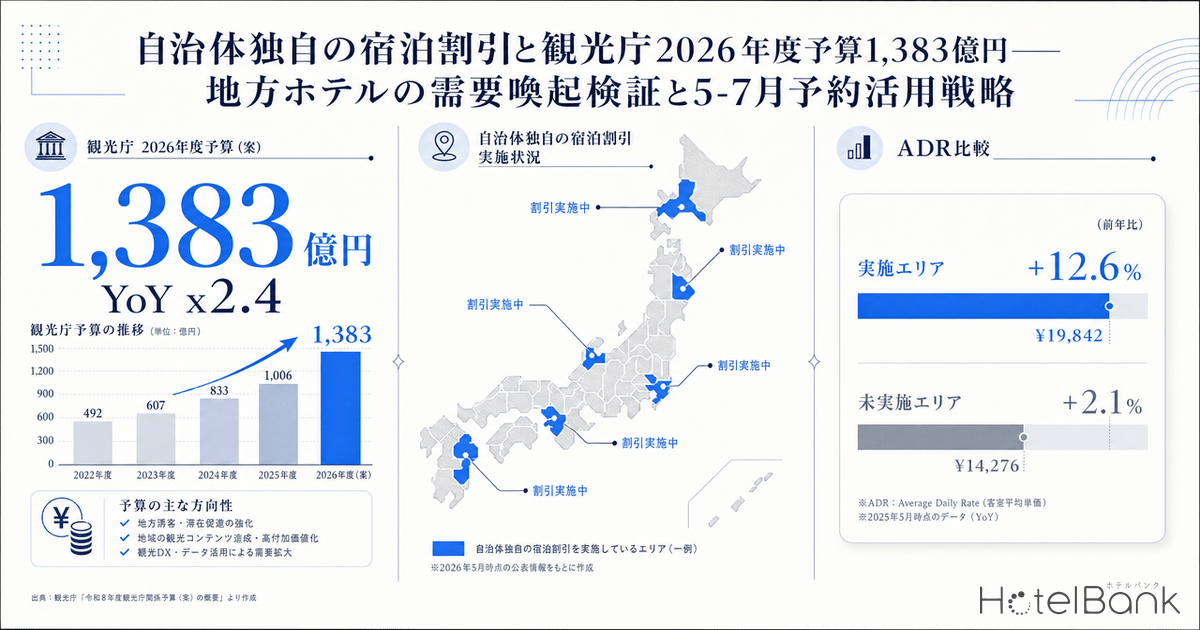
The Japan Tourism Agency’s (JTA) FY2026 budget has been expanded to ¥138.3 billion, a 2.4-fold year-over-year increase, with priorities placed on regional tourism promotion and improving acceptance environments at tourist destinations. Meanwhile, as of April 2026, local governments across Japan are rolling out their own accommodation subsidies and tourism discounts in rapid succession—including Fukushima Prefecture’s “Mata Kite.” Discount (¥3,000 off per night), Kagoshima Prefecture’s “Summer Kagoshima Lodging Discount” (up to ¥8,000 off), and Hiroshima/Yamaguchi’s “Hiroshima Wari” (up to ¥12,000 off)—creating a series of measures to lift regional lodging demand. This article maps the implementation status of these prefectural-level discount programs, then uses MetroEngines Research’s published price data (forward-looking inventory for May–July 2026) to verify how subsidies impact actual prices and inventory absorption at regional hotels. We offer practical implications for sales strategies leveraging subsidies, aimed at regional hotel operators, tourism association staff, and local government tourism promotion officers.
Metric Definitions Used in This Article
- ADR (Average Daily Rate): Average of selling prices published on OTAs and other channels. This differs from actual transaction prices (when cross-checked against REIT disclosure data, average is +25–30% higher than booked ADR. This is because unsold high-tier plans tend to remain on OTAs longer, structurally inflating the published-price average above the booked price). Per-room rate for double occupancy (tax included), averaged across all plans (room-only through meal-inclusive plans).
- Sold-out Rate: Percentage of plans that had closed reservation acceptance on OTAs at the survey timing. This differs from overall property occupancy rate. This article aggregates forward-looking inventory for May–July 2026 check-ins (as of April 2026).
- Data Source: MetroEngines Research (analyzing approximately 27,000 properties and 1.26 million rooms in Japan). The JTA FY2026 budget is based on official publications, and prefectural discounts are based on each local government’s official websites.
JTA FY2026 Budget ¥138.3 Billion—Where Has Regional Support Been Directed?
Approved by the Cabinet on December 26, 2025, the JTA’s FY2026 budget expanded approximately 2.4-fold from the previous year’s ¥57.1 billion to ¥138.345 billion. The core funding source is the International Tourist Tax (Departure Tax), which will be raised from ¥1,000 to ¥3,000 during FY2026, with tax revenue projected to jump from ¥44.1 billion to approximately ¥130 billion. In budget scale, this represents the largest level since the JTA’s establishment, signaling the government’s policy commitment to the tourism industry.
The budget is structured around three pillars. First, “balancing inbound acceptance with the quality of life for residents”; second, “promoting regional tourism through demand dispersion”; and third, “revitalizing the tourism industry.” For regional hotel operators, the regional support programs tied to the second pillar are particularly important. Specifically, ¥10 billion (8.34x year-over-year) has been allocated to acceptance environment improvements including overtourism prevention and mitigation, and ¥1.879 billion (2.21x) to promoting sustainable tourism community development. These funds, with DMOs and local governments serving as implementing entities, will be directed to infrastructure such as secondary transportation improvements, undergrounding of utilities, ICT deployment, and congestion mitigation. Additionally, barrier-free renovation subsidies for accommodation and tourist facilities (1/2 subsidy rate, capped at ¥30 million) are expected to continue.
Source: JTA FY2026 Budget Overview, compiled by HotelBank Editorial Team
Notably, while the JTA budget represents national-level “broad-area” support, prefectural accommodation subsidies and tourism discounts function as “pinpoint” immediate demand-stimulus measures. The two are complementary. For regional hotels selected as eligible properties for prefectural subsidies, a two-stage rocket effect emerges—broad-area infrastructure development (visitor delivery environment) via the JTA budget combined with direct price advantages (demand stimulus) via prefectural subsidies.
Prefectural Discounts Active as of April 2026—Major Program Overview
The following organizes the major prefectural accommodation and tourism discount programs active as of April 2026. There is significant variation across these programs—from systematically deployed prefecture-wide programs to limited municipal-level initiatives—in terms of scale, conditions, and duration. Comparing programs across the three axes of discount amount, period, and target scope makes it easier to determine sales strategy priorities at regional hotels.
| Area | Program Name | Discount Amount | Period | Conditions |
|---|---|---|---|---|
| Fukushima | “Mata Kite.” Discount | ¥3,000 / night / person | May 11–Jun 30, 2026 (Phase 1) | Stays of ¥8,000+; nationwide eligibility |
| Kagoshima | Summer Kagoshima Lodging Discount | Up to ¥5,000 (¥8,000 for remote islands) | May 6–Jul 31, 2026 | Up to 20% of lodging fee; nationwide |
| Hiroshima & Yamaguchi | Hiroshima Wari (Hiroshima/Iwakuni) | Up to ¥12,000 / night | Spring 2026, limited | Designated properties; combinable |
| Kumamoto | Kumamoto Rediscovery Trip | Up to ¥5,000 + ¥2,000 coupon | Year-round (FY-renewed) | Uses Regional Tourism Support Program |
| Miyagi (Sendai City) | Sendai Toku-tabi Campaign | Up to ¥3,000 / night / person | 2026 implementation | Targets stays in Sendai City |
| Akita (Happo Town) | Happo Travel Plus | Up to ¥3,000 / night / person | Feb 1–Jun 30, 2026 | Designated properties only |
| Akita (Kitaakita City) | Summer Hospitality Lodging Support | ¥3,000–¥4,000 coupons | May 1–Aug 31, 2026 | Stays at designated properties |
| Niigata (Shibata City) | Shibata City & Tsukioka Now & Get | Up to ¥5,000 + ¥2,000 souvenir | Apr 1–May 31, 2026 stays | Survey response required |
| Hokkaido | “Welcome Doumin” Goo-Pon | ¥3,000–¥30,000 | 17th–end of each month | Hokkaido residents only |
| Yugawara Onsen | Smile Coupon | Premium 30% (¥10,000 → ¥7,000) | Sales: Apr 2–12, 2026 | First-come, time-limited |
Source: Each local government’s official websites, compiled by HotelBank Editorial Team
Several clear trends emerge from this overview. First, only three prefectures—Fukushima, Kagoshima, and Kumamoto—deploy nationwide-eligible (open to non-residents) prefecture-level subsidy programs, all built on the JTA’s Regional Tourism Support Program framework. Second, the Tohoku region stands out for municipal-level original programs. Within Akita Prefecture alone, Happo Town, Kitaakita City, and Oga City each have set up their own subsidy schemes, employing a strategy of concentrating investment in specific hot spring areas and tourist destinations. Third, premium accommodation voucher schemes at hot spring resorts (such as Yugawara Onsen’s Smile Coupon) take the form of advance voucher sales rather than subsidies, simultaneously achieving prepaid funding and reliable demand lock-in.
Are Subsidies Driving Demand?—Verification Through Actual ADR and Sold-out Rates
From here, we use MetroEngines Research’s published price data to compare actual ADR and sold-out rates between subsidy-active and non-active areas. The comparison covers forward-looking inventory for May–July 2026 check-ins (survey timing: April 2026). We compare 7 subsidy-active prefectures (Fukushima, Kagoshima, Miyagi, Niigata, Akita, Hiroshima, Kumamoto) against 9 non-active prefectures (Nagano, Tochigi, Shizuoka, Mie, Wakayama, Okayama, Yamaguchi, Tottori, Shimane) with adjacent or similar tourism characteristics in a panel comparison.
Source: MetroEngines Research, compiled by HotelBank Editorial Team (N=5,253 properties in active group; 6,156 in non-active group)
Comparing ADR levels for June 2026, the average ADR for the subsidy-active group is ¥31,700, while the non-active group’s average is ¥39,100—a level approximately 23% higher in the non-active group. This gap itself reflects the structural concentration of resort destinations with strong access from the Tokyo and Kansai metropolitan areas in the non-active group—Nagano (Karuizawa, Matsumoto), Shizuoka (Atami, Izu), Tochigi (Nikko, Kinugawa), Mie (Ise-Shima), and Wakayama (Shirahama)—reflecting differences in structural tourism positioning. The 7 subsidy-active prefectures are structurally lower-ADR areas, and also areas where the need for subsidies is high.
Next, let’s examine the sold-out rate (forward inventory absorption status). For regional hotels, the share of May–July inventory already absorbed (i.e., booked) as of April 2026 is a key indicator for measuring subsidy effectiveness.
Source: MetroEngines Research, compiled by HotelBank Editorial Team
Examining sold-out rates by month reveals an interesting pattern. The subsidy-active group’s sold-out rate stands at 20.9% on average for May, 14.9% for June, and 16.4% for July. In contrast, the non-active group registers 14.3%, 14.0%, and 13.6% respectively. Particularly striking are Miyagi (May: 25.5%), Akita (May: 28.0%, July: 30.9%), and Hiroshima (May: 23.2%). Akita’s exceptionally high 30.9% sold-out rate as of July suggests that the seamless transition from Happo Town’s “Happo Travel Plus” (through Jun 30) to Kitaakita City’s “Summer Hospitality Support” (through Aug 31) is strongly driving demand.
An even more important finding lies in the ADR year-over-year change (June 2025 → June 2026). Fukushima rose from ¥29,300 to ¥32,600 (+11.4%), Kagoshima from ¥28,300 to ¥31,000 (+9.8%), Hiroshima from ¥27,300 to ¥30,100 (+10.3%), and Kumamoto from ¥29,900 to ¥32,700 (+9.3%)—all showing nearly double-digit increases. Meanwhile, the non-active group’s Nagano rose from ¥37,400 to ¥41,600 (+11.0%) and Shizuoka from ¥38,900 to ¥43,800 (+12.6%), showing similar growth levels.
Source: MetroEngines Research, compiled by HotelBank Editorial Team
In other words, ADR year-over-year growth in subsidy-active areas is being maintained at levels comparable to non-active areas. This suggests subsidies are functioning not as a “device to lower prices” but as a “device to stimulate demand while maintaining prices.” Without subsidies, the 7 active prefectures would likely have needed to lower prices to capture demand and close the ADR gap (~23%) with the 9 non-active prefectures. Subsidies allow operators to avoid price reductions, and as a result, secure year-over-year growth in lodging unit prices.
→ May 2026 Inbound Booking Trends: Western and Southeast Asian Visitors Lifting Regional ADR
Area-by-Area Movements—What’s Happening in Tohoku, Kyushu, and the Chugoku Region
Let’s examine individual area dynamics in more detail. The relationship between subsidy program design and actual prices/sold-out rates contains important implications for regional hotel operators.
| Prefecture | May ADR | May Sold-out | Jun ADR | Jun Sold-out | Jul ADR | Jul Sold-out |
|---|---|---|---|---|---|---|
| Subsidy-Active Group | ||||||
| Fukushima | ¥33,300 | 17.3% | ¥32,600 | 14.0% | ¥34,000 | 14.5% |
| Kagoshima | ¥32,100 | 19.5% | ¥31,000 | 14.6% | ¥33,000 | 14.2% |
| Miyagi | ¥30,500 | 25.5% | ¥29,400 | 19.2% | ¥31,100 | 20.7% |
| Niigata | ¥39,200 | 16.2% | ¥39,500 | 12.6% | ¥40,500 | 11.5% |
| Akita | ¥26,900 | 28.0% | ¥26,700 | 25.0% | ¥29,100 | 30.9% |
| Hiroshima | ¥33,300 | 23.2% | ¥30,100 | 16.2% | ¥32,700 | 16.0% |
| Kumamoto | ¥33,800 | 17.8% | ¥32,700 | 12.7% | ¥33,800 | 11.2% |
| Non-Active Group (Reference) | ||||||
| Nagano | — | — | ¥41,600 | 12.4% | ¥46,600 | 12.8% |
| Shizuoka | — | — | ¥43,800 | 13.7% | ¥47,600 | 13.1% |
| Tochigi | — | — | ¥40,000 | 12.9% | ¥43,500 | 12.6% |
| Mie | — | — | ¥43,000 | 14.6% | ¥46,600 | 14.4% |
Source: MetroEngines Research, compiled by HotelBank Editorial Team
Looking at the Tohoku area (Fukushima, Miyagi, Akita), the sold-out rates in Miyagi and Akita are clearly higher than other regions. Miyagi’s “Sendai Toku-tabi Campaign” is designed to concentrate investment in Sendai City hotels, and inventory absorption is likely accelerating in the Sendai Station area where business and tourism demand overlap. As mentioned earlier, Akita has multiple municipal-level programs from Happo Town, Kitaakita City, Oga City, and others rolling out continuously with staggered timing—maintaining a “subsidy-usable state” from May through August, which appears to be encouraging early bookings.
The Kyushu area (Kagoshima, Kumamoto) shows contrasting movements. Kagoshima’s May sold-out rate is high at 19.5%, but settles into the 14% range in June and July. The “Summer Kagoshima Lodging Discount” is limited to May 6–July 31, strongly capturing demand immediately after the Golden Week holidays while maintaining a certain level of demand during the lull before summer vacation. Kumamoto’s “Kumamoto Rediscovery Trip” is a year-round program, so June and July sold-out rates settle in the calm 12% range, but with ADR year-over-year growth of +9.3%, it shows the typical pattern of “subsidies as floor support, prices rising.”
In the Chugoku region (Hiroshima, Yamaguchi, Tottori, Shimane, Okayama), the contrast between subsidy-active areas (Hiroshima, Yamaguchi) and non-active areas (Okayama, Tottori, Shimane) is sharp. Hiroshima’s May sold-out rate of 23.2% reaches over 1.5x that of non-active Okayama (reference 14.9%). The maximum ¥12,000 discount targeting Hiroshima/Iwakuni is powerfully driving post-Golden-Week demand. Meanwhile, non-active Shimane and Tottori hold up well with sold-out rates of 12–18%, revealing a clear demarcation between areas that “can compete on tourism resources alone, without subsidies” and areas where “subsidies provide the final push for demand creation.”
→ Tokyu Stay × Mercure Hiroshima’s Dual-Brand Strategy: A New Opening Format for Mid-Sized Cities
May–July 2026—Practical Sales Strategy Proposals Leveraging Subsidies
The verification thus far confirms that prefectural subsidies function as a “device to stimulate demand while maintaining prices.” For regional hotel operators, sales strategy during subsidy periods needs to shift from simply “selling cheap with subsidies” to “leveraging subsidies to increase bookings at standard price ranges.” Below, we organize specific practical proposals.
Proposal 1: Promote subsidy-eligible plans to “flagship plan” display priority. Because subsidy-eligible plans are displayed at “pre-discount regular price” on OTAs, they may get buried if you simply compete on price. Instead, marking plan names with tags like “[Mata Kite. Discount Eligible]” or “[Summer Kagoshima Lodging Discount Eligible]” effectively differentiates them in search result visibility. In the case of Fukushima’s “Mata Kite.” Discount, eligibility requires lodging fees of ¥8,000 or more, so the subsidy-using segment concentrates in mid-to-high price ranges. Keeping lower-tier room-only plans as non-subsidy options optimizes the overall display strategy across price ranges.
Proposal 2: Combine staged pricing toward the end of subsidy periods. Fukushima’s “Mata Kite.” Discount Phase 1 covers stays from May 11 to June 30, 2026. Kagoshima’s “Summer Kagoshima Lodging Discount” deadline is July 31. Just before these deadlines, last-minute demand is expected as “the final chance to use the subsidy,” making it effective to design pricing that gradually raises rates above normal levels in the final week. Specifically, pricing of +5% in the two weeks before the deadline and +10% in the final week can maximize subsidy psychology while capturing additional revenue opportunities.
Proposal 3: Bundle subsidy-eligible plans with value-added plans. Kagoshima’s “Summer Kagoshima Lodging Discount” provides up to 20% off lodging fees (capped at ¥5,000). Reaching the discount cap requires lodging fees of ¥25,000 or more, so operators have an incentive to push “meal-inclusive plans or private hot spring plans of ¥25,000+” as flagship offerings. The subsidy cap design can become an incentive for operators to raise unit prices, so hotels should foreground messaging that “maximizing the discount = recommending higher-tier plans.”
Proposal 4: Reverse-engineer sales for non-subsidy months. When Fukushima’s “Mata Kite.” Discount Phase 1 ends on June 30, there may be a gap until Phase 2 (summer) is announced. This gap period is precisely the opportunity for in-house repeater initiatives and direct-booking strengthening. For lodging guests acquired during the subsidy period, operating with a message like “Next time, we’ll offer equivalent advantages exclusively through direct booking” channels OTA-routed guests toward direct bookings, lifting post-subsidy revenue.
Proposal 5: Be conscious of linkage with JTA regional support programs. The JTA FY2026 budget allocates ¥10 billion to acceptance environment improvements, and projects led by DMOs and local governments—ICT deployment, congestion mitigation, secondary transportation improvements—are getting underway. These are direct visitor-flow generation measures, so regional hotel operators can convert “broad-area support” into “pinpoint demand” by partnering with local DMOs, tracking the progress of JTA budget projects, and rolling out lodging plans linked to them (e.g., plans bundling secondary transportation, ICT booking system launch commemorative plans).
Source: MetroEngines Inc., compiled by HotelBank Editorial Team
Summary—Subsidies Function as a Dual Effect of “Demand Stimulation × Price Maintenance”
As of April 2026, prefectural accommodation discount and tourism subsidy programs are active in major regional areas including Fukushima, Kagoshima, Hiroshima, Kumamoto, Miyagi, Akita, Niigata, and Hokkaido. The JTA’s FY2026 budget of ¥138.3 billion is allocated to broad-area infrastructure improvements that complement these prefectural programs, forming a dual support structure of “broad-area (JTA) × pinpoint (local government)” under the policy goal of promoting regional tourism.
Verification using MetroEngines Research’s published price data shows the average ADR for the 7 subsidy-active prefectures at ¥31,700 versus ¥39,100 for the 9 non-active prefectures—structurally lower in the active group, but ADR year-over-year growth runs neck-and-neck at +9–13% in both groups. Sold-out rates exceed 20% in Miyagi, Akita, and Hiroshima, confirming that subsidies contribute to demand stimulation. Notably, Akita’s continuous municipal-level programs achieve a 30.9% sold-out rate as of July, making it a high-reference-value case study for regional hotel operators.
For regional hotel operators, the booking period of May–July 2026 demands a practical balance of “leveraging subsidies while maintaining ADR.” Rather than treating subsidies as mere price discounts, the keys to maximizing revenue opportunity are operator-side proactive actions—strategies to maintain or raise flagship plan prices during the subsidy period, transitions to in-house direct-booking strengthening after subsidies end, and linkage with JTA budget projects. From the perspective of tourism associations and local government tourism promotion staff, when designing subsidy programs, “discount caps,” “period continuity,” and “eligible property selection criteria” become important parameters directly tied to maintaining ADR and absorbing inventory across the entire region.
Note on Future-Date ADRs: The ADRs in this article are averages of selling prices published on OTAs at the survey timing (April 2026), and fluctuate as check-in dates approach. Prices currently set high may decline through last-minute reductions, and sold-out rates may shift due to additional subsidy program allocations or period extensions. For the latest information on each prefectural subsidy program, please always check the official websites.
Related Articles
- Hokkaido in June, Free of the Rainy Season: How Will Hotel Prices Move? A 6-City ADR Comparison for 2026
- National Average ADR Hits Record ¥32,340 (May 2026): Decoding the “+19% in 3 Years” Structure of Inflation × Labor Cost Pass-Through
- The True Nature of Labor-Cost-Pass-Through ADR Growth: Reading 2026 Hotel Pricing Structure Through OCC × ADR Divergence
- Will Junglia Okinawa’s Opening Shift the Northern Market to “Year-Round”? Verification Through 6-Area ADR and Sold-out Rates
- Tokyu Stay × Mercure Hiroshima’s Dual-Brand Strategy: A New Opening Format for Mid-Sized Cities
- May 2026 Inbound Booking Trends: Western and Southeast Asian Visitors Lifting Regional ADR
- Summer 2026 Top 5 Resort Areas: ADR, Sold-out Rate, and YoY Comparative Analysis
- Kansai Luxury Hotel Supply-Demand Inflection Point: Reading 2026 Through DBJ Estimates and OTA Actuals