


The “APA Hotel (TKP Nippori Ekimae) Annex (tentative name),” for which TKP Corporation held a groundbreaking safety ceremony on November 18, 2026, is planned as a 10-story steel-frame building with 63 rooms. Construction is scheduled to start in December 2026, with completion and opening planned for summer 2028. The annex will be built near the existing hotel (15 stories above ground, 278 rooms), which opened in December 2016, and the two buildings will be operated as one, bringing the total to 341 rooms. Stacking 996.58㎡ of floor area on a 205.01㎡ (62.01 tsubo) site, with 54 rooms—86% of the total—as twins, the plan is a concrete example of the option of “adding to” an existing hotel on a small site next to a station. In this article, we overlay the room stock within 1km of Nippori Station, the rate levels in Arakawa Ward and construction cost assumptions to read this expansion from an investment-return perspective.
• ADR (Average Daily Rate) = an estimated settled rate (tax-excluded equivalent), calculated by applying segment-specific adjustment factors to the lowest-plan rate each property publishes on OTAs (per room, 2 guests per room, tax-included). Checked against property-level results disclosed by listed hotel REITs (91 properties, most recent 3 months), the median error is about 7%. These are estimates and differ from each property’s actual settled prices and accounting figures.
• ADR at the area level (prefecture or city/ward) is the median of the estimated settled rates of the properties covered (the level of a typical property in the area).
• Where listed prices are mentioned, they are per-room rates for 2 guests per room (tax-included).
• OCC (occupancy rate) = the share of rooms sold out of total rooms in the area (an estimate based on OTA sales inventory).
• Source: MetroEngines Research (continuously tracking OTA published prices for approx. 168,000 properties in Japan, of which approx. 27,000 are confirmed operating)
Scope of the Room Stock Count
The room stock in this article covers lodging facilities with 10 or more rooms (excluding leisure hotels) within a 1,000m radius of Nippori Station. “Active” refers to properties whose selling prices were confirmed on major booking sites in the most recent 3 months (September–November 2026) (as of November 20, 2026, compiled by MetroEngines Research).
“Listed” refers to the total room stock of all properties we track within the radius, and “active” refers to those among them whose selling prices were confirmed in the period above. MetroEngines Research tracks approx. 168,000 properties in Japan, of which approx. 27,000 properties and approx. 1.26 million rooms confirmed as operating on OTAs are the subject of analysis.
| — The 63-room annex stacks 996.58㎡ of floor area on a 205.01㎡ site; dividing floor area by rooms gives 15.8㎡ per room. This can be read as the space efficiency that only an expansion sharing common functions with the existing building can achieve. |
| — Within 1km of Nippori Station, 23 properties with 1,168 rooms are confirmed as active. The existing 278-room hotel is the only property in the radius with 201 or more rooms, and the combined 341 rooms with the annex equal 27.7% of active rooms in the radius (after adding the annex). |
| — Arakawa Ward’s estimated settled ADR was ¥16,447 in October 2026 (+4.9% YoY, N=11 properties), with a trailing 12-month average of ¥13,789. The existing hotel’s average for the same period was ¥14,734, above the ward level. |
| — In the editorial team’s simple estimate, the building construction cost is about ¥730 million on a 2025-actual basis, rising to about ¥800 million (about ¥12.72 million per room) once cost increases during construction are factored in. |
| — Even after adding a reference land value based on nearby official land prices, the GOP-based yield comes to 6.9–10.4% (3 cases), and the ADR required for an 8% yield is about ¥13,100, below the ward’s 12-month average. |
Plan Overview — A 10-Story, 63-Room Annex Near the Existing Hotel, 2 Minutes from the Station
First, let us outline the published plan. According to TKP’s announcement as reported by Hotel Industry News, the annex will be located at 5-1132-8 Higashi-Nippori, Arakawa Ward, Tokyo, a 2-minute walk from Nippori Station, which is served by the JR Yamanote, Keihin-Tohoku and Joban lines, the Keisei Line and the Nippori-Toneri Liner. It will be a 10-story steel-frame building with a site area of 205.01㎡ (62.01 tsubo) and a total floor area of 996.58㎡ (301.46 tsubo), and its 63 rooms will consist of 54 twin rooms and 9 queen rooms. A coin laundry and vending machines are listed as in-house facilities, and the opening date and facility outline are described as current plans.
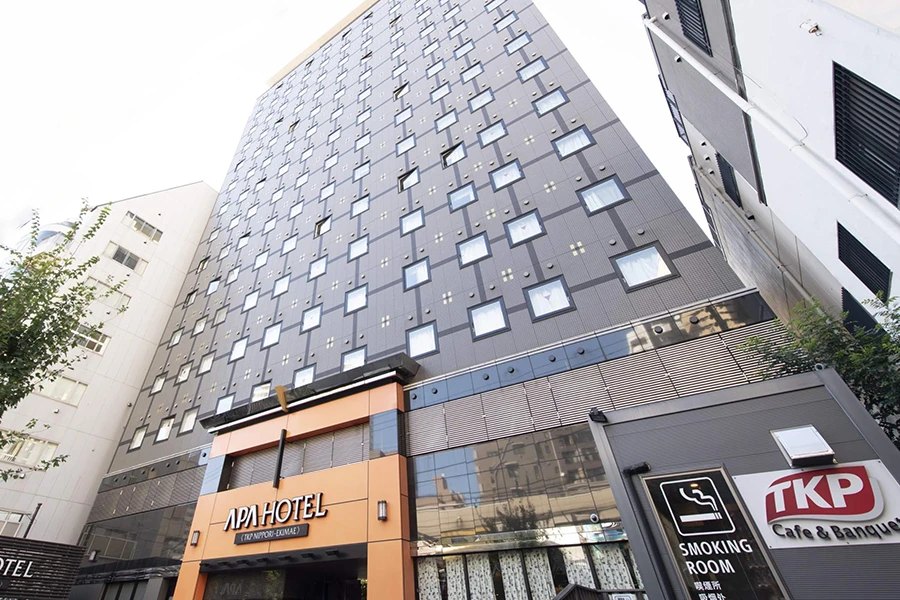
As the reason for the development, TKP cites strong lodging demand, centered on inbound travelers, near Nippori Station. The existing hotel, with 15 floors above ground and 278 rooms, was opened by TKP in December 2016 under a franchise agreement with APA Hotel, and houses the restaurant “TKP Cafe&Banquet.” The annex will be operated together with this existing hotel, for a planned total of 341 rooms after opening. TKP has been developing hotels on a franchise basis since “APA Hotel (TKP Sapporo Ekimae)” in 2014, and after the annex opens, its APA Hotel franchise business is expected to reach 25 buildings and 4,363 rooms, with all lodging facilities it operates totaling 37 properties and 5,194 rooms. The project can be positioned as part of a growth strategy of expanding operating scale through repeated capacity additions.
| Item | Annex (tentative name) | Existing Building |
|---|---|---|
| Location | 5-1132-8 Higashi-Nippori, Arakawa Ward, Tokyo | Near the annex (in front of Nippori Station) |
| Structure / Floors | Steel frame, 10 stories | 15 stories above ground |
| Rooms | 63 rooms (54 twin, 9 queen) | 278 rooms |
| Site Area | 205.01㎡ (62.01 tsubo) | — |
| Total Floor Area | 996.58㎡ (301.46 tsubo) | — |
| Facilities | Coin laundry, vending machines | Restaurant “TKP Cafe&Banquet” |
| Schedule | Construction start Dec 2026; completion and opening summer 2028 (planned) | Opened Dec 2016 |
| Operator | TKP Corporation (franchise agreement with APA Hotel). Operated as one after opening, 341 rooms in total | |
Space Efficiency — 15.8㎡ of Floor Area per Room and an 86% Twin Ratio
What stands out in this plan is how it uses the site and the floor area. Dividing the 996.58㎡ floor area by the 205.01㎡ site gives about 4.86 times, which works out to about 100㎡ per floor on a simple 10-story average. Floor area divided by the 63 rooms is 15.8㎡, a higher share of floor space devoted to guest rooms than in a 179-room, 3,954.08㎡ hotel project under way in the same Arakawa Ward (based on MLIT’s Building Dynamics Statistics, 22.1㎡ per room). Given that the annex’s facilities are limited to a coin laundry and vending machines and that it will be operated together with the existing hotel, which has a restaurant, the plan can be read as sharing common functions with the existing building in order to devote more floor space to guest rooms. We also examined the conditions under which a small annex sharing a front desk with its main hotel can work in our case study of a 14-room unstaffed annex below Okayama Castle.
The room mix is also distinctive. Of the 63 rooms, 54 (85.7%) are twins and 9 are queens, so every room is a type easily used by two guests. Weighting a station-front hotel with good airport access toward rooms for multiple guests can be read as a design to capture the inbound-centered lodging demand that TKP cited as its reason for development. Adding 63 rooms to the existing 278 rooms is a +22.7% increase, a scale at which growth in room count can readily translate into higher operating efficiency if the front desk, reservation management and housekeeping can be shared.
Location — 107,000 JR Boardings a Day at Nippori, Non-Commuters Are the Majority on Keisei
The strength of the location lies in its depth as a transport hub. According to JR East, Nippori Station’s average daily boardings in FY2024 were 107,077 (104.8% of the previous year). Keisei Electric Railway’s Nippori Station had average daily passengers (boarding and alighting) of 107,877 in FY2025, up about 6.4% from 101,435 in FY2024. The breakdown is notable: of Keisei’s passengers, non-commuter-pass users numbered 55,593, exceeding the 52,284 commuter-pass users. As a stop on the Skyliner linking Narita Airport and central Tokyo, the station evidently functions not only for commuting to work and school but also as a transfer hub for travelers.
| Indicator | Figure | Source / Period |
|---|---|---|
| JR Nippori Station, average daily boardings | 107,077 | JR East, FY2024 (104.8% of previous year) |
| Keisei Nippori Station, average daily passengers | 107,877 | Keisei Electric Railway, FY2025 (commuter pass 52,284 / non-commuter 55,593) |
| Official land price of commercial land near the station | ¥3.11 million/㎡ | 2026 Official Land Prices, Higashi-Nippori 5-chome (about 200m from the station, +18.7% YoY, floor area ratio 700%) |
| Establishments and employees within 1km of the station | 4,296 establishments, 35,370 employees | Economic Census for Business Activity (2021) |
Land price movements also reflect how the station area is valued. In the 2026 Official Land Prices, commercial land in Higashi-Nippori 5-chome, about 200m from Nippori Station, was valued at ¥3.11 million per ㎡ (+18.7% YoY), with a designated floor area ratio of 700%. Since the conditions of the annex site itself have not been disclosed, we avoid drawing firm conclusions, but at a time when land prices in front of the station are rising at nearly 20% a year, using a roughly 62-tsubo site near an existing hotel to add rooms is likely an easier way to expand scale while keeping land costs down than securing a large new site. In addition, within 1km of the station there are 4,296 establishments and 35,370 employees based on the Economic Census (2021), with office-type employees making up 18.1% of the total. Rather than a business district, it is a neighborhood mixing commerce, services and housing, a location where lodging demand is more likely to be driven by tourism and transfers than by business trips (employee counts are workplace-based statistics and do not represent the population present in the area).
Room Stock — 23 Active Properties with 1,168 Rooms Within 1km; Only the Existing Hotel Has 201+ Rooms
Next, we look at the size of the market the annex will join. Within a 1km radius of Nippori Station, we track 31 listed properties with 1,460 rooms, of which 23 properties with 1,168 rooms are active, with selling prices confirmed in the most recent 3 months. The annex’s 63 rooms equal 5.4% of the active stock, 8.4% of the 747 active business hotel rooms, and 4.3% on a listed basis; the ratio varies with the base used, but under every base the addition is less than 10% of the overall market.
By size, small properties with 50 rooms or fewer account for 16 active properties with 321 rooms, or about 70% of properties in the radius, while the only property with 201 or more rooms is the existing 278-room hotel. The existing hotel currently accounts for 23.8% of active rooms in the radius, and the combined 341 rooms including the annex equal 27.7% of the 1,231 rooms in the radius after the annex is added. Few properties in front of the station can sell a large block of rooms as one, and the expansion can be positioned as an investment that further raises the hotel’s presence.
Over time, room stock in the radius grew from 997 rooms in 2017 to 1,277 rooms in 2026, an increase of 280 rooms over 9 years. The largest increase came in 2021, when a 138-room hotel opened, and the total has been flat since 2022. By decade of opening, the 2010s are the thickest at 11 listed properties with 689 rooms, while the 2020s account for 8 properties with 250 rooms; apart from the single 138-room property, openings were mostly small. In other words, new supply of more than 100 rooms has been absent from the Nippori Station area in recent years, and the 63 rooms in summer 2028 will be the first sizable room addition in some time.
| Type | Listed: Properties | Listed: Rooms | Active: Properties | Active: Rooms |
|---|---|---|---|---|
| Business hotel | 14 | 855 | 11 | 747 |
| Hostel | 7 | 196 | 5 | 160 |
| City hotel | 1 | 128 | 1 | 128 |
| Dormitory | 2 | 88 | 0 | 0 |
| Other | 1 | 60 | 0 | 0 |
| Capsule hotel | 1 | 56 | 1 | 56 |
| Guesthouse | 3 | 48 | 3 | 48 |
| Ryokan | 2 | 29 | 2 | 29 |
| Total | 31 | 1,460 | 23 | 1,168 |
| Property | Type | Rooms | Opened | Distance from Station |
|---|---|---|---|---|
| APA Hotel (TKP Nippori Ekimae) (アパホテル〈TKP日暮里駅前〉) | Business hotel | 278 | 2016 | 211m |
| Almont Hotel Nippori (アルモントホテル日暮里) | Business hotel | 138 | 2021 | 296m |
| Art Hotel Nippori Lungwood (アートホテル日暮里 ラングウッド) | City hotel | 128 | 1988 | 206m |
| Sakura Hotel Nippori (サクラホテル日暮里) | Hostel | 94 | 2017 | 598m |
| Hotel MyStays Nippori (ホテルマイステイズ日暮里) | Business hotel | 93 | 1987 | 324m |
| Hotel Tokyo Trip | Business hotel | 60 | 2019 | 453m |
| HOTEL owl TOKYO | Capsule hotel | 56 | 2017 | 261m |
| Hotel Cerezo (ホテルセレッソ) | Business hotel | 48 | 2004 | 605m |
| Hotel Livemax BUDGET Nippori (ホテルリブマックスBUDGET日暮里) | Business hotel | 45 | 2011 | 641m |
| fav Tokyo Nishi-Nippori (fav 東京西日暮里) | Business hotel | 24 | 2022 | 649m |
The radius also includes a property owned by a listed REIT. According to our ownership master (as of November 16, 2026), Hotel MyStays Nippori (93 rooms) was acquired by Invincible Investment Corporation (8963) in July 2014 for ¥1,898 million, or about ¥20.4 million per room. The transaction took place more than 10 years ago and differs from current price levels, but it shows that this is an area where station-front limited-service hotels have become holdings of institutional investors.
Rates and Occupancy — Arakawa Ward ADR at ¥16,400 in October, with Peaks in Autumn and Spring
Next, we look at the rate levels underlying revenue. Arakawa Ward’s estimated settled ADR was ¥16,400 in October 2026, up 4.9% from ¥15,700 a year earlier (N=11 properties). The average for the most recent 12 months (November 2025–October 2026) was ¥13,800. Over the year, peaks appear in April (¥17,000 in 2026) and October–November, while June–August settles in the ¥10,000–¥11,000 range. This is a seasonality typical of eastern Tokyo, where inbound visitors concentrate in the cherry blossom and autumn foliage seasons, and whether a hotel can capture the height of those peaks—not just the annual average—determines its revenue.
Compared with neighboring wards, the most recent 12-month average is ¥15,500 in Sumida Ward, ¥14,600 in Taito Ward and ¥14,000 in Bunkyo Ward, against ¥13,800 in Arakawa Ward—94% of the level of Taito Ward, home to Ueno and Asakusa. Within that, the existing hotel’s estimated settled ADR for the same period was about ¥14,700, above the ward median and at or above the median (about ¥14,500) of the 11 properties within 1km of Nippori Station for which 12-month rates are available. The station-front location is also highly rated in reviews: of 1,365 guest reviews of the existing hotel compiled by the HotelBank Editorial Team (most recent 24 months, December 2024–November 2026), 534 mentioned proximity to the station (a mention rate of 39.1%), and 500 of those were positive. All 102 reviews that mentioned airport access were positive, with comments such as “close to Nippori Station, and getting to Narita Airport is easy” and “easy to reach from Narita Airport on the Skyliner.” Reviews written in languages other than Japanese numbered 733 (53.7%), a majority, consistent with TKP’s explanation citing strong inbound demand as its reason for development.
Supply and demand are also tight in terms of occupancy. Arakawa Ward’s occupancy rate (estimated, based on OTA listed inventory) was 86.5% in July 2026, 84.2% in August, 84.5% in September and 93.6% in October (12–13 properties / 893–907 rooms, based on listings on major booking sites). On the same basis, Tokyo as a whole was 91.1% in July and 95.5% in October, and Arakawa Ward also exceeded 90% at the autumn peak. These are estimates based on how inventory sold on OTAs is absorbed and differ from the actual occupancy of each property as a whole, but they do confirm that the rate peak and the occupancy peak coincide.
| Area | Jul 2026 | Aug | Sep | Oct | Coverage (based on major booking site listings) |
|---|---|---|---|---|---|
| Arakawa Ward | 86.5% | 84.2% | 84.5% | 93.6% | 12–13 properties / 893–907 rooms |
| Tokyo | 91.1% | 88.2% | 89.8% | 95.5% | 792–874 properties / 103,904–105,297 rooms |
A Two-Stage Construction Cost Estimate — About ¥730–800 Million for the Building
What follows is a simple estimate by the editorial team. Since TKP has not disclosed the project cost, we apply public statistics and market data to gauge its scale. The construction cost of lodging-use buildings in 2025, based on MLIT’s Building Construction Starts Statistics, was ¥2.405 million per tsubo for steel-frame structures. Multiplying this unit cost by the annex’s 301.46 tsubo of floor area gives about ¥730 million for the building, or about ¥11.51 million per room. This is the first-stage figure on a “2025-actual basis.”
However, construction is scheduled to start in December 2026 and finish in summer 2028, so most of the work will take place in 2027. Construction costs continue to rise, and assuming increases of +5.3% in 2026 and +5.0% in 2027, with reference to Turner & Townsend’s outlook, the unit cost rises to about ¥2.659 million per tsubo and the building to about ¥800 million (about ¥12.72 million per room). This is the second-stage figure “factoring in cost increases during construction.” Because rising construction costs raise the hurdle for new entrants, they can also be an upside factor for operators that already have an operating base and a station-front site, as competing new supply becomes less likely. How the required ADR moves when construction costs exceed expectations is covered in detail in our sensitivity analysis of construction cost overruns and required ADR.
| Stage | Cost per Tsubo | Building | Per Room | Total Incl. Reference Land Value |
|---|---|---|---|---|
| Stage 1: 2025-actual basis (steel frame) | ¥2.405 million | ¥725 million | ¥11.51 million | ¥1.363 billion |
| Stage 2: after factoring in increases during construction | ¥2.659 million | ¥802 million | ¥12.72 million | ¥1.439 billion |
As for the land, whether it was acquired and on what terms have not been disclosed. As a reference, valuing the 205.01㎡ site directly at the official land price of nearby commercial land near the station, ¥3.11 million per ㎡, gives about ¥640 million; combined with the second-stage building cost, the total is about ¥1.44 billion, or about ¥22.84 million per room. We stress that the official land price point and the annex site do not necessarily share the same conditions, and this is only a way to gauge the order of magnitude. Recalling that the REIT-owned property mentioned above was acquired for about ¥20.4 million per room (2014), if a new station-front building can be delivered at the low ¥20 millions per room including land, it is an investment unit cost that compares favorably with transaction levels for existing properties.
Revenue Scenarios — ¥270 Million in Room Revenue in the Mid Case; About ¥13,000 ADR Needed for an 8% Yield
We estimate revenue by setting Arakawa Ward’s rate level in three ways. The conservative case uses an ADR of ¥12,000 and 80% occupancy, close to the ward level in January–February 2026; the mid case uses an ADR of ¥13,800 and 85% occupancy, equal to the ward’s most recent 12-month average; and the upside case uses an ADR of ¥16,400 and 88% occupancy, close to the ward level in October 2026. Room revenue for 63 rooms and 22,995 room-nights a year comes to ¥221 million in the conservative case, ¥270 million in the mid case and ¥332 million in the upside case. A GOP ratio of 45% is used. Relo Hotel Solutions states that for GOP ratio “around 30–40% is one benchmark for the industry in general,” and the results of the 91 operating properties disclosed by Invincible Investment Corporation were 38.9% (period ended December 2024, including full-service properties), so 45% is this article’s assumption, somewhat above these levels. It reflects the fact that an expansion operated together with an existing hotel can share staffing and sales functions, but note that if the actual level falls below this, the yield will also fall.
| Item | Conservative | Mid | Upside |
|---|---|---|---|
| Assumed ADR | ¥12,000 | ¥13,800 | ¥16,400 |
| Assumed occupancy | 80% | 85% | 88% |
| Annual room revenue | ¥221 million | ¥270 million | ¥332 million |
| GOP (45% GOP ratio) | ¥99 million | ¥121 million | ¥149 million |
| GOP ÷ building ¥802 million | 12.4% | 15.1% | 18.6% |
| GOP ÷ ¥1.439 billion incl. reference land value | 6.9% | 8.4% | 10.4% |
| Payback years (total incl. reference land value ÷ GOP) | 14.5 yrs | 11.9 yrs | 9.6 yrs |
The results show GOP-based yields on the ¥1.44 billion total including the reference land value of 6.9% in the conservative case, 8.4% in the mid case and 10.4% in the upside case. Working backward, assuming 85% occupancy and a 45% GOP ratio, the ADR required for a 6% yield is about ¥9,800, and for 8% about ¥13,100. That the ADR required for 8% is below the ward’s most recent 12-month average of ¥13,800 shows how readily the economics of adding rooms at this location can be forecast. A twin-centered room mix makes it easier to capture rates for two-guest use, and if levels close to the upside case can be secured during the spring and autumn peaks, the annual average will be pushed up further.
| Assumption | ADR | Occupancy | Room Revenue | GOP | GOP Yield |
|---|---|---|---|---|---|
| Mid case | ¥13,800 | 85% | ¥270 million | ¥121 million | 8.4% |
| ADR −10% | ¥12,420 | 85% | ¥243 million | ¥109 million | 7.6% |
| Occupancy −5pt | ¥13,800 | 80% | ¥254 million | ¥114 million | 7.9% |
| ADR −10% and occupancy −5pt | ¥12,420 | 80% | ¥228 million | ¥103 million | 7.1% |
| ADR +10% | ¥15,180 | 85% | ¥297 million | ¥134 million | 9.3% |
| Assumed Occupancy \ Assumed ADR | ¥11,000 | ¥12,400 | ¥13,800 | ¥15,200 | ¥16,600 |
|---|---|---|---|---|---|
| 75% | 5.9% | 6.7% | 7.4% | 8.2% | 9.0% |
| 80% | 6.3% | 7.1% | 7.9% | 8.7% | 9.5% |
| 85% | 6.7% | 7.6% | 8.4% | 9.3% | 10.1% |
| 90% | 7.1% | 8.0% | 8.9% | 9.8% | 10.7% |
| 95% | 7.5% | 8.5% | 9.4% | 10.4% | 11.3% |
In the two-way table moving ADR and occupancy at the same time, the combinations reaching an 8% yield are “assumed occupancy of 90% or more at an ADR of ¥12,400,” “assumed occupancy of 85% or more at an ADR of ¥13,800 (7.9% at 80%),” and “8.2% even at 75% assumed occupancy at an ADR of ¥15,200.” If rates can be held near the ward’s most recent 12-month average (¥13,800), a yield of around 8% can be maintained even if occupancy falls to 80%; on the other hand, if rates stay at the ward’s January–February 2026 level (about ¥12,100–¥12,200) all year, 8% cannot be reached unless occupancy is raised to just over 90%. The structure in which capturing the rate peaks decides the economics holds in the two-way view as well.
Even when the assumptions change, the yield is 7.1% with ADR down 10% and occupancy down 5 points, and 9.3% if ADR comes in 10% higher; the range of variation depends largely on how the rate is set. This is a simple estimate based on public information and market data, and an actual investment decision requires a detailed feasibility study. We also note again that these are not figures published by TKP.
Implications for Operators Considering an Expansion or Annex
To sum up, three characteristics of the option of adding rooms near an existing hotel can be read from this plan. Below we summarize issues likely to serve as starting points for owners, for operators developing as franchisees, and for developers handling small sites in Tokyo.
The annex’s facilities are a coin laundry and vending machines, while the existing hotel provides the restaurant. The space efficiency of 15.8㎡ of floor area per room is easier to achieve precisely because a main building with common areas is nearby. When considering an annex, first work out how much of the front desk, breakfast and housekeeping flow can be shared with the main building.
The existing hotel has about 10 years of operating history since opening in 2016, and over 90% of review mentions of its proximity to the station were positive. Adding rooms of the same brand at a location where the quality of demand is known is a growth strategy that makes revenue easier to forecast than opening in a new area.
This plan for 10 stories and 63 rooms on a 205.01㎡ site shows that a sizable number of limited-service rooms can be secured even on a roughly 60-tsubo site in front of a station. Partnering with the operator of an adjacent hotel creates development opportunities even on sites too small to work on their own.
The expansion also makes sense in terms of the supply environment. Within 1km of Nippori Station, no openings of more than 100 rooms have been confirmed since 2022, and adding 63 rooms to the active 1,168 rooms is a 5.4% increase. In a market where the ward’s ADR stays up year on year and autumn occupancy (estimated) exceeds 90%, a room addition of this size should be readily absorbed as demand grows. In Arakawa Ward, a 179-room project is also under way in front of Minowa Station, so the ward’s depth as a lodging base is set to increase through 2027–2028 (for details of the Minowa project, see our analysis of the 179-room APA Hotel Tokyo Minowa Ekimae).
Summary — Growth by “Adding” on a Small Station-Front Site
The APA Hotel (TKP Nippori Ekimae) Annex (tentative name) is a plan to fit 63 rooms on a 205.01㎡ site with 996.58㎡ of floor area, creating a 341-room operation together with the existing 278 rooms. The only property with 201 or more rooms among the 23 active properties with 1,168 rooms within 1km of Nippori Station will add still more rooms. Arakawa Ward’s estimated settled ADR rose to ¥16,400 in October 2026 (+4.9% YoY), and the existing hotel’s rates have remained above the ward median.
In the editorial team’s simple estimate, the building comes to about ¥800 million after factoring in cost increases during construction, and even with a reference land value based on nearby official land prices, the GOP-based yield falls within a range of 6.9–10.4%. Rather than searching for a new site from scratch, adding rooms near a proven location is a realistic growth strategy for expanding operating scale at a time of rising land prices and construction costs. Looking toward the summer 2028 opening, the next point to watch is at what rate range the twin-centered 63 rooms will be sold.
⚠ Note on ADR for future dates: In this article, ADR for November 2026 and later months is an estimate based on selling prices published on OTAs at the time of research and will change as check-in dates approach. Please note that prices currently set high may change with last-minute adjustments.
Related Articles
References and Sources
■ Data Sources
Room stock is the count compiled by MetroEngines Research on an OTA-listing basis for lodging facilities with 10 or more rooms (excluding leisure hotels) within a 1,000m radius of Nippori Station (as of November 20, 2026, listed N=31 properties, active N=23 properties). ADR for Arakawa Ward and neighboring wards is the median of each ward’s estimated settled rates (Arakawa Ward N=11–13 properties per month, November 2025–October 2026), and occupancy is an estimate based on OTA listed inventory (Arakawa Ward 12–13 properties, July–October 2026). The plan outline is from industry news reporting TKP’s announcement, boarding and passenger figures are from the rail operators, and land prices and construction costs are from MLIT’s published figures.
■ Estimate Assumptions
Building construction cost takes the 2025 unit cost of ¥2.405 million per tsubo for steel-frame lodging buildings, assumes increases of +5.3% in 2026 and +5.0% in 2027 to reach ¥2.659 million per tsubo, and multiplies it by 301.46 tsubo of floor area. Land is a reference value (about ¥638 million) valuing the 205.01㎡ site at the official land price of nearby commercial land, ¥3.11 million/㎡. Room revenue is 63 rooms × 365 days = 22,995 room-nights × ADR × occupancy, with a uniform GOP ratio of 45%. All are editorial assumptions and not figures published by TKP.
■ Limitations and Caveats
ADR is an estimated settled rate applying segment-specific factors to OTA published prices, and occupancy is an estimate based on how OTA sales inventory is absorbed; both differ from properties’ accounting results. The estimate does not include whether or on what terms the annex land was acquired, FF&E, design fees, pre-opening costs, franchise-related costs, rent, depreciation or taxes. GOP yield is a simple metric for investment decisions, and actual decisions require a detailed feasibility study.
■ Market Data
MetroEngines Research & Consulting — Room stock within 1km of Nippori Station (listed 31 properties, 1,460 rooms / active 23 properties, 1,168 rooms), estimated settled ADR for Arakawa Ward and neighboring wards, occupancy (estimated, based on OTA listed inventory)
HotelBank Editorial Team research — Analysis of 1,365 guest reviews of APA Hotel (TKP Nippori Ekimae) (most recent 24 months)
Ownership master (as of November 16, 2026) — Ownership and acquisition information for Hotel MyStays Nippori
■ Government Statistics and Public Data
MLIT Real Estate Information Library (2026 Official Land Prices)
Official land prices in Higashi-Nippori (2026 Official Land Prices by survey point)
MLIT “Building Construction Starts Statistics”
MLIT “Building Dynamics Statistics”
MIC/METI “Economic Census for Business Activity” (2021, e-Stat)
■ Rail Operators, REITs and Industry Materials
JR East “Passengers by Station, FY2024”
Keisei Electric Railway “Passengers by Station (FY2025, daily average)” / same (FY2024)
Invincible Investment Corporation Portfolio List / Hotel Operating Results
archi-book “Construction Cost by Structure Based on Building Construction Starts Statistics (2025 Edition)”
Relo Hotel Solutions “GOP Ratio Benchmarks (around 30–40% for the industry in general)”
■ News and Press Releases
Recommended Reading
- Minowa 1km Hotels: 1,653 Rooms, +179 in 2027 Lift Arakawa Side 1.8x
- Tenmonkan Adds 225 Rooms in 2026: Kagoshima Reinvestment at ¥6,715 ADR
- Okayama 14-Room Unstaffed Annex: ¥6,400/Person, Shared Front Desk
- Tokyo 23 Wards Supply Pressure 2026: Arakawa 16.0%, Minato Just 4.5%
- Nomura’s 2 Asakusa Hotels: Sensoji 1km Rooms 4,504→11,106 in 10 Yrs