

Apartment hotels with kitchens, foreign-operated serviced apartments, and limited-service hotels that offer mid-to-long-stay plans — the category lumped together as “extended-stay hotels” in Japan actually splits into three quite different families. This article sorts the major brands operating in Japan by family, lists each operator’s own published property counts with sources attached, and then measures the per-night listed-price level for representative properties in Tokyo, Kyoto and Osaka using MetroEngines Research data, working it down to a 30-night equivalent price range.
Metric Definitions Used in This Article
- Listed price (lowest-plan level): the monthly average of the lowest-priced plans each property publishes on OTAs and similar channels. Per-room price for two guests in one room (tax included). Every price in this article uses this basis — these are not estimated settled ADRs.
- 30-night equivalent: the per-night rate above multiplied by 30. This is an upper-bound reference figure that does not factor in consecutive-night or monthly-plan discounts; actual long-stay pricing comes in below it.
- Period covered: June–August 2026 (three months of confirmed observations). Monthly values per property were averaged first, then medians and quartiles were computed by brand × area.
- Published property counts: quoted exactly as each company publishes them on its own website or in press releases. Because counting conventions differ by company (directly operated vs. group companies vs. how sub-brands are treated), these figures cannot be used to rank brands against each other.
- Data sources: MetroEngines Research, plus materials published by each company
- — The three families are different products: kitchen-equipped apartment hotels, serviced apartments, and mid-to-long-stay plan providers differ in how many guests a room is designed for, in sales channel, and in location.
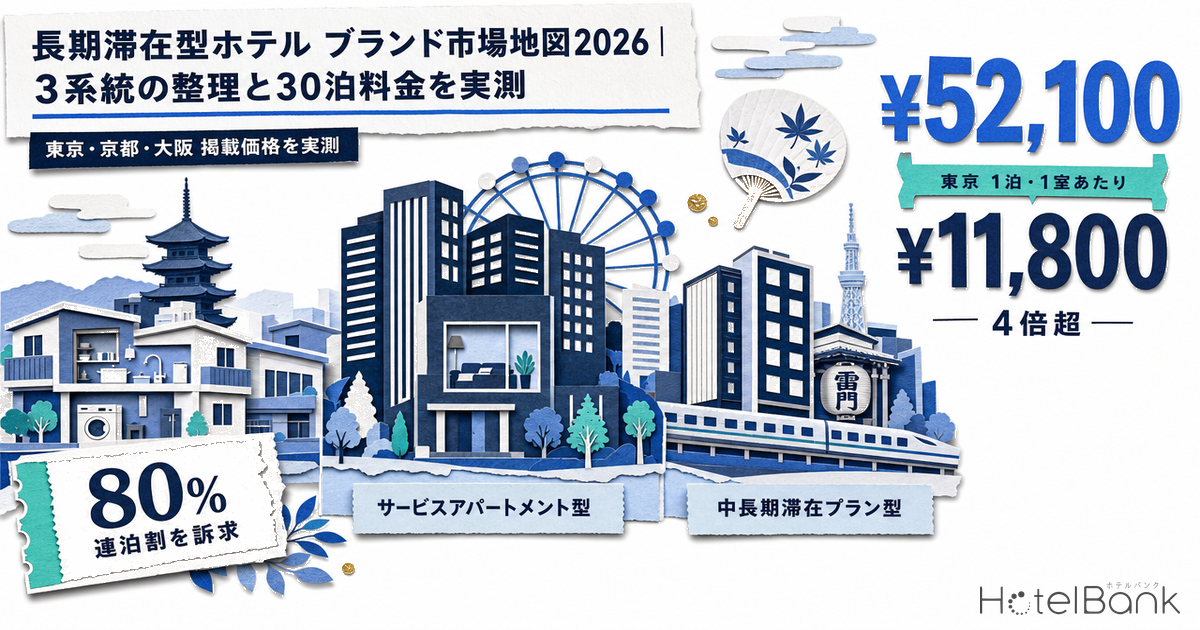
- — Tokyo per-room rates run ¥11,800–¥52,100 (median of the lowest-plan level, June–August 2026). The spread comes less from pricing strategy than from how many people a room is designed to hold.
- — The 30-night equivalent forms three tiers, from the ¥300,000s to over ¥1.3 million. That is an upper bound excluding consecutive-night discounts — and 80% of the 902 Tokyo plan names containing “consecutive nights” advertise such a discount.
- — Locations separate by family: kitchen-equipped properties cluster in Ueno, Asakusa and Nihonbashi; mid-to-long-stay plan properties sit near major Yamanote Line stations; serviced apartments lean toward Marunouchi and Shinjuku.
- — Supply piled up between 2018 and 2022 (N=103 properties, 6,829 rooms). Published next-wave targets include MIMARU’s 3,000 rooms by 2030 and Mitsubishi Estate’s WAYPOINT at 10 properties by 2030.
Extended-stay hotels split into three families
Start with the ground rules. Brands in Japan that market themselves for extended stays fall into roughly three families, defined by the combination of in-room fittings, operating model and assumed length of stay. This is not a question of which is better — the starting point is understanding that they are going after fundamentally different stays and different locations.
| Family | Room design philosophy | Core stay type | Typical location |
|---|---|---|---|
| 1. Kitchen-equipped apartment hotel | Units sleeping 4–6. Kitchen, washing machine and multiple beds inside a single room | Families and groups, a few nights to two weeks. Leisure stays built around self-catering | Older downtown districts and entertainment quarters on tourist routes (Ueno, Asakusa, Shinsaibashi, Kawaramachi and similar) |
| 2. Serviced apartment | Residence specification. Permanent front desk, housekeeping and shared lounge | Expatriate postings and corporate contracts running a month to several years. Between a hotel and a rental home | Business districts and expatriate residential areas (Marunouchi, Minato City, Umeda and similar) |
| 3. Mid-to-long-stay plan provider | Limited-service hotel rooms fitted as standard with a mini-kitchen and washer-dryer | Solo business trips, training and construction assignments. Working stays of one week to one month | Business locations close to major stations (government-ordinance-designated cities nationwide) |
Source: compiled by the HotelBank Editorial Team from materials published by each company
Families 1 and 3 are often grouped together because both “have a kitchen,” but the number of guests a room is designed for is fundamentally different. Family 1 designs a single unit for 4–6 people, and the product value lies in a family or group not having to split across rooms. Family 3, by contrast, is aimed squarely at solo working stays of one to two people, where the mini-kitchen and washer-dryer exist to let guests “pack lighter and stay longer.” That difference shows up directly in the per-room price levels discussed below.
Family 2, the serviced apartments, differs from 1 and 3 in that the center of gravity of its sales sits with corporate contracts and direct booking rather than OTAs. Looking only at listed OTA prices therefore does not reach the real picture. We return to this point in the measurement section.
Property counts as published by each company (counting conventions differ)
Next, the property counts each company publishes itself. The point to stress here is that these figures cannot be lined up to argue rankings or market share. Some companies count by brand, some across the whole group, and some combine sub-brands, so the underlying population is not consistent. What follows quotes each company’s published figures with sources attached; it does not indicate any order of standing.
| Brand / operator | Family | Published figure (and source) |
|---|---|---|
| MIMARU (Cosmos Initia) | 1 | The property list on the official site shows 15 in Tokyo, 7 in Kyoto and 7 in Osaka, for 29 properties in total (as of September 2026, including two Osaka properties scheduled to open). A target of 3,000 rooms by 2030 has been published (IR seminar for individual investors, 13 December 2025) |
| hotel MONday Apart (JHAT) | 1 | The hotel MONday group reports 24 in Tokyo, 5 in Kyoto and 1 in Osaka, for 30 properties (company press release, 30 January 2026). The apartment-type properties among them form the “MONday Apart” series |
| Minn (stay tuned) | 1 | See the property list on the official site (Tokyo, Kyoto, Osaka, Sapporo, Kanazawa, Karuizawa and elsewhere). No published brand-wide total could be confirmed |
| WAYPOINT (Mitsubishi Estate / Mitsubishi Estate Hotels & Resorts) | 1 | The first property, WAYPOINT TSUKIJI TOKYO, opened on 1 April 2026 with 52 rooms; the target is 10 properties by 2030 (release dated 2 February 2026) |
| Ascott / Somerset / Citadines / Oakwood / lyf (The Ascott Japan) | 2 | 22 properties across five brands in Tokyo, Yokohama, Osaka, Kyoto and Fukuoka (company release, 4 August 2026). Citadines North Shinjuku Tokyo, with 179 units (106 hotel rooms and 73 serviced residences), is scheduled to open on 28 October 2026 |
| Fraser Residence (Frasers Hospitality) | 2 | Operates serviced apartments in Osaka including Namba (official site) |
| Tokyu Stay | 3 | The property list on the official site covers Tokyo, Hokkaido, Kanazawa/Gifu, Kyoto/Osaka, the Chugoku-Shikoku region, Kyushu and Okinawa (as of September 2026). In-room washer-dryers are the brand’s strength, and mid-to-long-stay plans are permanently offered |
| Villa Fontaine | 3 | Comprises the Premier, Grand and Village lines plus urban properties carrying no sub-brand name (official site, as of September 2026). Strongest in central locations close to stations |
Source: compiled by the HotelBank Editorial Team from each company’s official site and press releases (quoted figures are as published)
Note too that 2026 was the year real-estate developers entered family 1 in earnest. Mitsubishi Estate announced its entry into the apartment-hotel business in February 2026; its first property in Tsukiji sleeps up to six, with mini-kitchens and washer-dryers in some rooms, and it set a target of 10 properties by 2030. Existing brands are expanding (MIMARU’s 3,000-room target for 2030) at the same time as developer-born brands are being launched.
Measuring per-night rates in Tokyo, Kyoto and Osaka
Now to price. From MetroEngines Research data we pulled the monthly lowest-plan level (two guests in one room, per room, tax included) for June–August 2026 for each of the properties above, then computed medians by brand × area.
Source: MetroEngines Research; compiled by the HotelBank Editorial Team
| Brand | Tokyo | Kyoto | Osaka |
|---|---|---|---|
| MIMARU | ¥52,100 (N=15) | ¥36,200 (N=7) | ¥41,400 (N=5) |
| MONday Apart | ¥25,000 (N=13) | ¥17,200 (N=2) | ¥30,700 (N=1) |
| Minn | ¥22,600 (N=14) | ¥10,700 (N=8) | ¥8,200 (N=2) |
| Citadines / Ascott group | ¥24,800 (N=3) | — | ¥18,400 (N=1) |
| Tokyu Stay | ¥16,700 (N=20) | ¥17,200 (N=2) | ¥10,600 (N=1) |
| Villa Fontaine | ¥11,800 (N=10) | — | — |
Median of the lowest-plan level, June–August 2026. Source: MetroEngines Research; compiled by the HotelBank Editorial Team
First, a misreading to head off. This table does not show which brand is expensive. The per-room rate is set by how many guests that room is designed to hold. MIMARU’s ¥52,100 in Tokyo is the price of a room in which 4–6 people can stay as one unit; Tokyu Stay’s ¥16,700 and Villa Fontaine’s ¥11,800 are prices for rooms designed mainly around solo or two-guest use. Even within “extended-stay,” these are different products being compared.
Reading the structure by family: family 1, the kitchen-equipped apartment type, shows wide variation across areas. MIMARU runs ¥52,100 in Tokyo against ¥36,200 in Kyoto and ¥41,400 in Osaka, with Tokyo the highest of the three cities. Minn runs ¥22,600 in Tokyo against ¥10,700 in Kyoto and ¥8,200 in Osaka — an even wider gap between Tokyo and the Kansai cities. In the two Kansai cities, smaller units dominate the mix, putting the bottom of the price band clearly below Tokyo’s.
Family 3, the mid-to-long-stay plan providers, sits in a ¥11,800–¥16,700 band per room in Tokyo — the most stable of the three families. Supplying budget-legible products for solo working stays, as a network of locations close to stations, is what makes this family work.
For family 2, the serviced apartments, the small sample in Tokyo (N=3) is itself the important information. This family leans heavily on corporate contracts and direct sales, so the inventory that surfaces on OTAs is limited and an aggregation of listed prices cannot capture actual conditions. It is thin as a subject for listed-price analysis — which is a separate matter from how substantial the business itself is.
Converted to 30 nights — the ceiling before consecutive-night discounts
Multiplying the nightly rate by 30 makes the budget for a long stay easier to grasp. It has to be stressed, though, that this is a ceiling that factors in no consecutive-night discount at all. Across the 902 plan names published in Tokyo that carry the word “consecutive nights,” fully 80% advertise a consecutive-night discount as a selling point. The realistic view is that actual 30-night pricing lands at the lower end of the ranges below, or beneath them. How many nights it takes for a consecutive-night discount to bite, and by how much, is measured in Japan Hotel Long-Stay Discounts: 15% at 7 Nights, 20% at 30 Nights.
Tokyo properties only. Bars show the 25th–75th percentile; the vertical line is the median. Source: MetroEngines Research; compiled by the HotelBank Editorial Team
The 30-night equivalent ranges in Tokyo (25th–75th percentile) came out at roughly ¥346,000–¥379,000 for Villa Fontaine, ¥444,000–¥703,000 for Tokyu Stay, ¥622,000–¥859,000 for Minn, ¥622,000–¥823,000 for MONday Apart, and ¥1.389–2.055 million for MIMARU. A three-tier structure emerges: family 3 in the ¥300,000s to ¥700,000s, the small-and-mid-unit brands within family 1 in the ¥600,000s to ¥800,000s, and MIMARU, built around large family units, above ¥1.3 million.
Those three tiers map directly onto differences in whose budget pays. The ¥300,000–¥700,000 range is absorbable within corporate travel budgets and project expenses, which makes it logical that family 3 is concentrated there. The ¥600,000–¥900,000 range works when a group trip’s total is divided across its members, and the above-¥1.3-million range is supported by family and group demand that values not having to split across rooms. Run as a business, the order of operations is to decide which budget you are going after before designing the room unit.
The Tokyo map — concentration in Ueno, Asakusa and Nihonbashi
Location divides by family too. Plotting the 83 major-brand properties we confirmed listed on OTAs within Tokyo’s 23 wards, a clear skew appears for each family.
Circle size indicates room count. Source: MetroEngines Research; compiled by the HotelBank Editorial Team
The kitchen-equipped apartment type (dark blue) is densely concentrated in the older downtown belt running from Taito City into northern Chuo City — Ueno, Asakusa, Kuramae, Nihonbashi. These are areas where proximity to tourist routes overlaps with conditions that make building conversions and mid-sized site acquisition easier. The mid-to-long-stay plan type (light blue), by contrast, is spread as a network around major Yamanote Line stations — Shinjuku, Shibuya, Gotanda, Ginza, Ikebukuro — positioned to match the origins and destinations of business travel.
The serviced apartment type (navy) sits close to corporate demand and expatriate residential areas such as Marunouchi and Shinjuku. What the map shows is three families pursuing location strategies that barely overlap within the same city. Put the other way: for anyone weighing entry in Tokyo, choosing the family already narrows the candidate locations considerably.
When the supply was built
For the major brands covered here, we aggregated the year in which each property was first confirmed listed on an OTA (N=103 properties, 6,829 rooms).
Source: MetroEngines Research & Consulting (based on confirmed OTA listings, N=103 properties)
Thirteen properties in 2018, 18 in 2020, 14 in 2021 and 15 in 2022 — the stock piled up in a concentrated five-year stretch from 2018 to 2022. Planned during the expansion of inbound demand, this stock was completed and opened across the pandemic years. From 2023 the count appears to settle at roughly six to ten properties a year, but that slowdown does not simply mean supply shrank. Our aggregation is based on the point at which an OTA listing was confirmed, which structurally undercounts the most recent years: few properties opening in 2024–2025 were listed on OTAs before opening, and listings are added progressively after opening.
In fact, adding up the medium-term targets each company has published reveals a thicker pipeline than the recent figures suggest. MIMARU is targeting 3,000 rooms by 2030, Mitsubishi Estate’s WAYPOINT 10 properties by 2030, and The Ascott Japan will open 179 units in Shinjuku in October 2026. Expansion by existing brands and entry by newcomers are running at the same time, and the next wave is forming with a different set of players than around 2020.
Three points from a B2B perspective
From the data above, three points are worth holding onto from an operating and investment perspective.
First, choosing the family is inseparable from designing the room unit. Whether a room is designed to sleep 4–6 or to assume one or two solo guests splits the per-room rate into a range of ¥11,800–¥52,100 in Tokyo — more than fourfold. This is not a matter of pricing skill; it is the consequence of product design itself. Within the same gross floor area, larger units mean fewer rooms and a higher per-room rate, smaller units mean more rooms and a lower one. Which RevPAR structure you want has to be decided first.
Second, the set of available locations is all but fixed once the family is chosen. As the Tokyo distribution shows, the kitchen-equipped apartment type occupies Taito City through northern Chuo City, the mid-to-long-stay plan type the major Yamanote Line stations, and the serviced apartment type the corporate-demand areas. Entering an area where incumbent brands are thick with the same family calls for a differentiation design first; entering a thin area calls first for confirming that the demand actually exists.
Third, the price architecture is really the design of the consecutive-night discount. Of the 902 Tokyo plan names containing “consecutive nights,” 80% advertise a consecutive-night discount, 32% evoke the idea of long-stay living, and 12% promote kitchen appliances. The gap between the 30-night ceiling and actual pricing lives inside that discount design. More than the level of the nightly rate, it is the design of how many nights in the discount starts and how deep it goes that determines the profitability of a long-stay product.
Conclusion
Inside the single label “extended-stay hotel” live three different products: the kitchen-equipped apartment hotel, the serviced apartment, and the mid-to-long-stay plan provider. They differ in how many guests a room assumes, where the center of gravity of their sales channels sits, and how they choose locations — and per-room rates in Tokyo spread more than fourfold, from ¥11,800 to ¥52,100. On a 30-night basis this becomes a three-tier structure from the ¥300,000s to over ¥1.3 million, which maps directly onto who pays: corporate travel budgets, group travel budgets, or family stay budgets.
On the supply side, a next wave — MIMARU’s 3,000-room target for 2030, Mitsubishi Estate’s launch of WAYPOINT — is forming on top of the stock that piled up between 2018 and 2022. Published property counts are not counted on a common basis and are unsuited to side-by-side ranking, but sorting by family and overlaying price and location makes the structure of the market readable enough. For anyone weighing entry or expansion, the important thing is to decide up front which family, and which budget tier, to go after.
For hoteliers: plan-name cues that work on this theme
Common selling points in plan names published for Tokyo × consecutive-night stays (N=902) ——
Consecutive-night discount 80%Room only 40%Breakfast included 37%Long stay / living 32%Discount 17%Kitchen appliances 12%
Examples of actual names (anonymized):
- [5-Night Stay Plan] Suite & Deluxe — 15% OFF! Lounge access included (no meals)
- [7-Night Stay Plan] Suite & Deluxe — 20% OFF! Lounge access included (no meals)
- [3-Night Stay Plan] Suite & Deluxe — the perfect base for your trip (no meals)
* These are tendencies based on an aggregation of published plan names; they do not indicate that naming causes sales.
Related reading
References and sources
■ Market data
- MetroEngines Research — OTA listed prices (June–August 2026; two guests in one room, per room, tax included), aggregation of properties and rooms by year first listed, aggregation of published plan names
■ Materials published by each company
- APARTMENT HOTEL MIMARU official site, property list (as of September 2026)
- Cosmos Initia accelerates expansion of its MIMARU apartment-hotel business, targeting 3,000 rooms by 2030 (logmi Finance, IR seminar for individual investors, 13 December 2025)
- Citadines to open a new stay base in Tokyo’s Shinjuku area, Citadines North Shinjuku Tokyo, on 28 October 2026 (The Ascott Japan Co., Ltd., 4 August 2026)
- [New opening] Premium Apart MONday Hamamatsucho Station grand opening on 27 March in Hamamatsucho, Tokyo (JHAT Co., Ltd., 30 January 2026)
- Full-scale entry into the apartment-hotel business / first property of the new WAYPOINT brand to open 1 April 2026 in Tsukiji, Tokyo (Mitsubishi Estate, 2 February 2026)
- hotel MONday official site, weekly and monthly plans
- Minn (stay tuned) official site
- Tokyu Stay official site
- Hotel Villa Fontaine official site
- Fraser Residence Nankai Osaka official site
■ Press coverage