

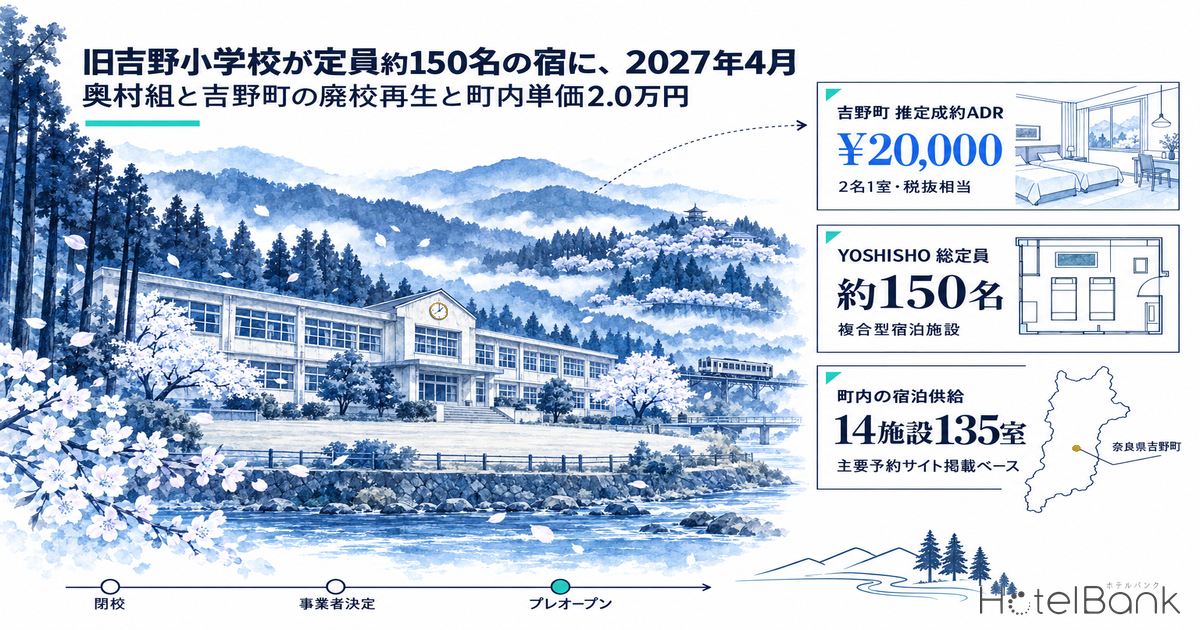
YOSHISHO, announced by Okumura Corporation (奥村組) on October 6, 2026, will convert the former Yoshino Elementary School in Yoshino Town, Nara (closed in March 2022), into a mixed-use lodging facility with a total capacity of about 150 guests across seven room types. A soft opening is scheduled for April 2027 and the grand opening for August 2027. The general contractor that built the school in 1967–68 is now, some 60 years later, turning that same building into an inn itself: a rare case of the original builder leading the regeneration. This article first lays out the confirmed facts from Yoshino Town’s tender documents and Okumura’s proposal as a timeline, then examines in turn the town’s estimated settled ADR (12-month average ¥20,000, N=6–8 properties) and its cherry-blossom seasonality, how to read a 150-guest capacity, and the site conditions verified with Ministry of Land, Infrastructure, Transport and Tourism (MLIT) geospatial data (zoning, flood inundation, landslide risk, land prices and station distance).
Metric Definitions Used in This Article
- ADR (average daily rate) = an estimated settled rate (tax-excluded equivalent), calculated by applying segment-specific adjustment factors to the lowest-plan rate each property publishes on OTAs (per room, 2 guests per room, tax included). Checked against property-level results disclosed by listed hotel REITs (91 properties, most recent 3 months), the median error is about 7%. These are estimates and differ from each property’s actual transaction prices and accounting figures. Area-level ADR is the median of the properties covered (the level of a typical property in the area).
- Listed price = the average of all plans’ selling prices published on major booking sites (per room, 2 guests per room, tax included). Wherever this article says “listed price”, it is a different level from the estimated settled ADR, and the two are not compared directly.
- OCC (occupancy) = rooms sold as a share of total rooms in the area (an estimate based on OTA sales inventory). The booking curves in this article show “occupancy (OTA-listed inventory basis, estimated)”: an estimate based on how inventory sold on OTAs is being absorbed, which differs from a property’s actual overall occupancy.
- Booking curve / LT = the trend in remaining OTA room inventory leading up to the check-in date. LT (lead time) = days until check-in; this article uses only LT45 to LT1.
- Property and room counts = based on listings on major booking sites. Of the properties tracked by MetroEngines Research, about 27,000 confirmed to be operating are analysed; lodgings not listed on booking sites are not included.
- Data sources = MetroEngines Research & Consulting (prices and inventory); MLIT Real Estate Information Library and National Land Numerical Information (site conditions); Yoshino Town and Okumura Corporation public documents (the project). Data as of October 10, 2026.
- — A 22-year deal: building free of charge, land for a fee: the school buildings and gymnasium are lent free of charge (loan for use), and a fixed-term business land lease covers the entire site (November 20, 2025 to November 2047). The proposed rent is ¥2.57M a year, almost exactly the town’s ¥2.568M minimum. Renovation is at the operator’s expense; the town’s outlay is capped at ¥84M for the inspection-certificate work.
- — Local ADR of ¥20,000 is about 1.6x Nara City: Yoshino Town’s estimated settled ADR averaged ¥20,000 over 12 months (N=6–8 properties), versus ¥12,700 for Nara City (N=58–61) and ¥13,200 for Nara Prefecture (N=131–136). In the cherry-blossom month of April 2026 it was ¥22,300, up 5.7% YoY.
- — 150 guests is more than half of the town’s supply: lodgings in town with selling prices observed in the last 3 months total 14 properties and 135 rooms (major booking site listings), the largest with just 41 rooms. Against roughly 270 guests at 2 per room, no property in town (on a major-booking-site basis) can take 150 guests at once.
- — Covering ¥128M of operating costs from outside demand takes 26% capacity utilisation: in the base case of ¥6,500 lodging + ¥2,500 food and beverage per guest-night, that is 14,200 guest-nights a year. Okumura’s 2024 proposal assumed annual occupancy of 51.5% (assumption at the time of the October 2024 proposal, full year) and 24,616 users, with strong seasonality: 100% in April–May and 19% in January–February.
- — The site is in an urbanisation promotion area, quasi-industrial zone (60% coverage, 200% FAR): about 350m from Yoshino-Jingu Station and about 600m from Yamato-Kamiichi Station. It lies within the flood inundation area for the maximum assumed flood (Kinokawa river system, depth 3.0m to under 5.0m) and outside landslide warning areas. The resident population within 1.5km is projected to fall from 2,171 in 2020 to 1,144 in 2040 (−47.3%), so the design must draw demand from outside.
The Facts of the Plan: Timeline from Tender to Opening, and the Confirmed Numbers
First, the confirmed facts, drawn from Yoshino Town’s published tender documents, Okumura’s proposal and the October 2026 opening announcement. The former Yoshino Elementary School stands at 2298 Oaza Kamiichi, Yoshino Town, Yoshino District, Nara (lot 2152-1 and others), on an 18,601 m² site facing the left bank of the Yoshino River. The school was built between December 1967 and June 1968 as a set of separate reinforced-concrete buildings (a 3-storey general classroom block of 2,130 m², a 2-storey special classroom block of 1,383 m², an administration block of 576 m², an entrance block of 188 m², a connecting corridor block of 72 m² and a 1,019 m² gymnasium). Total floor area including the gymnasium is 5,368 m². Seismic retrofits were carried out in 1995, 1999 and 2010, but because there is no completion inspection certificate under Article 7(5) of the Building Standards Act, the conversion was made conditional on a survey report under Article 12(5) of the same Act.
The tender opened on March 25, 2024 as a public proposal competition. Six companies attended the April 5 briefing, but only one group, Okumura Corporation’s Nara branch, submitted a proposal by the July 12 deadline. The selection committee (chaired by Associate Professor Yasuhisa Sakurai of Hannan University, with five members in total) scored the proposal 123.8 out of 180 points, with 20 points for price, and named the preferred negotiating party on September 19, 2024. The committee’s review cited as strengths that “there are no competing facilities nearby”, “the plan uses the existing facilities in full” and “year-round use at reasonable prices”.
| Date | Event | Source |
|---|---|---|
| March 2022 | Yoshino Town Yoshino Elementary School closes. The same month, the town adopts its “Policy for reuse of the Yoshino and Yoshino-Kita Elementary School sites” (reuse through private proposals; the buildings to be leased, not sold) | Yoshino Town residents’ briefing materials (October 19, 2024) |
| March 28, 2023 | First operator selection committee meeting (review of tender guidelines and selection criteria) | Yoshino Town review report |
| March 25, 2024 | Public proposal competition opens. Six companies attend the April 5 briefing; 49 questions across two rounds | Yoshino Town tender guidelines and process documents |
| July 12, 2024 | Proposal deadline. One group submits (Okumura Corporation Nara branch) | Yoshino Town operator selection result |
| September 25, 2024 | Preferred negotiating party announced. Proposed rent ¥2.57M a year | Yoshino Town operator selection result |
| October 4, 2024 | Basic agreement signed (published in line with Article 15(3) of the PFI Act) | Yoshino Town, “On the signing of the basic agreement” |
| November 2024 – November 2025 | Article 12(5) Building Standards Act report (compliance survey) and change-of-use design. Town’s share capped at ¥84M | Yoshino Town, “Upcoming schedule” / Okumura overview presentation |
| November 20, 2025 | Fixed-term business land lease and building loan-for-use agreements signed (term to November 2047, about 22 years). Renovation work begins thereafter | Okumura news release (November 21, 2025) |
| October 6, 2026 | Facility name “YOSHISHO” and opening dates announced. Total capacity ~150 guests, 7 room types, “Maruta Kitchen” dining hall (~70 seats), “Okeyu -OKU-” bath, gallery, lecture rooms and a shared kitchen in the former home-economics room | Okumura press release (PR TIMES) / R.E.port |
| April 2027 / August 2027 | Soft opening / grand opening (facilities and services expanded in stages) | Same as above |
| October 2046 / November 2047 | Facility closure (planned) / land returned and contract expires (planned). The newly built bath building is to be demolished before return | Okumura overview presentation (October 19, 2024) |
In terms of structure, the school buildings and gymnasium are lent free of charge under a civil-code loan for use, while a fixed-term business land lease under Article 23 of the Act on Land and Building Leases covers the entire site including the sports ground, at a ground rent of ¥2.57M a year. The minimum price the town set in its tender guidelines was ¥2.568M a year (FY2022) “where a private facility is newly built”, so the proposed rent essentially matches it. The town’s residents’ briefing materials put the initial investment at “Okumura: approx. ¥2.7 billion”, equivalent to ¥1.66M per tsubo over 5,368 m² (about 1,624 tsubo) of floor area. However, this figure includes the new bath building, exterior works and furnishings, so it cannot be read directly as a renovation cost per unit for the existing school. It is an investment close to the level of the 2024 new-build hotel construction cost per tsubo in MLIT’s Building Construction Starts statistics (¥1.95M on average across all structures), made while reusing the existing structure.
It is also worth stating what cannot be confirmed from press coverage and published documents. As of October 2026, the actual room count (only “7 types, ~150 guests” is disclosed), the name of the operating company (the proposal describes direct operation by Okumura with some functions outsourced), the renovation contract value, and the scope of functions at the soft opening have not been published. All estimates in this article are assumptions starting from “150 guests” and will need to be re-read once the room count is known.
Yoshino Town Rates: ¥20,000 12-Month Average, ¥22,300 in Cherry-Blossom April
Next, the price level of the Yoshino Town market that YOSHISHO is entering, measured by estimated settled ADR. Yoshino Town’s estimated settled ADR averaged ¥20,000 over the 12 months from October 2025 to September 2026 (N=6–8 properties), against ¥12,700 for Nara City (N=58–61 properties) and ¥13,200 for Nara Prefecture as a whole (N=131–136 properties) over the same period. Yoshino being about 1.6x Nara City reflects a supply mix skewed toward ryokan on Mt. Yoshino (where dinner and breakfast are standard), with no business hotels on a major-booking-site basis. That the town’s sample is in single digits affects how the figure should be read: a monthly value can move with a single property’s listing change, so this article always shows N and focuses on the level and the seasonal shape rather than individual monthly swings. The distribution of rates and length of stay by municipality across Nara Prefecture, including Yoshino Town, is laid out in Nara Hotel ADR by Town: Yoshino ¥19,900 vs Nara City ¥12,900.
By month, the highest finalised month was December 2025 at ¥23,900 (N=8) and the lowest June 2026 at ¥15,200 (N=8), a range of only about 1.6x. Cherry-blossom April was ¥22,300 in 2026 (N=8) and ¥21,100 in 2025 (N=8), up 5.7% YoY, a steady rise when comparing finalised months. November–December, covering autumn leaves and the year-end, runs as high as April, showing that demand on Mt. Yoshino is not concentrated in spring alone.
| Area | 12-month average (Oct 2025 – Sep 2026) | Properties N | April 2026 | April 2025 | April YoY |
|---|---|---|---|---|---|
| Yoshino Town | ¥19,991 | 6–8 | ¥22,282 | ¥21,084 | +5.7% |
| Nara City | ¥12,726 | 58–61 | ¥14,764 | ¥14,610 | +1.1% |
| Nara Prefecture | ¥13,181 | 131–136 | ¥14,807 | ¥14,319 | +3.4% |
While the town ADR is an area median, the shape of cherry-blossom pricing is clearer in each property’s listed price (all-plan average, tax included; a different level from the estimated settled ADR). Lining up the properties among the 14 in town with prices observed in the last 3 months that have listed prices in both April and September 2026, the main ryokan on Mt. Yoshino price April at 1.1–1.4x September, confirming a structure in which a year’s demand is concentrated into the one month of cherry blossoms.
| Property (location) | Rooms | Type | Listed price April 2026 | Listed price September 2026 | April / September |
|---|---|---|---|---|---|
| Chikurinin Gunpoen (竹林院群芳園) (Mt. Yoshino) | 41 | Ryokan | ¥99,266 | ¥73,756 | 1.35x |
| Houunkan (芳雲館) (Mt. Yoshino) | 25 | Ryokan | ¥71,279 | ¥53,723 | 1.33x |
| Yoshinoso Yukawaya (吉野荘 湯川屋) (Mt. Yoshino) | 14 | Ryokan | ¥78,633 | ¥70,424 | 1.12x |
| Miyoshino Sakuraan (美吉野 桜庵) (Mt. Yoshino) | 10 | Minshuku | ¥31,888 | ¥26,644 | 1.20x |
| Yoshinokan (吉野館) (Mt. Yoshino) | 10 | Ryokan | ¥33,896 | ¥25,920 | 1.31x |
| Motoyu Miyataki Onsen Matsuya (元湯 宮滝温泉 まつや) (Miyataki) | 8 | Ryokan | ¥32,599 | ¥37,106 | 0.88x |
| Taikoban Kamukamu (太鼓判 花夢花夢) (Mt. Yoshino) | 8 | Ryokan | ¥32,320 | ¥30,371 | 1.06x |
| Yoshino Onsen Motoyu (吉野温泉元湯) (Mt. Yoshino) | 6 | Ryokan | ¥43,560 | ¥45,673 | 0.95x |
| Minshuku Raku (民宿 楽) (Mt. Yoshino) | 4 | Minshuku | ¥26,398 | ¥20,360 | 1.30x |
| Shukubo Hotoji Ren (宿坊宝塔寺蓮) (Kamiichi) | 4 | Guesthouse | ¥24,050 | ¥23,625 | 1.02x |
| Yui Honmachi Yashiki (結ほんまち屋敷) (Kamiichi) | 1 | Guesthouse | ¥19,710 | ¥32,496 | 0.61x |
| Tokinoya Nara Yoshino (時乃家 奈良吉野) (Tanji) | 1 | Whole-house rental | ¥44,080 | ¥52,501 | 0.84x |
| Gofuku (呉福) (Kamiichi) | 1 | Whole-house rental | ¥17,716 | ¥18,227 | 0.97x |
For the pace of bookings, Yoshino Town on its own has too small a fixed cohort, so we look at the LT45-to-LT1 trend for Nara Prefecture’s ryokan category (a fixed cohort of properties that list at least 30% of their total rooms on major booking sites). For May 2, the first day of Golden Week (26 properties / 686 rooms), occupancy was 64% at LT45, 85% at LT14 and 90% at LT1. For August 14 during Obon (45 properties / 1,006 rooms) it rose from 61% at LT45 to 97% at LT1, and even an ordinary Saturday, June 13 (40 properties / 964 rooms), reached 89% by LT1. For October 10, the first day of a three-day weekend (46 properties / 1,088 rooms), occupancy was already 87% at LT45: most of the published inventory had been absorbed 45 days out. Rather than “filling at the last minute”, Nara ryokan follow a two-tier pattern: holiday periods are decided about six weeks ahead, while ordinary weekends build late. For YOSHISHO, with weekday demand from training and group stays, this suggests room to operate without colliding with weekend leisure demand.
At the property level on Mt. Yoshino, Houunkan (25 rooms) saw its published availability for the night of September 19, 2026 (first day of a three-day weekend) absorbed in steps from 17 rooms at LT45 to 5 at LT14 and 0 at LT5, and the night of October 10 filled in the same way from 14 rooms. By contrast, for the cherry-blossom night of Saturday, April 11, published availability stayed at 1 room or fewer throughout the observed period, and Chikurinin Gunpoen (41 rooms) peaked at 7 rooms that same weekend. Why published allocations are so small in the cherry-blossom season cannot be determined: channels other than OTAs (official websites, travel agents, groups) may dominate, inventory may be released in small increments as check-in approaches, or the allotment itself may be set low. What is certain is that on cherry-blossom weekends there is demand in town that the published inventory on major booking sites cannot absorb, and this is where opening capacity for 150 guests makes sense.
Reading a 150-Guest Capacity: Groups, Training Camps, Corporate Training and School Trips, and Three Scenarios of Utilisation x Spend per Guest
YOSHISHO’s “about 150 guests” differs from existing inns in that it is expressed as capacity, not room count. The 14 properties in town with selling prices observed in the last 3 months total 135 rooms, the largest, Chikurinin Gunpoen, having 41; at 2 guests per room, the whole town can host about 270 people at once. No property in town (on a major-booking-site basis) can take 150 guests in a single building, so for the first time the town opens its doors to demand that moves “around 100 people in one group”, such as school trips, university training camps and corporate training. In its 2024 proposal, Okumura itself stated that it would use the facility for training “more than 100 new employees every year”, and showed a layout with guest rooms for about 140 in the general classroom block and about 20 in the reception block (164 maximum at the time).
The same proposal also includes a single-year income and expense projection. Assuming annual occupancy of 51.5% (assumption at the time of the October 2024 proposal, full year) and 24,616 users, lodging-division revenue was ¥105.31M (rooms ¥34.28M, food and beverage ¥57.29M, ancillary facilities ¥13.74M) against operating expenses of ¥128.01M; on a differential basis that counts the internalised cost of its own training (¥36.45M), it showed a surplus of ¥13.75M a year. Assumed monthly occupancy was 100% in April and May, 95.9% in July and 73.9% in June, bottoming at 18.8% in January, 18.9% in February and 20.8% in November. Spring brings cherry blossoms, and May and July coincide with new-employee training; how to fill the off-season with demand other than training is the operation’s upside.
| Scenario | Capacity utilisation | Annual guest-nights | Lodging / guest-night | F&B / guest-night | Room revenue | F&B revenue | Total |
|---|---|---|---|---|---|---|---|
| A (Conservative) | 35% | 19,162 | ¥4,500 | ¥2,000 | ¥86.2M | ¥38.3M | ¥124.6M |
| B (Base) | 50% | 27,375 | ¥6,500 | ¥2,500 | ¥177.9M | ¥68.4M | ¥246.4M |
| C (Upside) | 60% | 32,850 | ¥9,000 | ¥3,000 | ¥295.6M | ¥98.5M | ¥394.2M |
| Reference: Okumura 2024 proposal | 51.5% (annual occupancy) | 24,616 (users) | Room rental ¥6,000–16,000 per room (corporate / individual) | ¥34.3M | ¥57.3M | ¥105.3M (incl. ancillary) | |
The assumptions are as follows. With 150 guests x 365 days = 54,750 guest-nights as the ceiling, we set capacity utilisation at 35%, 50% and 60%; lodging spend per guest-night at ¥4,500, ¥6,500 and ¥9,000 (room only, tax-excluded equivalent); and food and beverage spend at ¥2,000, ¥2,500 and ¥3,000. The lodging rates rest on two points: the town’s estimated settled ADR of ¥20,000 is a 2-guest room rate, equivalent to about ¥10,000 per person; and Okumura’s proposed room rental prices (single ¥6,000, twin ¥12,000, family ¥16,000; students ¥3,600–12,000) work out to ¥2,000–4,000 per person when divided by capacity (¥6,000 for a single used by one person). Scenarios A to C sit between these two ends. Food and beverage spend adds café and bar use on top of the proposal’s resident/general prices (breakfast ¥750, lunch ¥750, dinner ¥1,000).
On these assumptions, the capacity utilisation needed to cover the proposal’s ¥128.01M operating expenses from outside-demand revenue alone is 36% in Scenario A, 26% in B and 19% in C. In other words, in the base case of ¥9,000 per guest-night (¥6,500 lodging + ¥2,500 F&B), securing 14,223 guest-nights a year, or about 274 a week on average, would cover operating expenses without relying on in-house training. One school trip (120 students x 2 nights) is 240 guest-nights and one university training camp (40 people x 3 nights) is 120, so a rough benchmark is 2–3 school trips and about 5 training camps a month. Recovering the ~¥2.7 billion initial investment is a separate question from the operating account above; Okumura’s proposal positions it as “a highly sustainable business that does not depend on profit alone”. The design evaluates a combination of values together (internalising in-house training costs, a disaster-response base and community exchange), and this is not a deal to be read on standalone lodging yield.
Sensitivity Analysis: Moving Capacity Utilisation and Revenue per Guest-Night Separately
Because Scenarios A to C move utilisation and spend at the same time, we also show a sensitivity table that separates the two axes. Rows are capacity utilisation (20–60%), columns are revenue per guest-night (lodging + F&B; ¥6,500 = Scenario A, ¥9,000 = Scenario B, ¥12,000 = Scenario C), and each cell is annual revenue (¥M). Of the 25 combinations, the 19 shaded cells exceed the proposal’s ¥128.01M operating expenses: at ¥6,500 per guest-night this is reached from 40% utilisation (¥142.4M), and at ¥12,000 from 20% (¥131.4M). A 10-point change in utilisation moves annual revenue by ¥49.3M in the ¥9,000 column, and a ¥1,500 change in revenue per guest-night moves it by ¥41.1M in the 50% row. Stacking up group bookings and raising per-person revenue by combining meals and experiences carry almost equal weight.
| Capacity utilisation (annual guest-nights) | ¥6,500 / guest-night | ¥7,500 | ¥9,000 | ¥10,500 | ¥12,000 |
|---|---|---|---|---|---|
| 20% (10,950 guest-nights) | 71.2 | 82.1 | 98.6 | 115.0 | 131.4 |
| 30% (16,425 guest-nights) | 106.8 | 123.2 | 147.8 | 172.5 | 197.1 |
| 40% (21,900 guest-nights) | 142.4 | 164.3 | 197.1 | 230.0 | 262.8 |
| 50% (27,375 guest-nights) | 177.9 | 205.3 | 246.4 | 287.4 | 328.5 |
| 60% (32,850 guest-nights) | 213.5 | 246.4 | 295.7 | 344.9 | 394.2 |
Existing Mt. Yoshino ryokan (2 meals, over ¥10,000 per person)
The town’s estimated settled ADR is about ¥20,000 per room for 2 guests. Demand concentrates on cherry-blossom and autumn-leaf weekends, and published allocations tighten early.
Gap 1 Group capacity under ¥10,000 per person
No property in town can take 100 guests at once. School trips, training camps and corporate training are mainly weekday demand and are unlikely to collide with weekend leisure demand.
Gap 2 Off-season weekdays (January–February, November)
The proposal assumes 19–21% occupancy. There is room to build up non-seasonal demand such as workations, forestry and sawmill industry training, and disaster drills.
Checking the Site with Geospatial Data: Urbanisation Promotion Area, Quasi-Industrial Zone, Walking Distance to Stations, Flood Risk and Land Prices
We located the school by matching the address in Yoshino Town’s notice, “2298 Oaza Kamiichi”, against the Geospatial Information Authority of Japan’s GSI Maps (address search), obtaining 34.3923°N, 135.8511°E. The table below shows the site conditions confirmed by applying these coordinates to each layer of MLIT’s Real Estate Information Library. The site is in an urbanisation promotion area within a city planning area, zoned quasi-industrial (60% building coverage, 200% floor area ratio), with no fire-prevention district designation. Hotels and ryokan are permitted in quasi-industrial zones, which matches the town’s tender guidelines. Because the site lies within the ordinary zone of the Yoshinogawa-Tsuburo Prefectural Natural Park, building or extending structures above a certain size requires notification to the prefecture; Okumura has proposed that the new bath building “will not greatly alter the exterior and will take care over colour and height”.
1 Chikurinin Gunpoen (41 rooms)
2 Houunkan (25 rooms)
3 Yoshinoso Yukawaya (14 rooms)
4 Miyoshino Sakuraan (10 rooms)
5 Yoshinokan (10 rooms)
6 Motoyu Miyataki Onsen Matsuya (8 rooms)
7 Taikoban Kamukamu (8 rooms)
8 Yoshino Onsen Motoyu (6 rooms)
9 Minshuku Raku (4 rooms)
10 Shukubo Hotoji Ren (4 rooms)
11 Hotoji Temple (2 rooms)
12 Yui Honmachi Yashiki (1 room)
13 Tokinoya Nara Yoshino (1 room)
14 Gofuku (1 room)
| Item | Finding | Interpretation |
|---|---|---|
| Area classification | Within a city planning area; urbanisation promotion area | Development permit procedures are lighter than in an urbanisation control area; the change-of-use building confirmation is the main step |
| Zoning | Quasi-industrial zone (60% coverage, 200% FAR), no fire-prevention district | Hotels and ryokan permitted. Existing floor area of 5,368 m² on an 18,601 m² site leaves ample FAR headroom |
| Natural park | Yoshinogawa-Tsuburo Prefectural Natural Park, ordinary zone | Notification required for new construction or extension of structures above a certain size; applies to the new bath building |
| Flood inundation (maximum assumed) | Within the Kinokawa river system inundation area. Depth rank 3 (3.0m to under 5.0m = second floor flooded) | The school is 3 storeys. The proposal plans an emergency generator, disaster well and stockpiles, and says guest rooms will be opened to evacuees in a disaster. The evacuation plan should be re-checked against prefectural and town hazard maps on the premise of vertical evacuation |
| Landslide warning area | Site is outside. About 80m to the nearest debris-flow warning area (Iigai) | Warning areas line the foot of the hills on the north side of the site. The sports-ground side (Yoshino River side) is farther away |
| Liquefaction tendency (landform) | Valley-bottom lowland (gradient under 1/100); somewhat prone to liquefaction | Reusing the existing structure limits new piling, but a ground survey is needed for the new bath building |
| City planning road | Planned road Yoshino-Shimoichi Line (Branch 1) borders the east side of the site | Cherry-blossom season congestion and construction traffic routes are also issues in the proposal. Parking is planned on the former pool site |
| Nearest stations (Kintetsu Yoshino Line) | Yoshino-Jingu Station ~350m, Yamato-Kamiichi Station ~600m (straight-line distance) | Direct link toward Osaka on the Kintetsu Yoshino Line. Passengers in 2023: Yamato-Kamiichi 315/day, Yoshino-Jingu 264/day |
| Land prices (official / benchmark) | Kamiichi 151-5 (neighbourhood commercial) ¥31,100/m², Tanji 157-1 et al. (quasi-industrial) ¥16,800/m², Iigai 489-1 (Category 1 residential) ¥15,700/m² (all 2026) | Around −3% every year for 5 years. Valuing the 18,601 m² site at quasi-industrial/residential levels gives about ¥310M; the ¥2.57M annual ground rent is 0.8% of that |
Passenger numbers at both stations have more than halved, from FY2011 daily averages of 766 (Yamato-Kamiichi) and 677 (Yoshino-Jingu) to 315 and 264 in FY2023. Rail-using tourists tend to go straight to Yoshino Station (the terminus, connecting to the ropeway), while Kamiichi and Yoshino-Jingu serve mainly local residents. For YOSHISHO, station distance is realistically best read as “a site premised on groups arriving by bus, with a rail option for individual guests”. Land prices continue to fall by around 3% a year across the town: the neighbourhood commercial site at Kamiichi 151-5 went from ¥36,400/m² in 2021 to ¥31,100/m² in 2026 (−14.6% over 5 years), and the quasi-industrial benchmark site (Tanji 157-1 et al.) from ¥19,800 to ¥16,800 (−15.2%). The structure here, borrowing the building free of charge and paying ground rent only for the land, keeps the operator’s fixed costs down in a falling land market, while relieving the town of maintenance costs (FY2022 actuals are given in Attachment 4 of the tender guidelines).
The surrounding resident population can be checked with MLIT’s 250m-mesh future population projections. Within a 1.5km radius of the school, the resident population was 2,171 in 2020, projected at 1,881 in 2025 and 1,144 in 2040 (−47.3% versus 2020), with 52.3% aged 65+ as of 2025. Widening to a 3km radius, it falls from 7,299 to 4,551 (−37.6%), with 43.2% aged 65+. These are census-based resident populations, not daytime populations including tourists and commuters. The town’s tender guidelines also put the population at about 6,280 (April 2023) and tourist visits at around 1.1 million a year; demand for this facility can only be built on flows of people coming from outside the town for tourism, training and group stays, not on the resident population. The town’s request in the guidelines for “consideration including use by tourists”, and Okumura’s concept of “a place people come to”, can be read as judgments premised on this population structure.
Employment data (Economic Census, Ministry of Internal Affairs and Communications and Ministry of Economy, Trade and Industry) show 196 establishments and 1,108 employees within a 1km radius, with office-type establishments only 8.9%. This is an industrial cluster along the Yoshino River with many sawmills and timber-related businesses, and the “hub for forestry and sawmilling” function in Okumura’s proposal connects to this employment structure. It is a two-layer design: training demand is held in-house, while programmes linked to local industry are opened to outside users.
Procedures Required to Turn a School into an Inn: Key Points on Change of Use, Inn Business Licensing and Fire Safety
For converting a closed school into lodging, the tender documents and proposal in this case show the practical sequence as it is. First is the Building Standards Act. Changing a school into a hotel or ryokan is a change of use, and even after the June 2019 amendment, a building confirmation application is required for special buildings over 200 m²; here the general classroom block alone is 2,130 m². Moreover, because the existing building has no completion inspection certificate, the tender guidelines required a compliance survey by a designated confirmation and inspection body in line with MLIT’s guidelines (July 2014), and submission of an Article 12(5) report to Nara Prefecture. Okumura allotted a year, from November 2024 to November 2025, to this survey and the change-of-use design, with the town covering costs up to ¥84M. For municipalities preparing a tender, deciding at the tender-guideline stage whether an inspection certificate exists, and at whose cost any gap will be filled, is a precondition for attracting bidders. National conversion cases of closed schools into lodging assets fall into broadly distinct types, each with its own renovation cost and achievable rate, so the costs and rates in this case are best read against comparable conversions rather than as a general benchmark.
| Law / procedure | Role in this case | General points |
|---|---|---|
| Building Standards Act (change of use) | School to hotel/ryokan. With no inspection certificate, the Article 12(5) report and compliance survey came first (November 2024 – November 2025) | Building confirmation required for special buildings over 200 m². Fire resistance, smoke control, emergency lighting and interior finish restrictions must be brought into line with lodging-use standards |
| Inns and Hotels Act | Ryokan/hotel business licence from Nara Prefecture (public health centre). 7 room types, ~150 guests | The 2018 amendment merged ryokan and hotel businesses into a single “ryokan/hotel business” and abolished minimum room-count rules. Structural and equipment standards are set by prefectural ordinance |
| Fire Service Act | Fire-safety equipment installed as Item (5)(a) of Appended Table 1 of the Fire Service Act Enforcement Order (ryokan/hotels). Change of use after fire department consent | Automatic fire alarms and exit lights required regardless of floor area. Appointment of a fire prevention manager; securing evacuation routes |
| Public Bath Act | New “Okeyu -OKU-” bath building, also open to local residents | Prefectural licence as a public bath other than an ordinary public bath. Water quality and ventilation standards set by ordinance |
| Food Sanitation Act | “Maruta Kitchen” dining hall (~70 seats), serving breakfast, lunch and dinner | Restaurant business licence. Use of the shared kitchen (former home-economics room) to be discussed in advance with the public health centre |
| Natural park ordinance | Notification for the Yoshinogawa-Tsuburo Prefectural Natural Park ordinary zone (bath building) | Applies to new construction, extension or alteration of structures above a certain size. Consideration for landscape required |
| Air Pollution Control Act (asbestos) | Proper removal of asbestos-containing materials planned for the demolition of the former pool | Since April 2022, reporting the results of a prior survey is mandatory for demolition and renovation above a certain scale. 1960s school buildings are likely to be covered |
| Water supply and sewerage | Water service must be reconnected due to corrosion (supply contribution ¥5.59M for a 75mm connection); sewage to be connected to the public sewer | School infrastructure often does not suit the hot-water and bathing loads of lodging use; factor this into initial costs |
Second are the Inns and Hotels Act and the Fire Service Act. The 2018 amendment merged ryokan and hotel businesses into a single “ryokan/hotel business” and removed the minimum room-count rule, making it easier to cover a variety of room types created by partitioning classrooms under one licence. Under the Fire Service Act, ryokan and hotels fall under Item (5)(a); automatic fire alarms and exit lights are required regardless of size, and evacuation routes in the guest-room blocks often need to be reviewed against lodging-use standards. Third, issues specific to this case include the Public Bath Act (bath building), the Food Sanitation Act (dining hall and shared kitchen), the natural park ordinance (notification), and asbestos handling during demolition of the former pool. For a 1960s school building, a prior survey for asbestos-containing materials is unavoidable, and the cost range set out in our analysis of pre-renovation asbestos surveys needs to be built into the initial investment.
Implications for Municipalities, Operators and Lenders: Design Requirements from the Yoshino Model
Putting it all together, the design of this project has four elements that make it a useful reference for public-private partnerships. First, the split of building free of charge and land for a fee: the town steps away from maintenance costs while earning ground rent and the equivalent of fixed-asset tax, and the operator bears the renovation cost in exchange for a 22-year business term. Second, the town resolved up front the inspection-certificate gap common to existing school buildings, by setting a cost cap (¥84M). Third, the evaluation weighted business content (180 points) over rent (20 points), and maintaining an air-ambulance landing site and evacuation-shelter functions was made a condition. Fourth, the operator stated explicitly that the business “does not depend on profit alone”, building the value of internalised in-house training and a disaster-response base into the foundation of the business.
From the perspective of lenders and regional funds, as the town’s estimated settled ADR of ¥20,000 (N=6–8 properties) shows, Yoshino is one of the higher-rate municipalities in Nara Prefecture, yet its supply is limited to small ryokan, with no facility able to take groups of 100. A 150-guest facility entering at under ¥10,000 per person does not overlap with existing ryokan in price, creating a structure that can capture both excess cherry-blossom demand and weekday training demand. On the other hand, a projected −47.3% resident population within 1.5km by 2040, and a site showing 3m to under 5m of inundation in the maximum assumed flood, require at once a design that draws demand from outside the town and a disaster plan premised on vertical evacuation. In our estimate, 26% capacity utilisation in the base case of ¥9,000 per guest-night is the benchmark for operating expenses, and whether school trip, training camp and corporate training bookings can be levelled across the year will be the yardstick after the August 2027 grand opening.
Frequently Asked Questions
Q. When will YOSHISHO open, and what kind of facility is it?
According to Okumura Corporation’s announcement (October 6, 2026), a soft opening is planned for April 2027 and the grand opening for August 2027. The former Yoshino Elementary School (closed March 2022) is being renovated to include guest rooms of 7 types for a total of about 150 guests, the “Maruta Kitchen” dining hall with about 70 seats, the “Okeyu -OKU-” bath built around a wooden-tub theme, a gallery, multipurpose lecture rooms, a shared kitchen in the former home-economics room, and a lounge, gym and laundry. The layout links the central courtyard with a cloister, the “YOSHISHO Ring”.
Q. What is the business structure and contract term?
The school buildings and gymnasium are under a building loan for use (free of charge), and the entire site is under a fixed-term business land lease (for a fee), for about 22 years from the November 20, 2025 contract to November 2047. Ground rent is ¥2.57M a year; renovation is at the operator’s expense, and the town spends up to ¥84M on obtaining the inspection certificate. The town’s residents’ briefing materials put the initial investment at about ¥2.7 billion.
Q. What are hotel and ryokan rates like in Yoshino Town?
MetroEngines Research’s estimated settled ADR, as a 12-month average from October 2025 to September 2026, is ¥20,000 for Yoshino Town (N=6–8 properties), ¥12,700 for Nara City and ¥13,200 for Nara Prefecture. In cherry-blossom April 2026, Yoshino Town was ¥22,300, up 5.7% YoY. The town is dominated by Mt. Yoshino ryokan and the sample is in single digits, so monthly values should be read alongside the property count.
Q. What procedures are needed to convert a closed school into lodging?
The core steps are a change of use under the Building Standards Act (building confirmation for special buildings over 200 m²; without an inspection certificate, an Article 12(5) report and compliance survey), a ryokan/hotel business licence under the Inns and Hotels Act, and fire-safety equipment under the Fire Service Act (automatic fire alarms and exit lights are mandatory for ryokan/hotels) with fire department consent. In this case, the Public Bath Act (bath building), the Food Sanitation Act (dining hall), notification under the natural park ordinance, and asbestos handling during demolition of the former pool are added.
Q. How should the site’s disaster risk be checked?
Applying the coordinates in MLIT’s Real Estate Information Library, the site is within the inundation area for the maximum assumed flood of the Kinokawa river system (depth rank 3.0m to under 5.0m), outside landslide warning areas, and classified as valley-bottom lowland (somewhat prone to liquefaction). The school is 3 storeys, and the proposal plans an evacuation-shelter function with an emergency generator, disaster well and stockpiles. Final confirmation should be made against Nara Prefecture and Yoshino Town hazard maps and regional disaster prevention plans.
⚠ Note on ADR for future dates: Estimated settled ADR in this article for October 2026 onward is a level estimated from selling prices published on major booking sites as of the survey date (October 10, 2026), and will change as check-in dates approach. Note that prices currently set high may fall with last-minute adjustments. This article does not show YoY comparisons spanning finalised and forward months. The 150-guest revenue scenarios are simplified estimates with stated assumptions and will need to be re-read once room counts and the operating structure are published. An actual investment decision requires a detailed feasibility study.
References and Sources
■ Data sources
Prices and inventory were aggregated by MetroEngines Research & Consulting from public information on major booking sites (estimated settled ADR: Yoshino Town N=6–8 properties, Nara City N=58–61, Nara Prefecture N=131–136, October 2025 – September 2026; booking curves: Nara Prefecture ryokan fixed cohort of 26–46 properties, LT45 to LT1). Project facts are from Yoshino Town’s tender documents and Okumura’s public documents; site conditions are from MLIT’s Real Estate Information Library and National Land Numerical Information. Data as of October 10, 2026.
■ Estimate assumptions
With 150 guests x 365 days = 54,750 guest-nights as the ceiling, we assumed capacity utilisation of 35%, 50% and 60%; lodging spend per guest-night of ¥4,500, ¥6,500 and ¥9,000; and F&B spend of ¥2,000, ¥2,500 and ¥3,000 (all assumed values, tax-excluded equivalent). The required capacity utilisation is the ¥128.01M operating expenses in Okumura’s 2024 proposal divided back through room and F&B revenue. The sensitivity table covers 25 combinations of 20–60% utilisation and ¥6,500–12,000 revenue per guest-night.
■ Limitations
Room counts, operating structure and pricing had not been published as of October 2026, so the estimates are simple calculations based on capacity. They exclude recovery of the initial investment, depreciation, ancillary facility income and internal use for in-house training. Yoshino Town’s estimated settled ADR covers a single-digit number of properties, and monthly values can move with one property’s listing change. Estimated settled ADR and booking curves are both estimates and differ from each property’s actual results. Flood projections, land prices and future population projections are based on data published as of the survey date.
■ Primary sources on the project
- Okumura Corporation, “Mixed-use lodging facility YOSHISHO, reusing a former elementary school site in Yoshino Town, Nara, to soft-open in April 2027” (PR TIMES, October 6, 2026; Japanese)
- Okumura Corporation, “Signing ceremony held for the fixed-term business land lease and building loan-for-use agreements for the former Yoshino Elementary School site reuse project” (November 21, 2025; Japanese)
- Okumura Corporation, “Basic agreement signed with Yoshino Town for the former Yoshino Elementary School site reuse project” (October 2024; Japanese)
- Okumura Corporation, “Former Yoshino Elementary School site reuse project: overview presentation” (October 19, 2024, Yoshino Town residents’ briefing; Japanese)
- Yoshino Town, “(Former Yoshino Elementary School) Process from tender launch to basic agreement” (tender guidelines, selection result, review report, basic agreement notice, residents’ briefing materials; Japanese)
- R.E.port, “Okumura plans mixed-use lodging facility on former elementary school site in Yoshino, Nara” (October 6, 2026; Japanese)
- Nara Shimbun Digital, “Former elementary school site to become an exchange hub: Yoshino Town and Okumura sign contract” (November 21, 2025; Japanese)
■ Market data
- MetroEngines Research & Consulting — estimated settled ADR (Yoshino Town N=5–9 properties, Nara City N=50–63, Nara Prefecture N=94–142 per month), listed prices, booking curves (Nara Prefecture ryokan, fixed cohort of 26–46 properties), property-level published availability, registered properties in town (32 properties / 328 rooms, of which 14 properties / 135 rooms with prices observed in the last 3 months)
■ Government statistics and public data
- MLIT Real Estate Information Library — city planning GIS (area classification, zoning, city planning roads), official land prices and prefectural land price surveys (2021–2026), flood inundation areas (National Land Numerical Information A31a, maximum assumed), landslide warning areas (A33), landform classification (liquefaction tendency), passengers by station (S12)
- MLIT National Land Numerical Information — future population projections by 250m mesh (2024 MLIT estimates), inundation depth rank codes
- Geospatial Information Authority of Japan, GSI Maps — coordinate matching for the address “2298 Kamiichi, Yoshino Town”
- Ministry of Internal Affairs and Communications / Ministry of Economy, Trade and Industry, “Economic Census for Business Activity (2021)” — establishments and employees within a 1km radius
- MLIT, “Building Construction Starts Survey” — 2024 hotel construction cost per tsubo
- Ministry of Education, Culture, Sports, Science and Technology, “Everyone’s Closed Schools” project (Japanese)
Related Reading
- Nara Hotel ADR by Town: Yoshino ¥19,900 vs Nara City ¥12,900 in 2026
- 43 Municipal Kokumin-Shukusha: ¥8,800 ADR vs ¥20,400 After Conversion
- How to Buy a Municipal Inn in Japan: 81 Lodges, 6 Deals, 4–16% NOI
- Pre-Renovation Asbestos Surveys: 1975/2006 Cut-offs, ¥10k–¥570k/Room
- Residential Driving Schools: 135 Rooms in 3km; Yamagata 280k Nights
- School Trips 64% in Oct-Dec: Weekday Room in Kyoto, Okinawa, Hiroshima
- Nara Hotel Investment: Only 1 Hotel of 60+ Rooms Above ¥20,000 ADR