

Some young people in Japan do not get their driving licence at home. Instead they check into a driving school in the regions for about two weeks and qualify there — the practice known as gasshuku menkyo, or residential driving courses. An automatic-only standard car licence can be completed in as little as about 14 days, and for that whole period the student is housed either in the school’s own dormitory or in nearby hotels and ryokan. Neither tourism nor business travel, this education-driven long-stay demand flows into the same regions in roughly the same volume every year.
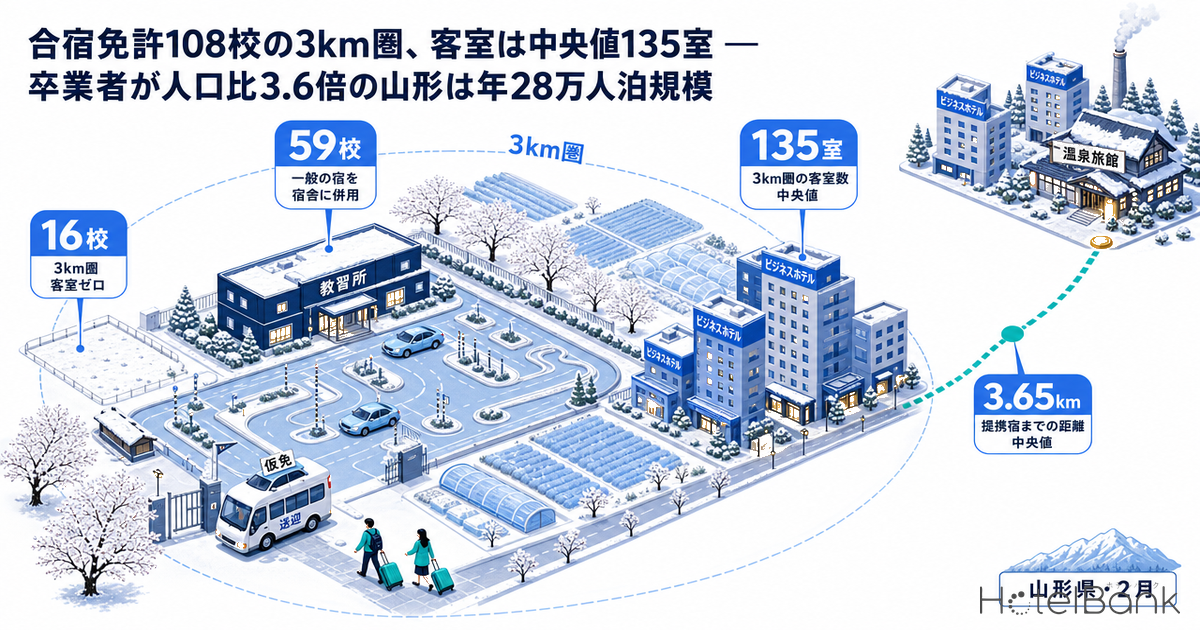
For this article we geocoded the locations of the 108 driving schools (in 36 prefectures, as of September 2026) listed on one private residential-driving-course booking site, and measured the lodging facilities and rooms within a 3 km radius of each. We also tallied the type of student lodging each school offers and, where hotels or ryokan are used, how far away they are. Demand-side scale is estimated from prefecture-level graduate counts in the National Police Agency’s Driver’s License Statistics (2025 edition). In short, the number of rooms within 3 km has a median of 135, and 16 schools have no rooms sold through OTAs or similar channels within 3 km. Even so, 59 of the 108 schools build regular hotels, ryokan and other general lodging into their student housing, and the median distance to those partner properties is 3.65 km — one ring beyond walking distance.
Metric Definitions Used in This Article
- ADR (Average Daily Rate) = estimated settled rate (tax-excluded equivalent), calculated by applying a property-type correction factor to the lowest published plan level each property lists on OTAs and similar channels (per room, two guests, tax-included). Checked against property-level results disclosed by listed hotel REITs (91 properties, latest three months), the median error is about 7%. These are estimates and differ from each property’s actual transaction prices and accounting figures. Area-level ADR is the median of the properties covered (the level of a typical property in the area).
- OCC (Occupancy Rate) = the monthly room occupancy rates cited in this article are the published 2025 final figures (business hotels) from the Japan Tourism Agency’s Overnight Travel Statistics Survey.
- Rooms within 3 km = total rooms at lodging facilities located within a 3 km radius of each driving school. Covers facilities, out of roughly 168,000 in Japan tracked by MetroEngines Research, whose selling prices were observed between September 2025 and August 2026. Excludes leisure (love) hotels and campgrounds, and does not include ryokan, minshuku or simple lodgings not listed on OTAs, nor dormitories and lodging run by the driving schools themselves.
- Listed residential-course schools = driving schools listed on one private residential-driving-course booking site as of September 2026 (N=108). This is not the full population of schools offering residential courses.
- Data sources: MetroEngines Research & Consulting / National Police Agency, Driver’s License Statistics (2025 edition) / Ministry of Internal Affairs and Communications, Population Estimates / Japan Tourism Agency, Overnight Travel Statistics Survey
- — Per 1,000 residents, standard-licence driving-school graduates number 8.35 nationwide. Yamagata reaches 29.8 (3.57× the national rate) and Tottori 24.3 (2.91×), while Tokyo is only 5.1 (0.61×). Graduates are concentrated not in the big cities but in a handful of regional prefectures.
- — Counting only the graduates above the national average at 13 nights each, Yamagata generates about 280,000 guest nights, equivalent to 6.0% of the prefecture’s total guest nights in 2025. Tottori: about 110,000 guest nights (4.3%).
- — Rooms within a 3 km radius of the 108 residential-course schools have a median of 135. Sixteen schools have zero and 46 have fewer than 100, yet 14 have 1,000 or more, so locations vary widely. Business hotels account for 74.0% of the rooms in these catchments.
- — 59 schools build hotels, ryokan and the like into their student housing. Of the 114 school–partner pairs we could match to our lodging database, 51 (44.7%) are within 3 km and 43 (37.7%) are more than 5 km away. With shuttle buses assumed, the catchment stretches into the next town.
- — In February, the peak season for residential courses, business-hotel occupancy in all five of Yamagata, Tottori, Fukui, Niigata and Shimane was below the annual figure (Niigata: 53.8% vs 64.9% for the year). The demand peak lands in the hotels’ trough.
1,277 driving schools, 1.505 million graduates — 55 fewer schools in 10 years, graduates holding in the 1.5 million range
First, the size of the demand pool. According to the National Police Agency’s Driver’s License Statistics (2025 edition), there were 1,277 designated driving schools (designated by prefectural public safety commissions) at the end of 2025, and they produced 1,505,044 graduates during 2025. Of these, 1,033,525 (68.7%) were standard licence (Class 1) graduates. Designated-school graduates made up 97.8% of those who passed the driving test, so nearly every licence in Japan is obtained via a driving school.
Compared with ten years earlier, the number of schools has fallen by 55 (4.1%) from 1,332 at the end of 2016. Graduates, on the other hand, peaked at 1.72 million in 2021 and have since declined, but have stayed in the 1.5 million range since 2023. Graduates per school were essentially flat: 1,172 in 2016 and 1,179 in 2025. Within this distribution of schools, residential courses have become an established way of taking in students from far away.
So where do those graduates get their licences? Dividing prefecture-level graduate counts by population from the Ministry of Internal Affairs and Communications’ Population Estimates (as of October 1, 2024) shows clear regional differences. Nationwide, standard-licence graduates number 8.35 per 1,000 residents, but Yamagata reaches 29.8, 3.57 times the national rate, followed by Tottori at 24.3 (2.91×), Fukui at 16.9 (2.02×), and Niigata and Shimane at 15.1 (1.81× and 1.80×). At the other end, Tokyo is 5.1 (0.61×), Kanagawa 5.5 (0.65×) and Osaka 6.3 (0.76×) (the bottom three per capita are Tokyo, Kanagawa and Nara at 0.67×).
Graduates are counted where the driving school is located. A prefecture far above the national average per capita is therefore most naturally read as one that takes in students from other prefectures. Other factors matter too, of course: car ownership and licensing rates are higher in rural areas, and the share of young people differs. But some regional prefectures, such as Akita (0.90×) and Aomori (0.89×), sit below the national average, so the size of the multiple is hard to explain by rurality alone.
Scale — Yamagata exceeds the national average by 22,000 graduates; at 13 nights each, that is 280,000 guest nights a year
To translate this intake into lodging terms, we subtracted from each prefecture’s standard-licence graduates the value “population × national graduation rate” and called the remainder excess graduates. Multiplying by nights per person gives a sense of the scale of residential-course demand. For nights per person we used 13 nights from enrolment day to graduation day, since the median minimum course length for an automatic standard car across the 108 listed schools is 14 days.
Yamagata’s excess graduates come to 21,723; multiplied by 13 nights, that is about 282,000 guest nights. Yamagata recorded 4,739,560 total guest nights in 2025 according to the Japan Tourism Agency’s Overnight Travel Statistics Survey, so this is equivalent to 6.0% of that total. Tottori has 8,485 excess graduates, about 110,000 guest nights, or 4.3% of its total guest nights. Populous Shizuoka also has a large excess of 20,577, about 268,000 guest nights.
| Prefecture | Standard-licence graduates | Per 1,000 residents | vs national | Excess graduates | At 13 nights (guest nights) | Share of total guest nights | Listed schools |
|---|---|---|---|---|---|---|---|
| Yamagata | 30,163 | 29.8 | 3.57× | 21,723 | 282,399 | 6.0% | 7 |
| Tottori | 12,918 | 24.3 | 2.91× | 8,485 | 110,305 | 4.3% | 3 |
| Fukui | 12,491 | 16.9 | 2.02× | 6,322 | 82,186 | 2.1% | 2 |
| Niigata | 31,675 | 15.1 | 1.81× | 14,152 | 183,976 | 1.8% | 11 |
| Shimane | 9,665 | 15.1 | 1.80× | 4,305 | 55,965 | 1.6% | 1 |
| Shizuoka | 50,021 | 14.2 | 1.70× | 20,577 | 267,501 | 1.2% | 4 |
| Tokushima | 9,504 | 13.9 | 1.66× | 3,785 | 49,205 | 1.8% | 2 |
| Kagawa | 12,339 | 13.5 | 1.61× | 4,684 | 60,892 | 1.2% | 2 |
These figures should be read as an indication of scale, not as a precise estimate of residential-course demand. The excess may include students commuting from neighbouring prefectures, and whether students staying in school dormitories are counted in the Overnight Travel Statistics depends on how the dormitory is licensed. Even so, it is clear that demand on the order of hundreds of thousands of guest nights arises every year in specific prefectures, driven by factors unrelated to swings in tourist numbers.
Treating all of the excess as residential-course demand at 13 nights is a conservative assumption on nights but a strong one on attribution. We therefore varied two axes: the share of excess graduates attributed to residential courses (100%, 75%, 50%) and nights per person (13 nights for the automatic minimum, 15 for a manual-transmission course, and 18 for using the full extension guarantee).
| Prefecture | Residential-course share | 13 nights | 15 nights | 18 nights |
|---|---|---|---|---|
| Yamagata | 100% | 282k guest nights (6.0%) | 326k guest nights (6.9%) | 391k guest nights (8.3%) |
| Yamagata | 75% | 212k guest nights (4.5%) | 244k guest nights (5.2%) | 293k guest nights (6.2%) |
| Yamagata | 50% | 141k guest nights (3.0%) | 163k guest nights (3.4%) | 196k guest nights (4.1%) |
| Tottori | 100% | 110k guest nights (4.3%) | 127k guest nights (4.9%) | 153k guest nights (5.9%) |
| Tottori | 75% | 83k guest nights (3.2%) | 95k guest nights (3.7%) | 115k guest nights (4.5%) |
| Tottori | 50% | 55k guest nights (2.1%) | 64k guest nights (2.5%) | 76k guest nights (3.0%) |
Even in the most conservative case — half attributed to residential courses, at the minimum 13 nights — Yamagata retains about 141,000 guest nights (3.0%) and Tottori about 55,000 (2.1%). Conversely, if students stay up to the full extension guarantee, Yamagata expands to about 391,000 guest nights (8.3%). Under every assumption the demand equals 3.0–8.3% of total guest nights in Yamagata and 2.1–5.9% in Tottori — not negligible at the prefectural level.
Within 3 km of 108 schools — median 135 rooms; 16 schools with none, 14 with 1,000 or more
Next, we measured how many rooms there are around the driving schools offering residential courses. The scope is the 108 schools listed on one private booking site: Niigata has 11, Yamagata and Gunma 7 each, and Iwate and Miyazaki 6 each — concentrated on the Sea of Japan side of eastern Japan and in northern Kanto. Aggregating lodging facilities within a 3 km radius of each school gives 940 facilities and 64,353 rooms across the 108 catchments (deduplicated), and a median of 135 rooms per school.
The spread is wide. Sixteen schools have not a single room on sale within 3 km and 30 have 1–99, so together 46 schools (42.6%) have fewer than 100 rooms. At the same time 14 schools have 1,000 or more — schools in the urban areas of prefectural capitals such as Hiroshima, Niigata, Kochi, Miyazaki and Nagasaki fall into this group. Because driving schools need large courses, they tend to locate in suburbs or farmland, and most schools sit away from lodging clusters.
Looking inside the catchments, 74.0% of the rooms are in business hotels. For the 56 schools with three or more facilities whose selling prices were observed within 3 km, the median estimated settled ADR is ¥7,200 (interquartile range ¥6,400–¥8,400), and 39 of the 56 schools are below ¥8,000. Schools near hot-spring resorts (such as Akayu Onsen) see the level rise as ryokan enter the mix, but around most schools what you find are economy-priced business hotels in regional cities.
How students are housed — 59 schools use hotels and ryokan; median distance to partner lodging 3.65 km
Who houses residential-course students varies by school. Classifying the lodging described on each school’s listing page, 49 schools rely solely on their own dormitories or dedicated lodging, while 59 schools include regular lodging — hotels, ryokan, pensions, guesthouses and the like — among their housing options. Schools using regular lodging have a median of 186 rooms within 3 km, more than the dormitory-only schools (median 112). The more rooms cluster around a school, the easier it seems to be to bring outside lodging into its housing.
Still, many schools with no rooms within 3 km use regular lodging too: 11 of the 59 schools that include regular lodging have zero rooms within 3 km. We therefore matched the property names each school lists as student housing against our lodging database and identified 57 schools and 114 school–partner pairs. The straight-line distance from school to partner lodging has a median of 3.65 km: 51 pairs (44.7%) are within 3 km, 20 are 3–5 km, 36 are 5–10 km and 7 are more than 10 km away. Using lodging in a neighbouring town centre or hot-spring resort, with shuttle buses assumed, is evidently common practice.
Of the 114 partner pairs, 90 are business hotels, with a median of 99 rooms. Residential-course students keep the same room on weekdays and weekends alike and spend their days at the driving school. Blocks of singles and twins used two weeks at a time fit business-hotel rooms and operations as they are. Many listing pages say they guarantee an extension of 3–5 nights beyond the minimum course length (44 of the 47 schools that state a guaranteed number of nights), so stays extended by retaking tests also become lodging demand.
Another distinctive feature is that the demand structurally comes from outside the area. Of the 108 schools, 75 state that they do not accept applicants whose residence registration or family home is in the surrounding municipalities. Locals can commute to get their licence, so residential places are channelled to students from far away. From the lodging side, this demand moves for reasons unrelated to the popularity of local tourism or the presence of events.
13 schools in the top 4 receiving prefectures — urban and suburban schools use lodging differently
For the four prefectures with the highest graduates per capita — Yamagata, Tottori, Fukui and Shimane — we lined up the surroundings of their 13 listed schools. Schools near town centres (Tsuruoka, Fukui, Yonago) have more than 1,000 rooms within 3 km and can readily fold business hotels into their housing. Suburban schools, even with only a few dozen rooms within 3 km, can be seen using town-centre hotels 5–9 km away via shuttle.
| Prefecture | Driving school | Facilities within 3 km | Rooms within 3 km | Housing type | Nearest partner lodging |
|---|---|---|---|---|---|
| Yamagata | Tsuruoka Driving School (鶴岡自動車学園) | 13 | 1,373 | Dorm + regular lodging | 0.3km |
| Yamagata | Matsuki Driving School Yonezawa Matsugasaki (マツキドライビングスクール米沢松岬校) | 14 | 977 | Dorm / dedicated lodging | — |
| Yamagata | Matsuki Driving School Akayu (マツキドライビングスクール赤湯校) | 15 | 226 | Dorm / dedicated lodging | — |
| Yamagata | Matsuki Driving School Yamagata Chuo (マツキドライビングスクール 山形中央校) | 2 | 92 | Dorm + regular lodging | 5.3km |
| Yamagata | Matsuki Driving School Nagai (マツキドライビングスクール長井校) | 3 | 81 | Dorm / dedicated lodging | — |
| Yamagata | Kanto Driving School Shonai Amarume (関東自動車学校庄内余目) | 1 | 12 | Dorm + regular lodging | 9.1km |
| Yamagata | Matsuki Driving School Sakuranbo (マツキドライビングスクールさくらんぼ校) | 0 | 0 | Dorm + regular lodging | 7.5km |
| Tottori | San’in Chuo Driving School (山陰中央自動車学校) | 26 | 1,226 | Dorm + regular lodging | 4.0km |
| Tottori | Tottori Prefecture Driving School (鳥取県自動車学校) | 8 | 59 | Dorm + regular lodging | 5.3km |
| Tottori | Kurayoshi Driving School (倉吉自動車学校) | 0 | 0 | Dorm + regular lodging | 9.3km |
| Fukui | Fukui Driving School (福井自動車学校) | 22 | 2,294 | Regular lodging | 2.2km |
| Fukui | Ono Driving School (大野自動車学校) | 7 | 88 | Dorm / dedicated lodging | — |
| Shimane | M-Land Masuda (Mランド益田校) | 1 | 13 | Dorm / dedicated lodging | — |
In Yamagata, four of the seven schools have their own dormitory or dedicated lodging but also use regular lodging. Even within the same school group, some schools house students entirely in dormitories while others fold in town-centre hotels, so how lodging is used differs school by school. Across all 108 schools, several of the facilities that schools describe as on-campus or dedicated housing also call themselves “hotels” or “pensions” — meaning there is also a route by which lodging buildings end up serving as driving-school housing.
Seasonal overlap — in February, the busiest month for residential courses, business-hotel occupancy in the five receiving prefectures is below the annual figure
Residential-course booking sites describe February–March enrolments, when high-school seniors graduate, as the busiest period, followed by the August–September summer holidays. What about the lodging side’s seasonality? Using the Japan Tourism Agency’s 2025 final Overnight Travel Statistics, we lined up monthly business-hotel room occupancy in the five prefectures with the largest intake.
February occupancy was below the annual figure in all five prefectures. Niigata recorded 53.8% in February 2025, 11.1 points below its annual 64.9%; Shimane was 57.5% (annual 67.7%), Tottori 60.6% (68.5%), Fukui 68.8% (74.0%) and Yamagata 67.1% (69.0%). Nationwide, business hotels ran at 74.3% in February, so the pattern is one of winter occupancy dropping in the regional Sea of Japan prefectures. The peak season for residential courses coincides with the period when hotels in these prefectures are most likely to have empty rooms.
Summer, August–September, is different. August occupancy was above the annual figure in all five prefectures, so this is when the demand collides with tourism. For a property considering residential-course demand, a natural annual mix is to take in blocks of consecutive nights from winter into early spring and keep the summer tourism peak for regular sales.
Three location types for lodging operators
We organised the findings so far into three types from the perspective of lodging operators and investors. The classification, by rooms within 3 km and how housing is used, is the HotelBank Editorial Team’s own.
Type AUrban host type
300+ rooms within 3 km, also uses regular lodging (25 schools)
Business hotels cluster near the school, and most partner lodging is within 3 km. Two-week consecutive stays are easy to take in as a base load for winter-to-spring occupancy. In peak periods when the school’s own housing fills up, there is room to be called on as overflow capacity.
Type BNext-town-by-shuttle type
Under 100 rooms within 3 km, also uses regular lodging (23 schools)
There are almost no rooms around the school, but lodging 5–10 km away in a town centre or hot-spring resort serves as student housing via shuttle. Because the demand reaches across that distance, even properties whose trade area seems not to include the driving school have an opportunity to capture it.
Type CSelf-contained suburban dorm type
Dormitory / dedicated lodging only (49 schools)
Lodging is handled entirely in the school’s dormitory, so little flows to regular lodging. Rebuilding the dormitory, outsourcing its operation, or converting existing lodging facilities tend to be the issues — a different kind of opportunity for operators with idle facilities.
Around Type A schools, business-hotel plans that package singles and twins for long consecutive stays work as housing as they are. For Type B, the entry point is for properties on the shuttle route to connect directly with the school. In every type, demand arises at almost the same time and on almost the same scale every year. Its predictability, unlike tourism or business travel, is probably this demand’s single biggest feature.
Note that 11 of the 16 schools with no rooms within 3 km already include regular lodging among their housing. The host capacity already exists in the next town, so anyone placing new rooms near these schools needs to estimate demand against current operations, including the shuttles.
For properties: plan-name hints for this theme
Most common selling points in published plan names for business hotels × consecutive stays (N=650) —
Multi-night discount 74%Breakfast included 49%Room only 33%Students 22%Eco 18%Long stay / live-in 17%
Real name examples (anonymised):
- [30-day early-bird discount] Save on 2+ consecutive nights ◆ Eco Stay ◆ Free breakfast buffet ◆ Children up to elementary age stay free when sharing a bed
- [Long Stay ◆ Breakfast included] 12:00 check-out ◆ Japanese breakfast buffet ◆ Free parking ◆ Children stay free when sharing a bed
* Trends based on a tally of published plan names; they do not show that naming causes sales. For a deeper look at market × naming, see our naming benchmark and event articles.
Frequently Asked Questions
Q. How many nights does a residential-course student stay?
A. Across the 108 listed schools, the median minimum course length for an automatic-only standard car licence is 14 days, or roughly 13 nights from enrolment day to graduation day. Manual courses take about two days longer. Many schools guarantee a 3–5 night extension if the stay runs longer, for example due to retaking a test.
Q. How many driving schools in Japan offer residential courses?
A. No public statistic gives the full count. There are 1,277 designated driving schools nationwide (end-2025); this article covers the 108 of them listed on one private residential-course booking site. Combining multiple sites would increase the number of schools covered.
Q. Can a property capture residential-course demand without a driving school nearby?
A. The median distance across 114 partner pairs is 3.65 km, and 37.7% are more than 5 km away. Lodging in a neighbouring town centre or hot-spring resort often serves as student housing with shuttles assumed, so properties outside the 3 km radius can also act as hosts.
Q. Which prefectures have the largest residential-course demand?
A. By standard-licence graduates per capita, the top prefectures are Yamagata (3.57× the national rate), Tottori (2.91×), Fukui (2.02×), Niigata (1.81×) and Shimane (1.80×).
Related Articles
References & Sources
■ Data Sources
Driving schools: the 108 schools listed on one private residential-driving-course booking site as of September 2026, aggregating location, map information, housing descriptions, minimum course length, extension guarantees and enrolment conditions from each school’s listing page. Locations use the map information on the listing pages, cross-checked against Geospatial Information Authority of Japan geocoding results. Lodging: locations and room counts of facilities tracked by MetroEngines Research & Consulting whose selling prices were observed between September 2025 and August 2026, aggregated within a 3 km radius of each school (excluding leisure hotels and campgrounds). Estimated settled ADR is the average of each facility’s monthly values over the same period, taken as a median for the 56 schools with three or more facilities. Partner lodging: 57 schools / 114 pairs where the names of facilities described as student housing could be matched to facility names in our lodging database.
■ Calculation Assumptions
Excess graduates = each prefecture’s standard-licence (Class 1) driving-school graduates minus population × the national graduation rate (8.35 per 1,000 residents). Guest-night conversion = excess graduates × 13 nights (nights from enrolment to graduation, based on the 14-day median minimum automatic-car course across the 108 listed schools); the share of total guest nights is the ratio to each prefecture’s total guest nights in the Japan Tourism Agency’s Overnight Travel Statistics Survey 2025 final figures. All are indications of scale, not estimates of residential-course demand itself. In the Table 2 sensitivity analysis, the share of excess graduates attributed to residential courses was set at 100%, 75% and 50%, and nights per person at 13, 15 and 18. The business-hotel “annual figure” is the full-year (January–December) room occupancy rate in Table 8 of the Overnight Travel Statistics Survey. The location-type classification is by the HotelBank Editorial Team.
■ Limitations
The 108 listed schools are only part of the schools offering residential courses; schools listed only on other booking sites, or recruiting on their own, are not included. Catchment room counts use straight-line distance and do not account for road distance or shuttle travel time. Ryokan and minshuku not listed on OTAs, and dormitories and lodging run by driving schools, are not included in catchment room counts. Partner lodging is identified by name matching, so some student housing could not be matched and confusion with a different facility of the same name remains possible. Graduates per capita also reflect differences in car dependence and the share of young people.
■ Market Data
- MetroEngines Research & Consulting — Lodging locations and room counts (3 km radius, 940 facilities), estimated settled ADR, composition of published plan names
■ Government Statistics & Public Data
- National Police Agency, Driver’s License Statistics (2025 edition) (annual trends in designated driving schools and graduates; graduates by prefecture; in Japanese)
- National Police Agency, Driver’s License Statistics 2025 edition, main report (PDF, in Japanese)
- Ministry of Internal Affairs and Communications, Population Estimates: population by prefecture and sex (as of October 1, 2024) (e-Stat table ID 0003448232)
- Japan Tourism Agency, Overnight Travel Statistics Survey 2025 (January–December) final figures (total guest nights; room occupancy by facility type; in Japanese)
- Geospatial Information Authority of Japan geocoding (used to verify locations)