

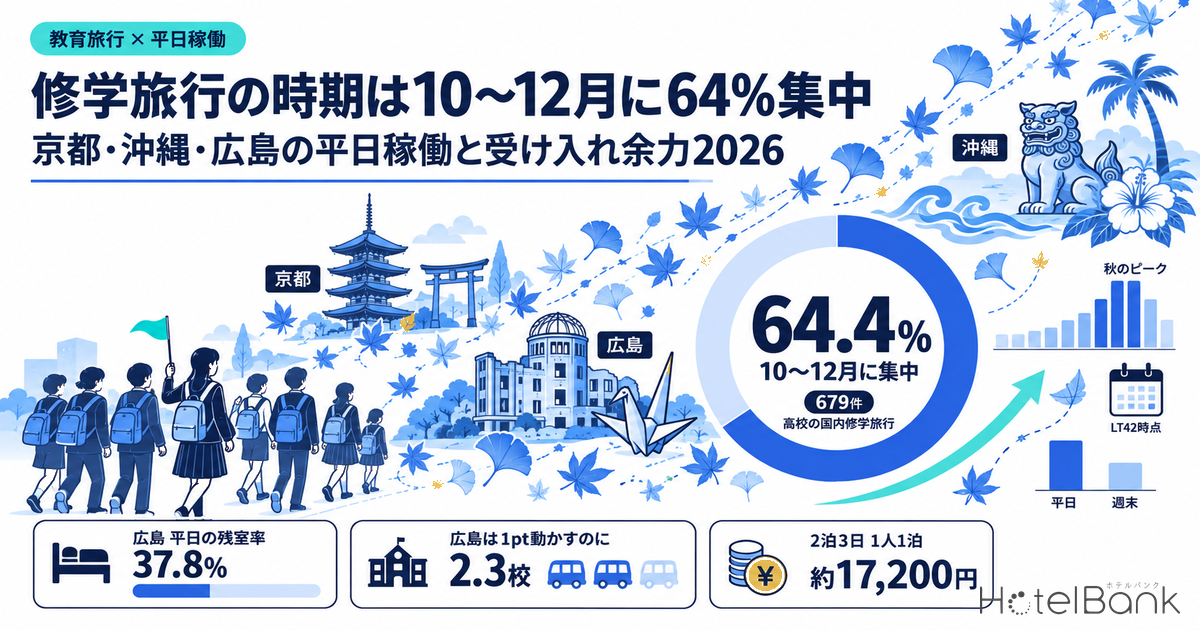
School trips in Japan are heavily skewed toward autumn. In the Japan School Tour Bureau’s survey of high schools covering trips conducted in FY2024, October–December accounted for 679 (64.4%) of 1,054 domestic school trips. Yet this demand moves through negotiated contracts rather than the major booking sites, so it barely shows up in ordinary booking curves. This article uses estimated OCC to quantify how much spare capacity remains on autumn weekdays, and reads measured data from Kyoto, Okinawa, Hiroshima and Tokyo to see which categories can absorb large, low-price group demand.
Metric Definitions Used in This Article
- OCC (occupancy): rooms sold as a share of total rooms in the area (an estimate based on OTA sales inventory). It is estimated from how inventory sold on the major booking sites is drawn down, and differs from a property’s actual occupancy. The universe is a fixed cohort of properties that list at least 30% of their rooms on the major booking sites; each statement gives the number of properties and rooms covered.
- LT (lead time): days until check-in. LT0 = the day of stay. Booking curves in this article use only observation points within LT45.
- ADR (average daily rate): an estimated settled rate (tax-exclusive equivalent), calculated by applying a category-specific correction factor to each property’s cheapest-plan level published on the major booking sites (2 guests per room, per-room price, tax-inclusive). Checked against property-level results disclosed by listed hotel REITs (91 properties, most recent 3 months), the median error is about 7%. It is an estimate and differs from each property’s actual settled prices and accounting figures. Area-level ADR is the median of the properties covered.
- Data source: MetroEngines Research
- — 64.4% in October–December: 679 of 1,054 domestic high-school trips fall between autumn and year-end (FY2024, Japan School Tour Bureau). The autumn peak is formed mainly by public schools.
- — One school moves Hiroshima by 0.44pt: at LT42 for October 2026, Hiroshima Prefecture’s weekday estimated OCC is 62.2%. One 200-student group in 67 rooms lifts the prefecture-wide weekday estimated OCC by about 7 times as much as in Tokyo (0.06pt).
- — Business hotels are the natural fit: Kyoto Prefecture has 197 business hotels with 19,758 rooms (100 rooms on average), while ryokan average only 19–25 rooms. Kyoto City keeps school trips exempt from its lodging tax and is steering groups toward the off-season with a transport subsidy for tickets used January–March.
School trips peak at 64% in October–December — monthly distribution of 1,054 high-school trips
According to the Japan School Tour Bureau’s FY2024 survey, which sampled 3,200 of 4,774 schools nationwide and received responses from 1,076 (a 33.6% response rate), 961 schools (89.3%) conducted a domestic school trip. Broken down by month, October had 238 trips, December 230 and November 211, so 679 trips are concentrated in these three months — 64.4% of all 1,054. October and November alone account for 449 (42.6%).
The skew was the same the year before: in FY2023, 764 of 1,149 trips (66.5%) fell in October–December. What stands out is the gap by type of school. In October FY2024, public schools made 164 trips against 74 for private schools, 2.2 times as many, but the order reverses in February (public 24, private 43) and March (public 9, private 49). Private schools tend to spread trips toward the end of the school year, so the autumn peak is formed mainly by public schools.
Source: compiled by the HotelBank Editorial Team from Japan School Tour Bureau, “Domestic School Trips Conducted in FY2024: Survey Summary (High Schools), Preliminary Edition” (N = 1,054 trips)
Destinations cluster in Kansai, Okinawa and the Tokyo area. The top prefectures were Osaka 290 (13.3%), Okinawa 273 (12.5%), Kyoto 230 (10.6%), Tokyo 220 (10.1%), Chiba 187 (8.6%), Hokkaido 132 (6.1%), Hyogo 123 (5.6%), Hiroshima 112 (5.1%) and Nara 102 (4.7%) (2,179 destinations in total, with each place visited counted once regardless of time spent). By main focus of activity, history studies led with 666, followed by peace studies at 387 and nature, environment and science studies at 310. This mix confirms that peace studies are what draw groups to Hiroshima and Okinawa.
Okinawa Prefecture publishes the most detailed figures from the receiving side. According to the prefecture’s Tourism Policy Division “School Trip Arrivals Survey”, arrivals in 2024 (calendar year) were 2,049 schools and 351,937 people, up 118 schools (+6.1%) and 10,557 people (+3.1%) year on year. Against 2019, that is a recovery to 85.4% by schools and 86.0% by people. By school type, high schools accounted for 1,371 schools (66.9%) and 264,193 people (75.1%), and junior high schools for 643 schools (31.4%) and 85,736 people (24.4%); together the two make up 99.4% of people. Monthly arrivals cluster in May–June and October–December, with November the largest by both schools and people. Osaka Prefecture is the largest origin, followed by Tokyo.
| Metric | 2024 | 2023 | 2019 |
|---|---|---|---|
| Schools received | 2,049 schools | 1,931 schools | 2,398 schools |
| People received | 351,937 | 341,380 | 409,011 |
| YoY change (people) | +3.1% | +48.9% | −4.7% |
| High schools’ share of people | 75.1% | — | — |
Source: compiled by the HotelBank Editorial Team from Okinawa Prefecture Tourism Policy Division, “Results of the 2024 (Calendar Year) School Trip Arrivals Survey”. The survey aggregates material supplied by the handling travel agencies and is not a complete count.
Kyoto City’s recruitment measures and lodging-tax exemption — the FY2026 framework
On the receiving side, the policy environment shifted significantly in Kyoto City in 2026: first a revision of lodging-tax rates, and second a transport subsidy for school-trip students. The two look as if they pull in opposite directions, but for groups they work in combination.
Start with the lodging tax. Kyoto City revised its rates for stays from March 1, 2026. The new rates are ¥200 for room charges under ¥6,000, ¥400 for ¥6,000 to under ¥20,000, ¥1,000 for ¥20,000 to under ¥50,000, ¥4,000 for ¥50,000 to under ¥100,000, and ¥10,000 for ¥100,000 and above. The design raises the mid-price bands and above the most.
On top of that, school trips remain exempt. According to Kyoto City, the exemption covers students on school trips from schools defined in Article 1 of the School Education Act other than universities (kindergartens, elementary schools, junior high schools, high schools, secondary schools, special-needs schools and colleges of technology), together with their chaperones. Chaperones include school staff accompanying the students as well as nurses and parents assisting students with disabilities, while travel-agency tour conductors and photographers are excluded. To apply it, a “certificate that the stay is a school trip” must be submitted to the property. Events recognised as school events under the national curriculum guidelines and held for a whole grade (such as outdoor school) are also covered, but club training camps are not.
In other words, even as the tax paid by ordinary guests rises, the effective price of a school trip stays put. The difference per night is a few hundred yen, but for a 200-student group staying 2 nights it adds up to a tax difference on the order of ¥100,000–200,000. For properties that host groups, this exemption is room to work with in price negotiations.
On transport, alongside the Kyoto School Trip 1-Day Ticket (standard edition ¥800, valid on all city bus and subway lines and on some Kyoto Bus, Keihan Bus and West JR Bus routes), a subsidy scheme covering the Keihan Railway extended edition is in place. Run by the Kyoto Tourism Promotion Council, it pays ¥1,100 per student for school trips by schools located outside Kyoto Prefecture that stay at least one night in Kyoto City. It covers tickets used from January 1 to March 31, 2027; applications are accepted from May 1, 2026 to February 26, 2027 and close once the budget cap is reached.
The point to note is that the subsidy covers January–March. From a lodging operator’s perspective, this is designed to steer groups into the off-season, not the autumn peak. In October–November, groups overlap with leisure demand, so their price advantage is harder to realise; January–March, by contrast, has ample spare capacity. The recruitment opportunity the policy signals is different in character in autumn and in winter.
Spare capacity left on autumn weekdays — estimated OCC in Kyoto, Okinawa, Hiroshima and Tokyo
From here, we use our own estimated OCC to see how much capacity remains on autumn weekdays. First, estimated OCC by check-in day of week for the most recent actuals (June 1 – September 19, 2026). Weekend is defined as Friday and Saturday check-ins; weekdays are all others.
| Area | Properties / rooms | Weekday est. OCC | Weekend est. OCC | Gap |
|---|---|---|---|---|
| Kyoto | 566 properties / 31,989 rooms | 79.3% | 85.3% | 6.0pt |
| Okinawa | 708 properties / 36,220 rooms | 85.7% | 89.1% | 3.4pt |
| Hiroshima | 215 properties / 14,797 rooms | 83.4% | 87.1% | 3.7pt |
| Tokyo | 805 properties / 104,583 rooms | 89.2% | 91.7% | 2.5pt |
Check-ins from June 1 to September 19, 2026 (79 weekdays, 32 weekend days). Based on listings on the major booking sites. Source: MetroEngines Research; compiled by the HotelBank Editorial Team
Kyoto shows the largest day-of-week gap at 6.0pt, while Tokyo’s is only 2.5pt. Tokyo, with its large market and deep corporate demand, holds up across the week, whereas Kyoto, with a heavier weighting of leisure demand, leans toward weekends. This is the summer baseline.
Next, for October, the peak month for school trips, we align on the same lead time (LT42, 42 days before the stay) to compare booking pace. The observation date differs by stay date, but as a comparison of booking progress the conditions are identical.
Each stay date in October 2026 compared at LT42 (42 days before the stay). 21 weekdays and 10 weekend days. Based on listings on the major booking sites (Kyoto Prefecture 781 properties / 33,433 rooms; Okinawa Prefecture 926 properties / 37,239 rooms; Hiroshima Prefecture 275 properties / 15,381 rooms; Tokyo 870 properties / 107,102 rooms). Source: MetroEngines Research; compiled by the HotelBank Editorial Team
At LT42 for October, Kyoto stood at 75.4% on weekdays and 78.9% on weekends (a 3.5pt gap), Okinawa at 70.1% and 75.5% (5.4pt), Hiroshima at 62.2% and 70.1% (7.9pt), and Tokyo at 65.5% and 68.0% (2.5pt). Hiroshima has the widest day-of-week gap at 7.9pt, with 37.8% of weekday inventory still unsold. Given that Hiroshima’s weekdays built up to 83.4% in the actuals months, most of this gap will fill after LT42 — but put the other way, 42 days out there is still physical room on weekdays for groups to come in.
An important caveat applies here. School trips move through negotiated contracts via travel agencies, so in many cases they do not appear as inventory on the major booking sites. The estimated OCC in this article may therefore count rooms already held by groups as “unsold”. The figures show only the capacity visible from the major booking sites, and actual vacancy is smaller. Conversely, the size of this visible capacity can be read as an indicator that the area has not yet been filled by individual demand.
Which categories can absorb groups — October progress and room stock by category
School-trip demand comes down to three traits: large numbers, use of Japanese-style or large shared rooms, and a low price per person. To test which categories can absorb demand on these three conditions, we look at progress by category at LT45 for October 2026 alongside room stock.
Monthly average curve for October 2026, at LT45. Based on listings on the major booking sites. Source: MetroEngines Research; compiled by the HotelBank Editorial Team
| Area | Category | Properties | Rooms | Avg rooms per property | Est. OCC at LT45 |
|---|---|---|---|---|---|
| Kyoto | Business | 197 | 19,758 | 100 rooms | 77.3% |
| Kyoto | City | 36 | 5,050 | 140 rooms | 83.4% |
| Kyoto | Ryokan | 118 | 2,186 | 19 rooms | 65.1% |
| Okinawa | Business | 138 | 12,908 | 94 rooms | 67.4% |
| Okinawa | Resort | 199 | 16,794 | 84 rooms | 78.6% |
| Hiroshima | Business | 96 | 11,138 | 116 rooms | 61.3% |
| Hiroshima | City | 16 | 1,799 | 112 rooms | 79.1% |
| Hiroshima | Ryokan | 45 | 1,111 | 25 rooms | 71.3% |
| Tokyo | Business | 552 | 80,109 | 145 rooms | 61.5% |
| Tokyo | City | 54 | 17,294 | 320 rooms | 77.5% |
October 2026 monthly average, at LT45. Based on listings on the major booking sites. Source: MetroEngines Research; compiled by the HotelBank Editorial Team
Ryokan are the first thing that comes to mind for Japanese-style and large shared rooms, but room stock is a hard constraint. Kyoto Prefecture’s ryokan number 118 properties with 2,186 rooms, an average of 19 rooms each. Housing one 200-student grade at 3 per room takes 67 rooms, so a Kyoto ryokan of average size cannot take a whole school on its own. In practice the group has to be split across several inns or combined with a larger category. Hiroshima’s ryokan follow the same pattern at 45 properties and 1,111 rooms (25 on average).
Business hotels, on the other hand, can absorb groups by sheer room stock. Kyoto Prefecture has 197 properties with 19,758 rooms (100 on average) and Tokyo 552 properties with 80,109 rooms (145 on average) — an order of magnitude larger — and their progress at LT45 is lower than city or resort hotels: 77.3% in Kyoto, 61.5% in Tokyo, 61.3% in Hiroshima and 67.4% in Okinawa. Business hotels in Tokyo and Hiroshima in particular still have nearly 40% of listed inventory unsold 45 days out. For where weekday listed prices sit relative to weekends in the same autumn school-trip season, by category, see Autumn School Trips: Weekday Rate Floors in 5 Areas, Nagasaki +1.6pt.
The macro structure points the same way. According to the Japan Tourism Agency’s Overnight Travel Statistics Survey for 2025 (annual, final figures), national room occupancy was 61.6% (+2.0pt year on year); by property type, business hotels ran at 75.3%, city hotels 74.1%, resort hotels 56.9%, ryokan 38.2% and simple lodgings 29.6%. Ryokan and simple lodgings have large spare capacity year-round, but with few rooms per property, taking a large group on their own requires networking. That is where joint bids by several inns, or local school-trip reception councils, have room to act.
Profitability of hosting groups — how to value ¥11,000–17,000 per student per night
Next, profitability. According to the Japan School Tour Bureau’s FY2024 survey, the total cost of a domestic high-school trip was ¥114,623 per student. The breakdown is transport ¥53,244 (47.6%), lodging ¥34,398 (30.8%), hands-on activities ¥10,586 (9.5%) and other ¥13,629 (12.2%). Lodging costs rose +13.1% in five years, from ¥30,412 in FY2019 to ¥34,398 in FY2024. Note that the Bureau totals and averages the overall figure and each component separately, so the components (¥111,857 in total) do not add up to the overall figure; the shares above are relative to the sum of components.
This lodging figure is the total for all nights of the trip. For 2 nights / 3 days it works out to about ¥17,200 per student per night, and for 3 nights / 4 days about ¥11,500. The travel agency’s arrangement fee and the cost of two meals are deducted from this, so what the property receives is lower. Even so, at 3 students per room, revenue per room per night comes to about ¥51,600 on a 2-night basis and about ¥34,400 on a 3-night basis — not small as a simple room rate.
| Assumption | Per student per night | Per room, 3 per room | Per room, 4 per room |
|---|---|---|---|
| 2 nights / 3 days (lodging ¥34,398 per student) | ~¥17,200 | ~¥51,600 | ~¥68,800 |
| 3 nights / 4 days (same) | ~¥11,500 | ~¥34,400 | ~¥45,900 |
| Reference: estimated settled ADR, October 2026 | — | Shimogyo Ward, Kyoto ~¥22,700 / Nakagyo Ward ~¥23,500 / Naka Ward, Hiroshima ~¥13,800 / Naha ~¥10,400 | |
Group amounts are on the school’s payment basis, including the travel agency’s arrangement fee and meal costs. Reference ADR is an estimate based on listed levels at the time of the survey (Shimogyo Ward N = 163 properties; Nakagyo Ward N = 109; Naka Ward, Hiroshima N = 62; Naha N = 144). Source: Japan School Tour Bureau / MetroEngines Research; compiled by the HotelBank Editorial Team
How much of the school’s payment reaches the property depends on the arrangement terms. We therefore set the property’s share after deducting the travel agency’s fee and similar items (the “take rate” below) at three illustrative levels — 60%, 70% and 80% — and show the amount received per room per night (meals included). A 10pt move in the take rate shifts the amount received per room per night by about ¥5,200 for 2 nights / 3 days at 3 per room, and about ¥3,400 for 3 nights / 4 days at 3 per room. Raising occupancy from 3 to 4 students per room has an effect at least as large as lifting the take rate by 20pt.
| Nights / students per room | Take rate 60% | Take rate 70% | Take rate 80% |
|---|---|---|---|
| 2 nights / 3 days, 3 per room | ~¥31,000 | ~¥36,100 | ~¥41,300 |
| 2 nights / 3 days, 4 per room | ~¥41,300 | ~¥48,200 | ~¥55,000 |
| 3 nights / 4 days, 3 per room | ~¥20,600 | ~¥24,100 | ~¥27,500 |
| 3 nights / 4 days, 4 per room | ~¥27,500 | ~¥32,100 | ~¥36,700 |
Illustrative amount received by the property per room per night (meals included): lodging ¥34,398 per student (FY2024, domestic high-school trips) divided by nights × students per room × take rate. Take rates are illustrative assumptions; actual fee rates and meal costs vary by contract. Source: compiled by the HotelBank Editorial Team from the Japan School Tour Bureau
Next, how much one school group moves weekday occupancy. At LT42 for October 2026, unsold weekday rooms per day were about 8,200 in Kyoto Prefecture (33,433 rooms; weekday estimated OCC 75.4%), about 11,100 in Okinawa (37,239 rooms; 70.1%), about 5,800 in Hiroshima (15,381 rooms; 62.2%) and about 36,900 in Tokyo (107,102 rooms; 65.5%). The rooms needed to move estimated OCC by 1pt are 334 in Kyoto, 372 in Okinawa, 154 in Hiroshima and 1,071 in Tokyo.
A 200-student group at 3 per room takes 67 rooms. Converted to area-wide estimated OCC, one school lifts Hiroshima by 0.44pt, Kyoto by 0.20pt, Okinawa by 0.18pt and Tokyo by 0.06pt. Expressed as schools needed to move occupancy by 1pt: Hiroshima 2.3, Kyoto 5.0, Okinawa 5.6 and Tokyo 16.0.
Converted per group of 200 students at 3 per room (67 rooms). Calculated from weekday estimated OCC and rooms covered at LT42 for October 2026. Source: MetroEngines Research; compiled by the HotelBank Editorial Team
In Hiroshima, a small market, 2–3 school groups move prefecture-wide weekday occupancy by 1pt. Hiroshima Prefecture received 112 high-school trip destinations (FY2024, a 5.1% share), with steady demand anchored in peace studies. Add the 37.8% of autumn weekday capacity still open, and group volume is structurally able to move the whole market’s occupancy. Tokyo, conversely, needs 16 schools for 1pt: groups can fill an individual property’s weekdays, but they are unlikely to move supply and demand across the market.
Okinawa is somewhat different. The prefectural survey counts 351,937 arrivals in 2024, with November the largest month by both schools and people. At the same time, our estimated OCC was the highest of the four areas in the actuals months at 85.7% on weekdays, and had already built to 70.1% on weekdays at LT42 for October. The depth of its resort-hotel stock — 199 properties with 16,794 rooms — meshes with a demand structure that has two distinct peaks, May–June and October–December.
Summary — two recruitment opportunities: autumn weekdays and the winter off-season
This article established four points. First, 64.4% of domestic high-school trips are concentrated in October–December, forming a clear autumn peak of 238 trips in October, 230 in December and 211 in November. Second, Kyoto City raised its lodging tax for the mid-price bands and above in March 2026, while keeping the exemption for school-trip students and chaperones, so groups’ relative price competitiveness is preserved. Third, at LT42 for October 2026, unsold weekday listed inventory stood at 37.8% in Hiroshima, 34.5% in Tokyo, 29.9% in Okinawa and 24.6% in Kyoto; the smaller the market, the more groups move occupancy. Fourth, business hotels are the category with the room stock to absorb groups, whereas ryokan, at an average of 19–25 rooms per property, need to cooperate across several inns.
The policy implications are also clear. As Kyoto City’s 1-Day Ticket subsidy covers tickets used in January–March 2027, the focus of recruitment is widening from the autumn peak to the winter off-season. In autumn, groups overlap with leisure demand and their price advantage is harder to realise, but January–March has ample spare capacity, and combined with the subsidy it also keeps the school’s total cost down. Lodging budgets of about ¥17,200 per student per night for 2 nights / 3 days and about ¥11,500 for 3 nights / 4 days deserve serious consideration as a way to fill off-season weekdays.
For October–November, since weekday room remains 42 days out, holding a group allocation makes sense as an option that does not depend solely on last-minute individual demand. In areas such as Hiroshima, where one school carries a large impact, building the capacity to receive groups has the headroom to lift the market as a whole.
⚠ Note on forward-dated data: Estimated OCC and estimated settled ADR for October 2026 in this article are estimates based on inventory and selling prices published on the major booking sites at the time of the survey, and will change as check-in approaches. Group demand such as school trips often moves through negotiated contracts via travel agencies and may not be reflected in inventory on the major booking sites. The estimated OCC in this article shows only the inventory drawdown observable on the major booking sites.
Related Articles
References and Sources
■ School trip statistics
- Japan School Tour Bureau, “Domestic School Trips Conducted in FY2024: Survey Summary (High Schools), Preliminary Edition” (in Japanese)
- Japan School Tour Bureau, Educational Travel Annual Report “Data Book” (in Japanese)
- Okinawa Prefecture, “School Trip Arrivals Survey” (in Japanese)
- Okinawa Prefecture Tourism Policy Division, “Results of the 2024 (Calendar Year) School Trip Arrivals Survey” (published December 2025, in Japanese)
■ Policy and municipal measures
- Kyoto City, “Lodging Tax Revision From March 1, 2026 Formally Decided” (in Japanese)
- Kyoto City, “FAQ for Guests (Tax Exemptions)” (in Japanese)
- Kyoto City Transportation Bureau, “Kyoto School Trip 1-Day Ticket (for School Trips)” (in Japanese)
- Kyoto School Trip Navi, “Kyoto School Trip 1-Day Ticket Subsidy Scheme” (Kyoto Tourism Promotion Council, in Japanese)
■ Government statistics
- Japan Tourism Agency, “Overnight Travel Statistics Survey” (2025 annual, final figures, in Japanese)
■ Market data
- MetroEngines Research — estimated OCC (based on inventory listed on the major booking sites), booking curves, estimated settled ADR