

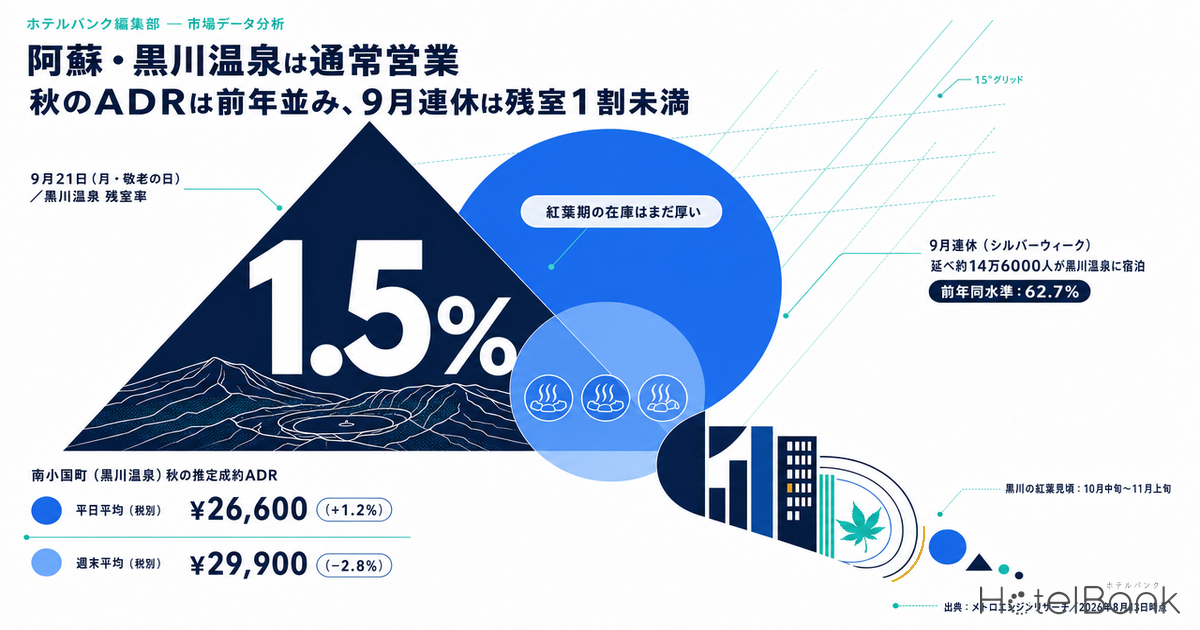
Let us start with the conclusion. As of mid-August 2026, accommodation facilities in Aso City and Kurokawa Onsen (Minamioguni Town) are operating normally. The Aso City Tourism Association announced on 31 July 2026 that “there has been no major damage to tourist facilities, accommodation, roads or rivers within Aso City, and we are operating as usual,” while the Kurokawa Onsen Ryokan Association stated on 29 July 2026 that “the onsen town has suffered no major damage” and that “ryokan and shops alike are operating as usual (some facilities are temporarily closed).” At the same time, Kumamoto Prefecture has reported that accommodation cancellations across the prefecture reached roughly 146,000 guest-nights. This article places the officially published operating status side by side with actual measured autumn (September-November) rate and inventory data compiled by MetroEngines Research, to assess when it makes sense to book – for travellers and for hoteliers alike.
Metric Definitions Used in This Article
- ADR (average daily rate): An estimated transacted rate (tax-excluded equivalent) calculated by applying a segment-specific adjustment factor to the lowest published plan level that each property lists on OTAs and other channels (2 guests per room, per-room price, tax included). Cross-checked against property-level actuals disclosed by listed hotel REITs (91 properties, most recent 3 months), the median error is approximately 7%. These are estimates and differ from each property’s actual transacted prices or accounting figures. Area-level ADR is the median of the properties covered (the level of a typical property in that area).
- LT (lead time): Days remaining until the check-in date. LT0 = same day.
- Remaining-inventory rate: The share of rooms observed as still on sale on OTAs, measured against the total room count in the area. It is an estimate based on how far published OTA inventory has been absorbed, and differs from each property’s actual total inventory.
- Number of observed properties: The number of properties for which inventory and pricing could be confirmed on OTAs on each observation date. This is not a complete census.
- Data source: MetroEngines Research (based on major OTA listings)
- — Operating normally: Both the Aso City Tourism Association (31 July 2026) and the Kurokawa Onsen Ryokan Association (29 July 2026) have stated there is no major damage and that operations are normal. Some individual facilities remain closed, so travellers should check each property’s official information.
- — Roughly 146,000 guest-nights cancelled (Kumamoto Prefecture announcement, cumulative through 6 August; estimated loss approximately ¥2.06 billion). About 60% was concentrated in Aso and Amakusa, areas that were comparatively less damaged – a distribution that does not match where building damage actually occurred.
- — Autumn ADR is flat year on year: The estimated transacted ADR for Minamioguni Town (Kurokawa Onsen) is +1.2% in September, −3.1% in October and −2.8% in November (N=42-46 properties). Aso City, by contrast, is running 8-15% above last year.
- — Only the September long weekend stands out: As of 13 August 2026, Minamioguni Town shows a remaining-inventory rate of 1.5% for 21 September (Monday, Respect for the Aged Day) and 7.3% for Saturday 19 September. These are mid-course readings at LT37-39, not a sell-out.
- — The autumn foliage season still has room: Saturdays from October through early November show remaining-inventory rates of 20-28% in Minamioguni Town and 50-63% in Minamiaso Village (also as of 13 August). There is upside left in how the LT60-30 window is priced and packaged.
What the primary sources say – Aso, Kurokawa and Minamiaso are all “operating normally”
The 2026 Kumamoto Earthquake (令和8年熊本地震) struck at 16:27 on 28 July 2026, with its epicentre in the Kumamoto region of Kumamoto Prefecture. According to the Japan Meteorological Agency (JMA), the magnitude was 7.1 and the maximum seismic intensity was 7. The agency notes that “the number of earthquakes is gradually decreasing overall, with fluctuations,” while cautioning that conditions remain more prone than usual to earthquakes of intensity 5-lower or above.
So what is the situation at accommodation facilities in the Aso and Kurokawa Onsen area right now? Arranging each locality’s official announcements chronologically, the Aso region – which sits at some distance from the epicentre – has consistently communicated “no major damage, operating normally” from the day after the quake through the following week.
| Source | Date published | Content as published |
|---|---|---|
| Kurokawa Onsen Ryokan Association | 29 July 2026 | Kurokawa Onsen recorded seismic intensity 4. The onsen town suffered no major damage; ryokan and shops are operating as usual (some facilities temporarily closed) |
| Aso City Tourism Association | 31 July 2026 | No major damage to tourist facilities, accommodation, roads or rivers in the city; operating as usual. Some suspensions and road closures remain on the JR Hohi Line, Sanko Bus services and expressways |
| Minamiaso Info (Minamiaso area information site) | 5 August 2026 | Most facilities and shops are operating as usual. No major damage to main roads in the village and no road closures. The Minamiaso Railway is running normally, and the Kumamoto Earthquake Memorial Museum KIOKU reopened normally from 5 August |
| Japan Tourism Agency, “2026 Kumamoto Earthquake related information” | 7 August 2026 | Kumamoto Prefecture directs travellers to its tourism association link list for facility-by-facility operating status. In Fukuoka, Saga, Nagasaki, Oita, Miyazaki and Kagoshima, accommodation and tourist facilities are broadly operating as normal |
| Kurokawa Onsen Ryokan Association | 31 July / 11 August 2026 | 23 ryokan are opening their outdoor baths free of charge to residents in areas still without running water (for the time being) |
Source: Compiled by the HotelBank Editorial Team from information published on each organisation’s official website
One caveat deserves emphasis: “operating normally” is not uniform at the property level. The Kurokawa Onsen Ryokan Association’s own notice explicitly states that “some facilities are temporarily closed.” Whether any individual inn is open should always be confirmed on that property’s official website or by telephone. This article does not name individual properties whose operating status cannot be officially confirmed.
On access, constraints remain. On the JR Hohi Line, service has resumed between Kumamoto and Higo-Ozu, but the Higo-Ozu to Miyaji section is still suspended. Some services on the Kyushu Odan Bus, which links Kumamoto, Kurokawa Onsen, Yufuin and Beppu, are suspended through 31 August. The Kurokawa Onsen Ryokan Association advises that travellers from the Fukuoka and Saga direction can use the Dazaifu IC – Kyushu Expressway – Tosu JCT – Oita Expressway – Hita IC – National Route 212 routing, which avoids the sections closed by the earthquake. The accurate reading is that difficulty varies by mode of transport.
Source: Compiled by the HotelBank Editorial Team from MetroEngines Research data
146,000 guest-nights cancelled prefecture-wide – but 60% concentrated in Aso and Amakusa
Even as operations continued, booking cancellations occurred on a large scale. According to figures released by Kumamoto Prefecture on 11 August, tourism-related damage – combining building and equipment damage at accommodation facilities with cancellations – amounts to approximately ¥6.0 billion. Of that, accommodation cancellations through 6 August total roughly 146,000 guest-nights, with an estimated loss of about ¥2.06 billion (Jiji Press, distributed 12 August 2026). According to the Kumamoto Nichinichi Shimbun (8 August 2026), cancellations at the 37 member properties tallied by the Aso City Tourism Association as of 3 August amounted to some 17,000 guest-nights (preliminary), with an estimated loss of about ¥280 million, while Kamiamakusa City has identified ¥197 million.
What matters here is the distribution. Press reports indicate that roughly 60% of cancellations were concentrated in Aso and Amakusa – the two areas that were comparatively less damaged. In other words, the distribution of building damage and the distribution of cancelled bookings do not match. This asymmetry is itself a structural pattern that recurs in post-disaster accommodation demand: seismic intensity decays with distance from the epicentre, but cancellations do not decay in the same way.
The Kumamoto Nichinichi Shimbun also reports that cancellations extend beyond July and August, reaching as far out as December. Read the other way round, that means autumn and later inventory is more likely than usual to remain unsold. From here, we turn to the actual measured autumn inventory and rate data.
First, confirm the observation is sound – stripping out apparent movements caused by delisting
There is one step that must come first when reading post-disaster inventory data. When properties temporarily pull their listings from OTAs, the rooms that drop out of the sample make it look as though remaining inventory has fallen – that is, as though rooms have sold. Occupancy appears to surge even though demand has not grown: the classic observational artefact.
To test for this, we tracked the daily trend in the number of properties for which inventory and pricing could be confirmed (the number of observed properties) in each area, for check-in on Saturday 10 October 2026, across the date of the earthquake.
Source: Compiled by the HotelBank Editorial Team from MetroEngines Research data (check-in 10 October 2026, based on major OTA listings)
The result was clear. In Aso City, Minamioguni Town (Kurokawa Onsen), Minamiaso Village and Oguni Town alike, the number of observed properties did not fall around 28 July, the day of the earthquake. If anything it rose from 25 July onwards (Minamioguni Town 38 to 51 properties; Aso City 29 to 40). The measured answer is that there is no sign of listings being withdrawn en masse in any particular area – consistent with the “operating normally” status published by the tourism associations and ryokan cooperatives.
That said, on 30-31 July the number of observed properties dipped simultaneously across all six areas (Chuo Ward of Kumamoto City 62 to 28 properties; Kamiamakusa City 27 to 19; Aso City 34 to 27). Because even Kamiamakusa City – distant from the epicentre and lightly damaged – fell by a similar proportion at the same moment, we judged this to be a discontinuity on the observation side rather than a suspension of sales in any specific area. Accordingly, this article does not use remaining-inventory or occupancy estimates for any snapshot covering 30-31 July. For Kumamoto Prefecture inventory data in that period, see also our verification at the 72-hour mark, how to read the disappearance of inventory.
Autumn ADR is flat at Kurokawa Onsen – Aso City is above last year
Next, rates. Overlaying the estimated transacted ADR for Minamioguni Town, home to Kurokawa Onsen, month by month for 2025 and 2026 reveals the shape of the season.
Source: Compiled by the HotelBank Editorial Team from MetroEngines Research data (Minamioguni Town, N=42-48 properties)
Minamioguni Town traces the classic winter-weighted curve, with rates climbing towards December. In 2026 the town ran well above the prior year from January through May, but from June onwards it returned to roughly the same level as last year, and the three autumn months sit close to flat: +1.2% in September, −3.1% in October and −2.8% in November. In short, autumn at Kurokawa Onsen is not currently priced at any particular premium.
Lining up the year-on-year autumn ADR change by area shows that movements diverge even within the Aso region.
Source: Compiled by the HotelBank Editorial Team from MetroEngines Research data
| Area | Sept ADR (YoY) |
Oct ADR (YoY) |
Nov ADR (YoY) |
N (2026) |
|---|---|---|---|---|
| Minamioguni Town (Kurokawa Onsen) | ¥26,600 (+1.2%) | ¥28,500 (−3.1%) | ¥29,900 (−2.8%) | 42-46 properties |
| Aso City | ¥19,600 (+12.8%) | ¥21,600 (+15.2%) | ¥21,400 (+8.4%) | 22-25 properties |
| Minamiaso Village | ¥26,300 (+6.5%) | ¥26,600 (+4.2%) | ¥26,400 (−1.4%) | 15-16 properties |
| Oguni Town | ¥18,000 (−2.5%) | ¥18,800 (+6.3%) | — (not shown; insufficient N) | 17-20 properties |
| Kamiamakusa City (comparison) | ¥15,100 (+16.4%) | ¥15,800 (+15.4%) | ¥15,300 (−2.5%) | 17-20 properties |
| Chuo Ward, Kumamoto City (comparison) | ¥11,500 (+33.8%) | ¥10,300 (+20.3%) | ¥10,800 (+13.9%) | 58-59 properties |
Source: Compiled by the HotelBank Editorial Team from MetroEngines Research data / Figures for September-December 2026 are estimates based on listing levels at the time of the survey. November for Oguni Town is not shown because the number of observed properties fell below 60% of that area’s median
Aso City is above last year in every month, while Minamioguni Town, home to Kurokawa Onsen, is broadly flat and Oguni Town is marginally below in September. Even within the same Aso region, rates are not moving in unison. Chuo Ward of Kumamoto City stands out at +33.8% in September, but urban business and recovery-related demand is driven by different forces than an onsen destination, so it cannot be placed on the same evaluative axis. It is shown here only as a reference point for the prefecture-wide level.
Which month autumn ADR peaks in varies by prefecture, and our editorial team has classified all 47 prefectures into September-peak, October-peak, November-peak and flat types. The Minamioguni Town curve is a late-weighted type that rises through October and November, and notably rates do not fall away even after the foliage season.
How far has autumn inventory sold – only the September long weekend stands out
So what about inventory? Using observations as of 13 August 2026, we checked the remaining-inventory rate in each area for Saturdays and public holidays from September through early November.
Source: Compiled by the HotelBank Editorial Team from MetroEngines Research data (observations as of 13 August 2026)
| Check-in date | LT | Minamioguni Town (Kurokawa Onsen) |
Aso City | Minamiaso Village | Oguni Town | Kamiamakusa City |
|---|---|---|---|---|---|---|
| Sat 19 September | 37 | 7.3% | 23.4% | 41.9% | 29.3% | 28.0% |
| Mon 21 September (Respect for the Aged Day) | 39 | 1.5% | 13.2% | 26.8% | 23.6% | 16.5% |
| Sat 26 September | 44 | 32.8% | 20.6% | 50.3% | 44.0% | 28.1% |
| Sat 10 October | 58 | 20.2% | 22.5% | 49.3% | 21.8% | 43.1% |
| Sat 17 October | 65 | 26.0% | 10.8% | 52.2% | 33.8% | 45.6% |
| Sat 31 October | 78 | 27.1% | 30.2% | 61.8% | 45.5% | 46.1% |
| Sat 7 November | 85 | 28.1% | 21.3% | 62.7% | 42.9% | 46.4% |
Source: Compiled by the HotelBank Editorial Team from MetroEngines Research data / Observations as of 13 August 2026. Observed properties: Minamioguni Town 50-52 properties (617-650 total rooms), Aso City 36-40 (1,143-1,247 rooms), Minamiaso Village 41-47 (848-900 rooms), Oguni Town 16-22 (170-228 rooms), Kamiamakusa City 27-31 (543-565 rooms)
Three things stand out.
First, only the three-day weekend that includes Monday 21 September (Respect for the Aged Day) is running well ahead. In Minamioguni Town the remaining-inventory rate was 1.5% as of 13 August (51 properties observed, 10 rooms remaining out of 647 total), and Saturday 19 September had also moved to 7.3% (47 rooms remaining). However, these are mid-course readings with 37-39 days still to go until check-in, and they will continue to move as inventory is added or bookings are cancelled. We do not describe these dates as sold out.
Second, weekends from October onwards still have room. Saturdays in October and November are running at 20-28% remaining in Minamioguni Town and 11-30% in Aso City. Even for late October and early November, in the heart of the foliage season, some areas still have around 30% of inventory unsold at this point.
Third, the gap between areas is wide. Minamiaso Village sits at 50-63% remaining on almost every weekend from 26 September onwards – the thickest inventory among the six areas. Kamiamakusa City also runs at 43-46% from October. Aso City, by contrast, has already moved to 10.8% for Saturday 17 October: even within the same Aso region, the pace of absorption is uneven.
At what lead time does it make sense to book?
Taken together, the right moment to book divides clearly by date for travellers.
| Dates | Position as of 13 August | The rational move |
|---|---|---|
| 19-21 September (Respect for the Aged Day weekend) | Kurokawa Onsen at 1.5-7.3% remaining; Aso City at 13-23% | Choices are already limited. Widening the search to Minamiaso Village (26.8-41.9% remaining) or Oguni Town makes booking easier |
| Ordinary late-September weekend | Kurokawa Onsen 32.8%, Minamiaso Village 50.3% – inventory loosens sharply once the holiday weekend passes | Shifting a week later also brings the published price down from ¥67,100 on 21 September to ¥54,200 on 26 September (Minamioguni Town, 2 guests per room, tax included) |
| October weekends | Kurokawa Onsen 20-26%, Aso City 11-23% | Still selectable at the current LT50-65. But some dates run ahead – Aso City on 17 October, for example – so book early if you are targeting a specific date |
| Late October to early November (foliage season) | Kurokawa Onsen 27-28%, Minamiaso Village 62-63% | At LT78-85, this is the window with the thickest remaining inventory. ADR is also settled at around −3% year on year |
Source: Compiled by the HotelBank Editorial Team from MetroEngines Research data (observations as of 13 August 2026)
Seen from the hotelier’s side, the same picture reads as a revenue opportunity. Demand for the September long weekend has already been demonstrated, making it a phase where tiered pricing can be applied effectively. The foliage season from late October into early November, by contrast, still carries thick inventory with ADR only at last year’s level, leaving room to rebuild the lead-time-based selling plan. Areas running at 50-60% remaining – Minamiaso Village and Kamiamakusa City in particular – have their upside in how they pull demand forward within the LT60-30 band. On the weekday side, how autumn onsen inventory moves across the lead-time curve is a related question we have examined separately.
The Aso region also has precedent: accommodation demand returned in stages during the recovery from the 2016 Kumamoto Earthquake. We examine that ten-year recovery curve in detail in Ten years after the Kumamoto Earthquake: how far has Aso tourism recovered, which is worth reading for a medium-to-long-term view.
Summary
According to announcements from the Aso City Tourism Association and the Kurokawa Onsen Ryokan Association, accommodation facilities in both areas are operating normally as of mid-August 2026 (with some facilities temporarily closed). Minamiaso Village also reports no road closures on its main village roads, and the Minamiaso Railway is running normally. On the other hand, suspensions remain on the Higo-Ozu to Miyaji section of the JR Hohi Line and on some Kyushu Odan Bus services, so travel arrangements should be checked in advance.
On rates, autumn ADR in Minamioguni Town, home to Kurokawa Onsen, is close to flat at −3% to +1% year on year. On inventory, only the 19-21 September long weekend has moved to 1-7% remaining, while weekends from October through early November still held 20-30% of inventory as of 13 August (50-63% in Minamiaso Village). Across autumn weekends, including the foliage season, there is still a genuine choice available.
Because operating status differs from property to property, please confirm each facility’s official information before booking. What the data shows is that the area as a whole is continuing to sell as normal, and that rates are not at any unusual level.
⚠ A note on forward-dated data: The ADR and remaining-inventory figures for September-December 2026 in this article are all estimates based on information published on OTAs at the time of the survey (13 August 2026), and will fluctuate as the check-in date approaches. Newly added plans, rate revisions and inventory returning through cancellations will all move these numbers. Operating status can also change at any time at each property’s discretion, so please always confirm each property’s official information before booking.
Related reading
- Kumamoto Quake 10Y x Aso: Data on Recovery and Tourism Brand Rebound
- Kumamoto Quake 2026, 72 Hours On: 6 Closures vs 17.9% Inventory Loss
- Kumamoto Quake 2026: 2016 Recovery Curve as Kyushu’s 7-Pref Benchmark
- Japan Autumn ADR 2026: 20 Prefectures Peak in Nov, Kyoto +81.8%
- Obon T-7: Kyushu’s 31.7pt Gap — Fukuoka 73.0%, Kagoshima 41.3%
- Chiba Floods: Narita 2.29x, Urayasu 2.40x, Disaster-Hit Chuo 0.83x
References and sources
■ Operating status / primary sources
- Kurokawa Onsen Ryokan Association, “Conditions at Kurokawa Onsen and transport access following the Kumamoto Earthquake” (29 July 2026) / “Support for affected areas after the 2026 Kumamoto Earthquake” (11 August 2026)
- Aso City Tourism Association, “Regarding the 2026 Kumamoto Earthquake” (31 July 2026)
- Minamiaso Info, “[Earthquake impact] Operating status of facilities and shops in Minamiaso, and road conditions” (5 August 2026)
- Japan Tourism Agency, “2026 Kumamoto Earthquake related information” (7 August 2026)
- Japan Meteorological Agency, “2026 Kumamoto Earthquake portal site”
- Kumamoto Prefecture, “Information on the 2026 Kumamoto Earthquake”
■ Transport
■ Press
- “Tourism damage of ¥6.0 billion, summer holidays hit directly, accommodation cancellations” (Jiji Press, distributed 12 August 2026)
- “<2026 Kumamoto Earthquake> Summer holidays hit directly, blow to prefectural tourism: ¥900 million in accommodation cancellations, possibly growing” (Kumamoto Nichinichi Shimbun, 8 August 2026)
■ Data sources
Aggregated from published-rate and inventory data collected daily by MetroEngines Research from public information on major OTAs (six municipalities in Kumamoto Prefecture, check-in dates from August 2025 through December 2026). Operating status is based on information published by tourism associations, ryokan cooperatives and government bodies; the scale of cancellations is based on tallies published by Kumamoto Prefecture as reported in the press.
■ Calculation assumptions
ADR is an estimated transacted rate derived by applying a segment-specific adjustment factor to the lowest published plan level that each property lists on OTAs and other channels (2 guests per room, per-room price, tax included); area values are the median of the properties covered. The remaining-inventory rate is the share of rooms observed as still on sale on OTAs against the total room count in the area. Year-on-year comparisons use 2025 actuals for the same area on the same definition. Cross-checked against property-level actuals disclosed by listed hotel REITs (91 properties, most recent 3 months), the median error is approximately 7%.
■ Limitations and caveats
Observations are based on major OTA listings and are not a complete census. Because the number of observed properties became discontinuous simultaneously across all six areas on 30-31 July 2026, remaining-inventory and occupancy estimates for that snapshot are not used. Months in which the number of observed properties fell below 60% of the area median (November 2026 for Oguni Town) are not shown. Figures for September-December 2026 are estimates for forward dates as of the survey date and will fluctuate as plans are added, rates revised, and inventory returns through cancellations. For any individual property, that property’s official information takes precedence on whether it is open.
■ Market data
- MetroEngines Research — estimated transacted ADR (monthly, by municipality), remaining-inventory trend, number of observed properties (based on major OTA listings)