

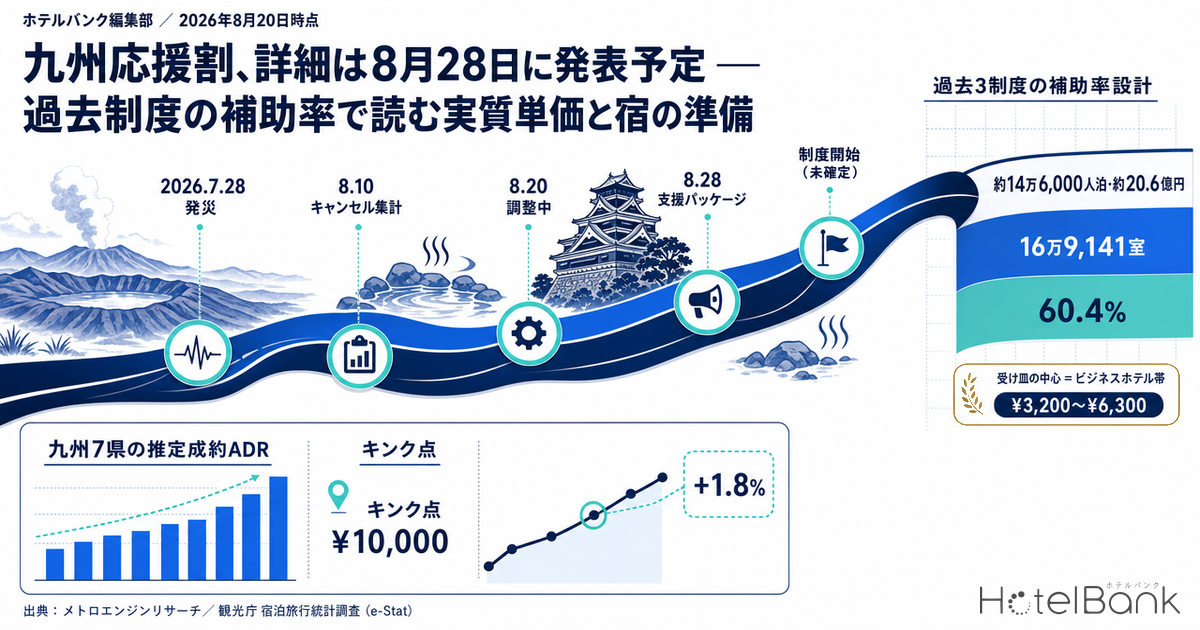
To support a tourism industry hit by the Kumamoto Earthquake (the 2026 Kumamoto Earthquake, which struck on July 28, 2026), the Japanese government has begun arrangements to launch “Kyushu Ouen-wari” (九州応援割), a program that would use public funds to subsidize part of accommodation charges and group travel fares. As of August 20, 2026, however, the only settled fact is that the program is “under arrangement toward implementation.” The eligible areas, the subsidy rate and the timing are all still undecided. The details are expected to be included in a support package that may be finalized as early as August 28.
This article is a practical brief for hotels waiting on a program that has not yet been fixed — the goal being to be ready to move the day after the announcement. We check the subsidy-rate designs of the past programs (Kyushu Fukkou-wari, Kenmin-wari and the National Travel Discount Program) against primary sources, simulate how combinations of subsidy rate and cap move the net price a traveler pays, and then read off “which price bands and which areas the subsidy will actually reach” from the current estimated settled ADR and room stock across Kyushu’s seven prefectures. Every figure in this article relating to subsidy rates, eligible areas and timing is an assumption drawn from past programs, and does not indicate the content of Kyushu Ouen-wari.
Premises of This Article (as of August 20, 2026)
- Kyushu Ouen-wari is at the stage of being “under arrangement toward implementation.” It has not been decided or announced as a formal program.
- The eligible areas, subsidy rate, discount cap, timing and budget scale are all undecided. MLIT is reported to be working out the details.
- The details are expected to be included in a Kumamoto Earthquake support package that may be compiled as early as August 28.
- The subsidy-rate simulations in this article apply the designs of previously implemented programs as-is, and neither forecast nor imply the subsidy rate of Kyushu Ouen-wari.
Metric Definitions Used in This Article
- ADR (average daily rate): an estimated settled rate (tax-excluded equivalent) calculated by applying property-type correction factors to the lowest publicly listed plan level each property publishes on OTAs and similar channels (two guests per room, per-room price, tax included). Cross-checked against per-property results disclosed by listed hotel REITs, the median error is 6.6%. These are estimates and differ from each property’s actual transacted prices and accounting figures. Area-level ADR is the median of the properties covered (the level of a typical property in that area).
- Per-person-per-night ADR (reference value): past travel demand stimulus programs set subsidy rates and caps on the basis of “travel cost per person per night,” so for comparison we divide the estimated settled ADR by two, assuming two guests per room. It is a rough guide for accommodation only (excluding transport) and differs from actual per-person prices.
- Room stock: the total number of guest rooms at properties observed to be listed for check-in between September 1 and 14, 2026. Properties not listed on OTAs are excluded.
- Data sources: MetroEngines Research / Japan Tourism Agency, “Overnight Travel Statistics Survey” (e-Stat)
- — Kyushu Ouen-wari has not yet been established as a program. Eligible areas, subsidy rate and timing are all undecided; details are expected to emerge with the August 28 support package.
- — Per-person-per-night ADR across Kyushu’s seven prefectures runs ¥3,200 to ¥6,300 (July 2026, N=2,232 properties) — below every kink point of the three past programs (¥10,000 / ¥12,500 / ¥15,000).
- — This is therefore a market where the rate matters more than the cap. Raising the cap would generate almost no additional effect at Kyushu’s price levels.
- — The bulk of capacity sits in business hotels: 102,204 rooms (60.4%), with estimated settled ADR of ¥5,900 to ¥10,400 — the band where the subsidy rate passes straight through to the net price.
- — 36.4% of room stock is concentrated in Fukuoka. Where the line is drawn on eligible areas determines the trade-off between how fast the budget is consumed and how well the policy works.
What Is Settled and What Is Not
Start by sorting the information. The single most important practical point at this stage is not to mix the “facts” confirmable from news reports and published materials from the Japan Meteorological Agency and Kumamoto Prefecture with the “undecided items” on which nothing has been fixed. Racing ahead with plan design means rebuilding everything if the subsidy rate or the eligible areas turn out differently from what you assumed.
| Item | Status | Detail / Source |
|---|---|---|
| Occurrence of the earthquake | Settled | July 28, 2026, 16:27; Mj7.1; maximum seismic intensity 7 (Uki City, Hikawa Town) / Japan Meteorological Agency |
| Scale of accommodation cancellations | Settled | Approx. 146,000 guest nights and approx. ¥2.06bn within Kumamoto Prefecture (as of 10:00, August 10) / Kumamoto Prefecture announcement |
| Direction of the support measures | Settled | Arrangements are under way to implement “Kyushu Ouen-wari,” subsidizing part of accommodation costs and group travel fares with public funds / news reports |
| Eligible areas | Undecided | Whether Kumamoto Prefecture only or all seven Kyushu prefectures — the scope is still being worked out |
| Subsidy rate and cap | Undecided | The discount rate, the per-person-per-night cap and whether regional coupons are included are all unannounced |
| Timing and budget scale | Undecided | Start date, duration and budget are all unannounced. Expected to become clear with the August 28 support package |
| Sales channels and allocation method | Undecided | Neither the method of allocating budget across prefectures nor the method of assigning it to operators has been announced |
Source: compiled by the HotelBank Editorial Team from the Japan Meteorological Agency, Kumamoto Prefecture publications and news reports (as of August 20, 2026)
The breakdown of accommodation cancellations that Kumamoto Prefecture published on August 10 shows wide regional differences. The Aso area accounted for roughly 51,000 guest nights and approx. ¥788m, the Amakusa area for roughly 26,000 guest nights and approx. ¥465m, and Kumamoto City for roughly 24,000 guest nights and approx. ¥257m. Strikingly, cancellations piled up in the tourist areas of Aso and Amakusa — where building damage was comparatively light — rather than in Uki City and Hikawa Town, which recorded seismic intensity 7. This is the classic shape of demand evaporating not from physical damage but from an information gap: travelers simply do not know whether it is acceptable to visit. That is precisely the segment a travel demand stimulus program targets. This asymmetry, where the distribution of seismic intensity does not match where cancellations occurred, has been examined in depth using data covering all of Kyushu in our separate analysis of post-earthquake lodging demand.
Subsidy-Rate Design of the Three Past Programs — Read “Rate” and “Cap” Together
Three previously implemented programs offer reference points for guessing at the design of Kyushu Ouen-wari: Kyushu Fukkou-wari in 2016 (recovery support following the earlier Kumamoto Earthquake), Kenmin-wari in 2021-2022 (the regional tourism business support scheme), and the National Travel Discount Program launched in October 2022. All three combine a “discount rate” with a “cap on the discount per person per night.”
| Program | Period | Discount rate | Cap per person | Regional coupon |
|---|---|---|---|---|
| Kyushu Fukkou-wari (Kumamoto, Oita) | Jul-Sep 2016 | Up to 70% | ¥20,000 for 1 night / ¥30,000 for 2 nights or more (with transport) | — |
| Kyushu Fukkou-wari (Kumamoto, Oita) | Oct-Dec 2016 | Up to 50% | Same as above | — |
| Kyushu Fukkou-wari (other 5 prefectures) | Jul-Sep 2016 | Up to 50% | Same as above | — |
| Kyushu Fukkou-wari (other 5 prefectures) | Oct-Dec 2016 | Up to 40% | Same as above | — |
| Kenmin-wari (regional tourism business support) | 2021-2022 | 50% | ¥5,000 | ¥2,000 |
| National Travel Discount Program (at launch) | From October 11, 2022 | 40% | ¥8,000 (with transport) / ¥5,000 | ¥3,000 weekdays / ¥1,000 weekends and holidays |
| National Travel Discount Program (after revision) | From January 10, 2023 | 20% | ¥5,000 (with transport) / ¥3,000 | ¥2,000 weekdays / ¥1,000 weekends and holidays |
Source: compiled by the HotelBank Editorial Team from the Japan Tourism Agency’s “Implementation of the National Travel Discount Program” and other published materials
Kyushu Fukkou-wari had a budget of roughly ¥18bn and was the first case in which the government provided travel-cost subsidies to local authorities as grants for the purpose of disaster recovery. Following roughly 750,000 accommodation cancellations across Kyushu as a whole, it was designed with a target of creating demand for 1.5 million people. Compared with the current scale of cancellations (approx. 146,000 guest nights within Kumamoto Prefecture), the damage in 2016 was spread far more widely. Assuming the same scale and the same subsidy rate will be reproduced would therefore be overly optimistic.
What operators need to grasp here is the structure whereby the ratio of discount rate to cap determines the price at which the effective discount rate hits its ceiling — the kink point. Above the amount obtained by dividing the cap by the discount rate, the headline discount rate becomes nominal only, and the effective discount rate falls as the price rises. For Kenmin-wari’s 50% with a ¥5,000 cap the kink point is ¥10,000; for the revised National Travel Discount Program’s 20% with a ¥3,000 cap it is ¥15,000.
Source: estimated by the HotelBank Editorial Team from the published terms of past programs / the ADR band for Kyushu’s seven prefectures is from MetroEngines Research (July 2026, N=2,232 properties)
As the chart shows, to the left of the kink point all three programs deliver their effective discount rate as advertised. And per-person-per-night ADR across Kyushu’s seven prefectures sits in a range of ¥3,200 (Miyazaki) to ¥6,300 (Oita) — far below every one of those kink points. In other words, Kyushu’s lodging market has the bulk of its inventory in a price band that never reaches the cap, so the setting of the subsidy rate (%) flows directly through to the net price. Whether the rate is 40% or 20% swings revenue impact far more than the size of the cap does.
| Travel cost per person per night | Kenmin-wari type 50%, ¥5,000 cap Kink point ¥10,000 | National Travel Discount (at launch) type 40%, ¥5,000 cap Kink point ¥12,500 | National Travel Discount (after revision) type 20%, ¥3,000 cap Kink point ¥15,000 |
|---|---|---|---|
| ¥3,200 Miyazaki level | ¥1,600 effective 50.0% | ¥1,920 effective 40.0% | ¥2,560 effective 20.0% |
| ¥4,600 Kumamoto level | ¥2,300 effective 50.0% | ¥2,760 effective 40.0% | ¥3,680 effective 20.0% |
| ¥5,400 Fukuoka level | ¥2,700 effective 50.0% | ¥3,240 effective 40.0% | ¥4,320 effective 20.0% |
| ¥6,300 Oita level | ¥3,150 effective 50.0% | ¥3,780 effective 40.0% | ¥5,040 effective 20.0% |
| ¥9,300 Saga ryokan band | ¥4,650 effective 50.0% | ¥5,580 effective 40.0% | ¥7,440 effective 20.0% |
| ¥12,000 high-value plan band (reference) | ▲ ¥7,000 effective 41.7% | ¥7,200 effective 40.0% | ¥9,600 effective 20.0% |
Source: estimated by the HotelBank Editorial Team from the published terms of past programs (accommodation-only discount rates and caps). The price bands in each row correspond to the per-person-per-night conversion of estimated settled ADR across Kyushu’s seven prefectures (MetroEngines Research, July 2026, N=2,232 properties). ▲ marks the cell that reaches the discount cap. Regional coupons are excluded.
As the table shows, within Kyushu’s price band (¥3,200 to ¥6,300) not a single cell reaches the cap under any of the three programs. Because the headline subsidy rate becomes the effective discount rate as-is, the discount a traveler receives is determined solely by the setting of the rate. The cap is only touched when the high-value plan band above ¥10,000 per person per night (the bottom row of the table) is put through the Kenmin-wari design — and only there does the effective discount rate step down from 50% to 41.7%. There is little practical value in debating cap design for the Kyushu lodging market: the subsidy rate and the length of the eligible period are what determine revenue impact.
Estimated Settled ADR and Room Stock in Kyushu’s Seven Prefectures — Where Is the Capacity?
Next we check the reality on the receiving side — the supply that would absorb demand once a subsidy arrives. According to MetroEngines Research data, estimated settled ADR across Kyushu’s seven prefectures as of July 2026 is as follows. We also show the number of properties and rooms observed to be listed for check-in between September 1 and 14, 2026.
| Prefecture | Estimated settled ADR July 2026 | YoY | Per person per night (reference) | Listed properties | Rooms |
|---|---|---|---|---|---|
| Oita | ¥12,600 | -9.4% | ¥6,300 | 817 | 20,390 |
| Saga | ¥11,400 | -6.6% | ¥5,700 | 231 | 7,839 |
| Fukuoka | ¥10,900 | -0.0% | ¥5,400 | 919 | 61,514 |
| Kumamoto | ¥9,200 | -10.0% | ¥4,600 | 688 | 22,742 |
| Nagasaki | ¥7,200 | -3.0% | ¥3,600 | 539 | 20,810 |
| Kagoshima | ¥6,500 | -2.5% | ¥3,300 | 762 | 22,454 |
| Miyazaki | ¥6,500 | -2.7% | ¥3,200 | 312 | 13,392 |
| 7-prefecture total | — | — | — | 4,268 | 169,141 |
Source: MetroEngines Research. ADR is for July 2026, N=Fukuoka 473, Saga 154, Nagasaki 255, Kumamoto 401, Oita 466, Miyazaki 166, Kagoshima 317 — 2,232 properties in total. Year-on-year is versus July 2025. Listed properties and rooms are a separate aggregation based on properties observed to be listed for check-in between September 1 and 14, 2026. ADR figures in the table are rounded to the nearest ¥100; Kagoshima and Miyazaki both round to ¥6,500 but their pre-rounding levels differ, giving per-person-per-night values of ¥3,300 and ¥3,200 respectively.
Source: compiled by the HotelBank Editorial Team from MetroEngines Research (July 2026, N=2,232 properties). Kink points are estimated from the terms of past programs.
All seven prefectures fall short of even ¥10,000, the kink point of the Kenmin-wari design (50%, ¥5,000 cap). Were the same design adopted, room rates at a typical Kyushu property would not reach the cap, and the discount a traveler receives would be almost exactly the headline 50%. Put the other way round, raising the cap would generate almost no additional effect at Kyushu’s price levels. From a budget-allocation standpoint, this is a market where the subsidy rate and the length of the eligible period matter more than the cap.
Turning to year-on-year change, Kumamoto at -10.0% and Oita at -9.4% show the largest declines among the seven. It is too early, however, to attribute this to the earthquake. The quake struck on July 28, so most of July preceded it. Moreover, looking at July 2026 nationwide, Tokyo is at -4.8% (¥13,283 to ¥12,642), Kyoto at -12.8% (¥13,950 to ¥12,161) and Osaka at -30.7% (¥12,645 to ¥8,761, the payback from Expo 2025 Osaka, Kansai) — year-on-year declines are spreading well beyond Kyushu. The falls in Kumamoto and Oita sit within that nationwide softening, and the data cannot yet isolate the earthquake’s effect numerically. As a gauge of the quake’s impact, the cancellation figures published by Kumamoto Prefecture (approx. 146,000 guest nights, approx. ¥2.06bn) carry more confidence.
By Property Type, 60% of the Capacity Sits in Business Hotels
Breaking Kyushu’s 169,141 rooms down by property type makes the structure clear. Business hotels account for 102,204 rooms, or 60.4% of the total, followed by city hotels at 19,425 rooms (11.5%), ryokan at 17,195 rooms (10.2%) and resort hotels at 12,909 rooms (7.6%). The top four types together make up 89.7%.
| Property type | Properties | Rooms | Share | Estimated settled ADR range (by prefecture, July 2026) |
|---|---|---|---|---|
| Business hotels | 972 | 102,204 | 60.4% | ¥5,900 (Kagoshima) to ¥10,400 (Fukuoka) |
| City hotels | 151 | 19,425 | 11.5% | ¥7,300 (Miyazaki) to ¥16,600 (Fukuoka) |
| Ryokan | 929 | 17,195 | 10.2% | ¥7,200 (Miyazaki) to ¥18,500 (Saga) |
| Resort hotels | 195 | 12,909 | 7.6% | ¥12,500 (Miyazaki) to ¥17,400 (Fukuoka) |
| Hostels | 302 | 3,582 | 2.1% | — |
| Other (capsule, adults-only, minshuku, vacation rentals, etc.) | 1,719 | 13,826 | 8.2% | — |
Source: MetroEngines Research. Room counts are based on the 4,268 properties observed to be listed for check-in between September 1 and 14, 2026. ADR ranges are prefecture-level values of estimated settled ADR (July 2026); for the N by property type see the note on the chart below. The ends of each range are prefecture-level aggregates, and the number of properties covered varies by type and prefecture (business hotels: Kagoshima N=160, Fukuoka N=340; city hotels: Miyazaki N=20, Fukuoka N=40; ryokan: Miyazaki N=45, Saga N=90; resort hotels: Miyazaki N=15, Fukuoka N=14). Note in particular that the prefecture-level cells for resort hotels and city hotels cover few properties, so the ends of those ranges reflect the levels of a small number of properties.
Source: MetroEngines Research (July 2026). N = business 971 / city 152 / resort 184 / ryokan 913 properties (seven-prefecture total).
Three implications follow.
First, on a room-count basis the core of the capacity sits in the business hotel band (¥5,900 to ¥10,400). This price band never touches the cap under either the Kenmin-wari or the National Travel Discount design. It is the zone where the subsidy rate passes straight through to the net price, and inventory on the scale of 100,000 rooms would gain a sense of value simultaneously. Even for properties driven mainly by business demand, a subsidy period widens the room to chase weekend and long-weekend leisure demand.
Second, the ryokan band in Saga and Oita (¥16,000 to ¥18,500) is the relatively high-priced tier of this market. On a per-person-per-night basis that is roughly ¥8,000 to ¥9,300 — still short of the ¥10,000 kink point of the Kenmin-wari design. In Kyushu, only a limited high-value tier above ¥10,000 per person per night would be constrained by a cap.
Third, the sheer weight of Fukuoka. Of the seven prefectures’ 169,141 rooms, 61,514 (36.4%) are concentrated in Fukuoka. Fukuoka suffered little direct earthquake damage, and its ADR is flat year on year at -0.0%. Depending on where the line is drawn on eligible areas, the speed at which the budget is absorbed changes dramatically. Including Fukuoka means fast consumption, but it dilutes the policy objective of sending travelers to the disaster-affected areas. That is exactly the trade-off the 2016 Kyushu Fukkou-wari was managing when it set different subsidy rates for Kumamoto and Oita versus the other five prefectures.
How the 2016 Kyushu Fukkou-wari Moved Lodging Demand
The most useful reference for thinking about subsidy-rate design is what actually happened in 2016. Using total guest nights from the Japan Tourism Agency’s “Overnight Travel Statistics Survey” (e-Stat), we tracked monthly results for Kyushu’s seven prefectures in 2016 on a year-on-year basis.
Source: compiled by the HotelBank Editorial Team from the Japan Tourism Agency’s “Overnight Travel Statistics Survey” (e-Stat, statistics ID: 0003313520)
After the earthquakes of April 14 and 16, 2016, total guest nights across the seven prefectures plunged -8.3% in April and -17.0% in May. Oita in particular fell as far as -39.4% in May, and for the three months April to June was down -31.6% year on year (1,767,000 guest nights to 1,209,000).
Then in July, when Kyushu Fukkou-wari began, Oita snapped back to +1.0% — essentially level with the prior year. Over the six months July to December it came in at +1.8% (3,836,000 guest nights to 3,904,000), above the prior year. Kumamoto also recovered to nearly the prior-year level at -0.2% for July to December. For the seven prefectures combined, the -10.5% of April to June halved to -4.4% in July to December.
It would go too far, however, to read all of that recovery as the effect of the subsidy program. Several factors overlapped: demand from workers on restoration and reconstruction projects arising over the same period, the natural fading of reputational damage with the passage of time, and seasonal factors. In fact Kumamoto had already turned positive at +13.2% in June 2016, before the program started — which looks far more like reconstruction demand than tourism demand. A correlation between the program and the recovery can be confirmed, but the data are not granular enough to isolate causation. Our separate analysis organizes the 2016 recovery curve as a prefecture-by-prefecture yardstick and matches it against the baseline at the time of the current earthquake, in Kumamoto Quake 2026: 2016 Recovery Curve as Kyushu’s 7-Pref Benchmark.
There is one more fact operators should not overlook. Nagasaki stayed below the prior year throughout 2016 — -15.4% in July and -12.9% in December — failing to recover even during the Fukkou-wari period. This was influenced by a high prior-year base created by the July 2015 World Heritage inscription, so simple comparison requires care. Even so, the point to hold onto is that a subsidy program does not lift every property equally. The program raises the total volume of demand, but where that demand flows is decided by how plans look and how inventory is released.
| Prefecture | Apr-Jun 2016 (pre-program) | Jul-Dec 2016 (program period) | Improvement |
|---|---|---|---|
| Oita | -31.6% | +1.8% | +33.4pt |
| Kumamoto | -2.3% | -0.2% | +2.1pt |
| Kyushu 7-prefecture total | -10.5% | -4.4% | +6.1pt |
Source: compiled by the HotelBank Editorial Team from year-on-year total guest nights in the Japan Tourism Agency’s “Overnight Travel Statistics Survey” (e-Stat)
Three Decisions You Can Make Before the Announcement — Plan Design, Inventory Allocation, System Integration
There is only so much you can do while neither the subsidy rate nor the eligible areas are known. But “being ready to move the moment they are known” can be arranged now. From how past programs were run in practice, we group the points you can settle in advance into three.
Point 1: Plan design — build the “prototype” of the subsidy-eligible plan first
Past programs required creating new plans to which the discount would apply and selling them under prescribed labeling rules. The shorter the lead time from program launch to plan release, the easier it is to capture the first wave of budget allocation. Here is what you can prepare now.
| Preparation item | What to do now |
|---|---|
| Take stock of base plans | Fix the plans you want to make subsidy-eligible in three lines — room only, with breakfast, and with two meals — and build the rate calendar in advance. Once the subsidy rate is known, duplicating them allows same-day release. |
| Design the price range up and down | At Kyushu’s ADR levels most cases will not reach a cap, but in case one is set, know what the per-person-per-night price comes to for each plan. Note that the per-person price differs between two guests per room and single occupancy. |
| Split weekday and weekend offers | Past programs used designs in which the regional coupon amount differed between weekdays and weekends. Under the same design, travelers gain more on weekdays. Prepare a structure that routes hard-to-fill weekday inventory into the subsidy-eligible allocation first. |
| Design for multi-night stays | If the cap is set per night, consecutive nights accumulate the benefit night by night. Messaging that extends length of stay pairs well with a subsidy program and is consistent with the policy goal of increasing stay-based spending in the affected areas. |
| Sort out cancellation terms | Subsidy-eligible plans are sometimes operated with cancellation conditions that differ from standard plans. Compare them against your own terms so that front-desk and reservations staff can answer immediately. |
Source: compiled by the HotelBank Editorial Team from how past programs were run in practice
Point 2: Inventory allocation — decide in advance whether to “release everything” or “hold back”
Every past program was built to end once the budget ceiling was reached. Under the National Travel Discount Program budget was allocated to each local authority and operator, and sales ended area by area starting with the fastest consumers. In other words, subsidy-eligible inventory has a first-come, first-served character.
At the same time, a subsidy is meant to widen a hotel’s revenue opportunity, and selling off existing high-rate demand cheaply defeats the purpose. What helps here is your own track record of when and at what lead time bookings usually fill. For the business hotel band, which accounts for 60.4% of Kyushu’s room stock, weekday business demand can be expected to deliver a certain level of occupancy without any subsidy, while weekends offer far more room to grow with one. For ryokan and resorts, the natural design is to allocate subsidy-eligible inventory heavily to off-season weekdays. That the peaks and troughs of the week can run in exactly opposite directions by property type can also be seen in Kumamoto Day-of-Week Occupancy Inverts by Type: Thu 88.3% vs Sat 89.9%.
Three things are worth deciding in advance. First, the ceiling share of inventory routed to the subsidy (for example, up to what percentage of total rooms on weekends). Second, the timing at which you review that share (for example, reallocating based on the take-up rate two weeks after launch). Third, the procedure for switching back to standard plans should the budget run dry. Debating this after the program starts costs you the first two weeks.
Point 3: System integration — estimate the workload of reflecting changes up front
Subsidy-eligible plans have to be registered separately on your own website, on OTAs and similar channels, and with travel agencies. In past programs the registration screens and required fields differed by sales channel, and the more channels a property ran, the more the workload ballooned. Even when a channel manager is in use, subsidy-specific fields can require handling one by one.
Three things to confirm in advance: (1) how many plans need to be registered on which channels, (2) who will do the registration work and how long it will take, and (3) whether rate revisions can be pushed to all channels at once. On top of that, inquiries spike immediately after a program launches. Preparing a set of anticipated questions and answers (eligible period, whether it can be combined with other offers, handling of same-day changes, how to use coupons) for both phone and email lowers the load on the floor.
Five things to finish before August 28 that will make the difference
- Fix the base plans you want to make subsidy-eligible across three lines (room only / with breakfast / with two meals)
- List the per-person-per-night price of each plan (for both two guests per room and single occupancy)
- Decide the ceiling share of inventory routed to the subsidy, and when you will review it
- Map out the registration workload and the person responsible for each sales channel
- Share anticipated questions and answers with front-desk and reservations staff
Summary
As of August 20, 2026, Kyushu Ouen-wari is at the stage of being “under arrangement toward implementation.” The eligible areas, subsidy rate and timing are all undecided, and the details are expected to become clear with the Kumamoto Earthquake support package that may be compiled as early as August 28. The subsidy-rate simulations in this article apply the designs of the previously implemented Kyushu Fukkou-wari, Kenmin-wari and National Travel Discount Program, and do not indicate the content of Kyushu Ouen-wari.
With that caveat, three things can be said from the settled information.
First, Kyushu’s room-rate band is concentrated in a range that never reaches a subsidy cap. Estimated settled ADR across the seven prefectures is ¥3,200 to ¥6,300 per person per night (July 2026, N=2,232 properties), short of both the ¥10,000 kink point of the Kenmin-wari design and the ¥15,000 kink point of the National Travel Discount design. This is a market where the subsidy rate and the length of the eligible period have a larger revenue impact than the setting of the cap.
Second, the core of the capacity sits in the business hotel band. Of the seven prefectures’ 169,141 rooms, 102,204 (60.4%) are business hotels, with estimated settled ADR in a ¥5,900 to ¥10,400 range. Inventory on the scale of 100,000 rooms would gain a sense of value simultaneously, creating room to chase weekend leisure demand on top of weekday business demand.
Third, even with a program in place, the degree of recovery is not uniform. During the 2016 Kyushu Fukkou-wari, Oita swung from -31.6% in April-June to +1.8% in July-December, while Nagasaki stayed below the prior year all year. A program lifts the total volume of demand, but which properties capture that demand depends on how plans look and how inventory is released.
What the remaining time before the announcement allows is getting into a state where you can move the day after the subsidy rate is known: fixing base plans, listing per-person prices, agreeing inventory allocation rules, sizing the channel registration workload, and sharing anticipated Q&A. Complete those five and you can capture the program’s opening wave.
Frequently Asked Questions
Q. Has the subsidy rate for Kyushu Ouen-wari already been decided?
A. No. As of August 20, 2026, the only thing announced is the fact that “arrangements have begun to subsidize part of accommodation costs and group travel fares with public funds.” The eligible areas, subsidy rate, discount cap and timing are all undecided. The details are reported to be expected in the Kumamoto Earthquake support package that may be compiled as early as August 28.
Q. Does it cover only Kumamoto Prefecture, or all seven Kyushu prefectures?
A. Undecided. The 2016 Kyushu Fukkou-wari covered all seven Kyushu prefectures while setting different subsidy rates for the harder-hit Kumamoto and Oita versus the other five. Whether a similar design will be used is not known at this point.
Q. If a subsidy cap is set, how much will my property be affected?
A. It depends on whether your per-person-per-night price exceeds the amount obtained by dividing the cap by the discount rate (the kink point). Estimated settled ADR across Kyushu’s seven prefectures is ¥3,200 to ¥6,300 per person per night (July 2026), well below the ¥10,000 kink point of the Kenmin-wari design, so most properties will not reach a cap. Only properties with high-value plans above ¥10,000 per person per night may be affected by one.
Q. Is it safe to build the plans before the announcement?
A. Hold off on publishing the subsidy-eligible plans themselves until the program’s content is fixed. What you can prepare now runs as far as fixing the base plans you want to make eligible, putting the rate calendar in order, listing per-person prices, agreeing inventory allocation rules and sizing the channel registration workload.
⚠ Note on ADR for future dates: the estimated settled ADR used in this article covers confirmed months up to July 2026. Monthly values from August 2026 onward are estimates based on selling prices publicly listed on OTAs and similar channels at the time of the survey; because they move as the check-in date approaches, they are not used in this article’s analysis.
⚠ Note on the program: all simulations of subsidy rates, caps and kink points in this article are assumptions based on the published terms of previously implemented programs. They neither forecast nor imply the content of Kyushu Ouen-wari. For the actual content of the program, please refer to official announcements by the national government and the relevant local authorities.
Related Reading
- Kurokawa Onsen After the 2026 Kumamoto Quake: Open as Usual (Aug 15)
- Hotel Supply Pressure Ranking 2026-2027: Ozu Kumamoto Tops at 30.8%
- Gifu 8.3% vs Wakayama 29.7%: Overnight Stay Rates in 20 Prefectures
- Saga Balloon Fiesta 2026: 2,567 Rooms Within 10km, 12,157 Within 30km
- Japan Hotel ADR Swings Up to 4.9x by Season: 633 Municipalities Ranked
- Kumamoto Quake 2026: 2016 Recovery Curve as Kyushu’s 7-Pref Benchmark
- Kumamoto Day-of-Week Occupancy Inverts by Type: Thu 88.3% vs Sat 89.9%
- Kumamoto Quake 10Y x Aso: Data on Recovery and Tourism Brand Rebound
References and Sources
■ Data sources
Estimated settled ADR, year-on-year change and listed property counts are aggregates of publicly listed selling prices and listed inventory for Japanese lodging properties collected by MetroEngines Research. ADR is for the confirmed month of July 2026 (Kyushu seven prefectures, N=2,232 properties; broken down as Fukuoka 473, Saga 154, Nagasaki 255, Kumamoto 401, Oita 466, Miyazaki 166, Kagoshima 317). Room stock is a separate aggregation of the 4,268 properties and 169,141 rooms observed to be listed for check-in between September 1 and 14, 2026. Total guest nights for 2016 come from the Japan Tourism Agency’s “Overnight Travel Statistics Survey” (e-Stat, statistics ID: 0003313520). Discount rates and caps for past programs follow the terms published by the Japan Tourism Agency and the relevant local authorities.
■ Simulation assumptions
Per-person-per-night ADR is a reference value obtained by dividing estimated settled ADR by two, assuming two guests per room, and covers accommodation only (excluding transport). Kink points are calculated as “discount cap ÷ discount rate”: ¥10,000 for the Kenmin-wari type (50%, ¥5,000 cap), ¥12,500 for the National Travel Discount (at launch) type (40%, ¥5,000 cap) and ¥15,000 for the same program after revision (20%, ¥3,000 cap). Net prices are calculated as “discount = min(travel cost × subsidy rate, cap)” and exclude regional coupons. Area-level ADR uses the median of the properties covered (the level of a typical property in that area).
■ Limitations and caveats
All simulations of subsidy rates, caps and net prices in this article are assumptions that apply the published terms of previously implemented programs, and neither forecast nor imply the content of Kyushu Ouen-wari. ADR is an estimate and differs from each property’s actual transacted prices and accounting figures (median error of 6.6% when cross-checked against per-property disclosures by listed hotel REITs). Properties without listed inventory are excluded from room stock. Some prefecture-level cells in the ADR ranges by property type cover few properties (resort hotels: Miyazaki N=15, Fukuoka N=14; city hotels: Miyazaki N=20, Fukuoka N=40), so the ends of those ranges reflect the levels of a small number of properties. The 2016 demand recovery reflects several overlapping factors, including demand from restoration and reconstruction workers and the fading of reputational damage over time; the data are not granular enough to isolate the program’s effect as causation.
■ Government statistics and public institutions
- Japan Tourism Agency, “Implementation of the National Travel Discount Program” (2022)
- Japan Tourism Agency, “Overnight Travel Statistics Survey,” total guest nights (e-Stat statistics ID: 0003313520)
- Japan Meteorological Agency, “2026 Kumamoto Earthquake portal site”
- Japan Meteorological Agency, “Overview of the 2026 Kumamoto Earthquake” (PDF)
■ News reports
- “Kyushu Ouen-wari to be implemented for tourism recovery, supporting ryokan hit by cancellations after the Kumamoto Earthquake” (Response, August 20, 2026)
- “Kumamoto Earthquake: arrangements under way to implement the ‘Kyushu Ouen-wari’ tourism recovery support measure” (KSB Setonaikai Broadcasting)
- “Accommodation cancellations from the Kumamoto Earthquake reach 146,000 guests and over ¥2bn, Kumamoto Prefecture” (KAB Kumamoto Asahi Broadcasting)
- “Kumamoto Earthquake: accommodation cancellations in the prefecture top ¥2bn, 40% in the lightly damaged Aso area” (Nikkei, August 2026)
- “Kumamoto Earthquake: accommodation cancellations in the prefecture expected to reach approx. 65,000 guest nights and approx. ¥900m” (Travel Voice, August 3, 2026)
- “¥900m in accommodation cancellations from the Kumamoto Earthquake; ryokan and hotels begin accepting secondary evacuees” (Kanko Keizai Shimbun)
- “National Travel Discount Program resumes January 10 in the new year; discount rate 20%, up to ¥5,000 off per night” (Travel Watch)
■ Program materials
- “Kyushu Fukkou-wari” (Imidas, dictionary of current terms)
- “Kyushu Fukkou-wari” Kyushu tourism support travel voucher program (project report by a travel research institute)
■ Market data
- MetroEngines Research — estimated settled ADR (July 2026, N=2,232 properties) and room stock (4,268 properties and 169,141 rooms observed to be listed for check-in between September 1 and 14, 2026)