

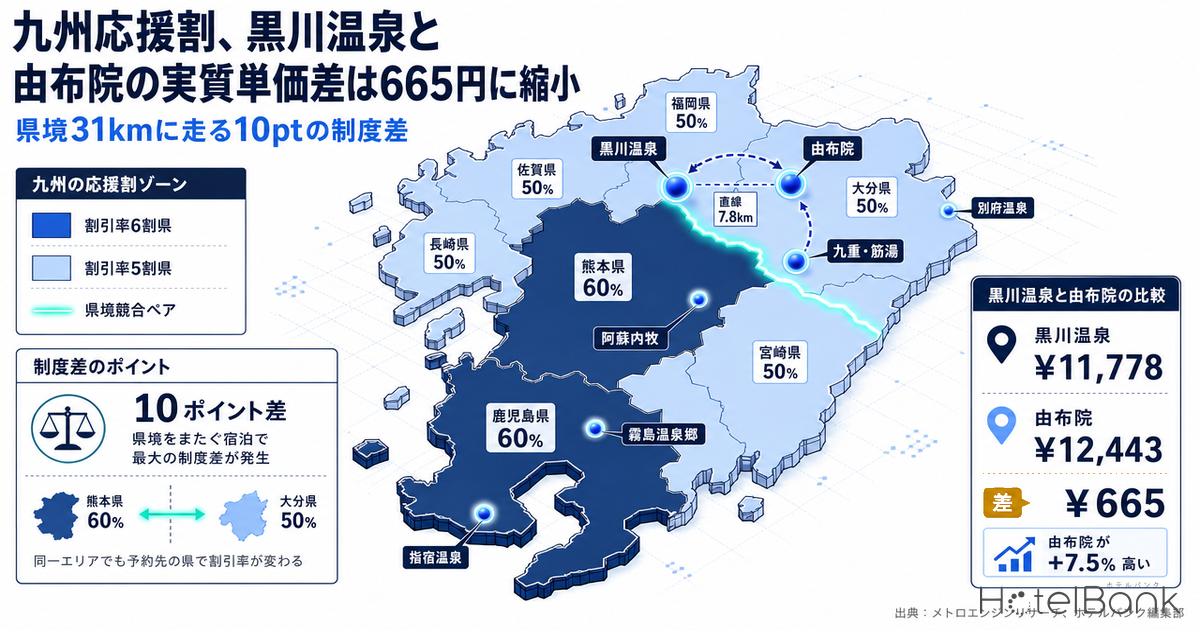
On August 28, 2026, Minister of Land, Infrastructure, Transport and Tourism Yasushi Kaneko announced that the Kyushu Fukko Ouenwari recovery travel subsidy will start in October. The discount is 60% in Kumamoto and Kagoshima and 50% in the five prefectures of Fukuoka, Saga, Nagasaki, Oita and Miyazaki. Stays from October 1 onward are eligible, and each prefecture sets its own eligible period and booking start date. In that all seven Kyushu prefectures are covered, this is support across a plane — but a discount rate that differs by 10 points from prefecture to prefecture also means that what a traveler pays steps up or down the moment they cross a border. This article picks out pairs of onsen areas facing each other across prefectural borders and reads, quantitatively from prior-year same-month settled-ADR estimates, how that step reshuffles their competitive relationships.
Metric Definitions Used in This Article
- ADR (average daily rate): A settled-rate estimate (tax-exclusive equivalent) calculated by applying a category-specific adjustment factor to the lowest published plan level each property lists on OTAs and elsewhere (two guests per room, per-room rate, tax-included). Cross-checked against per-property results disclosed by listed hotel REITs (91 properties, most recent three months), the median error is about 7%. These are estimates and differ from each property’s actual transacted prices or accounting figures. Area-level ADR is the median of the covered properties (the level of a typical property in that area); municipality-level values are medians weighted by property count, so they cannot simply be added to or subtracted from prefecture-level values.
- Calculation basis: Values for September–December 2025 are on a settled historical basis; the October 2026 value is on a snapshot basis reflecting listings at the time of the survey. Because the bases differ, the difference between the two cannot be interpreted as a year-on-year change.
- Net rate (this article’s estimate): A reference figure obtained by applying the announced discount rates directly to the settled-ADR estimate for the same month a year earlier (October 2025).It is not a forecast of what guests will actually pay in October 2026.The discount cap has not been officially confirmed as of writing, so the calculation assumes no cap.
- Data source: MetroEngines Research
- — Discount rates are 60% in Kumamoto and Kagoshima, 50% in the other five prefectures. This 10-point gap is not a line between “disaster area” and “everywhere else” — it surfaces in onsen competition as a seam running along the prefectural border.
- — Kurokawa Onsen ¥11,778 against Yufuin ¥12,443. Applying the discount rates to prior-year same-month settled-ADR estimates turns a ¥4,560 gap in normal times into a ¥665 reversal (reference figure, no cap assumed).
- — The Aso-Uchinomaki vs Beppu gap goes from ¥3,847 to ¥47. Two areas that were 25.8% apart in normal times end up on virtually the same shelf because of a single line in the scheme.
- — Kurokawa Onsen and Kokonoe-Sujiyu are 7.8 km apart in a straight line. They are close enough to be swapped within the same itinerary, yet their discount rates differ by 10 points.
- — The reversal only holds if the cap is set at roughly ¥17,700 or higher. At a ¥15,000 cap the ranking reverts to normal times, and at ¥10,000 the price gap is fully restored (Table 4).
The 60% prefectures and the 50% prefectures: the boundary runs along an administrative line
First, the shape of the scheme. This support is positioned as the tourism pillar of the government’s package following the 2026 Kumamoto Earthquake (a ¥147.8bn reserve-fund allocation), setting 60% for the hardest-hit prefectures of Kumamoto and Kagoshima and 50% for the remaining five. It is an allocation matched to the actual damage, and as a design it is straightforward. For the time axis of how demand moved immediately after the quake and which prefectures come back first, see Kumamoto Quake 2026: 2016 Recovery Curve as Kyushu’s 7-Pref Benchmark.
From a lodging-demand perspective, though, this 10-point gap appears not as a line separating “disaster area” from “everywhere else” but as an administrative boundary. Kyushu’s major onsen areas cluster near prefectural borders, so different discount rates end up coexisting within the distance a traveler uses to compare “which one to stay at.” Below we measured that distance and that price gap.
Operating status has already been covered in Kurokawa Onsen After the 2026 Kumamoto Quake: Open as Usual and Aso & Kurokawa Onsen Are Open, so this article treats it as a given and concentrates on prices from here on.
Net rates across 13 onsen and urban areas — estimated assuming no cap
For 13 major onsen and urban areas across Kyushu’s seven prefectures, the table and chart below line up the October 2025 settled-ADR estimate against the net rate obtained by applying the new discount rates directly to it. To repeat, these are reference figures produced by applying discount rates to prior-year actual levels, not forecasts of actual amounts in October 2026.
| Area | Discount rate | October 2025 settled-ADR est. |
Properties covered |
Net rate (reference) |
Discount per night |
October 2026 listing-basis est. |
|---|---|---|---|---|---|---|
| Kurokawa Onsen Minamioguni, Kumamoto | 60% | ¥29,446 | 43 | ¥11,778 | ¥17,668 | ¥27,870 (45) |
| Minami-Aso Minamiaso, Kumamoto | 60% | ¥25,570 | 14 † | ¥10,228 | ¥15,342 | ¥26,583 (15) |
| Yufuin Yufu, Oita | 50% | ¥24,886 | 133 | ¥12,443 | ¥12,443 | ¥24,394 (141) |
| Aso-Uchinomaki Aso, Kumamoto | 60% | ¥18,772 | 24 | ¥7,509 | ¥11,263 | ¥21,968 (25) |
| Ureshino Onsen Ureshino, Saga | 50% | ¥18,556 | 32 | ¥9,278 | ¥9,278 | ¥18,950 (32) |
| Unzen Onsen Unzen, Nagasaki | 50% | ¥18,012 | 28 | ¥9,006 | ¥9,006 | ¥18,451 (29) |
| Kokonoe-Sujiyu Kokonoe, Oita | 50% | ¥16,946 | 38 | ¥8,473 | ¥8,473 | ¥18,004 (38) |
| Beppu Onsen Beppu, Oita | 50% | ¥14,925 | 117 | ¥7,462 | ¥7,463 | ¥15,906 (117) |
| Ibusuki Onsen Ibusuki, Kagoshima | 60% | ¥13,172 | 20 | ¥5,269 | ¥7,903 | ¥15,752 (18) |
| Kirishima Onsen-kyo Kirishima, Kagoshima | 60% | ¥12,703 | 57 | ¥5,081 | ¥7,622 | ¥15,577 (55) |
| Amakusa Amakusa, Kumamoto | 60% | ¥7,256 | 26 | ¥2,902 | ¥4,354 | ¥10,102 (28) |
| Kagoshima City Center Kagoshima, Kagoshima | 60% | ¥6,645 | 73 | ¥2,658 | ¥3,987 | ¥8,600 (71) |
| Hitoyoshi Onsen Hitoyoshi, Kumamoto | 60% | ¥6,472 | 21 | ¥2,589 | ¥3,883 | ¥11,402 (22) |
† Areas with fewer than 20 covered properties. Shown for reference only; they are not used as grounds for this article’s argument. The rightmost column sits on a different calculation basis, so its difference from the same month a year earlier cannot be read as a year-on-year change.
Source: MetroEngines Research, compiled by the HotelBank Editorial Team
Source: MetroEngines Research, compiled by the HotelBank Editorial Team (dark = October 2025 settled-ADR estimate; light = reference net rate after applying the discount rate. Not a forecast of actual October 2026 amounts.)
The first thing that stands out is the reordering at the top of the range. On the normal-times settled-ADR estimate, Kurokawa Onsen stands clear at ¥29,400, ¥4,560 above Yufuin’s ¥24,900. Apply the discount rates, however, and Kurokawa Onsen comes to ¥11,778 while Yufuin comes to ¥12,443 — a reversal in which Yufuin is the more expensive of the two, by ¥665. In money terms the two are essentially level, and it is closer to reality to read this as both entering a zone where price stops being a deciding factor for travelers.
The same thing is happening in the middle of the range. Aso-Uchinomaki (Kumamoto, 60%) sits at ¥18,772 in normal times, 25.8% above Beppu’s (Oita, 50%) ¥14,925, but after the discount it is ¥7,509 against ¥7,462 — a gap of ¥47. Rounded, they are identical. Two areas that were a quarter apart in normal times land on the same shelf because of a single line in the scheme.
Four cross-border pairs — 10 points switch over within 8 km
This is the heart of the article. The list above takes a bird’s-eye view of all of Kyushu, but travelers do not compare all of Kyushu evenly. What actually gets compared are properties close enough to swap into the same itinerary. So we pulled out four pairs facing each other across the Kumamoto and Oita sides of the border and set them out alongside straight-line distances. Coordinates use each onsen town’s location as matched through the address search API of the Geospatial Information Authority of Japan.
| Pair | Straight-line distance | Normal-times ADR | Gap, normal times | Net rate | Gap, post-discount | Narrowing of gap |
|---|---|---|---|---|---|---|
| Kurokawa Onsen (Kumamoto, 60%) vs Yufuin (Oita, 50%) | 30.9 km | ¥29,446 / ¥24,886 | +¥4,560 | ¥11,778 / ¥12,443 | ¥-665 | ▲¥3,895 |
| Kurokawa Onsen (Kumamoto, 60%) vs Kokonoe-Sujiyu (Oita, 50%) | 7.8 km | ¥29,446 / ¥16,946 | +¥12,500 | ¥11,778 / ¥8,473 | +¥3,305 | ▲¥9,195 |
| Aso-Uchinomaki (Kumamoto, 60%) vs Kokonoe-Sujiyu (Oita, 50%) | 22.1 km | ¥18,772 / ¥16,946 | +¥1,826 | ¥7,509 / ¥8,473 | ¥-964 | ▲¥862 |
| Aso-Uchinomaki (Kumamoto, 60%) vs Beppu Onsen (Oita, 50%) | 54.6 km | ¥18,772 / ¥14,925 | +¥3,847 | ¥7,509 / ¥7,462 | +¥47 | ▲¥3,800 |
Source: MetroEngines Research, compiled by the HotelBank Editorial Team / Distances are straight-line distances between coordinates matched through the place-name search API of the Geospatial Information Authority of Japan
Source: MetroEngines Research, compiled by the HotelBank Editorial Team (reference figures applying the discount rates to the October 2025 historical basis. Not a forecast of actual October 2026 amounts.)
The closest pair is Kurokawa Onsen and Kokonoe-Sujiyu, only 7.8 km apart in a straight line. That is not walking distance, but it is close enough to see both in a single day, and on a Yamanami Highway itinerary they are effectively the same option. The 10-point discount gap runs through those 7.8 km. A rate gap of ¥12,500 in normal times narrows to ¥3,305 after the discount. Seen from Kurokawa Onsen’s side, a price premium that used to require explanation is compressed by the scheme, automatically, to a level that explains itself.
More dramatic is the 30.9 km between Kurokawa Onsen and Yufuin, where the gap narrows by ¥3,895 and even flips sign. The 22.1 km between Aso-Uchinomaki and Kokonoe-Sujiyu behaves the same way: Aso-Uchinomaki was ¥1,826 more expensive in normal times, but after the discount Kokonoe-Sujiyu is ¥964 higher.In all four pairs, the normal-times price ranking is either shaken by the scheme or reversed outright.
Mapping the seam in the plane
Let us confirm the picture geographically. The map below plots the 13 areas, coloring the 60% prefectures (Kumamoto, Kagoshima) in navy and the 50% prefectures (Fukuoka, Saga, Nagasaki, Oita, Miyazaki) in blue. Circle size corresponds to the normal-times settled-ADR estimate, and the dashed lines show the straight-line distances of the four pairs discussed above.
Source: MetroEngines Research, compiled by the HotelBank Editorial Team / Coordinates: place-name search API of the Geospatial Information Authority of Japan
Zoom into the Aso-Kuju area and you see the high-rate Kumamoto-side areas — Kurokawa Onsen, Minami-Aso and Aso-Uchinomaki — packed within 40 km of the Oita-side areas of Kokonoe-Sujiyu and Yufuin. This belt is continuous both as an onsen region and as a road network; there is no topographic break. Even so, the discount rate alone switches at the prefectural border. Saying that the scheme acts as a “seam in the plane” rather than as a line refers precisely to this mismatch between geographic continuity and institutional discontinuity.
On the Kagoshima side the situation is different. Kirishima Onsen-kyo and Ibusuki Onsen are both on the 60% list and have no comparable onsen destination in a 50% prefecture nearby. The nearest onsen area in a 50% prefecture, Ureshino Onsen, is 151 km away, so substitution within a single itinerary is unlikely to arise. Kagoshima’s 60% is structured to work less as cross-border competition than as a lift to demand within the prefecture.
At prefecture level, the post-discount ranking holds
Rankings shifted at the area level — what about at the prefecture level? The chart below lines up the October 2025 settled-ADR estimate for all seven prefectures against the net rate after applying the discount rates.
Source: MetroEngines Research, compiled by the HotelBank Editorial Team (reference figures applying the discount rates to the October 2025 historical basis. Prefecture-level values draw on a different population from municipality-level values, so the two cannot be added or subtracted.)
Oita is the highest of the seven at ¥14,610 in normal times (N=446 properties) and stays top at ¥7,305 after the 50% discount. Kumamoto is at ¥10,428 in normal times (N=374 properties) but falls to ¥4,171 after the 60% discount, below Saga (¥5,989) and Fukuoka (¥5,614). At prefecture-average granularity the 60% prefectures sink below the 50% ones, and the ordering does not move much.
In other words, how the scheme bites looks different depending on granularity. At prefecture average it looks like the simple story that “Kumamoto and Kagoshima become relatively cheap,” but at the granularity where competition actually happens — individual onsen areas — a different picture emerges: high-rate Kurokawa Onsen lines up with Yufuin, and Aso-Uchinomaki lines up with Beppu. Sales teams at border-area onsen should be looking at the second picture.
The October–December upside sitting on the 50% side
Now consider the opportunity for properties on the 50% side. As background, Kyushu’s onsen areas have a seasonal structure in which rates rise from October into December. Lining up the 2025 results by month shows the slope varies considerably by area.
| Area | October 2025 | November 2025 | December 2025 | Oct → Dec |
|---|---|---|---|---|
| Kurokawa Onsen 60% Kumamoto | ¥29,446 (43) | ¥30,744 (42) | ¥31,644 (42) | +7.5% |
| Yufuin 50% Oita | ¥24,886 (133) | ¥25,766 (131) | ¥27,123 (131) | +9.0% |
| Aso-Uchinomaki 60% Kumamoto | ¥18,772 (24) | ¥19,720 (23) | ¥21,628 (23) | +15.2% |
| Ureshino Onsen 50% Saga | ¥18,556 (32) | ¥23,123 (31) | ¥23,777 (31) | +28.1% |
| Unzen Onsen 50% Nagasaki | ¥18,012 (28) | ¥20,659 (27) | ¥20,177 (27) | +12.0% |
| Kokonoe-Sujiyu 50% Oita | ¥16,946 (38) | ¥17,559 (37) | ¥19,320 (36) | +14.0% |
| Beppu Onsen 50% Oita | ¥14,925 (117) | ¥16,640 (113) | ¥18,941 (114) | +26.9% |
| Kirishima Onsen-kyo 60% Kagoshima | ¥12,703 (57) | ¥13,783 (55) | ¥16,034 (55) | +26.2% |
Source: MetroEngines Research, compiled by the HotelBank Editorial Team
The largest increases are at Kirishima Onsen-kyo (+26.2%), Beppu Onsen (+26.9%) and Ureshino Onsen (+28.1%). Ureshino Onsen rises 24.6%, from ¥18,556 to ¥23,123, between October and November, making it an area where autumn-foliage demand shows up clearly in rates. If the subsidy’s eligible period extends into November and beyond, onsen areas on the 50% side are positioned to have this seasonal slope working for them.
On top of that, a 50% discount rate also means rates are easier to hold than in the 60% prefectures. As Table 2 showed, Yufuin came out ¥665 above Kurokawa Onsen on the post-discount net rate. To travelers it looks like “Yufuin has entered the same effective price band as an option.” For Yufuin that is a chance to reach price-sensitive travelers it could not reach in normal times. The same structure applies to Kokonoe-Sujiyu (its gap to Kurokawa Onsen goes from ¥12,500 to ¥3,305) and to Beppu (its gap to Aso-Uchinomaki all but disappears).
That said, the room for differentiation on the 50% side naturally sits on axes other than price itself. When net rates line up, the chosen-or-not test stops running on price, and what works instead is the amount of information about the stay. Three things stand out concretely: (1) laying out touring routes for multi-night stays, (2) spelling out on-site experiences such as in-house dining and onsen-hopping, and (3) showing the post-discount payment picture early in the booking path. Point (3) matters most in a scheme like this one, where discount rates differ by prefecture: travelers are otherwise left doing the arithmetic themselves before they can compare, so whoever shows it first tends to gain.
How it looks if a discount cap is introduced
Every estimate in this article assumes no cap. Comparable past schemes have often set a per-night subsidy cap, and if a cap is set this time as well, the effective discount rate in the high-rate band will fall short of the headline 60% and 50%. As of writing the cap has not been officially confirmed, so we have not calculated the specific size of its effect.
The direction of the effect, though, can be pinned down. Caps bite first in the highest-rate areas, and among this article’s 13 areas the highest normal-times settled-ADR estimates are Kurokawa Onsen at ¥29,446, then Minami-Aso at ¥25,570 and Yufuin at ¥24,886 (all per room, two guests per room). Whether the cap is set per room or per person completely changes the level at which these areas hit it. Until both the cap amount and the unit it applies to are published, then, the effective discount rate on high-rate plans cannot be stated definitively. Analysis of the cap itself will be handled as a separate article once details are published.
| Area | Headline Discount rate | October 2025 settled-ADR est. | No cap | Cap ¥20,000 | Cap ¥15,000 | Cap ¥10,000 | Cap ¥7,000 |
|---|---|---|---|---|---|---|---|
| Kurokawa Onsen Minamioguni, Kumamoto | 60% | ¥29,446 | 60% ¥11,778 | 60% ¥11,778 | 51% ¥14,446 | 34% ¥19,446 | 24% ¥22,446 |
| Minami-Aso Minamiaso, Kumamoto | 60% | ¥25,570 | 60% ¥10,228 | 60% ¥10,228 | 59% ¥10,570 | 39% ¥15,570 | 27% ¥18,570 |
| Yufuin Yufu, Oita | 50% | ¥24,886 | 50% ¥12,443 | 50% ¥12,443 | 50% ¥12,443 | 40% ¥14,886 | 28% ¥17,886 |
| Aso-Uchinomaki Aso, Kumamoto | 60% | ¥18,772 | 60% ¥7,509 | 60% ¥7,509 | 60% ¥7,509 | 53% ¥8,772 | 37% ¥11,772 |
| Ureshino Onsen Ureshino, Saga | 50% | ¥18,556 | 50% ¥9,278 | 50% ¥9,278 | 50% ¥9,278 | 50% ¥9,278 | 38% ¥11,556 |
| Kokonoe-Sujiyu Kokonoe, Oita | 50% | ¥16,946 | 50% ¥8,473 | 50% ¥8,473 | 50% ¥8,473 | 50% ¥8,473 | 41% ¥9,946 |
| Beppu Onsen Beppu, Oita | 50% | ¥14,925 | 50% ¥7,462 | 50% ¥7,462 | 50% ¥7,462 | 50% ¥7,462 | 47% ¥7,925 |
Red text and pale-red cells mark cases where the cap actually bites and the effective rate falls below the headline rate. The cap amount and the unit it applies to (per room or per person) have not been officially confirmed as of writing; ¥20,000 / ¥15,000 / ¥10,000 / ¥7,000 are placeholder values used to check sensitivity.
Source: MetroEngines Research, compiled by the HotelBank Editorial Team (cap amounts are placeholders; not a forecast of actual amounts)
Two things can be read from this table. First, this article’s headline finding — the Kurokawa Onsen / Yufuin reversal — only holds if the discount cap is set at roughly ¥17,700 or more per room per night (Kurokawa Onsen’s 60% discount amount of ¥17,668). At a ¥15,000 cap, Kurokawa Onsen’s effective discount rate drops to 51% and its net rate becomes ¥14,446, ¥2,003 above Yufuin’s ¥12,443 — back to the normal-times order. At a ¥10,000 cap, Kurokawa Onsen is ¥19,446 and Yufuin ¥14,886, a gap of ¥4,560, restoring the normal-times price gap exactly. The reversal is extremely sensitive to where the cap is set.
Second, caps start biting in descending order of ADR, so effective discount rates are shaved first in the high-rate areas of the 60% prefectures. At a ¥10,000 cap, Kurokawa Onsen at 34%, Minami-Aso at 39% and Aso-Uchinomaki at 53% all fall below the headline rate on the 60% side, while the three areas of Ureshino Onsen, Kokonoe-Sujiyu and Beppu Onsen hold at 50%.The lower the cap, the more the high-rate onsen areas of Kumamoto and Kagoshima — nominally on 60% — are overtaken on effective discount rate by the 50% prefectures — a second-order reversal that becomes possible. In reading competition between border pairs, the cap is a variable carrying as much weight as the discount rate itself.
Summary
The 10-point discount gap in the Kyushu Fukko Ouenwari subsidy appears on the map of Kyushu’s onsen areas not as a line dividing “disaster area” from “everywhere else” but as a seam running along the prefectural border. On reference figures applying the discount rates to prior-year same-month settled-ADR estimates, the Kurokawa Onsen–Yufuin gap narrows from ¥4,560 to ¥665 and the Aso-Uchinomaki–Beppu gap from ¥3,847 to ¥47, and the normal-times price ranking is shaken by the scheme. Kurokawa Onsen and Kokonoe-Sujiyu in particular are only 7.8 km apart in a straight line and substitute for each other within the same itinerary, yet their discount rates differ.
For the 60% side this widens the customer range reachable in the high-rate band; for the 50% side it means being compared within the same effective price band as the areas above them. For both, the fact that the scheme runs over the period when Kyushu onsen rates climb from October into December makes it a good moment to rebuild the sales plan. Because each prefecture sets its own eligible period and booking start date, the first step is to wait for your own prefecture’s dates while deciding in advance where in the booking path to show the post-discount payment picture.
Related Reading
- Kyushu Travel Subsidy Due Aug 28: ¥3,200-¥6,300 ADR, Rate Beats Cap
- Aso & Kurokawa Onsen Are Open: Autumn ADR Flat, Sept Holiday 1.5% Left
- Kurokawa Onsen After the 2026 Kumamoto Quake: Open as Usual (Aug 15)
- Intra-Prefecture ADR Gaps 2026: Median 2.74x, Okinawa Widest at 5.86x
- Miyazaki & Saga Hotel Investment Whitespace: Zero Hotels at ¥18-25k
- Kumamoto Quake 2026: 2016 Recovery Curve as Kyushu’s 7-Pref Benchmark
- Obon T-7: Kyushu’s 31.7pt Gap — Fukuoka 73.0%, Kagoshima 41.3%
- Chuseok Sep 24-27: Only Fukuoka, Saga, Kyoto Hold After Silver Week
References and Sources
■ Data sources
Settled-ADR estimates are settled-rate estimates calculated by applying a category-specific adjustment factor to the lowest published plan level each property lists (two guests per room, per room, tax-included). Area values are medians of the covered properties; municipality-level values are medians weighted by property count. September–December 2025 is on a settled historical basis; October 2026 is on a listing-snapshot basis as at the time of the survey. Coverage is Kyushu’s seven prefectures and 13 municipalities (Minamioguni, Minamiaso, Aso, Yufu, Kokonoe, Beppu, Ureshino, Unzen, Amakusa, Hitoyoshi, Ibusuki, Kirishima and Kagoshima). Representative coordinates for each onsen town were cross-checked externally using the place-name search API of the Geospatial Information Authority of Japan. The scheme’s outline (discount rates, start timing, reserve-fund scale) is based on press reports of August 28, 2026.
■ Calculation assumptions
Net rate = prior-year same-month (October 2025) settled-ADR estimate × (1 − discount rate). Discount rates are taken as 60% for Kumamoto and Kagoshima and 50% for the five prefectures of Fukuoka, Saga, Nagasaki, Oita and Miyazaki. All of the main estimates in the body assume no discount cap. The cap amounts in Table 4 (¥20,000 / ¥15,000 / ¥10,000 / ¥7,000) are not officially announced values but placeholders set to test how robust the conclusions are to where a cap is placed, applied per room per night. Distances between pairs are straight-line distances between each onsen town’s representative coordinates, not road distances.
■ Limitations and caveats
Settled-ADR estimates are estimates and differ from each property’s actual transacted prices or accounting figures (median error of about 7% against per-property disclosures by listed hotel REITs; 91 properties, most recent three months). The historical basis and the listing-snapshot basis draw on different populations, so the difference between them cannot be interpreted as a year-on-year change. Municipality-level and prefecture-level values draw on different populations and cannot simply be added or subtracted. Areas with fewer than 20 covered properties (Minamiaso, Ibusuki, Hitoyoshi) are shown for reference only and are not used as grounds for this article’s argument. The cap amount, the unit it applies to (per room or per person), and the eligible period and booking start date set by each prefecture are all undetermined as of writing; once fixed, effective discount rates could differ from this article’s estimates.
- “Kyushu Fukko Ouenwari”: 60% off in Kumamoto and Kagoshima, 50% off in Fukuoka and four other prefectures, from October (Nishinippon Shimbun, August 28, 2026)
- Kyushu travel subsidy to start in October; 60% off for travel to Kumamoto and Kagoshima (Kyodo News, August 28, 2026)
- Partial subsidy for travel costs to the Kyushu region — government package for the Kumamoto Earthquake, funded by ¥147.8bn from reserves (RKK Kumamoto Broadcasting, August 2026)
- Japan Tourism Agency, Ministry of Land, Infrastructure, Transport and Tourism
- Geospatial Information Authority of Japan — GSI Maps API list (place-name search API; coordinate cross-check for each onsen area)
- MetroEngines Research — settled-ADR estimates (September–December 2025: historical basis / October 2026: listing-snapshot basis), 13 municipalities and 7 prefectures