

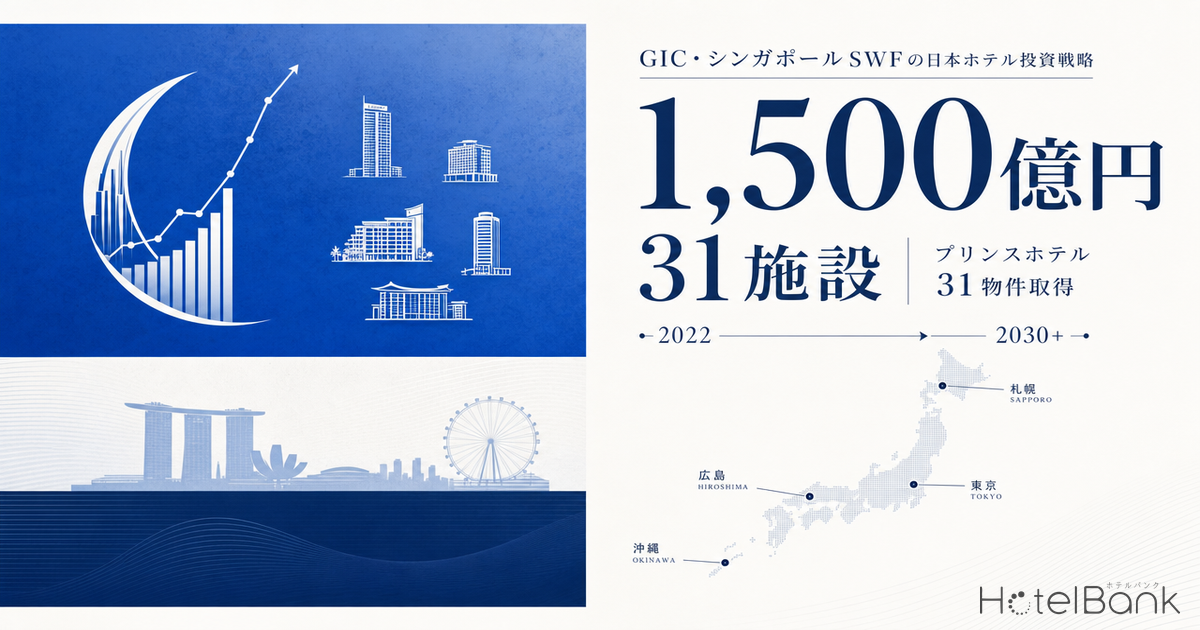
In February 2022, Singapore’s sovereign wealth fund GIC (Government of Singapore Investment Corporation) agreed to acquire 31 Prince Hotel properties from Seibu Holdings for approximately ¥150 billion. This transaction has had a significant impact on the subsequent structure of Japan’s hotel real estate market, symbolizing the long-term stance of sovereign wealth funds (SWFs) toward Japanese hotel real estate. In this report, we cross-reference OTA published price data and REIT monthly operating performance data compiled by MetroEngines Research & Consulting to analyze the property characteristics SWFs prefer, quantify the long-term holding premium, calculate dollar-denominated IRR across foreign exchange scenarios, and examine the implications for Japanese investors.
Metric Definitions Used in This Article
- ADR (Average Daily Rate): Average of published prices on OTAs. Differs from actual transaction prices (when cross-referenced with REIT disclosure data, typically averages +25-30% higher than transacted ADR). Per-room rate for 2-person occupancy (tax-included), averaged across all plans (room-only through meal-inclusive plans).
- OCC (Occupancy Rate): Ratio of sold rooms to total room inventory in the area (estimated value based on OTA sales inventory).
- RevPAR: Revenue per available room, calculated as ADR x OCC.
- NOI: Net Operating Income. Rental income minus operating expenses; a profitability indicator for real estate investment.
- Data Sources: MetroEngines Research, REIT monthly operating performance reports
1. Transaction Overview – Why GIC Invested ¥150 Billion
On February 10, 2022, Seibu Holdings announced the transfer of 31 of its 76 Prince Hotel properties to a GIC Group limited liability company. The transferred assets consisted of 15 hotels, 10 golf courses, and 6 ski resorts, with a transfer price of approximately ¥150 billion and a transfer gain for Seibu HD of roughly ¥80 billion. The asset transfer was completed in September 2022. Core properties included The Prince Park Tower Tokyo, Sunshine City Prince Hotel, Sapporo Prince Hotel, Grand Prince Hotel Hiroshima, The Prince Kyoto Takaragaike, and Naeba Prince Hotel. Note that in March 2023, the transfer of 5 properties including Shiga Kogen Yakebitaiyama Ski Resort was cancelled, reducing the final number of acquired properties below initial plans.
The essence of the deal lay in the alignment of two strategies: Seibu HD’s “asset-light strategy” announced in its May 2021 mid-term management plan, and GIC’s goal of “obtaining long-term exposure to Japanese hotel real estate.” Seibu HD retained brand names post-transfer and adopted a “separation of ownership and operation” model in which Seibu/Prince Hotels Worldwide handles operations and Seibu SCCAT manages building maintenance. This is positioned as a symbolic case for Japan’s market transition to the ownership-operation separation model that dominates Western hotel chains.
2. ADR Distribution Across the 31 SWF-Selected Properties – Characteristics of Grade, Scale, and Location
From OTA published price data tracked by MetroEngines Research, we analyzed the ADR levels of representative properties acquired by GIC. The Prince Gallery Tokyo Kioicho is at ¥140,576 and The Prince Park Tower Tokyo at ¥125,443, with luxury-tier (¥100,000+) properties forming the core. Meanwhile, regional resort/business hotel-tier properties such as Kushiro Prince Hotel at ¥24,005 and Monbetsu Prince Hotel at ¥27,914 are also included. The property characteristics SWFs prefer lie in being able to “secure a nationally diversified portfolio spanning luxury to mid-tier in a single transaction,” with risk reduction through geographic and grade diversification prioritized over yield maximization on individual properties.
3. Nationally Diversified Portfolio – A Three-Tier Structure of Metropolitan, Resort, and Regional
Looking at the geographic distribution of the 31 properties acquired by GIC, flagship properties are concentrated in Tokyo (Prince Park Tower Tokyo, Sunshine City Prince, Shinjuku Prince Hotel, Tokyo Prince Hotel, The Prince Gallery Kioicho, etc.), while assets are distributed across major tourism and business hubs nationwide, including Hokkaido (Sapporo, Kushiro, Hakodate Onuma, Kussharo, Monbetsu), Nagano (Karuizawa, Shiga Kogen), Kyoto (The Prince Kyoto Takaragaike), Hiroshima (Grand Prince Hiroshima), Niigata (Naeba), Kanagawa (Shin-Yokohama, Oiso, Hakone Sengokuhara), Iwate (Shizukuishi), Gunma (Manza, Tsumagoi), Shiga (Lake Biwa Otsu), Shizuoka (Shimoda), and Miyazaki (Nango).
This distribution demonstrates a strategy of acquiring three layers in one bundle: metropolitan business demand, resort tourism demand, and regional MICE demand. Unlike REITs and private funds that concentrate on single areas, SWFs have the scale to internally absorb regional business cycle volatility risk. While exposed to overall Japan real estate price fluctuations driven by FX and interest rate environments, oversupply risk in specific cities and disaster risk are relatively limited.
4. Room Count x ADR Positioning Map – Areas and Grades SWFs Avoid
Mapping the room counts and ADRs of acquired properties reveals three distinct clusters. First, the urban luxury tier (ADR ¥120,000+, 200-600 rooms) anchored by The Prince Gallery Tokyo Kioicho and The Prince Park Tower Tokyo. Second, the large-scale mid-tier (ADR ¥30,000-60,000, 500-1,200 rooms) including Naeba, Sunshine City, Shinjuku, Tokyo Prince, and Grand Prince Hotel Osaka Bay. Third, the mid-sized regional resort tier in Hokkaido and Tohoku (ADR ¥25,000-35,000, 150-400 rooms).
Noteworthy is the whitespace at “large-scale upper-mid” (ADR ¥80,000-¥120,000 and 400+ rooms). Virtually no acquired properties exist in this zone. SWFs prefer a bipolar structure of ultra-high-end flagship assets and mid-to-large hotels, while avoiding the mid-sized high-ADR segment that requires high operational complexity. This reflects an SWF investment philosophy that prioritizes management cost efficiency, operating partner consistency, and brand uniformity.
Cluster A Urban Luxury
ADR ¥120k+ x 200-600 rooms
Prince Park Tower Tokyo, Kioicho Gallery. The flagship assets SWFs prioritize most. High stability of long-term cash flow.
Cluster B Large-Scale Mid-Tier
ADR ¥30-60k x 500-1,200 rooms
Naeba, Sunshine, Shinjuku, Tokyo Prince, Grand Prince Osaka Bay. The tier that generates yield through absolute volume of room occupancy.
Cluster C Regional Resort/Business
ADR ¥25-45k x 150-400 rooms
Sapporo, Hakodate Onuma, Kussharo, Kushiro, Monbetsu, Shizukuishi, Grand Prince Hiroshima. Geographic diversification effect and a hedge on regional tourism demand.
5. Long-Term Holding Premium in REIT Data – Empirical Evidence from NOI Trends
While the profitability of the 31 Prince properties acquired by GIC is undisclosed, analyzing NOI trends of REIT-held properties of similar grade and area allows us to estimate the scale of the long-term holding premium SWFs are enjoying. Looking at the 12-month RevPAR YoY trend obtained via the REIT monthly operating performance API, listed REITs show significant volatility.
Hoshino Resorts REIT (3287) posted a sharp drop in RevPAR YoY of -17.7% in May 2025 and -32.8% in June 2025, then recovered to +15.0% in October 2025 and +10.5% in February 2026. Japan Hotel REIT (8985) showed a pattern of decelerating from +21.8% in April 2025 and +20.0% in May to +6.2% in July 2025, then recovering to +9.0% in March 2026. Invincible Investment Corporation (8963) decelerated sharply from peaks of +19.6% in April 2025 and +21.5% in May to +1.4% in January 2026, then rebounded to +9.0% in March. Nippon Hotel & Residential Investment Corporation (3472) has shown near-uniform negative YoY growth since June 2025, struggling at -8.4% RevPAR YoY as of March 2026. For detailed analysis of these REIT-level ADR and RevPAR fluctuations from both event-driven and supply-demand structural perspectives, see Osaka Expo 2025’s Impact on Hotel ADR: Verified with REIT and OTA Data.
Because REITs have their NOI reflected in market prices on a monthly basis, they bear this volatility risk directly. SWFs, on the other hand, evaluate profitability on a book-value-of-acquisition basis and operate with quarterly unrealized gain valuations. Assuming an NOI yield of 5.5% on the 31 Prince properties, annual NOI would be approximately ¥8.25 billion. Cumulative 10-year NOI (inflation-adjusted) could reach the ¥100 billion scale, and the internal rate of return (IRR) against the ¥150 billion acquisition price would fall within the 8-10% range. Unconcerned with monthly market price fluctuations, SWFs target this long-term cash flow generation as their primary objective, operating on a structurally different time horizon from listed REITs.
6. Dollar-Denominated IRR Projections by FX Scenario
The FX rate at acquisition for the ¥150 billion deal is estimated at around 145 yen/USD as of September 2022 (the month of transaction completion). Assuming an exit within 2025, comparing the actual USD-denominated acquisition price with the current valuation under three USD/JPY scenarios (150, 160, and 140 yen) produces a ±10-20% USD-denominated performance differential from FX effects alone. Since SWFs generally do not hedge or only partially hedge, dollar-denominated IRR compresses during yen-weakness periods, while FX revaluation gains materialize all at once when the yen reverses to strength.
| Item | Yen Weak Scenario (160) | Neutral (150) | Yen Strong Scenario (140) |
|---|---|---|---|
| Actual USD Conversion at Acquisition (145 base) | $1.034B | $1.034B | $1.034B |
| 10-Year Valuation in JPY (Exit Cap 4.5%) | ¥183B | ¥183B | ¥183B |
| 10-Year Valuation in USD | $1.144B | $1.220B | $1.307B |
| Cumulative 10-Year USD NOI | $0.516B | $0.550B | $0.589B |
| USD-Denominated IRR (simplified) | ~8.2% | ~9.6% | ~11.1% |
What this scenario reveals is that the JPY-denominated price at acquisition directly translates into FX revaluation gains when the yen reverses. GIC’s decision to rush the acquisition during yen-weakness in 2022 can be interpreted as a defensive FX position anticipating long-term yen strength. If the yen reverses to the 120-130 range in the 2030s, dollar-denominated IRR could be boosted by an additional 200-300 bps.
7. Okinawa Market – GIC’s Area of Interest and New Supply 2024-2027
The head of GIC’s Asia real estate division indicated strong interest in Tokyo and Okinawa hotel investments in a September 2022 Bloomberg interview, stating that investment targets include not only resorts and full-service hotels but also business hotels. As of April 2026, Okinawa’s market ADR stands at ¥27,219, +6.2% YoY, showing solid growth and forming a large-scale market with 1,723 operating hotels.
According to MetroEngines Research tracking data, multiple new openings with 50+ rooms have progressed in Okinawa Prefecture since January 2024. Ryukyu Orion Hotel Naha Kokusai Dori (205 rooms, opened October 2025), Canopy by Hilton Okinawa Miyakojima Resort (306 rooms, opening April 2026), Alamanda Splendid (100 rooms, opening April 2026), Sumiichi Miyakojima (93 rooms, opening April 2026), and Island Hotel Yonaguni (61 rooms, opening March 2026) demonstrate a supply structure spread from the main island to remote islands. Okinawa Prefecture recorded 122 new openings in 2025 alone (the highest among all prefectures nationwide), with an extremely rapid pace of supply expansion.
SWFs are drawn to Okinawa for revenue engines distinct from Tokyo: inbound resort demand, long-stay accommodation, and condominium demand. Since the 31 Prince properties do not include any Okinawa assets, Okinawa stands as GIC’s next target candidate. Japan Hotel REIT holds large properties such as Okinawa Harbor View Hotel, Southern Beach Hotel & Resort Okinawa, and Oriental Hotel Okinawa Resort & Spa, suggesting potential “co-investment” or “block acquisition” opportunities with such REITs. For detailed verification of the FX sensitivity and booking patterns of three resort regions including Okinawa, see Summer Resort 3-Region Comparison 2026: Niseko, Okinawa, Karuizawa – ADR, Booking Pace, FX Sensitivity.
8. The Sharp Decline in Foreign Capital Ratio and SWFs’ Relative Advantage
According to JLL research, the foreign capital ratio in Japan’s hotel investment market was 20% in 2024 but had halved to 10% by the end of Q3 2025. The background lies in “an extreme reduction in properties for sale” – Japan’s hotel investment total reached a record-high ¥1.0613 trillion in 2024, and the number of domestic owners who feel no pressure to sell their hotel holdings has increased.
Even under such conditions, SWFs like GIC continue to demonstrate their presence as committed buyers. While not all foreign investment has stopped – examples include the sale of Park Hyatt Tokyo acquired by Hong Kong’s Gaw Capital in partnership with KKR (reportedly sold to JHR for over ¥100 billion in 2025) and Gaw Capital’s acquisition of Tokyu Plaza Ginza (over ¥150 billion in 2025) – Hong Kong-based and US-based funds predominantly pursue exit-oriented medium-term holdings. SWFs possess a structural advantage in tolerating low cap rates (= high acquisition multiples) due to minimal exit pressure. For new luxury supply trends preferred by foreign and domestic funds, see 6 Luxury Hotels Opening in 2026: Market Impact Analysis from an Investor Perspective, which estimates property-by-property investment impacts.
9. The 2027 New Lease Accounting Standard and SWF Advantage
Starting with fiscal years beginning April 2027, the new lease accounting standard (IFRS 16-compliant) will be mandatorily applied in Japan. As a result, all real estate lease contracts entered into by hotel operating companies will require on-balance-sheet treatment (recognition as assets and liabilities). Some companies’ total assets are expected to expand by tens of percent, making a decline in equity ratios unavoidable.
This change will further strengthen the incentive toward “asset-light” structures for hotel-owning companies (such as Seibu HD). Between operators wanting to lighten their balance sheets and SWFs capable of long-term holding, additional ownership-operation separation deals are likely to be triggered over the next five years. The 31 Prince properties transaction is positioned as a leading case of this major structural shift. The implication for Japanese investors is clear: while opportunities to participate alongside SWFs in asset-light leaseback transactions will expand, ownership-type standalone investments will struggle to win deals because they cannot tolerate low cap rates, leading to a polarized market.
10. Investor Implications – Lessons for Japanese Investors
The advantages SWFs enjoy in Japanese hotel real estate can be summarized into four points. First, tolerance of low cap rates based on an ultra-long-term horizon (10+ years). Second, a two-way position of acquiring during yen-weakness combined with FX revaluation gains when the yen reverses. Third, internal absorption of individual area and grade risks through nationwide diversification. Fourth, separation of operational risk through ownership-operation separation.
While taking SWF-equivalent long-term horizons is difficult for Japanese REITs and private funds due to the nature of their capital, strategies such as “secondary acquisition in areas surrounding or similar to SWF-acquired properties,” “becoming operating partners for SWF-held property leases,” and “co-investment fund formation alongside SWFs” can fully function. In particular, after mandatory application of the 2027 new lease accounting standard, asset sales by operating companies are likely to accelerate, and a structure where domestic capital picks up mid-sized and regional properties that SWFs do not acquire is anticipated. The 31 Prince properties transaction serves as a critical reference point for reading future transaction dynamics, marking a turning point at which Japan’s hotel real estate market shifts toward “long-term money.”
Related Articles
- Tokyu Stay x Mercure Hiroshima: A Dual-Brand Strategy – A New Opening Format for Mid-Sized Cities
- Toward Hotel Logistics Efficiency: Seibu/Prince Hotels Expands Joint Delivery Area to Nagano, Gunma, and Niigata
- Nagoya Hotel Investment 2026 – New Scenarios from Conrad Opening x Luxury Whitespace x Linear Shinkansen Delay
- Hotel Investment in the Age of 80% Nankai Trough Probability: Disaster Risk x ADR x Risk-Adjusted Yield Analysis of 10 Pacific Coast Tourism Areas
- 6 Luxury Hotels Opening in 2026: Market Impact Analysis from an Investor Perspective
- Summer Resort 3-Region Comparison 2026: Niseko, Okinawa, Karuizawa – ADR, Booking Pace, FX Sensitivity
- Osaka Expo 2025’s Impact on Hotel ADR: Verified with REIT and OTA Data
- Marriott vs. Hyatt Japan Expansion Strategy in Data: 122 Properties x 15 Brands vs. 22 Properties x 7 Brands – Next Regional Foreign Brand Candidates
- Are Japan’s Hotels Cheap by Global Standards? Tokyo, Osaka, Kyoto ADR Converted to USD and Compared with NY, Paris, London
References & Sources
– Market Data
- MetroEngines Research & Consulting – OTA published price data (approx. 168,000 properties tracked, approx. 27,000 properties with confirmed operation), ADR, new opening data
– Transaction Information / Press Releases
- GIC “Announcement of Acquisition of 31 Hotel & Leisure Business Assets from Seibu Holdings” (February 2022)
- Travel Voice “Seibu HD Transfers 31 Prince Hotel Properties to Singapore SWF, Transfer Price ¥150 Billion” (February 2022)
- Bloomberg “Seibu HD to Sell 30 Hotels and Facilities to GIC for ¥150 Billion – Report” (February 2022)
- Monthly HOTERES “Seibu Holdings Sells 31 Prince Hotel Properties to Singapore SWF”
– SWF Trends / Market Analysis
- Bloomberg “Singapore GIC Takes Active Stance on Japanese Real Estate Investment – Boosted by Border Reopening” (September 2022)
- The Asset “Singapore’s GIC takes long-term view of Japanese hotel sector”
- JLL “Japan’s Hotel Investment Market to Achieve Further Growth in 2025”
- Travel Voice “Latest Trends in Japan’s Hotel Market: Undervalued in Global Comparison (JLL US)” (December 2025)
– REIT / Other Foreign Capital Trends
- Japan Hotel REIT Investment Corporation – Monthly Operating Performance
- JAPAN-REIT “JHR Acquires 4 Properties Including Okinawa Harbor View Hotel” (2024)
- The Japan Times “KKR and Gaw look to sell Tokyo Hyatt Regency for over ¥100 billion” (February 2025)
- Nikkei “Hong Kong-Based Fund to Acquire Tokyu Plaza Ginza for Over ¥150 Billion” (February 2025)
– Accounting Standards / Regulations
- Works Applications “2027 New Lease Accounting Standard – Overview, Changes, Impact, Practical Response”
- Accounting Standards Board of Japan (ASBJ) Statement No. 34 “Accounting Standard for Leases” (Published September 2024)
– Land Prices / Public Notice Prices
- Shibakoen Station Public Notice Land Prices (Minato Ward, Tokyo)
- Ministry of Land, Infrastructure, Transport and Tourism Real Estate Information Library – Public Notice Land Prices and Roadside Land Prices
CONFIDENTIAL – This document is an analytical report prepared by MetroEngines Research & Consulting. Data sources are based on each company’s publicly available information.