

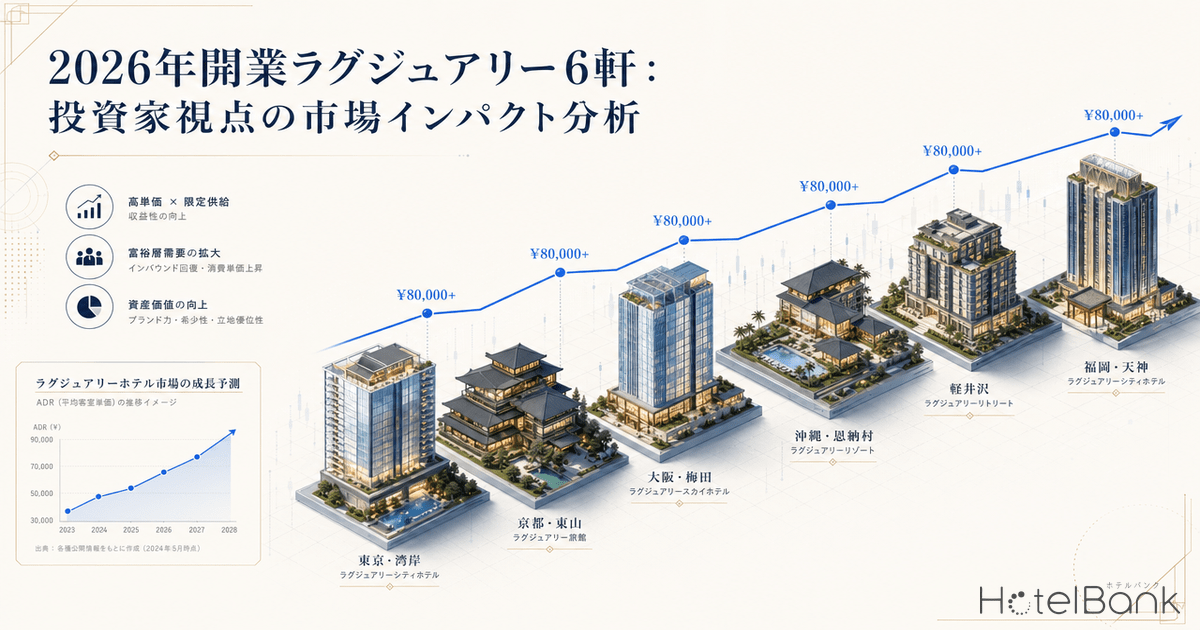
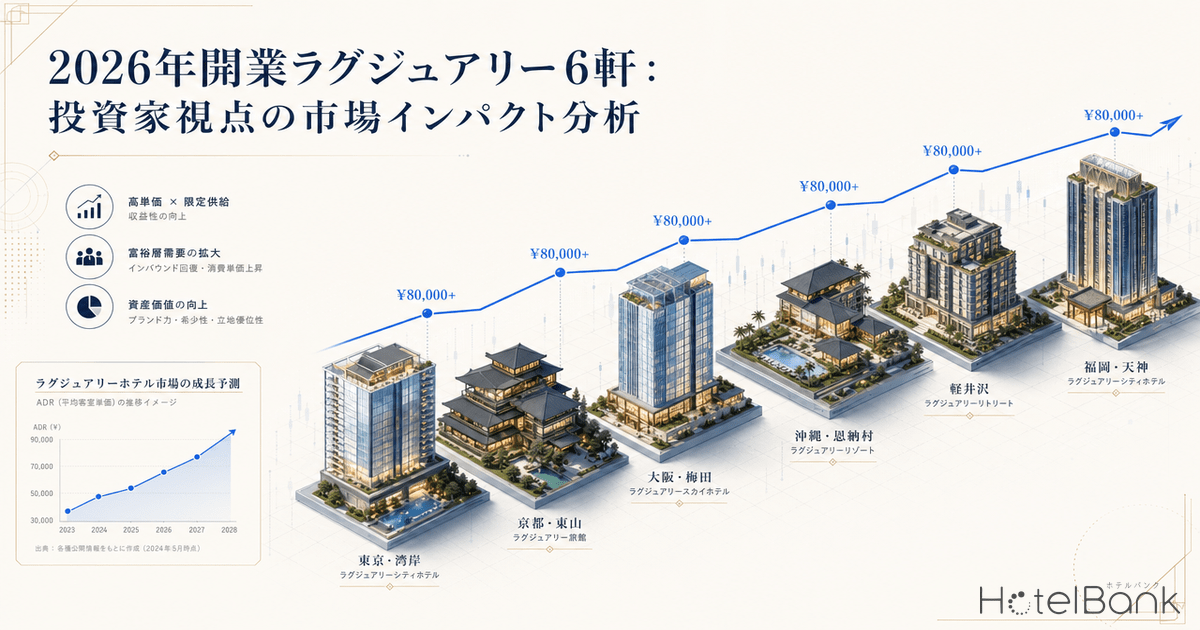
2026 marks the year with the largest new luxury hotel supply impact in Japan in the past decade. Six properties are scheduled to open in succession—Imperial Hotel Kyoto (帝国ホテル京都), Capella Kyoto (カペラ京都), Hoshinoya Nara Prison (星のや奈良監獄), Conrad Nagoya (コンラッド名古屋), Four Seasons Hotel Tokyo at Marunouchi (rebranded), and Aman Niseko (アマンニセコ)—all positioned at price points above ¥150,000 per night. Drawing on publicly available pricing data and REIT monthly operating data, this article quantitatively examines each area’s market ADR levels, the price positioning against existing luxury competitors, and the impact risk on REIT-held properties.
*Prices are per-room rates (tax included) for double occupancy. Market ADR figures are aggregated by MetroEngines Research from publicly listed OTA prices and may differ from actual transacted ADR.
Metric Definitions Used in This Article
- ADR (Average Daily Rate): The average of publicly listed sale prices on OTAs. This differs from actual transacted prices. Per-room rate (tax included) for double occupancy, averaged across all plan types (room-only through plans with meals).
- Sellout Rate: The percentage of plans on OTAs that had stopped accepting reservations at the time of survey. This differs from property-level occupancy rate.
- Data Source: MetroEngines Research
Overview of the Six Luxury Hotels Opening in 2026
First, we summarize the key facts on the six major luxury hotels scheduled to open in 2026. Tabulating room counts, opening dates, and announced launch prices captures the scale of this new supply. Of note, the six properties total only around 449 rooms—a limited supply in volume terms—yet all target the segment above ¥150,000 per night. The impact lies less in supply volume than in the signaling effect of the price band.
| Hotel Name | Area | Rooms | Opening | Launch Price (Min.) |
|---|---|---|---|---|
| Imperial Hotel Kyoto | Kyoto, Gion (Higashiyama-ku) | 55 | March 2026 | ¥164,500~ |
| Capella Kyoto | Kyoto, Gion (Higashiyama-ku) | 89 | March 2026 | ¥210,400~ |
| Hoshinoya Nara Prison | Nara City | 48 | June 2026 | ¥147,000~ |
| Conrad Nagoya | Nagoya, Sakae (Naka-ku) | 170 | July 2026 | Not disclosed |
| Four Seasons Marunouchi (Renewal) | Tokyo, Marunouchi (Chiyoda-ku) | 57 | April 2026 | ¥130,000~ (current run rate) |
| Aman Niseko | Niseko, Mt. Moiwa | 30 | 2026 (TBC) | Not disclosed |
Source: Compiled by HotelBank Editorial Team from each company’s published materials
The disclosed launch price range for four of the properties is ¥147,000 to ¥210,400—roughly four to six times the average ADR of urban city hotels in Japan. Conrad Nagoya and Aman Niseko have not yet disclosed pricing, but based on brand positioning and room specifications (Conrad standard rooms approx. 50 sqm; Aman Niseko features fireplaces and onsen baths in every room), both are expected to land in the ¥80,000 to ¥200,000 range.
Ownership Structure of the Six New Properties
For luxury hotel investment analysis, the separation between ownership and operation (asset-light vs. owner-operated) is a key evaluation axis. The ownership structure of each property is summarized below.
| Hotel Name | Owner | Operator | Scheme |
|---|---|---|---|
| Imperial Hotel Kyoto | Yasaka Nyokoba Gakuen (land) Imperial Hotel (building & interior) |
Imperial Hotel, Ltd. | Owner-operated Land on fixed-term lease |
| Capella Kyoto | NTT Urban Development | Capella Hotel Group (NTT Urban Development Hotel Management) |
Owner-operator separation Management contract |
| Hoshinoya Nara Prison | Government of Japan (Ministry of Justice) | Hoshino Resorts (via Former Nara Prison Preservation & Utilization Co.) |
Concession scheme Public facility operating rights |
| Conrad Nagoya | Mitsubishi Estate, Japan Post Real Estate, Meiji Yasuda Life, Chunichi Shimbun |
Hilton | Owner-operator separation Management contract (upper floors of mixed-use tower) |
| Four Seasons Hotel Tokyo at Marunouchi | Pacific Century Group (Hong Kong, Richard Li) |
Four Seasons Hotels & Resorts | Owner-operator separation Management contract (relaunch after renovation) |
| Aman Niseko | Wellspring Investments Holdings (foreign investment company) |
Aman Resorts (CEO: Vlad Doronin) |
Owner-operator separation Branded residences attached |
Investor Takeaway: Five of the six properties follow an asset-light model that separates ownership from operations. The sole exception is Imperial Hotel Kyoto, which preserves the traditional own-brand, owner-operated model. Conrad Nagoya is a four-party joint-ownership mixed-use development, while Hoshinoya Nara Prison uses a concession scheme over a state-owned Important Cultural Property—reflecting an increasingly diverse ownership landscape.
- Imperial Hotel Kyoto — Imperial Hotel Press Release (March 2025)
- Capella Kyoto — NTT Urban Development News Release
- Hoshinoya Nara Prison — Hoshino Resorts × Former Nara Prison Preservation Co. Press Release, PR TIMES (2026 opening announcement)
- Conrad Nagoya — Hilton Press Release, MICE TIMES ONLINE
- Four Seasons Hotel Tokyo at Marunouchi — Hospitality Net (Spring 2026 relaunch announcement)
- Aman Niseko — Aman Resorts Official, Hotel Planet
Market ADR Levels in Each Area
We compare the market-wide ADR (publicly listed price basis) for April 2026 in each area where the six new luxury hotels are located. Kyoto’s Gion (Higashiyama-ku) stands out at ¥90,900, followed by Tokyo’s Chiyoda-ku at ¥75,700. Nara, Niseko, and Nagoya’s Naka-ku all sit in the ¥30,000-¥45,000 range, clearly showing that the launch prices of the six new luxury hotels are being introduced at price points two to five times the prevailing market ADR.
Source: Compiled by HotelBank Editorial Team from MetroEngines Research (April 2026 check-in basis, N=40 to 421 properties per area)
The ¥90,900 figure for Higashiyama-ku (Gion) is not a simple average. The area already hosts a cluster of luxury hotels with rates above ¥100,000 per night—including The Ritz-Carlton Kyoto, The Hotel Seiryu Kyoto Kiyomizu, Four Seasons Hotel Kyoto, and Park Hyatt Kyoto—biasing the area-wide ADR upward. By contrast, Nara at ¥41,400 and Nagoya’s Naka-ku at ¥28,500 indicate that current luxury supply is extremely limited. In other words, Hoshinoya Nara Prison and Conrad Nagoya are tasked with creating untapped luxury markets, while the two Kyoto properties target an update of the price ceiling in an already crowded battlefield—two distinct strategic axes.
Price Range of Existing Luxury Competitors
We extracted the price distribution of existing luxury inventory (¥50,000+ per night) in each area from bookable inventory for April-June 2026. Comparing medians, maximums, and sample sizes provides a quantitative view of where the six new properties’ launch prices sit relative to existing competitors.
| Area | Luxury Properties | Median Price | Max Price | New Launch (Min.) |
|---|---|---|---|---|
| Kyoto, Higashiyama-ku (Gion) | 233 | ¥119,900 | ¥1,492,700 | ¥164,500 (Imperial Kyoto) |
| Kyoto, Shimogyo-ku | 353 | ¥95,300 | ¥1,300,000 | — |
| Kyoto, Nakagyo-ku | 224 | ¥103,000 | ¥932,300 | — |
| Nara City | 63 | ¥89,400 | ¥824,800 | ¥147,000 (Hoshinoya Nara Prison) |
| Nagoya, Naka-ku (Sakae) | 69 | ¥81,300 | ¥481,400 | Not disclosed (Conrad Nagoya) |
| Tokyo, Chiyoda-ku (Marunouchi) | 88 | ¥136,200 | ¥1,290,300 | ¥130,000 (FS Marunouchi) |
| Niseko, Kutchan Town | 67 | ¥99,200 | ¥699,200 | Not disclosed (Aman Niseko) |
Source: Compiled by HotelBank Editorial Team from MetroEngines Research (April-June 2026, properties priced ¥50,000+ only)
Source: Compiled by HotelBank Editorial Team from MetroEngines Research
Three implications emerge from this data. First, Imperial Hotel Kyoto’s ¥164,500 sits about 37% above Gion’s luxury median of ¥119,900, taking a clearly upper-tier position. Capella Kyoto’s ¥210,400 is roughly 1.76 times the median, placing it in the top tier alongside The Ritz-Carlton Kyoto and Park Hyatt Kyoto. Second, Hoshinoya Nara Prison’s ¥147,000 is approximately 1.65 times Nara’s luxury median of ¥89,400, signaling intent to reset the area’s price ceiling. Third, Four Seasons Marunouchi’s expected post-rebrand price of ¥130,000 falls slightly below the area’s median of ¥136,200, suggesting a cautious pricing strategy in the immediate post-renewal window.
New Launch Prices vs. Existing Competitor Medians
We visualize how far the launch prices of the six new properties deviate from the existing luxury competitor medians in their respective areas. Conrad Nagoya and Aman Niseko remain undisclosed, so estimates based on brand positioning are used.
Source: Compiled by HotelBank Editorial Team from MetroEngines Research and each company’s published materials
The two properties opening in Kyoto’s Gion—Imperial Hotel Kyoto and Capella Kyoto—are deliberately entering a crowded battlefield at premium price points. The backdrop is that Kyoto’s prefecture-wide ADR reached ¥50,300 in April 2026, a sharp +18.6% YoY rise. As inbound demand returns and tourists shift toward higher value-add stays, the price ceiling across Kyoto is being lifted, structurally tailwinding the luxury segment. By contrast, Nara’s area average ADR of ¥42,100 in April 2026 indicates a thin luxury market, framing Hoshinoya Nara Prison as a market-creating entry.
Demand Curve: Booking Patterns at Opening Months
Of the six new properties, the earliest to open are Imperial Hotel Kyoto and Capella Kyoto—both in March 2026. In that month, the market-wide ADR for the Gion area (Higashiyama-ku) is hovering in the ¥90,000s, with a seasonal pattern of further increases into April. Year-over-year monthly price trends in Kyoto and Tokyo over the past 18 months are shown below.
Source: Compiled by HotelBank Editorial Team from MetroEngines Research (Kyoto and Tokyo monthly average ADR)
Sellout rates across each area in April 2026 (the share of fully booked inventory among publicly listed plans) also warrant attention: Higashiyama-ku 16.2%, Nara 30.2%, Niseko (Kutchan) 29.3%, Chiyoda-ku 49.0%, Kyoto Shimogyo-ku 47.4%, and Nagoya Naka-ku 44.8%. Chiyoda-ku’s 49.0% in particular signals a tight supply-demand balance—an ideal market environment for the timing of Four Seasons Marunouchi’s rebrand. Conversely, Higashiyama-ku’s 16.2% suggests room remains in Gion to absorb new high-value-add hotel supply.
Note on Data Sources: This article uses both OTA-listed pricing data (sale-price basis) and REIT monthly operating data (transacted-price basis) in parallel. Because the two have structurally different levels, focus on YoY change rates rather than direct absolute-value comparisons.
Impact Risk Assessment on REIT-Held Properties
Next, we examine a key investor question—the risk of new luxury supply pressuring the ADR of existing REIT-held properties—using REIT monthly operating data. The sample comprises five REITs: Hoshino Resorts REIT (3287, holding Hoshinoya Kyoto), Japan Hotel REIT (8985, with a Hokkaido portfolio among others), Ichigo Hotel REIT (3463, holding properties in Kyoto and Nagoya Marunouchi), Invincible Investment Corporation (8963, holding properties in Kyoto Shijo, Nagoya Nishiki/Sakae, and Nara), and Mori Trust Hotel REIT (8961, holding Tokyo Station Marriott).
| REIT | Competing Properties Held | Current ADR | OCC | Expected Impact |
|---|---|---|---|---|
| Hoshino Resorts REIT (3287) | Hoshinoya Kyoto | ¥100,400 | 87.3% | Same brand—limited impact |
| Ichigo Hotel REIT (3463) | Smile Hotel Kyoto Shijo KOKO HOTEL Nagoya Marunouchi | ¥6,100 ¥9,100 | 77.5% 85.6% | Different price band—minimal impact |
| Invincible (8963) | MyStays Kyoto Shijo MyStays Nagoya Sakae Kamenoi Hotel Nara | ¥16,700 ¥10,900 ¥20,300 | 79.8% 68.1% 94.2% | Different price band—minimal impact |
| Mori Trust REIT (8961) | Courtyard Tokyo Station | ¥41,200 | 73.3% | Different price band—limited direct impact |
| JHR (8985) | Hokkaido segment | ¥12,200 | 84.8% | Large price-band gap from Aman Niseko |
Source: Compiled by HotelBank Editorial Team from each REIT’s monthly operating data (as of February-March 2026)
The ADR range of REIT-held properties (¥6,000-¥41,000) and the launch prices of the six new properties (¥130,000-¥210,400) differ by more than four-fold, with limited price-band overlap. In other words, direct price cannibalization on existing REIT-held assets from the new openings is assessed as small. What deserves more attention is the spillover effect: new luxury supply lifts the area-wide price reference, which can also exert upward pressure on mid-priced hotels. Hoshino Resorts REIT, which holds Hoshinoya Kyoto, has within-group competitive overlap, but the brand and concept—an urban onsen ryokan—is clearly differentiated, so the impact is more likely to be positive, driven by the broader Nara-area awareness boost from the April 2026 opening of the “Nara Prison Museum.”
Major REIT ADR Trends: Past 24 Months
Looking at the monthly average ADR trends of each REIT, levels in early 2026 remain firm versus the prior-year period. Mori Trust REIT trades around ¥30,000s, JHR around ¥20,000, Hoshino Resorts REIT around ¥20,000, Invincible around ¥14,000, and Ichigo Hotel REIT around ¥10,000—all stable. As of now, no downward pressure from new luxury supply has been observed.
Source: Compiled by HotelBank Editorial Team from each REIT’s monthly operating data (past 19 months)
Of particular note is the move at Mori Trust REIT. ADR rose sharply from ¥33,700 → ¥40,400 → ¥39,900 between September and November 2025, indicating that luxury demand around Tokyo Station remains robust. Following Four Seasons Marunouchi’s April 2026 renewal, the average ADR in Chiyoda-ku could be lifted further—structurally a tailwind for nearby mid-priced hotels.
Implications for Investors: Three Key Points
From this data analysis, we present three key takeaways for hotel REIT investors and hotel operators.
First, the supply of the six new luxury hotels is a price-ceiling-update event for the market. Average ADRs of ¥90,900 in Kyoto’s Gion and ¥75,700 in Chiyoda-ku are propped up by the presence of luxury price points. The introduction of these six new properties will lift the upper price tier across each area further, potentially exerting upward pressure on mid-tier hotels (ADR ¥30,000-¥80,000) as well. This is not negative for existing REIT-held assets—rather, it can act as a positive factor by expanding ADR upside.
Second, the limited price-band overlap means direct cannibalization risk is small. Major REIT-held property ADRs range from ¥6,000 to ¥41,000—clearly a different segment from the ¥130,000-¥210,400 range of the six new luxury properties. Direct market-share displacement from new supply is therefore unlikely. That said, in areas where luxury supply is already thick—such as Kyoto Gion and Chiyoda-ku—the formation of a high-season price ceiling cannot be ruled out.
Third, the risk-return structure clearly diverges by area. Kyoto Gion sees intensifying luxury competition with both demand and supply at high levels; Nara and Nagoya see price ranges expand upward through new supply; Marunouchi sees brand value redefinition through rebrand; Niseko sees the formation of price points aimed at affluent inbound travelers. For investment decisions, exposure management that distinguishes between these four scenarios is desirable.
Summary
2026 can be positioned as the “year of price-ceiling renewal” in Japan’s luxury hotel market. The six new properties’ supply scale of 449 rooms is limited, but launch prices of ¥130,000-¥210,400 correspond to two to five times the market ADR, with significant signaling effect that lifts the area-wide price benchmark. Meanwhile, existing REIT-held properties sit in clearly different price bands, so the direct ADR-pressuring risk is small. Rather, the spillover effect from the area-wide expansion of price ranges is more likely to play out positively. For investors and operators, the key perspective is to view new supply not as a threat but as an opportunity for re-evaluating market premiums.
Note on Future ADR Figures: The ADRs in this article are averages of sale prices publicly listed on OTAs at the time of survey, and they will fluctuate as check-in dates approach. Note that prices set high at the present time may decline through last-minute discounting.