

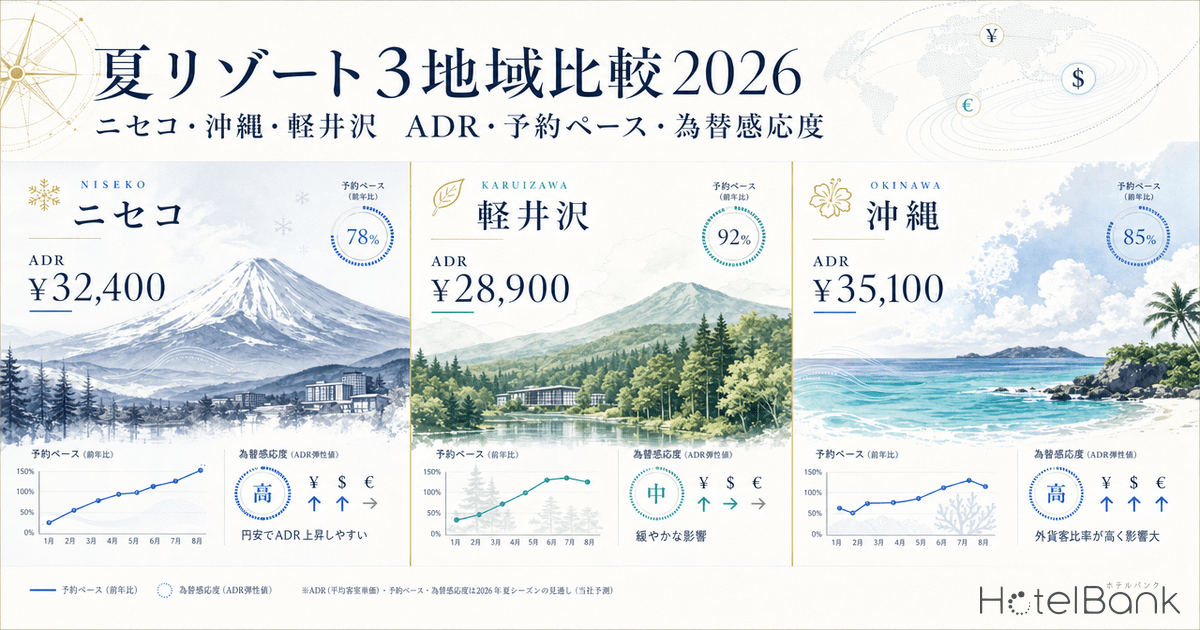

For the summer 2026 booking period (July–August), Japan’s three flagship resort regions — Niseko/Kutchan, Onna Village (Okinawa)/Ishigaki, and Karuizawa — are showing significant year-over-year ADR increases. From the perspective of investors and luxury-segment marketers, this article unpacks the regional drivers and quantifies revenue sensitivity under different FX scenarios. All prices in this article are unified as per-room rates for double occupancy (tax included).
Metric Definitions Used in This Article
- ADR (Average Daily Rate): The average of public selling prices on OTAs etc. This differs from actual transacted prices. Per-room rate for double occupancy (tax included), averaged across all plans (room-only through meal-inclusive).
- Sold-out Rate: The percentage of plans that had stopped accepting reservations on OTAs as of the survey date. This differs from the property’s overall room occupancy rate.
- Data Source: MetroEngines Research
Three-Region ADR Summary: YoY +3.4% to +24.9%, with Niseko’s Core (Kutchan) Standing Out
We first compared selling prices for July–August 2026 with prior-year actuals. Kutchan Town (the core of the Niseko area, including Grand Hirafu, Village Niseko, and Powder Resort) stands out at YoY +24.9%, followed by Onna Village at +11.9%, Ishigaki City at +8.9%, Karuizawa Town at +6.3%, and Niseko Town itself at +3.4%. ADRs span ¥56,100 to ¥97,600, making regional disparity pronounced — and indicating that the market has moved beyond the point where a single “resort outlook” can describe it.
Source: Compiled by HotelBank Editorial Team from MetroEngines Research (N = Kutchan 139,727 / Niseko 96,738 / Karuizawa 511,868 / Onna 660,054 / Ishigaki 553,848 records)
Most striking is Kutchan’s +24.9%. The market is absorbing an absolute price hike of roughly ¥12,000 per room per night, from ¥47,808 to ¥59,709 — implying robust willingness-to-pay on the demand side. By contrast, Niseko Town itself (the township west of Hirafu, across the road) is up only +3.4%. With its ADR already in the ¥56,000s and converging on Kutchan’s level, price convergence between the two areas is also clearly underway.
Booking Pace: Onna Village Stands Out, Karuizawa and Niseko Town Are Slower
We compared sold-out rates as of April 25 for plans 61–90 days and 91–130 days out (i.e. the July–August window). Onna Village is most strained at 23.0% (61–90 days), followed by Kutchan at 16.5% and Ishigaki at 17.5%. Karuizawa Town (10.9%) and Niseko Town (10.3%) show lower sold-out rates, indicating relatively ample inventory.
Source: Compiled by HotelBank Editorial Team from MetroEngines Research (as of 2026/04/25, target = July–August 2026 check-ins)
Onna Village’s tightness reflects a structure where inbound and domestic summer demand overlap, plus inventory absorption ahead of new hotel openings discussed below. Karuizawa’s lower sold-out rate, despite high inventory volume (up to 321 hotels covered) coexisting with high-tier ADRs, suggests that affluent domestic demand remains strong but that price elasticity may be starting to bite as rates rise.
Weekly ADR Trend: The Obon Surge Widens Regional Gaps
Breaking July–August 2026 down by week makes regional characteristics even clearer. Looking at the weekly ADR trajectory, prices accelerate across all regions toward Obon week (starting August 8), with Karuizawa Town in particular jumping from ¥106,669 (week of August 1) to ¥141,172 (week of August 8) — a +32% move in a single week. This reflects the unique nature of the Obon period, when domestic family and luxury demand concentrates.
Source: Compiled by HotelBank Editorial Team from MetroEngines Research
Onna Village also rises to an Obon-week ADR of ¥116,991, making it effectively the second-largest premium summer market after Karuizawa. So what is driving these ADR increases? We now break down the drivers region by region.
Niseko: Australian Capital × Weak Yen × Year-Round Operation Drives a “De Facto USD-Denominated” Market
Kutchan Town’s +24.9% — the largest gain among the regions — can be attributed to a combination of three factors. First, the “de facto foreign-currency-denominated” pricing set by Australian and other foreign-capital hotel operators and condo owners. Second, the structural weakness of AUD/JPY (with further yen-weakening risk priced in for full-year 2026 due to the widening Japan–Australia rate differential). Third, progress toward year-round operation, exemplified by Rusutsu Resort.
According to JNTO, inbound visitors from Australia in 2025 reached 1.06 million, exceeding the one-million mark for the first time. Although Australia’s summer holiday is in the southern hemisphere and Japan’s winter is the primary demand window, Niseko/Kutchan is also establishing itself as a destination for Australian long summer holidays in the northern hemisphere (especially July–August). The structurally stronger AUD against JPY expands Australian customers’ yen-denominated spending capacity, making it easier for local hotels to lift JPY-converted ADRs.
Rusutsu Resort is operating its amusement park and hotel summer business from April 29 through October 18, 2026, lifting baseline summer-stay motivation for the entire Niseko/Kutchan area (Source: Rusutsu Resort official). This means that Niseko/Kutchan, traditionally a winter ski-only market, is shifting to a structure where ADRs do not collapse in summer either.
Okinawa: Naha–Resort Bifurcation and Premiumization Driven by New Openings
Within Okinawa, bifurcation between Naha’s business-demand hotels and resort areas is progressing. Onna Village and Ishigaki City covered in this article sit on the upper end of the resort-bifurcation curve, with ADRs of ¥95,111 and ¥55,503 respectively. Art Hotel Ishigakijima, held by Invincible Investment Corporation, posted OCC 81.4% / ADR ¥13,779 in February 2026 — illustrating that the gap between business/mid-tier and Onna’s premium tier remains wide.
Major new supply in Onna Village in 2026 includes the following. Granvista Hotels & Resorts plans to open BLISSTIA SUITES & RESORT Okinawa Onna Village in July 2026, and PGM Hotel Resort Okinawa is also planned for opening within 2026 (Sources: Granvista official, Tabirai Okinawa). These properties will function as anchor pricing that lifts the ADR ceiling for the area, while also adding competitive pressure on existing hotels.
Hoshino Resorts REIT Investment Corporation’s Hoshinoya Okinawa posted OCC 87.4% / ADR ¥69,300, while its Iriomotejima Hotel posted OCC 59.5% / ADR ¥21,932 — showing differentiation even between island and main-island resorts. Ishigaki City’s OTA price YoY of +8.9% lags behind the main island’s Onna Village at +11.9%, confirming a structural pattern in which remote islands have less room to raise prices.
| Area / Property | OCC | ADR | RevPAR |
|---|---|---|---|
| Hoshinoya Okinawa (Hoshino Resorts REIT) | 87.4% | ¥69,300 | ¥60,600 |
| Hoshinoya Karuizawa (Hoshino Resorts REIT) | 86.7% | ¥76,700 | ¥66,500 |
| BEB5 Karuizawa (Hoshino Resorts REIT) | 87.6% | ¥21,000 | ¥18,400 |
| Art Hotel Ishigakijima (Invincible) | 81.4% | ¥13,800 | ¥11,200 |
| Iriomotejima Hotel (Hoshino Resorts REIT) | 59.5% | ¥21,900 | ¥13,100 |
| JHR Hokkaido Region Average | 88.4% | ¥22,100 | ¥19,500 |
| JHR Okinawa Region Average | 88.1% | ¥21,400 | ¥18,800 |
Note on data switching: This article uses both OTA public price data (selling-price basis) and REIT monthly operating data (transacted-price basis). The two have a structural level gap, so please focus on YoY (year-over-year) percentage changes rather than direct absolute-value comparisons.
Source: Compiled by HotelBank Editorial Team from each REIT’s monthly operating data (February 2026 actuals)
Karuizawa: A Domestic Affluent Shift and a New-Opening Rush
Karuizawa Town’s ADR of ¥97,602 (July–August average) is the highest among the five locations covered. Although YoY at +6.3% is below double digits, the absolute level dwarfs the others — and during Obon week it surges to ¥141,172, the highest peak rate of the three regions.
Karuizawa’s distinguishing feature is that demand is “domestic-affluent-led, not inbound-led.” On the supply side, 2026 brings major moves: on March 17, the joint venture of Mitsubishi Estate, Aqua Ignis, and Culture Convenience Club (CCC) opened “Karuizawa T-SITE” (directly connected to the station, with bathing facilities, a 9-room hotel, and 17 tenants). In addition, List Development is planning Japan’s first “Anantara Karuizawa Retreat” (23 suites and 18 villas with 28 rooms), promising additional supply at the highest price tier (Sources: estie report, Nikkei).
Hoshino Resorts REIT Investment Corporation’s Hoshinoya Karuizawa posted OCC 86.7% / ADR ¥76,684, and BEB5 Karuizawa OCC 87.6% / ADR ¥20,956 — both the luxury and youth-oriented tiers maintain occupancy in the high 80s. The REIT’s overall February 2026 actuals were OCC 76.5% / ADR ¥20,771 / RevPAR ¥15,884 (RevPAR +10.5%, ADR +8.6% YoY; Source: Hoshino Resorts REIT IR), confirming that the Karuizawa core hotels are pulling above the portfolio average.
FX Sensitivity: ADR Upside Under a Continued Yen-Weakness Scenario
From an investor standpoint, the most important question is regional revenue sensitivity to FX scenarios. Nomura Securities’ full-year 2026 outlook posits that “yen-weakness pressure persists in the first half, with a correction in the second half,” placing the July–August summer window squarely in the residual yen-weakness period (Source: Nomura Wealth Style). The gap in rate-hike pace between the RBA (Reserve Bank of Australia) and the BOJ has been flagged as leaving further yen-weakness room on the AUD/JPY side.
Each region’s FX sensitivity differs based on its inbound share and the home currencies of its customers. Starting from current ADRs, we estimate ADR upside under scenarios of “USD/JPY ±10 yen and AUD/JPY ±10 yen.” Assumptions: (1) Niseko/Kutchan are assumed to have a substantively high inbound share, with Australian and U.S. customers’ willingness-to-pay varying linearly in JPY terms; (2) Okinawa resorts are mid-inbound; (3) Karuizawa is domestic-led and therefore has low FX sensitivity.
Source: HotelBank Editorial Team estimates (assumptions: Australian customer share Niseko 45% / Onna 20% / Ishigaki 10% / Karuizawa 5%; U.S. and Australian customers’ ADR willingness-to-pay assumed constant in home currency terms)
The estimates show that under a 10% yen-weakness scenario (USD/JPY +15 yen, AUD/JPY +10 yen equivalent), Niseko/Kutchan ADR has +8.5% upside relative to current levels, while Karuizawa has only +1.0%. Conversely, under a yen-strength scenario, Niseko’s downside risk is the largest. From a portfolio perspective, Niseko-only holdings carry a large FX β, while Karuizawa and Ishigaki (domestic / remote islands) are closer to FX-neutral — a clear difference in risk profile emerges.
Investor Outlook: Regional RevPAR Upside / Downside Ranges
Finally, integrating current ADR, sold-out rate, and FX scenarios, we present RevPAR upside/downside ranges for July–August 2026 by region. For RevPAR = ADR × OCC, OCC was set tentatively from prior-year prefecture-level occupancy in JTA’s Overnight Travel Statistics combined with the current sold-out-rate progression.
| Region | Current ADR | Assumed OCC | Base RevPAR | Yen-Weak Scenario | Yen-Strong Scenario |
|---|---|---|---|---|---|
| Kutchan Town | ¥59,700 | 82% | ¥48,900 | +8.5% | -7.0% |
| Niseko Town | ¥56,100 | 78% | ¥43,800 | +6.0% | -5.0% |
| Onna Village | ¥95,100 | 85% | ¥80,800 | +4.0% | -3.0% |
| Ishigaki City | ¥55,500 | 80% | ¥44,400 | +2.0% | -2.0% |
| Karuizawa Town | ¥97,600 | 88% | ¥85,900 | +1.0% | -1.0% |
Source: HotelBank Editorial Team estimates from MetroEngines Research and JTA Overnight Travel Statistics (OCC set conservatively from area characteristics × prior-year JTA × current booking pace)
In short, the upside for July–August 2026 revenue is overwhelmingly largest in Kutchan Town, but downside risk is also the greatest. Conversely, although Karuizawa Town has the highest absolute level, its FX-scenario range is a narrow ±1% — meaning “stable cash flow that is little affected by FX,” which in portfolio-theory terms is favorable as a diversification target.
Summary: Regional Characteristics and Investment Mapping
To summarize this analysis, in the summer 2026 booking period (July–August), the three regions are raising prices through different drivers, and their investor-facing characterizations are as follows.
Niseko/Kutchan is a high-growth, high-volatility market driven by the trinity of Australian capital, a weak yen, and year-round operation. Kutchan Town’s YoY +24.9% dwarfs the others, but downside in an FX-headwind regime is also large. Now that ADR has reached the ¥59,000 range, the next test is whether it can settle into the ¥70,000 range.
Okinawa (Onna Village / Ishigaki City) is bifurcating between main-island resorts and the remote islands. Onna Village’s 23% booking-tightness rate and +11.9% YoY, combined with multiple new luxury hotel openings, suggest that premiumization will continue. Ishigaki City has limited supply elasticity due to its remote-island geography, and is expected to maintain a stable +8% to +10% growth band.
Karuizawa is led by domestic affluent demand and is close to FX-neutral; while it produces the highest peak rates (¥141,000 in Obon week), its annual average is little affected by FX. The Karuizawa T-SITE opening and the Anantara Karuizawa plan add supply pressure, but brand diversification is more likely to expand the demand base.
Investors and luxury-segment marketers have entered a phase where they should no longer lump these three regions together as “the same summer resorts,” but instead segment them on two axes — FX β and domestic-affluent premium — when designing portfolios and accommodation-promotion strategies.
Note on future-date ADRs: The ADRs in this article are averages of public selling prices on OTAs at the survey date and will fluctuate as check-in dates approach. Please be aware that prices currently set high may decline through last-minute markdowns.