

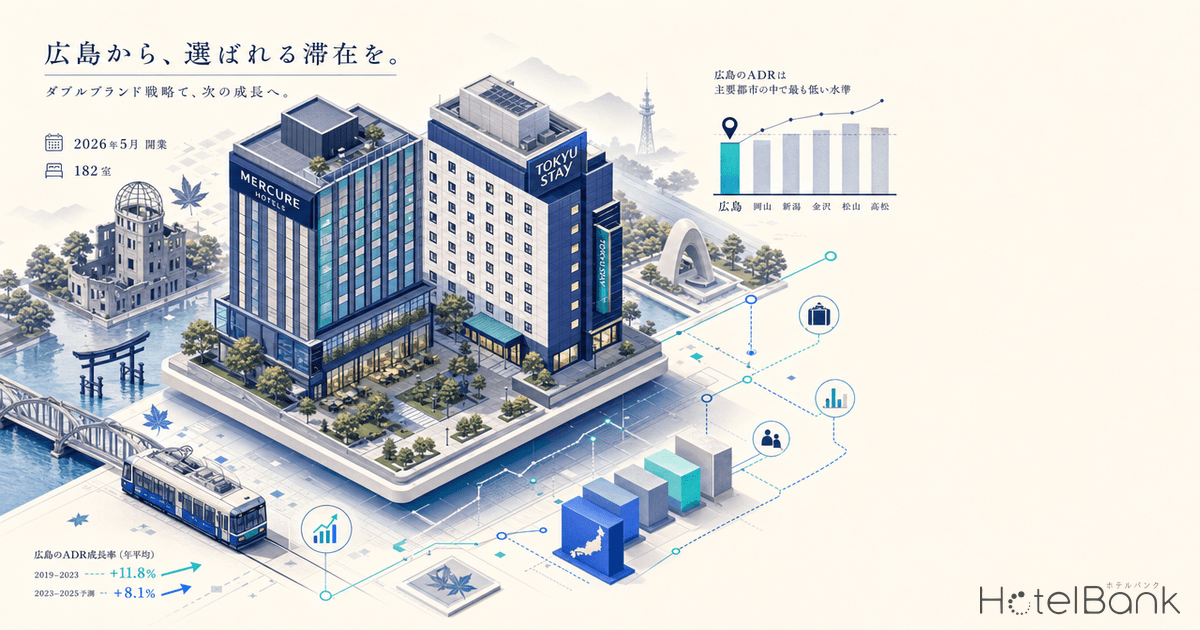
On May 18, 2026, “Tokyu Stay Mercure Hiroshima” (182 rooms) will open in Hatchobori, Naka-ku, Hiroshima. As a dual-brand hotel combining Accor’s “Mercure” brand with “Tokyu Stay” operated by Tokyu Resorts & Stay, this is the second after Osaka Namba which opened in December 2022. In this article, drawing on publicly available pricing data from MetroEngines Research, we examine ADR trends among competing hotels in Hiroshima, the price reaction expected before and after this new opening, and the economic rationale of the dual-brand strategy from multiple angles, while also considering the potential for horizontal expansion to other regional core cities such as Okayama, Niigata, Kanazawa, Matsuyama, and Takamatsu.
Metric Definitions Used in This Article
- ADR (Average Daily Rate): Average of publicly listed sales prices on OTAs and similar channels. This differs from actual booked rates. Per-room rate (tax inclusive) for 2 guests/1 room, averaged across all plans (room-only through plans with meals included).
- Sold-out rate: Percentage of plans on OTAs that had stopped accepting bookings at the time of survey. This differs from a property’s overall room occupancy rate.
- Data source: MetroEngines Research
The Current State of Hiroshima’s Hotel Market: Distinctive Traits Revealed by Comparing Six Regional Core Cities
First, let us position Hiroshima’s hotel market relative to other comparably sized regional core cities. According to MetroEngines Research data covering 77 properties and over 310,000 data points in Hiroshima City (as of April 2026), the city’s ADR stands at ¥24,000, up just +2.2% year-on-year — essentially flat. By contrast, Matsuyama posted +11.8% and Kanazawa +8.1%, recording near double-digit growth. Even among regional core cities, clear divergence in pricing momentum has emerged.
Source: Compiled by HotelBank Editorial Team based on MetroEngines Research (N=Hiroshima 77 properties, Okayama 41, Niigata 59, Kanazawa 103, Matsuyama 88, Takamatsu 63, as of April 2026)
What stands out is that Hiroshima’s ADR level itself ranks at the lower end of regional core cities. Compared with Matsuyama (¥33,500), Kanazawa (¥30,800), Niigata (¥26,400), and Takamatsu (¥26,900), Hiroshima possesses World Heritage-class tourism assets — Peace Memorial Park, the Atomic Bomb Dome, and Miyajima — yet its high proportion of business hotels structurally suppresses price levels. Looking at the distribution of hotels in Hiroshima, business hotels (budget through upper) account for roughly 70% of the 77 properties, while full-service categories such as city hotels and ryokan remain at around 20%.
ADR Trends at Nine Existing Competitors: Upper-Luxury Strong, Mid-Tier Stagnating
Next, we examine ADR trends from April 2025 through April 2026 at nine representative large-scale hotels in Hiroshima: Sheraton Grand Hotel Hiroshima, Grand Prince Hotel Hiroshima, Rihga Royal Hotel Hiroshima, ANA Crowne Plaza Hotel Hiroshima, Hotel Granvia Hiroshima, Mitsui Garden Hotel Hiroshima, Hiroshima Washington Hotel, Hiroshima Tokyu REI Hotel, and Daiwa Roynet Hotel Hiroshima. Together they comprise 2,944 rooms and form the backbone of Hiroshima’s mid-to-large hotel supply.
Source: Compiled by HotelBank Editorial Team based on MetroEngines Research (monthly average ADR for 9 major Hiroshima properties, N=1,000–28,000 data points per property)
Looking at YoY figures as of April 2026, upper-luxury and upper-tier hotels such as Sheraton Grand (+7.6%), Hotel Granvia (+12.0%), and ANA Crowne Plaza (+9.8%) have steadily raised prices. By contrast, several traditional large hotels have fallen below prior-year levels: Rihga Royal (-2.3%), Grand Prince (-20.2%), Mitsui Garden (-6.5%), and Hiroshima Washington (-5.2%). This suggests that hotels which benefited from the May 2023 G7 Hiroshima Summit demand spike have seen that boost taper off through 2024 and 2025, and in 2026 are entering an environment where they will be more sensitive to supply increases including new openings.
| Property | Rooms | Apr 2025 ADR | Apr 2026 ADR | YoY | Sold-out Rate |
|---|---|---|---|---|---|
| Sheraton Grand Hotel Hiroshima | 238 | ¥53,400 | ¥57,400 | +7.6% | 62.3% |
| Grand Prince Hotel Hiroshima | 510 | ¥55,300 | ¥44,100 | -20.2% | 56.6% |
| Rihga Royal Hotel Hiroshima | 491 | ¥44,000 | ¥42,900 | -2.3% | 54.3% |
| Hotel Granvia Hiroshima | 407 | ¥42,300 | ¥47,400 | +12.0% | 48.1% |
| ANA Crowne Plaza Hotel Hiroshima | 402 | ¥34,600 | ¥38,000 | +9.8% | 63.5% |
| Mitsui Garden Hotel Hiroshima | 281 | ¥25,200 | ¥23,600 | -6.5% | 50.8% |
| Hiroshima Washington Hotel | 266 | ¥21,700 | ¥20,600 | -5.2% | 57.7% |
| Hiroshima Tokyu REI Hotel | 239 | ¥18,300 | ¥21,000 | +14.4% | 66.8% |
| Daiwa Roynet Hotel Hiroshima | 231 | ¥16,000 | ¥15,900 | -0.4% | 79.1% |
Source: Compiled by HotelBank Editorial Team based on MetroEngines Research
Of particular note, Hiroshima Tokyu REI Hotel (Nagarekawa-cho, Naka-ku) posts very strong figures — +14.4% YoY and a 66.8% sold-out rate. Ahead of the opening of its sister property “Tokyu Stay Mercure Hiroshima” (Hatchobori), Tokyu brand recognition appears to be receiving early evaluation in the market. After the new opening, the two properties together could further raise the receptivity to the Tokyu brand in central Hiroshima.
Competitor Distribution Within 1 km of Hatchobori: Supply-Demand Impact of 182 Additional Rooms
Next, we look at the hotel supply situation within a 1 km radius of Hatchobori, the location of Tokyu Stay Mercure Hiroshima. Hatchobori is a major Hiroden tram stop and connects directly to Hiroshima’s largest business and entertainment areas — Kamiyacho, the Hondori shopping arcade, and Nagarekawa. Within this radius, 48 properties of various sizes house roughly 8,000 rooms, making competitor density extremely high.
Map: Distribution of major hotels within 1 km of Hatchobori. Source: Compiled by HotelBank Editorial Team based on MetroEngines Research
Within this radius, mid-sized business hotels in the upper-to-budget range cluster densely, including CANDEO HOTELS Hiroshima Hatchobori (183 rooms), Hotel Vista Hiroshima (228 rooms), Hiroshima Washington Hotel (266 rooms), and Hiroshima Tokyu REI Hotel (239 rooms). Extending to an 800 m radius brings in competitive relationships with major city hotel groups such as Rihga Royal Hiroshima (491 rooms, luxury), ANA Crowne Plaza (402 rooms, luxury), and Grand Prince (510 rooms, high-grade). The 182 rooms now opening represent roughly a +2.3% supply increase relative to the area as a whole.
Precedent: ADR at Tokyu Stay Mercure Osaka Namba Demonstrates Dual-Brand Strength
The most useful reference for understanding the economic rationale of the dual-brand strategy is “Tokyu Stay Mercure Osaka Namba” (288 rooms), which opened in December 2022. Now over three years into operation, the property posted an average ADR of ¥48,800 in fiscal 2025 (April 2025–March 2026) according to MetroEngines Research data — exceeding solo Tokyu Stay brand properties in Tokyo Shinjuku (¥45,500), Tokyo Shimbashi (¥30,000), Hakata (¥28,400), and Sapporo (¥32,300).
Source: Compiled by HotelBank Editorial Team based on MetroEngines Research (average ADR April 2025–March 2026, N=Tokyu Stay Mercure Osaka Namba 273,678 data points and others)
Of course, the location in Osaka’s Shinsaibashi area and the high-inbound Osaka market provide a significant geographical advantage. Even so, when compared with the average ADR range (¥30,000–¥45,000) of major Tokyu Stay solo-brand properties in Tokyo, the dual-brand Osaka Namba captures a price premium of +10% to +60%. Combining the international recognition of the Mercure brand — operated by Accor across more than 140 countries — with the functional appeal Tokyu Stay has built domestically (washer-dryer and mini-kitchen for extended stays) secures dual demand sources targeting both overseas travelers and domestic mid-to-long-stay guests. This appears to be the core of the dual-brand strategy.
Hiroshima’s Demand Structure: Overlap of MICE, Business Travel, Tourism, and Extended Stays
So why was “Hiroshima” chosen as the second dual-brand location? Hiroshima’s lodging demand structure exhibits characteristics that align extremely well with the dual-brand strategy. First, Hiroshima is a manufacturing hub anchored by Mazda’s headquarters, and steady business travel demand arises from related suppliers and trading partners. Second, the city hosts politically and internationally significant events such as the annual Peace Memorial Ceremony in August and various international conferences and MICE events. Third, with World Heritage-class tourism assets including Peace Memorial Park, the Atomic Bomb Dome, Miyajima, and the Yamato Museum (Kure), Hiroshima maintains one of the highest inbound visitor ratios from Western countries and Australia in western Japan.
The signature feature of Tokyu Stay — rooms equipped with washer-dryer and mini-kitchen for extended stays — speaks directly to all three demand layers. Specifically, the format suits engineer dispatches accompanying long-term manufacturing projects (2-week to 1-month stays), multi-city long-stay tours by Western and Australian inbound visitors (around one-week stays where laundry needs become evident), and pre-/post-event extended stays for MICE attendees. Furthermore, the on-site SHARE LOUNGE (operated by CCC) functions as a device for capturing workation and remote-work demand during business trips.
Source: Compiled by HotelBank Editorial Team based on MetroEngines Research (monthly ADR for 77 Hiroshima properties, year-over-year overlay)
Viewing Hiroshima’s ADR trajectory as a year-over-year overlay, 2024 to 2025 traced a clear upward path. From early 2026, however, the recovery from the bottom has slowed somewhat compared with the prior year: ¥17,100 in January, ¥18,700 in February, ¥21,600 in March, and ¥24,000 in April. This likely reflects the gradual fading of the 2023 G7 Summit demand spike running concurrently with supply pressure from new 2026 openings (Tokyu Stay Mercure Hiroshima 182 rooms, Setouchi Cycle Stays Hiroshima Ujina 123 rooms, etc.).
Note on data switching: This article uses both OTA listed price data (asking-price basis) and REIT monthly operational data (transacted-price basis). Because the two have a structural level difference, please focus on YoY (year-over-year) percentage change rather than direct comparison of absolute values.
Investor View: Hiroshima’s Position Through JHR’s Chugoku Region Data
A useful reference for investors and chain operators is the regional operating performance disclosed by Japan Hotel REIT Investment Corporation (8985). The REIT discloses operating results under the “Chugoku Region” category, and as of March 2026 reports OCC of 90.3%, ADR of ¥23,600, and RevPAR of ¥21,300 — very close to the MetroEngines Research aggregate average ADR for Hiroshima City (¥21,600 in March).
Source: Compiled by HotelBank Editorial Team based on monthly REIT operational data (Japan Hotel REIT Investment Corporation, 29 hotels with variable-rent or similar structure, March 2026)
JHR’s Chugoku Region category maintains high occupancy on par with Tokyo (OCC 89.1%) and Kansai (OCC 87.8–90.4%), running above the portfolio average (OCC 85.1%, ADR ¥20,800). This means that despite being a regional core city, Hiroshima offers stable inbound and MICE demand and on an occupancy basis can match major metropolitan areas in profitability. From an investment perspective, Hiroshima fits the position of a “core city where ADR is below Tokyo or Osaka, but the balance between occupancy stability and OCC × ADR makes it an attractive risk-adjusted return.”
Economic Rationale of the Dual-Brand Strategy: Brand Power × Japan-Spec Operations Double Optimization
The economic rationale of the dual-brand strategy can be broken down into four components. First is inbound customer acquisition through global OTAs and Accor’s worldwide reservation system. Accor has a network of over 5,500 hotels worldwide and over 90 million members of the “ALL-Accor Live Limitless” loyalty program. This delivers a customer-acquisition channel directly tapping Western, Australian, and Southeast Asian travelers — segments difficult to reach with Tokyu Stay alone.
Second is reach into domestic customers. Tokyu Group’s Tokyu Hotels & Resorts membership network, Tokyu Card holders, and contact points with commuters and business travelers in the Kanto area remain powerful, functioning as a distribution device toward domestic segments where Mercure recognition is low. Third is hardware differentiation. By integrating Tokyu Stay’s long-stay specifications such as washer-dryer and mini-kitchen with Mercure’s globally deployed “design that incorporates local culture,” the rooms achieve multi-use functionality covering business travel, leisure, and workation. Fourth is reduced development risk compared with single-brand premium build-up. The dual-brand structure splits the cost of brand recognition with two parties at market entry while lowering vacancy risk through mutual complementarity of the existing brands.
| Economic Rationale Component | Accor (Mercure) Contribution | Tokyu (Tokyu Stay) Contribution |
|---|---|---|
| Customer Acquisition Channel | Global OTAs, ALL members 90M | Domestic corporate, Tokyu Group members |
| Customer Segments | Western/Australian inbound, international MICE | Domestic corporate travel, mid-to-long stays |
| Room Specifications | Design reflecting local culture | Washer-dryer, mini-kitchen |
| Pricing Strategy | Headroom toward international price levels | Steady domestic regular customers |
| Operational Know-how | F&B, high-end service | Japanese-style operations and housekeeping |
Source: Prepared by HotelBank Editorial Team
Horizontal Expansion Potential to Other Mid-Tier Cities: Fit for Okayama, Niigata, Kanazawa, Matsuyama, and Takamatsu
Can this dual-brand model be deployed in regional core cities beyond Hiroshima and Osaka? The market characteristics and dual-brand fit of each city are summarized below. Kanazawa posts the highest ADR among regional core cities at ¥30,800 in April 2026, and following the Hokuriku Shinkansen extension both tourism and business demand are extremely robust. The inbound ratio is also high, leaving substantial room for hardware-side investment recovery. Matsuyama, at ¥33,500, has the highest ADR among the six and benefits from the strong tourism asset of Dogo Onsen and MICE demand, but business travel demand is smaller than Hiroshima — a caveat to keep in mind.
Niigata, at ¥26,400, sits at a mid-range level with manufacturing concentration (chemicals, machinery) and demand from logistics personnel via Niigata Port, supporting a complex business × tourism × extended-stay demand structure similar to Hiroshima. Okayama at ¥20,600 has lower price levels and substantial business travel demand as a transportation hub for Shikoku and the Chugoku region, but premium formation potential on the tourism and inbound side is limited. Takamatsu at ¥26,900 enjoys international tourism recognition through the Setouchi Triennale. Considering these factors, Kanazawa, Matsuyama, and Niigata stand out as the next high-priority candidates for the dual-brand model on the three axes of ADR level, inbound ratio, and complex demand similar to Hiroshima.
Source: Compiled by HotelBank Editorial Team based on MetroEngines Research (April 2026 ADR and YoY for 6 regional core cities)
| City | Apr 2026 ADR | YoY | Main Demand Sources | Dual-Brand Fit |
|---|---|---|---|---|
| Hiroshima | ¥24,000 | +2.2% | Manufacturing travel, MICE, World Heritage tourism, Western/Australian inbound | ★★★★★ |
| Kanazawa | ¥30,800 | +8.1% | Hokuriku Shinkansen, traditional culture tourism, European inbound | ★★★★★ |
| Matsuyama | ¥33,500 | +11.8% | Dogo Onsen, MICE, Shikoku tourism hub | ★★★★ |
| Niigata | ¥26,400 | -3.0% | Manufacturing travel, Sado tourism, Sea of Japan gateway | ★★★★ |
| Takamatsu | ¥26,900 | -2.2% | Setouchi Triennale, Shikoku business hub | ★★★ |
| Okayama | ¥20,600 | +1.8% | Chugoku-Shikoku transport hub, link to Kurashiki tourism | ★★★ |
Source: Compiled by HotelBank Editorial Team based on MetroEngines Research
Predicted ADR Reaction Around Opening: Differentiation from Hiroshima Tokyu REI Hotel
We project several scenarios for the impact that the opening of Tokyu Stay Mercure Hiroshima (May 18, 2026) will have on surrounding hotels. In the short term, upper-tier business hotels within 1 km of Hatchobori — Hotel Vista Hiroshima, CANDEO HOTELS Hatchobori, Hiroshima Washington, Hiroshima Tokyu REI, etc. — will face the most direct competition. By contrast, large city hotels such as Sheraton Grand, Grand Prince, and Rihga Royal differ in price band and customer base, so direct demand cannibalization should be limited.
As of April 2026, sold-out rates among existing large city hotels in Hiroshima run 48–63%, while business hotels in the upper-to-economy tier sit at 50–79% — area-wide inventory pressure remains strong. If new inbound demand can be captured through the Mercure brand against the new 182-room supply, the result should be expansion of the overall market rather than poaching from existing properties. As for intra-group competition with Hiroshima Tokyu REI Hotel (239 rooms, about 7 minutes on foot from Hatchobori), the differentiation in room specifications at Tokyu Stay Mercure Hiroshima (washer-dryer, mini-kitchen, SHARE LOUNGE) is clear, allowing a division of roles between long stays and transit-style stays.
Implications for Investors and Operators: Conditions for Replicating the Dual-Brand Model
The Tokyu Stay × Mercure Hiroshima case demonstrates that in new hotel development in regional core cities, “to avoid the brand-recognition cost of going solo while simultaneously capturing the three-layer demand of inbound × domestic corporate × extended stay, cross-branding between a global chain and a local operator is highly effective.” For investors and chain operators, the replicable conditions can be summarized as follows.
| Condition | Applicability to Hiroshima Case |
|---|---|
| (1) Regional core city with ADR ¥20,000+ | Hiroshima April 2026 ADR ¥24,000 — applicable |
| (2) Stable foundation of inbound demand | Peace Memorial Park, Miyajima, Yamato Museum — applicable |
| (3) Sustained corporate travel demand | Mazda and manufacturing cluster — applicable |
| (4) Within 5-min walk of major transport node | 2 minutes from Hiroden Hatchobori — applicable |
| (5) Mid-scale 150–300 rooms | 182 rooms — applicable |
| (6) Washer-dryer and kitchen for extended stays | Standard equipment — applicable |
Source: Prepared by HotelBank Editorial Team
Conclusion
The opening of Tokyu Stay × Mercure Hiroshima is more than just the debut of a single new hotel. It is a major real-world test of the dual-brand strategy as a new opening format for regional core cities. Hiroshima is a rare market where four demand layers — manufacturing-related travel, MICE, World Heritage tourism, and Western/Australian inbound — overlap, and although its ADR sits in the mid-range among regional core cities, its dual-brand fit is extremely high. The precedent in Osaka Namba captures an ADR range over ¥10,000 higher than solo Tokyu Stay properties, and pricing data confirms that the “brand power × Japan-spec operations” double optimization is working.
For horizontal expansion, Kanazawa, Matsuyama, and Niigata show high fit on the three axes of ADR level, inbound ratio, and complex demand, mirroring Hiroshima. For investors and chain operators, this case provides a reference for a new opening format that “avoids brand-recognition cost as a sole brand and captures regional core cities’ three-layer demand simultaneously through global × local cross-branding.” Data from Hiroshima’s operational record accumulating in the second half of 2026 and beyond will reveal the true economic rationale of this strategy.
Note on future-dated ADR: The ADR figures in this article are averages of OTA-listed sales prices at the time of survey, and they fluctuate as check-in dates approach. Currently high-set prices may decline through last-minute discounting, so please be aware of this point.
External reference links:
Japan Tourism Agency: “Overnight Travel Statistics Survey”
Tokyu Stay Mercure Hiroshima Official Site