

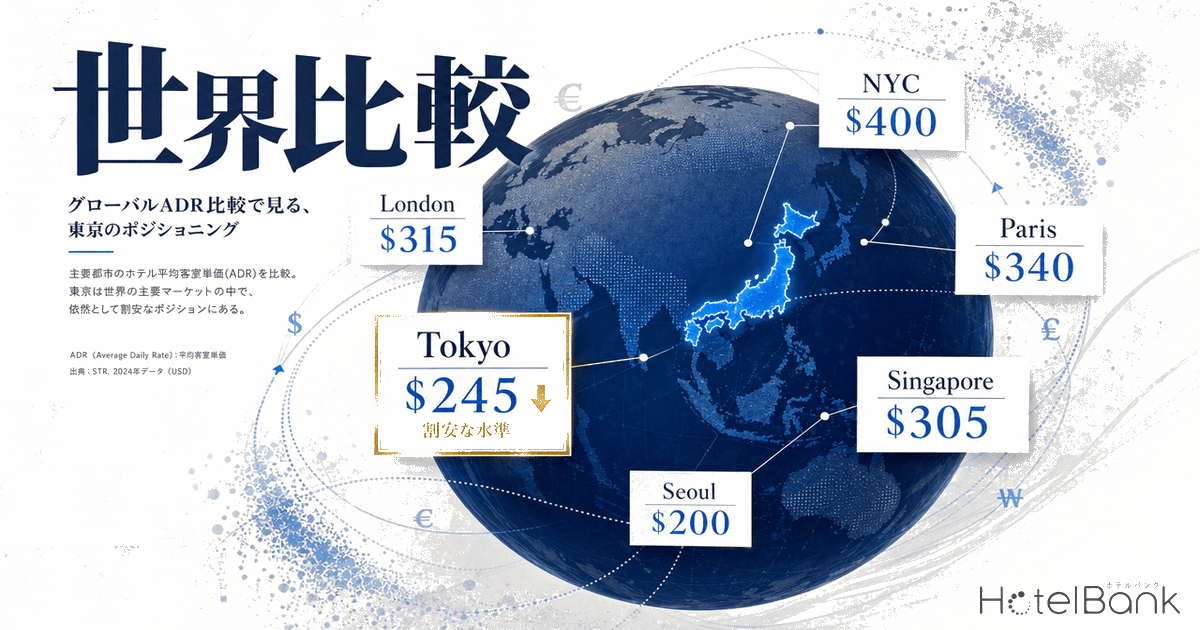
A report published by JLL in December 2025, titled “Japan Hotel Market Update,” noted that the combination of a weak yen and surging construction costs has kept Japanese hotels “underpriced” from a global perspective. This affordability is not merely a currency effect — it represents a structural factor driving the successive entry of international luxury brands into Japan. In this article, MetroEngines Research converts May 2026 ADR data (publicly listed average rates) into US dollars and benchmarks Tokyo, Osaka, and Kyoto against New York, Paris, and London. We also examine resort hotels in Nagano and luxury properties in Kanagawa on a USD basis to quantify where Japan stands relative to global pricing standards.
Metric Definitions Used in This Article
- ADR (Average Daily Rate): The average publicly listed rate on OTAs. This differs from actual transacted prices. Rates are per room for double occupancy (tax included), averaged across all plans (room-only through meal-inclusive).
- USD Conversion: This article uses a base-case rate of 150 yen/dollar based on late April 2026 exchange levels. Sensitivity analysis at 130 yen/dollar and 110 yen/dollar is also provided.
- International City Reference Ranges: Mainstream to upper-midscale range estimates based on JLL, STR, national tourism statistics, and published rates from local hotel booking sites.
- Data Source: MetroEngines Research (tracking approximately 168,000 domestic properties, with approximately 27,000 active OTA-listed properties comprising roughly 1.26 million rooms as the analysis base).
The Reality Behind JLL’s “Underpriced by Global Standards” Assessment
In JLL’s December 2025 Japan Hotel Market Update report, the firm noted that the simultaneous occurrence of yen depreciation and construction cost inflation has limited new hotel supply, while Japanese hotel rates in dollar terms remain below international benchmarks. In JLL’s sentiment survey of 832 hotel operators across 22 countries in the Asia-Pacific region, Japan is projected to see gross operating profit (GOP) grow +4% year-over-year in 2026, positioning it as a growth market alongside Vietnam, India, and South Korea.
Particularly noteworthy is the low “effective price” for inbound visitors. While yen-denominated ADR has continued double-digit growth over the past two years, when converted to US dollars, rates remain largely unchanged from 2019 levels — or in some cases, even lower. This continues to attract inbound demand from mature markets such as New York, Paris, and London.
Let us now use actual May 2026 data compiled by MetroEngines Research to quantify this “affordability gap” in US dollar terms.
USD-Converted ADR for Japan’s 3 Major Cities vs. Global Benchmarks
First, we examine ADR for Japan’s three major cities (Tokyo, Osaka, Kyoto) in May 2026, converted at 150 yen/dollar. Tokyo comes in at approximately ¥37,700 (~$245), Osaka at approximately ¥27,900 (~$186), and Kyoto — driven by strong tourism demand — at ¥45,700 (~$305). Kyoto’s +20.4% year-over-year increase is particularly notable. The factors behind Golden Week ADR surges across major cities, including Kyoto’s +20% and Tokyo’s +17% growth, reflect seasonal demand concentration and structural supply constraints.
| City | May 2026 ADR (JPY) | USD ($150/JPY) | YoY | N (Properties) |
|---|---|---|---|---|
| Tokyo | ¥37,700 | $245 | +14.2% | 1,637 |
| Osaka | ¥27,900 | $186 | +12.5% | 842 |
| Kyoto | ¥45,700 | $305 | +20.4% | 1,510 |
| Fukuoka | ¥31,100 | $208 | +6.4% | 718 |
| Hokkaido | ¥31,400 | $210 | +13.1% | 1,511 |
| Okinawa | ¥28,600 | $191 | +10.9% | 1,697 |
Source: MetroEngines Research, compiled by HotelBank Editorial Team
When placed alongside mainstream hotel ranges in major world cities, the structural gap becomes clear. New York Manhattan commands $350-$450, Paris $300-$380, London $280-$350, and Singapore $280-$330. Tokyo’s $245 falls below even London’s floor. Osaka’s $186 is comparable to Seoul’s central district range of $180-$220 — meaning this megacity sits at pricing levels equivalent to emerging Asian cities.
Source: MetroEngines Research, JLL published data, compiled by HotelBank Editorial Team
Kyoto is the exception at $305, approaching Paris-level pricing — but this reflects extreme seasonal demand concentration during cherry blossom and fresh green seasons, combined with a rapid +20.4% YoY ADR increase. Meanwhile, within Kyoto, deluxe hotels (¥132,400 = ~$883) and resort hotels (¥139,700 = ~$931) are entering world-class territory, indicating growing polarization within the market.
FX Sensitivity Analysis: What If the Yen Strengthens to 130 or 110?
USD-converted ADR is heavily influenced by exchange rates. We modeled what Japanese hotels would look like in USD terms if the yen appreciates to 130/dollar or 110/dollar, keeping yen-denominated ADR fixed at actual May 2026 levels.
| City | 150 JPY/USD | 130 JPY/USD | 110 JPY/USD |
|---|---|---|---|
| Tokyo | $245 | $290 | $343 |
| Osaka | $186 | $215 | $254 |
| Kyoto | $305 | $351 | $415 |
| Nagano (Resort) | $382 | $440 | $520 |
| Kyoto (Deluxe) | $883 | $1,019 | $1,204 |
Source: MetroEngines Research, compiled by HotelBank Editorial Team
This sensitivity analysis reveals that if the yen strengthens to 110/dollar, Tokyo would reach $343 — matching London’s mid-range ($280-$350) — while Kyoto would hit $415, exceeding Paris’s upper bound. In other words, a significant portion of the current “affordability” is amplified by yen weakness. Conversely, if exchange rates remain at current levels while yen-denominated ADR continues rising, a scenario where the gap with global benchmarks structurally narrows becomes increasingly plausible.
Source: MetroEngines Research, compiled by HotelBank Editorial Team
Luxury Segment: Where Do Nagano and Kanagawa Sit Globally?
Next, we shift focus to regional comparisons in the luxury segment. According to MetroEngines Research, resort hotel ADR in Nagano as of May 2026 is ¥57,200 (N=102), while Kanagawa resort hotels stand at ¥54,800 (N=49). At 150 yen/dollar, these translate to $382 and $365 respectively — still 20-30% below New York Manhattan’s upper tier ($450+) and London luxury hotels ($500-$700 range).
However, the luxury segment spans a wide range. Within Nagano, the “Other” category (including ultra-premium villas in the Karuizawa area) reaches ¥178,500 = ~$1,190, approaching the top class in Paris and London. In Kanagawa, auberges in the Hakone and Miura areas (¥89,100 = ~$594) and deluxe hotels (¥69,600 = ~$464) in the upper tier are reaching world-class territory.
| Area / Category | ADR (JPY) | USD ($150/JPY) | N | Global Comparison |
|---|---|---|---|---|
| Kyoto – Deluxe | ¥132,400 | $883 | 34 | On par with Paris/NY upper tier |
| Kyoto – Resort | ¥139,700 | $931 | 13 | World top class |
| Tokyo – Deluxe | ¥86,900 | $579 | 52 | London mid-tier |
| Nagano – Resort | ¥57,200 | $382 | 102 | 80% of NY upper tier |
| Kanagawa – Resort | ¥54,800 | $365 | 49 | Paris mid-tier |
| Kanagawa – Deluxe | ¥69,600 | $464 | 10 | NY upper tier |
Source: MetroEngines Research, compiled by HotelBank Editorial Team
In summary, within the luxury segment, “urban-type” properties (Kyoto Deluxe, Tokyo Deluxe) are catching up to global standards, while “resort-type” properties (Nagano, Kanagawa) still lag by 20-30%. This gap is precisely one of the reasons international luxury brands are investing more aggressively in the resort market.
Source: MetroEngines Research, compiled by HotelBank Editorial Team
The Affordability Gap Is Triggering a Foreign Hotel Brand Rush
The USD-based affordability gap is not merely a paper calculation — it is manifesting as real investment activity. A prime example is Hilton’s “13 new Japan openings” plan. Hilton currently operates 33 properties across 9 brands in Japan, and in early 2026 formally announced plans for 13 additional openings.
Specifically, starting with the December 2025 opening of The Green Leaf Niseko Village, a Tapestry Collection by Hilton in Niseko, upcoming properties include Conrad Nagoya (170 rooms, July 2026), Hilton Takayama Resort (2026), Hilton Garden Inn Yokohama Minato Mirai (2026), Canopy by Hilton Okinawa Miyakojima Resort (2026), Conrad Yokohama (2027), Waldorf Astoria Tokyo Nihonbashi (2027), Canopy by Hilton Tokyo Akasaka (2028), and LXR Hotels & Resorts Hatsukaichi, Hiroshima (2028) — a multi-layered deployment spanning luxury to lifestyle segments.
Similarly, Mandarin Oriental is planning two Seto Inland Sea properties in Takamatsu (92 rooms) and Naoshima (22 rooms), with island-based expansion toward 2030 also under consideration. Raffles is also preparing its Japan debut, accelerating moves to fill blank spots in the luxury resort landscape.
| Brand / Property | Opening | Area | Rooms |
|---|---|---|---|
| The Green Leaf Niseko Village (Tapestry) | Dec 2025 | Hokkaido, Niseko | 200 |
| Conrad Nagoya | Jul 2026 | Aichi, Nagoya Sakae | 170 |
| Hilton Takayama Resort | 2026 | Gifu, Takayama | TBD |
| Canopy by Hilton Okinawa Miyakojima | 2026 | Okinawa, Miyakojima | TBD |
| Conrad Yokohama | 2027 | Kanagawa, Yokohama | TBD |
| Waldorf Astoria Tokyo Nihonbashi | 2027 | Tokyo, Nihonbashi | TBD |
| Mandarin Oriental Takamatsu | TBD | Kagawa, Takamatsu | 92 |
| Mandarin Oriental Naoshima | TBD | Kagawa, Naoshima | 22 |
Source: Company press releases, compiled by HotelBank Editorial Team
All of these new projects are predicated on the assumption that USD-based affordability will persist over the long term. If yen-denominated ADR catches up rapidly, the effect will likely first materialize in the resort luxury segment — where the gap with global standards is largest. In other words, upward pricing pressure bringing Nagano/Kanagawa-class rates toward global benchmarks is expected to become observable over the next several years.
Conclusion: The Affordability Gap Signals Structural Change Ahead
To summarize: First, as of May 2026, ADR levels of Tokyo $245, Osaka $186, and Kyoto $305 remain in underpriced territory compared to New York, Paris, and London. Second, if the yen strengthens to 110/dollar, Tokyo and Kyoto would approach London and Paris mid-to-upper tiers respectively, indicating that the current affordability is largely currency-driven. Third, within the luxury segment, Kyoto Deluxe and Kyoto Resort have reached global standards, while Nagano and Kanagawa resorts remain 20-30% cheaper — and this is precisely where foreign brand investment is concentrating.
Hilton’s 13-property expansion, Conrad Nagoya, and Mandarin Oriental’s Seto Inland Sea plans are all investments premised on continued USD-based affordability and sustained inbound demand. Going forward, if either the yen reverses course or yen-denominated ADR continues rising, Japanese hotel pricing could rapidly “normalize” in global comparison terms. We recommend that industry stakeholders factor in USD-based ranges — not just yen-based pricing — when formulating their pricing strategies.
Note on Forward-Looking ADR: The ADR figures in this article represent average publicly listed rates on OTAs at the time of research. Prices fluctuate as check-in dates approach — currently high rates may decrease closer to the date. Exchange rates also fluctuate daily, so USD-converted values should be considered reference points as of late April 2026.
Related Resources
- Japan Hotel Market Update: Underpriced by Global Standards (JLL) — Travel Voice
- Hilton Plans 13 New Openings in Japan — Travel Voice