

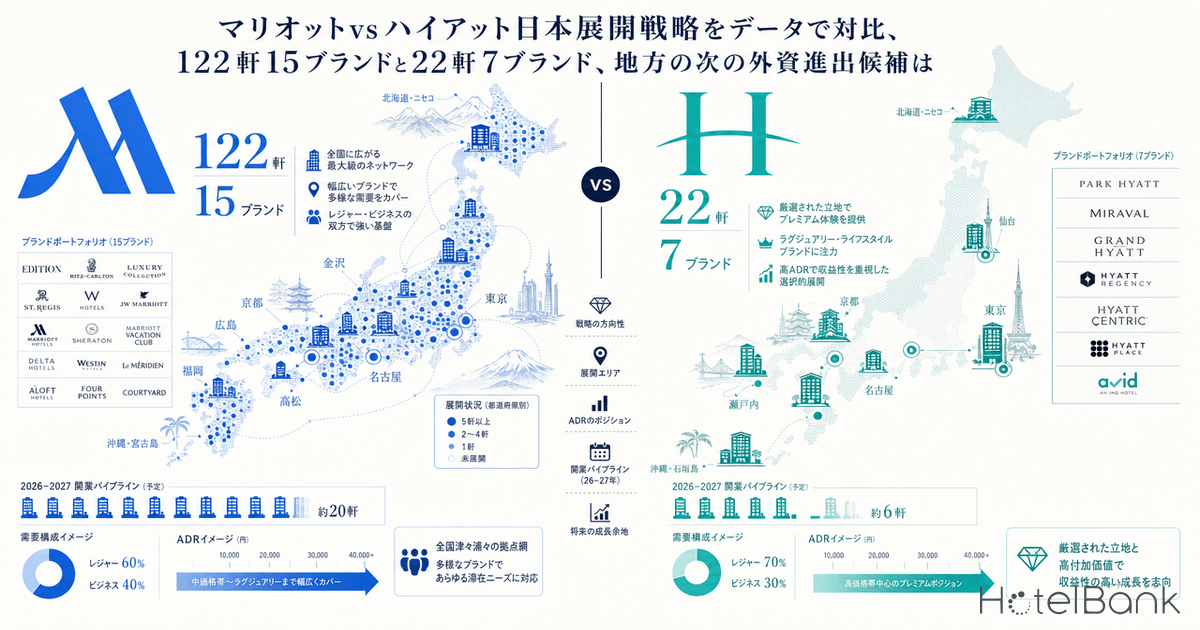
The July 2026 opening of Conrad Nagoya, marking the full-scale entry of Hilton’s flagship brand into a regional government-designated city outside Tokyo, Osaka, and Kyoto, has drawn industry attention. Meanwhile, the two foreign hotel-chain titans, Marriott International and Hyatt Hotels Corporation, are pursuing entirely different strategies in the Japanese market. Marriott blankets the country down to regional resort destinations with an overwhelming 122 properties under 15 brands, while Hyatt — far smaller in count at 22 properties under 7 brands — pursues a “rate-focused” selective strategy that actually beats Marriott on average daily rate (ADR) in some segments.
In this article, drawing on publicly available pricing data from MetroEngines Research, we compare brand-level ADR distributions, prefecture-level deployment density, and the 2026-2027 opening pipelines of the two chains. We close with a data-driven view on the most likely “next regional luxury hotspots” the data points to.
A 5.5x Scale Gap, Yet Contrasting “Blanket” vs “Pinpoint” Strategies
Let us begin with the headline numbers. Within the scope tracked by MetroEngines Research, the two chains’ currently operating property counts, prefectures of presence, and total room counts are as follows.
| Metric | Marriott | Hyatt | Gap |
|---|---|---|---|
| Operating properties | 122 | 22 | 5.5x |
| Number of brands | 15 | 7 | 2.1x |
| Prefectures with presence | 31 | 10 | 3.1x |
| Largest brand by count | Fairfield (33 properties) | Hyatt Regency (8 properties) | — |
| Segment range | Select-service to Luxury | Upper-midscale to Luxury | — |
Source: Compiled by HotelBank Editorial Team based on MetroEngines Research (as of April 2026)
Of Marriott’s 122 properties, the largest single brand is Fairfield by Marriott at 33 properties — a regional resort format developed jointly with Sekisui House since 2020 under the “Trip Base” project, located alongside roadside stations across rural Japan. Next come Sheraton (30 properties), Courtyard (10), Westin (9), Ritz-Carlton (7), and Moxy (4). Hyatt, by contrast, is composed of Hyatt Regency (8 properties), Hyatt House (4), and Park Hyatt (3) — and notably has chosen not to deploy any select-service equivalent to Fairfield or Moxy in Japan.
In short, the contrast can be summed up as “Marriott covers by area, Hyatt picks individual points.” Marriott uses Fairfield, its regional roadside-format brand, to penetrate small cities and hot-spring resort towns nationwide. Hyatt, meanwhile, restricts itself to prime urban locations and keeps its brand portfolio narrow, holding average rates higher.
Brand-Level ADR Distribution: The Peak Belongs to Park Hyatt, Not Marriott
Next, we compare the two chains’ brand-level ADRs (April 2026, per-room rate for double occupancy, tax inclusive).
Source: Compiled by HotelBank Editorial Team based on MetroEngines Research
The result is striking. The highest ADR is held neither by Marriott’s EDITION (¥243,600, N=2) nor by Ritz-Carlton (¥213,200, N=7), but by Hyatt’s Park Hyatt at ¥315,700 (N=3). Hyatt’s Andaz also matches Ritz-Carlton at ¥213,100 (N=1), and Grand Hyatt holds ¥167,500 (N=2), comfortably in the high-end range.
In other words, the average ADR of Hyatt’s six luxury-tier properties is ¥211,500, while Marriott’s twelve luxury-tier properties average ¥195,900. Despite operating less than half the count, Hyatt holds a roughly 8% premium at the top tier. In the upper-midscale segment — the volume zone — Marriott’s 74 properties average ¥48,100 versus Hyatt’s three properties (Hyatt Place, Hyatt House) at ¥64,000, again about 33% higher for Hyatt.
Source: Compiled by HotelBank Editorial Team based on MetroEngines Research
The clearest divergence appears at the bottom of the brand pyramid. Marriott has Fairfield at ¥17,100 (N=31) and Moxy at ¥30,000 (N=4) in the mid-priced and economy bands, and these brands form the foundation that supports its 122-property scale. Hyatt has no equivalent segment — its lowest tier stops at Hyatt House (¥58,500).
This suggests Hyatt is intentionally choosing not to bring its lower-tier brands into Japan. CEO Mark Hoplamazian explained at the early-2026 earnings call that Hyatt’s global pipeline of 148,000 rooms is “luxury and lifestyle-focused,” and the same posture appears to apply to Japan.
City-Level ADR: Hyatt 20% Below Marriott in Kyoto, 20% Above in Tokyo
Next, placing the two chains’ city-level ADRs side by side reveals that their relative position shifts substantially by location.

Source: Compiled by HotelBank Editorial Team based on MetroEngines Research
Source: Compiled by HotelBank Editorial Team based on MetroEngines Research
| Prefecture | Marriott ADR | Marriott Count | Hyatt ADR | Hyatt Count | Price Gap |
|---|---|---|---|---|---|
| Tokyo | ¥147,700 | 16 | ¥172,400 | 7 | +17% |
| Kyoto | ¥128,000 | 9 | ¥109,100 | 3 | −15% |
| Osaka | ¥65,700 | 16 | — | 0 | — |
| Okinawa | ¥157,400 | 1 | ¥122,900 | 2 | −22% |
| Fukuoka | ¥102,400 | 3 | ¥107,500 | 1 | +5% |
| Kanagawa | ¥66,900 | 3 | ¥50,600 | 2 | −24% |
| Hokkaido | ¥25,800 | 9 | ¥93,600 | 1 | +263% |
Source: Compiled by HotelBank Editorial Team based on MetroEngines Research (April 2026, N=22,580 samples)
In Tokyo, Hyatt’s seven properties average roughly 17% higher than Marriott’s 16. This reflects a structural difference: on the Hyatt side, the ultra-premium brands Park Hyatt Tokyo (Shinjuku), Andaz Tokyo (Toranomon), and Grand Hyatt Tokyo (Roppongi) are concentrated, while Marriott’s Tokyo presence mixes mid-tier brands such as Courtyard and AC Hotels.
Conversely, in Kyoto, Okinawa, and Kanagawa (Yokohama and Hakone), Marriott runs ahead of Hyatt. In Kyoto, the JW Marriott Hotel Nara (in neighboring Nara, but within the Kyoto catchment) and Ritz-Carlton Kyoto pull the average up; in Okinawa, Okinawa Marriott Resort & Spa and other resort brands deliver higher rates than Hyatt’s two properties.
In Hokkaido, Marriott’s nine properties (Fairfield, Courtyard, etc.) average just ¥25,800, while Hyatt’s standalone presence — Hyatt Regency Ishigaki — clocks in at ¥93,600. This is perhaps the sharpest illustration of the strategic divide: “Marriott takes the regions by volume; Hyatt takes them by pinpoint placement at premium rates.”
Deployment Density Map: Hyatt’s Vast Whitespace of 37 Empty Prefectures
Counting properties at the prefecture level, the difference in deployment density between the two chains is dramatic. Marriott covers 31 of Japan’s 47 prefectures, while Hyatt is present in only 10.
Source: Compiled by HotelBank Editorial Team based on MetroEngines Research (as of April 2026)
Hyatt’s 10-prefecture footprint comprises Tokyo (7 properties), Hokkaido (3), Kyoto (3), Fukuoka (2), Okinawa (2), Kanagawa (2), Ishikawa (2), and Chiba (1). Notably, Hyatt currently has no operating property in Osaka — the former Hyatt Regency Osaka exited the market at the end of December 2024.
Marriott, by contrast, reaches Miyagi, Iwate, and Yamagata in Tohoku; Okayama and Hiroshima in Chugoku-Shikoku; and Kumamoto, Kagoshima, Miyazaki, Saga, and Nagasaki in southern Kyushu. This broad distribution is largely driven by Fairfield’s 33 properties, many of which are located in small cities and hot-spring resort areas with populations under 200,000.
Among Hyatt’s “37 blank prefectures,” several stand out as candidates where the underlying conditions for foreign luxury entry — population, inbound tourism flow, and prevailing hotel rate levels — appear to be aligning. We turn to those candidates next.
2026-2027 Pipeline: “Osaka, Sapporo, Hiroshima” Are the Shared Focus Cities
Looking at publicly disclosed opening pipelines, the 2026-2027 deployments of both chains reveal clear focus areas.

Source: Compiled by HotelBank Editorial Team based on MetroEngines Inc. data
| Opening | Property | Location | Rooms | Brand Tier |
|---|---|---|---|---|
| Marriott | ||||
| April 2026 | Sugata Hotel Osaka Shinsaibashi (Series by Marriott) | Osaka | 256 | Upper-midscale (Japan first) |
| May 2026 | Hamamatsu Marriott Hotel | Shizuoka | 236 | Upper-midscale |
| June 2026 | Courtyard by Marriott Kobe | Hyogo | — | Upper-midscale |
| August 2026 | Courtyard by Marriott Shin-Yokohama Station | Kanagawa | — | Upper-midscale |
| Autumn 2026 | HOTEL THE MITSUI HAKONE (Luxury Collection) | Kanagawa | — | Luxury |
| Within 2026 | Osaka Marriott Hotel Bayside Tower | Osaka | 829 | Upper-midscale |
| Within 2026 | City Express by Marriott Osaka Namba South / Shin-Imamiya | Osaka | — | Select-service (Asia first) |
| Q1 2027 | Hiroshima Marriott Hotel | Hiroshima | 183 | Upper-midscale |
| Q1 2027 | Kokura (Kitakyushu) Marriott-affiliated | Fukuoka | 90 | — |
| Hyatt | ||||
| June 2026 | Hyatt Centric Sapporo | Hokkaido | 216 | Premium |
| Within 2027 | Andaz Hiroshima | Hiroshima | 235 | Luxury (Hiroshima’s first foreign luxury) |
| Scheduled 2029 | Park Hyatt Sapporo (Odori Park) | Hokkaido | — | Luxury |
Source: Compiled by HotelBank Editorial Team from Marriott International, Hyatt Hotels Corporation, NTT Urban Development IR materials and press releases
Marriott alone is set to bring on seven properties in 2026, totaling roughly 1,500 rooms. Two of these — “Series by Marriott” and “City Express by Marriott” — will be making their Asia/Japan debuts simultaneously in Osaka. Riding the demand wave from the 2025 Osaka-Kansai Expo, this looks like a deliberate move to claim share in the mid-priced segment where rival Hilton lacks comparable brands like True Hotels or Motto.
Hyatt, on the other hand, is rolling out only three Japan properties between 2026 and 2029 — far fewer in number, but every one is positioned at “Regency tier or above.” Hyatt Centric Sapporo (Premium), Andaz Hiroshima (Luxury), and Park Hyatt Sapporo (top-tier Luxury) signal a clear concentration on the upper-end brands. Andaz Hiroshima will be both Hyatt’s first property in Hiroshima Prefecture and the first foreign luxury hotel in the prefecture, making it a landmark for regional luxury entry in 2027.
Investment Implications: Where Comes Next After Conrad Nagoya?
With Conrad Nagoya opening in July 2026 and Andaz Hiroshima in 2027, we look at which regional cities are most likely to host the next foreign-luxury entry, applying three quantitative criteria.
| Criterion | Indicator |
|---|---|
| (1) Demand foundation | Prefecture-wide ADR of ¥30,000 or above, meaningful share of foreign overnight stays, presence of redevelopment plans |
| (2) Foreign-brand whitespace | Hyatt currently absent; Ritz-Carlton, Conrad, Four Seasons and other luxury brands also unopened |
| (3) City function | International convention venues, large-scale retail, international airport access (within 90 minutes) |
Key indicators for the candidate areas are as follows.
Source: Compiled by HotelBank Editorial Team based on MetroEngines Research (April 2026, regional prefecture ADRs)
| Candidate Area | Prefecture ADR | Marriott | Hyatt | Likelihood |
|---|---|---|---|---|
| Shizuoka (Hamamatsu/Izu) | ¥42,800 | Izu Shuzenji, Hamamatsu (May 2026) | Absent | Medium (resort-format) |
| Nagano (Karuizawa/Matsumoto) | ¥40,900 | Karuizawa, Hakuba | Absent | High (resort-luxury) |
| Ishikawa (Kanazawa) | ¥39,300 | Absent | 2 existing (Hyatt Centric, etc.) | High (Marriott whitespace) |
| Hiroshima | ¥33,100 | 2027 Hiroshima Marriott planned | 2027 Andaz planned | Confirmed |
| Okayama | ¥32,700 | Hiruzen, Tsuyama (Fairfield) | Absent | Low |
| Kumamoto (Aso) | ¥31,400 | Aso (Fairfield) | Absent | Low to medium (resort-format only) |
Source: Compiled by HotelBank Editorial Team based on MetroEngines Research
The data points most clearly to two next-wave candidates: Nagano Prefecture (resort-luxury around Karuizawa) and Kanazawa in Ishikawa Prefecture (Marriott whitespace). Nagano’s prefecture-wide ADR of ¥40,900 ranks second among regional prefectures. Karuizawa Marriott Hotel already exists, but no property at the Ritz-Carlton or JW Marriott level has yet opened. Combined with 70-minute Shinkansen access from Tokyo and an established affluent-customer base anchored by legacy resorts like Karuizawa Prince Hotel, a “Karuizawa Ritz-Carlton Reserve”-type luxury resort would be a plausible next step.
Kanazawa already hosts Hyatt Centric Kanazawa and Hyatt House Kanazawa, but Marriott’s luxury brands (such as Ritz-Carlton Kanazawa) remain absent. Since the 2024 extension of the Hokuriku Shinkansen to Tsuruga improved access from the Kansai region, and given the redevelopment plans around Omicho Market and Kenrokuen, full-scale luxury entry in this area looks plausible from 2028 onward.
By contrast, Okayama, Kumamoto, and Miyagi (Sendai) — all government-designated regional cities — have ADR levels around ¥30,000, which remains a tough threshold for sustaining a luxury hotel’s economics. For these areas, upper-midscale to premium-tier entries such as Courtyard or Hyatt Centric appear more realistic.
Conclusion: Marriott’s Scale, Hyatt’s Selectivity
Marriott pursues a sweeping “blanket strategy” — 122 properties, 15 brands, 31 prefectures — using Fairfield, its regional roadside-format brand, to channel its loyalty members into regional markets where foreign hotel brands are otherwise absent. Hyatt, by contrast, sticks to a “pinpoint strategy” of 22 properties, 7 brands, and 10 prefectures, deploying only its top-tier brands — Park Hyatt, Andaz, Grand Hyatt — at the best metropolitan addresses, which lifts its average luxury-tier ADR above Marriott’s.
The 2026-2029 pipelines reinforce this divide. Marriott keeps expanding the lower and middle tiers with new brands like Series and City Express, while Hyatt drives a tightly focused luxury push with Andaz Hiroshima and Park Hyatt Sapporo. The two strategies look unlikely to converge any time soon — each will continue to deepen its chosen market position.
For the next regional luxury entry candidates, the data identifies Karuizawa (Nagano) and Kanazawa (Ishikawa) as the most promising areas, given their ADR levels, demand fundamentals, and existing hotel mix. Following Conrad Nagoya (2026) and Andaz Hiroshima (2027), the third wave of regional foreign-luxury openings could well begin in these resort and regional cities.
Appendix: Who “Owns” These Hotels — The Ownership Structure of Foreign-Branded Hotels in Japan
Both Marriott and Hyatt only operate hotels in Japan; ownership of the underlying real estate is primarily held by Japanese companies under management contracts. In other words, the brand on the marquee is foreign, but the risk and return on the building and land sit with Japanese real-estate developers and REITs. Understanding this ownership structure clarifies why certain brands tend to cluster in certain areas.
Owners of major Hyatt properties:
| Property | Owner | Owner Type |
|---|---|---|
| Park Hyatt Tokyo | Tokyo Gas Urban Development | Operating company (Shinjuku Park Tower) |
| Grand Hyatt Tokyo | Mori Building | Developer (Roppongi Hills) |
| Andaz Tokyo | Mori Building | Developer (Toranomon Hills) |
| Hyatt Regency Tokyo | Odakyu Electric Railway | Railway / real estate |
| Hyatt Regency Kyoto | Sekisui House | Developer |
| Hyatt Regency Naha / Seragaki | Tokyo Tatemono | Developer |
| Hyatt Regency Yokohama | Ken Corporation | Real estate |
| Hyatt House Kanazawa | Tokyo Tatemono | Developer |
| Park Hyatt Niseko | PCPD (Hong Kong-based developer) | Foreign developer |
Owners of major Marriott properties:
| Property | Owner | Owner Type |
|---|---|---|
| The Ritz-Carlton, Tokyo | Mitsui Fudosan | Developer (Tokyo Midtown) |
| The Ritz-Carlton Kyoto | Sekisui House | Developer |
| The Ritz-Carlton Nikko | Tobu Railway | Railway / real estate |
| The Ritz-Carlton Okinawa | Mori Trust | Developer / REIT |
| The Ritz-Carlton Fukuoka | Sekisui House | Developer (Daimyo Garden City) |
| The Tokyo EDITION, Toranomon | Mori Building | Developer (Toranomon-Azabudai PJ) |
| JW Marriott Hotel Nara | Mori Trust | Developer |
| The St. Regis Osaka | Sekisui House | Developer |
| W Osaka | Sekisui House | Developer |
| The Westin Tokyo | Sapporo Real Estate | Operating company (Yebisu Garden Place) |
| Sheraton Miyako Hotel Tokyo | Kintetsu Group | Railway / real estate (owner-operator) |
| Fairfield (33 properties) | Sekisui House | Developer (Trip Base project) |
Holdings by owner:
| Owner | Properties | Brand Examples |
|---|---|---|
| Sekisui House | 40+ (incl. 33 Fairfield) | Ritz-Carlton Kyoto/Fukuoka, St. Regis Osaka, W Osaka, Hyatt Regency Kyoto, Fairfield nationwide |
| Mori Building | 3 | Grand Hyatt Tokyo, Andaz Tokyo, EDITION Toranomon |
| Tokyo Tatemono | 3 | Hyatt Regency Naha, Seragaki, Hyatt House Kanazawa |
| Mori Trust | 2 | Ritz-Carlton Okinawa, JW Marriott Nara |
| Mitsui Fudosan | 2 | Ritz-Carlton Tokyo, Courtyard Tokyo Station |
Sekisui House stands out by a wide margin. In addition to its 33 Fairfield “Trip Base” properties, the company owns Ritz-Carlton Kyoto and Fukuoka, St. Regis Osaka, W Osaka, and Hyatt Regency Kyoto — making it Japan’s largest single owner of foreign-branded hotels across both Marriott and Hyatt luxury portfolios. Mori Building, by contrast, concentrates two Hyatt-affiliated and one Marriott-affiliated property within its own development zones in Toranomon and Roppongi, executing a distinctive “urban development × hotel brand” strategy.
Source: Compiled by HotelBank Editorial Team from each company’s IR materials, securities reports, and press coverage (as of April 2026). Ownership may shift through inter-REIT transactions.
Data Sources & References
| Data Source | Description | Reference URL |
|---|---|---|
| MetroEngines Research | OTA published-price data (ADR, property counts, brand classification). Per-room rate for double occupancy (tax inclusive), all-plan average. | — |
| Hyatt Q4 2025 earnings | 148,000-room pipeline, luxury & lifestyle-focused strategy (CEO Mark Hoplamazian) | Hyatt official / Hotel Management |
| Sekisui House Trip Base | Fairfield by Marriott michi-no-eki (roadside-station) project | Trip Base official / Fairfield official |
| Hyatt Centric Sapporo | 216 rooms, slated for autumn 2026 opening | Hyatt official / Monthly Hoteres |
| Conrad Nagoya | 170 rooms, scheduled to open July 31, 2026 | Hilton PR TIMES |
| Park Hyatt Niseko | Developed by PCPD (Pacific Century Premium Developments) | PCPD official / Developer info |
| Ritz-Carlton Kyoto | Developed and owned by Sekisui House | Sekisui House case study |
| Ritz-Carlton Fukuoka | Located within Daimyo Garden City; developed by Sekisui House et al. | Sekisui House official / Marriott PR TIMES |
| W Osaka | Developed and owned by Sekisui House; design supervised by Tadao Ando | Sekisui House case study |
| Grand Hyatt Tokyo | Roppongi Hills, operated by Mori Building Hospitality Corporation | Roppongi Hills official |
| Marriott International | Japan official site / news releases | Japan official / Newsroom |
| Hyatt Hotels | Japan official site / Newsroom | Japan official / Newsroom |
| Japan Tourism Agency | Lodging Travel Statistical Survey | mlit.go.jp |
Note: ADRs in this article are averages of publicly listed prices on OTAs and may differ from actual transacted prices. Ownership information is based on each company’s IR materials, securities reports, and media coverage, and may shift through inter-REIT transactions. Data as of April 2026.