

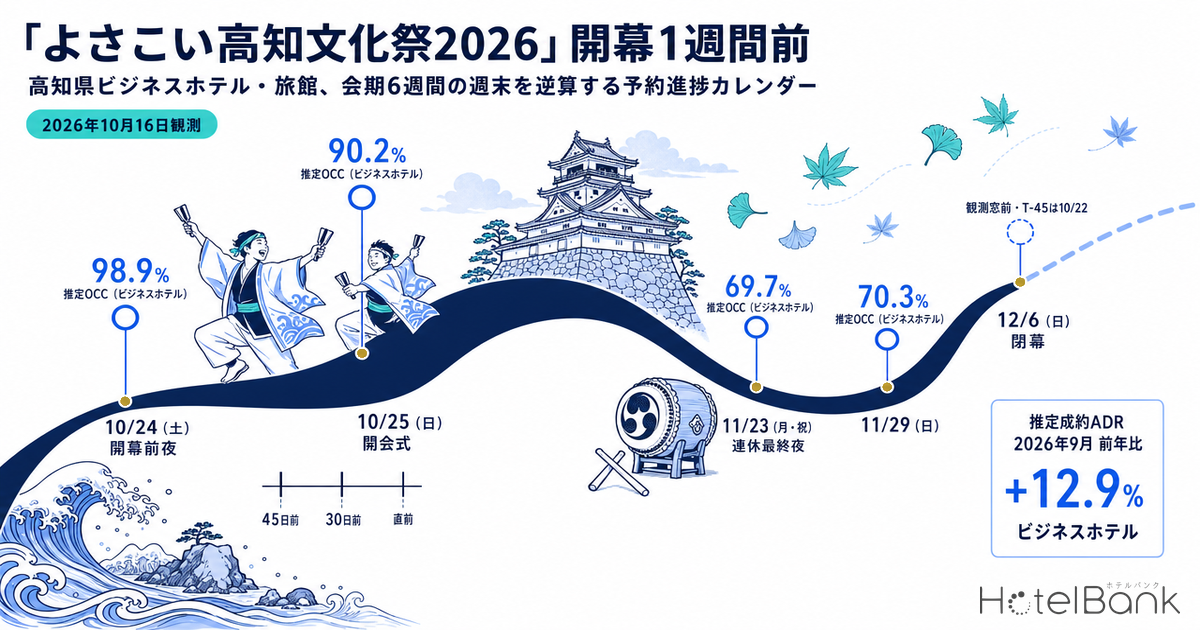
The 41st National Cultural Festival and 26th National Arts and Culture Festival for Persons with Disabilities, branded “Yosakoi Kochi Bunkasai 2026,” opens on Sunday, October 25, 2026, and runs genre-specific festivals across Kochi Prefecture for 43 days through Sunday, December 6. As of October 16, one week before the opening, estimated OCC (based on OTA-listed inventory) for Kochi Prefecture business hotels (N=30 properties, 3,112 rooms) had climbed to 98.9% for Saturday, October 24 (the eve of the opening) and 90.2% for Sunday, October 25 (opening ceremony day). Ryokan (N=26 properties, 742 rooms) also topped 90% on both nights, at 94.3% and 92.2%. Across the festival period, every Saturday already stands at 93-99%, while Sundays range from 70% to 92% with a spread of more than 20pt between weeks; the differences show up on Sundays and on the last night of long weekends. This article works backward through the six festival weekends using fixed checkpoints at 45 days out, 30 days out and the latest reading, including the closing weekend (Dec 5-6) that has not yet entered the observation window, and lays out as a calendar what revenue managers should check and when.
Scope: Kochi Prefecture business hotels N=30-31 properties (3,112-3,172 rooms) and ryokan N=26-27 properties (742-759 rooms). The price metric in this article is the estimated settled ADR (the settled price level estimated from OTA and other sales data, tax-excluded equivalent); occupancy is an estimate based on OTA-listed inventory. Both are defined at the end of the article. Data as of: October 17, 2026 (latest observation date October 16).
- — Opening eve Oct 24 (Sat) 98.9%, opening ceremony day Oct 25 (Sun) 90.2% (Kochi Prefecture business hotels, N=30 properties, observed October 16, 2026). Ryokan (N=26 properties) also topped 90% on both nights at 94.3% and 92.2%.
- — Saturdays during the festival currently stand at 93-99%, with sold-out property rates of 58.1-83.9%. Saturdays have moved past “building occupancy” into “deciding how to sell the remaining rooms.”
- — The gaps appear on Sundays and the last night of long weekends. Sundays range from 91.5% on Nov 1 to 70.3% on Nov 29, a spread of more than 20pt, and Nov 23 (Mon, holiday) sits at only 69.7%.
- — The opening-day Sunday uplift is unique to Kochi. Versus the previous Sunday, Kochi rose +4.3pt while Kagawa fell -2.7pt and Ehime -0.3pt (compared at the same days to arrival).
- — Settled September estimated settled ADR is up YoY: business hotels +12.9%, ryokan +19.0%. For a 100-room hotel, adding +5pt on the four weak nights yields roughly ¥215,000 in room revenue at the mid case (estimate).
Where the Opening Weekend Stands — Saturday at 98.9% Is in “Sell-Out Mode,” Sunday Gained 6.7pt Since T-30 to Reach 90.2%
First, let us check the progress of the opening weekend itself against the previous weekend. For Kochi Prefecture business hotels, Saturday, October 24 had already reached 95.4% at 45 days out, rose to 97.4% at 30 days out, and stood at 98.9% on October 16 with 8 days to go, leaving almost no room for further pickup. The sold-out property rate (the share of properties with no listed inventory visible on OTAs and other channels, estimated) was 70.0%, meaning seven in ten of the 30 tracked properties had closed Saturday inventory. Whereas the previous Saturday, October 17, landed at 98.0% after building 9.4pt from 88.6% at T-45, October 24 started 6.8pt higher at T-45, suggesting that demand tied to the festival opening came in early. The same pattern of Kochi event dates already standing high at 45 days out was observed in our Yosakoi Festival 2026 booking progress analysis of the summer main festival, and appears to be a trait common to event dates in Kochi.
By contrast, Sunday, October 25 (opening ceremony day) was flat at 83.5% at both 45 and 30 days out, and only started moving after T-30. It reached 89.8% at 14 days out and 90.2% with 9 days to go, a gain of 6.7pt since T-30. For comparison, the previous Sunday, October 18, went from 71.1% at T-45 to 75.1% at T-30, 80.6% at T-14 and 85.9% with 2 days to go; with 9 days still remaining, October 25 was already 4.3pt above the previous Sunday’s final reading. This is an unusually high level for a Sunday, and it is likely that first-day programs such as the taiko drum festival held in Kochi City on the same day as the opening ceremony and the National Hogaku (Traditional Japanese Music) Ensemble Festival in Kochi on October 24-25 are lifting Sunday stays.
Source: MetroEngines Research; compiled by HotelBank Editorial Team
Booking curves for Kochi Prefecture business hotels (N=30-31 properties, 3,112-3,172 rooms). The horizontal axis is days to arrival (45 to 1); the vertical axis is estimated OCC (based on OTA-listed inventory). For Oct 24 and Oct 25, the October 16 observation is the latest point.
Ryokan show a different shape from business hotels. Saturday, October 24 stayed almost flat, from 93.1% at T-45 to 94.3% at the latest reading, while Sunday, October 25 built more strongly: 84.1% at T-45, 88.7% at T-30, 92.6% at T-14 and 92.2% with 9 days to go. As a result, the Saturday-Sunday gap for ryokan has narrowed to 2.1pt, compared with 8.7pt for business hotels, indicating that opening-day Sunday stays are coming in more heavily at ryokan. The sold-out property rate was 57.7% on Saturday and 50.0% on Sunday: of the 26 tracked properties, just under 60% had closed listed inventory for Saturday and half for Sunday.
A Calendar of the Six Festival Weekends — Every Saturday Is Above 90%; the Gaps Are on Sundays and Long-Weekend Final Nights
This is the core of the article. Because the festival runs from October 25 to December 6 across six weekends, each weekend needs to be tracked at the same checkpoints, not just the opening weekend. The table below lists the weekends through Sunday, November 29 that had entered the observation window (45 days or fewer before arrival) as of October 16.
| Stay date | Days to arrival (as of Oct 16) | Business T-45 | Business T-30 | Business Latest | Business Sold-out rate | Ryokan T-45 | Ryokan Latest | Checkpoint dates |
|---|---|---|---|---|---|---|---|---|
| Oct 24 (Sat) | 8 days | 95.4% | 97.4% | 98.9% | 70.0% | 93.1% | 94.3% | Opening weekend (final stretch) |
| Oct 25 (Sun) | 9 days | 83.5% | 83.5% | 90.2% | 26.7% | 84.1% | 92.2% | Opening weekend (final stretch) |
| Oct 31 (Sat) | 15 days | 87.9% | 95.1% | 98.0% | 73.3% | 85.0% | 96.6% | T-45 Sep 16 / T-30 Oct 1 / T-14 Oct 17 |
| Nov 1 (Sun) | 16 days | 75.9% | 81.5% | 91.5% | 26.7% | 87.2% | 93.5% | T-45 Sep 17 / T-30 Oct 2 / T-14 Oct 18 |
| Nov 3 (Tue) | 18 days | 57.6% | 60.7% | 64.7% | 6.7% | 62.1% | 74.5% | — |
| Nov 7 (Sat) | 22 days | 87.1% | 93.7% | 97.8% | 66.7% | 88.4% | 91.4% | T-45 Sep 23 / T-30 Oct 8 / T-14 Oct 24 |
| Nov 8 (Sun) | 23 days | 69.5% | 75.7% | 79.9% | 13.3% | 75.7% | 80.6% | T-45 Sep 24 / T-30 Oct 9 / T-14 Oct 25 |
| Nov 14 (Sat) | 29 days | 90.0% | 96.7% | 96.6% | 70.0% | 90.0% | 93.1% | T-45 Sep 30 / T-30 Oct 15 / T-14 Oct 31 |
| Nov 15 (Sun) | 30 days | 73.3% | 79.9% | 79.9% | 13.3% | 79.8% | 83.4% | T-45 Oct 1 / T-30 Oct 16 / T-14 Nov 1 |
| Nov 21 (Sat) | 36 days | 96.5% | — | 98.5% | 83.9% | 97.4% | 97.8% | T-45 Oct 7 / T-30 Oct 22 / T-14 Nov 7 |
| Nov 22 (Sun) | 37 days | 87.7% | — | 90.7% | 32.3% | 90.0% | 91.9% | T-45 Oct 8 / T-30 Oct 23 / T-14 Nov 8 |
| Nov 23 (Mon) | 38 days | 66.3% | — | 69.7% | 9.7% | 63.9% | 67.0% | T-45 Oct 9 / T-30 Oct 24 / T-14 Nov 9 |
| Nov 28 (Sat) | 43 days | 91.8% | — | 93.2% | 58.1% | 88.9% | 89.0% | T-45 Oct 14 / T-30 Oct 29 / T-14 Nov 14 |
| Nov 29 (Sun) | 44 days | 70.2% | — | 70.3% | 16.1% | 65.1% | 65.0% | T-45 Oct 15 / T-30 Oct 30 / T-14 Nov 15 |
| Dec 5 (Sat) | Over 45 days | — | — | — | — | — | — | T-45 Oct 21 / T-30 Nov 5 / T-14 Nov 21 |
| Dec 6 (Sun) | Over 45 days | — | — | — | — | — | — | T-45 Oct 22 / T-30 Nov 6 / T-14 Nov 22 |
Estimated OCC (based on OTA-listed inventory). Business hotels N=30-31 properties, 3,112-3,172 rooms; ryokan N=26-27 properties, 742-759 rooms (both fixed cohorts based on listings on major booking sites; the number of properties varies by stay date). “Latest” is the October 16, 2026 observation. The sold-out rate is the share of properties with no listed inventory visible on OTAs and other channels (estimated). Dec 5 and Dec 6 are not shown because they have not yet entered the observation window (45 days or fewer before arrival).
Source: MetroEngines Research; compiled by HotelBank Editorial Team
Reading down the Saturday column: October 31 at 98.0% (15 days to go), November 7 at 97.8% (22 days), November 14 at 96.6% (29 days), November 21 at 98.5% (36 days) and November 28 at 93.2% (43 days) — every Saturday during the festival is already above 90%. What deserves attention is the difference in days remaining. Saturday, November 21 (the first day of the Labor Thanksgiving three-day weekend) started at 96.5% at T-45 (sold-out rate 71.0%), on par with or above the opening-eve October 24 at T-45 (95.4%, 66.7%), and its sold-out rate now stands at 83.9%, suggesting that demand for the first day of the three-day weekend is coming in heavily, separate from the festival. Conversely, Saturday, November 28, at 91.8% at T-45 and 93.2% now, is the Saturday during the festival with relatively the most room left for pickup.
The Sunday column, by contrast, varies widely. November 1 (91.5%) and November 22 (90.7%) are above 90%, while November 8 and November 15 sit at 79.9% and November 29 at 70.3%. Sunday, November 1 went from 75.9% at T-45 to 81.5% at T-30 and 91.5% with 16 days to go, building 10.0pt after T-30; two-day programs such as “Mansai 23rd – Kochi Manga Festival 2026” (October 31 – November 1) at the Kochi City Culture Plaza CUL-PORT on the same weekend appear to be supporting Sunday stays. Sunday, November 22 is the middle day of a three-day weekend, so the holiday calendar plays a large role there (see also our Nov 21-23 foliage long weekend booking progress, which compares the same three-day weekend using remaining-room rates in five autumn-foliage prefectures including Kyoto and Nagano). The Sundays of November 8 and November 15, on the other hand, have not reached 80% despite gaining +10.4pt and +6.6pt respectively since T-45, and are low even against the September Sunday average for Kochi Prefecture business hotels (84.5%, N=30-33 properties). That said, a choral festival is also held at the Kochi City Culture Plaza CUL-PORT on Sunday, November 8, so it is reasonable to assume that the spillover into Sunday stays depends not only on whether a program is held but on its scale and where its attendees live. The picture the data paints so far is that even during the festival, Sunday demand depends on each week’s program lineup.
Source: MetroEngines Research; compiled by HotelBank Editorial Team
Estimated OCC for weekends and holidays during the festival (based on OTA-listed inventory; latest point observed October 16, 2026). Business hotels N=30-31 properties, 3,112-3,172 rooms; ryokan N=26-27 properties, 742-759 rooms. Days to arrival differ by stay date (Oct 24 = 8 days to Nov 29 = 44 days), so comparisons of progress at the same point in time must be read together with days to arrival.
The last night of long weekends and standalone holidays need separate treatment. November 23 (Mon, holiday) is at 69.7% for business hotels and 67.0% for ryokan, and November 3 (Tue, holiday) at 64.7% and 74.5% — both more than 20pt below the Saturday of the same weekend. A shape of 98.5% on the first day and 90.7% on the middle day of a three-day weekend versus 69.7% on the final night is a situation where designing multi-night stays to build the final night works best for properties that closed the first and middle days early, and it is the central issue of the action plan below. The pattern of only the final night of a long weekend staying open across the market also appeared in the Hokkaido October three-day weekend, where the sold-out property rate on the holiday itself stayed around 2%, so it is not a phenomenon limited to Kochi.
Weekdays are worth a mention as well. Right after the opening, Monday, October 26 and Wednesday, October 28 stood at 85.5% and 85.1% with 10-12 days to go, already matching the September Wednesday average of 85.4% for Kochi Prefecture business hotels. Wednesday, November 4 (71.6%, 19 days to go), Wednesday, November 11 (77.7%, 26 days) and Wednesday, November 18 (73.4%, 33 days) cannot be compared directly because of the longer lead times, but the festival’s genre-specific events are also scheduled on weekdays, so weekly checks of weekday progress matter more during the festival than in a normal month.
Comparing with Neighboring Shikoku Prefectures — Only Kochi Gets Its Opening-Day Sunday Above 90%
To check whether Kochi’s high Sunday is due to the festival, we lined up business hotels for the same stay dates in Kagawa and Ehime, two other Shikoku prefectures (Table 2). From the previous Sunday, October 18, to the opening ceremony Sunday, October 25, Kochi rose +4.3pt from 85.9% to 90.2%, while Kagawa fell from 71.6% to 68.9% (-2.7pt) and Ehime was essentially flat from 74.4% to 74.1% (-0.3pt). The T-45 starting points for October 25 were also far apart: 83.5% for Kochi versus 44.2% for Kagawa and 63.9% for Ehime. Days to arrival are identical across the three prefectures, so the opening-day Sunday uplift can be read as specific to Kochi.
On the other hand, the final night of the Labor Thanksgiving three-day weekend, November 23 (Mon, holiday), drops sharply from the same weekend’s Saturday in all three prefectures: Kochi 69.7%, Kagawa 46.8%, Ehime 57.5%. The final-night trough is a holiday-calendar shape common across Shikoku, and Kochi is in fact the highest of the three. For ryokan, Sunday, October 25 is at 93.6% in Ehime (N=50 properties, 1,415 rooms), level with Kochi’s 92.2%, so strong Sunday ryokan demand cannot be called a feature unique to Kochi within the Shikoku ryokan market.
| Stay date | Kochi T-45 | Kochi Latest | Kagawa T-45 | Kagawa Latest | Ehime T-45 | Ehime Latest |
|---|---|---|---|---|---|---|
| Oct 18 (Sun, prior week) | 71.1% | 85.9% | 58.2% | 71.6% | 55.1% | 74.4% |
| Oct 24 (Sat) | 95.4% | 98.9% | 57.7% | 83.1% | 84.1% | 93.9% |
| Oct 25 (Sun, opening ceremony) | 83.5% | 90.2% | 44.2% | 68.9% | 63.9% | 74.1% |
| Nov 1 (Sun) | 75.9% | 91.5% | 46.5% | 65.1% | 57.0% | 69.2% |
| Nov 21 (Sat) | 96.5% | 98.5% | 90.8% | 96.8% | 88.9% | 94.2% |
| Nov 22 (Sun) | 87.7% | 90.7% | 83.9% | 84.7% | 74.8% | 80.1% |
| Nov 23 (Mon, holiday) | 66.3% | 69.7% | 45.4% | 46.8% | 56.4% | 57.5% |
Estimated OCC (based on OTA-listed inventory). Fixed cohorts of business hotels: Kochi Prefecture N=30-31 properties, 3,112-3,172 rooms; Kagawa Prefecture N=40 properties, 2,963 rooms; Ehime Prefecture N=52-53 properties, 5,806-5,816 rooms (the number of properties varies by stay date). “Latest” is the October 16, 2026 observation; days to arrival are the same for all three prefectures (Oct 18: 2 days, Oct 25: 9 days, Nov 23: 38 days).
Source: MetroEngines Research; compiled by HotelBank Editorial Team
Price Context — Settled September Estimated Settled ADR Is Up +12.9% YoY (Business Hotels) and +19.0% (Ryokan)
Placing occupancy progress in the context of price, the estimated settled ADR for Kochi Prefecture (tax-excluded equivalent, monthly) is clearly above the prior year in the most recent settled month. Business hotels came in at about ¥8,000 (¥7,994, N=66 properties) in September 2026, +12.9% versus about ¥7,100 (¥7,080, N=68 properties) in September last year. Growth in September was larger than in July (+4.3%) and August (+4.9%), indicating that rate gains accelerated as the autumn demand season began. Ryokan came in at about ¥9,900 (¥9,892, N=40 properties) in September, +19.0% YoY, an even larger swing from -0.1% in July and +1.2% in August.
The 2026 figures from October onward are estimates based on current sales: business hotels at about ¥11,100 for October (¥11,073, N=65), about ¥10,800 for November (¥10,751, N=65) and about ¥9,300 for December (¥9,310, N=63); ryokan at about ¥12,400 for October (¥12,396, N=38), about ¥13,100 for November (¥13,149, N=37) and about ¥13,200 for December (¥13,204, N=34). These are calculated on a different basis from settled figures and may change as sales progress, so a straight comparison with settled figures has to wait for the month-end settlement. For reference, last year’s settled figures were about ¥7,500 (N=68) in October 2025 and about ¥8,400 (N=67) in November for business hotels, and about ¥8,600 (N=38) in October and about ¥12,900 (N=36) in November for ryokan; last year, too, had a seasonal shape with rates rising from October into November during the autumn demand season. The festival period overlaps this seasonal shape.
Source: MetroEngines Research; compiled by HotelBank Editorial Team
Year-over-year overlay of estimated settled ADR for Kochi Prefecture business hotels (tax-excluded equivalent, monthly). Solid line = settled figures; dotted line = estimates based on current sales (October-December). N=63-70 properties (varies by month).
| Month | Business 2025 | Business 2026 | YoY | Ryokan 2025 | Ryokan 2026 | YoY |
|---|---|---|---|---|---|---|
| Jul (settled) | ¥6,846 N=67 | ¥7,137 N=67 | +4.3% | ¥8,820 N=38 | ¥8,814 N=38 | -0.1% |
| Aug (settled) | ¥8,705 N=67 | ¥9,131 N=66 | +4.9% | ¥10,568 N=38 | ¥10,694 N=40 | +1.2% |
| Sep (settled) | ¥7,080 N=68 | ¥7,994 N=66 | +12.9% | ¥8,316 N=38 | ¥9,892 N=40 | +19.0% |
| Oct (2026 = current estimate) | ¥7,542 N=68 | ¥11,073 N=65 | — | ¥8,592 N=38 | ¥12,396 N=38 | — |
| Nov (2026 = current estimate) | ¥8,363 N=67 | ¥10,751 N=65 | — | ¥12,884 N=36 | ¥13,149 N=37 | — |
| Dec (2026 = current estimate) | ¥6,988 N=68 | ¥9,310 N=63 | — | ¥11,942 N=36 | ¥13,204 N=34 | — |
Estimated settled ADR for Kochi Prefecture (tax-excluded equivalent, monthly). July-September show YoY changes between settled figures. The 2026 figures for October-December are estimates based on current sales and are calculated on a different basis from settled figures, so no YoY change is shown until month-end settlement. October-December 2025 are settled figures (for reference).
Source: MetroEngines Research; compiled by HotelBank Editorial Team
For Revenue Managers Running Business Hotels and Ryokan in Kochi Prefecture — Implications and Action Plan
Operational insights
1. Saturdays have moved past “building occupancy” into “deciding how to sell the remaining rooms.” Saturdays during the festival currently stand at 93-99%, with sold-out property rates of 58.1-83.9%. If your Saturday progress is close to the market level, the question is whether to hold the few remaining rooms without conceding on rate or to bundle them with Sunday as multi-night stays, and there is room to make that call this week rather than in the final stretch.
2. The gaps appear on Sundays and long-weekend final nights, and that is where the revenue upside lies during the festival. Sundays range from above 90% on Nov 1 and Nov 22 to 70.3% on Nov 29, and Nov 23 (Mon, holiday) sits at only 69.7%. Whether you can steer demand you could not capture on Saturday into nights the market as a whole has not filled is likely to decide revenue differences over the six weeks of the festival.
3. Sunday progress tracks each week’s program lineup. Sundays are high on Oct 25 (opening ceremony day) and Nov 1, when a two-day festival overlaps, while the Sundays of Nov 8 and Nov 15 have not reached 80% (a choral festival is also held on Nov 8, so whether a program exists does not decide it alone). When selling your Sunday inventory, there is room to use which genre-specific festival is held at which venue in Kochi City that weekend as promotional context.
4. Use the settled September YoY change (business +12.9%, ryokan +19.0%) as the yardstick for pricing decisions, and treat estimated levels from October onward as directional only. A sensible approach to rate changes during the festival is to start from the fact shown by settled figures — that the market is settling at levels more than 10% above last year — and to verify movements in the estimated levels against the month-end settlement.
Upside Estimate for Sundays and Long-Weekend Final Nights — Building Four Nights at a 100-Room Hotel
Here we translate the “upside” in Insight 2 into money. For the four nights that currently sit at or below roughly 80% (the Sundays of Nov 8, Nov 15 and Nov 29, and the long-weekend final night of Nov 23), we estimated the room revenue a 100-room property would gain by lifting estimated OCC, using November’s estimated settled ADR (business hotels, ¥10,751, tax-excluded equivalent) as the mid case with ±10% either side (Table 4). At the mid case, +5pt is about ¥54,000 per night and about ¥215,000 over four nights; varying the uplift from 3 to 10pt and ADR by ±10% puts the four-night total in a range of about ¥116,000 to ¥473,000. Saturdays are already at 93-99%, so a similar uplift is hard to expect there, and the room for additional revenue during the festival is concentrated in how these four nights are handled.
| Uplift per night | Pessimistic ADR ¥9,676 (-10%) | Mid ADR ¥10,751 | Optimistic ADR ¥11,826 (+10%) |
|---|---|---|---|
| +3pt (3 rooms) | ¥29,000 (4 nights: ¥116,000) | ¥32,000 (4 nights: ¥129,000) | ¥35,000 (4 nights: ¥142,000) |
| +5pt (5 rooms) | ¥48,000 (4 nights: ¥194,000) | ¥54,000 (4 nights: ¥215,000) | ¥59,000 (4 nights: ¥237,000) |
| +10pt (10 rooms) | ¥97,000 (4 nights: ¥387,000) | ¥108,000 (4 nights: ¥430,000) | ¥118,000 (4 nights: ¥473,000) |
Estimate: 100 rooms × uplift (pt) × estimated settled ADR. ADR uses the November 2026 estimate for Kochi Prefecture business hotels (¥10,751, N=65 properties, an estimate based on current sales, tax-excluded equivalent) as the mid case, with ±10% as the pessimistic and optimistic cases. The four nights are Nov 8, Nov 15, Nov 23 and Nov 29. Room revenue only; excludes rate changes on the Saturday side from steering multi-night stays and sales commissions.
Source: MetroEngines Research; compiled by HotelBank Editorial Team
Action plan (with timeline)
| Timeline | Action | Decision trigger (figures in this article) | Goal |
|---|---|---|---|
| Today to opening weekend (Oct 17-25) | Run the T-14 check for Oct 31 (Sat) and Nov 1 (Sun) and decide how to handle the remaining rooms for the opening weekend | Where your Oct 31 and Nov 1 progress stands against the market’s 98.0% and 91.5% for business hotels (96.6% and 93.5% for ryokan) | Decide early whether to hold the few rooms left on Saturday without conceding on rate, or to bundle them with Sunday as multi-night stays |
| Today to opening weekend (Oct 17-25) | Run the T-45 checkpoint for Dec 5 (Sat) and Dec 6 (Sun) on Oct 21 and Oct 22 | Whether your progress for the closing weekend at T-45 is lower or higher than the other festival Saturdays at T-45 (87.1-96.5%) | Treat the closing-ceremony weekend as the festival’s last demand peak and lock in rate ranges and sales conditions early |
| Within two weeks (by Oct 31) | Run the T-30 checkpoint for the Labor Thanksgiving three-day weekend (Nov 21-23) on Oct 22-24 | Whether your Nov 21 and Nov 22 are close to the market’s 98.5% and 90.7%, and whether the final night of Nov 23 is stuck near the 69.7% level | The first and middle days are already well advanced, so review their conditions; build the final night with multi-night conditions and second-night design |
| Within two weeks (by Oct 31) | Decide how to sell standalone Sunday inventory for the Sundays of Nov 8 and Nov 15 (market 79.9%) | If your Sunday progress is below the market’s 80% | Consider multi-night conditions that steer demand not captured on Saturday into Sunday, and review Sunday-only sales allocations |
| Looking ahead to next month (November) | Run the T-30 checkpoint for Nov 28 (Sat) and Nov 29 (Sun) on Oct 29-30, and T-14 on Nov 14-15 | Whether your Saturday progress lags the market’s 93.2% for Nov 28 | Late-festival Saturdays retain relatively more room for pickup, so adjust rates and sales conditions in stages |
| Looking ahead to next month (November) | Check weekday (Wednesday) progress during the festival every week | Where you stand against the market’s 71.6% and 77.7% for Nov 4 and Nov 11 (Wed) | Consider capturing weekday demand from the festival’s genre-specific events through group and party allocations |
All decision-trigger figures are Kochi Prefecture aggregates from this article (observed October 16, 2026). When comparing with your own figures, compare at the same number of days to arrival.
Summary — Three Yardsticks for Tracking the Six-Week Festival
First, read Saturdays by their T-45 starting point. Festival Saturdays had already reached 87.1-96.5% at 45 days out; the curves for each Saturday show that if a date was above 90% at T-45, pickup to date has been a few points (Oct 24 +3.5pt, Nov 14 +6.6pt), and if it was in the high 80s, around 10pt (Oct 31 +10.1pt, Nov 7 +10.7pt). T-45 for the closing-weekend Saturday, Dec 5, is October 21, and that is when the same yardstick as the other festival Saturdays should be applied.
Second, read Sundays by how much they build after T-30. Oct 25 gained +6.7pt and Nov 1 +10.0pt after T-30: Sundays that coincide with the opening ceremony or two-day programs moved after 30 days out. For Sundays that have not reached 80% at T-30, keep in mind that they may stay around 80% into the final stretch, as Nov 8 and Nov 15 have, and finish designing multi-night conditions first.
Third, manage long-weekend final nights and standalone holidays separately from weekends. Nov 23 (Mon, holiday) at 69.7% and Nov 3 (Tue, holiday) at 64.7% are 21-33pt below the first or middle days. The earlier a property closed the first and middle days, the more room it has to build the final night through second-night design.
Frequently Asked Questions
Q. How full are Kochi hotels for the opening weekend of Yosakoi Kochi Bunkasai 2026?
A. As observed on October 16, 2026, estimated OCC (based on OTA-listed inventory) for Kochi Prefecture business hotels (N=30 properties, 3,112 rooms) is 98.9% for Saturday, October 24 (the eve of the opening) and 90.2% for Sunday, October 25 (opening ceremony day). Ryokan (N=26 properties, 742 rooms) also exceed 90% on both nights at 94.3% and 92.2%.
Q. Which festival weekend dates still have availability?
A. Saturdays are all at 93-99% at this point; the differences show up on Sundays and holidays. As observed on October 16, 2026, business hotels were at 79.9% for Sundays, November 8 and 15, 70.3% for Sunday, November 29, 69.7% for Monday, November 23 (holiday; the last night of the Labor Thanksgiving three-day weekend), and 64.7% for Tuesday, November 3 (holiday).
Q. Is the high opening-ceremony Sunday due to the festival?
A. Compared with neighboring Shikoku prefectures, it reads as a movement specific to Kochi. From Sunday, October 18 (the previous week) to Sunday, October 25, estimated OCC rose +4.3pt in Kochi at the same days to arrival, while Kagawa fell -2.7pt and Ehime -0.3pt. The T-45 starting points were also 83.5% for Kochi versus 44.2% for Kagawa and 63.9% for Ehime.
Q. When should the closing weekend of December 5-6 be checked?
A. The T-45 checkpoint is October 21 for Saturday, December 5 and October 22 for Sunday, December 6. T-30 falls on November 5-6 and T-14 on November 21-22. A good guide is to compare your progress using the same yardstick as the other festival Saturdays at T-45 (87.1-96.5%).
Q. How much revenue does building Sundays and long-weekend final nights generate?
A. If a 100-room property lifts estimated OCC by 5pt on each of the four nights of Nov 8, Nov 15, Nov 23 and Nov 29, the estimate is about ¥215,000 over four nights at the November 2026 estimated settled ADR of ¥10,751 (tax-excluded equivalent). Varying the uplift from 3 to 10pt and ADR by ±10% gives a range of about ¥116,000 to ¥473,000 (Table 4).
Q. Are hotel rates in Kochi Prefecture up from last year?
A. For settled September 2026, estimated settled ADR (tax-excluded equivalent) was ¥7,994 for business hotels (N=66 properties), +12.9% YoY, and ¥9,892 for ryokan (N=40 properties), +19.0%. The 2026 figures for October-December are estimates based on current sales, so YoY comparisons need to wait for month-end settlement.
About the Data
– Definition of estimated OCC (based on OTA-listed inventory): OTA-listed-inventory occupancy = 100 – 100 × OTA-listed remaining rooms ÷ total rooms. The sample is a fixed cohort of properties that list at least 30% of their total rooms on OTAs (the same set of properties for each stay date; N in the tables is the number of properties). It is an estimate based on how inventory sold on OTAs is being absorbed, and its definition differs from actual room occupancy (it tends to read high because unlisted rooms are counted as sold).
– Booking curves: Based on observations from 45 days before the stay date to the latest reading. The latest observation date in this article is October 16, 2026. Because days to arrival differ by stay date, the text and tables show days to arrival alongside each figure.
– Estimated settled ADR: The settled price level (tax-excluded equivalent) estimated from OTA and other sales data (lowest-plan level × category-specific factor, ensembled across multiple channels). Past months are settled figures; current and future months are estimates based on current sales. Median error against published operating results is 6.6%. YoY changes are calculated only between settled months (July-September 2025 vs July-September 2026).
– Scope: Kochi Prefecture (entire prefecture). Booking curves cover business hotels N=30-31 properties, 3,112-3,172 rooms, and ryokan N=26-27 properties, 742-759 rooms (fixed cohorts based on listings on major booking sites; the number of properties varies by stay date). September 2026 day-of-week estimated OCC covers business hotels N=28-35 properties (varies by day). Estimated settled ADR covers business hotels N=63-70 properties and ryokan N=34-40 properties (varies by month). The sold-out rate is the share of properties with no listed inventory visible on OTAs and other channels (estimated).
– Data as of: October 17, 2026. Sales status and inventory change daily, so the figures in this article are a snapshot as of the time of retrieval.
– Source (internal data): MetroEngines Research; compiled by HotelBank Editorial Team.
References and Sources
■ Data sources
MetroEngines Research aggregated data: booking curves by stay date, prefecture and category (observations from 45 days before the stay date through October 16, 2026; estimated OCC based on OTA-listed inventory and sold-out property rates), September 2026 day-of-week estimated OCC, and monthly estimated settled ADR by prefecture and category (January 2025 – December 2026). Kagawa and Ehime in Table 2 are fixed cohorts of business hotels in each prefecture aggregated using the same method as Kochi. Festival dates and venues are based on materials published by the Agency for Cultural Affairs, Kochi Prefecture and Kochi City.
■ Estimate assumptions
Table 4 assumes a 100-room property and calculates room revenue = rooms × uplift (pt) × estimated settled ADR. ADR uses the November 2026 estimate for Kochi Prefecture business hotels of ¥10,751 (tax-excluded equivalent) as the mid case, with ±10% as the pessimistic and optimistic cases. The four nights covered are those currently at or below roughly 80% (Nov 8, Nov 15, Nov 23, Nov 29). T-45 / T-30 / T-14 checkpoint dates are the stay date minus 45, 30 and 14 days.
■ Limitations and caveats
Estimated OCC is an estimate based on OTA-listed inventory and differs in definition from actual room occupancy; it tends to read high because unlisted rooms are counted as sold. Days to arrival differ by stay date, so comparisons between dates must be read together with days to arrival. Estimated settled ADR for October-December is an estimate based on current sales and is calculated on a different basis from settled figures. The relationship between Sunday stays and festival programs is an interpretation of observed values and does not indicate causation.
– Agency for Cultural Affairs, “National Cultural Festival” page — dates of the 41st National Cultural Festival “Yosakoi Kochi Bunkasai 2026” (October 25 – December 6, 2026; 43 days): https://www.bunka.go.jp/seisaku/geijutsubunka/chiiki/kokubunsai/
– Yosakoi Kochi Bunkasai 2026 official website (Kochi Prefecture) — opening ceremony (Kochi City, October 25, 2026) and full program list: https://yosakoi-kochi-bunkasai2026.pref.kochi.lg.jp/
– Kochi Prefecture Tourism Policy Division, “FY2025 1st Kochi Prefecture Omotenashi Citizens’ Council” (Material 2-1: Overview of Yosakoi Kochi Bunkasai 2026): https://www.pref.kochi.lg.jp/doc/2025092600158/
– Kochi City, materials from the “Yosakoi Kochi Bunkasai 2026 Kochi City Executive Committee FY2025 2nd General Meeting” (schedule of genre-specific festivals and city-run events in Kochi City): https://www.city.kochi.kochi.jp/uploaded/attachment/175102.pdf
Related Articles
- Yosakoi 2026 booking progress: Kochi’s Aug 11 main festival day 86.9% sold out at T-45, a 45.0pt gap over a normal Saturday
- Courtyard by Marriott Kochi: 210 rooms add +3.8% to the existing 5,551-room supply — ¥7,900 ADR and a site with 1-2m flood risk
- Nov 21-23 foliage long weekend booking progress: Kyoto ryokan 18% rooms left, Nagano 32% — five prefectures as of Oct 9
- Hokkaido’s October three-day weekend: only the holiday itself fails to fill — a backward calendar at T-45, T-30 and the latest reading
- Read booking curves at just three points: a procedure for judging a stay date’s character at T-45, T-30 and the final stretch
- Kagawa’s October three-day weekend: ryokan 90% full at T-45, business hotels +19pt late — booking curves by category for pricing timing