

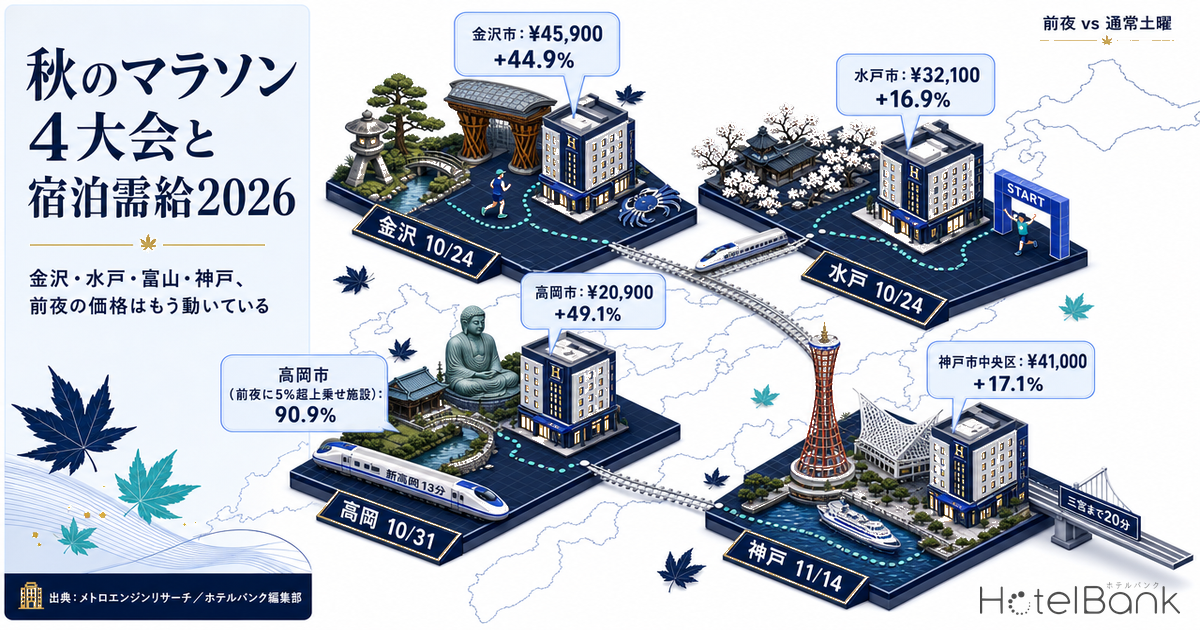
In the autumn of 2026, four citizen marathons with a combined full-marathon capacity of roughly 58,000 runners fall within a three-week window from October 25 to November 15: Kanazawa Marathon 2026 (October 25), the 11th Mito Komon Manyu Marathon (October 25), Toyama Marathon 2026 (November 1), and Kobe Marathon 2026 (November 15). Pre-race accommodation demand concentrates on the Saturday before each race, meaning the lodging markets of the four host prefectures all hit a “special day” on just three dates: October 24, October 31, and November 14. This article matches each of those three Saturdays against a regular Saturday in the same month on a property-by-property basis, quantifying how much demand each city has already priced in — and where capacity still remains.
Metric Definitions Used in This Article
- ADR (Average Daily Rate): An estimated settled rate (tax-exclusive equivalent), calculated by applying category-specific adjustment coefficients to the lowest published plan level each property lists on OTAs and other channels (double occupancy, per-room rate, tax-inclusive). Cross-checked against property-level actuals disclosed by listed hotel REITs (91 properties, most recent three months), the median error is approximately 7%. These are estimates and differ from each property’s actual contracted prices and accounting figures. Area-level ADR is the median across the target properties (the level of a typical property in that area).
- Listed Price: The average price across all plans published on OTAs and other channels (double occupancy, per-room rate, tax-inclusive, ranging from room-only to meal-inclusive). Daily analysis uses this listed price; area values are the median of each property’s daily average.
- OCC (Occupancy Rate): The share of sold rooms against total rooms in the area (an estimate based on OTA sales inventory). Used only at the prefectural level.
- LT (Lead Time): Days until the check-in date. LT0 = same day.
- Data source: MetroEngines Research
- — Four races in three weeks, with a combined full-marathon capacity of roughly 58,000 runners. Pre-race demand narrows onto just three Saturdays: October 24, October 31, and November 14.
- — Race-eve listed prices in the host cities run +49.1% in Takaoka City and +44.9% in Kanazawa City versus a regular Saturday in the same month, followed by Toyama City at +28.6%, Chuo Ward in Kobe at +17.1%, and Mito City at +16.9%.
- — At the property level, however, the median uplift is only +10.9% in Kanazawa and +6.7% in Kobe, and the share of properties raising rates by more than 5% sits around 60%. Roughly 40% of properties are heading into race eve at ordinary prices.
- — The ripple crosses administrative boundaries. Takaoka City also rises +46.7% on the eve of the Kanazawa Marathon (October 24) — two consecutive weeks of increases. Price gaps to overflow markets run −¥21,500 from Kanazawa to Komatsu and −¥14,000 from Kobe to Osaka Prefecture.
- — All three race eves currently sit outside the 90-day lead-time observation window (observation begins July 26, August 2, and August 16). What can be stated at this point is limited to price movement, not the pace of inventory take-up.
58,000 Runners in Three Weeks — Four Autumn Races Line Up in 2026
First, the basic parameters of the four races, all confirmed against each event’s official website and host-municipality announcements. Two points stand out: Kanazawa and Mito are held on the same day, October 25; and the Toyama Marathon starts not in Toyama City but in front of Takaoka City Hall. The former means demand peaks overlap between the Hokuriku and northern Kanto regions, while the latter suggests that the intuition of “staying in the host prefecture’s capital” does not always match reality.
| Race | Date | Full capacity | Start / finish | Race eve (Sat) |
|---|---|---|---|---|
| Kanazawa Marathon 2026 | Sun, October 25, 8:30 | 15,000 | Kanazawa City | October 24 |
| 11th Mito Komon Manyu Marathon | Sun, October 25, 9:00 | 10,000 | Start: Minamimachi 2-chome intersection, Mito City → Finish: Sannomaru Government Building | October 24 |
| Toyama Marathon 2026 | Sun, November 1, 9:00 | 13,000 | Start: in front of Takaoka City Hall → Finish: Fugan Canal Kansui Park | October 31 |
| Kobe Marathon 2026 | Sun, November 15 | 20,000 | Start: in front of Kobe City Hall → Finish: Kobe Harborland | November 14 |
Source: Compiled by the HotelBank Editorial Team from each race’s official website and municipal announcements
Kanazawa returns to a mass-start format for the first time in seven years, allocating 1,000 of its 15,000 places to overseas entrants. Mito’s general entry closed on April 27 once capacity was reached, and Kobe drew more than 60,000 entries for 20,000 places awarded by lottery. In other words, the base volume of accommodation demand is already fixed for every one of these races. The only remaining variable is where those runners will stay.
How Much Higher Is Race-Eve Pricing Than a Regular Saturday?
For this analysis we extracted only those properties for which prices could be observed on all nine Saturdays across October and November 2026 (October 3, 10, 17, 24 and 31; November 7, 14, 21 and 28), giving a balanced comparison set. The scope covers 715 properties across the four host prefectures of Ishikawa, Toyama, Ibaraki and Hyogo, plus 398 properties in Osaka Prefecture for comparison. The first days of the three-day holiday weekends (October 10 and November 21) were excluded from the baseline because separate seasonal factors apply; only regular Saturdays in the same month as each race eve were used as the reference. Note also that even for identical event demand, prices and inventory behave differently depending on the day of the week the event falls on. We compare against a weekday festival in Nagasaki Kunchi vs. Kishiwada Danjiri: Weekday vs. Weekend Hotel Demand, which helps frame how specific the Saturday-eve condition in this article is.
Source: MetroEngines Research; compiled by the HotelBank Editorial Team
The results are unambiguous. In Kanazawa City the median race-eve listed price is ¥45,900, or +44.9% against a regular October Saturday (¥31,700). Takaoka City jumps to ¥20,900 on the eve of the Toyama Marathon, up +49.1% from ¥14,000 on a regular Saturday. Mito City comes in at ¥32,100 (+16.9%) and Chuo Ward in Kobe at ¥41,000 (+17.1%).
| Host city | N | Race eve | Regular Sat, same month | Area-level gap | Property-level median | Properties with >5% uplift |
|---|---|---|---|---|---|---|
| Kanazawa City (10/24) | 60 | ¥45,900 | ¥31,700 | +44.9% | +10.9% | 60.0% |
| Mito City (10/24) | 21 | ¥32,100 | ¥27,500 | +16.9% | +25.7% | 76.2% |
| Toyama City (10/31) | 32 | ¥28,600 | ¥22,300 | +28.6% | +7.5% | 59.4% |
| Takaoka City (10/31 · start point) | 11 | ¥20,900 | ¥14,000 | +49.1% | +16.6% | 90.9% |
| Chuo Ward, Kobe (11/14) | 43 | ¥41,000 | ¥35,100 | +17.1% | +6.7% | 60.5% |
Median across properties of the listed price (all-plan average, double occupancy, tax-inclusive) / Source: MetroEngines Research; compiled by the HotelBank Editorial Team
Two numbers here need to be read separately. The “area-level gap” compares the median price of the area as a whole and is therefore affected by the mix of properties in operation. The “property-level median,” by contrast, is the median of the ratio between each individual property’s race-eve price and its own regular Saturday price — a pure measure of rate increase that is unaffected by compositional shifts.
The two diverge most sharply in Kanazawa City. At the area level the figure is +44.9%, but at the property level the median is only +10.9%. This means the market contains a mix of properties raising race-eve prices substantially and properties selling at essentially the same price as any other Saturday. Indeed, 60.0% of properties are adding more than 5% — which is to say that 40% are heading into October 24 on business-as-usual pricing.
The Share of Properties Moving Prices — Differences in Temperature by City
Source: MetroEngines Research; compiled by the HotelBank Editorial Team
The most unified market is Takaoka City, where 10 of 11 properties (90.9%) add more than 5% on race eve. Local operators have clearly priced in the fact that the Toyama Marathon starts in front of Takaoka City Hall. Mito City is also high at 76.2%, and its property-level median of +25.7% is the largest of the four cities. The likely backdrop is that lodging supply within the city is relatively thin against a field of 10,000 runners.
Kanazawa City and Chuo Ward in Kobe, by contrast, sit around 60%, leaving room to move. Kobe in particular has the largest field of the four races at 20,000 runners, yet its property-level median uplift is just +6.7%. This reflects the depth of lodging supply across the Kobe–Osaka region absorbing upward price pressure — but read the other way, it means that for properties with strong drawing power, a full night of revenue opportunity on race eve still remains on the table. There is considerable scope to build stepped pricing by lead time into a single day whose demand is already locked in.
Waves That Reach the Next Prefecture — Takaoka Rises Two Weeks Running
What is striking is how the effect of these races spreads across administrative boundaries. Takaoka City is up +49.1% on the eve of its own Toyama Marathon (October 31) — but one week earlier, on the eve of the Kanazawa Marathon on October 24, it also climbs to a comparable +46.7%. The Hokuriku Shinkansen covers Kanazawa to Shin-Takaoka in as little as 13 minutes. On a night when prices inside Kanazawa City reach ¥45,900, Takaoka’s ¥20,500 functions as a clear alternative. Toyama City likewise responds on October 24 with +13.5%. The same pattern of demand seeping outward once host-city inventory tightens was observed in Nagaoka Fireworks 2026: City Sold Out by March, Demand Ripples Out.
Source: MetroEngines Research; compiled by the HotelBank Editorial Team
The ripple in the opposite direction is limited. On the eve of the Toyama Marathon (October 31), Kanazawa City is up only +6.7% and Ishikawa Prefecture as a whole just +1.3%. That is the flip side of Kanazawa being Hokuriku’s largest lodging cluster: it can absorb demand from the Toyama direction and still have inventory to spare.
| Overflow candidate | Race eve in question | N | Race eve | Regular Sat, same month | Area-level gap | Gap vs. host city |
|---|---|---|---|---|---|---|
| Komatsu City | 10/24 (Kanazawa) | 17 | ¥24,400 | ¥21,900 | +11.4% | −¥21,500 |
| Kaga City (Kaga Onsen resort area) | 10/24 (Kanazawa) | 39 | ¥61,000 | ¥62,200 | −2.0% | +¥15,100 |
| Tsukuba City | 10/24 (Mito) | 18 | ¥19,800 | ¥21,600 | −8.6% | −¥12,300 |
| Hitachinaka City | 10/24 (Mito) | 11 | ¥32,300 | ¥28,500 | +13.6% | +¥200 |
| Imizu City | 10/31 (Toyama) | 11 | ¥36,200 | ¥35,800 | +1.1% | +¥7,600 |
| Akashi City | 11/14 (Kobe) | 7 | ¥21,700 | ¥20,300 | +6.9% | −¥19,300 |
| Osaka Prefecture | 11/14 (Kobe) | 398 | ¥27,000 | ¥26,000 | +3.8% | −¥14,000 |
“Gap vs. host city” is the difference against the median listed price of the host city (Kanazawa City / Mito City / Toyama City / Chuo Ward, Kobe) on that race eve / Source: MetroEngines Research; compiled by the HotelBank Editorial Team
The widest price gaps among overflow options are Osaka Prefecture (−¥14,000) and Akashi City (−¥19,300) relative to Kobe, and Komatsu City (−¥21,500) relative to Kanazawa. Osaka is already ¥9,100 cheaper than Chuo Ward in Kobe on a regular Saturday, and on race eve that gap widens to ¥14,000. The Kobe Marathon starts on the morning of November 15, and Sannomiya is a little over 20 minutes from central Osaka on the Special Rapid Service. Factoring in travel cost, the widening gap represents a genuine broadening of rational options. For how the rate gap between Komatsu and Kanazawa looks outside event days, Hokuriku Shinkansen Year 3: Fukui, Tsuruga, Komatsu & Kanazawa ADR Compared sets out the full-year levels.
Note that Kaga City stands out at ¥61,000 because the Kaga Onsen resort area is dominated by ryokan serving two meals, which structurally pushes the all-plan average listed price higher. It is not a figure that can be measured on the same yardstick as room-only-oriented business hotels. Tsukuba City, meanwhile, actually falls −8.6% on race eve, indicating that at roughly 60 km from Mito it sits outside the catchment of race demand.
The Seasonal Lift Itself — ADR Performance Across the Four Prefectures
So far we have looked at daily listed prices, but viewed through monthly estimated settled ADR, autumn is already a season of rising rates in these four prefectures. Overlaying Ishikawa Prefecture’s monthly trend by year shows November forming a clear peak. In Hokuriku, the opening of the snow crab season around November 6 structurally lifts both lodging demand and rates, and a single day of marathon demand sits on top of that seasonality.
Source: MetroEngines Research; compiled by the HotelBank Editorial Team
| Prefecture | Oct 2024 | Oct 2025 | YoY | Nov 2024 | Nov 2025 | YoY |
|---|---|---|---|---|---|---|
| Ishikawa (N=229–237) | ¥11,700 | ¥12,600 | +8.1% | ¥12,600 | ¥14,000 | +11.1% |
| Toyama (N=160–163) | ¥7,600 | ¥7,600 | +0.8% | ¥7,500 | ¥8,000 | +5.8% |
| Ibaraki (N=305–313) | ¥6,500 | ¥6,800 | +4.7% | ¥6,700 | ¥7,100 | +6.0% |
| Hyogo (N=539–562) | ¥11,900 | ¥13,300 | +11.6% | ¥13,700 | — | — |
Estimated settled ADR (tax-exclusive equivalent). November 2025 for Hyogo is not shown because the aggregation covers only N=34 properties, far below other months (median around 540), and accuracy could not be assured / Source: MetroEngines Research; compiled by the HotelBank Editorial Team
The pace of autumn rate growth varies by prefecture. Hyogo rose +11.6% year on year in October 2025 and Ishikawa +8.1%, with November up +11.1%, while Toyama was essentially flat in October at +0.8%. Toyama has yet to enter a re-acceleration phase for rates now that the initial boost from the Hokuriku Shinkansen opening has run its course. Put another way, it is a prefecture where how days of locked-in demand such as race eve are handled feeds directly into the annual average rate.
Inventory Take-Up Is Still Outside the Observation Window
One point should be stated plainly here. None of the three race eves currently falls within the period in which inventory take-up can be observed. Lodging inventory movement is tracked within a 90-day lead time, which means October 24 enters that range on July 26, October 31 on August 2, and November 14 on August 16. What can be said at this point, therefore, is limited to “prices are already moving” — it is not possible to state numerically how much has been booked.
| Target date | Date inventory tracking begins (LT90) | Prefecture | Properties covered |
|---|---|---|---|
| October 24 (eve of Kanazawa & Mito) | July 26, 2026 | Ishikawa / Ibaraki | 70 / 108 |
| October 31 (eve of Toyama) | August 2, 2026 | Toyama | 76 |
| November 14 (eve of Kobe) | August 16, 2026 | Hyogo | 185 |
Property counts are as of October 17, 2026, limited to properties publishing at least 30% of their total rooms on OTAs and similar channels / Source: MetroEngines Research; compiled by the HotelBank Editorial Team
All inventory-based aggregations are restricted to a population of properties publishing at least 30% of their total rooms as inventory on OTAs and similar channels. Properties below that threshold may be running direct-sales-led operations through their own websites, controlling inventory by releasing rooms in small increments as check-in approaches, or operating under small contractual OTA allocations — several possibilities exist, and their remaining-room trends are not suited to reading supply and demand.
For reference, the chart below shows occupancy trends for the first observable Saturday in October 2026 (October 3) across the four prefectures (estimated from OTA sales inventory, aggregated as of July 25, 2026). Over the 19 days from lead time 90 to 71, Toyama Prefecture progressed from 81.1% to 84.0% and Ibaraki from 75.9% to 79.0%. Ishikawa and Hyogo were broadly flat over the same interval, showing that the onset of demand differs considerably by prefecture.
Estimates based on OTA sales inventory. The temporary dip visible at LT75 for Toyama Prefecture reflects denominator-side movement as some properties increased the volume of inventory they published, not a reversal in demand / Source: MetroEngines Research; compiled by the HotelBank Editorial Team
How Runners and Hotels Should Each Read This
For runners already entered. Of the four races, Kanazawa shows the widest price spread. Against ¥45,900 in the city, Komatsu City is ¥24,400, and going as far as Shin-Takaoka brings it to ¥20,500. The Kanazawa Marathon starts early at 8:30, so travel time has to be weighed against the saving, but the price gap as an option clearly exists. For Kobe, Osaka Prefecture (¥27,000) is the realistic alternative and a strong one given that Sannomiya is a little over 20 minutes away. For Mito, the city is ¥32,100 against ¥19,800 in Tsukuba City — but at roughly 60 km, a comparison that also includes Hitachinaka City and other areas within the prefecture is more practical.
For lodging operators. Race eve is one of the few days where the base volume of demand is fixed months in advance. Capacity is set, the lottery has closed, and participants must stay somewhere. Even so, 40% of properties in Kanazawa City — and 40% in Chuo Ward, Kobe — are selling at prices little different from a regular Saturday. There is room here to introduce stepped pricing.
Concretely, that means designing rates to rise in stages according to lead time, building packages that pair race eve with a second night (the night of the race itself), and differentiating through runner-oriented add-on services such as early checkout and luggage storage. In areas like Takaoka City in particular — a little over ten minutes from the host city by shinkansen yet more than ¥25,000 cheaper — a “pre-race stay plan with travel time stated up front” can itself become the selling point. The fact that 90% of Takaoka properties have already moved on race-eve uplift suggests this reading is becoming shared across the market.
The focus from here is the pace of inventory take-up as these dates enter the observation period from July 26 onward. Will bookings actually follow in the cities where prices moved first, or will properties that held rates steady fill up sooner? We intend to revisit this once sufficient observational data has accumulated.
⚠ A note on pricing for future dates: All prices for October–November 2026 discussed in this article are estimates based on selling prices published on OTAs and similar channels as of the survey date (July 25, 2026), and will fluctuate as the check-in date approaches. Prices set high at present may be adjusted closer to the date, and conversely levels may shift as new plans are added. In addition, monthly estimated settled ADR from July 2026 onward is estimated from current listed levels and cannot be compared directly with months based on actuals. Year-on-year calculations in this article are therefore limited to months based on actuals.
Further Reading
- Nagaoka Fireworks 2026: City Sold Out by March, Demand Ripples Out
- Hokuriku Shinkansen Year 3: Fukui, Tsuruga, Komatsu & Kanazawa ADR Compared
- Nagasaki Kunchi vs. Kishiwada Danjiri: Weekday vs. Weekend Hotel Demand
- Hotel Pricing on Cruise Port Days: ADR Premium Analysis for Yokohama, Kobe & Naha
- All Market Trends articles
- All Seasonal Events articles
- All Area & Property Analysis articles
References and Sources
■ Official race information
- Kanazawa Marathon 2026 official site, “Race Overview”
- 11th Mito Komon Manyu Marathon official site, “Race Information”
- Mito City, “Notice on the 11th Mito Komon Manyu Marathon”
- Toyama Marathon 2026 official site, “Race Overview”
- Kitanippon Shimbun, “Toyama Marathon to start November 1, 2026” (December 2025)
- Kobe Marathon 2026 official site, “Race Guidelines”
- Kobe Marathon 2026, “On Runner Entry Status”
- Hyogo Prefecture, “Kobe Marathon 2026 is scheduled for November 15, 2026”
■ Data sources
Listed prices, estimated settled ADR and estimated occupancy based on OTA sales inventory are from MetroEngines Research. Daily price analysis covers 1,113 properties in total — 715 across the four prefectures of Ishikawa, Toyama, Ibaraki and Hyogo plus 398 in Osaka Prefecture; monthly ADR is at the prefectural level (Ishikawa N=229–237 / Toyama N=160–163 / Ibaraki N=305–313 / Hyogo N=539–562). Race dates, capacity and start/finish points are from each race’s official website and materials published by the host municipalities.
■ Analytical assumptions
We use a balanced comparison set covering only properties for which prices could be observed on all nine Saturdays across October and November 2026. October 10 and November 21, the first days of three-day holiday weekends, are excluded from the baseline because separate seasonal factors apply; only regular Saturdays in the same month as each race eve are used as the reference. The “area-level gap” compares median prices across areas, while the “property-level median” is the median of each property’s race-eve price divided by its own regular Saturday price — the latter being unaffected by changes in the mix of properties in operation. Inventory and occupancy aggregations restrict the population to properties publishing at least 30% of their total rooms on OTAs and similar channels.
■ Limitations and caveats
Prices for October–November 2026 in this article are estimates based on selling prices for future dates and will fluctuate as check-in approaches. None of the three race eves falls within the 90-day lead-time observation window, so inventory take-up cannot be stated numerically. Areas dominated by ryokan serving two meals, such as Kaga City, show structurally higher listed prices and cannot be compared on the same yardstick as room-only-oriented cities. Year-on-year change for Hyogo in November 2025 is not shown because the aggregation covers only N=34, far below other months. Listed prices and estimated settled ADR are both estimates and differ from each property’s actual contracted prices and accounting figures.
■ Market data
- MetroEngines Research — listed prices, estimated settled ADR, and estimated occupancy based on OTA sales inventory (daily analysis scope: 715 properties across the four prefectures of Ishikawa, Toyama, Ibaraki and Hyogo plus 398 in Osaka Prefecture, limited to properties with observable prices on all nine Saturdays in October–November 2026)