

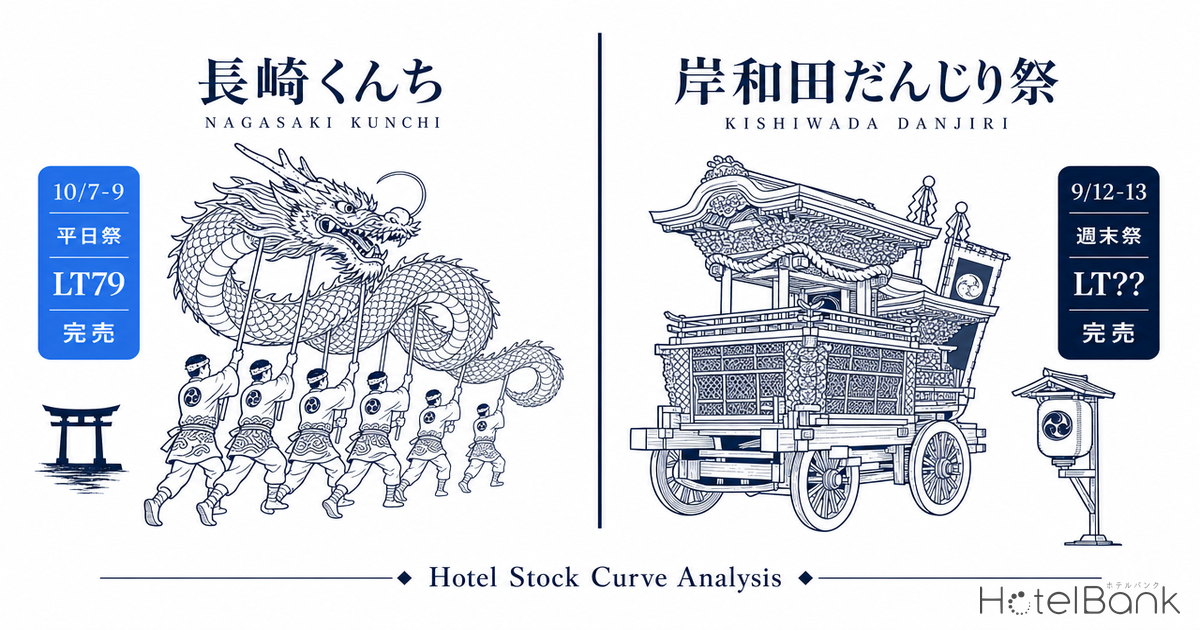
Among Japan’s celebrated traditional festivals are Nagasaki Kunchi (the autumn grand festival of Suwa Shrine, held over three weekdays in early October — October 7-9, 2026) and the Kishiwada Danjiri Festival (September festival, held on the weekend of September 19-20, 2026 in mid-September). Even for two large autumn festivals, the difference in the days of the week on which they fall produces a major gap in how hotel demand emerges. In this article, we aggregate publicly available OTA pricing data on a day-by-day basis, to the extent captured by MetroEngines Research, and examine how each festival acts on hotel rates and inventory absorption in its surrounding area.
Metric Definitions Used in This Article
- ADR (Average Daily Rate): The average of selling prices publicly listed on OTAs and similar channels. This differs from actual transaction prices (in cross-checks against REIT disclosure data, it tends to run about +25-30% higher than transacted ADR. This is a structural effect: higher-priced plans that go unsold remain listed on OTAs, and single-occupancy bookings are also aggregated at the double-occupancy rate, so the average of listed prices skews above transacted prices). Per-room rate for double occupancy (tax included), averaged across all plans (from room-only to plans that include meals).
- LT (Lead Time): The number of days until the check-in date. LT0 = same day.
- Early Sellout LT: The lead time at which remaining rooms first reached zero (the larger the value, the earlier the sellout).
- Data Source: MetroEngines Research
- — Weekday festival x 3-day structure: Nagasaki Kunchi (10/7-9) forms a linear premium, recording an average of ¥42,600 against a normal weekday level of ¥33-36k. At the 10/8 peak, 26.2% of rooms remained.
- — Weekend festival x Silver Week 3-day holiday: the Kishiwada Danjiri (9/19-20) pushed remaining rooms across all of Osaka Prefecture down to 10.7%, with demand propagating into adjacent clusters — Sakai City ¥28,300 / Kishiwada City ¥25,900.
- — Surrounding areas (Sasebo, Isahaya) barely reacted to Nagasaki Kunchi; the demand footprint of a weekday festival is extremely localized. In contrast, the weekend festival spread widely via a compound effect.
- — In revenue-management practice, a weekday festival calls for a uniform three-day premium design, while a weekend festival calls for lifting the opening day and drawing in the holiday-weekend side — two different pricing strategies.
The Conclusion First — The Demand Signals Observed for a “Weekday Festival” and a “Weekend Festival” Are Exact Opposites
Let us state the conclusion up front. Because Nagasaki Kunchi runs over three weekdays, it draws a sharp contrast against the usual weekday ADR level (¥33,000-36,000): the October 7-9 average was ¥42,600, forming an ADR premium of +26.0% against the ¥33,800 average of the same weekdays the following week (October 14-16, weekdays). Some properties added as much as ¥28,000 (1.7x) per room. For Awa Odori 2026 (Tokushima), a summer weekday-festival of the same type analyzed in our article Awa Odori 2026 (Tokushima), an ADR premium of +56.5% was observed; the premium range for weekday festivals varies within a several-tens-of-percent band depending on the host area’s lodging supply and audience scale.
On the other hand, the Kishiwada Danjiri Festival’s September festival (yoi-miya on Sat 9/19, hon-miya on Sun 9/20) coincides with the opening momentum of a three-day holiday weekend that includes Respect for the Aged Day on Mon 9/21. The Osaka Prefecture average ADR was ¥43,300 on 9/19 and ¥42,500 on 9/20 — large upswings of +25% on Saturday and +71% on Sunday against the same weekdays the prior week (Sat 9/12 ¥34,700, Sun 9/13 ¥24,800). However, this premium mixes both “attendance drawn by the danjiri festival” and “wide-area leisure demand from the Respect for the Aged Day three-day weekend,” making it difficult to isolate the festival’s standalone lift. Looking only at the festival’s home areas — Kishiwada City, Sakai Ward, and Izumi City — all 12 of the 12 properties in Sakai Ward moved to raise prices, with 4 of them applying increases of +15% or more.
Source: MetroEngines Research, compiled by the HotelBank Editorial Team
Nagasaki Kunchi — A Linear Premium Across Three Weekdays
Nagasaki Kunchi 2026 is held over three days — yoi-miya on Wednesday October 7, naka-hi on Thursday October 8, and ato-hi on Friday October 9 — as the autumn grand festival of Suwa Shrine. Begun in 1634, it is a nationally designated Important Intangible Folk Cultural Property with more than 380 years of history. Seven odori-cho (dance districts) take turns on a seven-year rotation to present their “dedicatory dances,” and in addition to niwamise, shagiri, and the kasaboko procession, the niwasaki-mawari — famous for its cry of “motte-koi” — winds through the city streets.
Tracking Nagasaki City hotel ADR by day, the three festival days rise almost in a flat line at ¥42,700 / ¥42,500 / ¥42,600, drawing a clear step against the immediately preceding weekdays (October 5-6) at ¥33,300 / ¥37,000 and the immediately following weekdays (October 12-13) at ¥33,400 / ¥31,900. Saturday October 10 and Sunday October 11 jump further to ¥48,600 / ¥46,700, but this is a weekend effect overlapping with a three-day holiday (10/12 Sports Day) and must be interpreted separately from the Kunchi festival itself.
Source: MetroEngines Research, compiled by the HotelBank Editorial Team (Nagasaki City city_id=1072, N=46-52 properties/day)
Looking at individual-property premiums, the distribution is as follows. The main hotels located in the three clusters of Nagasaki Station front, Shianbashi, and Dejima offered ADR levels roughly 1.4-2.2x on October 8 (Kunchi naka-hi, Thursday) versus the same weekday the following week, October 15. Because the figures are on an all-plan average basis, they are per-room values including room-only, breakfast-inclusive, and dinner-inclusive plans.
| # | Property | Rooms | 10/8 Kunchi | 10/15 Normal | Difference | Multiple |
|---|---|---|---|---|---|---|
| 1 | Hotel New Nagasaki | 153 | ¥67,380 | ¥39,307 | +¥28,073 | 1.71x |
| 2 | Ooedo Onsen Monogatari Nagasaki Hotel Seifu | 100 | ¥36,735 | ¥16,940 | +¥19,795 | 2.17x |
| 3 | Hotel Forza Nagasaki | 175 | ¥38,735 | ¥19,689 | +¥19,046 | 1.97x |
| 4 | APA Hotel (Nagasaki-Eki-Minami) | 101 | ¥31,390 | ¥15,097 | +¥16,293 | 2.08x |
| 5 | Richmond Hotel Nagasaki Shianbashi | 207 | ¥36,150 | ¥20,205 | +¥15,945 | 1.79x |
| 6 | Victoria Inn Nagasaki | 87 | ¥29,620 | ¥14,018 | +¥15,602 | 2.11x |
| 7 | APA Hotel (Nagasaki-Ekimae) | 85 | ¥32,004 | ¥19,045 | +¥12,959 | 1.68x |
| 8 | Hotel Cuore Nagasaki Ekimae | 161 | ¥31,284 | ¥18,694 | +¥12,590 | 1.67x |
| 9 | Esperia Hotel Nagasaki | 155 | ¥29,034 | ¥16,526 | +¥12,508 | 1.76x |
| 10 | Dejima-no-Yu Dormy Inn Nagasaki Shinchi Chinatown | 211 | ¥48,916 | ¥36,839 | +¥12,077 | 1.33x |
Source: MetroEngines Research, compiled by the HotelBank Editorial Team (Nagasaki City, properties with 30+ rooms, N=15 properties sampled)
Hotel New Nagasaki (153 rooms, near Shianbashi) reached ¥67,400, an upswing of +¥28,100 from its usual Thursday of ¥39,300. Garden Terrace Nagasaki (36 rooms, mid-slope on Mt. Inasa, resort type) was already in a high-price band above ¥95,000, but during Kunchi it added further to ¥107,700. In the same Shianbashi zone, Richmond Hotel Nagasaki Shianbashi (207 rooms) and JR Kyushu Hotel Nagasaki (144 rooms) sat in the ¥36,000-¥42,000 range, each layering on a premium of +¥12,000-¥16,000 over normal levels.
Spillover to Surrounding Cities — Sasebo and Isahaya Barely Move
What is striking is that, in contrast to central Nagasaki City, there is almost no spillover to other cities in the prefecture. Sasebo City (12 properties, centered on business hotels in front of the station) posted ADR of ¥28,700-¥29,900 for 10/7-9, barely moving from its normal range of ¥27,000-¥29,000. Isahaya City (12 properties) was also completely at normal values, ¥14,600-¥14,800. Nagasaki Kunchi has a structure in which spectators concentrate in central Nagasaki City (from Suwa Shrine through the city center to the Dejima area), and one can read that lodging demand, too, condenses within that same area.
Source: MetroEngines Research, compiled by the HotelBank Editorial Team (3 cities in Nagasaki Prefecture, N=90 properties)
Kishiwada Danjiri — The Compound Effect of a Weekend Festival x Silver Week 3-Day Holiday
In 2026, the Kishiwada Danjiri Festival’s September festival is held on the schedule of yoi-miya on Saturday September 19 (6:00-22:00) and hon-miya on Sunday September 20 (9:00-22:00). Because Monday September 21 is Respect for the Aged Day, forming a three-day weekend, festival visitors and wide-area leisure demand overlap completely. Trial pulls (shiken-biki) are held on Sunday September 6 and Friday September 18 in the 14:00-16:00 window.
Tracking the ADR for all of Osaka Prefecture by day, on the opening day of the Silver Week three-day holiday, Saturday September 19, it surges to ¥43,300, and stays elevated at ¥42,500 on Sunday the 20th. Compared with the normal weekend of the prior week (Sat 9/12 ¥34,700, Sun 9/13 ¥24,800), upswings of +25% on Saturday and +71% on Sunday are observed. However, comparing with Sat 9/5 (¥34,300) two weeks earlier, the Saturday values from September 5-12 are at roughly the same level — these represent Osaka’s normal weekend ADR band. The overall structure of festival supply-demand in Osaka Prefecture from summer into autumn, and how a two-stage peak forms, is explored in our article Reading Hotel Demand Through Osaka’s Two Great Festivals — The Two-Stage Demand of Tenjin Matsuri (July) and Yodogawa Fireworks (October).
Source: MetroEngines Research, compiled by the HotelBank Editorial Team (Osaka Prefecture pref_id=39, N=477-514 properties/day)
Lodging demand aimed primarily at the Kishiwada Danjiri Festival and wide-area leisure demand from the Silver Week three-day holiday cannot be separated in the high-ADR formation of 9/19-20. That said, the following two points suggest a “festival-only lift”:
- APA Hotel (Kansai-Airport Kishiwada) (68 rooms), very close to Kishiwada City, reached ¥76,700 on 9/19 — a range on a completely different order, 5.09x the ¥15,000 of the prior Saturday 9/12. Its level differs from the 1.25x of Osaka Prefecture as a whole, and for this single property, the aspect of accommodating festival visitors can be read as stronger than Silver Week.
- All 12 of the 12 properties in Sakai Ward (Toyoko Inn, APA Hotel, Comfort Hotel, Daiwa Roynet, Super Hotel, the Renaissance line, etc.) moved to raise prices on 9/19 versus 9/12, with 4 of them at +15% or more, and the average going from ¥17,400 to ¥19,900 (+14%). Sakai has direct access to Kishiwada via the Nankai Main Line, and this move likely functioned as a catchment for festival demand.
ADR Trends in the Sakai / Kishiwada / Izumi Cluster
We track daily ADR across the three cities of the festival’s home area (Kishiwada City, Izumi City, Sakai Ward) alongside Higashiosaka City on Osaka’s east side as a control group. The premium-forming movement toward the festival day of 9/19 can be clearly read.
Source: MetroEngines Research, compiled by the HotelBank Editorial Team (4 cities in Osaka Prefecture, N=approx. 22 properties)
The properties showing the sharpest increases individually are listed below. Overall, the characteristic pattern is that the main chain hotels in Sakai Ward move in a stable +10-30% range, while the APA Hotel in Kishiwada City moves in an extreme +5x range.
| # | Property | Location | Rooms | 9/19 Festival Sat | 9/12 Normal Sat | Difference | Multiple |
|---|---|---|---|---|---|---|---|
| 1 | APA Hotel (Kansai-Airport Kishiwada) | Kishiwada City | 68 | ¥76,666 | ¥15,050 | +¥61,616 | 5.09x |
| 2 | Comfort Hotel Sakai | Sakai Ward | 119 | ¥24,209 | ¥16,219 | +¥7,990 | 1.49x |
| 3 | Kuretake Inn Nankai Sakai Ekimae | Sakai Ward | 122 | ¥19,443 | ¥14,461 | +¥4,982 | 1.34x |
| 4 | Daiwa Roynet Hotel Sakai-Higashi | Sakai Ward | 230 | ¥23,417 | ¥19,817 | +¥3,600 | 1.18x |
| 5 | APA Hotel (Sakai-Ekimae) | Sakai Ward | 153 | ¥27,029 | ¥23,811 | +¥3,218 | 1.14x |
| 6 | Super Hotel Sakai Marittima | Sakai Ward | 99 | ¥18,805 | ¥15,666 | +¥3,139 | 1.20x |
| 7 | Hotel Agora Regency Osaka Sakai | Sakai Ward | 241 | ¥36,847 | ¥34,283 | +¥2,564 | 1.07x |
| 8 | The Base Sakai-Higashi Apartment Hotel | Sakai Ward | 54 | ¥20,614 | ¥18,783 | +¥1,831 | 1.10x |
| 9 | Hotel Route-Inn Osaka Izumi -Kishiwada Izumi Inter- | Izumi City | 200 | ¥18,028 | ¥16,841 | +¥1,187 | 1.07x |
| 10 | Osaka Bay Plaza Hotel | Sakai Ward | 100 | ¥14,083 | ¥13,213 | +¥870 | 1.07x |
Source: MetroEngines Research, compiled by the HotelBank Editorial Team (Kishiwada, Izumi, Sakai Ward, N=15 properties sampled)
Remaining Room Status for Osaka 9/19 — A Mid-Progress Snapshot of Booking Pace
Next, from the Osaka Prefecture inventory-observation data we capture, we look at the properties currently showing fast booking progress toward Saturday September 19 (Danjiri Festival + SW opening day). At the time of this analysis (early July 2026), there are 75 days until check-in, which exceeds the period within which our SOP allows us to state “early sellout” definitively (within 30 days). The following is therefore presented strictly as a mid-progress snapshot at this point in time. Going forward, inventory adjustments may occur via channels other than OTAs (direct sales on official sites, travel agencies, corporate contracts, etc.), and cases where OTA remaining rooms are re-released are also observed.
How to read this table: “Early Sellout LT” = the lead time at which remaining rooms first reached zero (the larger the value, the earlier the sellout was observed). “Days Sellout Observed” = the cumulative number of days on which zero remaining rooms have been observed to date. “Max OTA Listing %” = the maximum number of rooms placed on OTAs during the observation period / total rooms. A small value for a property may reflect multiple factors, such as a high share of sales via direct booking or travel agencies, or an operation that limits OTA allocation.
| # | Property | Category | Rooms | Early Sellout LT | Days Sellout Observed | Max OTA Listing % |
|---|---|---|---|---|---|---|
| 1 | APA Hotel (Namba-Shinsaibashi) | Business Hotel | 221 | 89 | 1 | 134% |
| 2 | Smile Hotel Namba | Business Hotel | 88 | 89 | 12 | 46% |
| 3 | Toyoko Inn Shin-Osaka Chuo-guchi Honkan | Business Hotel | 202 | 89 | 13 | 32% |
| 4 | Via Inn Shin-Osaka West | Business Hotel | 433 | 89 | 3 | 35% |
| 5 | Via Inn Shin-Osaka | Business Hotel | 226 | 89 | 3 | 52% |
| 6 | Hotel Livemax BUDGET Namba | Business Hotel | 51 | 89 | 1 | 72% |
| 7 | Hotel Links Namba | Business Hotel | 72 | 89 | 4 | 86% |
| 8 | Osaka Tsuruhashi-tei | Guesthouse | 4 | 88 | 7 | 75% |
| 9 | Hotel Trad | Business Hotel | 48 | 88 | 8 | 56% |
| 10 | S.TRAINING CENTER HOTEL | Business Hotel | 82 | 88 | 9 | 38% |
Source: MetroEngines Research, compiled by the HotelBank Editorial Team (Osaka Prefecture, 9/19 check-in, aggregated across the 98 properties with 30%+ OTA listing share)
The top of the ranking concentrates in Osaka’s main business and tourism clusters — Namba, Shinsaibashi, Shin-Osaka, and Tennoji. In addition to danjiri-festival visitors alone, these areas draw wide-area leisure demand from the Silver Week three-day holiday and represent a period when inbound travelers concentrate, so a compound booking progression is likely at work. Properties very close to the Danjiri Festival — in Kishiwada, Izumi, and Sakai — do not appear at the top of the ranking, but that is due to a structural observation constraint: the number of OTA-listed properties in those areas is small to begin with (Kishiwada City = 1, Izumi City = 2, Sakai Ward = 12).
Differences in the Supply-Demand Signals Observable Between “Weekday Festival vs. Weekend Festival”
When we line up the data from both festivals, we can see that the observational structure of “how a festival acts on hotel demand” is fundamentally different.
| Item | Nagasaki Kunchi 10/7-9 | Kishiwada Danjiri 9/19-20 |
|---|---|---|
| Days of the week | Wed / Thu / Fri (weekdays) | Sat / Sun (weekend) |
| Holiday overlap | None | Respect for the Aged Day (Mon 9/21) = 3-day weekend |
| Festival-home-area ADR (direct impact) | Nagasaki City +26% (weekday baseline) | Kishiwada 5.09x; Sakai +14% average |
| Ease of isolating festival-only effect | Easy to isolate | Hard to isolate (mixed with SW) |
| Spillover to surrounding areas | Sasebo, Isahaya barely move | The entire Sakai cluster reacts |
| Implication for revenue optimization | A weekday festival is “a chance to break the weekday baseline” | A weekend festival is “combined with the holiday-weekend synergy” |
Because Nagasaki Kunchi is a weekday festival with a low, stable weekday baseline rate, the “visibility” of passing festival demand through into rates is straightforward. From the hotel operator’s viewpoint, the three weekdays in early October are easy to separate out clearly as “special-rate days” from the normal weekday rate structure. Indeed, the main hotel group in Nagasaki City offered rates in a 1.4-2.2x range over the same weekday the following week during the three festival days, and a premium structure is already reflected in their pricing.
The weekend festival of the Kishiwada Danjiri, on the other hand, is compounded with a weekend premium, the Respect for the Aged Day three-day holiday, and wide-area Silver Week demand, making it difficult to design pricing that isolates the festival’s standalone lift. It is practical for hotel operators to design 9/19-20 as “a three-day-weekend market that includes festival demand”; unless a property is very close to the festival, it tends to be absorbed into the Silver Week market. In this data, too, festival-demand markups are observed in the festival-home areas of Kishiwada City, Izumi City, and Sakai Ward, while across Osaka Prefecture as a whole the festival and SW are working simultaneously, so analysis that separates the demand sources is not possible.
A Revenue Management Perspective — The Opportunity Created by Differences in Day-of-Week Structure
The contrast between the two festivals offers several implications for revenue-management practice. Here we organize them from the viewpoint of “opportunity” rather than “criticism.”
Weekday-festival types (Nagasaki Kunchi, Aomori Nebuta, Sendai Tanabata, etc.) allow a clear delta from the weekday baseline, giving high explainability for passing costs through into price. Traditional regional events have their scheduling slots essentially fixed on a 3-10-year horizon, and by putting them on a calendar in advance they are easy to build into next year’s and later sales plans. In the case of Nagasaki Kunchi, because of the seven-year odori-cho rotation, each district’s turn year is announced in advance, so there is also a special structure in which the visitor volume and lodging-demand growth of a turn year are easy to forecast.
Weekend-festival types (Kishiwada Danjiri, Aomori Neputa, Kyoto Gion Matsuri hon-miya, etc.) are compounded with holiday weekends and wide-area tourism demand, making it hard to extract the standalone effect; but by that same token, through the synergy of “holiday-weekend market x festival demand,” the overall level tends to reach a notably higher range. Hotel operators have an opportunity to create further room to add on top of the holiday-weekend market by combining it with a demand-generation strategy that emphasizes positioning very close to the festival’s home area (e.g., along the Nankai Main Line, with direct Namba-Kishiwada access). In weekend festivals that run over consecutive days, such as the Kyoto Gion Matsuri, a phenomenon is observed within the schedule where booking progress spikes on “days when the yamahoko procession overlaps” — an analysis of this within-schedule disparity is something we have explored for the four days of the Gion Matsuri ato-matsuri, examining how Kyoto hotel sellout progressed.
In either structure, the high advance certainty of the schedule is a strength for revenue planning. Through annual calendar design anchored on festival dates, and stepped pricing of the surrounding days and lead-up dates, operators can pursue both peak rates and occupancy at once.
Note on ADR for future dates: The ADR in this article is the average of selling prices publicly listed on OTAs at the time of the survey (early July 2026), and it fluctuates as the check-in date approaches. Prices set high now may fall through last-minute discounting, or conversely may be raised further as bookings progress — either movement can occur. Nagasaki Kunchi 10/7-9 was observed at LT94-95 days at the time of this survey, and Kishiwada Danjiri 9/19-20 at LT75-76 days; in both cases, multiple rounds of price and inventory adjustments are expected before the day of check-in.
Summary
Both Nagasaki Kunchi and the Kishiwada Danjiri Festival are registered as nationally designated Important Intangible Folk Cultural Properties and are among Japan’s representative autumn festivals, yet the hotel supply-demand signals observed differ greatly depending on the difference in their day-of-week structure. Nagasaki Kunchi (10/7-9, Wed-Fri) draws a +26% ADR premium as a clear step against the weekday baseline, with a linear visibility of cost pass-through into rates. The Kishiwada Danjiri Festival (9/19-20, Sat-Sun) overlaps with the Respect for the Aged Day three-day weekend, so an upswing of +25-71% is observed on the Osaka Prefecture average, but isolating the festival-only effect from wide-area Silver Week demand is difficult; only when narrowed to the Kishiwada and Sakai clusters very close to the festival’s home area can the festival-specific markup be extracted. The contrast between the two suggests that, for hotel operators, annual pricing design anchored on a “festival calendar” and an understanding of the spillover structure into surrounding areas are the keys to capturing the effective revenue opportunities that differ by region and season.
Related Reading
- A Thorough Analysis of Weekday ADR in Tokyo, Nagoya, Osaka, and Fukuoka | Visualizing the Recovery of Business Demand
- Labor Thanksgiving Day 3-Day Weekend x Peak Foliage: Reading the Booking Pace of Ryokan in Kyoto, Nikko, and Hakone
- Marine Day 3-Day Weekend (7/18-20) Resort Remaining-Room Map | The Summer’s First Peak — Where Can You Still Book?
- Summer Festival Demand x Late-Night Check-in — Lost Lodging Opportunity at Japan’s Major Festivals and a Labor-Saving Capex Proposal
References and Sources
- Nagasaki Kunchi Official Site (Nagasaki Traditional Performing Arts Promotion Association) — primary information on the 2026 schedule, dance districts, and performances
- Nagasaki Travel Net “[2026] Nagasaki Kunchi” — event overview and highlights
- Kishiwada Danjiri Festival (Kishiwada City Official Website) — primary information on the 2026 September and October festivals
- Osaka Convention & Tourism Bureau “Kishiwada Danjiri Festival” — viewing spots and access
- MetroEngines Research — publicly listed OTA pricing data (Nagasaki Prefecture N=approx. 190 properties/day, Osaka Prefecture N=approx. 500 properties/day), hotel-stock-ranking API (LT observation period within 90 days)